Motorcycle Not Starting Atlanta — How to Fix It
The sounds your bike makes when it won't fire, what each one is telling you, and how fast you need to act.
So and Give it one more month and the story changes. A bike that cranks slow today becomes a bike that only clicks. The battery that was merely tired gets drained flat, then sulfated, then done. Fuel that sat still turns to varnish and glues up the jets or gums the injectors. That’s the real price of waiting, and it’s why a motorcycle not starting Atlanta riders push off until August costs more work than the same bike would have in July. Here’s the happy part, though. Almost every no-start we see is a small, findable thing, and small findable things get fixed fast.
We’re Diaz Motorcycles in Marietta, and we hear this call all season. A rider walks out to the deck, thumbs the starter, and gets something that isn’t the sound they expect. Panic sets in. But your bike is actually talking to you right then, and it’s saying something pretty specific. Once you learn to read those sounds, you stop guessing. You’ll know what’s wrong, roughly, before anybody picks up a wrench.
Start with the sound your bike makes
Riders describe no-starts in a handful of ways. Each one points at a different part of the bike. Find yours on this list, because the rest of this post is built around it.
- One loud click, then nothing. Dash lights may dim hard or go dark.
- Rapid clicking, like a fast typewriter, and the headlight browns out.
- It cranks, but slow and lazy, like the engine is turning through syrup.
- What’s more, it cranks fast and strong and simply never catches.
- It fires for half a second, coughs, then dies right back out.
- Total silence. No click, no crank, no dash lights, nothing at all.
- It starts fine cold, then refuses to restart once it’s hot.
- It starts in neutral but dies the second you pull in the clutch and click into gear.
Notice how none of those are the same problem. That’s the whole point. “It won’t start” isn’t a diagnosis, it’s a category, and the sound narrows the category down fast.
What each one usually means
Clicking, dimming, slow cranking: it's the battery or its connections
This is the most common cause by a wide margin, and it’s also the friendliest one. A battery has enough juice to run your dash and pop the starter relay, but not enough to spin a motor with compression behind it. So you get the click. You get the brownout. You get the lazy crank that sounds like the bike just woke up from a nap and would rather not.
Bad grounds and corroded terminals cause the exact same symptoms, so don’t buy a battery before somebody checks. Vibration loosens the negative cable over time. Green fuzz on a terminal acts like a partial disconnect. Atlanta’s summer heat also cooks batteries harder than cold does, which surprises people, since heat speeds up the chemical wear inside the case.
There’s a storage angle here too, and it matters enormously in town. Roughly half of Atlanta households own their home, so most in-town riders park on an apartment deck, in a shared garage, or at the curb, with no outlet anywhere near the bike. No outlet means no battery tender. No tender means a bike that sits two weeks slowly drains itself through the clock, the alarm, and the ECU. Portable lithium jump packs solve a lot of this for people stuck without power at the parking spot.
Cranks strong but never catches: it's fuel or spark
If the starter is spinning the engine with real speed, your electrical system is basically fine. Now you’re hunting for one of two missing ingredients. Either fuel isn’t getting to the cylinder, or the spark isn’t lighting it.
Fuel problems love bikes that sit. Modern pump gas starts breaking down in weeks, not years, and what it leaves behind is a sticky varnish that clogs the tiny passages in a carburetor or fouls an injector’s spray pattern. A clogged fuel filter, a dying fuel pump, or a pinched vent line on the tank will do it too. One quick test at home: turn the key and listen for the fuel pump to prime for two or three seconds. Silence there is a real clue.
Spark problems come from old plugs, cracked plug caps, a failing ignition coil, or a crank position sensor that’s giving up. Plugs are wear items. People forget that, then act shocked when a set with four seasons on them stops doing the one job they have.
Dead silence: it's a switch, a fuse, or a safety circuit
Total silence feels the scariest and is usually the cheapest to fix. Bikes are covered in interlocks designed to keep them from launching without you. The kill switch got bumped in the parking lot. Better yet, the sidestand switch is dirty and thinks the stand is down. The clutch switch under the lever isn’t closing. A main fuse popped. That’s the whole list most days, and we’ve watched more than one friend we’ve helped go pale, then laugh, when the answer was a kill switch.
Starts cold, won't restart hot: something is heat-sensitive
This one drives riders up a wall because it never acts up in the driveway. Heat expands metal and changes resistance, so a marginal coil, a tired crank sensor, or a starter with worn brushes can work perfectly at seventy degrees and quit at two hundred. It’s a pattern, not a mystery, and patterns are findable.
Most people stop reading here. That’s the expensive mistake. Because knowing the likely cause is only half of it. The other half is knowing whether you should be riding the bike at all while you sort it out, and that answer changes a lot depending on which symptom you’ve got.
When it's safe to ride and when it isn't
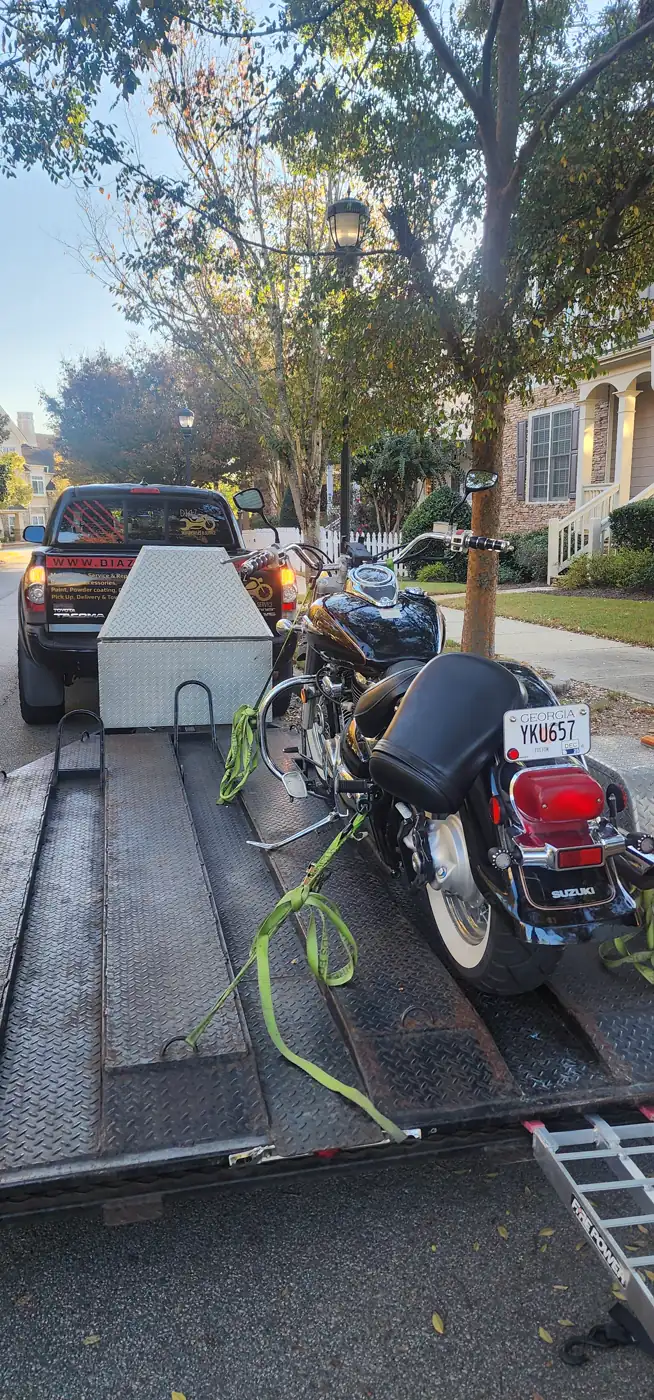
Here’s our honest line on this, and it’s the first thing we say when someone calls about a motorcycle not starting Atlanta heat has been sitting on all week. If the bike is hard to start but runs clean once it’s going, and you’re doing short daylight trips, you can ride it to the shop. If it’s stalling, cutting out at speed, or dying at idle, do not ride it. Get it trailered. A bike that quits mid-corner isn’t a repair problem anymore.
| Symptom | Ride it? | Why |
|---|---|---|
| Slow crank, then runs fine | Short trips only | Charging system may not keep up after dark |
| Clicks, needs a jump every time | No | It will strand you, likely somewhere inconvenient |
| Starts cold, no restart hot | No | It can quit while you're moving |
| Dies when you shift into gear | No | A safety circuit is unreliable |
| Silence, then fine after a fuse | Yes, watch it | Fuses blow for a reason worth finding |
ATLANTA-SPECIFIC WARNING
DeKalb Avenue has a reversible center lane, which means the direction of traffic in it changes by time of day. A bike that stumbles or stalls on that street is a genuine head-on risk. If your no-start comes with any hesitation at all, keep it off DeKalb Avenue entirely until it’s fixed.
What actually happens when you bring it in
No mystery here, and no theater. We start where the odds are, then work outward. Load-test the battery under real draw instead of just reading voltage. Check grounds and terminals. Confirm the charging system is putting current back in. Then we look for spark at the plug, check that the pump primes and holds pressure, and pull codes if the bike stores them.
- Battery load test and a full charging-system check, since that’s where most no-starts live.
- Grounds, terminals, main fuse and the safety interlocks, because they’re fast and free to rule out.
- Spark test at the plug, plus a look at plug condition, which tells its own story.
- Fuel delivery: pump prime, pressure, filter, and injector or carb condition.
- Sensors and codes if the first four come back clean.
That order matters. Skipping to the expensive guess is how bikes end up with new parts and the same symptom. If you want the full picture of what you get when you bring it in, we’ve laid it out plainly. And before you book anywhere, it’s worth reading what that service actually involves, so you know which questions get you a straight answer.
Timing: how long you've got
A weak battery gives you days, not months. Once it drops below a certain state of charge and stays there, the plates sulfate and it never fully comes back. Old fuel is a similar clock. Two months of sitting is usually fine. Six months without stabilizer, and now somebody’s cleaning carbs. A dirty sidestand switch, meanwhile, will happily annoy you for a year without getting worse.
So the honest ranking is simple. Electrical draw and dead batteries want attention this week. Fuel that’s gone stale wants attention before it sits another month. Switches and fuses can wait for your next service, though you’ll be happier once they’re right.
Why Atlanta bikes do this more than most
Riding in town is hard on machines in ways suburban riding isn’t. Embedded streetcar rails run through Edgewood, Auburn, Peachtree, Luckie and Jackson on that 2.7-mile loop, and the flangeway gaps beside them are a documented crash risk. Peachtree Street carries steel plates over utility trenches near the High Museum of Art. The city runs a Pothole Posse and a public resurfacing dashboard for a reason. That surface diet chews through fork seals, wheel bearings and rims, and the constant vibration is exactly what loosens a battery terminal.
Then there’s traffic itself. Georgia law, O.C.G.A. 40-6-312, requires you to stay fully within one lane and bans riding between lanes or rows of cars, so filtering and splitting are both illegal here with a police-only exception. Practically speaking, an Atlanta rider stuck on the Connector sits there in summer heat with the clutch pulled in. That’s a cooling-system story, a clutch story, and above all a battery story, since a slow crawl doesn’t spin your charging system hard enough to replace what you’re using.
Where you park changes things too. Around Tuxedo Park, where the estates and the Georgia Governor’s Mansion sit, bikes tend to be cruisers and premium European machines that get ridden on weekends and sit the rest of the week, which is a battery-tender situation whether the owner knows it or not. Over by Chastain Park, built around Atlanta’s largest city park, we see the same weekend-rider pattern. Meanwhile in Blandtown along Huff Road, one of the first Black settlements around Atlanta after the Civil War and a fast-redeveloping district now, new construction means new decks and new residents with nowhere to plug anything in. And riders working the east-side grid off Moreland Avenue put constant short trips on small-displacement bikes, which is the single toughest duty cycle a battery can face.
The last piece is the one people underestimate: pollen. Atlanta’s season runs late February through May and peaks between March 19 and April 2, and the city set an all-time record count of 14,801 on March 29, 2025. That yellow film isn’t just cosmetic. It packs into air filters and restricts flow, which makes a marginal bike harder to start and rougher to idle. A filter that’s choked with pollen can absolutely be the difference between a bike that fires on the first crank and one that fights you every morning.
Getting it looked at without wrecking your day
In-town riders find shops by searching and asking neighbors, not by driving past, and they judge a shop by whether it texts back. Fair standard. We text back.
Distance surprises people. From Buckhead near Lenox Square at Peachtree and Lenox Roads, we’re about 13 miles and 20 to 30 minutes away. West Midtown is about 14 miles, 22 to 32 minutes. Midtown runs about 16 miles and 25 to 40 minutes, Old Fourth Ward about 18 miles and 30 to 45, and East Atlanta Village about 21 miles and 35 to 55. Add 20 to 40 minutes at peak, naturally. Compare that to heading up to Killer Creek Harley-Davidson at 11480 Alpharetta Hwy in Roswell, open since 1999 with nine service bays, a detail bay, a dyno and a machine shop, but closed Mondays and Tuesdays. Marietta is no farther than the OTP alternatives, and for Buckhead and West Midtown riders it’s usually closer.
Dealer or independent, both can do good work, and we’ve written honestly about the tradeoffs between them. If you’re curious how the same diagnostic process looks a little further west, here’s how this plays out in Powder Springs. Either way, we can pick the bike up if it won’t roll.
A no-start is a puzzle with about six pieces. We've seen all six.
One more thing while the bike’s down. Check your tires, since a bike that sits develops flat spots and loses pressure, and Dunlop’s technical resources cover pressure and wear better than most. And if you’re newer to riding, the MSF Basic RiderCourse is still the best time anybody spends on two wheels.
Here’s what we want you to walk away with. That silence in your garage isn’t a verdict on your bike, and it isn’t a sign you did something wrong. It’s a symptom with a short list of causes, and you now know how to read it. Listen to the sound. Rank the likely cause. Decide whether it’s safe to ride. Then get it handled while it’s still small, because small is always the cheaper version of the same problem.
Questions Atlanta riders ask us
Can I fix a no-start myself?
Often, yes. Charging the battery, cleaning terminals, checking the kill switch and sidestand switch, swapping a main fuse and installing fresh plugs are all reasonable driveway jobs with basic tools. Where it gets tricky is fuel pressure testing, injector cleaning and sensor diagnosis, since those need equipment and a known-good reference. If the easy list doesn’t solve it, that’s your signal to hand it off.
Will it get worse if I keep riding it?
Usually, yes, and sometimes quickly. A battery that’s chronically undercharged sulfates and loses capacity permanently. Fuel that’s already stale keeps degrading and deposits more varnish every week. The one real exception is a sticky switch or interlock, which tends to stay annoying without escalating. Everything else on the list rewards moving early.
How urgent is this, honestly?
Rank it by whether the bike can strand you or quit while moving. Needing a jump every single time means it will strand you, so that’s a this-week problem. Starting cold but refusing to restart hot means it can shut off in traffic, which is more serious still. A hard start that then runs perfectly for an hour gives you a little breathing room.
What happens if I just ignore it for a few months?
The cheap version becomes the long version. A battery that could have been recharged becomes a battery that has to be replaced. Fuel that just needed draining becomes carbs that need disassembly and cleaning. Add a Georgia winter of sitting untouched and you’re also looking at surface rust in the tank. Nothing catastrophic, just more hours than you needed to spend.
How do you actually find the cause?
We work in order of probability instead of guessing. Battery load test and charging output first, then grounds, fuses and safety switches, then spark at the plug, then fuel delivery and pressure, then sensors and stored codes. Testing beats parts-swapping every time, and it means you’re not paying for components your bike didn’t need.
Does pollen season really affect starting?
It can. Atlanta’s pollen peaks between March 19 and April 2, and that yellow layer packs into air filters and restricts airflow. On a bike that’s already marginal, a choked filter is enough to turn an easy start into a fight. A filter check and a good wash during pollen season is cheap insurance for how the bike runs.
We take care of riders all over metro Atlanta from our shop in Marietta. That means Buckhead and Midtown riders whose bikes live on apartment decks, Decatur and Brookhaven commuters putting short daily miles on small bikes, and folks in Sandy Springs, Smyrna, Vinings and Mableton who ride weekends and want the bike ready when they are. We also help riders in East Point, Chamblee and Tucker, and plenty of neighbors right here in Marietta. If your bike won’t roll onto a trailer, tell us where it’s parked and we’ll come to it.
TEXT US AND WE'LL SORT IT OUT
If your bike is clicking, cranking slow, or sitting silent somewhere in Atlanta, send us a text and describe the sound it’s making. That one detail usually points us at the cause before the bike ever reaches the lift. We’ll tell you straight whether it’s safe to ride over, and if it isn’t, we’ll arrange pickup. No guessing, no runaround, just your bike running again.
470-460-9883Diaz Motorcycles and Service, LLC · 847 Barnes Mill Road, Marietta, GA 30062