Best Motorcycle Repair Lawrenceville — A Rider's Guide To Picking A Shop
How to judge a shop before you hand over the keys, and what a real diagnosis should sound like.
By Melvin Diaz||9 min read
In fact, that said, a rider over in Collins Hill Heights sent us a quote he’d been handed for a ticking noise. Three lines long. For example, No cause, no test, no notes — just a total at the bottom and a line saying the engine “may need to come apart.” He read it twice and it still didn’t sit right. After that, that gut feeling is usually correct, and it’s usually the start of a search. When riders go looking for the best motorcycle repair Lawrenceville can point them toward, they’re almost never shopping for the cheapest hands. What’s more, They’re shopping for someone who will tell them what’s actually wrong before anyone touches a bolt.
So let’s talk about that. Not in a salesy way, because plenty of good shops work Gwinnett and we’re not here to swing at anybody. So and Better yet, there are honest independents and there are dealers with sharp techs. Still, what we can do is hand you the same criteria we’d use if we were the ones dropping off a bike in a town we didn’t know.
The quote that doesn't sit right
Plus, Here’s the thing about that ticking-noise quote. It wasn’t dishonest. It was just early. Somebody heard a noise, recognized the general shape of it, and priced the worst version of the problem so they’d be covered either way. That’s not fraud. Of course, Now, That’s a busy shop protecting itself with a guess.
But a guess costs you. You either approve a big job you may not need, or you walk away and ride around with a noise in your head for three months. Neither one is a good afternoon. The fix is simple to describe and harder to do: the shop should be able to tell you what test they ran and what the test showed. If nobody can answer that, you don’t have a diagnosis. You have a hunch with a price tag stapled to it.
On that particular bike, the noise turned out to be a cam chain tensioner that had stopped doing its job. Not a bottom end. Not an engine-out weekend. Just a part that gave up quietly and took the rest of the top end’s reputation down with it. He rode it home the same week.

Why bikes get misdiagnosed around here
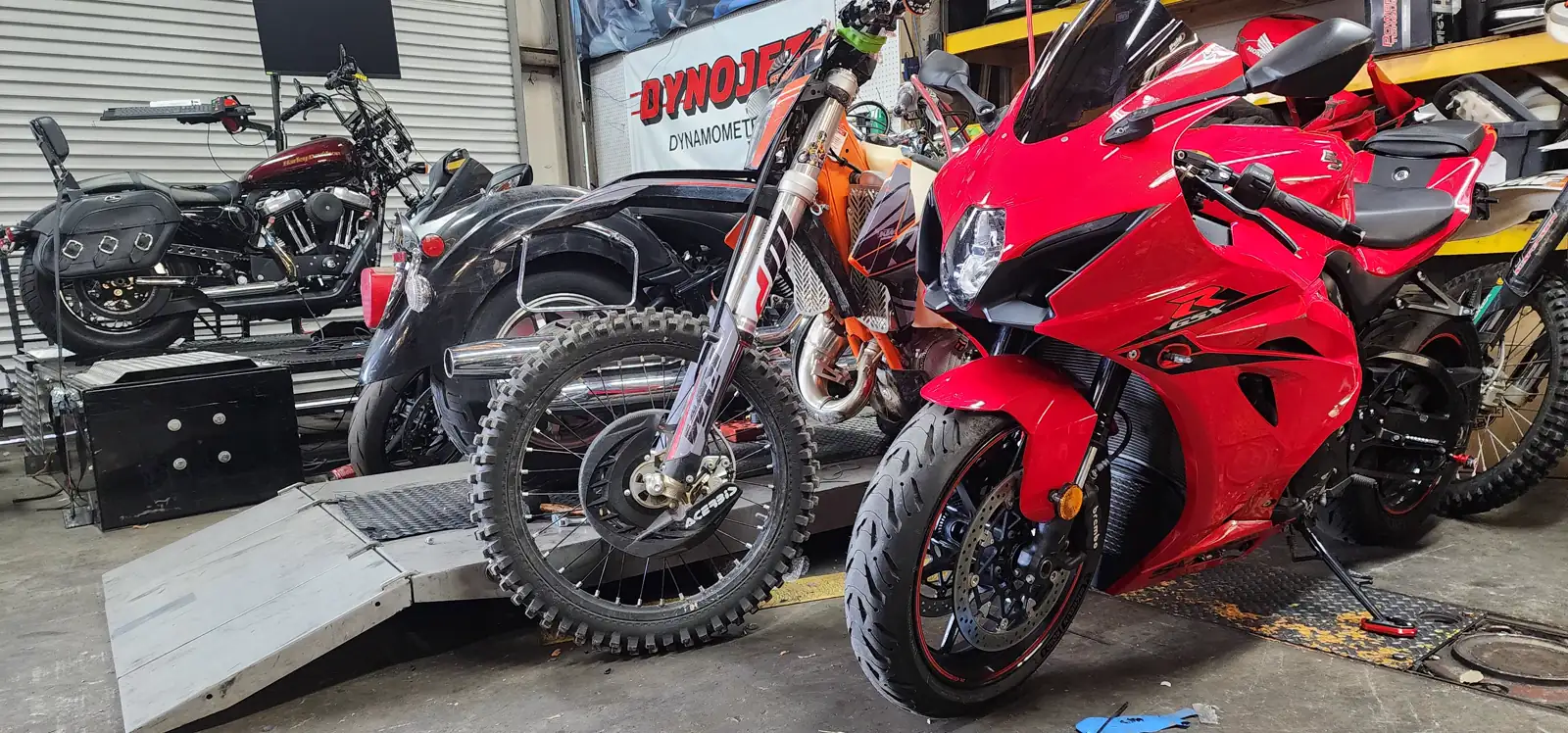
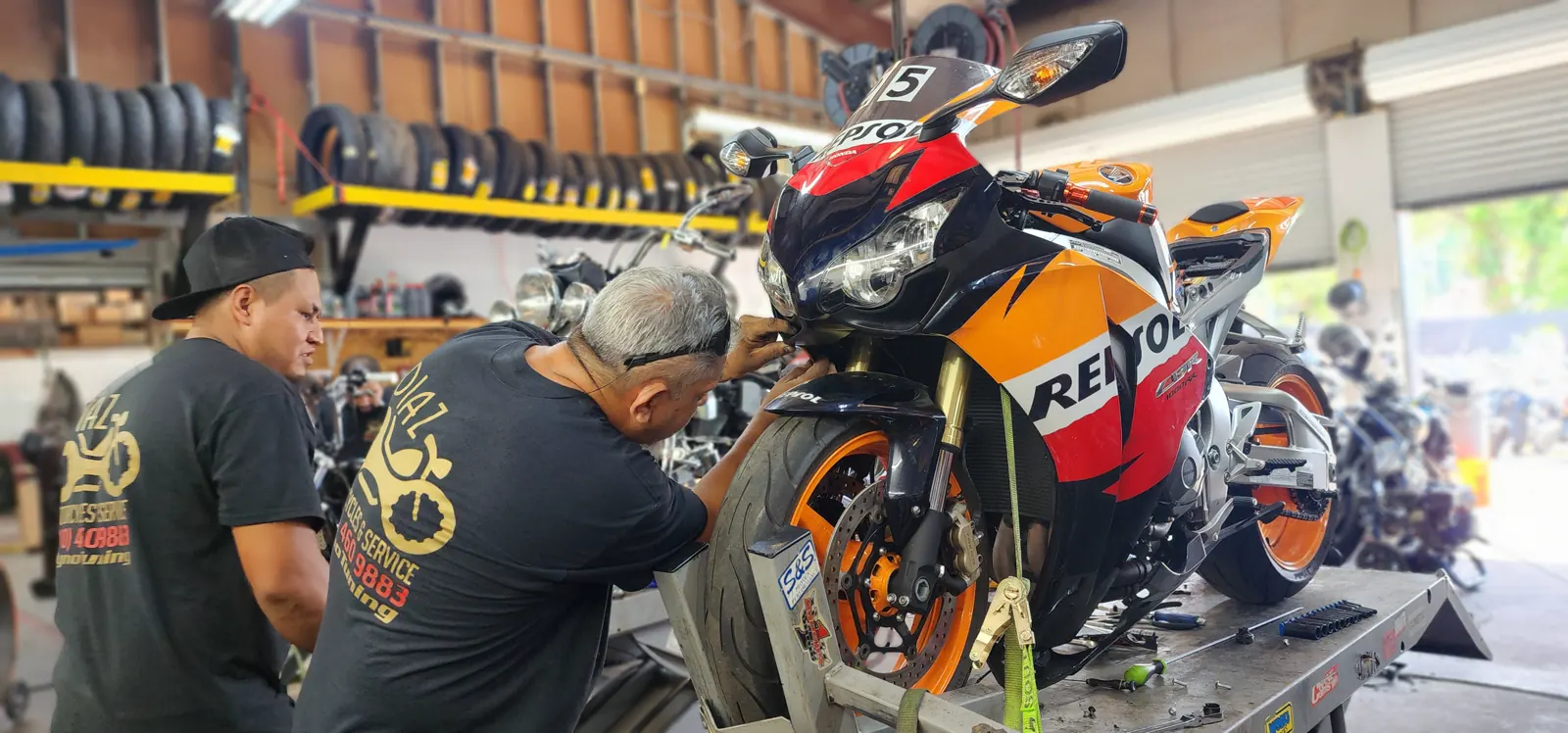
Gwinnett is the densest sportbike county we serve, and it isn’t close. R-series Yamahas, GSX-Rs, Ninjas and ZXs, CBRs, plus a healthy row of Ducati and Aprilia riders who take their bikes seriously. Cruisers and baggers are here too, just outnumbered. And a huge share of those bikes have been changed — slip-on or full exhaust, a freer-flowing air filter, different gearing, a fender eliminator to clean up the tail.
None of that is a mistake. Modifying a bike is half the fun of owning one. The problem is that a bike breathing more air and dumping exhaust faster is now running a fuel map written for parts it doesn’t have anymore. So it runs lean. Lean bikes get hot, pop on decel, surge at steady throttle, and eat plugs. Then they get taken in for a “running rough” complaint, and the symptom gets chased instead of the cause.
That’s the loop we see over and over:
- New pipe goes on, nobody remaps the fuel, and the bike gets thirstier for air than the ECU knows.
- Bike surges and pops, so it gets new plugs and a carb clean or an injector service.
- It feels better for a couple hundred miles, then does it again.
- Three shops later, everyone’s frustrated and the tune still hasn’t been touched.
Nobody in that story did anything wrong. They just never got to the part where the bike’s fuel map matches the bike. And that’s a real supply gap in Gwinnett — riders modify heavily, then have to leave the county to get the modifications to actually work together.
Here's where it gets interesting — and where most advice online falls apart.
Most “how to pick a shop” advice tells you to read reviews and check certifications. Fine advice, as far as it goes. In a county this dense and this transient, reviews genuinely matter — personal networks don’t stretch across Gwinnett the way they do in a small town, so volume and recency of reviews do real work. But reviews tell you how a shop treats people. They don’t tell you whether it can find your problem. Those are two different skills, and you need both.
How a real diagnosis should go
A good diagnosis is boring to watch and very satisfying to read. It’s a sequence, not a hunch. Here’s the order we work in, and it’s a fair yardstick to hold any shop to, including the dealer down the road.
- Ask you what it does, when it does it, and what changed right before it started. You are the best sensor on the bike.
- Reproduce it. If we can’t make the bike misbehave, we can’t prove we fixed it later.
- Pull codes and live data, then check the basics — fuel pressure, spark, compression, valve clearance, charging output.
- Separate cause from symptom. A fouled plug is evidence, not a diagnosis.
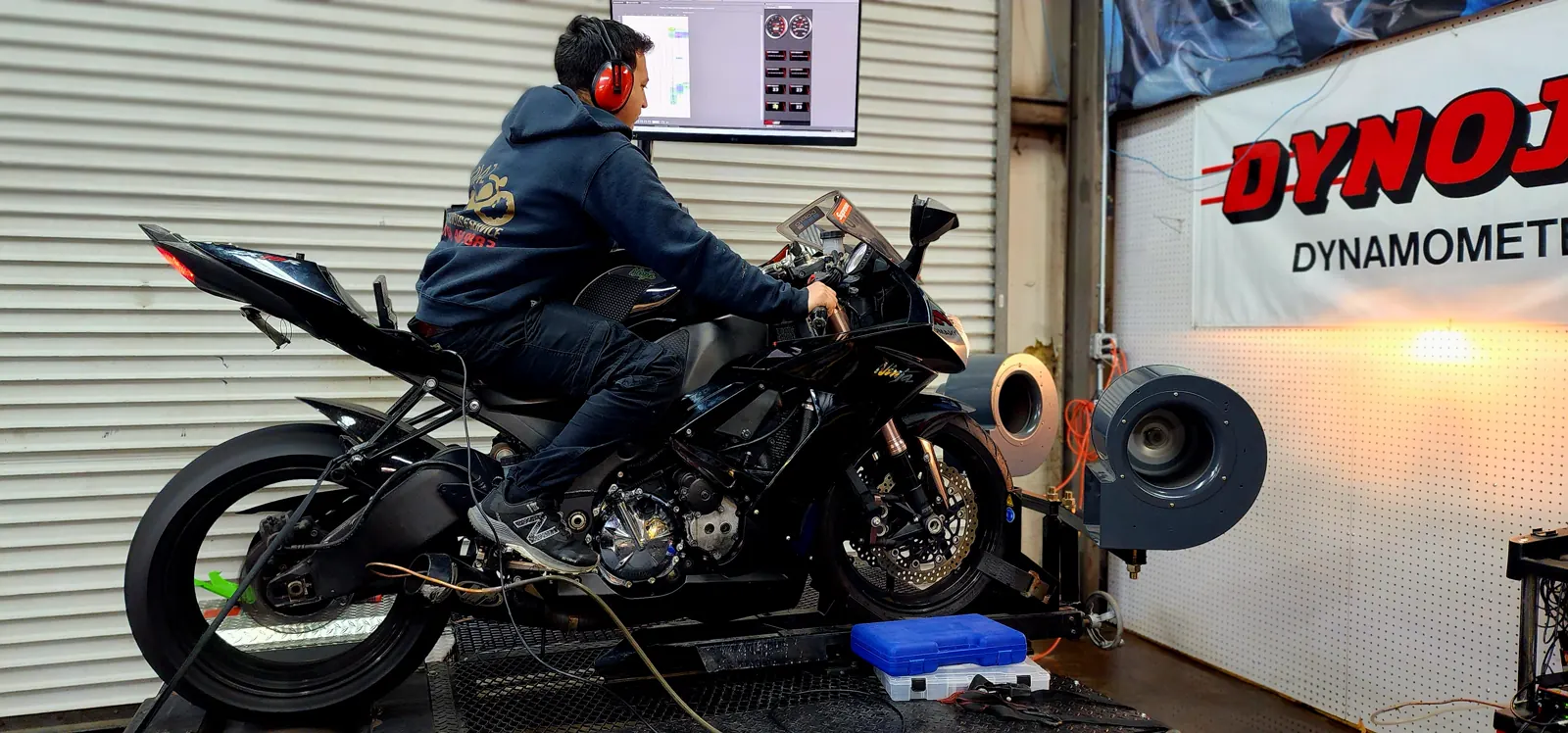
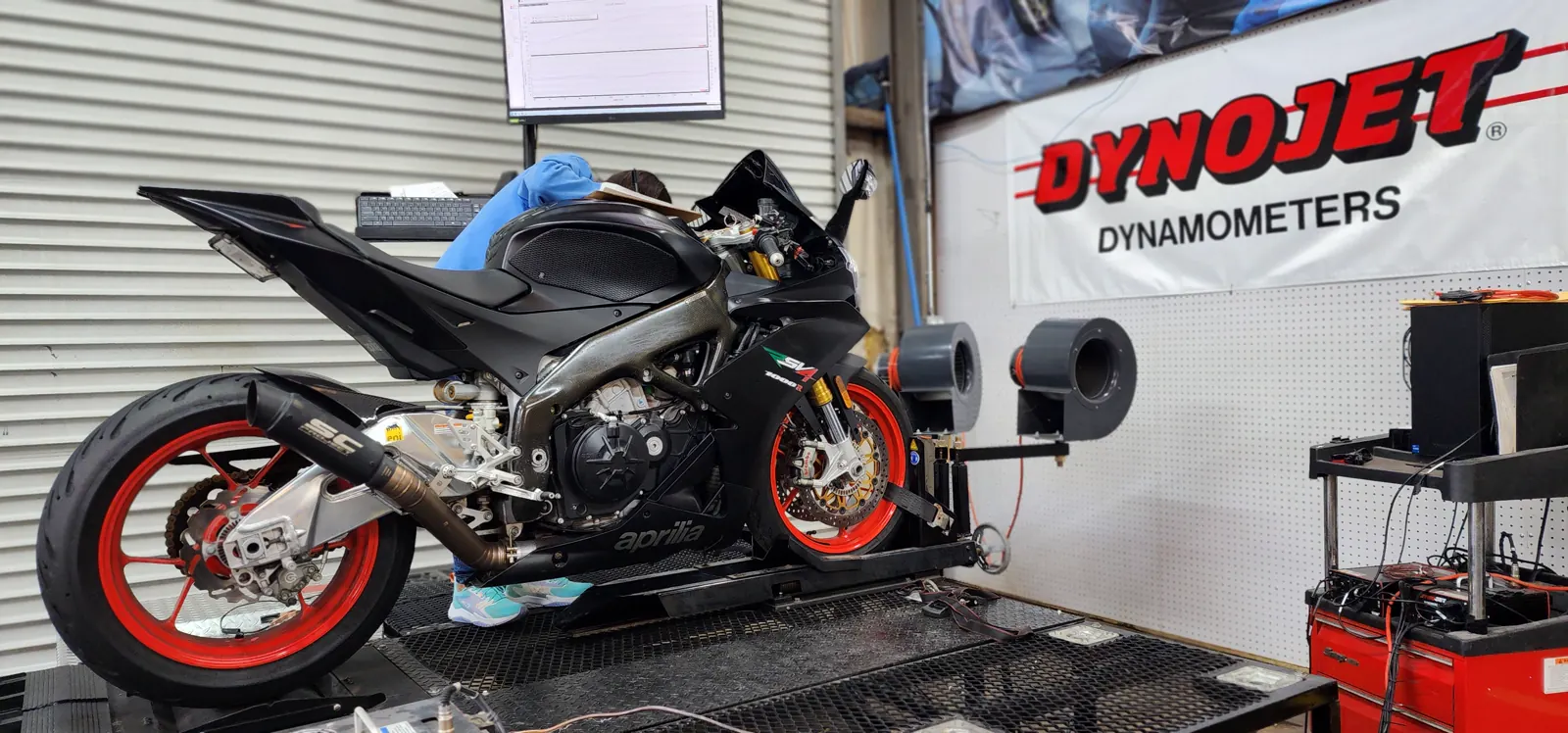
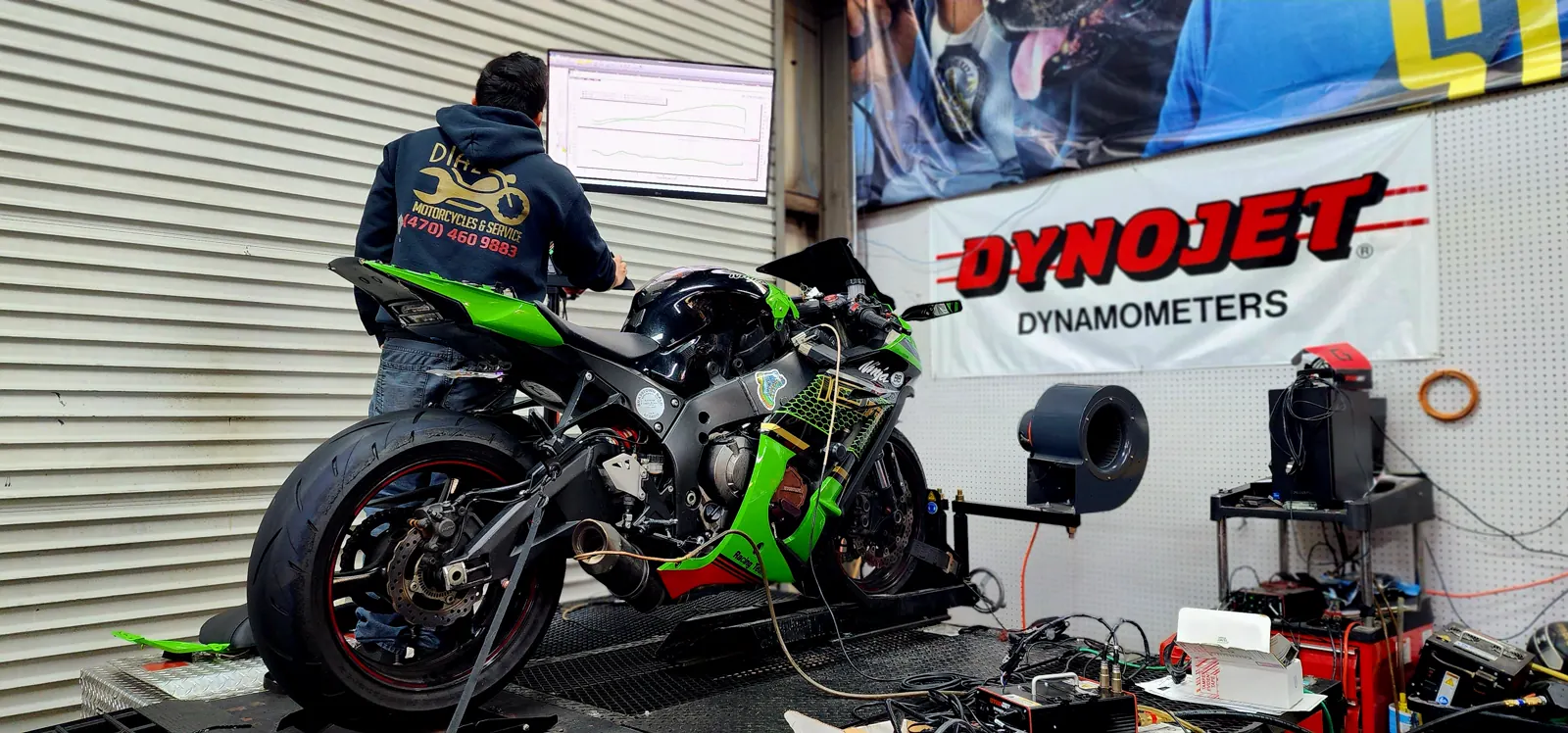
- Put it on the dyno when fueling is in question, because a lean spot shows up as a number instead of an opinion.
- Write it down and show you, in plain words, before anyone approves anything.
That last step is the one riders remember. You should get told what’s wrong, what it’ll take, and what happens if you wait. If you want the full picture on how the work adds up, we’ve written that out plainly too. No mystery math, no surprises when you come to pick it up.

What the fix usually involves
Once the cause is nailed down, the work splits into two buckets. Bucket one is mechanical: a tensioner, a stator, a clutch pack, a leaking fork seal, a chain and sprocket set that’s been stretched past saving. Bucket two is tuning: getting the fuel and ignition maps to match the parts that are actually bolted to the bike. A lot of Gwinnett bikes need a little of both.
Mechanical work is honest labor with a clear finish line. We’ll tell you which parts are wear items you’ll see again in a couple of seasons and which ones you’ll likely never think about twice. Tuning is the part fewer shops offer, and it’s where a modified bike quietly gets its manners back — smoother off idle, no popping on the overrun, and a temperature gauge that behaves in stop-and-go traffic. Here’s what we take care of here if you want the whole menu.
And yes, some jobs go deep. Transmissions, clutch baskets, engine cases. Those are week-long jobs, not afternoon jobs, and we’d rather tell you that up front than discover it together on day four.

Lawrenceville context: the roads decide a lot
Where you ride shapes what breaks. Riders out of Five Forks Manor and the Five Forks stretch along Five Forks Trickum Road put on a different kind of mileage than someone commuting the GA-316 corridor every morning. GA-316 is the defining local hazard — four lanes at speed with at-grade intersections, which makes the left-turn-across-traffic scenario the one every Gwinnett rider has a story about. Lane splitting is illegal in Georgia, so sitting still in traffic is just part of the job, and rear-end risk is the everyday commuter’s real problem. The MSF Basic RiderCourse spends real time on exactly that kind of positioning.
Then there’s the pavement itself. Gwinnett is perpetually widening something, so steel plates, milled surfaces, temporary lane shifts and gravel at construction entrances are a constant. Older subdivision streets and county connectors carry potholes and seams from freeze-thaw and truck traffic. That punishes wheel bearings, fork seals, and chain adjusters, and it’s why we check those on every bike that comes in from the county — even when you brought it in for something else.
Commuters near the Heritage Station, Heritage Commons, Heritage Park and Heritage Square cluster by the historic core rack up miles fast, which means consumables wear quicker and owners tend to be more mechanically aware than average. That’s a good thing. Those riders usually show up with a decent theory already, and we’d rather start from a theory than from nothing.
Weekends are a different animal. The mountain run — GA-11 and GA-53 north to US-129, GA-60, GA-52 and the Russell-Brasstown Scenic Byway — is about ninety minutes out, usually staged through Gainesville or Cleveland. Those roads ask for tires, brakes and suspension that are actually sorted. There’s a reason we get calls on Thursday nights from riders who suddenly want fresh pads before Saturday.
Real criteria for judging a shop
Here’s the checklist we’d use anywhere, including on ourselves. It’s fair to dealers and independents alike, because good shops of both kinds pass it and weak shops of both kinds don’t.
| What to look for | Why it matters |
|---|---|
| They ask questions before quoting | A shop that quotes off a two-sentence description is pricing a guess. |
| They can name the test they ran | "It sounded like" isn't a test. Compression, fuel pressure, live data, dyno pull — those are. |
| They're specific about your model | A bike-specific quirk is a sign someone has actually been inside one. |
| They tell you what can wait | Shops that flag everything as urgent aren't sorting for you. |
| Recent reviews, and a lot of them | In a county this dense, recency beats reputation-by-word-of-mouth. |
| They'll say "I don't know yet" | The three best words in this trade, honestly. |
Dealer or independent isn’t the real question. A dealer like Killer Creek Harley-Davidson over in Roswell has factory tooling, factory training and warranty authority — if your bike is under warranty or needs a recall handled, that’s the right door. A good independent tends to be stronger on older bikes, mixed brands, custom work and performance, and you usually talk to the person doing the work. Pick based on the job in front of you, not on the sign out front.
Distance matters less than people expect, too. From Lawrenceville to our door is roughly 33 to 38 miles — call it 45 to 70 minutes depending on how I-285 is feeling, and I-285 is the honest barrier between Gwinnett and Cobb, not the mileage. That’s an estimate from the map, not a stopwatch. It’s also why we run pickup and delivery, so the drive stops being your problem. Riders comparing options often find that how this plays out in Douglasville looks almost identical.

What changes once it's actually sorted
Here’s what changes once it’s actually sorted. The bike stops being a question mark. You stop listening for the noise at every stoplight. You quit planning rides around whether it’ll make it back. A properly diagnosed and properly tuned bike pulls clean from a roll, holds temperature in traffic, and doesn’t surprise you halfway to somewhere.
Riders tell us the difference shows up in how often they ride, not just how the bike feels. Friends we’ve helped go from riding twice a month to riding to work. That’s the whole point. And because Gwinnett’s group-ride and club scene is genuinely active, one bike that suddenly runs right tends to get noticed by a lot of people at once.
Winter is worth a mention here. December through February is the quiet window, and humidity does more damage than cold — that plus ethanol fuel sitting in a tank and a battery nobody charged. Gwinnett’s garages are mostly attached two-car setups, which is great for bike condition and great for restoration projects. It’s also the right window for tuning, paint or a full restoration, since the bike isn’t costing you riding days while it’s with us.

None of this is exotic. It’s just a shop doing the boring steps in the right order, then telling you the truth about what it found. That’s what people are really asking for when they go hunting for the best motorcycle repair Lawrenceville has within reach. If you want a closer look at the everyday side of it, here’s what that service actually involves in plain terms.
Lawrenceville has real character to it — the Aurora Theatre and Lawrenceville Arts Center pull people downtown from all over the region, and the Gwinnett Veterans War Museum along with the Fallen Heroes Memorial and Armed Forces Monument sit right in that same downtown area. It’s a town people are proud of. Your bike should be something you’re proud of too, not something you’re negotiating with.
BEFORE YOU BOOK
Ask any shop one question: “What test will you run to confirm that?” The answer tells you almost everything. If you’d rather skip the drive entirely, we’ll come get the bike and bring it back.
Safety data backs up the boring stuff, too — brakes, tires and visibility carry most of the weight in real-world outcomes, and NHTSA crash data is worth a browse if you like knowing the why behind a maintenance list.
Questions Lawrenceville riders ask us
How do I know the diagnosis is right?
Ask what test was run and what it showed. A real diagnosis names a measurement — compression, fuel pressure, live sensor data, a dyno pull — not just a sound. We write ours down and walk you through it before any work starts, and we’re happy to show you the failed part afterward.
What makes your shop different?
Two things, mostly. We diagnose before we quote, so you’re approving a known problem instead of a worst case. And we do performance and tuning work in-house, which matters a lot in Gwinnett where so many bikes are modified but the fuel map never got updated to match.
How do I pick a good shop in general?
Look for a shop that asks questions before giving numbers, can be specific about your model, and tells you what can safely wait. Recent reviews in volume are a good signal in a county as dense as Gwinnett. A shop willing to say “I don’t know yet, let me test it” is usually the one you want.
Dealer or independent — which should I use?
It depends on the job. If your bike is under warranty or has an open recall, the dealer is the right call because they have factory authority and tooling. For older bikes, mixed brands, custom work, restoration or performance tuning, a good independent usually gives you more direct access to the person doing the work.
What should I ask a shop before I hand over the keys?
Ask how they’ll confirm the cause, roughly how long the bike will be there, whether they’ll call before doing anything beyond the agreed work, and whether they’ve worked on your specific model before. Clear answers to those four tell you a lot about how the rest will go.
Is the drive from Lawrenceville worth it?
It’s roughly 33 to 38 miles, usually somewhere around 45 to 70 minutes depending on traffic, and that’s estimated from the map rather than clocked. For quick maintenance, plenty of Gwinnett shops handle it well. For tuning, custom, paint or restoration, we run pickup and delivery so the drive isn’t yours to make.
We work with riders all across Gwinnett and the east side of the metro. Along with Lawrenceville, we regularly pick up bikes from Duluth and Suwanee, run out to Snellville and Grayson, and handle plenty of work for riders in Dacula and Lilburn. Buford and Sugar Hill riders come to us for tuning and custom work, Norcross and Loganville owners for restoration projects that live in the shop for a few weeks, and we’re just as happy heading toward Tucker and Stone Mountain. If you’re anywhere in that stretch and the drive across I-285 is the thing holding you back, that’s exactly what pickup and delivery is for.
TELL US WHAT IT'S DOING
If your bike is making a noise, running rough, or you’ve got a quote that doesn’t sit right, send us a text and describe what it does. We’ll tell you what we’d test and why, before anybody talks about work. Lawrenceville riders get pickup and delivery, so you don’t have to lose a Saturday to traffic just to get a straight answer.
470-460-9883Diaz Motorcycles and Service, LLC · 847 Barnes Mill Road, Marietta, GA 30062
Keep reading
Written by Melvin Diaz
Melvin Diaz is the owner and lead technician at Diaz Motorcycles and Service in Marietta, Georgia. He has spent his career diagnosing, repairing, tuning, and rebuilding motorcycles for riders across Cobb County and metro Atlanta.
Back to top