Motorcycle Dyno Tuning Marietta Riders Can Actually Understand
What a dyno really measures, why your bike runs lean or rich, and how we figure it out before we ever quote you a number.
It started small. Of course, a little hesitation right off idle, the kind you feel through the grips more than you hear, and only when the engine was still cold. Our friend rode on it for two more weeks before he said anything. By then the stumble had grown teeth, and it picked the worst possible moment to show up: merging onto I-75, throttle open, nothing happening for half a second. That is usually how motorcycle dyno tuning Marietta riders book actually begins. Not with a bang. With one small thing that refuses to go away.
The short answer, up front
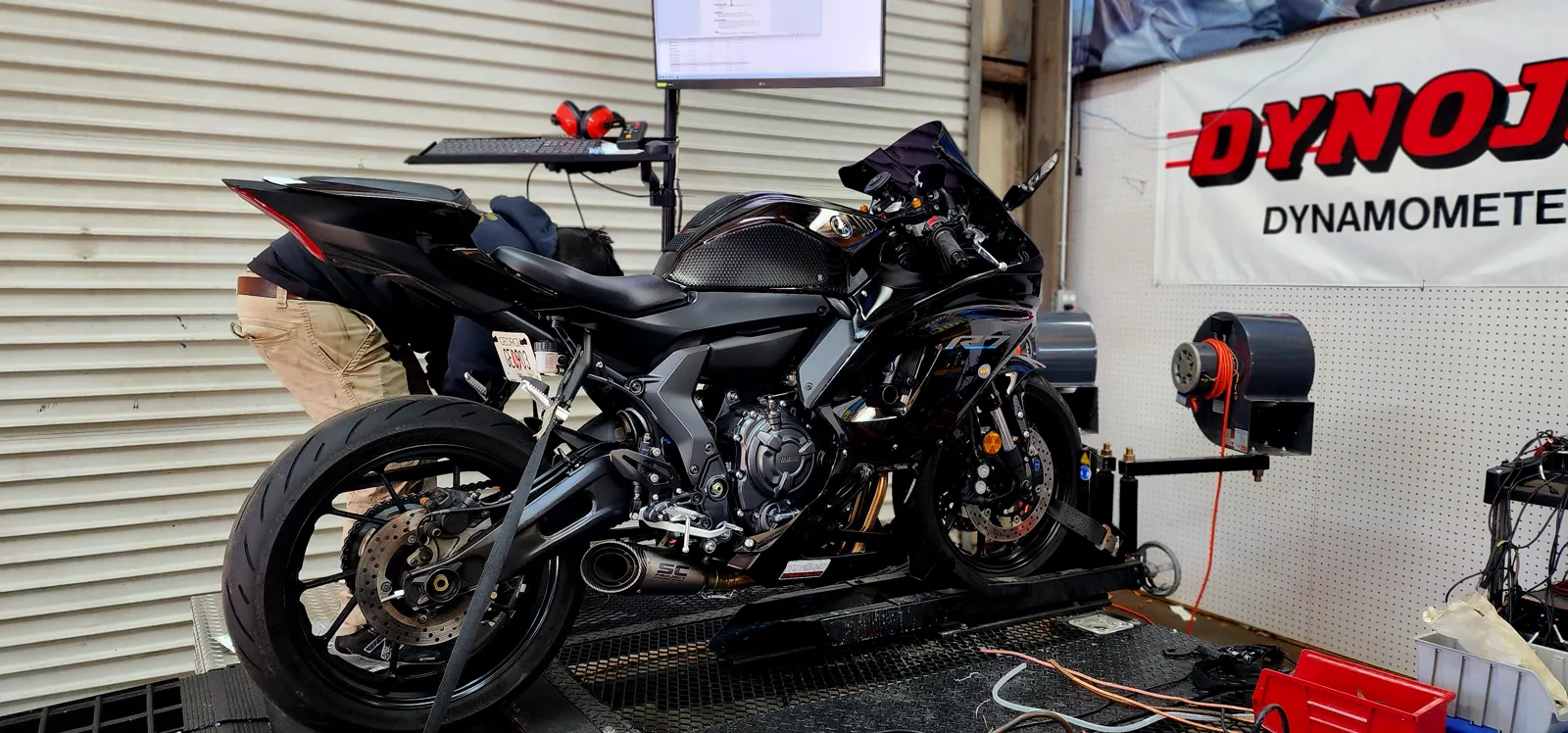
A dyno tune is a bike-by-bike fuel and ignition calibration done on a machine that measures what your engine is really doing. Your bike gets strapped down on the drum, we run it through its rev range under load, and we watch the numbers instead of guessing. Then we change the map inside the ECU so the engine gets the right amount of fuel and spark at every throttle position. That is the whole idea. Everything else is detail.
This service is for you if you have added a slip-on or a full exhaust, opened up the airbox, put in a high-flow filter, or bought a used bike that somebody else already modified. It is also for you if the bike is bone stock and still runs hot, surges at steady cruise, pops hard on deceleration, or eats fuel like a small truck. You do not need a race bike. You need an engine that is not being fed correctly, and that describes a lot of bikes rolling around Cobb County.
We do this in house. Our own dyno, our own ECU flashing, our own Power Commander work, on our own floor. Nothing gets shipped out and nothing waits on a third party’s calendar. If you want the full menu, here is the work we do in house.
What a dyno actually measures
Picture a treadmill for your motorcycle. The rear wheel sits on a heavy steel drum, and the drum resists. When you roll the throttle on, the engine has to accelerate that drum, and the machine records how hard that was and how fast it happened. From that, it works out power and torque through the whole rev range. Not one number on a sticker. A curve, from just off idle to redline.
At the same time, a probe in the exhaust reads the air-fuel ratio, and that is the real prize. Peak power makes a nice photo, but the air-fuel line tells us whether the engine is happy or fighting for its life at 4,000 rpm in third gear, which is where you actually live on Roswell Road. So a dyno session gives us three things at once:
- A power and torque curve, so we can see flat spots, dips and surges instead of feeling around for them
- An air-fuel reading at every rpm and throttle opening, so we know exactly where the fuel is wrong
- A repeatable baseline, so the after run can be compared honestly against the before run
That last one matters more than people expect. Without a baseline, any change feels like an improvement, because your right wrist is an optimist. The dyno is not.
Lean, rich, and why your bike ends up either one
Engines want a certain mix of air and fuel. Too little fuel for the air coming in and the bike is lean. Too much fuel and it is rich. Both feel like something, and once you know the feeling you can spot it from the saddle.
Lean shows up as heat you can feel through your boots at a red light, popping on the overrun, a flat spot where the bike should pull, and hard starting when cold. Rich goes the other way: fuel smell, sooty plugs, sluggish response, bad mileage, and a bike that fouls up in traffic. Neither one means your engine is doomed. It means the fuel map does not match the air the engine is breathing, and a map is a thing we can change.
So why does the map drift out of match? Bikes leave the factory tuned for emissions targets and for every market at once, which usually means lean in the low and mid range. Add an exhaust that flows better and the engine breathes more air, but the ECU keeps sending the same fuel. Add a filter, same story. Georgia heat pushes it further, and ethanol in pump gas nudges it again. Stack four small things and you get a bike that never feels quite right while nobody can point at one broken part.
Nothing is broken. The instructions are just wrong.
This is the point where a lot of riders make the wrong call
Here is what usually happens next. The bike feels off, so a rider downloads a canned map and loads it. Sometimes that lands close. Often it does not, because the file was built for a different exhaust, a different filter, a different climate and a different fuel. The bike now runs differently, which the brain reads as better for about a week. Then the flat spot comes back, and there are two variables to untangle instead of one.
The other wrong call is throwing parts at it. New plugs, new coils, a fuel cleaner, then a whole exhaust because a forum said so. We have met plenty of friends who spent a season chasing a symptom that one afternoon on the drum would have shown them in twenty minutes. If you are budgeting the work, read what changes the total before you order parts, not after.
What we check before we quote you anything
We do not price a tune off a phone call. A tune sitting on top of a mechanical problem is money set on fire, and we would rather tell you that on day one. So the bike gets looked at first, and it goes roughly like this.
- You text us photos of the bike, the exhaust and anything that has been changed, plus a sentence about how it misbehaves and when.
- We give you a straight read on whether a tune is even the right answer.
- Bike comes in. We check the basics: plugs, air filter, throttle bodies or carbs, chain and sprockets, tires, and whether the engine holds compression.
- We look for leaks. An exhaust or intake leak will fake a lean condition all day long and no map can fix it.
- Baseline run on the dyno, recording power, torque and air-fuel exactly as the bike sits right now.
- We show you the graph, explain it in normal English, then quote the work.
If step three or four turns up a real mechanical fault, we stop and call you. Sometimes the honest answer is that your bike needs a stator or a valve adjustment before it needs anything clever, and you get to decide with real information in front of you.
Mistakes worth skipping
- Tuning before a service. Fresh plugs, a clean filter and correct valve clearances change the results, so do them first.
- Chasing a peak number. A curve that pulls smoothly from 3,000 rpm makes a better street bike than a spikier one that wins a screenshot.
- Loading a stranger’s map and calling it tuned. Your bike is not that bike.
- Ignoring the fuel you actually buy. If you run one grade all summer, tell us, because we will map for the fuel in your tank.
- Waiting until the week of a big ride. September and October book up fast around here for a reason.
None of these are shameful. Each one is something a reasonable person does with good intentions and a decent internet connection. Riders in other towns walk into the same ones, which is why we wrote up what Woodstock riders run into too.
Here's the thing we wish every rider knew a season earlier
A tune is not mostly about horsepower. It is about how the bike behaves in the ten percent of the throttle you use every day. Smooth pickup from a closed throttle. No lurch when you crack it open in traffic. Steady cruise that does not surge. Less heat on your right leg at a long light. Better mileage, usually, because the engine stops wasting fuel it never needed.
Riders tell us the same thing afterward, almost word for word: the bike feels like it finally makes sense. That is the part nobody puts on a dyno sheet, and it is the part you will notice on the ride home. If you want the specifics, we broke down what the work covers gain by gain.
Why this matters specifically in Marietta
Marietta has more motorcycle retail packed into a few miles than almost anywhere in metro Atlanta. Five significant dealers sit along about four miles of Cobb Parkway, plus Hellbender Harley-Davidson over on South Cobb Drive. That density exists because the customers are here. What the market is thin on is independents with real capability. Most of those dealers will sell you parts and bolt them on, but custom mapping on a machine in the building is a different animal, and that gap is exactly why motorcycle dyno tuning Marietta riders can book locally is worth knowing about. CayloR-Made Motorsports over on Rosewood Circle is the closest shop to us on the performance side, and we would rather tell you that plainly than pretend we are the only game in town.
The riding here punishes a bad map more than most places. Georgia does not allow lane splitting, so a commute down I-75 means sitting in the same stop-and-go as everybody else while an air-cooled engine bakes in July. Surface streets are stoplight to stoplight. A lean midrange that you would never notice at highway speed becomes heat and a snatchy throttle in exactly that kind of traffic. Fix the fuel and the same commute gets noticeably calmer.
We see the whole spread of bikes around town, too. Baggers heading out toward Dallas Highway, sportbikes from students and young commuters, European sport-touring and ADV machines, and a genuinely healthy vintage Japanese restoration crowd. A nurse finishing a twelve-hour shift at Kennestone off Church Street Extension needs a bike that behaves at six in the morning. Somebody on a Lockheed shift schedule needs the same. Different bikes, same request: make it predictable.
Geography helps here. We are about three miles from Marietta Square, roughly eight to twelve minutes down Roswell Road, and no point inside the city limits is more than about twenty minutes out. If you live in the Whitlock Avenue Historic District, those eighty-two acres and a hundred and one contributing buildings listed on the National Register back in 1989, you are a short ride away. Same for folks just off the corridor in Whitlock Heights, and same for the townhomes at Marietta Walk near the Square. Drop the bike, walk a lap around Glover Park at the center of the Square, and it is barely an errand.
What you get at the end
You leave with a bike calibrated to itself, a before-and-after graph you can actually read, and an explanation of what changed and why. We will also flag anything we noticed that you should keep an eye on. No mystery invoice, no book-rate shrug, no service writer relaying messages between you and the person holding the wrench.
Then comes the fun part. September and October bring the best riding weather of the year, and that means the north Georgia runs. The Suches loop is the marquee one, about two hours up: SR-60 to Suches, Wolf Pen Gap Road over to Vogel State Park, and US-19 back down, with Two Wheels of Suches in the middle of it. That ride asks for clean throttle response on tight corner exits for hours. A bike with a flat spot at 4,000 rpm will remind you of it two hundred times before lunch. A properly mapped one just goes.
For a broader read on where the sport is heading, the Motorcycle Industry Council tracks it well, and RevZilla’s Common Tread is worth a scroll with coffee.
EASIEST NEXT STEP
Text us a few photos of the bike and the exhaust, plus one line about how it acts up. We’ll tell you straight whether a tune is the right call. No phone tag, no service writer in the middle.
That is really it. One small thing usually starts this, and one honest look usually ends it. If your bike has been telling you something for a few weeks now, let’s go find out what it is saying.
Questions Marietta riders ask us
What happens if my bike needs more work than expected?
We stop and call you before we touch anything extra. You get told what we found, what it means for how the bike runs, and what your options are. Nothing gets added to the work without you saying yes first. If the smart move is to fix a mechanical issue now and tune later, we’ll say that.
What does a dyno tune actually include?
A baseline run to record power, torque and air-fuel exactly as the bike sits, then custom mapping through ECU flashing or a Power Commander depending on your bike, then verification runs to confirm the change. You also get the before and after graph and a plain-English walkthrough of what we adjusted.
How long does it take?
Most tunes are a same-day or next-day job once the bike is on the schedule. Time on the dyno itself is usually a couple of hours, though a heavily modified engine or a carbureted bike can take longer. If we find something mechanical during the checks, we’ll give you a revised timeline before we go any further.
Do you work on my brand of bike?
Almost certainly. We tune Japanese, American and European bikes, from Harley baggers to Suzuki and Honda sportbikes to BMW and KTM ADV machines, plus older carbureted project bikes. Send us the year, make and model in a text and we’ll confirm before you ride over.
Do I need an appointment?
Yes, for dyno work specifically, because the dyno gets booked and we don’t want you sitting around. Text us first and we’ll get you a slot. Fall books up quickly, so if you’re aiming at leaf-season riding weather, reach out earlier than feels necessary.
Will a tune help if my bike is completely stock?
Often, yes. Stock maps are set for emissions targets and for every market at once, which usually leaves the low and mid range leaner than ideal. Riders with untouched bikes regularly notice smoother throttle pickup, less heat in traffic and steadier cruising after a tune.
We’re a short ride from most of the county, so riders come to us from East Cobb, Kennesaw, Smyrna, Acworth, Powder Springs, Mableton, Austell and Vinings without much thought about it. Folks head down from Woodstock, over from Roswell and Sandy Springs, and out from Dallas too, usually because they’ve already called around and found that in-house dyno work is harder to come by than it should be. If you’re anywhere in northwest metro Atlanta and you can get the bike here, we can get it on the drum.
TEXT US A PHOTO
If your bike has a stumble, a flat spot or a heat problem you’re tired of explaining, send us a couple of photos and one line about how it acts up. We’ll give you a straight read on whether a dyno tune is the right fix, and if it isn’t, we’ll tell you that instead of selling it to you. We’re about three miles from Marietta Square and we’d rather help you sort it now than watch you chase it all season.
470-460-9883Diaz Motorcycles and Service, LLC · 847 Barnes Mill Road, Marietta, GA 30062