Dyno Tuning Cost Marietta — What You Pay
A plain-English look at what a dyno tune involves, what makes one job bigger than another, and why a straight shop won't price it blind.
Even so, it’s nine at night, the garage light is still on, and the bike has been ticking as it cools for twenty minutes. Meanwhile, You’ve read four forum threads about fuel maps and two of them argue with each other. So you open one more tab and type dyno tuning cost Marietta, because underneath the question about price is a simpler one: is this a real fix, and how do I keep anybody from surprising me halfway through?
What you're really asking
In fact, that said, Nobody searches for a number just to collect it. You’re asking whether the money buys something you can feel from the saddle, and whether a shop will hand you one figure Tuesday and a different one Friday. You’re also asking whether your bike is a simple job or a complicated one, because you already suspect those aren’t the same thing.
All three are answerable. For example, not with one number typed into a blog post, but with a clear picture of what happens on the dyno and what turns a two-hour visit into a two-day project. Know that, and you can walk into any shop in Cobb County and ask sharp questions.
What a dyno actually measures
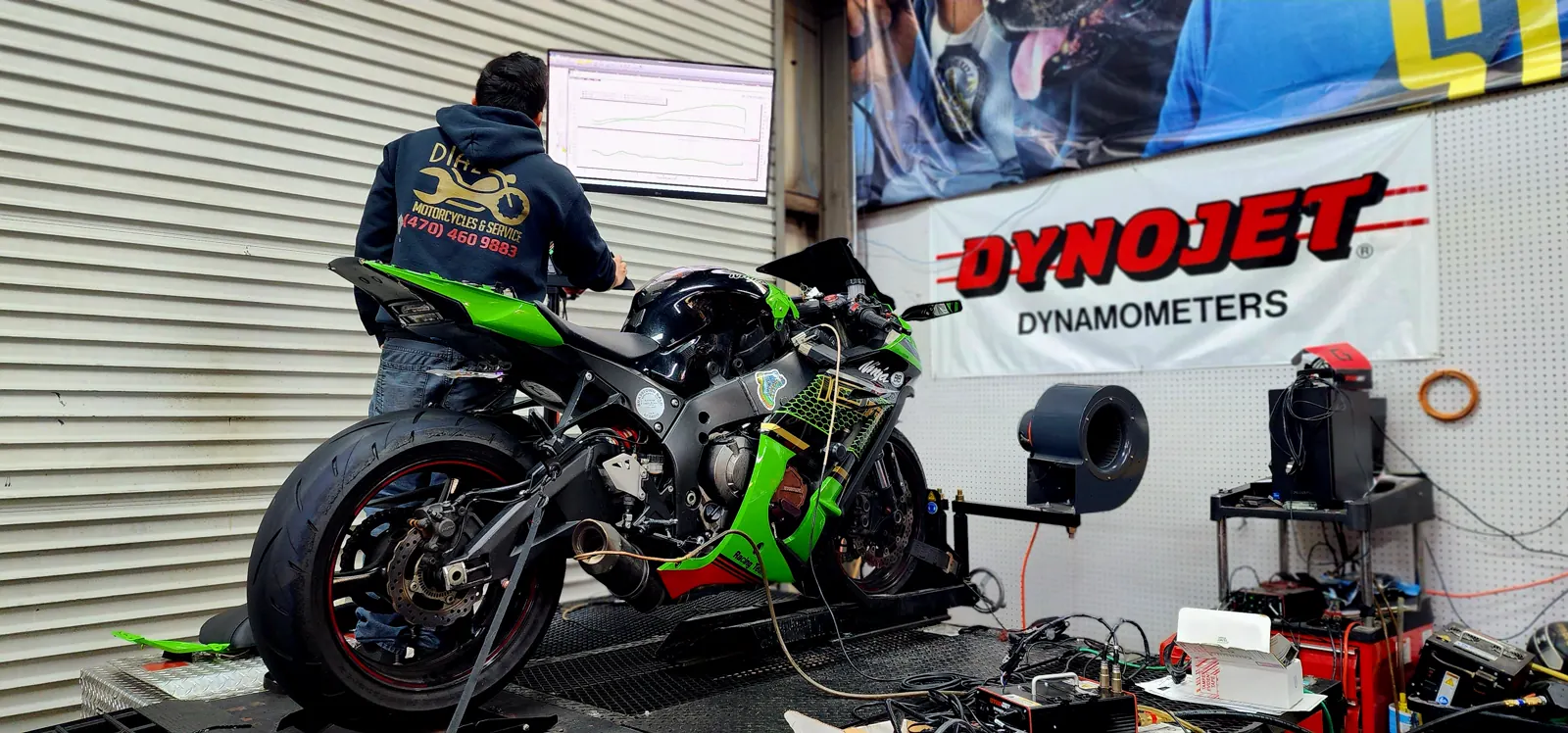
After that, a dyno is a heavy drum set into the floor. What’s more, your rear wheel sits on it, straps hold the bike down, and a fan blows air at the engine so it thinks it’s moving. So and Better yet, Roll the throttle on and the drum has to spin up. Still, the dyno knows exactly how heavy that drum is, so it can measure how hard your engine pushed to turn it. Plus, Everything else is math on top of that one honest measurement.
The dyno also watches your exhaust. Of course, a sniffer goes in the pipe and reads the unburned oxygen coming out, which tells us the real ratio of air to fuel your engine is burning. Then again, Riders hear “lean” and “rich” like insults, but they’re just descriptions. Even so, lean means too much air for the fuel going in, so the engine runs hot, surges, and pops on deceleration. Rich is the opposite: extra fuel that never burns, giving a lazy pull and fouled plugs.
A tune changes the instructions the bike gives itself. On a modern fuel-injected bike that’s a flash to the ECU, the little computer deciding how long each injector opens and when the spark fires. On other setups it’s a Power Commander, a piggyback box that adjusts those numbers on the fly. Either way the parts don’t change. The recipe does.
And the recipe is where riders feel it. A bike that ran lean at quarter throttle stops surging in traffic. A cruiser that got cranky at a light on Cobb Parkway runs cooler. Throttle response tightens, so the bike goes when your wrist says go. Those wins matter more day to day than any peak number on a printout.
The honest answer about price
Here’s the part most shops dodge when riders ask about dyno tuning cost Marietta shops quote. A tune is mostly labor, and labor is time on the machine with a skilled person watching it. Parts are usually the small half — a fuel module, plugs, a filter, sometimes a sensor bung welded into the pipe. The big variable is how many hours your bike takes.
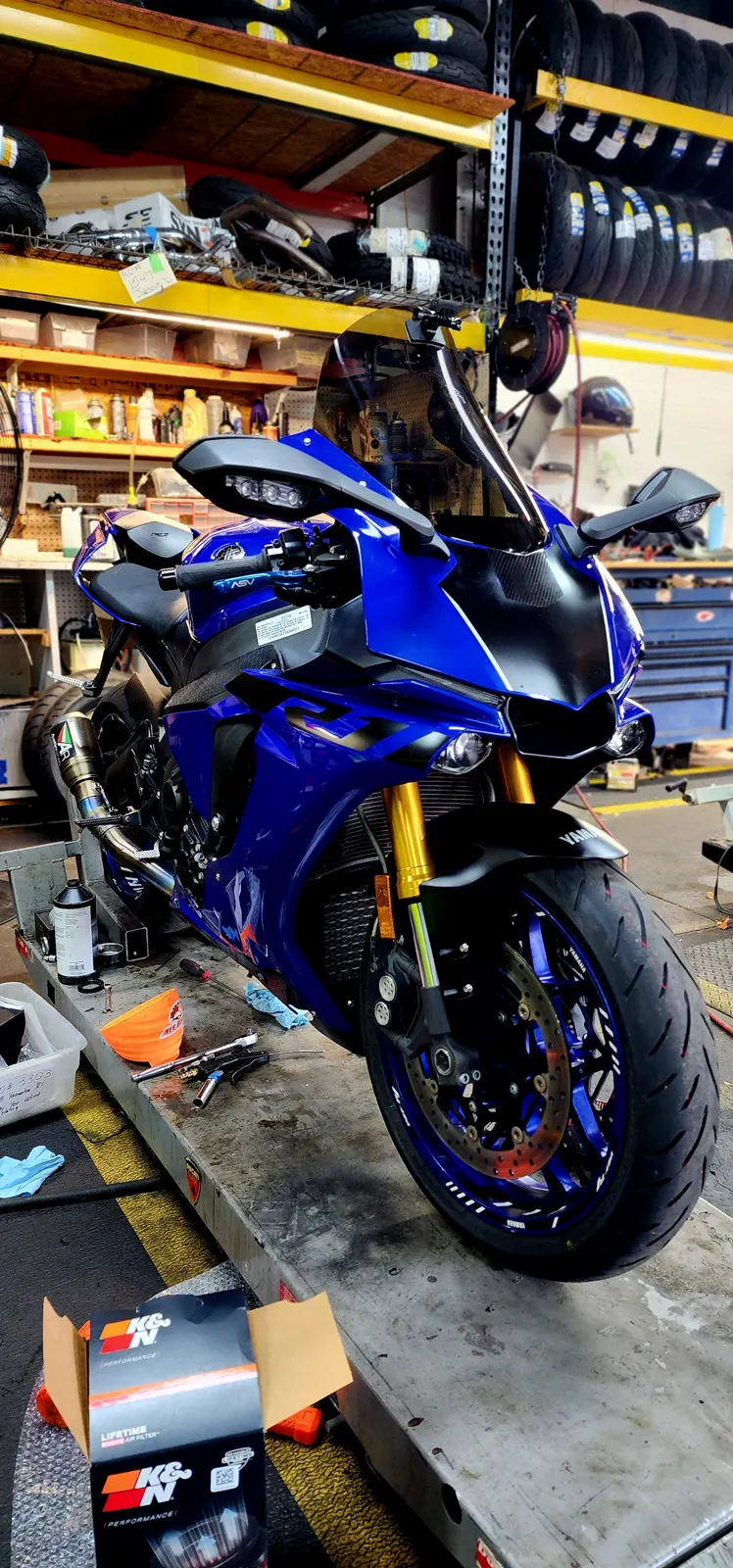
That’s why access matters. On some bikes the ECU port sits right under the seat and you’re plugged in inside five minutes. On others the tank comes off, then the airbox, then a fairing panel sharing fasteners with something else. Same tune, very different clock. It’s like painting a room: the paint costs what it costs, but the trim work is where the day goes.
Condition is the other half. A dyno tells the truth about an engine, so it also tells the truth about problems the engine was hiding. A weak coil, a cracked intake boot, a clogged injector — all show up the second we ask the bike for everything it has. None are tuning problems, and all have to be fixed first, because tuning around a fault bakes the fault into the map.
THE SHORT VERSION
Parts are predictable. Time isn’t. Access, condition, and how far your bike sits from stock drive the size of the job.
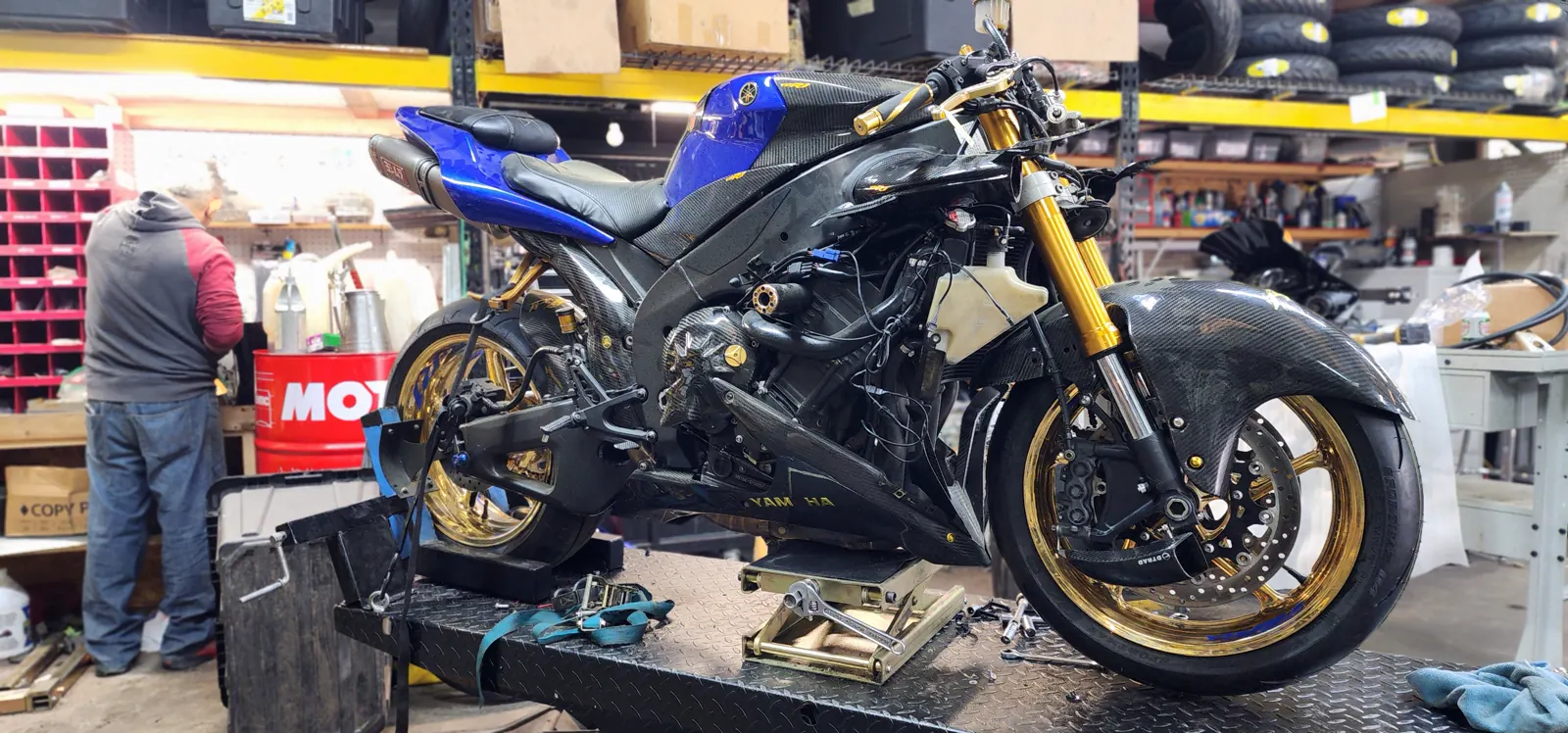
That’s the common version. The real story is a little different, and it’s the part that helps you most. The biggest driver isn’t the tune at all — it’s what got done to the bike before the tune. A slip-on and an air filter installed a year ago with no remap has been running lean ever since. The tune doesn’t create that work. It reveals it. Bikes modified in stages over three summers are almost always a bigger job.
What makes one job bigger than another
We’d rather show you the levers than make you guess at them. Here’s what stretches a tuning job, roughly in order of how often it matters:
- How modified the bike is. Stock with a slip-on is quick. Full system, cams and a big-bore kit is another conversation.
- How the ECU is reached. Some bikes flash through the port; some need the unit pulled, which means bodywork off and back on.
- Whether the bike is healthy. Good plugs, solid compression, no air leaks — a healthy bike tunes fast.
- Whether the fueling hardware exists yet. A module still to be installed and wired is install time before tuning time.
- Carbureted versus fuel injected. Older bikes get jetting changes by hand, and each one means the carbs come off again.
- What you want. A rideability tune for stop-and-go on Roswell Road is a different target than a track map.
Notice what’s missing: your bike’s badge. A Harley isn’t automatically more or less than a KTM. It’s the mix of what’s been done and how hard it is to reach, and that mix is different on every bike.
How the job actually runs, start to finish
This is the walkthrough we give friends we’ve helped when they ask what the day looks like. Same order every time, no surprise steps.
- We talk first. What’s the bike, what’s been changed, what bothers you now, and what you want it to do.
- We inspect. Plugs, filter, carbs or throttle bodies, intake boots, exhaust joints, chain, clutch, oil — anything that would make the numbers lie.
- We tell you what we found before touching the tune. If a repair is in the way, you hear it then, not after.
- Baseline pull. The bike runs as-is on the drum, strapped and fanned. That graph is your before picture.
- Read the air-fuel data. The surging, the popping, the flat spot all get a location instead of a feeling.
- Adjust and re-run. A tune is a stack of small corrections, not one big move.
- Road sanity check. Numbers on a drum are one thing; how the bike pulls away from a light is the other.
- Hand you the sheets and explain them. You leave knowing what changed and why.
That last step is the one riders remember. A run graph looks like spaghetti until somebody points at the dip and says “that’s your flat spot, right there.” Here’s how we handle that job once the pulls are done.
For the deeper version, plus which bikes we can flash directly, see what our team handles on the dyno side. And if you’re weighing shops rather than services, we wrote a piece on what separates a good shop from one that just owns a machine.
A dyno doesn't create horsepower. It finds out where yours went.
Why we won't quote it sight-unseen
We could throw a number at you over the phone, and plenty of places do. The problem is that a phone number becomes a promise in your head, and then the bike shows up with a cracked intake boot. We’d rather talk at the counter with the bike between us, where you can see the thing we’re pointing at.
There’s a fairness angle too. If a shop quotes every tune the same, simple bikes are paying for complicated ones. That’s a book rate, and it’s the exact complaint we hear about dealer service departments — a flat number and a wait measured in weeks. A real estimate takes ten minutes of looking.
One rider off South Cobb Drive (GA-5) put it better than we could. He’d been quoted over the phone somewhere else, showed up, and got told the price had changed because of “the exhaust situation.” What bothered him wasn’t the money — it was that somebody had guessed and then made it his problem. He was right. Guessing is easy. Being accountable to a number means looking at the bike first.
What this looks like in Marietta specifically
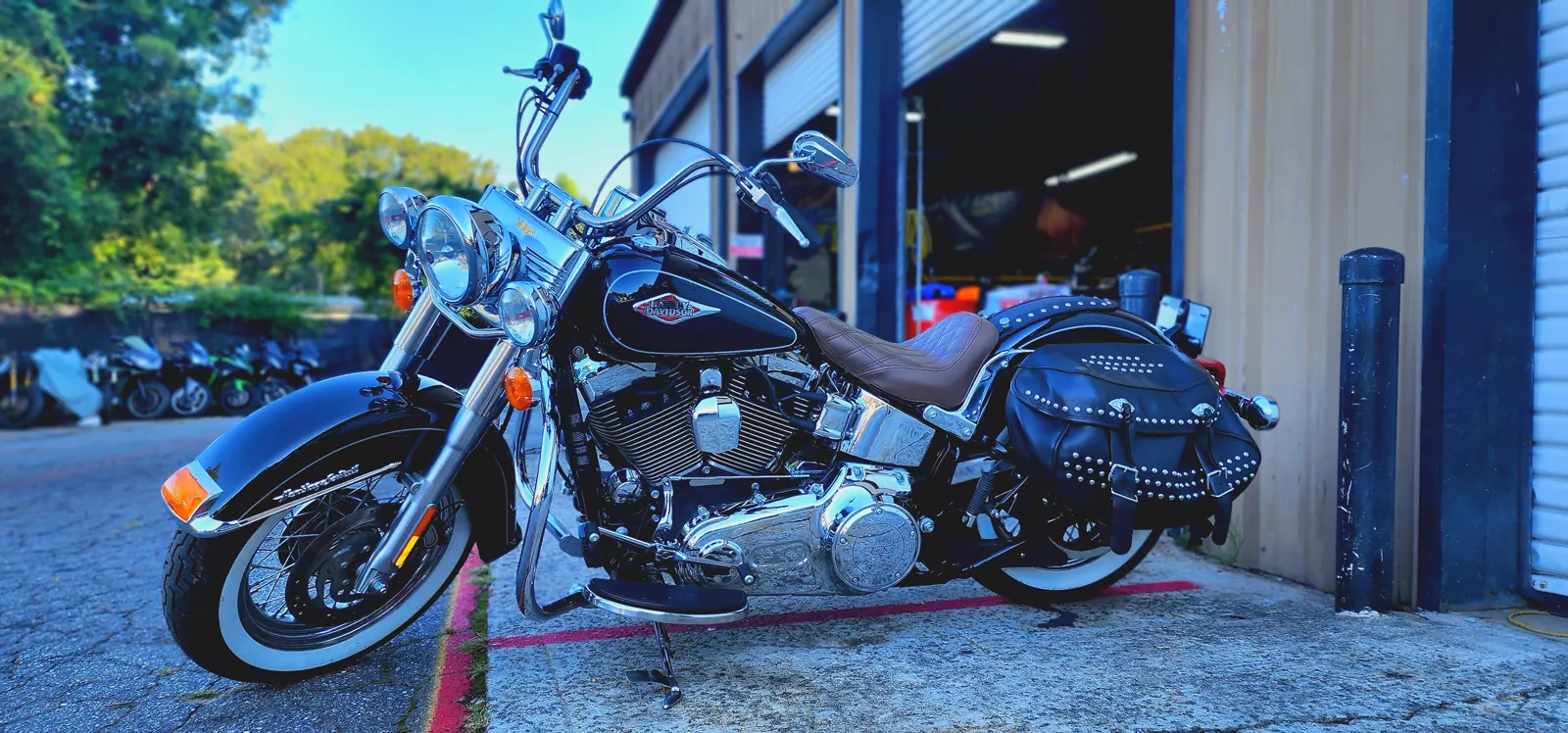
Marietta riders don’t all ride the same way, and that shapes the tune. Somebody in the Whitlock Avenue Historic District — eighty-two acres of Greek Revival through 1930s houses that joined the National Register in 1989, with a hundred and one contributing buildings — is often on an older bike threading narrow streets, so low-throttle manners matter more than anything near redline. A bagger owner out of the Overlook at Marietta Country Club runs long steady miles and wants heat and cruise smoothness sorted. Over in Barrett Heights, the Barrett corridor crowd skews commuter, and stop-and-go punishes a lean map hardest.
The commute is part of the diagnosis. Georgia doesn’t allow lane splitting, so you sit in the same I-75 crawl as the cars, and an air-cooled engine in July feels every minute. Surface riding on Cobb Parkway and Canton Road is stoplight to stoplight — exactly the throttle range where a bad map shows up as surging and heat between your knees.
For enjoying the tune afterward, riders here head out Old US-41 and Stilesboro Road, the quieter run north toward Kennesaw and Acworth, with the 2,923 acres of Kennesaw Mountain National Battlefield Park sitting off to the side as scenery. Come back into town, park near the Square, and The Strand Theatre, a movie palace restored from 1935, sits right there while the bike cools. We’re about three miles from the Square, eight to twelve minutes up Roswell Road, and no corner of the city limits is more than about twenty minutes out.
Worth knowing what else is here. Marietta packs more motorcycle retail into a few miles of Cobb Parkway than almost anywhere in metro Atlanta, and there are good mobile options too — Mini Boss Mobile Mechanic runs appointment-only across Marietta, Kennesaw, Smyrna, Acworth and into Atlanta. Mobile work suits plenty of jobs. Dyno tuning isn’t one, since the drum weighs more than a van.
How to walk in without surprises
The riders who have the smoothest experience all do the same few things. They bring a list of every modification, including the previous owner’s. They describe what bugs them plainly, since “it stumbles when I crack the throttle” beats “I think it’s lean.” They ask for the health check before the tune. And they book in the off months, since January and February are the coldest stretch and the best window for engine and ECU work when you aren’t losing riding days.
Timing helps another way. Plenty of Marietta works shifts — Lockheed Martin’s Aeronautical Systems plant, Dobbins Air Reserve Base, twelve-hour nursing rotations at Wellstar Kennestone. Tell us your schedule and we’ll fit the bike around it. If you’re north, the Roswell side of things covers the same ground.
One last bit of perspective: a properly fueled bike responds when you ask it to, and predictable throttle is a safety feature as much as a fun one. Groups like the Motorcycle Industry Council track how riders really use their machines, and the pattern holds — most miles happen at ordinary speeds, at exactly the throttle openings a good tune cleans up.
What you should walk away with
You started this typing dyno tuning cost Marietta into a search bar, looking for a number. What you’ve got instead is the map behind the number, which is worth more. A dyno measures real force at the rear wheel and reads the actual air-fuel mix from your pipe. A tune rewrites instructions, not hardware. Access, condition and modification history stretch a job, and anybody quoting blind is guessing on your behalf.
Ask the sharp questions now. What happens if you find a fault, do I get before and after sheets, and will you show me the air-fuel graph? Any shop worth your time answers without flinching. That’s the point of knowing this — so you’re the one steering the conversation.
Questions Marietta riders ask us
Does the type of bike change the work?
Less than you’d think, and not the way people expect. A Harley, a KTM and an old Japanese project all get the same core process. What changes is access — how much has to come off to reach the ECU or the carbs — and whether the bike is fuel injected or carbureted, since carb work means hands-on changes between runs.
What happens if you find something else wrong?
We stop and tell you before going further. A dyno finds faults because it asks the engine for everything it has, so a weak coil or an air leak shows up fast. We’ll explain what it is, what it affects, and what it takes to fix. Nothing gets done that you didn’t agree to.
How do I avoid surprises?
Bring a complete list of modifications, including anything a previous owner did. Describe the symptom in plain words rather than diagnosing it for us. Ask for the inspection before the tune so any repairs are on the table up front. Riders who do those three things almost never get surprised.
What makes one tuning job bigger than another?
Mostly three things: how far the bike sits from stock, how hard the ECU or carbs are to reach, and how healthy the engine is when it arrives. A stock bike with a slip-on is quick work. A bike with a full exhaust, a big-bore kit and years of one-part-at-a-time changes takes real time to sort out.
Why can't you quote it over the phone?
Because we’d be guessing, and a guess turns into a promise in your head. Ten minutes with the bike in front of us tells us more than an hour on the phone. We’d rather give you a real estimate you can hold us to than a comfortable answer that changes later.
Will I actually feel the difference?
Yes, and usually not where riders expect. The peak numbers on the sheet are fun, but the change you feel daily is smoother throttle at low speed, less heat in traffic, no surging at steady cruise, and a bike that responds right when your wrist moves.
We tune bikes for riders all over the northwest side of metro Atlanta. That means East Cobb and Kennesaw just up the road, Smyrna and Vinings heading toward the city, Acworth at the top of the county, and Powder Springs, Mableton and Austell out to the west. Riders come down from Woodstock and over from Roswell and Sandy Springs regularly, and we see plenty of bikes make the run in from Dallas as well. If you’re anywhere in Cobb County, you’re a short ride from the shop.
BRING IT IN AND WE'LL LOOK
Text us and tell us what you ride, what’s been changed, and what bugs you about the way it runs right now. We’ll set a time that works with your shift, put eyes on the bike before we quote anything, and walk you through what we find. We’re about three miles from Marietta Square, and no corner of Marietta is more than roughly twenty minutes out.
470-460-9883Diaz Motorcycles and Service, LLC · 847 Barnes Mill Road, Marietta, GA 30062