Motorcycle Dyno Tuning Kennesaw — What to Expect
What a dyno really measures, what a tune changes in how your bike feels, and how we figure out the price before you commit.
Still, most weeks, the bike that gets rolled through our door isn’t broken. It starts. It idles. Plus, It’ll get you to work and home again without drama. But somewhere in the middle of the rev range it goes flat, or it snatches when you crack the throttle at a light, or it runs hot enough in stopped traffic to toast your right calf. That’s the bike we see most. It’s also the exact bike that motorcycle dyno tuning Kennesaw riders ask about, week after week, is built to fix. Nothing dramatic. Of course, just a machine that’s been guessing, and a way to stop the guessing.
First, the myth we have to clear out of the way
Then again, there’s an old idea floating around that a dyno is a toy for racers. Even so, big numbers on a screen, a printout to wave at your friends, bragging rights and not much else. Plenty of riders believe it, so they never bother, and they keep living with a bike that feels a little off.
We get why the myth stuck. Meanwhile, Peak horsepower is the number everybody quotes, because it’s the easiest one to say out loud. But peak power happens at one single point on the tach, and almost nobody rides there. You ride the middle. In fact, that said, you ride the roll-on out of a corner, the part-throttle cruise, the stop-and-go crawl. For example, that’s where a bad map hurts and a good one pays you back.
So here’s the honest version. A dyno isn’t a scoreboard. After that, it’s a measuring tool, like a scale or a thermometer, and its real job is to tell us the truth about your engine instead of making us guess.
What a dyno actually measures, in plain words
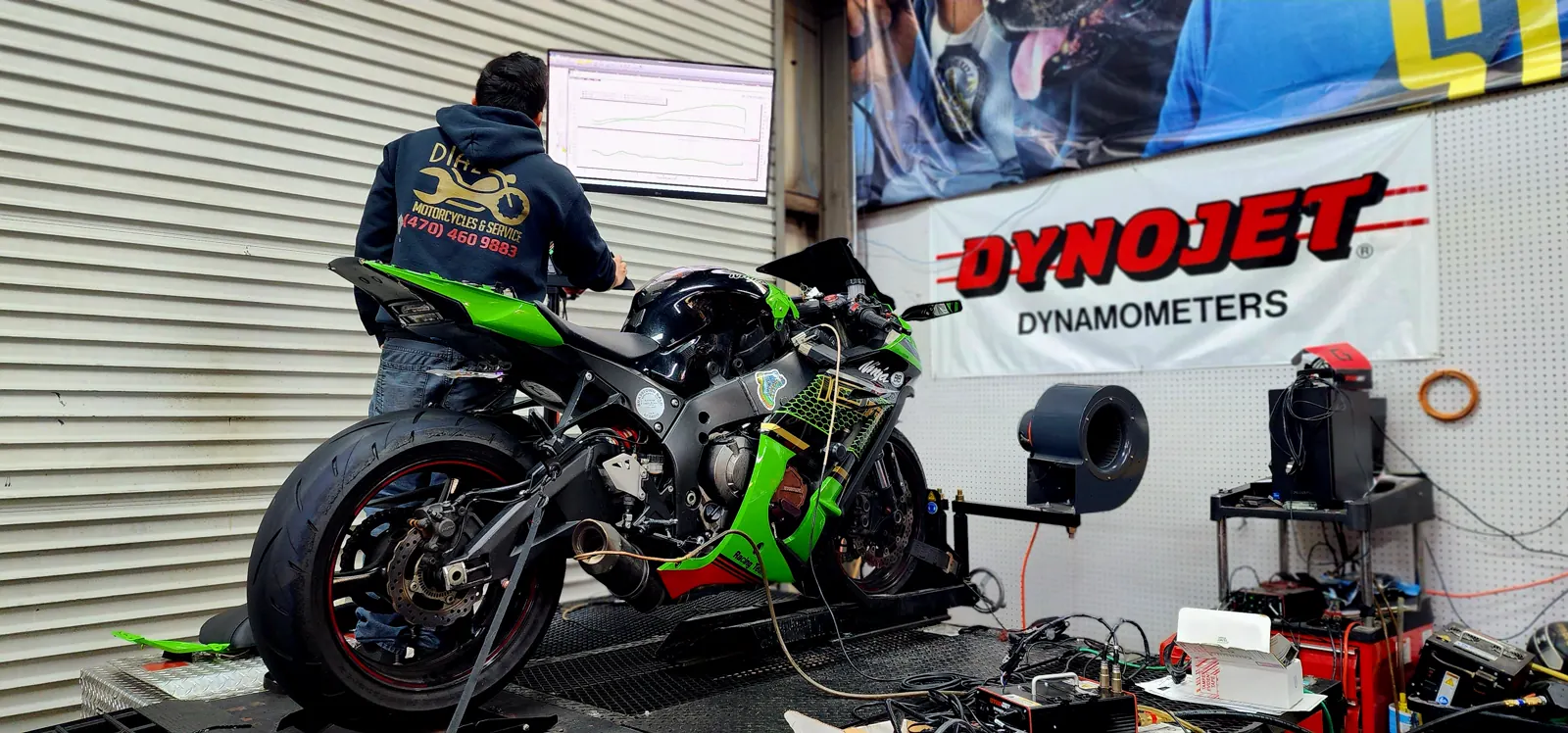
What’s more, Think of a dyno as a treadmill for your motorcycle. So and Better yet, the bike gets strapped down over a heavy steel roller. Still, the rear wheel spins the roller, the roller pushes back, and a fan blows air across the engine so it thinks it’s moving down the road. Plus, the bike stays put and the road comes to it.
Of course, the machine measures how hard your rear wheel can shove that roller. That shove is torque. Pair torque with engine speed and you get horsepower, which is really just torque with a stopwatch attached. Both get drawn as a line across the rpm range, and the shape of that line tells us far more than the highest point on it. Dips, flat spots and sudden humps all mean something.
At the same time, a probe in your exhaust reads what’s coming out the back. That reading tells us the air-fuel ratio, which is the whole ballgame.
Lean, rich, and what each one feels like from the saddle
Your engine wants a specific mix of air and fuel. Too much air for the fuel it’s getting is called lean. Too much fuel for the air is called rich. Neither one is exotic. Both are common, and both leave fingerprints you can feel.
A lean bike tends to run hot, surge at steady throttle, pop and crackle on the way down through the gears, and go soft in one specific band of the rev range. A rich bike feels heavy and lazy instead, smells strong at idle, fouls plugs, and drinks more fuel than it should. Riders often blame the clutch, the chain, the gas station or the weather. Usually it’s just the map.
And the map is often lean straight from the factory, because a brand-new bike has to pass emissions and noise rules and has to run in Phoenix, Seattle and Georgia on one setting. That’s a compromise, not a mistake. Then you add a slip-on, or a free-flowing filter, or you simply live where July hits like a wet towel, and the compromise slides further out of shape.
So what does a tune actually change?
Two things, mostly. How much fuel gets sprayed in at every combination of throttle and rpm, and when the spark fires. On most modern bikes we do that by flashing the ECU, which is the bike’s own computer, so the corrected numbers live inside the factory brain. On other bikes, especially older fuel-injected ones, we add a Power Commander, a small module that sits between the sensors and the injectors and edits the signal on the fly.
What you feel afterward isn’t a punch in the back. It’s smoothness. The throttle stops snatching at small openings. The flat spot fills in. Heat drops in traffic. Cruising gets steadier, fuel mileage often improves, and the bike stops feeling like it’s arguing with you. Riders describe it the same way over and over: it finally does what my wrist tells it to.
THE SHORT VERSION
A dyno measures. A tune corrects. The measuring has to come first, or the correction is just a fancier guess.
Something changes once you know what to look for. All those little annoyances you’ve been riding around stop feeling like personality quirks and start looking like data points. The hot right leg, the hesitation at the 4,000 mark, the popping on the way down Barrett Parkway. They’re not random. They’re a graph you haven’t seen yet.
How we diagnose before we ever quote you
We won’t put a price on work we haven’t looked at. That’s the rule, and it saves everybody a bad afternoon. Here’s the order we go in.
- You text us the bike, the year, and what it’s doing wrong. Photos help. A short video with sound helps even more.
- We check the mechanical basics first: plugs, filter, valve clearance history, exhaust leaks, throttle bodies, battery health. A tune can’t fix a sick engine, and we’d rather find that on day one.
- We put it on the dyno and make a baseline run. No changes yet. This is your bike exactly as it sits today.
- We read the air-fuel line against the power line and mark where the two disagree.
- We call or text you with what we found, what we’d change, and what it costs. Then you decide.
That baseline run is the part riders end up loving most, because it’s proof rather than opinion. If you want to go deeper on reading those lines yourself, we walked through it in detail here, and it explains a lot about how we handle that job from the first pull to the printout you take home.
What tuning day looks like
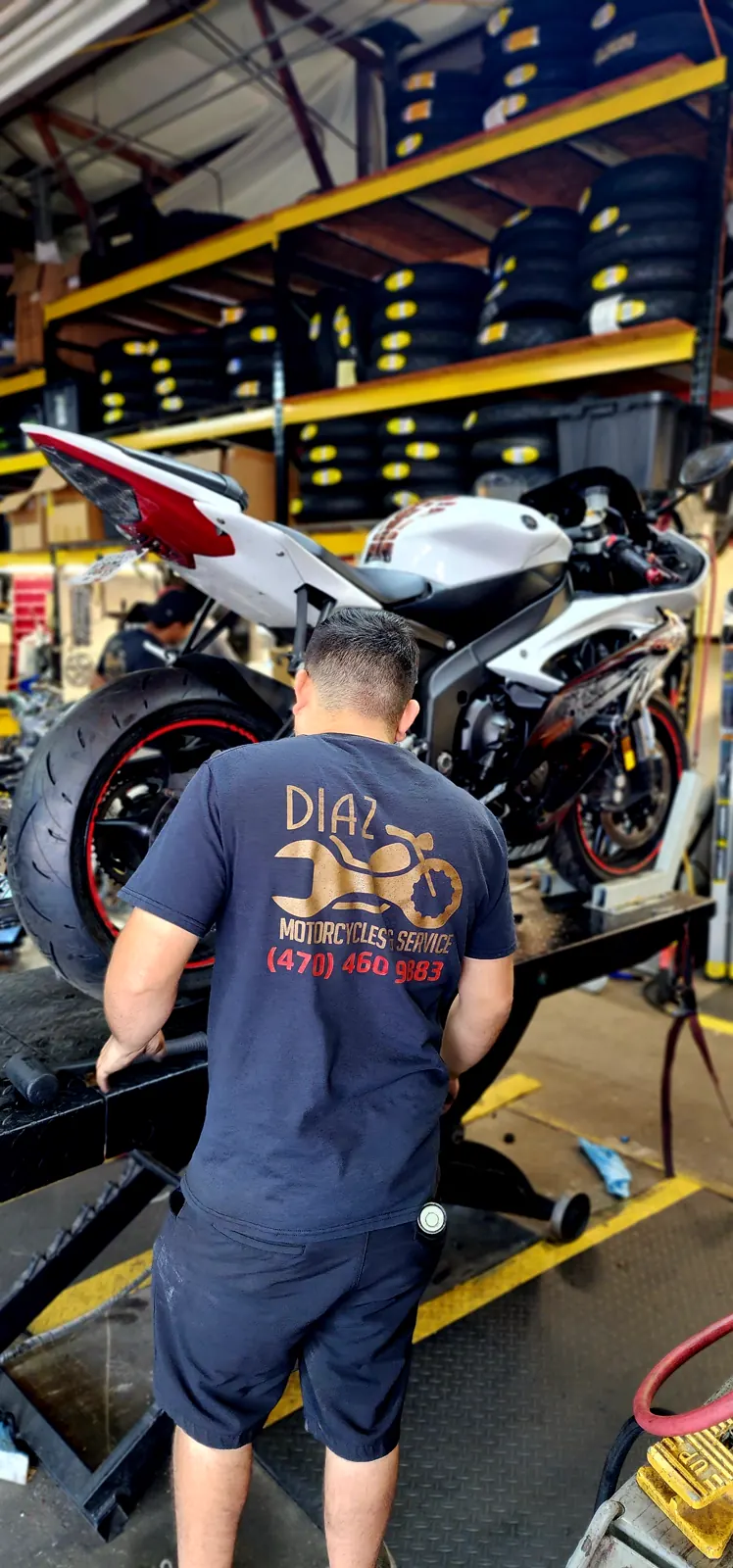
The bike gets strapped down, the fan gets aimed, and we make a series of runs. After each one we adjust the fuel and timing values in the areas that were off, then run it again to confirm the change did what we expected. It’s a loop, and the loop is the work.
Part-throttle gets as much attention as full throttle here, because that’s where you actually live. Cruising at a steady sixty, easing out of a turn, feathering through a parking lot. Once the numbers hold steady across the whole range, we do final verification pulls and print the sheet. You leave with the graph, the before and after, and a plain-English explanation of what moved and why. We cover the rest of everything we cover on our service page if you’d like the full menu.
How to tell a good tuning shop from a hopeful one
You don’t need a technical background to spot the difference. You just need to know which questions land.
- They make a baseline run before touching anything. No baseline, no proof.
- They inspect the mechanical side first and will tell you no if the bike isn’t ready.
- And they talk about the middle of the rev range, not just the peak.
- They hand you the actual sheet, not a number shouted across the counter.
- So they explain what they changed in words you can repeat to a friend.
- They quote after the diagnosis, and the quote doesn’t move without a phone call.
We put together a longer breakdown of what separates a good shop if you’re comparing options, and riders east of here can read the Lawrenceville side of things too, since the questions turn out to be nearly identical no matter which side of the interstate you’re on.
Now for the part that has nothing to do with parts at all. The single biggest complaint we hear about shops isn’t the wrenching. It’s the silence. A bike goes in, a week goes by, nobody answers, and the rider spends the whole time imagining the worst.
So we text. You can send us a message on a lunch break instead of holding for a service writer, and you’ll get pictures of your own bike on the dyno while it’s happening. If we open something up and find a bigger issue underneath, you hear about it that day, with a photo, before a single extra dollar of work happens. No surprises at pickup. That’s it. That’s the whole policy, and it’s shockingly rare.
Why Kennesaw riders end up on our dyno
Kennesaw is a real riding town, and it’s a strange one in the best way. Over in Legacy Park, where 117 acres wrap around a seven-acre Town Green with four pools, eleven tennis courts, disc golf and an amphitheater, the garages are full of cruisers and touring baggers that get ridden hard on weekends and parked all week. Down in Downtown Historic Kennesaw, the older single-family homes around Main Street sit in a core that got a large mixed-use development approved in late 2024, so the streets are busier than they were. And in the subdivisions off Due West Road, which everybody names by the road rather than by the neighborhood signs, we see a bit of everything.
Then there’s the daily grind. Georgia doesn’t allow lane splitting, so a Kennesaw commuter sits still in the I-75 crawl between Barrett Parkway at exit 269 and Chastain Road at exit 271, baking. Air-cooled engines soak up that heat, and a lean map makes it worse. Riders heading to Town Center at Cobb or cutting past the skate plaza and dog park at Swift-Cantrell Park deal with signal-dense arterials all day, which means constant on-off throttle. If your bike is going to be rude anywhere, it’s right there.
The flip side is the good stuff. Twenty minutes north you’ve got Lake Allatoona and Red Top Mountain, with a well-known fifty-three mile route running from Emerson toward Canton, all sweepers and twisties and elevation change. That’s a ride where a clean midrange feels like a gift, and a snatchy throttle feels like sandpaper. Fall is when those roads shine, which is exactly why our dyno stays busy in September and October.
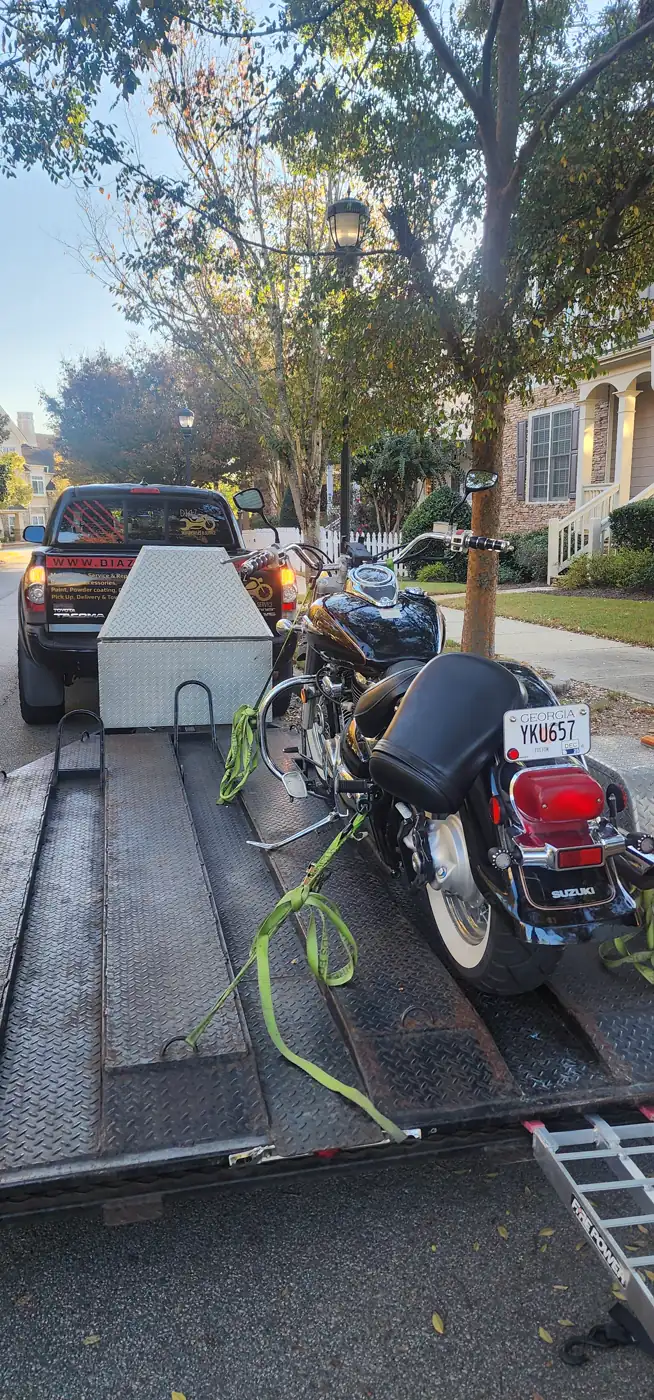
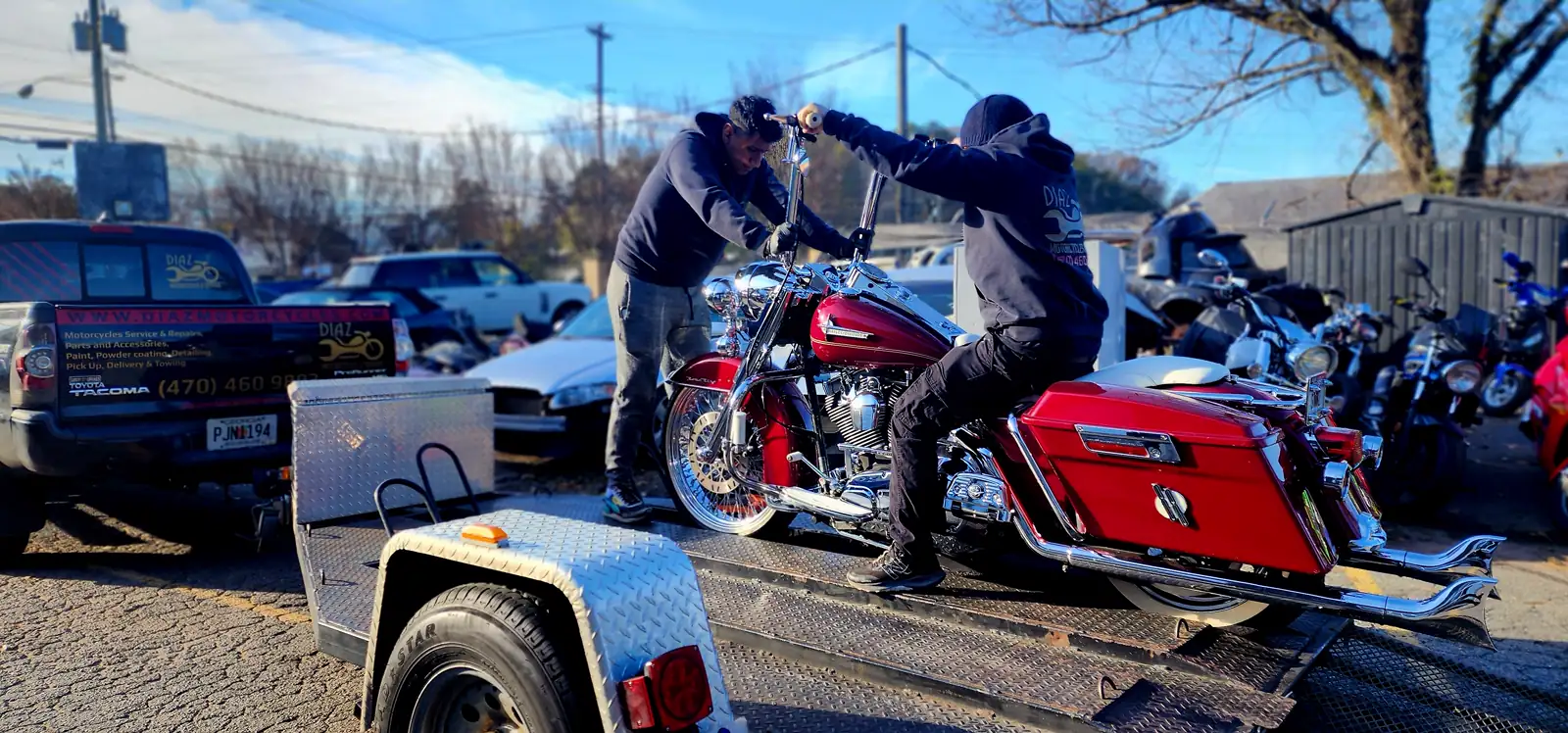
Getting to us is easier than the map suggests. We’re about eleven to fourteen miles out, roughly twenty-two to thirty minutes, either I-575 to I-75 south and over to Roswell Road, or Barrett Parkway east to Sandy Plains and Roswell Road. For comparison, WOW Motorcycles over at 522 Cobb Pkwy N in Marietta is around eighteen minutes south of Kennesaw and closed Sunday and Monday, so distance really isn’t the deciding factor here. And if the ride still doesn’t fit your week, we’ll transport the bike or pick it up and drop it back off, which erases the drive entirely.
We also see a lot of younger riders from the KSU side of town on first bikes and used sportbikes, plus plenty of DIY-curious owners who got halfway through a project and need someone to finish it clean. Nobody gets a lecture. If you’re still working on the license side of things, the state lays it out at the Georgia Motorcycle Safety Program, and the course is genuinely worth a weekend.
What you walk away with
A bike that pulls evenly instead of in patches. Cooler running in traffic. A throttle that answers on the first ask. And a sheet of paper that shows exactly what your engine was doing before and after, so the whole thing stops being a mystery you have to take on faith. Good motorcycle dyno tuning Kennesaw riders can trust always ends that way, with proof in your hand.
You shouldn't have to trust us. You should be able to read the graph yourself.
That’s the real point of all this. Not a bigger number. Just a bike you understand, tuned by people who show their work, so you can spend the next fall weekend chasing curves instead of second-guessing your right hand.
Questions Kennesaw riders ask us
How do I get a quote?
Text us the year, make and model plus what the bike is doing wrong, and send a photo or a short video with sound if you can. We’ll give you a ballpark right away and tell you what we’d need to check. The firm number comes after we’ve inspected the bike and made a baseline dyno run, because that’s the only way to quote honestly.
Do you work on older bikes?
Absolutely. Older fuel-injected bikes often respond beautifully to a Power Commander, and carbureted machines can be dialed in on the dyno with jetting and needle changes instead of software. We’ll tell you upfront if an older engine needs mechanical attention before tuning is worth doing.
What happens if it needs more than expected?
You hear from us that same day, with a photo of what we found and a clear explanation. Nothing extra gets done until you say go. We’d rather have an awkward five-minute conversation than hand you a surprise at pickup.
What does the service include?
A mechanical health check, a baseline dyno run, air-fuel readings across the rev range, fuel and timing corrections through an ECU flash or a Power Commander, verification runs to confirm the changes, and your printed before-and-after sheet. We also walk you through what changed in plain language before you ride off.
How long does it take?
Most tunes are a one-day job once the bike is on the schedule. Bikes needing plugs, filters, valve checks or exhaust repairs first can take longer, and we’ll tell you that timeline before we start. Drop-off, pickup and transport from Kennesaw are all available if the drive doesn’t fit your week.
Do I need a modified exhaust or intake to benefit?
Not at all. Plenty of completely stock bikes come off the dyno smoother and cooler, because factory maps are built to satisfy emissions rules across every climate in the country. If you have added a slip-on or a filter, tuning matters even more, since the engine is now breathing differently than the map expects.
We tune and service bikes for riders all over the northwest metro, starting right here in Marietta and running up through Kennesaw, Acworth, Emerson and Cartersville. Woodstock and Canton riders come down the I-575 corridor to us regularly, and we see plenty of bikes from East Cobb, Smyrna and Mableton on the south side. Powder Springs, Dallas and Hiram riders are a straight shot over as well. If you are somewhere in between, text us and we will sort out pickup.
TEXT US A PHOTO OF YOUR BIKE
If your bike has a flat spot, runs hot in traffic, or just doesn’t feel right, we’ll figure out why before we quote a thing. Kennesaw riders can text us the year, model and symptom and get a real answer the same day. If the drive down doesn’t fit your schedule, we’ll come get the bike, tune it, and bring it home.
470-460-9883Diaz Motorcycles and Service, LLC · 847 Barnes Mill Road, Marietta, GA 30062