Motorcycle Running Lean Mableton — Causes & Fixes
The popping, the surge, the heat — what your bike is actually telling you, and how we find the cause instead of shrugging at it.
Of course, you rolled up to a counter somewhere, described the popping on decel and the way the bike surges at steady throttle, and the guy nodded before you finished your sentence. They all do that, he said. Ride it. Then again, you left with the same bike and a little less confidence than you walked in with. But you weren’t imagining it. Even so, a motorcycle running lean Mableton riders bring through our door almost always shows the same short list of signs, and every single one of them has a cause you can actually find.
So let’s do this the other way around. Meanwhile, No shrug, no shop talk you can’t follow. In fact, that said, We’ll walk through what you’re feeling, what’s likely causing it, how we chase it down, and what the fix really involves.
What a lean bike feels like from the seat
For example, Almost nobody walks in and says the word lean. They say the bike feels weird. After that, that’s the honest version, and it’s usually right on the money.
What’s more, here’s what weird tends to sound like once we start asking questions.
- So and Better yet, Popping or crackling out of the pipe when you roll off the throttle.
- Still, a surge or a hunt at steady speed, like somebody else is tapping your throttle.
- Hard starting when cold, then an idle that never quite settles down.
- Plus, the engine and pipes running hotter than they used to, especially sitting in traffic.
- A flat spot when you crack the throttle open, like the bike hesitates before it goes.
- Of course, an idle that hangs high for a few seconds after you pull the clutch in at a light.
Then again, one of those on its own might be nothing at all. Three of them together is a pattern, and patterns are what we work from. So if you’ve been keeping a mental list, that list is useful. Bring it with you.
What lean actually means, in plain words
Your engine works off a recipe. A certain amount of air, a certain amount of fuel, mixed and burned thousands of times a minute. Lean means there’s too much air for the fuel it’s getting. Rich is the opposite — too much fuel for the air. Neither one is a character flaw in your bike. It’s just a recipe that drifted off.
Lean burns hotter and faster than it should. That’s exactly why the symptoms cluster around heat and hesitation. The popping on decel is leftover fuel and extra air lighting off inside a hot exhaust, which sounds dramatic but is mostly harmless by itself. Now, the surge at cruise is the engine trying to hold a speed with less fuel than it wants. The flat spot is that same problem, just at a bigger throttle opening.
Rich has its own tells: sooty black plugs, a strong fuel smell, and mileage that falls off a cliff. Figuring out which direction your bike drifted is honestly half the job.
Before we go further, one thing worth clearing up. Lean isn’t a brand, a curse, or a sign you bought a bad bike. Plenty of motorcycles leave the factory running slightly lean on purpose, because emissions rules get written for a lab bench, not for a July afternoon crawling up Floyd Road. Your bike may have been a touch lean the day you rode it home. What changed is that something else stacked on top of it.
Why it happens — most common first
- An intake or exhaust change. A slip-on, a full system, a high-flow filter — all of them move more air, and the factory fuel map has no idea any of it happened.
- An air leak. A cracked intake boot, a dry-rotted vacuum line, a loose clamp, a tired gasket. Air sneaks in past the point where the bike measures it.
- Fuel starvation. A clogged filter, a weak pump, a partly blocked injector, or varnish in the carbs from a bike that napped through winter.
- A lazy sensor. Oxygen sensors, air temperature sensors and throttle position sensors all drift as they age and cook.
- Heat, humidity and air density. Georgia in August is a different planet than Georgia in March, and your engine notices.
- A leftover tune. Somebody flashed the ECU or bolted on a Power Commander years ago and never finished the job properly.
Notice that four of those six have nothing to do with performance parts. A totally stock bike with an aging vacuum line will act lean too. That’s the whole reason guessing gets expensive in time even when the parts are cheap.
How we actually find the cause
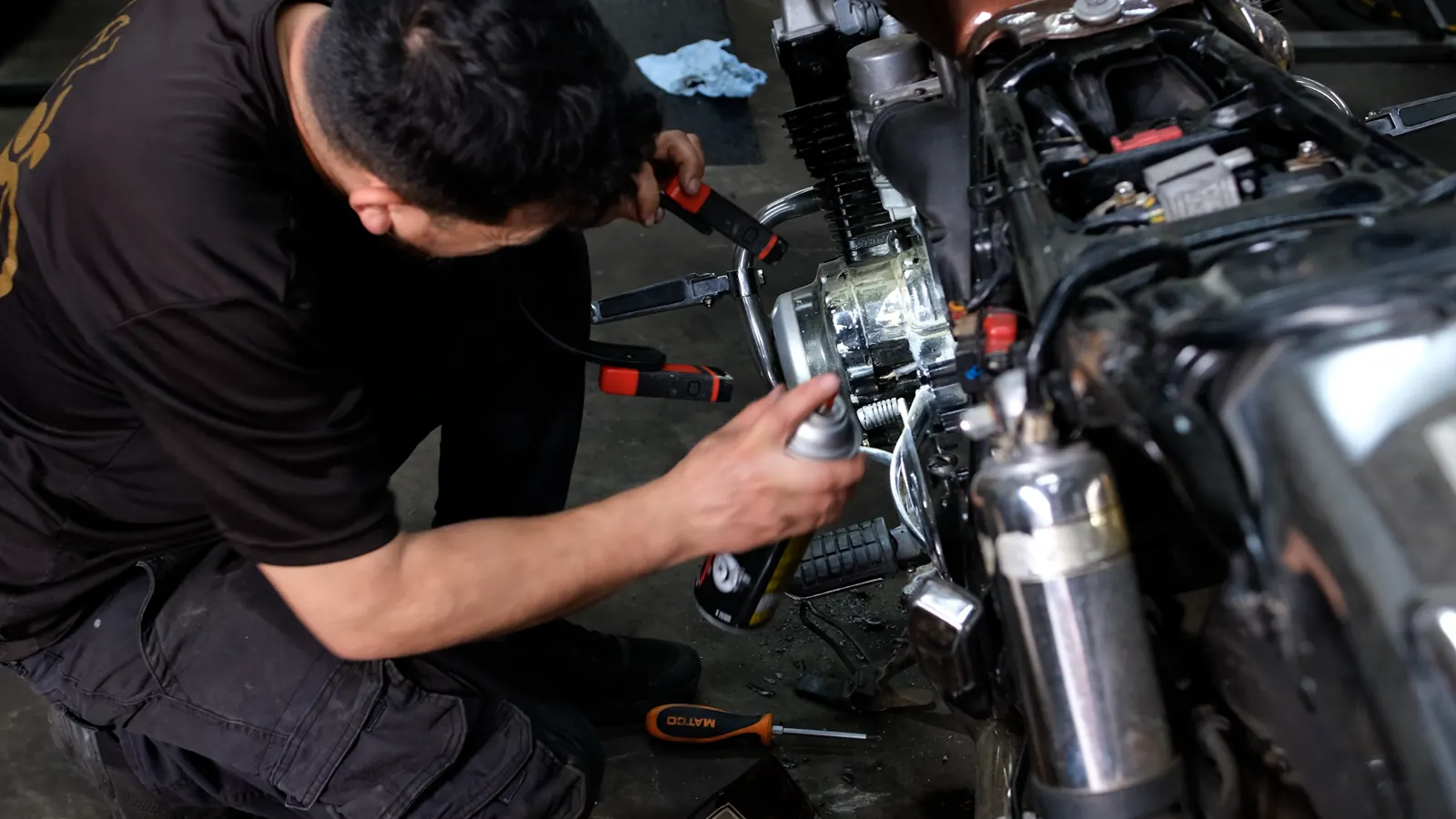
We start with the boring stuff, because the boring stuff is usually the answer. Codes get pulled. Plugs come out and get read, since plug color tells a story a scan tool can’t. Then we hunt for leaks the old-fashioned way, with smoke or a careful spray around the intake while the bike idles, watching for the idle speed to twitch. When it twitches, we found it.
After that, fuel pressure gets checked and filters get inspected. If your bike runs carbs, we look at the slides, the needles and whatever jetting the previous owner left behind, which is frequently a surprise. Nobody ever writes that stuff down.
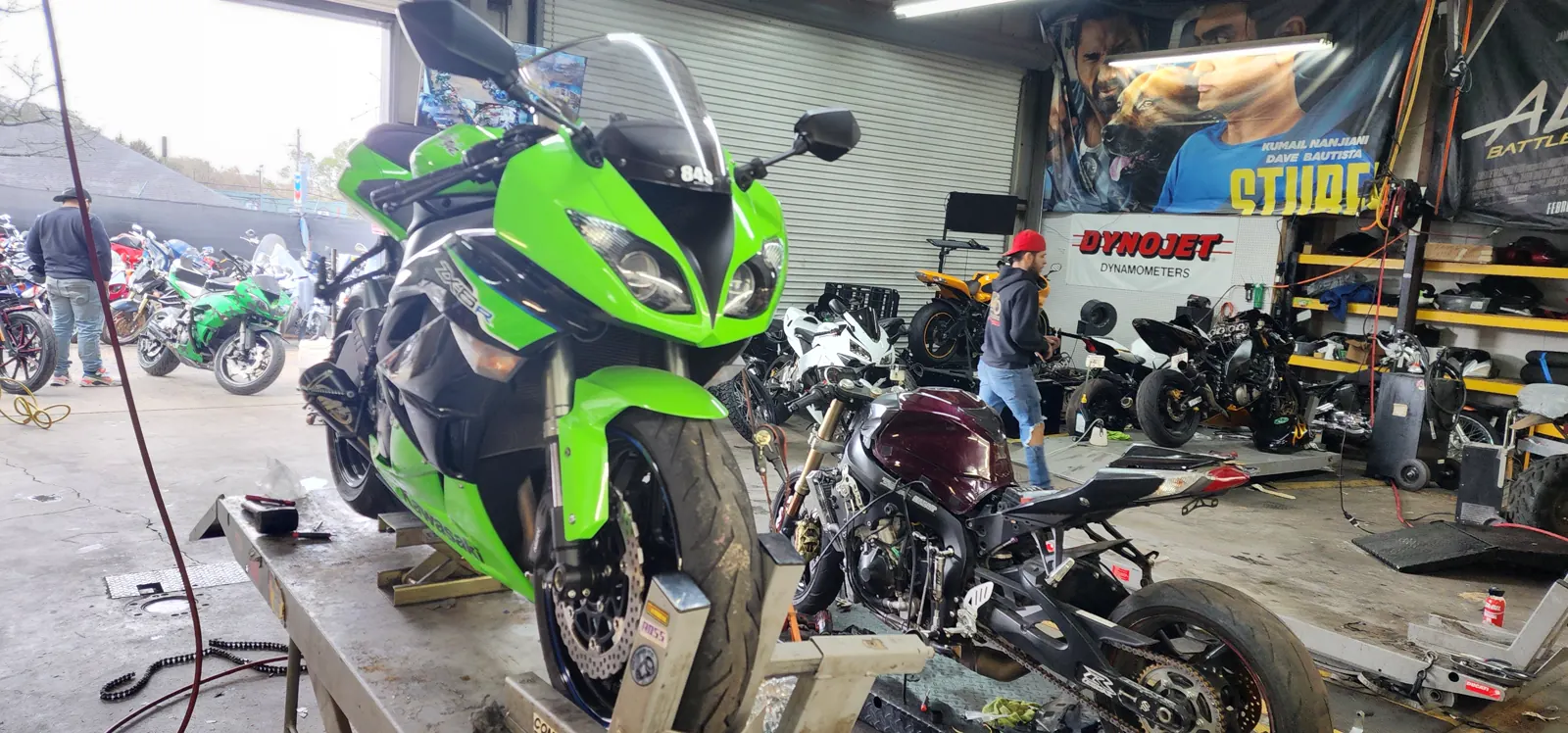
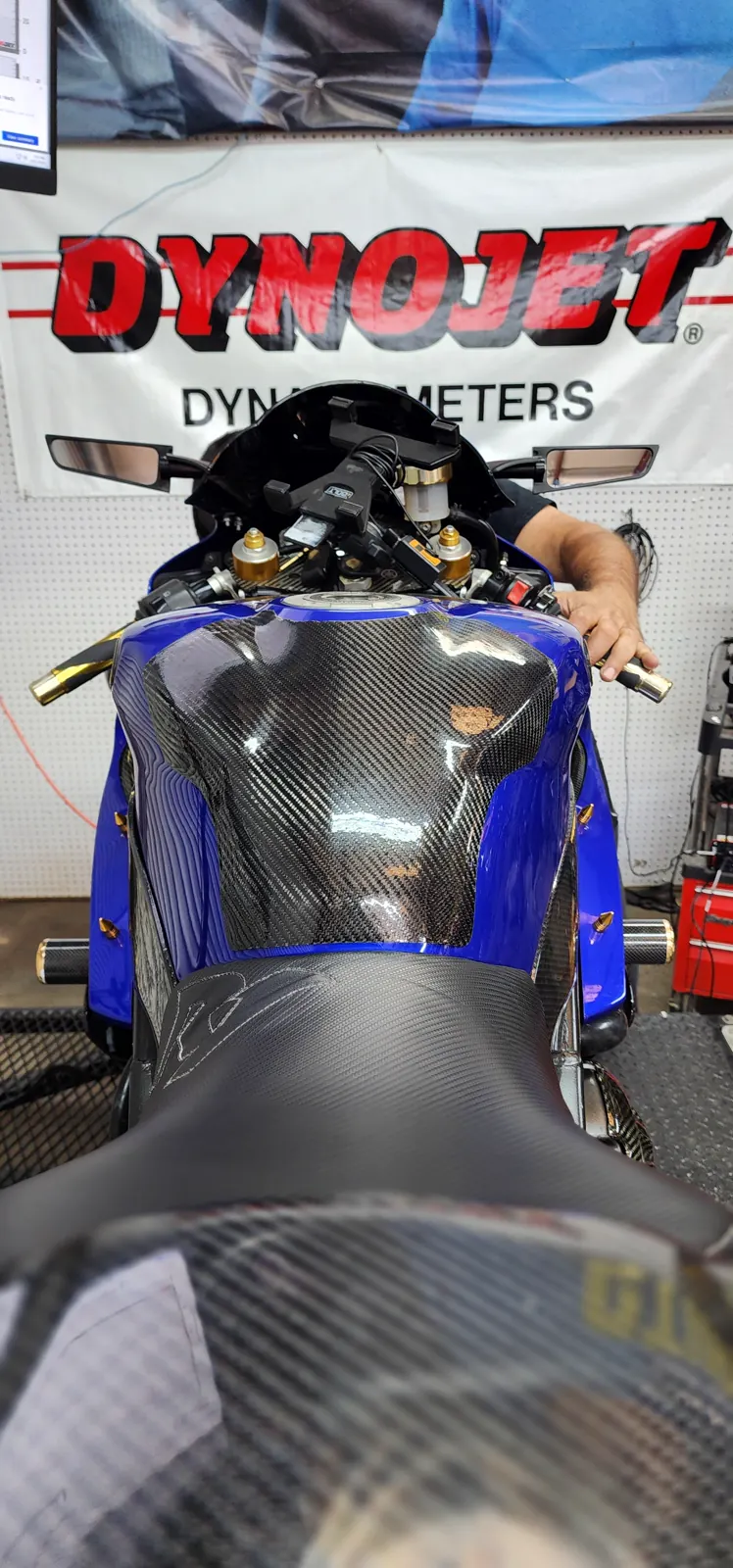
Then the bike goes on the dyno, and this is where guessing officially stops. A dyno is a heavy drum that your rear wheel spins against. It measures how hard your engine is actually working at every point in the rev range, and with a wideband sensor in the pipe it measures precisely how lean or rich you are at each of those points. Not a feeling. A number, plotted on a graph, from idle all the way to redline. Dynojet’s dyno center explains the hardware side well if you like the engineering.
That graph is the whole difference between a shop that shrugs and a shop that shows you. If you’d like the mechanical detail before you come in, here’s what happens in our bays, and here’s what that service actually involves once a bike is strapped down and rolling.
What the fix involves
Sometimes the answer is one cracked vacuum line and you’re back on the road the same day. We love those days. More often it’s a repair plus a tune, because the repair gets your bike back to honest and the tune gets it back to right. Those are two different jobs, and doing only one of them is why people end up frustrated.
On a fuel-injected bike, tuning means changing the numbers your ECU uses to decide how long to hold the injectors open at each throttle position and each engine speed. We either flash the ECU directly or add a Power Commander, which sits between the ECU and the injectors and adjusts the signal on the way through. On a carbureted bike it’s physical work instead — jets, needles, air screws — and the dyno tells us which direction to move and how far.
Either way, the loop looks the same. Run it, read the numbers, change the map, run it again. Over and over until the line sits where it belongs across the entire range, not just at the two spots you happened to notice from the seat.
WHAT A GOOD TUNE FEELS LIKE
Not fireworks. The bike quits hunting at steady throttle. It pulls clean off a closed throttle instead of stumbling. Heat drops. It idles like it means it. Riders usually describe it as the bike finally doing what their wrist asked for.
If you want the honest list of what changes afterward, we wrote the full rundown on it. And riders over in Peachtree City deal with the exact same symptoms on the exact same bikes, so that one covers the same ground from a different corner of metro Atlanta.
Is it safe to ride like this?
Usually yes, for a while, with limits. A mild lean condition on an otherwise healthy bike is not an emergency. Ride it to work. Ride it home. Just don’t let it ride out an entire season while you hope it fixes itself, because it won’t.
There’s a reason we bring this up on nearly every intake. If your engine is pinging or knocking under load — a metallic rattle when you roll on in a tall gear — park it and call. That’s detonation, and it’s the one lean symptom that genuinely chews up pistons and valves. Park it too if the engine gets hot enough to be uncomfortable at a stoplight, or if it’s cutting out and leaving you stranded in an intersection. Everything short of that can wait for an appointment.
A bike that pops once in a while is talking. A bike that knocks under load is shouting.
Why this shows up so much around Mableton
Mableton is South Cobb, it’s OTP, and it rides harder than people give it credit for. Riders here rack up real mileage — roughly fifteen miles into downtown Atlanta, warm weather nine months out of twelve, and no lane splitting or filtering allowed in Georgia, so your bike sits in the same jam a car does. That means a lot of idling in summer heat, which happens to be the exact condition where a lean bike shows its worst manners. That’s the honest reason a motorcycle running lean Mableton riders own tends to feel far worse in July than it did back in March.
Storage here is split right down the middle, and that split matters more than most people think. Bikes over in Vinings Estates, where the homes went up between 1996 and 2007 with the tennis courts and the clubhouse, mostly live in two- and three-car garages. Same story in the Providence corridor and in Vinings Glenn, which sits in that same Vinings-branded cluster. Meanwhile, along the townhome and apartment stretches near Floyd Road, a big share of bikes sit outside under a cover or in a shared lot. Outdoor bikes collect water in the fuel, dry-rotted vacuum lines and corroded connectors — three of our top six causes, all showing up at once.
Road conditions add their own quiet contribution. Heavy truck traffic through the corridor leaves rutting and shoved asphalt at intersections, and after a hard rain the streets near Nickajack Creek collect washed gravel and silt. None of that makes an engine run lean by itself. Over a few thousand miles of shaking, though, clamps loosen and fittings back off, and a loose clamp is just an air leak that hasn’t introduced itself yet.
The riding around here is genuinely good, which is the fun part of the problem. Friends we’ve helped run southwest on US 78, Veterans Memorial Highway, toward Douglasville and Villa Rica, with Sweetwater Creek State Park as the classic short loop when there’s only an afternoon to spare. That’s warmed-up, steady-throttle riding, and steady throttle is precisely where a lean surge is most maddening. Closer to home, Heritage Park gives you shaded trails along Nickajack Creek past the old mill ruins, and the Silver Comet Trail runs 61.5 paved miles on the roadbed of the Silver Comet passenger train that carried people from 1947 to 1969. Neither is a motorcycle road, but both are a decent reminder of how far this corridor reaches.
If you’ve been trekking over to Atlanta Harley-Davidson at 501 Thornton Rd in Lithia Springs, eight to twelve miles southwest, that’s a good shop with a published bike night schedule and their Rider Academy training program. It’s simply brand-locked. We’re multi-brand, which matters a lot when your ZX-6R and your neighbor’s Road Glide both need the same answer. Newer riders, or anyone coming back after a long break, should also look at the MSF rider courses — smoother throttle control makes a well-tuned bike feel even better.
Getting to us is easy enough. From Mableton it’s about thirteen to sixteen miles, roughly twenty-five to thirty-five minutes, north on South Cobb Drive through Smyrna into Marietta, then east on Roswell Road to Barnes Mill Road.
What you get back
Here’s the reassuring part, and it’s the whole reason we wrote this. Lean is one of the most fixable conditions a motorcycle can have. It’s measurable, it’s repeatable, and the fix holds. Nobody has to guess, and nobody has to talk down to you either.
When you pick the bike up, the popping is gone. The surge at cruise is gone. The engine sits cooler in traffic on a hot day, the throttle answers immediately, and that hesitation off idle simply isn’t there anymore. It’s the same motorcycle you already liked, minus the nagging feeling that something is slightly off.
That’s the outcome we’re after with every motorcycle running lean Mableton riders trust us with. Bring the symptom list, bring the bike, and let the numbers do the arguing.
Questions Mableton riders ask us
How urgent is this? Do I need to stop riding today?
For most mild lean conditions, no. You can keep commuting while you wait on an appointment. The exception is knocking or pinging under load, or an engine that’s running hot enough to feel uncomfortable at a light — those two mean park it and call us.
What happens if I just ignore it?
Mild lean running mostly costs you smoothness, mileage and comfort for a while. Left alone through a full Georgia summer, though, the extra heat starts working on valves, pistons and exhaust components. It’s a slow problem, not a sudden one, which is exactly why it’s worth handling before riding season peaks.
How do you find the cause instead of guessing?
We pull codes, read the plugs, check for air leaks with smoke or spray at idle, verify fuel pressure, and inspect filters and injectors or carbs. Then the bike goes on the dyno with a wideband sensor so we can see the actual air-fuel numbers across the whole rev range. The graph tells us where the problem lives.
Could my symptoms be something else entirely?
Absolutely, and we check for that. Popping and stumbling can also come from a weak coil, worn plugs, bad plug wires, a dirty throttle body or even a clutch and chain issue that feels like an engine hesitation. That’s why we diagnose first and change parts second.
I added a slip-on exhaust. Is that what caused this?
Very likely a big part of it. Any exhaust or intake change moves more air, but your factory fuel map has no idea and keeps delivering the same fuel. A tune brings the fuel back in line with the new airflow, which is usually when the bike finally feels like the parts were worth installing.
Do you work on carbureted bikes too, or just fuel injection?
Both. Fuel-injected bikes get an ECU flash or a Power Commander, and carbureted bikes get jets, needles and air screws sorted on the dyno. Older, higher-mileage bikes are a big part of what rolls through our door, so nothing about a carburetor scares us.
We take care of riders all over the west and northwest side of metro Atlanta. Mableton is a short run up South Cobb Drive for us, and we see plenty of bikes from Smyrna, Vinings and Cumberland on that same corridor. Riders come in from Austell, Clarkdale and Powder Springs on the west side, and from Hiram a little further out. Marietta and Fair Oaks are right in our backyard. We also see a steady stream from Douglasville and Lithia Springs down US 78, plus riders from Atlanta itself who’d rather come out of the city for the work than fight the wait inside it.
STOP GUESSING. START MEASURING.
If your bike is popping, surging or running hot, text or call us and describe exactly what you feel from the seat — that’s the most useful information we can get. We’ll get it on the dyno, find the real cause, and show you the numbers before we touch anything. Mableton riders are a short ride up South Cobb Drive from our bays in Marietta, and we’d love to get your bike feeling right again before the best part of riding season gets away from you.
470-460-9883Diaz Motorcycles and Service, LLC · 847 Barnes Mill Road, Marietta, GA 30062