Dyno Tuning Cost Mableton — Full Breakdown
What a dyno really measures, what a tune really changes, and why an honest shop won't hand you a number over the phone.
Here’s something most shops would rather not say out loud. When you call and ask what a tune runs, we don’t actually know yet. Of course, we can guess, and our guess is usually close, but a guess isn’t a number you should plan a weekend around. Then again, that’s the honest place to start with dyno tuning cost Mableton riders bring up almost every week.
Even so, the good news is that the guessing part ends fast. Once the bike is on the drum and we’ve heard it pull through the rev range, the picture stops being fuzzy. Meanwhile, Ten minutes of real data beats an hour of phone conversation. So instead of pretending we can quote your bike blind, let’s walk the whole job in plain words, start to finish, and show you exactly what makes one tune a short afternoon and the next one a two-day project.
What you're really asking when you ask about a tune
Nine times out of ten, when the subject is dyno tuning cost Mableton, the number isn’t the real question. The real question is whether the work is worth doing, and whether the person doing it actually knows what he’s looking at. Both are fair. In fact, that said, Nobody wants to hand over a bike and hope for the best.
So here’s the frame we’d use if you were our neighbor. A tune is mostly labor and knowledge, not parts. For example, On a lot of bikes, the physical parts list is short — maybe a flash cable, maybe a Power Commander, maybe a set of plugs. After that, what you’re paying for is the hours on the dyno, the pulls, the reading, the small changes, and the pulls again. That’s the shape of the job. Once you see it that way, the rest of this post makes a lot more sense.
What a dyno actually measures
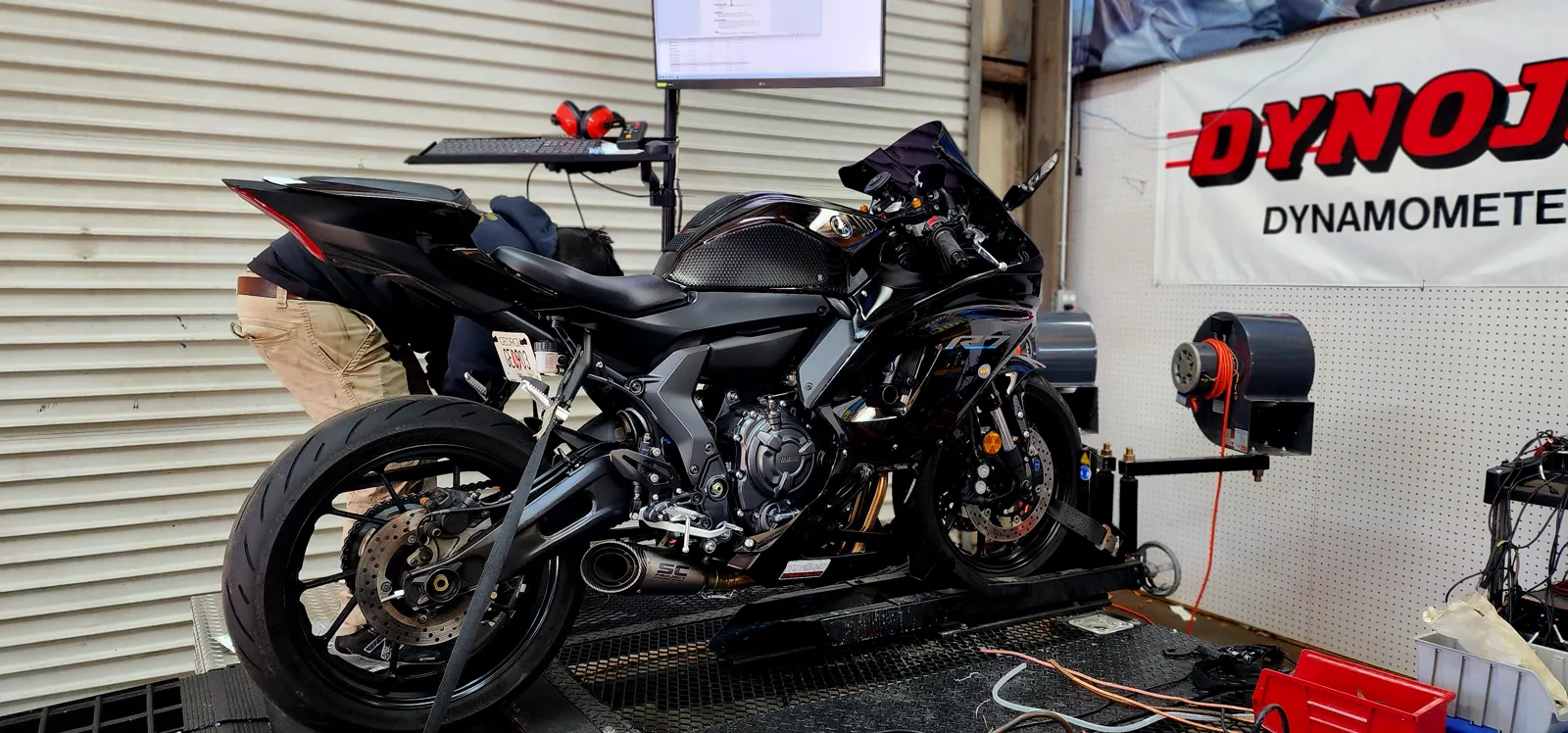
What’s more, a dyno is a heavy roller in the floor with a rear tire strapped down on top of it. So and Better yet, the bike runs in gear and spins that roller. Still, the roller is a known weight, so the machine watches how quickly the engine can speed it up and does the math backward into power. That’s it. No magic. It’s a very honest scale for engines.
While that’s happening, a probe sits in the exhaust and reads the leftovers coming out the back. Those leftovers tell us the air-to-fuel mix the engine was actually running at every point in the pull — not what the factory map claims, what really happened on your bike, with your exhaust, in Georgia air. That reading is the whole ballgame.
Lean, rich, and why your bike feels the way it feels
Lean means too much air for the fuel. The engine runs hot, the throttle feels snatchy, and it may pop on decel or surge at steady cruise. Rich is the opposite — too much fuel for the air. It feels lazy and soft, fouls plugs, smells strong, and drinks more gas than it should. Neither one is a disaster. Both are fixable, and that’s the point.
Bikes drift lean for boring reasons. Factory maps are built to pass emissions and to work everywhere from Denver to Savannah, so they play it safe. Then somebody adds a slip-on, or a real exhaust, or an air filter that flows better, and the engine is suddenly breathing more than the map ever expected. If that’s where you are, here’s what usually causes it in more detail.
A tune changes the instructions, not the hardware. We adjust how much fuel goes in and when the spark fires, across the whole range from a light crack of throttle to a full pull. You feel it as smoothness first, power second. The snatch at small throttle openings goes away. Heat comes down. The bike stops arguing with you in traffic. Most riders notice the manners before they notice anything else.
A dyno doesn't sell you power. It tells you the truth about what your engine is already doing.
The honest answer, without a number attached
We won’t quote your bike sight-unseen, and we’d be a little suspicious of anyone who would. Not because we’re being cagey — because the honest answer depends on things we can’t see through a phone. Here’s what actually has to be known first:
- What’s already been changed. Exhaust, filter, cams, gearing, anything internal.
- Whether your ECU can be flashed directly, or whether it needs a piggyback controller like a Power Commander.
- How the bike is running right now — a healthy engine tunes fast, a tired one tells on itself in the first pull.
- What you want out of it. Smooth street manners and better heat control is a different job than chasing everything the engine has.
- Access. Some bikes hand you the ECU in two minutes. Others want the tank, the tail, and half the fairing off first.
That last one surprises people, so it’s worth sitting with. On some sportbikes we’re pulling body panels and lifting the tank before a single wire gets touched. On a bagger, we may be into the seat and side covers. That’s real labor before the tuning even begins, and it’s why two bikes with identical goals can be very different jobs. It’s the same reason a plumber charges differently for a pipe in the open than a pipe behind drywall.
THE SHORT VERSION
Parts are usually the small half. Access and dyno time are the big half. Any shop that quotes you without knowing your bike’s access is quoting the parts and hoping.
This is the point where a lot of riders make the wrong call. They take the fastest number they hear on the phone, drop the bike off, and get a canned map loaded in twenty minutes with no pulls run and no readings taken. That’s not a tune. That’s a file transfer. It might even feel better than stock for a week. But nobody ever checked what your engine was actually doing, which was the entire reason to come in.
What makes one job bigger than another
Think of it as three dials. Each one can be small or large, and they stack.
| The dial | Small job | Bigger job |
|---|---|---|
| Access | ECU reachable under the seat | Tank and body panels off first |
| Hardware | Stock or a simple slip-on | Full exhaust, cams, or internal work |
| Method | Direct ECU flash | Piggyback controller wired and mapped |
| Goal | Smooth, cool, honest street map | Chasing the top of the range |
Health matters too. If the bike shows up with a stretched chain, a worn sprocket, a clogged filter, or plugs that have seen better days, we’re going to say so before we tune. Mapping around a mechanical problem just teaches the computer to hide it. Fixing the basics first usually makes the tune shorter, which is the rare case where more work up front means less time on the dyno.
Riding style shapes it as well. If you spend most of your miles on the Silver Comet Trail side of town running errands and short hops, your bike lives in the bottom third of the throttle, and that’s where the tune should be sharpest. If your favorite Sunday is Burnt Hickory out toward Sheffield WMA and High Shoals Falls, the middle and top of the range matter more. Same machine, different priorities, honestly different amounts of time on the drum.
How we actually run the job
Nothing here is a secret. Here’s the whole process, in order, so you know what your bike is doing while you’re at work.
- We talk first. What’s changed, what bugs you, what you want it to feel like.
- Health check. Plugs, filter, chain and sprocket, leaks, and anything that would throw the numbers off.
- Baseline pulls. The bike goes on the drum and we run it as it sits, with the probe reading the exhaust.
- We read the data with you if you’re around. Lean spots, rich spots, and where the factory map got nervous.
- Mapping. Flash the ECU where we can, or wire and map a Power Commander where that’s the better path.
- Pull, adjust, pull again. This is the part that takes time, and it’s the part that’s worth it.
- Final pulls and a road check, because a drum and a real road are cousins, not twins.
- You get the sheet. Before and after, in writing, no interpretation required.
Doing it in-house is the difference. We’re not shipping your ECU somewhere and waiting on a file. The dyno is in the building, so a change and a check are minutes apart instead of days. That’s how our crew approaches it, and it’s also why we can stop mid-job, call you, and say the honest thing if we find something unexpected.
Mableton riders, specifically
South Cobb has the widest spread of bikes we see anywhere in our radius, and it changes what a tune is for. Out in Vinings Estates, the garages hold well-optioned baggers and European bikes — BMW, Ducati, Triumph, KTM — that get ridden hard on good weekends and parked clean. Over in Providence, it’s a similar story with a little more everyday mileage on it. Along the Nickajack Road corridor and the older streets around it, we see higher-mileage cruisers and sportbikes that have earned every mile.
Then there’s the commuter crowd, and Georgia gives them no favors. Lane splitting and filtering are both illegal here, so on I-20 just south of town your bike sits in the same jam a car does, at the same temperature, for the same twenty minutes. A hot, lean, snatchy engine is miserable in that. A properly mapped one is calm. That single change is why plenty of our tuning friends came in for power and stayed for the manners.
Heat and air matter here in a real way. Summer afternoons out past Charlie Brown Field at Fulton County Airport are thick, and pollen season from mid-March into late April coats everything and loads up air filters right when riding season starts. A bike mapped on a cool spring morning behaves a little differently in August. That’s normal physics, not a flaw, and a good map leaves room for it.
Here’s the thing we wish every rider knew a season earlier: a tune is diagnosis before it’s performance. Riders spend a whole summer chasing a hot-running, surging bike with parts, when one afternoon on the drum would have shown them exactly what the engine was doing. The dyno finds the problem and fixes it in the same visit. That’s a rare thing in this line of work.
Distance is easy from your side of town. You’re about 13 to 16 miles out, call it 25 to 35 minutes up South Cobb Drive through Smyrna into Marietta, then east on Roswell Road to Barnes Mill Road. You’ll pass Hellbender Harley-Davidson on South Cobb Drive on the way, which markets to Mableton and does good Harley work. The difference is scope. They’re brand-locked. Your street might have a Road Glide, an R6, and a twenty-year-old metric cruiser on it, and all three end up on the same dyno here.
How to avoid surprises entirely
Call and tell us what’s on the bike. Send pictures of the exhaust if you’re not sure what it is. We’ll tell you which path your model takes — flash or piggyback — and what the access looks like before you ride out. After the baseline pulls, you get the real scope with nothing hidden, and you decide from there. Nobody starts mapping without a yes from you.
Riding is safer and cheaper when the machine does what you expect, which is the quiet argument for all of this. NHTSA crash data keeps pointing at rider control and machine condition as things that matter, and a bike that surges at the wrong moment isn’t helping you. If you like reading around the topic, here’s what Marietta riders run into and a longer look at what the work covers.
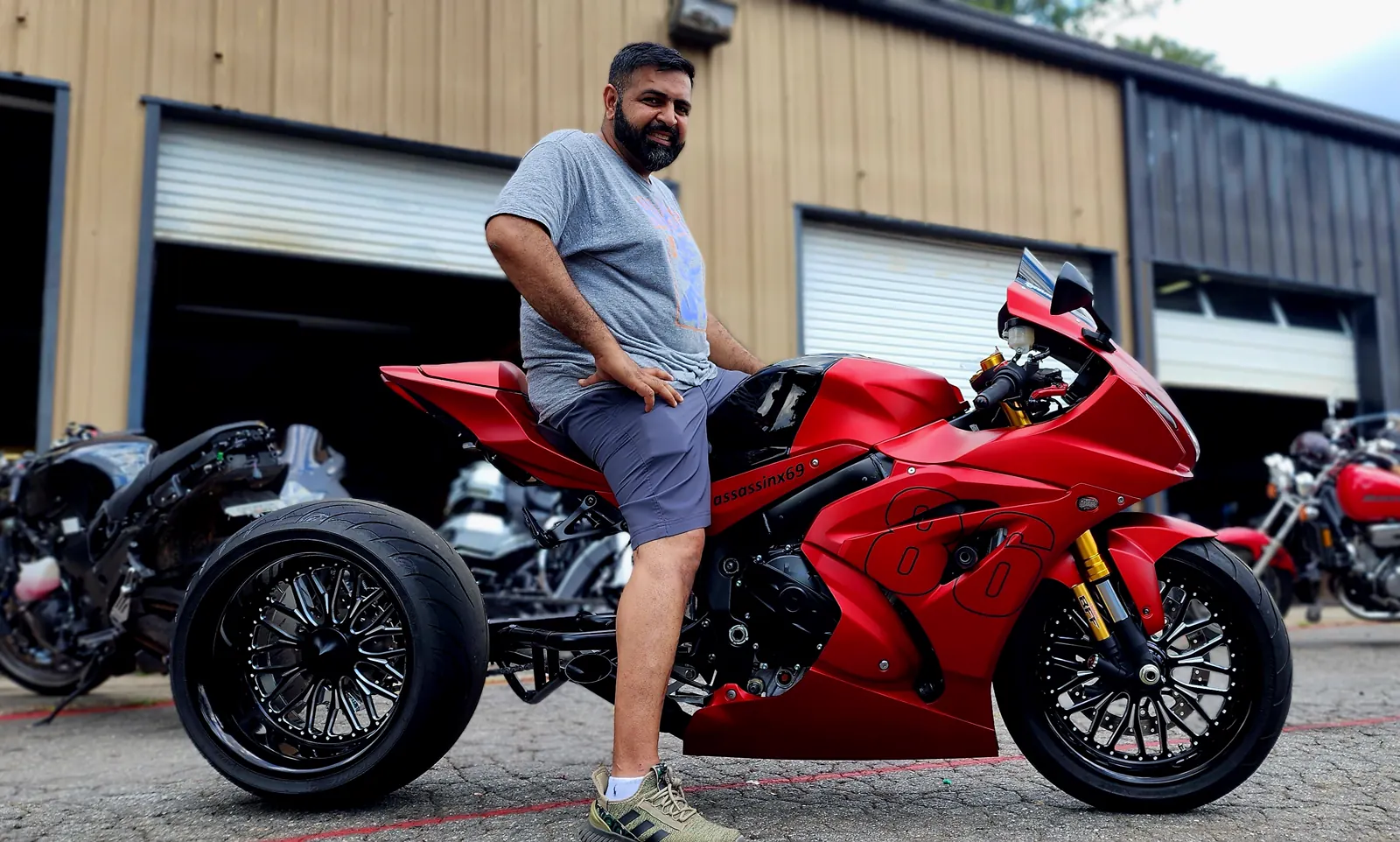
When it’s done right, the payoff isn’t a bragging number. It’s a bike that starts clean, idles steady, pulls without a hitch off idle, runs cooler in traffic, and stops making you think about it. You get your attention back and spend it on the road instead of the engine. That’s the outcome we’re after every time, and it’s why we’d rather look at your bike than guess at it.
Questions Mableton riders ask us
How do I avoid surprises?
Tell us everything that’s been changed on the bike before you come in, even the small stuff. Then let the baseline pulls do the talking. You get the real scope after we’ve seen the data, and nothing gets mapped until you say go.
Why can't you quote it over the phone?
Because the two biggest factors are invisible from here: how hard your ECU is to reach, and how your engine is actually running. We can tell you which path your model usually takes and what the process looks like. The rest comes after the first pulls.
What makes one tune bigger than another?
Access, hardware, and method. A bike with the ECU under the seat and a simple slip-on is a short job. A bike that needs the tank and panels off, plus a Power Commander wired and mapped, is a longer one. Your goals move it too.
What's included in the work?
A health check first, baseline pulls with the exhaust probe reading, the mapping itself, then pull-adjust-pull until it’s right. We finish with final pulls and a road check, and you leave with the before-and-after sheet in hand.
How long does it take?
Plan on the bike staying with us at least a day. A straightforward flash on a healthy bike can be quicker. Heavy disassembly, a piggyback install, or something we find during the health check can push it into a second day.
Will a tune hurt my engine?
Done properly, it does the opposite. We watch the air-fuel readings the whole time, and a lean, hot-running engine is harder on itself than a well-mapped one. If we ever see something we don’t like mid-job, we stop and call you.
We tune bikes for riders all over the west and northwest metro. Mableton is a short run up South Cobb Drive, and we see plenty of the same faces from Smyrna, Vinings and Cumberland on one side, with Austell, Clarkdale and Powder Springs on the other. Riders come east from Douglasville, Lithia Springs and Hiram, and we’re a quick hop for anyone in Marietta or Fair Oaks. Folks ride out from Atlanta too, since a real in-house dyno is worth the trip.
BRING IT IN AND LET'S LOOK
If your bike runs hot, surges in traffic, or just doesn’t feel like it should, we’d rather see it than guess at it. Tell us what’s on it, ride it up from Mableton, and we’ll put it on the drum and show you exactly what your engine is doing. You’ll leave knowing more about your bike than you did this morning.
470-460-9883Diaz Motorcycles and Service, LLC · 847 Barnes Mill Road, Marietta, GA 30062