Motorcycle Running Lean Canton — How to Fix It
The symptom, the real causes, and the plain-English way we find out which one you've got.
So and Better yet, you don’t have to know what’s wrong. Still, that’s the whole point of having a shop. Plus, you felt something change — a pop on the way down through the gears, a stumble off idle, heat off the header that wasn’t there in April — and you noticed. That’s your job done. Of course, nine times in ten, what you’re feeling is a motorcycle running lean Canton riders end up blaming on bad gas, hot weather, or the bike just getting older. Sometimes it is one of those. Then again, Usually it’s something simpler, and it’s fixable.
The Saturday it stopped feeling right
Even so, here’s a story we hear a lot. Meanwhile, a rider leaves his garage early, rolls out past the golf course at BridgeMill while the sprinklers are still going, and points the bike north. In fact, that said, he’s done this ride a hundred times. Coffee, then the Henderson Mountain Loop — GA-140 out, GA-108, Sam Nelson Road, Little Refuge Road past the lake, then Henderson Mountain Road and home. Forty-some miles of the good stuff.
The first twenty minutes feel normal. Then, coming out of a slow corner, the bike hesitates. Just a beat. He rolls on and it catches up. Ten miles later it does it again, and this time there’s a little pop out the pipe when he closes the throttle. Nothing dramatic. Nothing that stops the ride. But the bike doesn’t feel like his bike anymore, and he spends the rest of the loop listening instead of riding.
By the time he’s back down near Boling Park, he’s built a whole theory in his head. Bad fuel from the last fill-up. Maybe the heat. Maybe he needs a whole new engine. That’s the part we’d like to take off your plate, because a hesitation like that almost never means what riders fear it means. It means the bike is asking for a little more gas than it’s currently getting.
What "running lean" actually means
Your engine wants two things at the same time: air and fuel. Air comes in through the intake. Fuel comes in through the injectors, or through the carbs on an older bike. The engine wants those two mixed at a pretty specific ratio, and it wants that ratio to shift a little depending on what you’re asking for — cold start, idle, cruising, hard pull.
Lean means too much air for the fuel that showed up. Rich is the opposite. Neither is a moral failing on your bike’s part. It’s just a recipe that drifted.
A lean mixture burns hotter and burns faster, and that’s why lean has a personality you can feel from the saddle. Riders describe it in these ways:
- A stumble or flat spot when you first crack the throttle
- Popping or crackling out the exhaust when you close the throttle
- Idle that hunts up and down instead of sitting still
- More heat on your right leg in stop-and-go than you remember
- Surging at a steady cruise, like someone’s tapping the throttle for you
- Hard starting when cold, then fine once it’s warm
None of that means your engine is falling apart. It means the air side and the fuel side stopped agreeing, and something changed to make that happen.
Timing matters too. February and March are our busiest weeks for exactly this, because a motorcycle running lean Canton owners parked back in November is often just a bike whose fuel went stale in an unheated garage. Everything else on it is fine. The gas simply got old while the bike waited.
The usual causes, most common first
We go in this order because that’s roughly how often we find each one. It’s not a guessing game so much as a short list worked from the top down.
- An intake leak. A cracked rubber boot, a loose clamp, a hardened O-ring — anywhere unmetered air sneaks in after the sensor, the bike is getting air it never accounted for.
- What’s more, a fuel delivery problem. A tired pump, a clogged filter, or varnished injectors from a bike that sat all winter. Same result: not enough fuel arriving.
- An exhaust or air filter change without a tune. A slip-on and a fresh filter move a lot more air. The stock fuel map doesn’t know that happened.
- A lazy or contaminated oxygen sensor. It reports the wrong thing, and the bike obediently trims fuel the wrong direction.
- Gummed-up carbs on an older bike. Ethanol plus a cold garage plus five months of sitting is a recipe for tiny blocked passages.
- A stock map that was always a little lean from the factory, and finally got noticed.
That last one surprises people. Plenty of bikes leave the factory running lean on purpose to pass emissions testing. It’s legal, it’s normal, and it’s also why some brand-new bikes have a snatchy throttle right out of the crate.
Most people stop reading here. That's the expensive mistake.
They’ve got a name for the symptom now, so it stops feeling scary, and the bike goes back in the garage until next weekend. We get it. Nothing broke, nothing’s leaking, and the ride still happened. But a lean condition doesn’t sit still. It’s a heat problem wearing a performance problem’s clothes.
Over months, extra combustion heat is hard on valves, on spark plugs, and on the top end generally. A small intake leak also tends to get bigger as the rubber keeps hardening. The good news is that catching it at the stumble stage is cheap in time and easy in parts. Catching it later is neither.
So can you still ride it?
Usually, yes. Here’s the honest line we draw for friends we’ve helped.
Ride it, but get it looked at soon, if the symptom is a small stumble, some decel popping, or a slightly restless idle, and the bike otherwise pulls clean. Short local trips are fine. A run down to grab lunch is fine. Riding it gently to us is fine.
Don’t ride it if the bike is pinging or rattling under load, if the temperature gauge climbs past where it normally sits, if it stalls in traffic, or if it won’t hold an idle at all. Those are the versions where heat is already winning, and a trailer is cheaper than a top end. Save that big mountain run for after.
THE HONEST TEST
Does it pull cleanly to redline in third with no rattle, no ping, and no surge? If yes, you’ve got time. If no, park it and text us. We’d rather talk you through it for free than meet your engine later.
Your options once you know
There are basically three roads from here. First, fix the fault and leave the bike stock — perfect when the cause is a split intake boot or a dying pump, because the factory map was fine all along. Second, fix the fault and add a fuel controller like a Power Commander, which lets us add or subtract fuel where the bike needs it. Third, flash the ECU itself, which reaches deeper into the bike’s own brain and changes fueling, timing, rev limits and throttle response at the source. We wrote up the tradeoffs between them if you want the long version.
Which road you take depends on your bike, your parts, and honestly what you want out of the thing. A bagger that lives on GA-372 heading northeast toward Ball Ground wants smooth low-end and cool running in traffic. A sportbike that gets ridden hard wants a clean midrange. Those are different tunes, and both are legitimate.
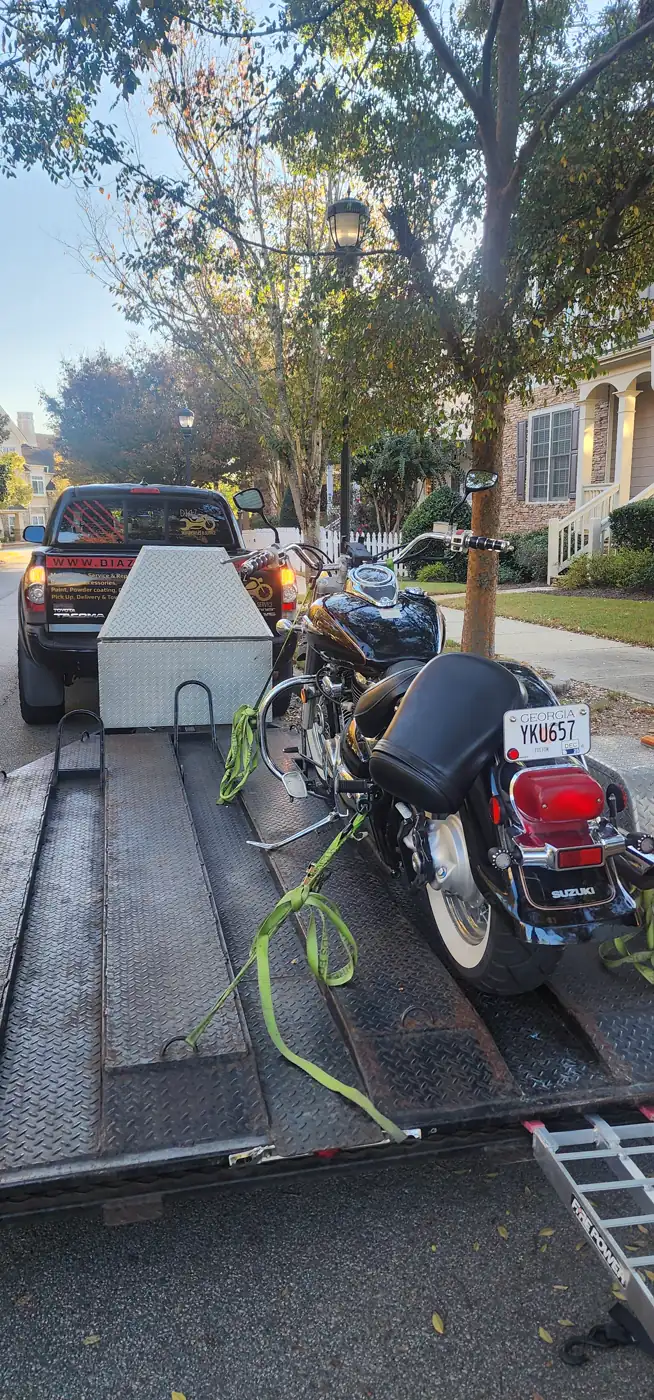
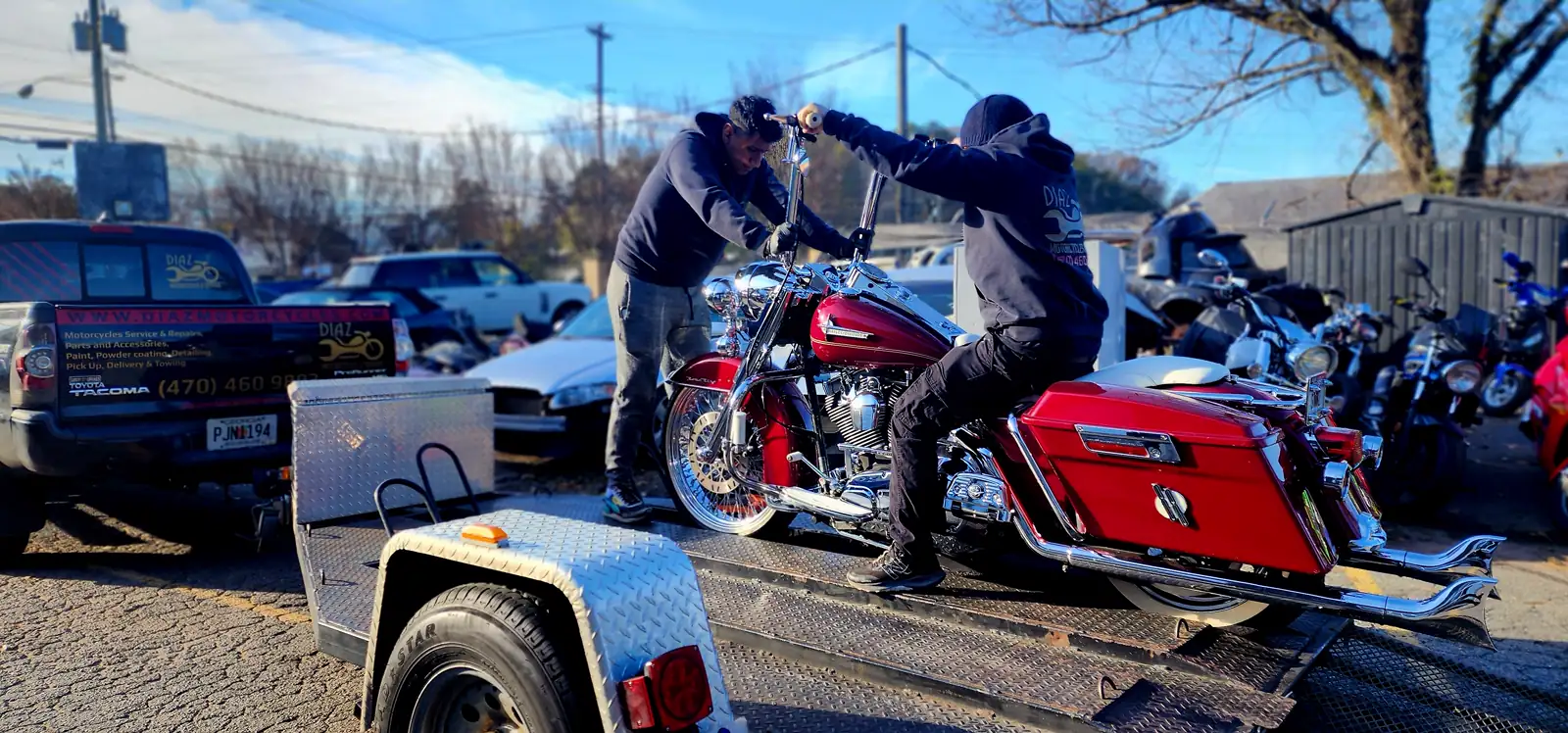
One thing to know about this corner of Cherokee County: routine service is well covered. RideNow Powersports Canton over on Riverstone Parkway does a lot of oil changes and tires, and they’re the default for most folks. What’s thin around here is custom mapping — an actual in-house dyno with someone who tunes on it every week. That’s the gap we fill, and it’s the reason riders make the trip. Here’s how our crew approaches it.
How we decide — and what a dyno actually measures
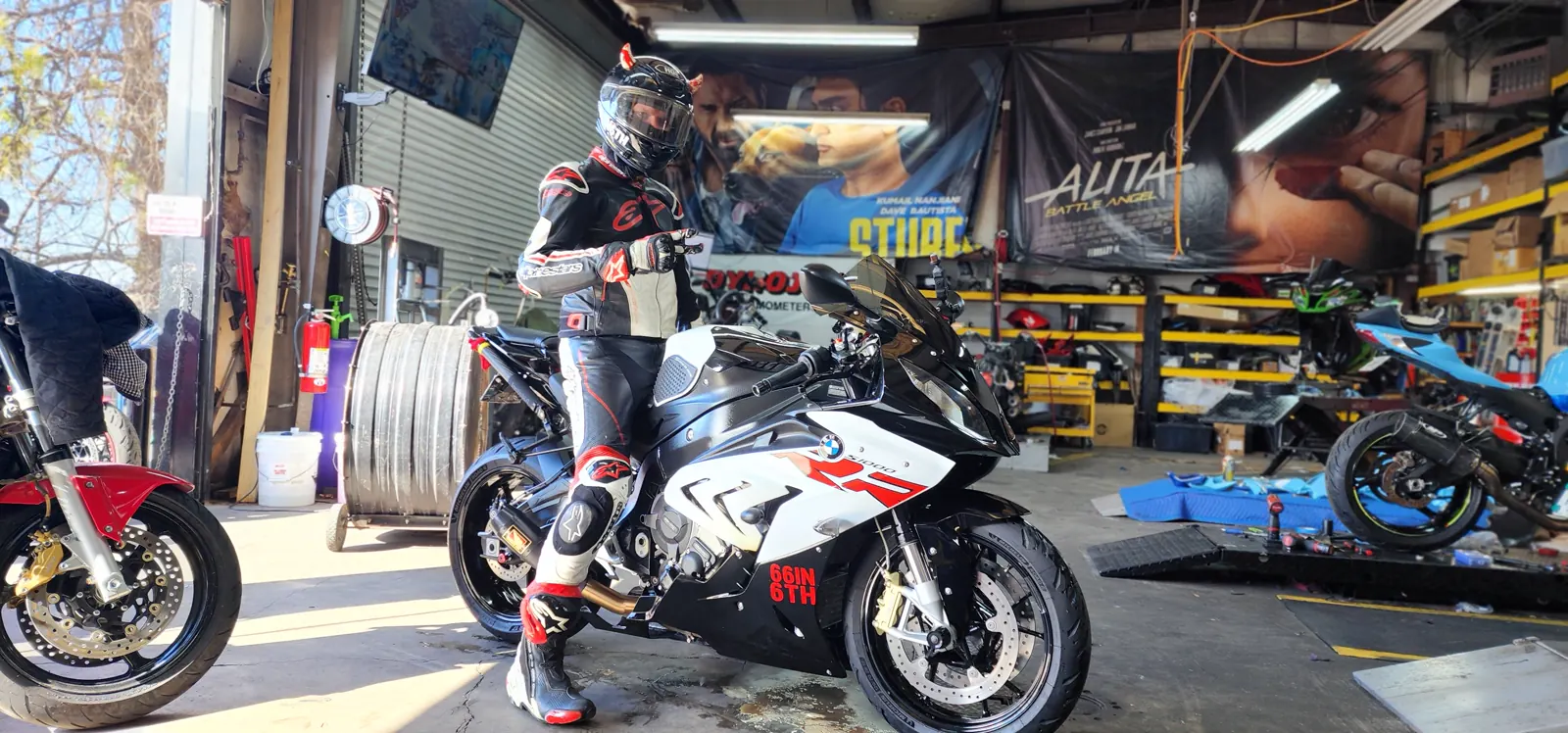
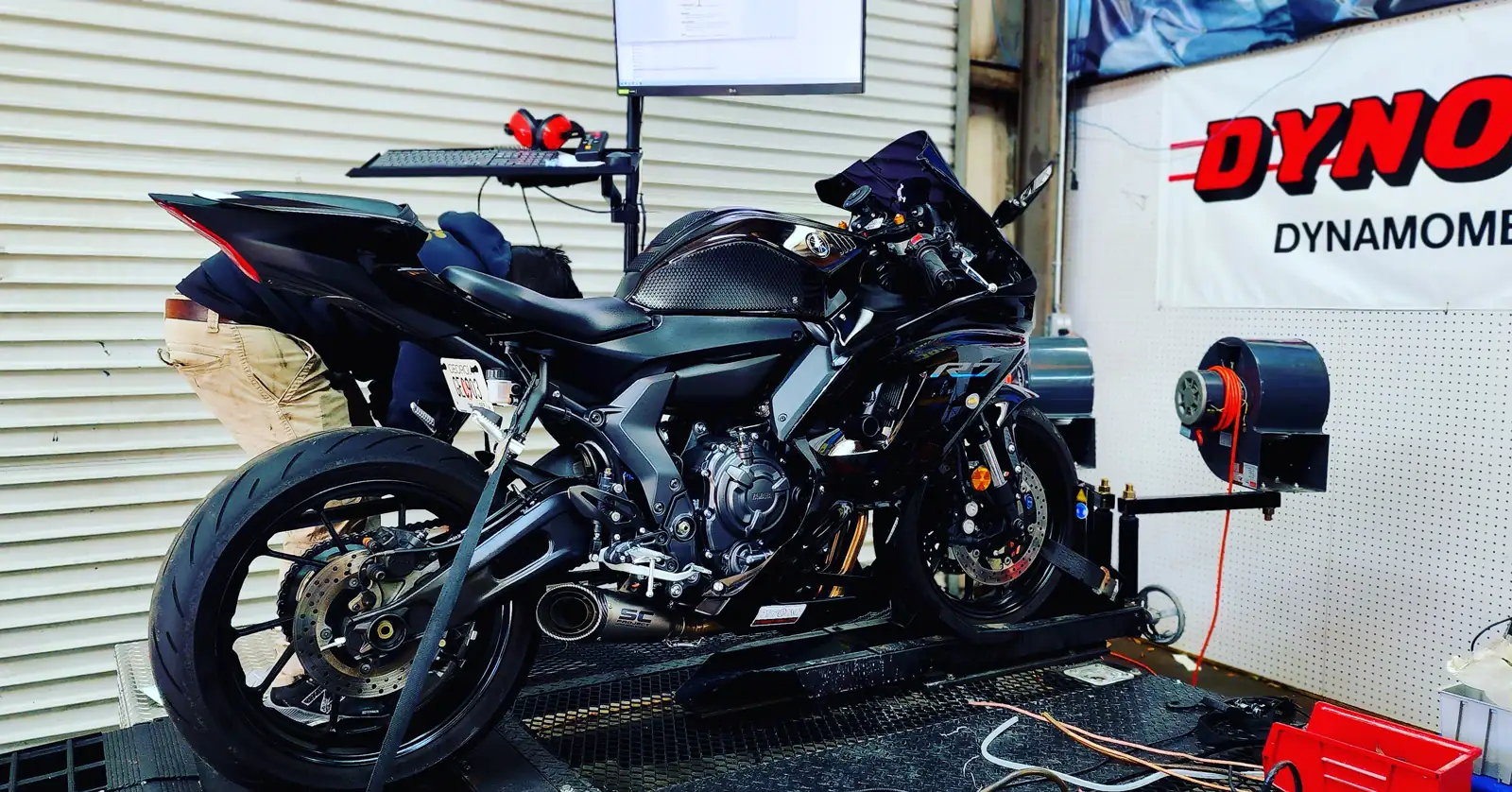
A dyno is a big roller in the floor. Your rear wheel sits on it, the bike gets strapped down tight, a fan blows air over the radiator, and a sensor goes in the exhaust. Then we run the bike through the gears while it stays right where it is.
The roller has known weight. By measuring how quickly your bike spins it up, the dyno works out how much force the engine is really making at every single rpm — not a number from a brochure, but from your bike, with your exhaust, on this particular day. At the same time the exhaust sensor reads the air-fuel ratio hundreds of times through the pull. That’s the part that matters for lean. We can see exactly where the mixture goes thin, and whether it happens at 3,000 rpm on a light throttle or only up top at full send.
That’s the whole trick. A road test tells us the bike feels wrong. The dyno tells us where and when. Then we change the fuel in that spot, run it again, and check our work. Riders down in Fulton deal with the same thing on a different bike — here’s how this plays out in Alpharetta — and the method doesn’t change from city to city.
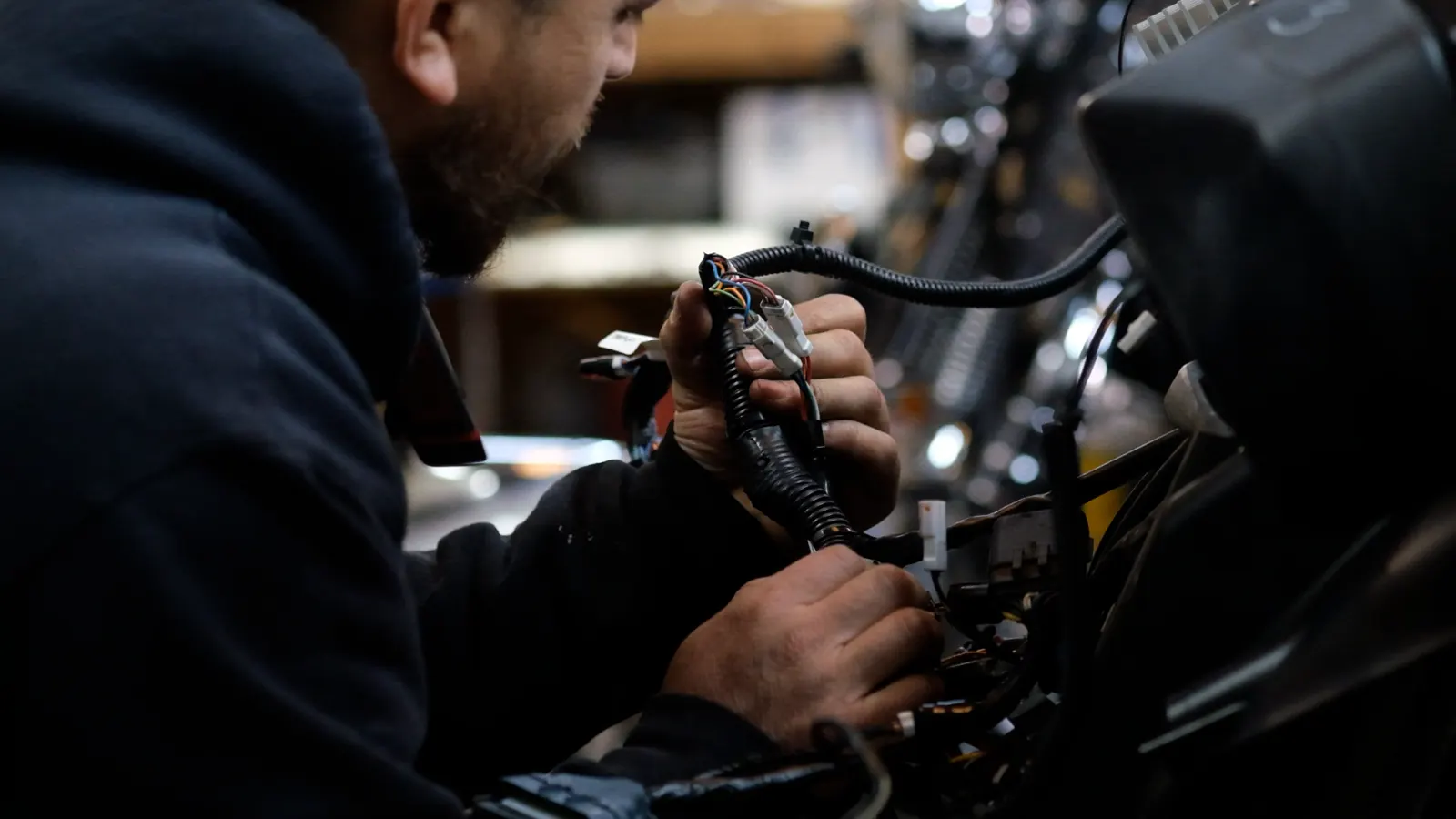
The last piece is the one people underestimate. It isn’t the map. It’s the stuff we check before we ever write one — plug condition, valve clearances if they’re due, air filter, fuel pressure, and whether the bike holds a steady reading at idle. Tuning a bike with an intake leak is like tuning a guitar with a cracked neck. It’ll hold for about a day.
We also ask about your tires, because a worn or badly cupped rear behaves oddly on the roller and tells us how you actually ride. If yours are getting close, Michelin’s motorcycle tire resources break down the wear patterns. And since I-575 keeps getting worked on, a look at Georgia DOT before a long day out saves you some steel plates and gravel.
What it feels like after
Riders always describe the same three things. The throttle stops being snatchy at small openings, so slow-speed stuff gets easy — parking lot turns, the walking-pace crawl through Etowah River Park on a festival afternoon, filtering out of a driveway in one of the townhome pockets like Overlook at Sixes Road, Holly Commons, The Villages at River Pointe, Hidden Green, Cypress Springs or Stonegate. Second, the decel popping quiets down. Third, the bike runs cooler in traffic, which your right leg notices in July.
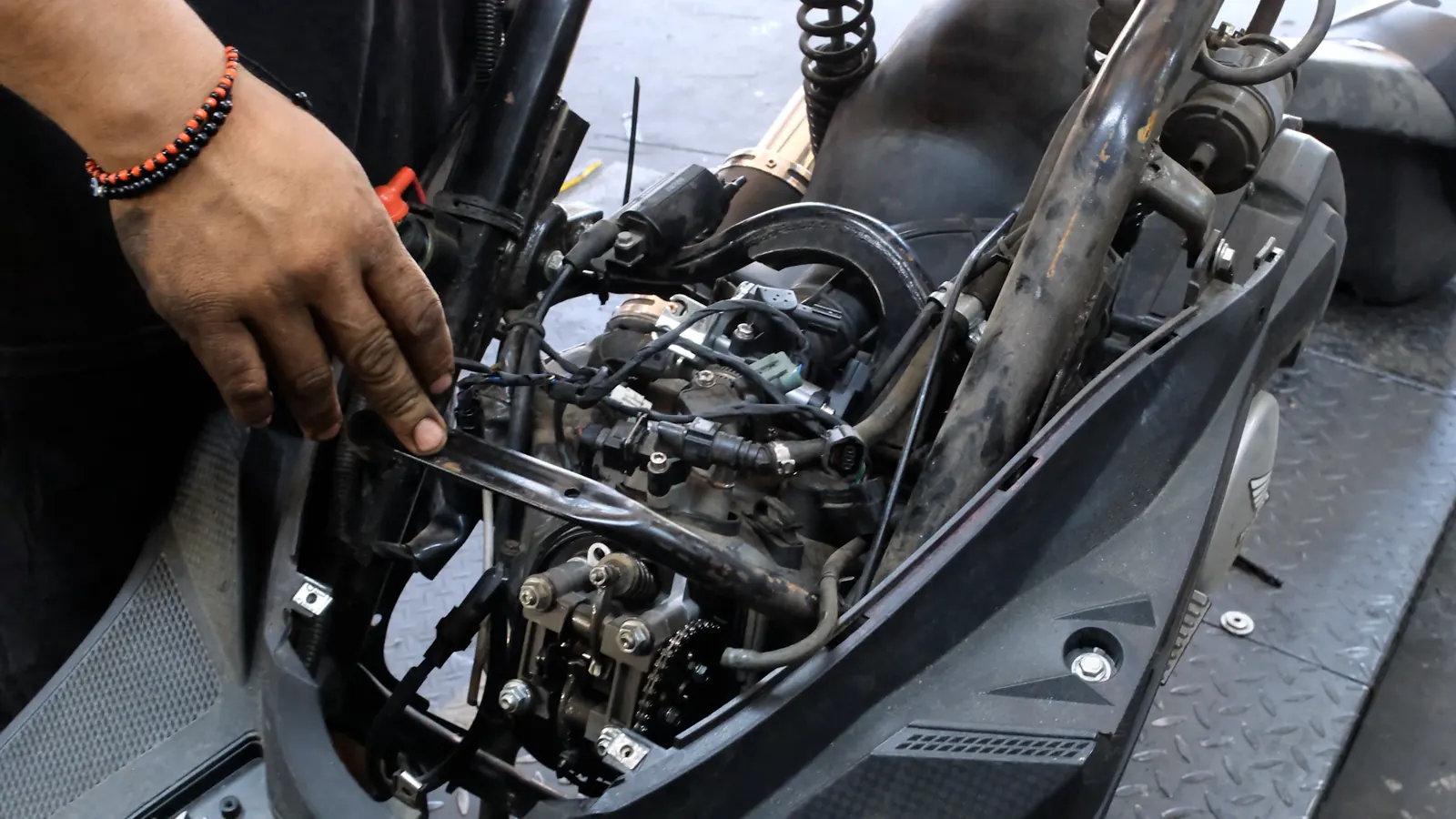
A friend of ours who keeps a bagger out near Woodmont Golf & Country Club put it best. He said the bike stopped arguing with him. Same engine, same exhaust, same rider — just a recipe that finally matched the ingredients. If you want a fuller picture, here’s what that service actually involves.
Where this leaves you
You started this page not knowing what was wrong. Now you know the symptom has a name, you know the short list of causes, you know when it’s fine to ride and when it isn’t, and you know how anyone worth trusting would go about finding the answer. That’s not a small thing. That’s you walking into a shop able to ask real questions.
You’re already heading down 575 most mornings anyway, so dropping the bike with us is barely a detour. Bring it in the morning, tell us what it feels like in your own words, and let the roller do the rest. Then go ride the loop the way you meant to.
Questions Canton riders ask us
Can I fix a lean condition myself?
Some of it, yes. Anyone can check an air filter, look for cracked intake boots, and swap a fuel filter with basic tools and a service manual. What you can’t do at home is measure the air-fuel ratio through the whole rev range under load. That part needs a dyno and a sensor, so most riders handle the easy checks and let us handle the mapping.
Will it get worse if I leave it alone?
Usually, slowly. The root causes tend to grow — rubber keeps hardening, filters keep clogging, injectors keep gumming up. Meanwhile the extra heat works on your plugs and valves the whole time. It rarely goes from fine to failed overnight, but it almost never fixes itself either.
How urgent is this really?
If the bike still pulls clean with no rattle or ping, you’ve got weeks, not days. Ride it locally and book when it suits you. If it’s pinging under load, running hot, stalling, or surging badly at cruise, treat it as a this-week problem and take it easy getting to us.
What happens if I just ignore it?
Best case, you spend a season with a bike that’s less fun and a little thirstier than it should be. Worse case, sustained heat takes out plugs, then valves, and a small fuel job turns into engine work. The fix is far simpler while it’s still just a stumble.
How do you actually find the cause?
We start with a conversation and a road test so we can feel what you’re feeling. Then come the mechanical checks — leaks, filter, fuel pressure, plugs. Finally the bike goes on the dyno with a sensor in the pipe, and we watch the air-fuel ratio across every rpm. By then the cause isn’t a theory, it’s on the screen.
Do I need a Power Commander or an ECU flash?
Not always. If your bike is stock and the cause is a leak or a dying pump, fixing the fault is the whole job. Fuel controllers and ECU flashes matter most once you’ve changed the exhaust or intake, or when the factory map was lean to begin with. We’ll tell you honestly which camp you’re in.
We tune bikes for riders all over the north side, and plenty of them come down from Cherokee County. Along with Canton, we regularly see bikes from Woodstock, Holly Springs, Ball Ground, Waleska, Free Home and Nelson, plus riders coming south out of Jasper before the mountains. West of the interstate we get folks from Acworth, Cartersville and Kennesaw, and from the east side we see Alpharetta riders often. Our own doors are in Marietta, which makes us an easy stop on a route most Cherokee County riders already drive.
BRING IT IN, WE'LL FIND IT
If your bike has that stumble, that pop, or that extra heat, you don’t need a diagnosis before you call — that’s what we’re for. Text or call us, tell us what it feels like in plain words, and we’ll tell you whether it’s a ride-it-easy situation or a trailer-it situation. Canton riders make this trip all the time, usually on a morning they were driving south anyway. Then we get you back on the loop with a bike that finally does what your wrist asks.
470-460-9883Diaz Motorcycles and Service, LLC · 847 Barnes Mill Road, Marietta, GA 30062