Dyno Tune vs Stock Canton — Which Is Right
Two honest options, one clear recommendation, and the exact situation where leaving your bike alone is the smarter call.
Still, you are rolling north out of town on a cool Saturday, coffee still warm in you, third gear, no traffic yet. Plus, you crack the throttle and the bike hesitates. Just a beat. Of course, it catches, pulls clean, and you tell yourself you imagined it. Two lights later it does the exact same thing. Then again, that tiny stumble is almost always the bike telling you something about how it is being fed fuel and air, which is why so many riders end up weighing a dyno tune vs stock Canton style, right there in the garage with a cup of coffee and a phone full of forum posts.
Good news first. That hesitation is rarely scary. Even so, it is not a dying engine or a cooked transmission. Meanwhile, it is usually a fueling story, and fueling stories have fixes. Our job here is to lay out both real choices, say who each one is right for, then give you a straight answer instead of a shrug.
What that stumble is actually telling you
Your engine wants a specific mix of air and fuel. Too little fuel for the air coming in and we call it lean. Too much and we call it rich. Lean feels like a flat spot, a surge at steady speed, popping on decel, and extra heat at a stoplight. Rich feels lazy and soft and can foul plugs. Neither means your bike is broken. Both mean the fuel map does not match the air your engine is really breathing.
Riders notice it in specific places. A buzz at steady highway speed on 575. And a hitch off idle in a parking lot. A hot leg creeping between lights on the Riverstone Parkway retail district run along GA-5. Those are not three problems. Usually they are one problem showing up in three situations.
Why bikes leave the factory this way
Here is the part nobody mentions at the dealership. Your bike was not tuned for you. It was tuned for a compliance target and a worldwide average. The factory has to pass emissions rules, sell the same model in wildly different climates, and assume any fuel might go in it. So the safe move is a map that runs lean in the cruise range and conservative everywhere else.
Then the bike gets to Georgia. Summer air here is thick and wet. Winter air is thin and dry. Our pump gas has ethanol in it. And plenty of riders add a slip-on exhaust or pull a restrictive air filter because it sounds better, which changes how much air moves through the motor without changing a single number in the computer telling it how much fuel to add. That mismatch is where the stumble lives.
None of this is a defect. It is a compromise, and compromises are fine right up until you feel one. If you have never felt yours, that matters, and it is the whole basis of our recommendation.
What a dyno actually does
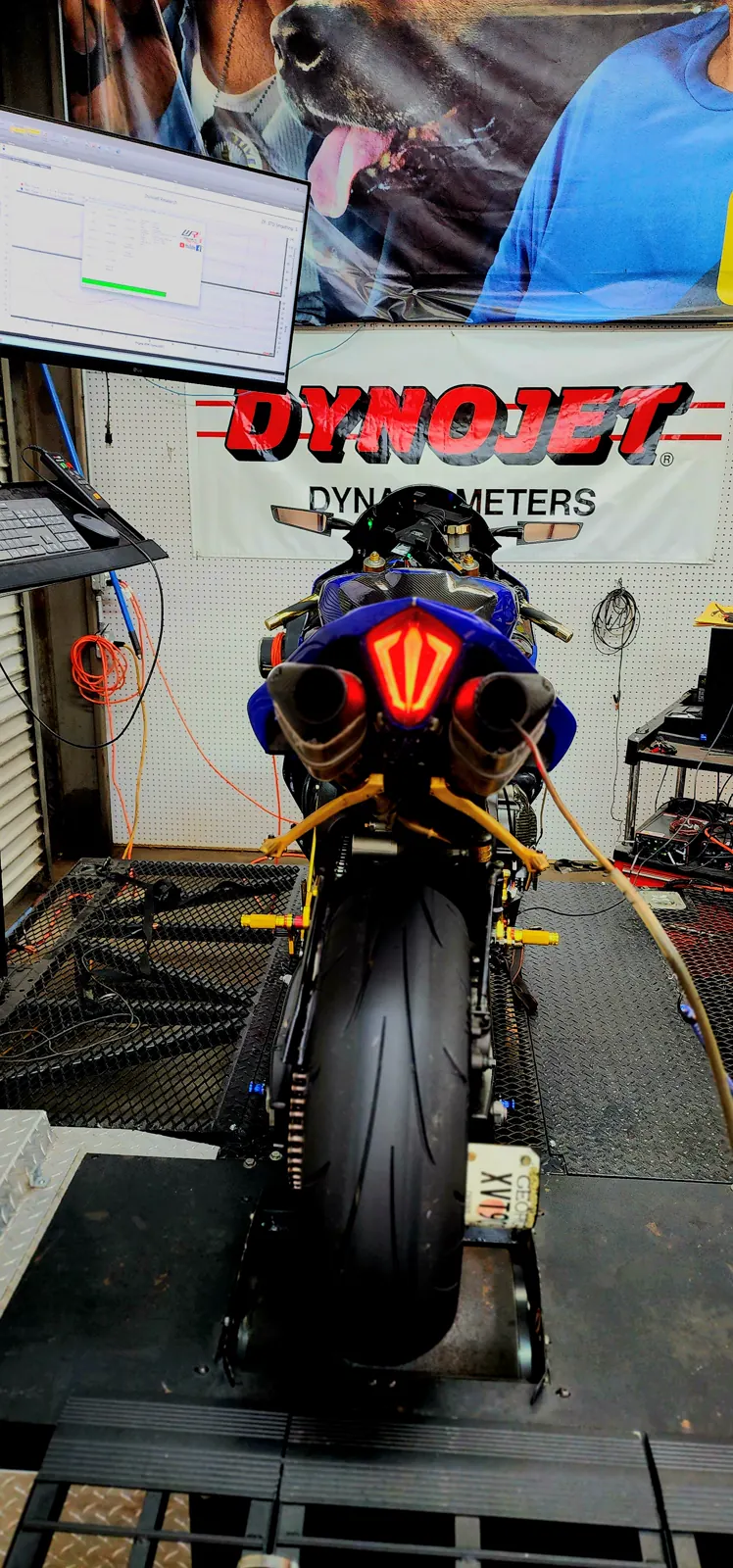
A dyno is a big steel drum in the floor. Your bike gets strapped down on top of it, the rear tire spins the drum, and the drum measures how hard your engine is pushing. That is it. It is a scale for effort. Nobody is racing anything and nobody is beating on your bike.
While the drum measures effort, a small probe in your exhaust reads the leftover oxygen coming out. That tells us, moment by moment, whether the engine got too much fuel or not enough at that exact throttle position and rpm. So we end up with your motor’s real behavior instead of a factory guess. Every hesitation you have been feeling shows up as a dip on the screen, and there is something deeply satisfying about watching a mystery turn into a squiggly line you can point at.
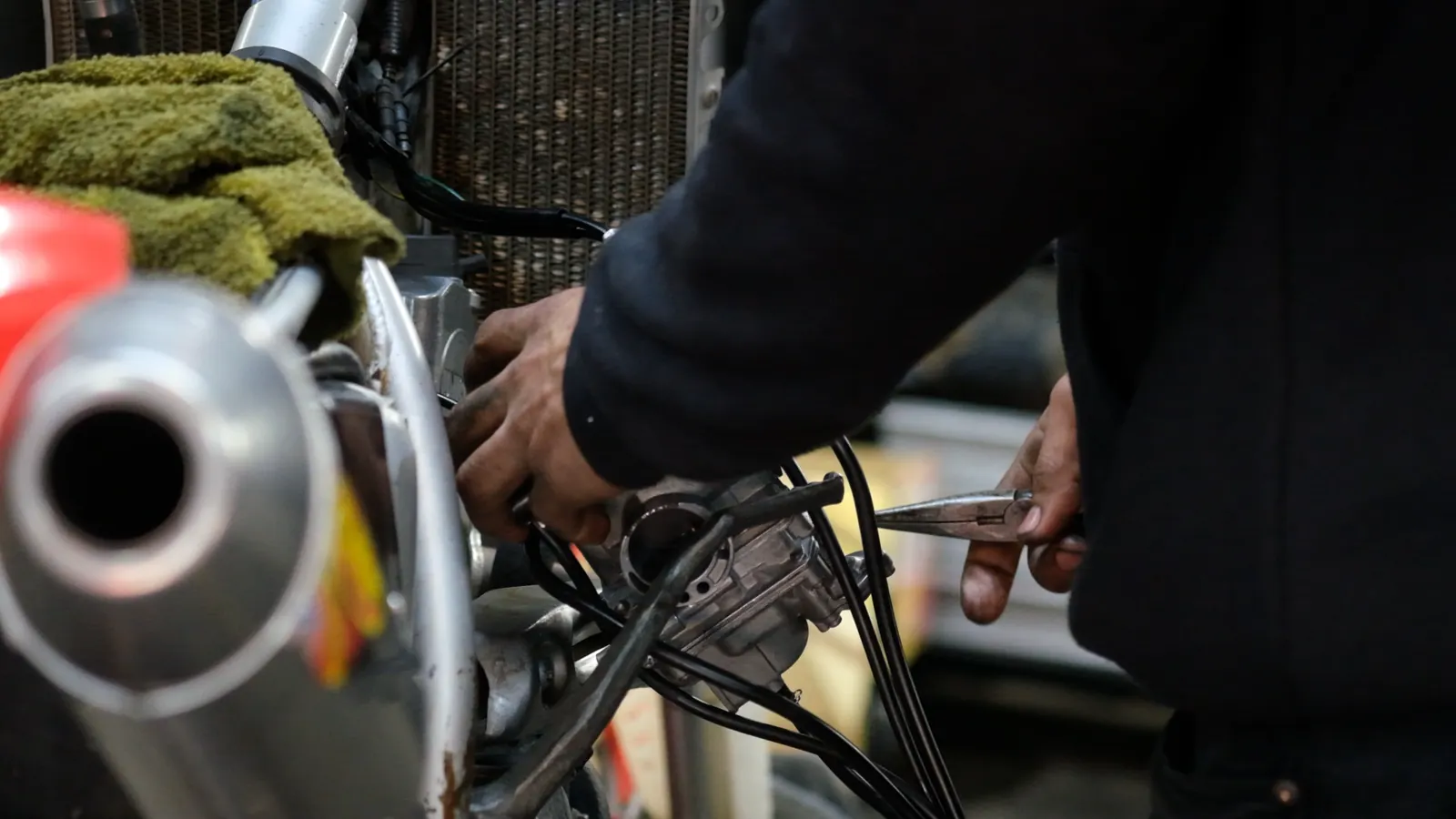
From there we change the numbers. On a modern fuel-injected bike we either flash the ECU, which is rewriting the bike’s own computer, or we add a Power Commander, which is a small unit that sits between the sensors and the injectors and adjusts fuel on the fly. On older carbureted bikes there is no computer at all, so the fix is physical: jets, needles, float height, air screws, all dialed by hand and confirmed on the drum. If you want the deeper version, we wrote the full rundown on it, and there is also a page covering what that service actually involves start to finish.
PLAIN ENGLISH
Stock is a map written for everyone. A tune is a map written for your bike, your exhaust, your air filter and the air we actually breathe here.
But here’s what most riders get wrong about this. They think a tune is about peak power. It usually is not. The part you feel every single day is the bottom and middle of the throttle, and that is where a good map does its quiet work. Smoother pull off a stop sign. No surge when you hold steady speed. Less heat in traffic. Cleaner engine braking so the bike does not shove you when you shut the throttle in a corner. Peak numbers are the least interesting thing on the sheet.
Option one: leave it stock
Stock is a legitimate choice and we will say so out loud. If your bike is completely unmodified, still under warranty, runs clean through every gear and never gets hot in traffic, there is nothing here that needs fixing. A tune on a healthy stock bike is a small refinement, not a rescue. Many riders will not feel enough difference to care.
Stock is also right if your riding is short and gentle. Plenty of folks in the master-planned neighborhoods here put a couple thousand miles a year on a garage-kept cruiser, mostly smooth roads and nice weather. That bike is not being asked hard questions.
Stock is genuinely right for you if
- Your bike is bone stock with the factory exhaust and air filter still in place
- You are in the first stretch of a factory warranty and would rather not have that conversation
- You ride mostly short, easy miles and the bike feels fine every time
- You are about to sell it and the next owner can make their own call
- The bike has a mechanical issue that needs sorting first, because tuning around a problem never works
Option two: get it tuned
A tune earns its keep when something has changed, and on most bikes we see, something has. A slip-on changes how easily air leaves. A high-flow filter changes how easily air enters. Even miles change things, because a settled-in engine does not breathe like a new one.
A tune also earns its keep when the riding is demanding. Ride to a mountain road and elevation changes the air on you. Sit in real traffic and heat becomes the story. Load a passenger and a weekend bag and the motor works in a range it rarely visits. Stock handles all that adequately. A real map handles it well.
A tune is genuinely right for you if
- You changed the exhaust, the air filter, or both
- The bike surges, hesitates or pops on decel and the maintenance is already current
- It runs hot in stop-and-go and you would like your right leg back
- You ride two-up, ride loaded, or ride long days in the mountains
- You want smooth, predictable throttle in corners more than you want a big number
| What you care about | Stock | Tuned |
|---|---|---|
| Bone-stock bike, easy miles | Right call | Small gain |
| Aftermarket exhaust or filter | Mismatched fueling | Right call |
| Heat in traffic | Runs warmer | Usually improves |
| Throttle feel off idle | Factory average | Built for your bike |
| Long mountain days, two-up | Adequate | Noticeably better |
So which one do we recommend
Here is our straight answer to the dyno tune vs stock Canton question. If you have modified the intake or the exhaust in any way, get it tuned. Not eventually, and not after the next riding season. That mismatch is exactly what a tune exists to solve, and every week you ride it is another week of wondering why the bike feels twitchy.
If your bike is completely stock and it feels good, stay stock. We would rather send you home with your money in your pocket and a bike you already like. Come see us when something changes, and something usually does.
Modified the intake or exhaust? Tune it. Bone stock and happy? Ride it. That is the whole decision.
The middle group is stock bikes with a real complaint, and those we look at before promising anything. A stumble can come from a clogged filter, a tired plug or old fuel, and no map fixes a mechanical problem. If the bike is healthy and still feels wrong, tuning is the answer. If it is not healthy, we say so.
Why this decision hits different up here
Canton is the gateway to the North Georgia mountains, and that shapes everything about how bikes get used here. This is the last real services town before the road turns into GA-515 and points at Jasper, Ellijay and Blue Ridge. On a good April or October Saturday, GA-5 north is a parade. Nobody up here is riding a bike that only sees flat pavement.
Take GA-108, which everyone here calls Fincher Road, running north past Lake Arrowhead toward Waleska. That is exactly where fueling shows up in your hands. You change throttle position constantly, working the bottom half of the rev range. A bike with a lean flat spot feels abrupt there. A tuned bike follows your wrist. Push farther and run GA-52 over Fort Mountain, the Ellijay-to-Chatsworth stretch, and elevation stacks on top of everything else.
The other half of local riding is the opposite. Warm-up loops down by Boling Park, where the trails and Etowah River access pull people out on nice mornings, then an easy cruise through town. Short hops like that are where heat and rough idle get noticed most, because the bike never settles into a rhythm.
Roads matter too. I-575 carries heavy truck traffic with grooved pavement and tar-snake patches, and the rural two-lanes pick up chip-seal and gravel wash off the shoulders. That is a surface story more than a tuning story, but the two meet in one place: predictable throttle response makes an unpredictable surface much less stressful. While you are thinking about grip, Michelin’s motorcycle tire resources are a solid read.
Let us tell you about a rider near BridgeMill. He had a bagger he loved, a slip-on he loved more, and a complaint he could not put words to. The bike felt fine on the highway and felt wrong everywhere else. Hot in traffic, jumpy off idle, and it popped coming down off the throttle. He assumed he had broken something with the exhaust swap. So he had not. He had simply given the motor more air without telling the computer about it. On the drum, the dip showed up right where he said it did, low in the range and just off closed throttle. New map, same afternoon. He texted after his next mountain run to say the bike finally felt like the one he thought he bought.
That story repeats. We hear it from Laurel Canyon, where the golf-community garages hold a lot of low-mileage bikes that only come out for good weather, and we hear it from Hickory Flat in the southeast corner of 30115, which has its own identity and its own crowd of riders who treat the mountains as a standing weekend plan. Same bikes, same complaint, same fix.

What the day actually looks like
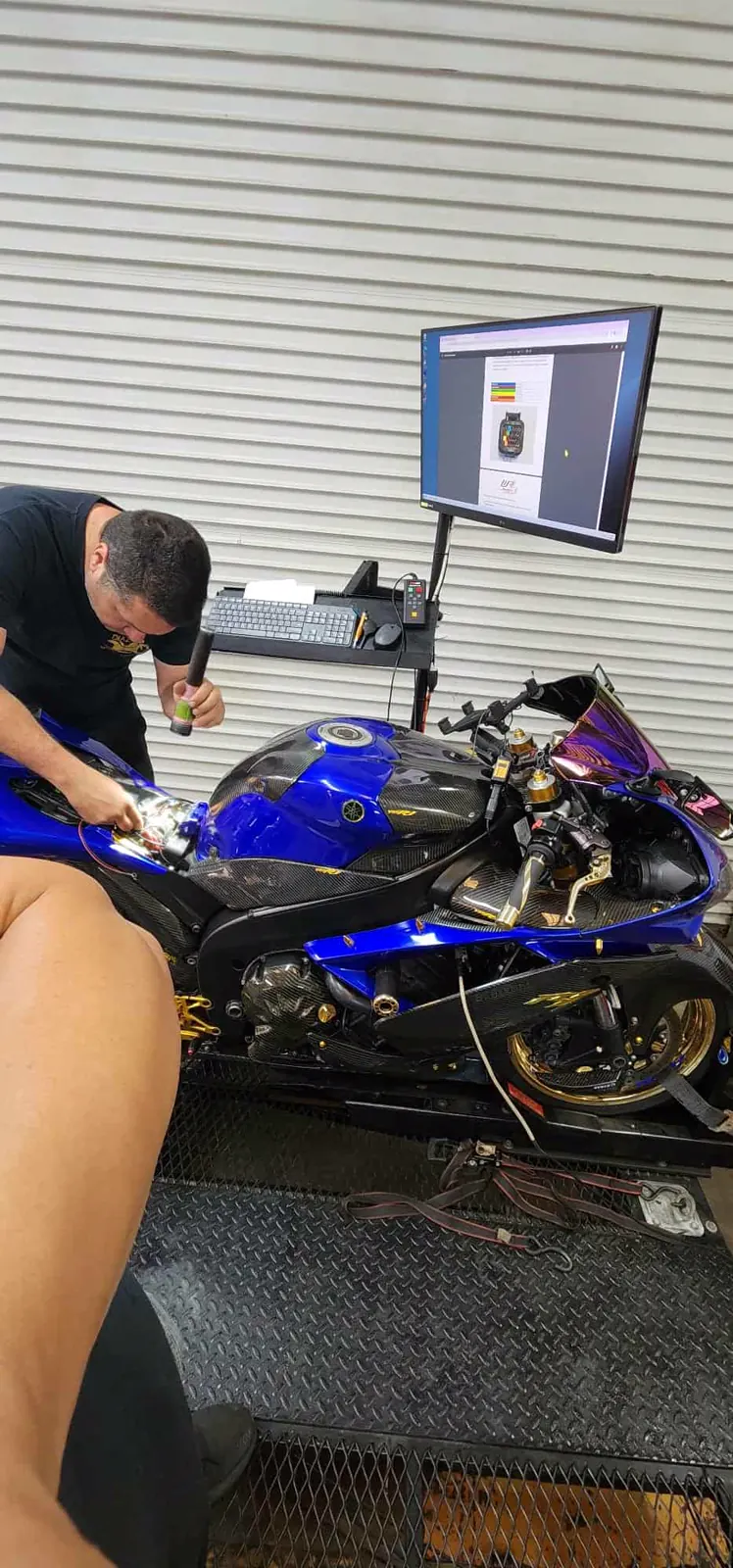
There is no mystery to it. You drop the bike off. We go over the basics first, because a tune sitting on top of a worn plug is wasted work. Then the bike goes on the straps, the probe goes in the pipe, and we run it through its range while the software records what the motor is doing. We change numbers, run it again, and keep going until the line looks right across the whole range, not just at the top.
Fuel-injected bikes get an ECU flash or a Power Commander depending on the model and what you want out of it. Carbureted bikes get hands, jets and patience. Either way you leave with a bike mapped to itself. That is what we take care of here, and it is the same process riders over in Atlanta come to us for.
We know Cherokee County riders already drive for everything. You run to Woodstock, Kennesaw and Alpharetta without a second thought, and there is a Suzuki dealer over at Bartow Powersports in Cartersville if west is your direction. Coming south down 575 and cutting east through East Cobb is the same kind of trip you already make. For general reading between now and then, RevZilla’s Common Tread is worth your time.
How it feels afterward
Here is the honest outcome. You will not walk out feeling like you bought a different motorcycle. You will notice the annoyances are gone. The hitch off idle disappears. The cruise-speed surge flattens. Your leg is cooler at a long light. The throttle stops feeling like a switch and starts feeling like a dial, which is what riders mean when they say a bike feels sorted.
That is what the whole comparison comes down to. Stock is a fine place to be until something changes. Once it changes, a tune is not a luxury, it is finishing the job you started when you bolted on that pipe. Either way, you deserve a bike that behaves the same way twice, and that is a very fixable thing.
Questions Canton riders ask us
Which one should I pick?
If you have changed the exhaust or the air filter, pick the tune. That change is exactly what a tune is for. If your bike is completely stock and it feels good through every gear, stay stock and ride it.
What's the real difference between stock and tuned?
Stock is a fuel map written for an average bike in an average place under emissions rules. A tune is a map written for your specific bike with its current parts and our actual air. The difference shows up most in throttle feel, heat and smoothness, not in bragging numbers.
Which one lasts longer?
A properly tuned bike often runs a little cooler and cleaner than one running lean in the cruise range, which is easy on the engine over time. A bad tune is worse than stock, so who does the work matters more than whether it is done. We check the bike over before we touch any numbers.
Which is right for the kind of riding I do?
Short, gentle suburban loops in good weather do fine on stock. Long mountain days, two-up riding, loaded bags, heavy traffic or anything with elevation changes is where a tune pays you back every ride. If your weekends point north toward the mountains, that is your answer.
Can I switch later if I stay stock now?
Absolutely, and plenty of riders do. Nothing about staying stock closes the door. When you add a pipe, or when the bike starts feeling off, bring it in and we go from there.
Will a tune fix a bike that already has a problem?
No, and we will tell you that up front. Bad plugs, a clogged filter, old fuel or a sticky throttle body need sorting first, because a map cannot cover for hardware. We look the bike over before it goes on the drum so you are not paying to tune around a fault.
We take care of riders all over the north metro and up into the mountains, so if you are heading our way from Canton you are in good company. Folks come to us from Woodstock and Holly Springs on their way down 575, from Ball Ground, Free Home and Nelson out on the northern two-lanes, and from Waleska and Jasper when the mountain roads are calling. We also see plenty of bikes from Acworth, Cartersville and Kennesaw on the west side, from Alpharetta on the east, and from all over Marietta right here around us. Wherever you start, the ride to us is the easy part.
BRING US THE STUMBLE
If your bike hesitates, surges, pops or cooks your leg at a light, we would love to take a look. Text us and tell us what your bike does and where you feel it, and we will tell you straight whether a tune is your answer or whether stock is already right for you. Canton riders make the run down to us all the time, and most of them leave with a bike that finally behaves the same way twice.
470-460-9883Diaz Motorcycles and Service, LLC · 847 Barnes Mill Road, Marietta, GA 30062