Dyno Tuning Cost Roswell Riders Can Actually Plan For
What a tune really involves, why no two bikes take the same amount of work, and how an honest shop figures it out before you commit.
Even so, two riders showed up the same week with the exact same complaint. Meanwhile, both live a few minutes apart in Roswell. In fact, that said, both said the bike stumbled off idle, popped on the way down through the gears, and roasted their right leg at every red light. For example, the first rider had already bought a slip-on, a filter, and a fresh set of plugs off the internet, and the bike still ran ugly. After that, the second rider skipped the shopping cart and asked one question instead: what does dyno tuning cost Roswell riders like him, and what would it actually fix? Same symptom, two very different roads. What’s more, Only one of those roads ended with a bike that felt right.
So and Better yet, Rider one spent three weekends in an older two-car garage on a quiet street in Kingswood, sharing floor space with an SUV and a lawn mower. Still, he bolted on parts, cleared a code, rode it, hated it, and bolted on more parts. Every piece he added changed how much air the engine could gulp. Nothing he added told the engine about it. So the bike got worse, not better.
Rider two brought his bike to us first. We put it on the dyno, watched what the engine was really doing, and had the answer in about the time it takes to eat lunch. He needed a tune, not a parts haul. He rode home that evening on a bike that pulled clean from a stoplight. That’s the whole difference between guessing and measuring.
Why a bike runs lean or rich in the first place
An engine is basically a very organized air pump. It sucks in air, mixes in fuel, lights the mix, and shoves the leftovers out the pipe. Your bike’s computer decides how much fuel to squirt in for the air it thinks is coming. Too much air for the fuel is called lean. Lean runs hot, surges at steady throttle, and feels flat when you crack it open. Too much fuel is rich, which runs sooty, fouls plugs, and feels lazy.
Here’s the part nobody tells you at the counter. Your bike left the factory with a map written to pass emissions tests and survive bad fuel in a hundred countries. It was never written for your exhaust, your filter, or the sticky August air over the Chattahoochee. Factory maps are safe, legal, and conservative on purpose.
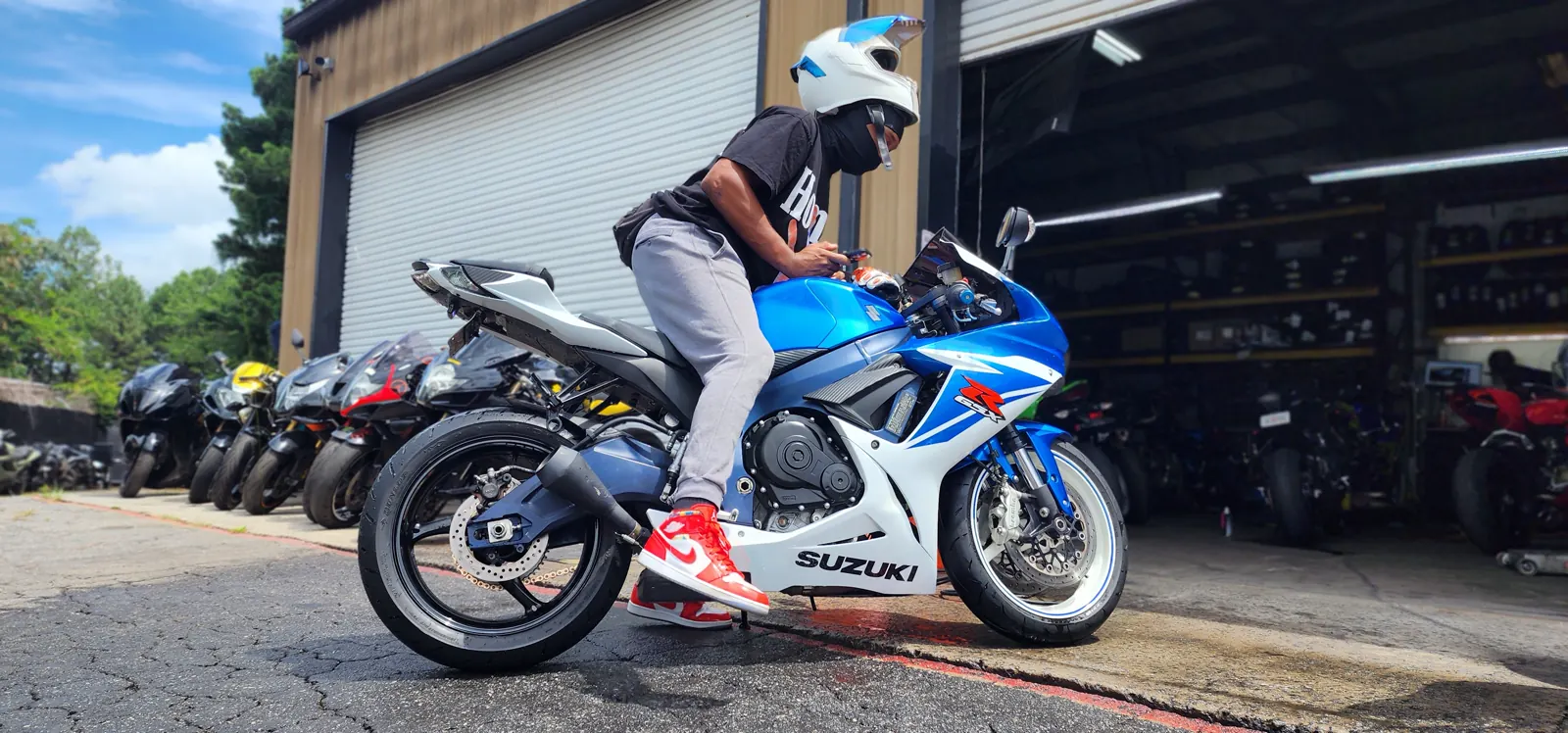
Then you change something. A slip-on lets exhaust leave faster. A high-flow filter lets air in faster. The computer keeps squirting the same fuel it always did, so now the numbers don’t line up. That’s when the popping, the heat, and the hesitation show up. The good news is that none of this is broken. It just needs new instructions.
What a dyno actually measures
A dyno is a heavy steel roller set into the floor. Your rear tire sits on it, strapped down tight, and the bike runs through the gears while standing still. The roller has known weight, so the machine does simple math: how fast did this bike spin up that much steel, at every point in the rev range? That gives us a power curve, not a bumper sticker. We care about the shape of the curve far more than its peak.
A probe called a wideband sensor also sits in your exhaust and sniffs what’s coming out. It reports the air-to-fuel ratio at every rpm and throttle position, like a lie detector for the engine. A bike can feel fine at half throttle and still be starving at a quarter throttle in third gear, which is exactly where you live on a commute.
- Power and torque across the whole rev range, not just one headline number
- Air-fuel ratio at every rpm and throttle opening, measured at the pipe
- Where the bike goes lean and hot, and where it dumps fuel it doesn’t need
- Whether a hesitation is a fuel problem, a spark problem, or something mechanical
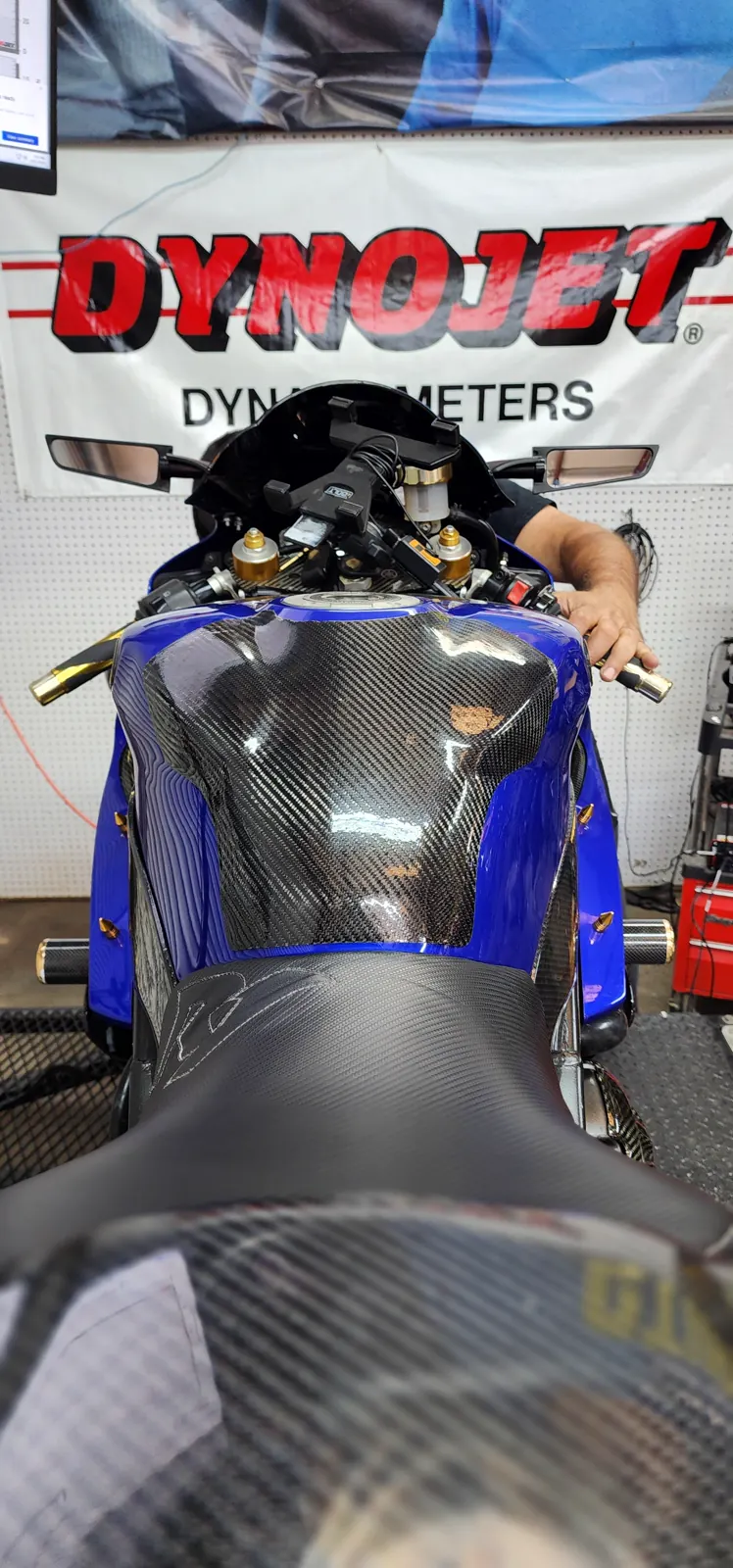
Before we go further, one thing worth clearing up. A dyno is a measuring tool, not a magic wand. Nobody adds power by sitting on a roller. The dyno shows us the truth so the tune can fix what’s wrong, then proves the fix worked. That’s why a baseline pull matters, because without a before, an after is just a story. For the deeper version, we wrote the full rundown on it.
Riders here tend to get that quickly, which is a compliment to the town. Alpharetta Highway between roughly 10800 and 11500 is North Fulton’s motorcycle row, with Mountain Motorsports, Cycle Gear, BMW Motorcycles of Roswell, G&G Cycles, and Killer Creek Harley-Davidson within about half a mile of each other. When you’ve walked five service counters in one afternoon, you learn fast what a real answer sounds like. So when someone asks what dyno tuning cost Roswell shops quote, they already know a flat number is a red flag.
Parts, labor, and the part nobody sees
Every tuning job splits into three buckets. Parts are the physical things: a fuel controller, a sensor, a bung welded into a pipe, plugs, sometimes a filter. Labor is our hands on your bike. And then there’s access, which is the quiet one that decides whether a job is small or big.
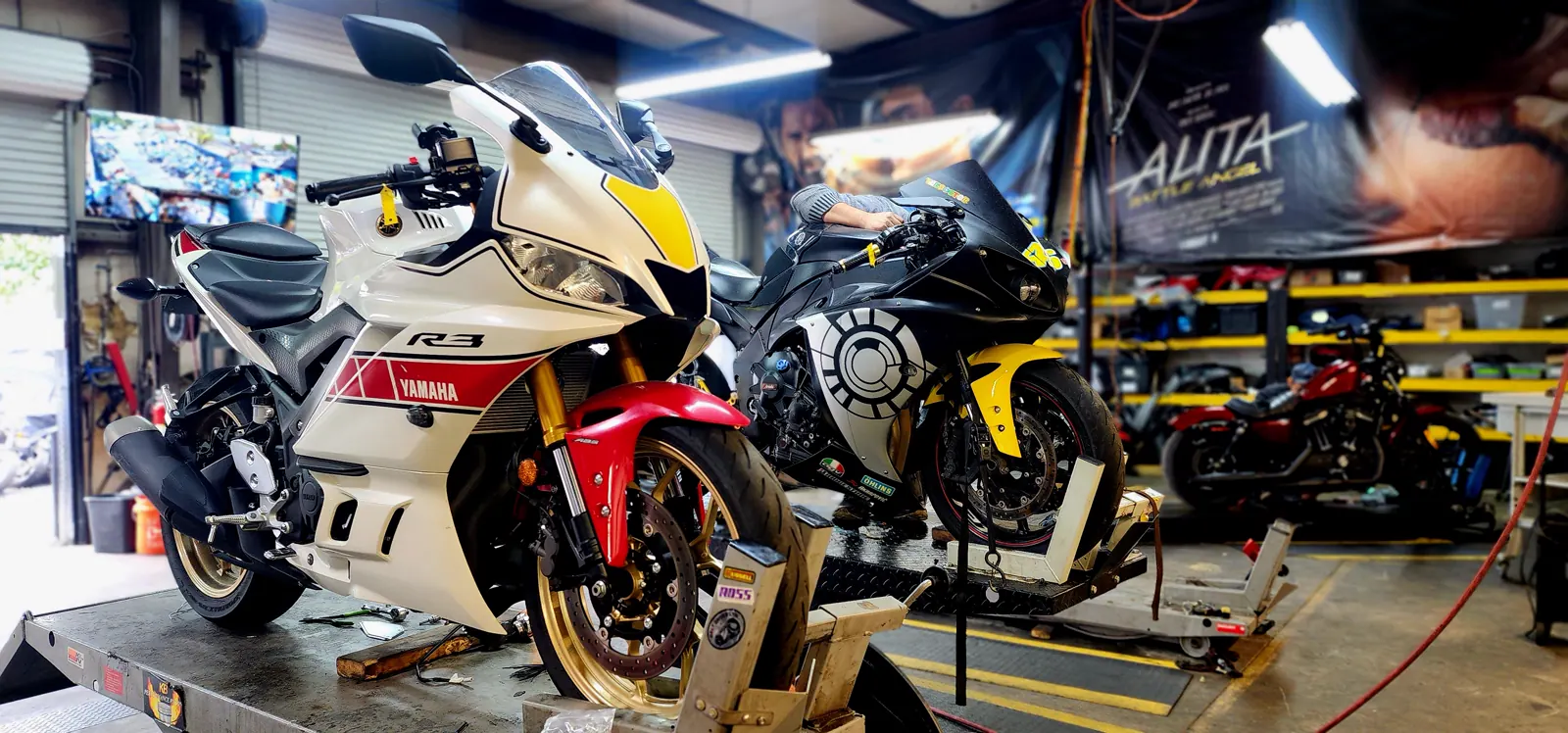
Access means how much has to come apart before we can reach the thing we’re touching. On a naked bike, the computer might be under the seat, a two-minute reach. Now, On a full-dress bagger, the same job means bags off, covers off, seat off, and a harness carefully unclipped. On a faired sportbike, everything comes off first, then goes back on with clips designed by someone who has never had cold hands.
So two tunes with identical parts lists can be very different jobs. Parts don’t care what bike they’re on. Labor absolutely does. Anyone quoting a flat number for every bike on the planet is either padding the easy jobs or eating the hard ones.
Your three main paths
ECU flash
We rewrite the software already inside your bike’s stock computer. No extra box, no extra wires, nothing under the seat to rattle loose. A flash can change fueling, ignition timing, throttle response, and rev limits, and on many bikes it can clean up a numb ride-by-wire map. It’s our first choice when the bike supports it.
Piggyback controller
A Power Commander and its cousins sit between the stock computer and the injectors, adjusting fuel on the fly. That’s the answer when a factory computer is locked down, or when a rider wants to swap maps easily later. It’s proven, flexible, and it has kept modified bikes happy for a very long time.
Carburetor work
Older bikes have no computer to argue with. Instead we change jets, needles, and air screws by hand, then run it again to see what the change did. It’s slower, more back-and-forth, and deeply satisfying when it finally sings. Plenty of Roswell garages hide a carbureted bike nobody else will touch, and we’re happy to say yes.
Which path you land on isn’t a preference. It depends on the bike’s year, its computer, what’s already bolted to it, and what you want from it. A rider chasing smooth low-speed manners around Historic Roswell and the Canton Street district needs a different map than a rider chasing top-end punch. Both are valid, just not the same job.
How we decide what you need
- We talk first. What does it do, when does it do it, and what have you already changed?
- We look the bike over on the lift, checking intake, exhaust, plugs, and anything loose or leaking.
- Of course, we run a baseline pull on the dyno to get the honest before picture with real numbers on the screen.
- We read the air-fuel trace with you and point at the exact spot where the bike goes wrong.
- Then again, we pick the path together, flash or controller or carb work, and tell you what comes apart to get there.
- We tune in passes until the curve is smooth and the mixture is right everywhere you ride.
- We do a final pull, show you the before and after side by side, and send you out to ride it.
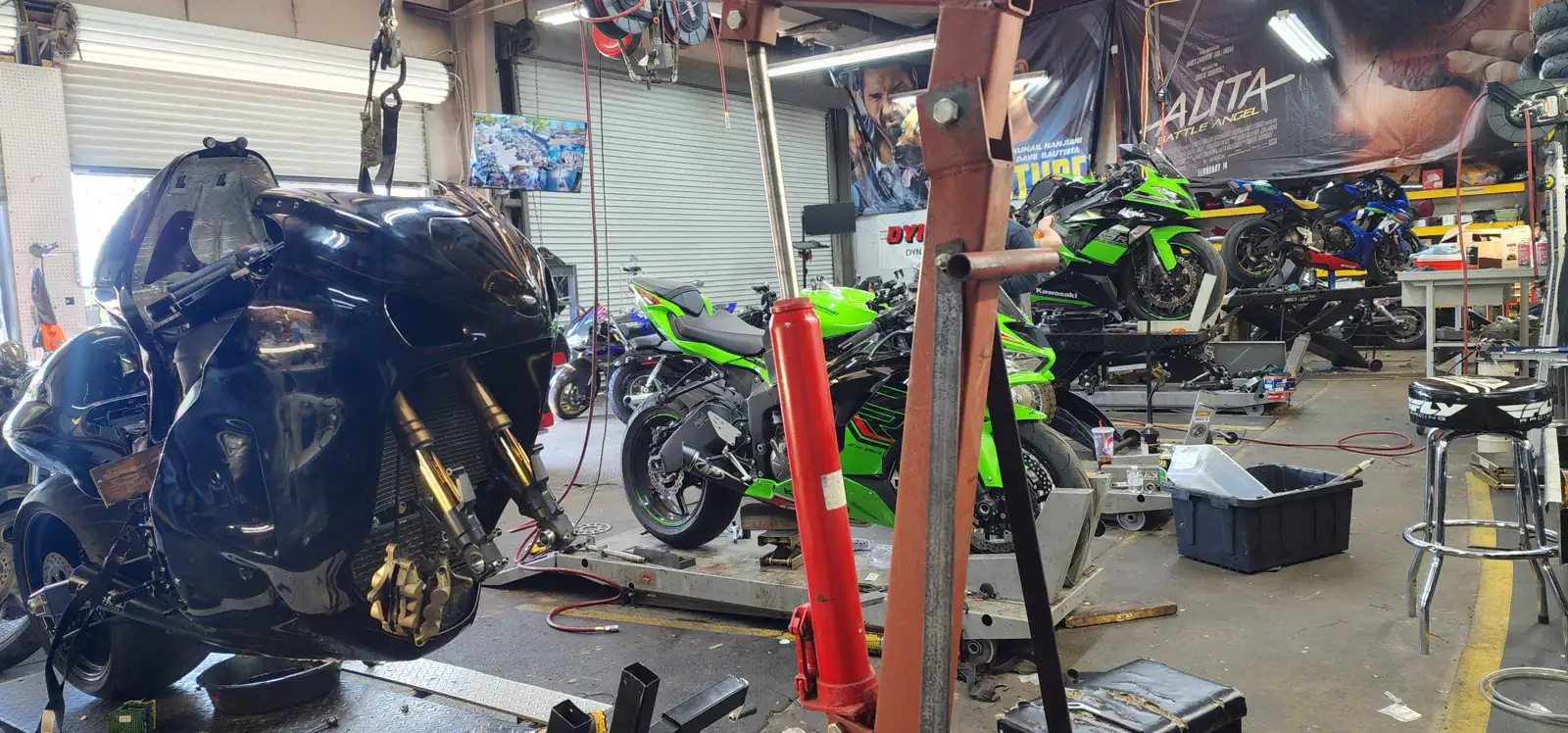
That sequence is the same for a bagger, a GSX-R, and a thirty-year-old twin. What changes is how long each step takes, and that’s the honest answer to what drives the number at the end. Here’s what our team handles day to day.
There’s a reason we bring this up on nearly every intake. Once in a while the baseline turns up something that has nothing to do with tuning: a cracked intake boot pulling in stray air, a tired coil, a filter packed with spring pollen, a sensor that’s been quietly lying for a year. Finding that early is a win, even though it means a phone call. We’d rather tell you on day one than tune around a problem.
Why we won't quote a tune sight unseen
You can call and ask for a flat number over the phone. We’ll say the same thing every time: we don’t know yet, and neither does anyone who hands you one. We haven’t seen what’s on the bike, how much has to come off, whether a previous owner left a controller on a generic map, or whether that pop on decel is fueling or an exhaust leak. A number given before any of that is a guess wearing a confident voice.
What we can do is give you a real range after we look, explain which way it’ll move and why, then call before anything changes. Roswell folks appreciate that. This is a city that argues about the right way to restore a porch railing, in the shadow of an 1839 Greek Revival house like Bulloch Hall, where Mittie Bulloch grew up and got married. People who care that much can spot a shortcut from across the parking lot.
NO SURPRISES
We call before we change the plan. If the baseline turns up something unrelated, you hear about it while the bike is still on the roller, not when you come to pick it up.
What it feels like after
This is the part riders don’t expect. A good tune doesn’t feel like a rocket strapped to your frame. It feels like the bike stopped arguing with you. Throttle response gets crisp, so a small wrist input does a small thing instead of a lurch. The flat spot at the bottom disappears. Heat at a stoplight drops, because the engine isn’t running lean and cooking itself. You notice all of it in the first mile.
A tuned bike doesn't feel faster right away. It feels like it finally agrees with you.
Take that bike out GA 372, Birmingham Highway, toward Ball Ground on a Saturday and the difference gets obvious. Rolling on and off the throttle through corners is where a sloppy map shows and a good one disappears. Friends we’ve helped say the same thing: they stopped thinking about the engine and started thinking about the road. We hear it from riders over in Gainesville too.
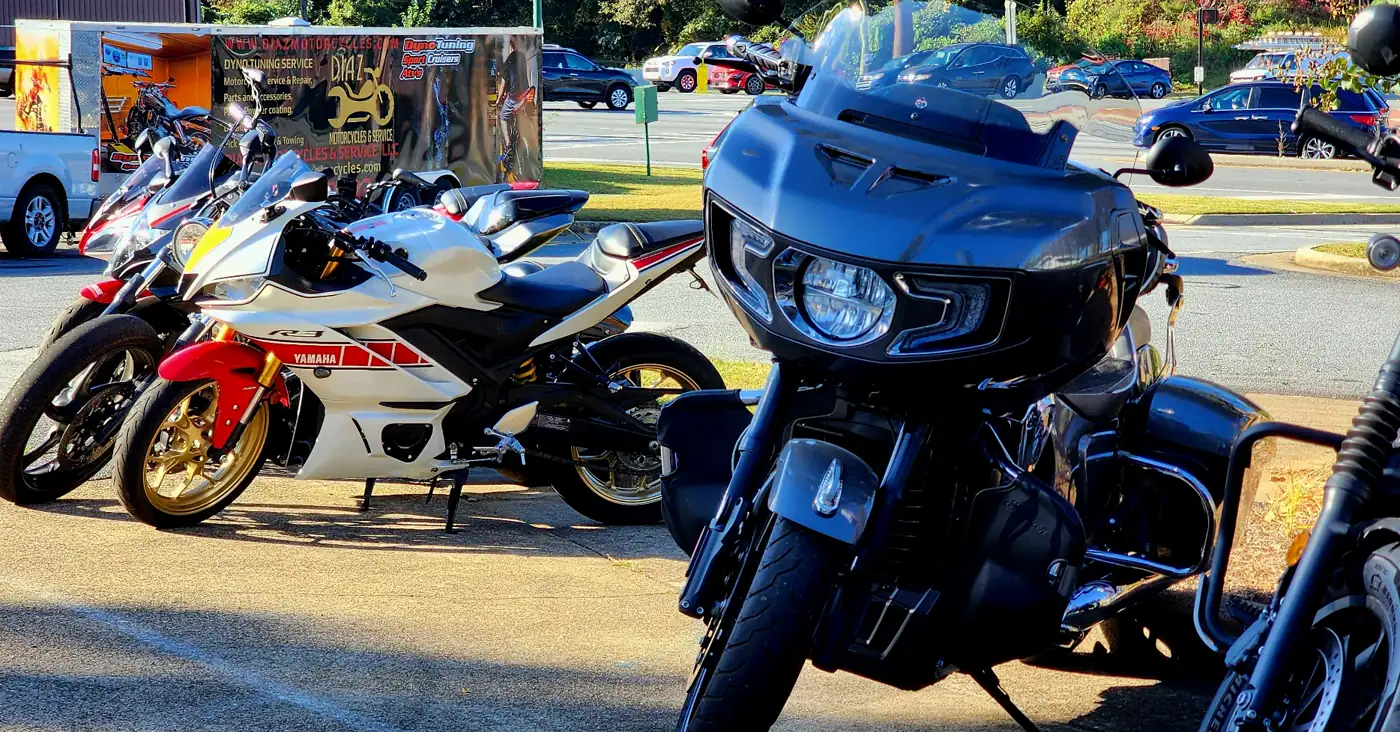
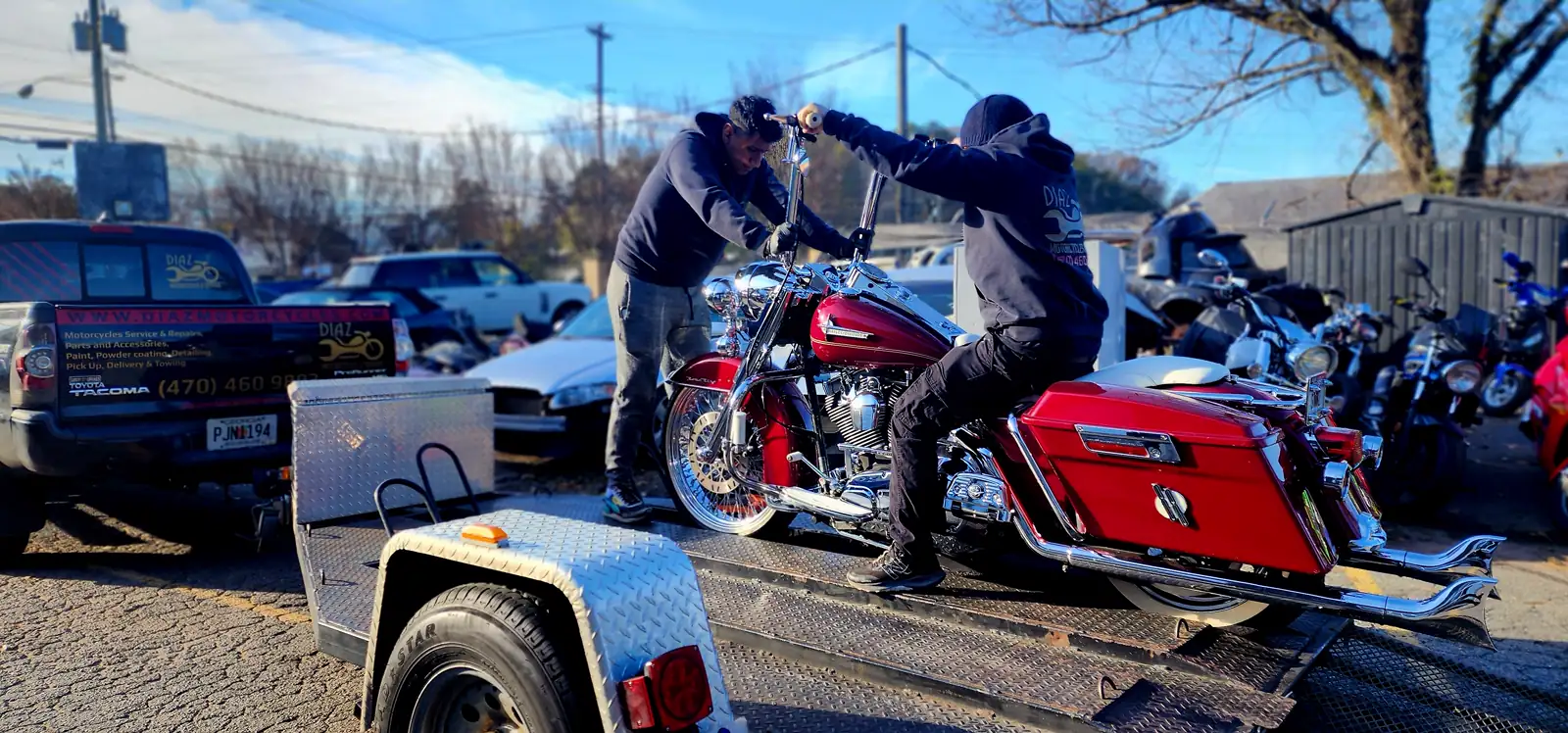
Getting to us is easy from your side of the river. Roswell Road, GA 120, runs straight west out of the Canton Street area, crosses the Chattahoochee, and becomes our part of East Cobb, so it’s roughly a fifteen to twenty minute ride most of the day. From the Holcomb Bridge and GA 400 side it’s a bit longer. We also pick up and deliver, which matters for riders in Barrington who’d rather not ride a bike that’s already misbehaving.
You’ve got good options out your way. Killer Creek Harley-Davidson on Alpharetta Highway is a real dealer with a real service department and an active H.O.G. chapter. The gap we fill is breadth. We’re an independent that takes Japanese, European, and American bikes, old or new, carbureted or computerized, with a paint booth and a dyno in the same building. Bikes stay on the road longer than they used to, something the Motorcycle Industry Council has tracked for years, and older bikes need a shop that isn’t brand-siloed.
So back to our two riders. Rider one eventually brought us his box of parts and his frustration, and the fix took a fraction of the time he’d already burned. Rider two never had the frustration at all. Both bikes run great now, and the only real difference was the order they did things in. Measure first, then decide. If you’re curious about the tuning side specifically, here’s what that service actually involves.
Questions Roswell riders ask us
How much of a tune is parts and how much is labor?
It swings a lot by bike. An ECU flash on a modern bike can be almost all labor and dyno time, because we’re rewriting software you already own. A piggyback controller setup adds real hardware, and carbureted bikes add small parts like jets and needles plus more back-and-forth time on the roller.
Does the type of bike change the work?
More than anything else does. A naked bike with the computer under the seat is quick to reach. A full-dress bagger or a faired sportbike means bodywork comes off first and goes back on last, and that time is real. Same tune, very different day.
What happens if you find something else while it's on the dyno?
We call you before we touch it. Sometimes a baseline pull uncovers an intake leak, a tired coil, or a filter packed with pollen, and tuning around that would just hide the problem. You decide whether we fix it now or later, and nothing changes on your bike without a yes.
How do I avoid surprises?
Tell us everything the bike has had done, including work you didn’t do yourself, and let us do a baseline pull before we commit to a plan. That one step turns a guess into a range. We’ll also walk you through what comes apart, so there’s no mystery about where the time goes.
What makes one tuning job bigger than another?
Access, condition, and how far the bike has drifted from stock. A clean bike with one slip-on is straightforward. A bike with a full exhaust, an aftermarket intake, a leftover controller from a previous owner, and a mystery map is a longer conversation, because we’re undoing someone else’s guesswork first.
Do I need a tune if I haven't changed anything?
Not always, but plenty of stock bikes still leave real smoothness on the table because factory maps are written for emissions and worldwide fuel. If your bike runs hot in traffic or feels flat off idle, a baseline pull will tell us in one session whether a tune helps or whether something else is going on.
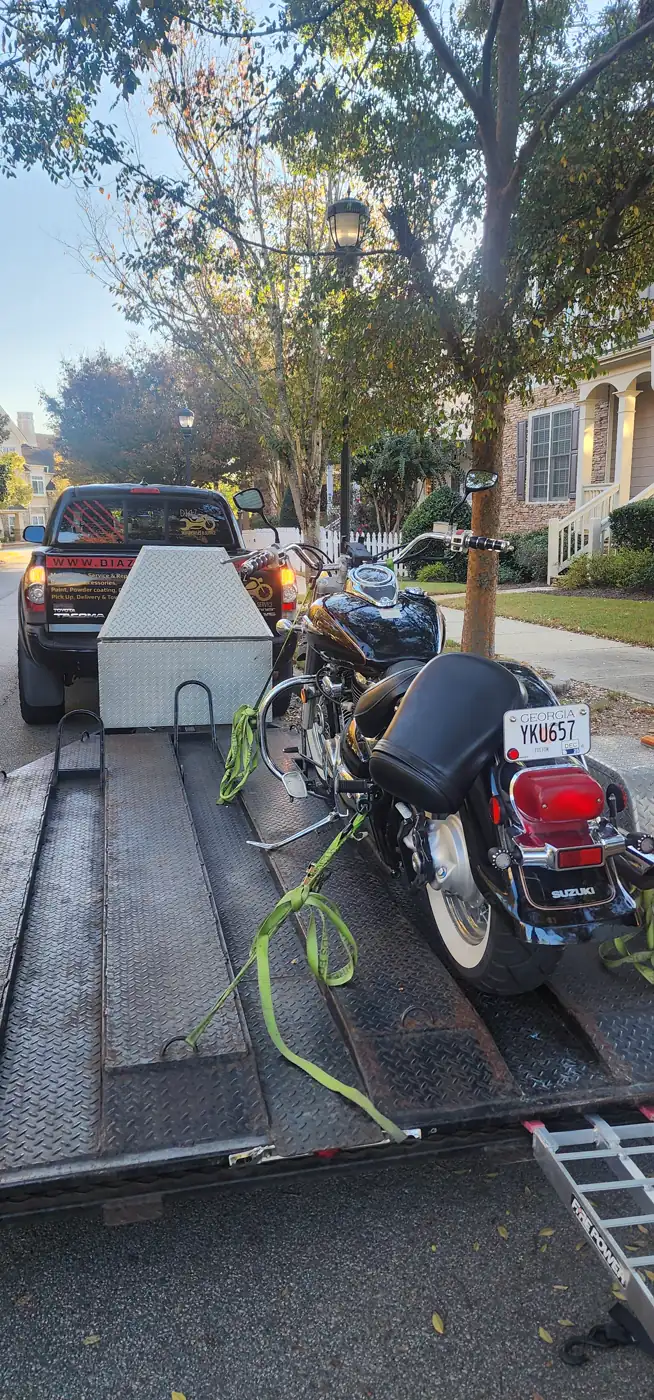
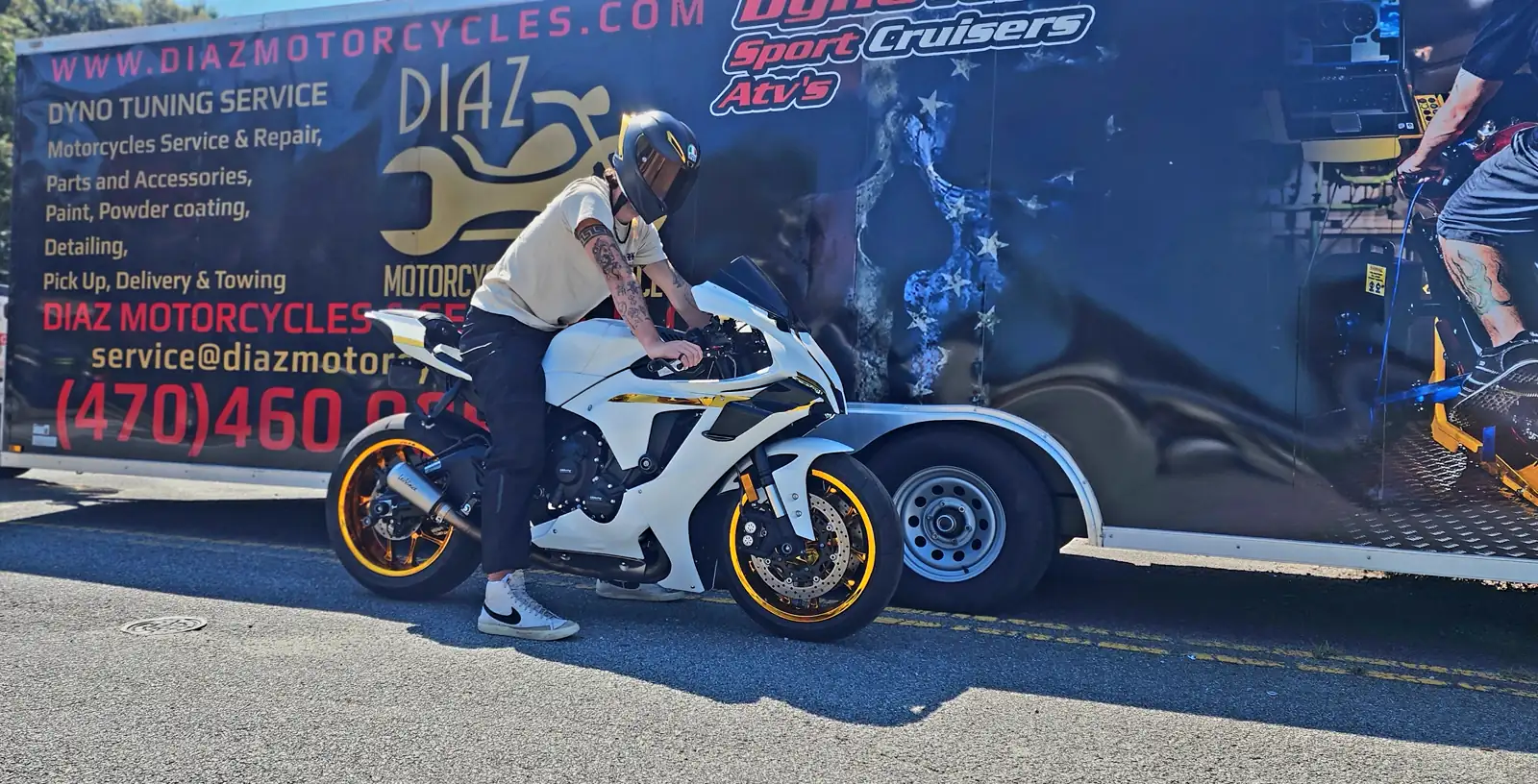
We take care of riders all over the north metro, starting with Roswell and the rest of North Fulton. That includes Alpharetta, Milton, Johns Creek, Mountain Park, and Crabapple, plus Sandy Springs and Dunwoody on the run down toward the Perimeter. On our side of the river we cover East Cobb, Marietta, Kennesaw, and Woodstock, and we see plenty of bikes from Atlanta proper too. If you’re outside that circle, call anyway, because our enclosed trailer goes farther than you’d think.
LET'S PUT IT ON THE ROLLER
If your bike runs hot, pops on decel, or feels flat where it should feel eager, bring it west on Roswell Road and let us measure it instead of guessing. We’ll do a baseline pull, show you exactly where the fueling goes wrong, and give you a straight answer before anything comes apart. Call or text us, or ask about pickup from Roswell if you’d rather not ride it in.
470-460-9883Diaz Motorcycles and Service, LLC · 847 Barnes Mill Road, Marietta, GA 30062