Best Dyno Tuning Dallas Riders Can Reach — A Rider's Guide
A used bike carries a history nobody wrote down. A dyno reads it back to you and fixes what's off.
You bought it used. On the other hand Maybe from a guy off Cedarcrest Road, maybe from a listing two counties over. So the tank looked shiny in the driveway, the tires looked fine, and the price felt right. But a few miles in, something’s off. It surges at a steady cruise. Also it pops on the way down. It runs hot sitting in traffic. Still, that nagging feeling is exactly why riders start hunting for the best dyno tuning Dallas can reach — because a secondhand bike carries a history nobody bothered to write down.
Here’s the good news up front. Plus, that weird behavior almost never means the bike is junk. More often, someone bolted on a pipe or a filter years ago and never had it tuned to match. The bike has been guessing ever since. A dyno stops the guessing. It measures what’s really happening, then a tuner corrects it. We’ve fixed this for a lot of friends who thought their bike was just “old” or “cranky.” It usually wasn’t.
So before you write off that used bike, let’s walk through what those symptoms mean, what happens when you put a bike on a dyno, and how to pick a shop you can trust. If you’re comparing options around Paulding County, this matters more than a slick logo.
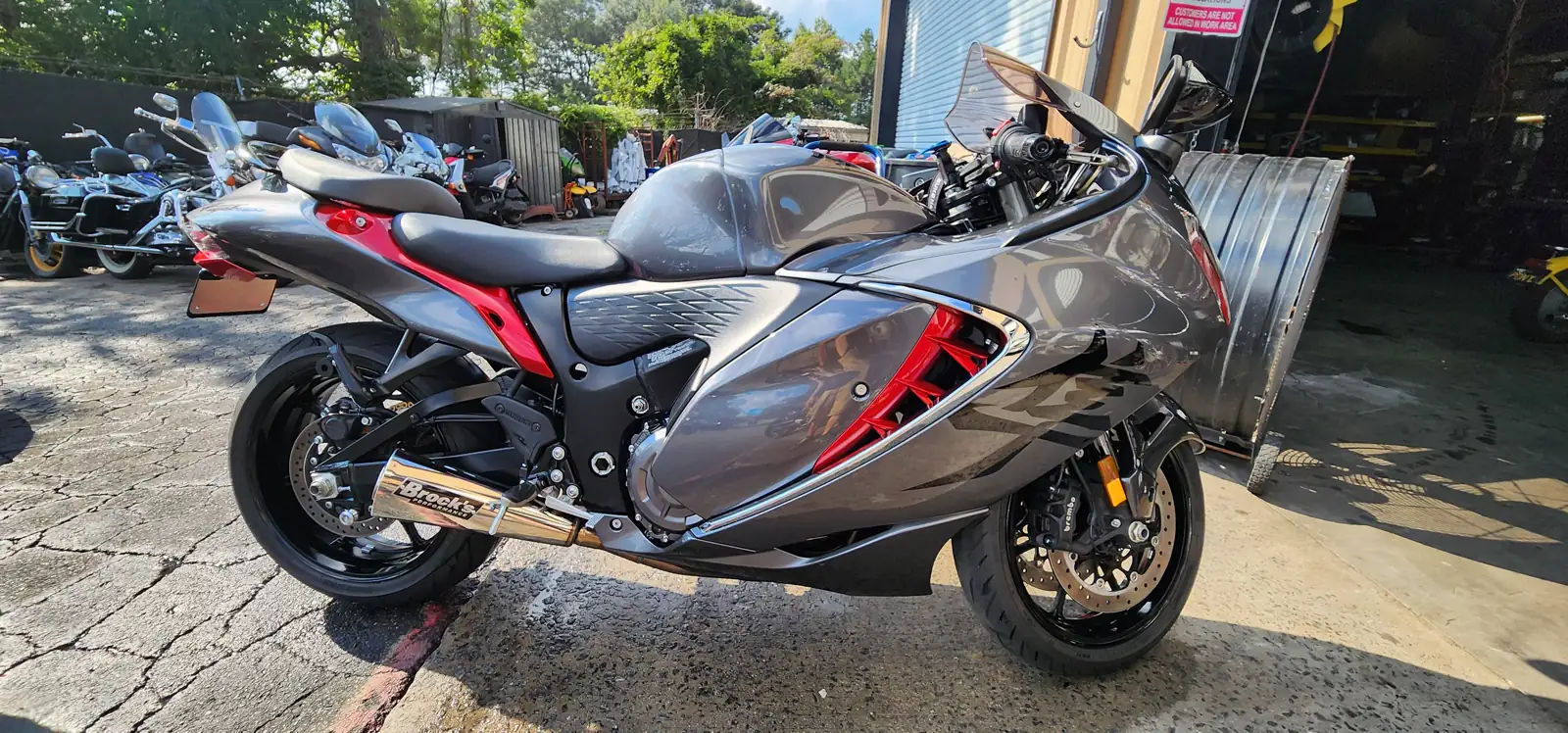
First, the bike is trying to tell you something
Your bike talks. Not in words, but in feel and sound and smell. When the fueling is wrong, it complains in ways you can learn to read. Here are the signs we hear about most from riders who just bought secondhand:
- Surging or hunting at a steady cruise — the throttle is pinned in one spot but the bike keeps speeding up and slowing down on its own.
- Popping and backfiring on deceleration — that snap-crackle sound when you roll off the throttle coming down a hill.
- Hesitation or a flat spot — you crack the throttle and the bike stumbles for a beat before it pulls.
- Running hot — the engine and your right leg cook in stop-and-go traffic worse than they should.
- Hard starts or a rough idle — it takes a few tries to catch, then it can’t hold a steady idle.
- Sooty exhaust tips or fouled plugs — black, wet grime where it should be light tan.
- Worse fuel range than the previous owner promised — you’re hitting reserve sooner than the model should.
If you nodded at three or four of those, don’t panic. You’re not describing a broken bike. You’re describing a bike whose fuel and air are out of balance. And that balance is the whole ballgame.
What each symptom actually means
An engine runs on a mix of air and fuel. Get the mix right and it’s smooth, cool, and strong. Get it wrong and every symptom above shows up. There are only two ways to be wrong here: too little fuel, or too much. Riders call these lean and rich.
Running lean means not enough fuel
A lean bike is starving. There’s plenty of air but not enough gas to go with it. This is the classic result of adding a free-flowing exhaust or a high-flow filter and never re-tuning — you let more air in, but the bike keeps squirting the same old amount of fuel. Lean bikes run hot. They surge at cruise, they pop on decel, and they get a flat spot when you open the throttle. That popping is the fun-sounding symptom, but it’s the bike telling you it’s hungry. The fix is simple: give it more fuel where it needs it.
Running rich means too much fuel
A rich bike is drowning. It’s dumping in more gas than it can burn clean. You’ll see it in black, sooty exhaust tips and fouled spark plugs. It bogs down, it smells strong, and your fuel range drops. On a used bike, this often comes from a previous owner who slapped on a cheap “power” tuner and cranked the fuel up everywhere, thinking more is always better. It isn’t. The fix is to trim the fuel back to where the engine actually wants it.
Here’s the part people miss: most real-world bikes are lean in some spots and rich in others across the rev range. You can’t fix that by feel or by turning one knob. You have to measure it, rpm by rpm. That’s the whole point of the machine you keep hearing about.
A dyno doesn't guess how your bike feels. It measures what your bike is actually doing.
Here’s where it gets interesting — and where most advice online falls apart. The forums will tell you to “just flash a map off the internet” or “run the same tune my buddy runs.” But your buddy’s bike isn’t your bike. Your air filter has 12,000 miles of Paulding County construction dust in it. Your exhaust is a brand the last owner picked. Instead your fuel, your altitude, even the mud tracking and gravel spill you ride through on Cedarcrest Road all shape how your engine breathes. A downloaded map is a stranger’s guess. A dyno tune is the truth about your machine.
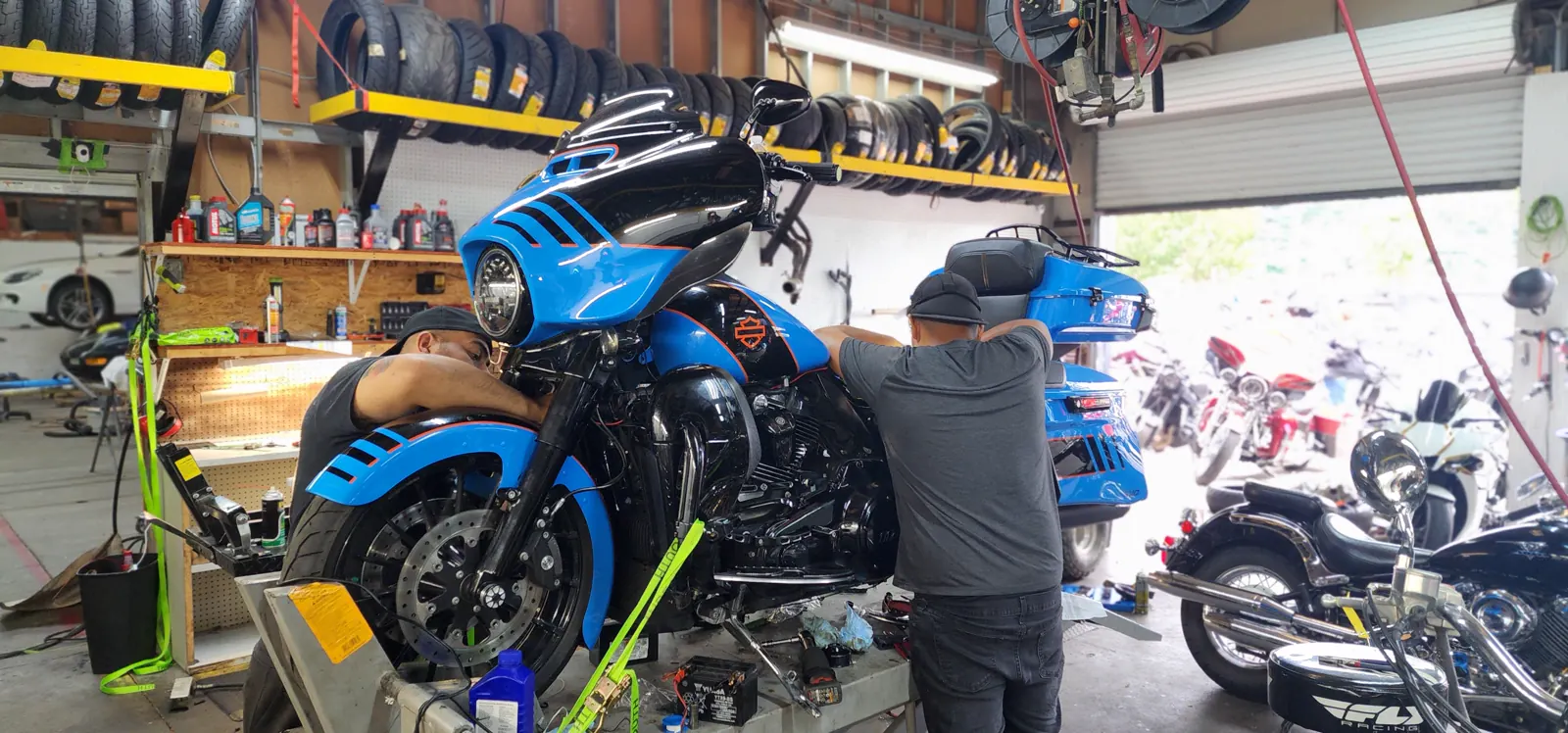
What actually happens when you put a bike on the dyno
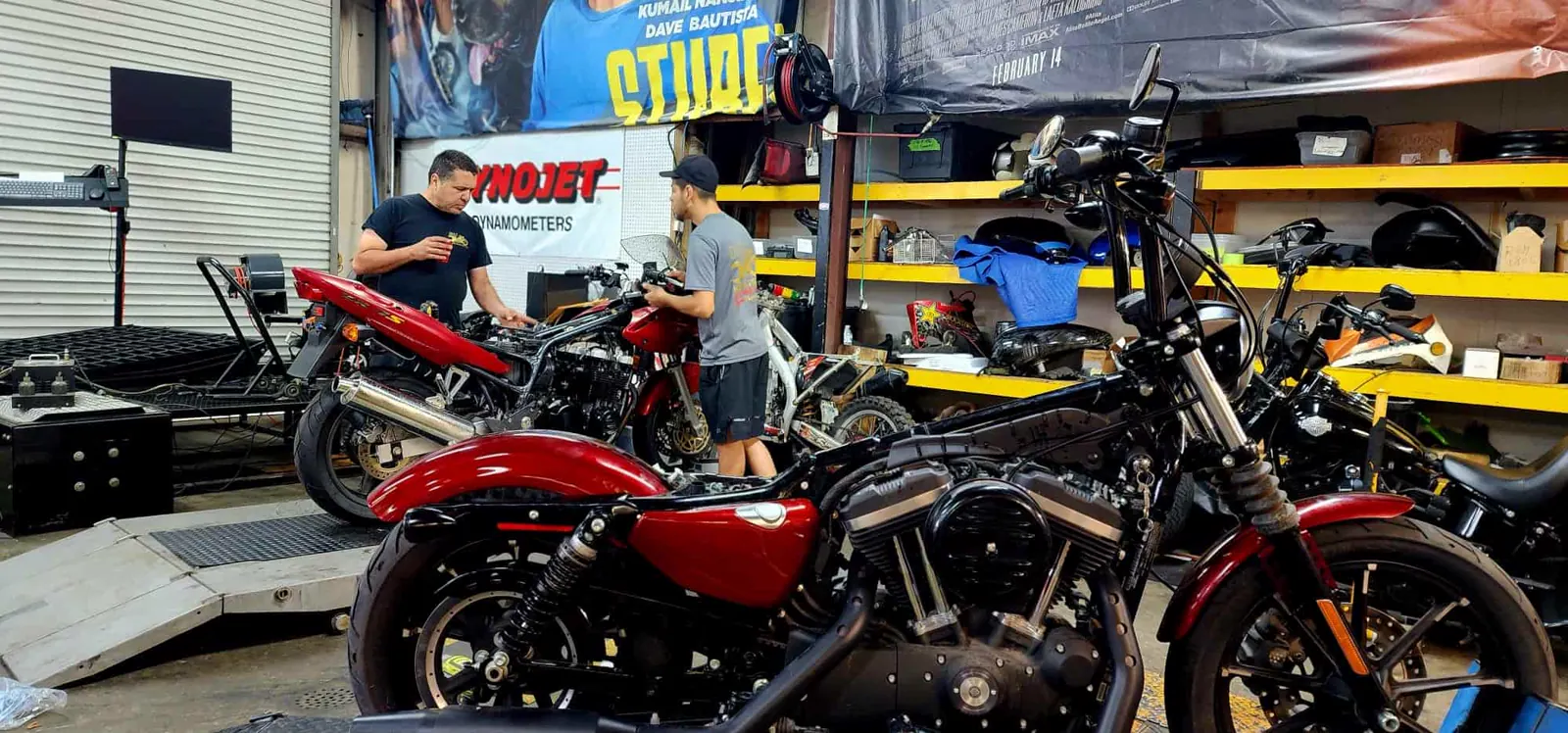
A dyno is a roller the rear wheel spins on. As the bike runs, the machine measures how much power and torque the engine puts down. But the number on the screen isn’t the magic part. The magic part is the small probe we slide into your exhaust. It’s called a wideband sensor, and it reads your exact air-fuel mix in real time, all the way up the rev range.
That reading is the map of your bike’s health. We can see the exact rpm where it goes lean and starts popping. Besides we can see where it’s dumping too much fuel and fouling plugs. Then we correct it. On many modern bikes we do that with an ECU flash — we reprogram the bike’s own computer. On others we add or adjust a Power Commander, a small piggyback unit that fine-tunes the fuel. Either way, we make a change, run it again, and watch the numbers move until the mix is right across the whole range. If you want to see what that service actually involves, we lay it out plain.
Then we hand you the sheet. A dyno sheet is a picture of your power and your fueling, and it’s yours to keep. It’s proof of what changed, not a sales pitch. If you’ve never read one, here’s what that service actually involves and how to read the lines. And if you’re weighing the whole thing out, we also break down how the work adds up so there are no surprises.
- We strap the bike down on the roller and slide the wideband probe into the exhaust.
- Actually we run it through the rev range and record power, torque, and the exact air-fuel mix.
- We read where it’s lean and where it’s rich, spot by spot.
- That’s why we correct the fueling — an ECU flash on the bike’s own computer, or a Power Commander adjustment.
- We run it again and again until the mix is smooth and safe across the range.
- We hand you the dyno sheet so you can see exactly what changed.
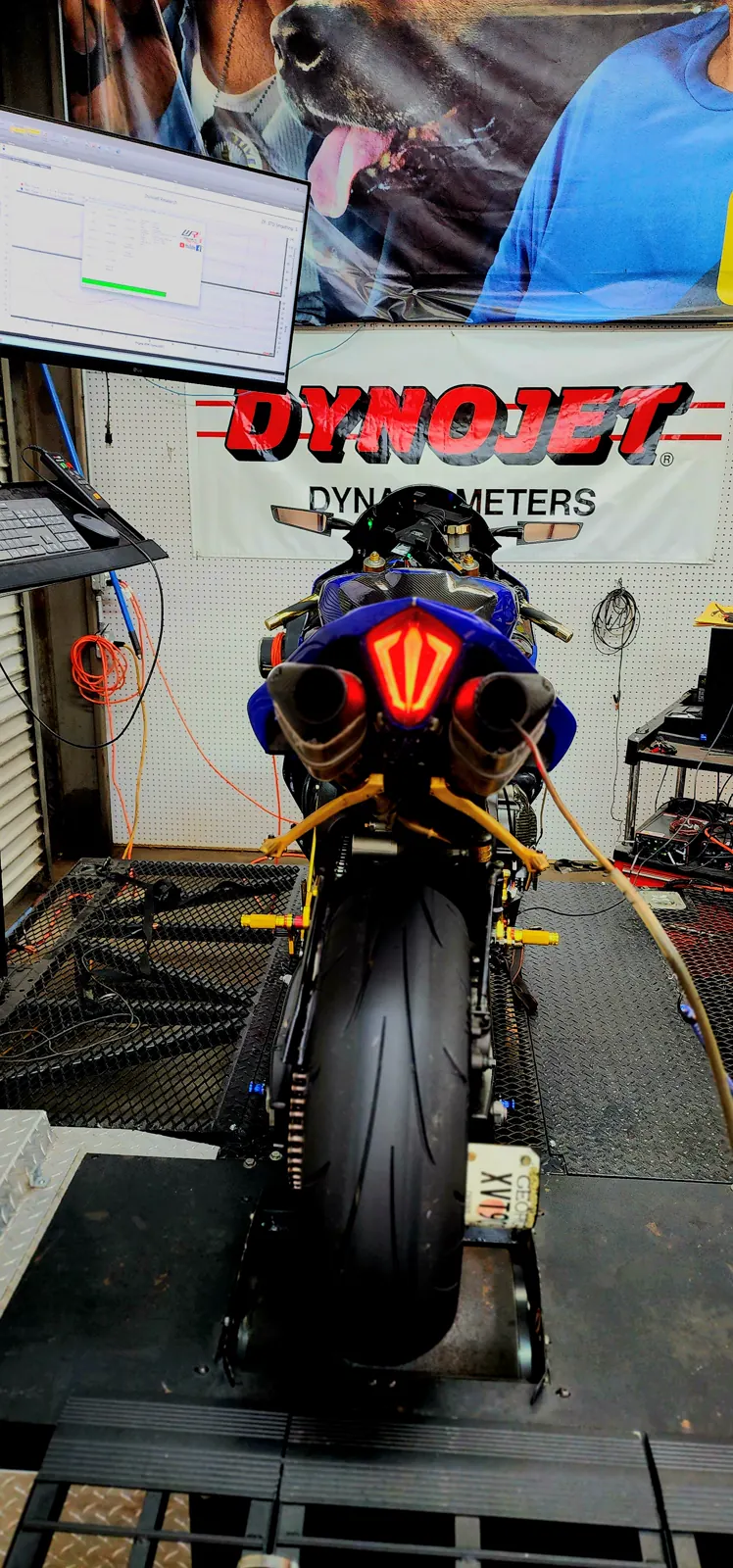
How long it takes and when to plan for it
A proper custom dyno tune isn’t a ten-minute oil change. Plan on the better part of a day, because the whole value is in the back-and-forth of run, adjust, and run again. Rushing it defeats the point. The good part is you only do it once for a given setup. Once your bike is dialed, it stays dialed until you change the exhaust, the filter, or the engine internals.
Timing matters around here, too. Prime riding season in Paulding runs March through June and picks back up September into October, with April through June being the sweet spot for the backroads. So the smart move is to get your tune done in late winter or very early spring, before the good weekends arrive. That way you’re not parked in the garage during peak season waiting on a bench slot. Book it in the off-season and roll into spring already sorted — your future self on a Saturday morning will thank you.
WHY LATE WINTER
Shops fill up fast once the weather breaks. Getting your tune done before the season starts means the first warm Saturday, you’re riding — not waiting.
Choosing a shop: the criteria that actually matter
Now for the question you really came here to answer. How do you pick? Paulding County is a great place to own a bike and a tough place to service one. There’s no full-line motorcycle dealership in the county — no dyno, no ECU flash bench. Riders in Seven Hills, that big North Paulding swim-and-tennis community with the 13-acre amenity park and the water slide, love their garages but have to leave the county for real tuning work. Same for the newer west-side neighborhoods like Riverwood, with its pickleball courts and resort-style pool, and nearby Timberlands. The bikes are here. At the same time the dyno isn’t.
So you’ll be driving somewhere either way. Judge a shop by these, not by the flashiest ad:
- They put your bike on a real dyno with a wideband sensor — not just a laptop and a downloaded map.
- Either way they tune your specific bike and give you the sheet to keep.
- They can do both ECU flashing and Power Commander work, so they fix the problem the right way instead of the only way they know.
- In short they explain what’s wrong in plain words and don’t try to sell you what you can do yourself.
- They tell you honestly when a tune won’t help — sometimes the real issue is a clogged filter or a tired plug.
Be fair to the dealers and the other shops, too. A good dealer does honest work, and a solid independent can be gold. Southeast Motorcycle over on Spring Street in Douglasville is a real option about 35 to 40 minutes south if that’s your direction. The point isn’t that everyone else is bad. It’s that custom, in-house dyno mapping is rare, so the best dyno tuning Dallas riders can find is simply the shop that does it under one roof. If you’re curious how the same choice looks in another town, here’s how this plays out in Peachtree City.
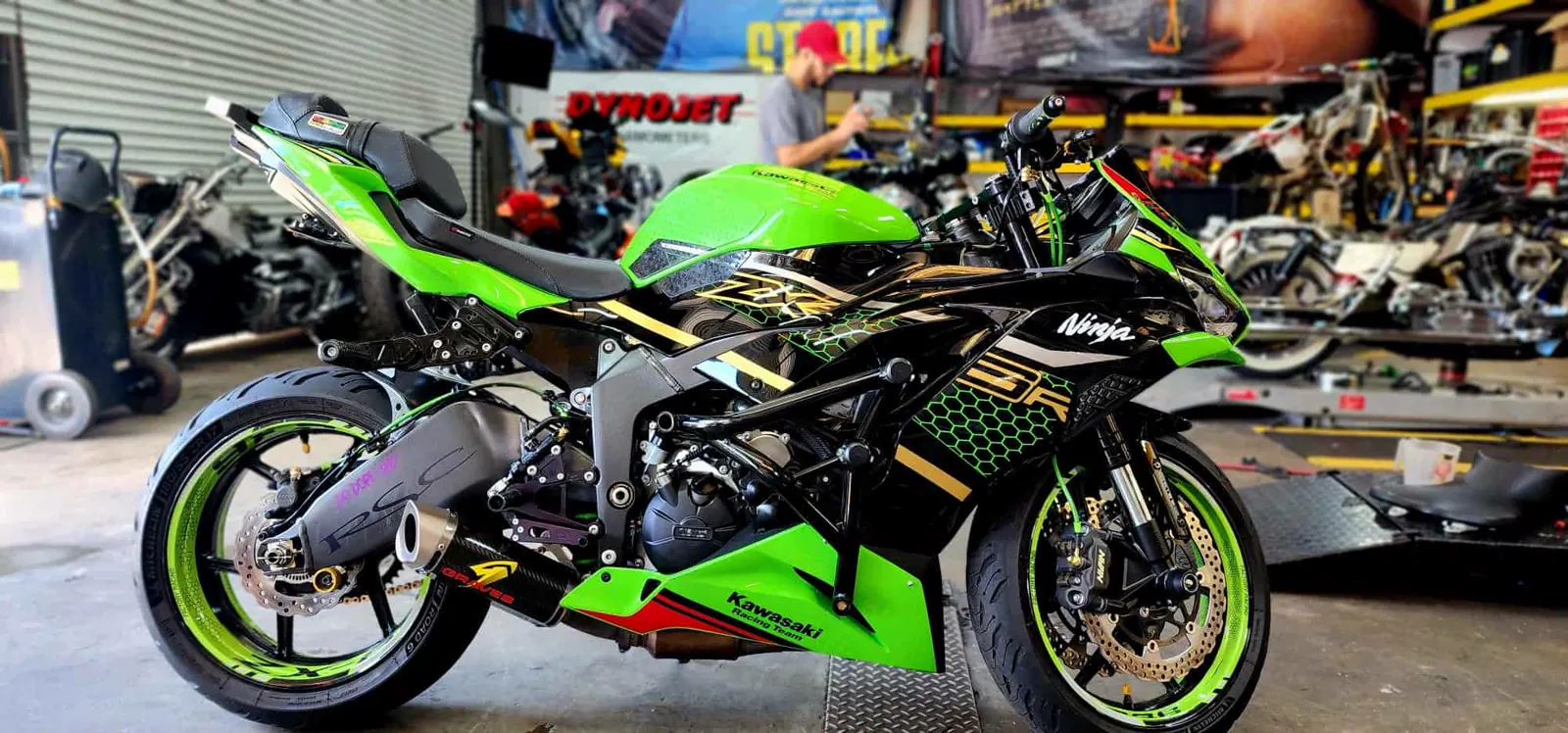
The Paulding rider, honestly
We get the local rider because we’ve helped a lot of them. You live in a garage-first county and ride the rural west-side two-lanes on Saturday morning before the heat sets in. Maybe you run the Quad County Figure Eight — that loop through Cobb, Bartow, Paulding and Polk that starts near US-41 and Black Acre Trail in Acworth, threads Dabb Bridge Road over to GA-61, and rolls past Burnt Hickory Park, Sheffield WMA and High Shoals Falls. Roads like those near the Paulding Wildlife Management Area are exactly where you feel a bad tune. A hesitation mid-corner or a surge on a two-lane breaks your rhythm on the good stuff.
There’s another local truth worth naming. Bikes here don’t rack up big miles. A lot get ridden maybe fifteen hundred miles a year and sit clean in the garage the rest of the time. That’s easy on the paint but hard on the mechanicals — varnished fuel, tired plugs, and fueling nobody has ever checked. A used bike from a low-mile Paulding garage can look showroom-fresh and still run rough, simply because it’s never been dialed in. That’s not a knock on the bike, just a job that never got done.
About the drive: from Dallas it’s roughly 24 to 28 miles to our bench, call it 40 to 50 minutes east on GA-120 and Charles Hardy Parkway to Dallas Highway, straight through West Cobb into Marietta. In a county where most folks already commute out every day, forty minutes to fix your bike right isn’t the objection — a wasted trip is. So we make the trip count.
Here’s what changes once it’s actually sorted. The surge at cruise goes quiet. The popping on decel calms down to a mellow note instead of a machine-gun snap. As a result the flat spot fills in, so when you crack the throttle exiting a corner near the Paulding Meadows Arts & Crafts Festival grounds in the fall, the bike just pulls — clean and predictable. It runs cooler in traffic. It starts on the first try. And that used bike you almost gave up on suddenly feels like the one you hoped you were buying.
A few honest words on safety and rules
Since a good tune makes a bike easier to ride smoothly, here’s a quick reminder on the boring-but-important stuff. Georgia requires DOT-approved helmets for every rider and passenger, and the roads you love have their quirks — chip-sealed two-lanes with loose gravel at the driveways and truck-rutted stretches on 278. You can check current road conditions through Georgia DOT, and for riding resources, the American Motorcyclist Association is a solid place to start. A well-tuned bike gives you one less thing to fight while you enjoy the ride.
Bottom line: a rough-running used bike is usually a fixable one, and the dyno is how you find out for sure. Bring us the symptoms, we’ll bring the machine that reads them. That’s what you get when you bring it in — a real measurement, a real fix, and a sheet that proves it.
You didn't buy a bad bike. You bought a bike that never got tuned. There's a difference — and it's an easy one to fix.
Questions Dallas riders ask us
How do I know your diagnosis is right and not just a way to sell me a tune?
Because the dyno measures it, not us. The wideband probe reads your real air-fuel mix at every rpm, and you can watch the numbers on the screen. We hand you the dyno sheet at the end, so you can see exactly what was off and what changed. If a tune won’t help, we’ll tell you straight — sometimes the fix is a filter or a plug.
What makes your approach different from other shops?
We do custom dyno mapping in-house, with both ECU flashing and Power Commander work under one roof. That means we fix the fueling the right way for your exact bike, not with a downloaded map made for someone else’s setup. A lot of shops near Paulding County can bolt on parts, but real in-house custom tuning is rare in this area.
How do I pick a good dyno shop?
Look for a real dyno with a wideband sensor, a tuner who explains things in plain words, and a shop that gives you the sheet to keep. A good shop tunes your specific bike, offers both ECU flash and Power Commander options, and tells you honestly when a tune isn’t the answer. If they only offer one method or won’t show you data, keep looking.
Should I go to a dealer or an independent shop?
Both can do great work, so judge the shop, not the label. A good dealer is honest and a solid independent can be excellent. What matters is whether they can actually put your bike on a dyno and do custom mapping — many can’t. Since Paulding County has no full-line dealership or dyno, you’ll be driving out either way, so pick the one that truly does the work you need.
What should I ask a shop before I book a tune?
Ask if they use a real dyno with a wideband sensor, whether they can do both ECU flashing and Power Commander work, and if you get to keep the dyno sheet. Ask how long the tune takes — a real one takes the better part of a day. And ask what happens if they find the issue isn’t tuning at all. Good answers to those tell you a lot.
My used bike looks perfect but runs rough. Is it worth tuning?
Very likely, yes. Low-mile, garage-kept bikes here often look showroom-fresh but were never tuned to match an old exhaust or filter swap. That mismatch causes surging, popping, and hot running. A dyno tune sorts the fueling and usually transforms how the bike feels — without touching the good looks it already has.
We tune and service bikes for riders all across the western arc of metro Atlanta. From Dallas and nearby Hiram over to Powder Springs, Acworth, and Kennesaw, and out toward Douglasville and Villa Rica, the drive to our Marietta bench is a straight, easy run. We also see plenty of friends coming in from Cartersville, Rockmart, Taylorsville, Braswell, and Yorkville, along with the Cobb County crowd right here around Marietta. If you ride the west-side two-lanes and want your bike dialed in for them, we’re one commute away.
GET YOUR BIKE DIALED IN
If your used bike surges, pops, or runs hot, don’t guess — measure. We do real in-house dyno tuning for Dallas and Paulding County riders, with ECU flashing and Power Commander work under one roof and a dyno sheet you keep. Text us to talk through your symptoms and grab an off-season slot before riding season fills up. One easy trip east into Marietta and your bike comes back running the way you hoped it would.
470-460-9883Diaz Motorcycles and Service, LLC · 847 Barnes Mill Road, Marietta, GA 30062