Best Motorcycle Service Roswell: A Rider's Guide to Picking a Shop
What a real service covers, how to judge a shop before you hand over the keys, and when the dealer is the right call.
Actually your first month on a new-to-you bike is mostly listening. It sits taller than anything you’ve owned. That’s why the bars feel wide in your hands. Either way On a bend out near the Chattahoochee Nature Center on Willeo Road, the front end pushes a little where your old bike would have just tucked and gone. Nothing is broken. In short the machine simply has habits you haven’t learned yet. At the same time that’s usually the moment a rider goes looking for the best motorcycle service Roswell has, because an unfamiliar bike is a bike you want somebody sharp to look over.
We get that call a lot. As a result Somebody moves up from a naked bike to a big adventure bike, or from a sportbike to a bagger, and the machine starts talking in a new language. The chain stretches on a different schedule. Also the tires wear into a shape nobody warned them about. None of that means the bike is sick. It means the rider is new to the platform, and a rider in that spot deserves a shop that explains things instead of handing over a list.
The bike wasn't broken. You just hadn't learned it yet.
One friend we helped lives a few blocks off Historic Canton Street, in the 1840s mill-town core where Craftsman bungalows sit next to newer infill townhomes. He’d owned his bike about six weeks. What he described on the phone sounded ugly: a shudder under braking, a clunk from the back, a front end that felt vague. What we found on the lift was ordinary. The chain had one tight spot. Instead the rear tire had cupped from a lot of slow, low-speed miles through the Canton Street district. The front pads were glazed. Three small things, stacked, that felt like one big problem.
That stacking effect is the whole story of motorcycle upkeep. One worn part almost never feels like one worn part. It feels like the entire bike went wrong at once, usually on the morning you had a ride planned. Catch each item early and every one is a small job. Let three travel together for a season and you get a machine that feels untrustworthy, which is the worst feeling a motorcycle can hand you.
What a service actually includes, in plain words
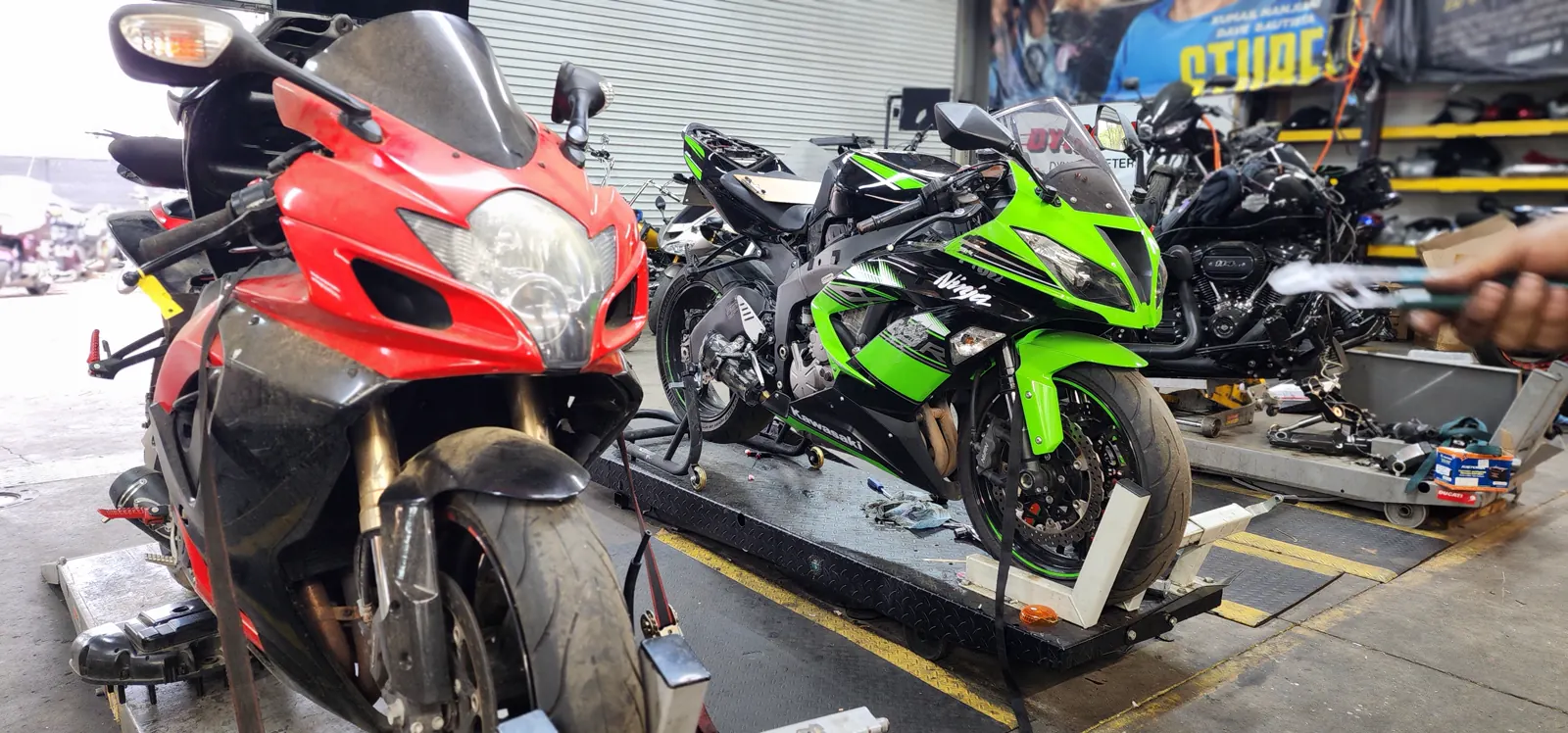
Service is a word shops use loosely, so here’s what it means on our lift. A tech puts the bike up, gets it level, and works through it in order. Fluids first. Then the parts that connect you to the road. Then the parts that keep you seeing and being seen. Nothing mysterious — just a list somebody works honestly, with the bike in front of them instead of a schedule on a screen.
- Engine oil and filter, plus a look at what came out of the drain pan, because metal, color and smell all tell a story.
- Chain or belt: slack, tight spots, sprocket teeth, and a proper clean-and-lube rather than a spray over old grit.
- Brakes: pad thickness at every corner, rotor wear, fluid color, and a check for glazing.
- Tires: tread depth, wear shape, the age of the rubber, and pressures set cold.
- Controls and cables, steering head bearings, fork seals, shock feel and the rear linkage.
- Battery health, charging output, lights, coolant, air filter and every fastener that likes to walk loose.
How often should all that happen? Your owner’s manual sets that, not us and not a stranger in a forum. A big twin, a high-strung inline four and a modern adventure bike each have their own schedule, and the manual accounts for how yours was built. What we’ll do is read it with you and be straight about how your real riding shifts the picture. Short summer hops through the Canton Street district are harder on oil than a long highway run.
THE ONE RULE
Small things caught early stay small. A tight chain spot is a quick fix. Ignored, it takes the sprockets with it — and sprockets never leave quietly.
Roswell has more motorcycle businesses than most cities its size
Alpharetta Highway between roughly 10800 and 11500 is North Fulton’s motorcycle row. Mountain Motorsports, Cycle Gear, BMW Motorcycles of Roswell, G&G Cycles and Killer Creek Harley-Davidson at 11480 all sit within about half a mile of each other. That’s unusual, and it means riders here are educated buyers. You’ve walked a flagship service department. You know what dealer labor rates look like. Odds are you’ve been to a H.O.G. Chapter #0746 ride or you know somebody who has.
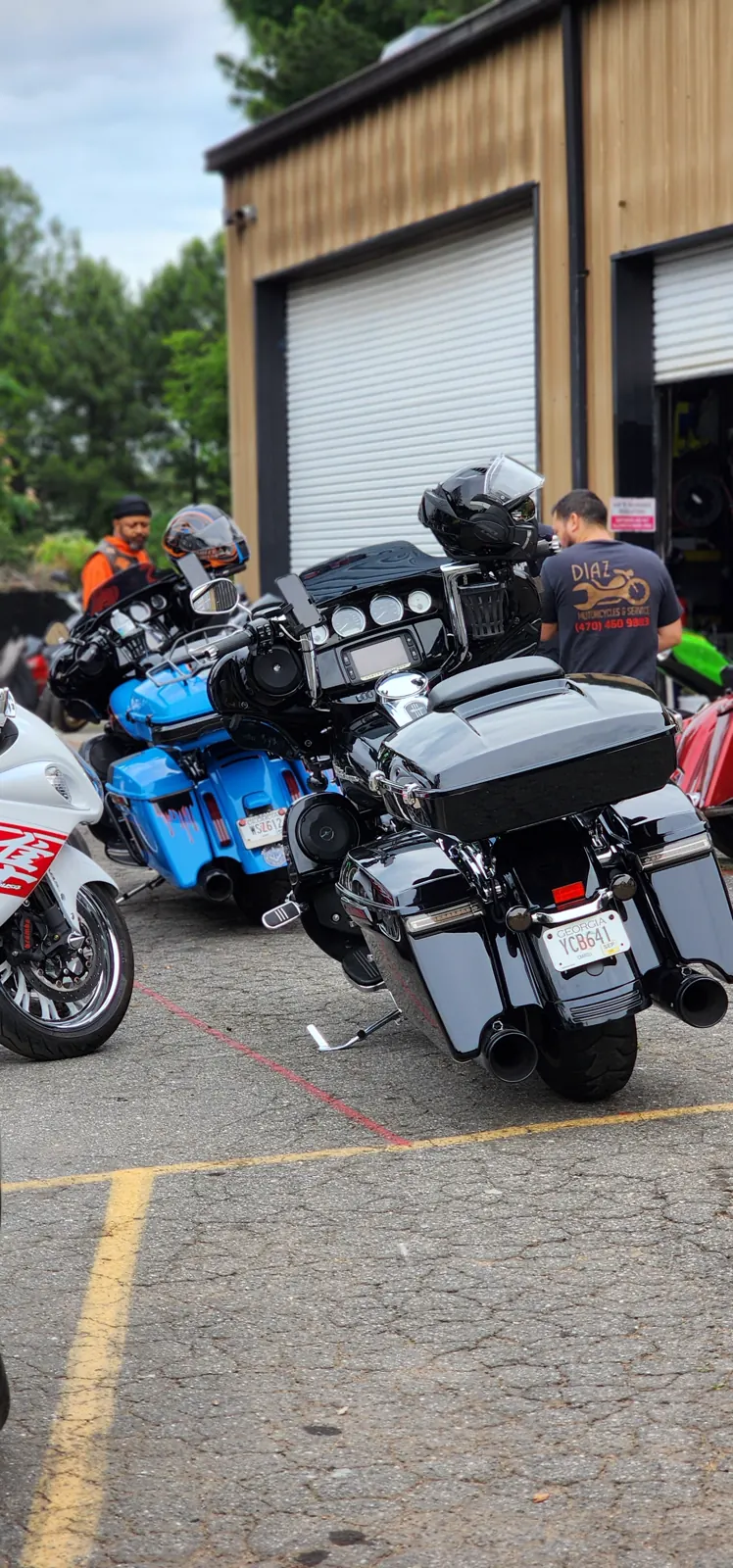
Dealers are good at real things, and we’d rather say so plainly. A brand store has factory training, model-specific tooling, warranty authority and quick access to service bulletins the rest of us have to hunt down. If your bike is under warranty, if there’s an open recall, or if the job needs a proprietary diagnostic tool, the dealer is often the right call. We tell people that on the phone. Killer Creek runs a proper service department with a real community around it, and saying otherwise would insult your intelligence.
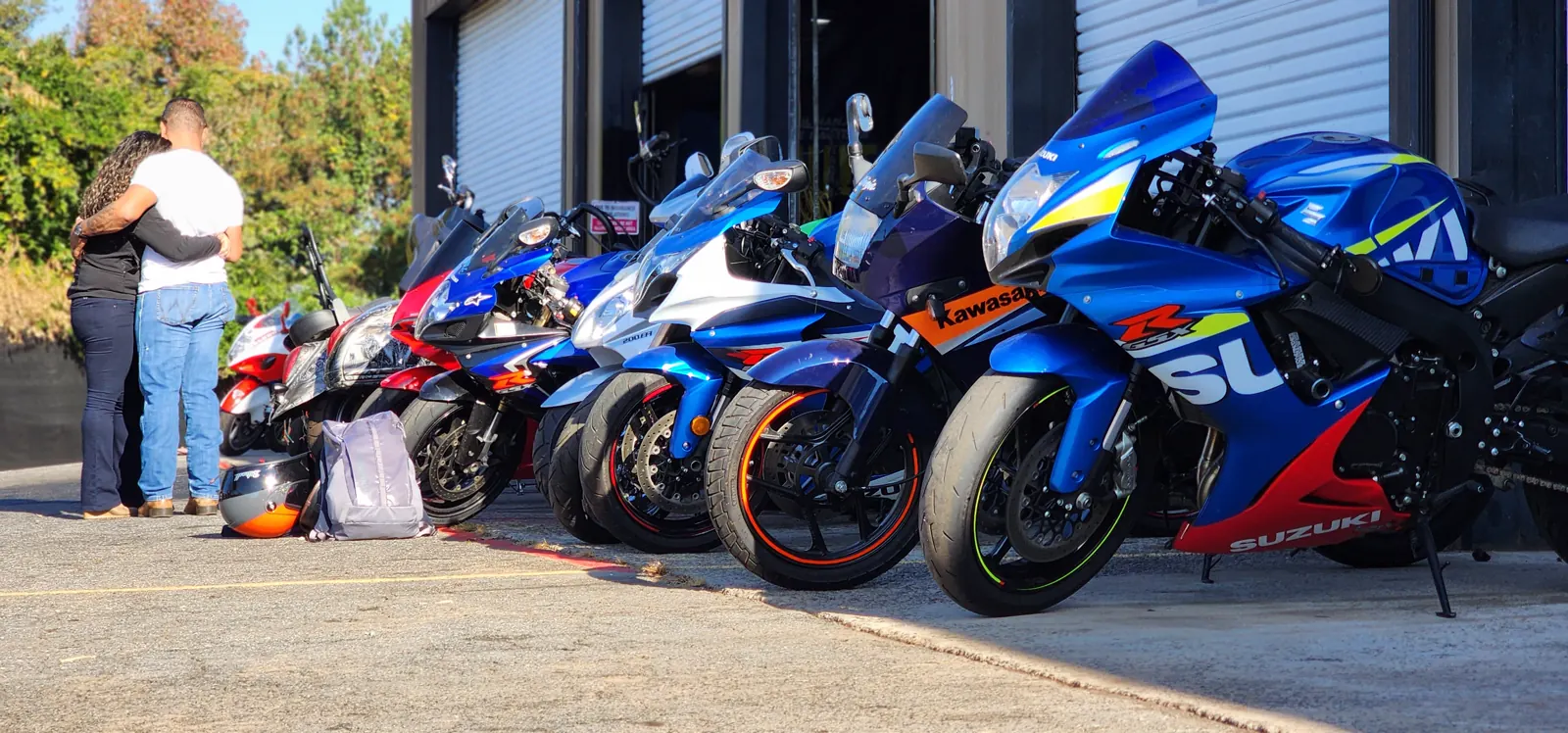
Where an independent earns its keep is breadth and flexibility. We work on the mixed garage — the Ducati, the older Italian bike somebody politely declined, the twenty-year-old sportbike, the GS and the bagger, often for the same household. Under one roof we’ve got a paint booth, a dyno, ECU work, restoration and transport, so a single project doesn’t get shuttled between five businesses and three waiting lists. If you want the nuts and bolts of a routine visit, here’s how our crew approaches it.
Here’s where it gets interesting — and where most advice online falls apart. Every list you’ll find says to check reviews and ask about a warranty. Fine. But reviews mostly tell you how a shop behaves when things go right, and nearly every shop looks good then. What you really want to know is how a shop behaves when a job turns weird: when the part is backordered, when the first fix doesn’t hold, when the bike comes back with the same noise. That’s the only test that counts, and the good news is you can predict it before you ever hand over a key.
How to judge a shop before you hand over the keys
- Ask them to show you the worn part. A shop happy to walk you to the lift and point at a cupped tire has nothing it’s hiding.
- Listen for the words “I don’t know yet.” Honest diagnosis has a step where nobody knows. Shops that skip straight to certainty are guessing out loud.
- Ask what happens if the first fix doesn’t solve it. The answer should be immediate and specific, not vague reassurance.
- Ask who actually touches your bike, and whether that person will talk to you. Passing everything through a counter works fine for a car.
- Look at the floor. Bikes strapped properly, tires racked, tools where they belong — a tidy bay usually means tidy work.
- See whether they’ll ever talk you out of something. A shop that sells every item on the list at every visit isn’t inspecting. It’s reciting.
Notice what isn’t on that list: being cheapest. Price matters, and you should always get the plan in writing before a wrench turns. Yet the lowest quote often just means fewer things got checked, and a search for the best motorcycle service Roswell riders actually recommend tends to end with a referral rather than an ad. If you’d like a clear breakdown of what goes into a bill and why two quotes on the same bike can look so different, we wrote a whole piece on how the work adds up.
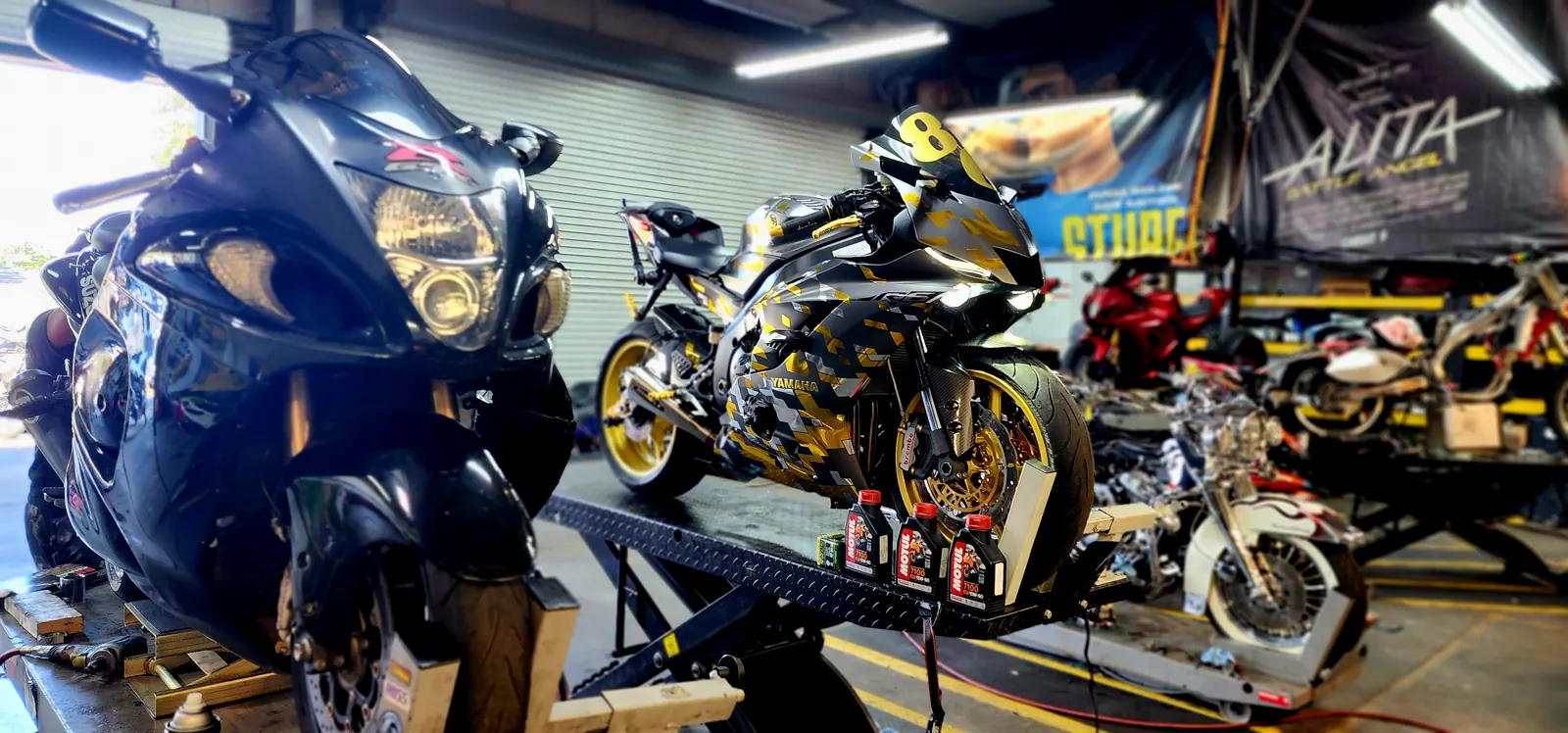
Roswell riding shapes the work, too. The city has been resurfacing and rebuilding streets across town, with Bulloch Avenue, Canton Street, Riverside Road and Old Roswell Road among the named targets. Construction zones and utility-cut seams are hard on a motorcycle. They bend rims, chew tires and knock alignment sideways in a way you feel as a slow wobble long before you see it. Roswell also runs a pothole and issue reporting app plus SeeClickFix, and reporting a bad patch is worth the two minutes — your rims will send a thank-you note.
How we decide what your bike actually needs
Our order of operations is boring on purpose. We ride it or run it when that’s safe. We listen to your description, because riders are usually right about what changed even when they’re wrong about the cause. Then the bike goes on the lift and we check the connected systems, not only the one complaining. After that you get two lists: what your bike needs now, and what it’ll want soon. You choose from both. We don’t quietly move the “soon” list into the “now” list.
Some jobs need data instead of opinions. A flat spot off idle, fueling that got worse after an exhaust swap, a bike that runs hot in traffic — those go on the dyno so everybody can look at real numbers instead of arguing about seat-of-the-pants feel. If you’ve never watched a run, Dynojet’s dyno center explains the idea well. And if that’s the road your bike is heading down, here’s how we handle that job.
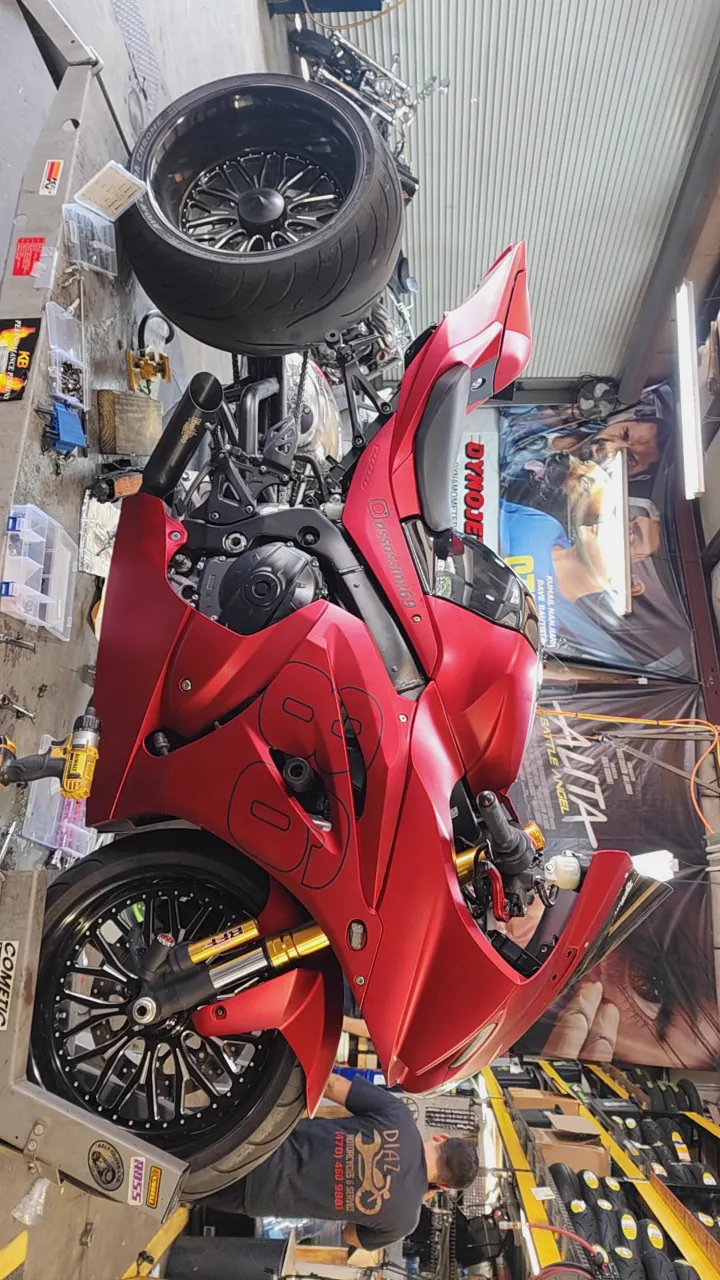
Where the bike sleeps matters as well. Out in Lake Charles and Lake Charles Estates, most bikes live in an older two-car garage shared with the family car, so there’s room to store one properly but not much room to work on one. Mountain Park, its own small incorporated city tucked inside Roswell’s footprint with lakes, cabins and a quirky historic character, runs about the same. Near Historic Canton Street, the townhome and condo infill means some bikes sit under a cover outside instead. Storage changes what we find. A covered bike gets damp underneath; a garage bike gets flat-spotted tires and a tired battery.
You shouldn't have to become a mechanic to know your mechanic is being straight with you.
Here’s what changes once it’s actually sorted. The shudder is gone, of course. But the bigger shift is quieter than that. You stop negotiating with the bike. Besides you stop planning rides around a noise. You stop wondering whether what you’re feeling is the road or the machine — and that low hum of doubt rides along with you every single mile until somebody removes it.
What it feels like after
A sorted machine holds its line. The chain runs quiet. The brakes arrive the same way at mile ten and at mile two hundred. That’s the difference between surviving the Suches loop on US-19 and GA-180 — Georgia’s Dragon, the standard weekend target along with GA 60 — and genuinely enjoying it. Up there a tight chain spot or a glazed pad isn’t merely annoying. It eats your attention, and attention is the best safety equipment you own. If you like the research behind that idea, IIHS motorcycle research is worth an evening.
The commute changes too. GA 400 south toward Perimeter and Buckhead is one of the few metro runs where people genuinely ride year-round. Georgia doesn’t permit lane filtering, so commuting on two wheels here is about parking and range rather than slipping between cars — though motorcycles can legally use the GA 400 HOV lanes, which is a real reason so many riders bother. A bike you trust makes that ride easy. A bike you’re babying makes it a chore, and sooner or later the car wins the argument.
Getting here is basically one road
From the Canton Street side it’s one road most of the way: Roswell Road, which is GA 120, running straight west across the Chattahoochee into East Cobb. Figure roughly seven to nine miles, give or take, and something like fifteen to twenty minutes without traffic. Coming off the Holcomb Bridge and GA 400 side, it’s a bit farther. Plenty of our OTP regulars drop a bike on the way to work and grab it on the way home. We do this on the west side of the metro as well — here’s how this plays out in Smyrna.
The short version
Ask a shop hard questions and watch how comfortable they are answering. Use the dealer when the dealer is the right tool. Use an independent when your garage is mixed, your bike is older, or the work crosses more than one trade. Let your owner’s manual set the interval. And catch things while they’re small, because a small thing caught early is a good afternoon. That’s what riders here really mean when they trade names for the best motorcycle service Roswell can offer — not a magic wrench, just somebody paying close attention on your behalf.
Spring is our busiest window for exactly this reason. March and April bring dead batteries, varnished fuel, dry-rotted tires and sticky brakes, all from bikes that sat politely all winter. Book that wake-up service before the first warm Saturday and you’ll ride while everybody else waits. Show up the week the weather breaks and, well, you’ll get very familiar with our waiting area.
Questions Roswell riders ask us
How do I know your diagnosis is right?
We show you. If a pad is glazed or a tire is cupped, we’ll walk you to the lift and put the part in your hand. We also tell you when we’re not sure yet and what we’d check next. If you want a second opinion before you commit, take it — a shop that’s confident in the work has no reason to fear one.
What makes Diaz different from other shops?
Breadth, mostly. Paint booth, dyno, ECU work, restoration and transport all sit under one roof, so a project doesn’t bounce between several businesses and several waiting lists. We also take the bikes other shops pass on, including older European machines. That’s it. No secret sauce, just more of the job in one building.
How do I pick a good motorcycle shop?
Watch how they behave when something is uncertain. Good shops say “I don’t know yet” and then tell you how they’ll find out. They show you worn parts, put the plan in writing, and occasionally talk you out of something. A tidy shop floor with bikes strapped properly is another honest signal.
Should I use a dealer or an independent?
Both have a place, and we’d rather be useful than territorial. Warranty work, open recalls and jobs needing a proprietary factory tool usually belong at the brand store. A mixed garage, an older bike, custom work or a project that crosses several trades is where an independent shines. Ask each one what they’re best at and believe the honest answer.
What should I ask before I leave my bike?
Ask who will actually work on it and whether you can talk to them. Ask for the plan in writing before anything starts. Ask what happens if the first repair doesn’t fix it. Then ask them to save the old parts so you can see what came off.
How often does my bike need service?
Your owner’s manual sets the interval, and we won’t invent a number for you. What we will do is read it with you and adjust for how you actually ride. Short hops, heavy traffic, hard mountain days and long storage all change the picture, so two identical bikes in the same neighborhood can need different attention.
We’re a straight run west of Roswell on GA 120, so we see a lot of North Fulton riders along with the rest of the metro. Friends we’ve helped roll in from Alpharetta, Milton, Johns Creek and Crabapple, from Mountain Park and Sandy Springs, and from Dunwoody when the GA 400 traffic cooperates. Closer to the shop we take care of riders all over Marietta, East Cobb and Kennesaw, plus plenty of folks coming down from Woodstock or up from Atlanta. If your bike lives anywhere in that stretch, the ride here is an easy one.
BRING IT BY. WE'LL LOOK IT OVER.
If you’re new to your bike, or you’ve got a noise you keep riding around, text or call us and describe it in your own words. We’ll tell you honestly whether it sounds like a small job or a bigger one before you ever leave Roswell. It’s one road west on GA 120, and you’ll leave knowing exactly what your bike needs now and what it can wait on.
470-460-9883Diaz Motorcycles and Service, LLC · 847 Barnes Mill Road, Marietta, GA 30062