Dealer vs Indie Service Dallas — How to Choose
A straight recommendation for Paulding County riders, including the times we'd send you to the dealer instead.
It started as a tick. One small tick, once per wheel turn, quiet enough that wind covered it past forty. After that, he first heard it on a cool morning backing out of a garage in Seven Hills, decided it was a pebble stuck in the tread, and rode two more months on it. When the chain finally came off the bike, the sprocket teeth had been filed into little shark fins. Also that tick was a ten-minute adjustment in March. Instead By May it was a parts order. Besides Which lands us on the question behind dealer vs indie service Dallas, GA riders keep bringing us: who should touch your bike, and when does the choice actually matter?
The short answer, before we explain ourselves
Actually For routine upkeep — fluids, chains and belts, tires, brakes, batteries, cables, the whole keep-it-healthy list — an independent shop is the better call for most Paulding riders. That’s why you get the same tech twice, so somebody actually remembers your bike. Either way you get told what’s urgent and what can wait until fall. In short and you can stack four jobs into one drop-off instead of booking four separate visits. At the same time that’s our recommendation, and the rest of this post is us showing our work.
Here’s the honest other half. As a result the dealer wins outright in three situations, and we’ll point you there ourselves without blinking. One, anything still covered by warranty — let the brand pay for the brand’s parts. Two, an open recall, because that’s factory work on the factory’s dime. On the other hand three, a very new model that needs proprietary software, a factory-only diagnostic tool, or a fix the manufacturer hasn’t released to anyone else yet. That’s not fence-sitting. That’s just where the paperwork lives.
What actually drives the work — it isn't the calendar
Miles matter, but miles aren’t the boss. How a bike gets used and how it sits matter just as much. Your owner’s manual sets the service intervals for your exact model, and that’s the only number we’d trust, because every manufacturer draws that line in a different place. Harley riders who like reading ahead can dig through the factory’s own Harley-Davidson service information before they ever call a shop.
Paulding has a specific version of this problem, and it isn’t theft. Bikes here live in big attached garages, dry and safe and mostly still. A garage queen that sees fifteen hundred miles a year builds varnish in the fuel system, kills a battery it never recharges, and grows dry-rotted tires that still look showroom fresh. Brake fluid nobody has touched in five years is the quiet one. A tire can look brand new and still be older than the truck parked next to it, which is a joke until it’s your front end on wet chip seal.
So the real drivers look like this:
- How often it rolls — short weekly hops are harder on a bike than long Saturday rides
- Where it rolls — rutted arterial pavement chews tires differently than smooth rural two-lanes
- How it sits — months parked with old fuel and a flat battery is its own kind of mileage
- Season — February cold hides problems that show up the first warm Saturday
- Who rode it last, and whether anything got adjusted after
What a real service actually includes
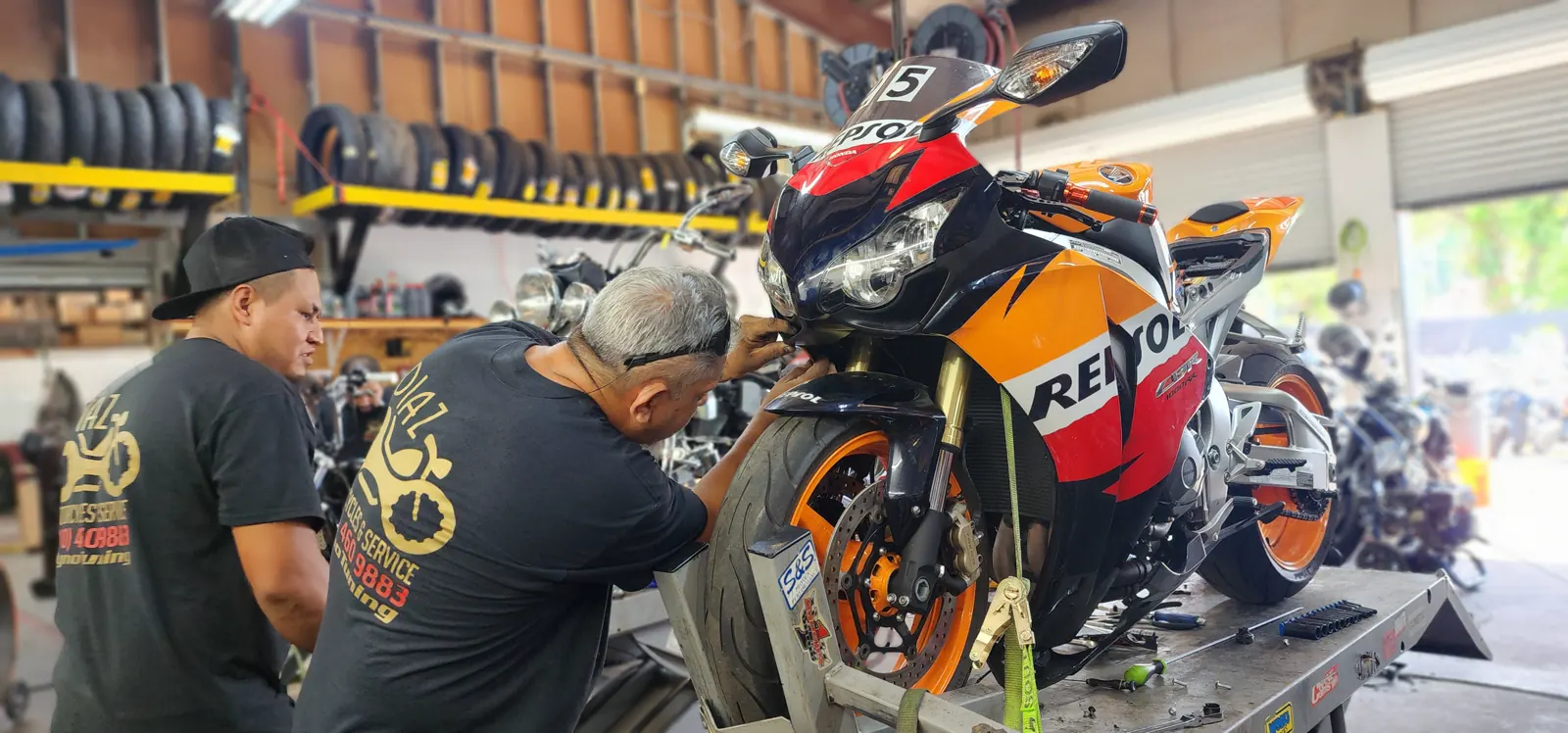
Plenty of riders have never been shown what’s on the list, so here it is in plain words. Oil and filter, drained warm and refilled to spec. Chain or belt cleaned, checked for tight spots, tensioned and lubed — or a fresh chain and sprockets together if the old set is done arguing. Tires get pressure, tread depth, date code, and a look for cupping or a plug somebody forgot to mention. Brakes get pad thickness, rotor condition, and a fluid check, because brake fluid pulls in moisture whether you ride or not.
Then the parts nobody thinks about. Battery and charging output. Coolant level and condition. Air filter. Cables and controls, worked by hand to feel for drag. Fasteners and torque on anything that matters. Lights, horn, brake light switch. Fork seals, shock, steering head bearings, wheel bearings, and a hunt for leaks along the way. That’s what you get when you bring it in, and none of it requires a dealership sign out front.
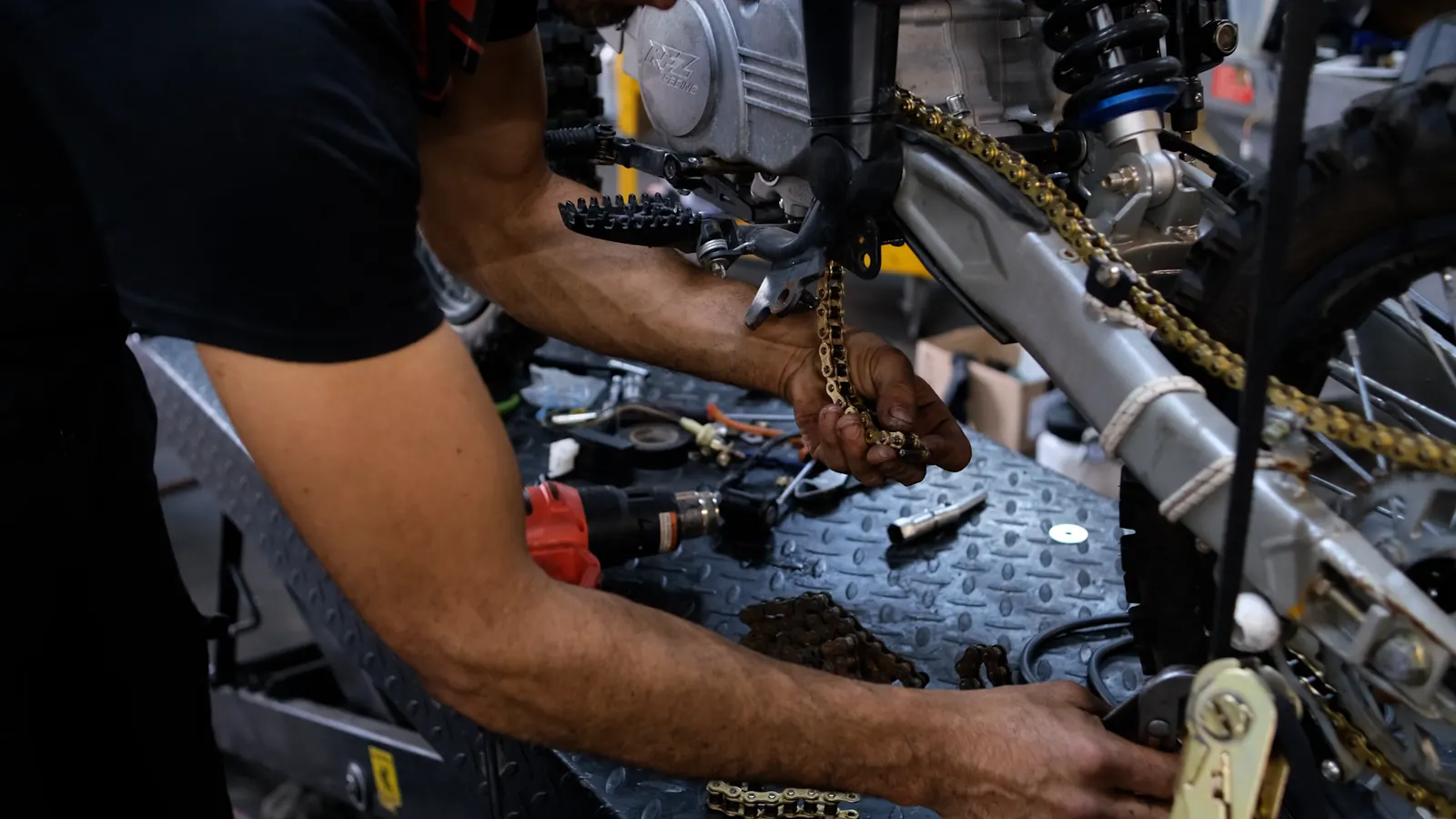
Now, the part nobody mentions until you’re already paying for it. Small things don’t stay small on a motorcycle — they recruit. A loose chain doesn’t just stretch; it eats sprockets, and now you’re buying three parts instead of one. Pads worn past the backing plate score the rotor, and rotors cost more than pads every single time. Old fuel gums an injector or a pilot circuit, and a hard-starting bike becomes a torn-down fuel system. None of that is drama, it’s just how machines behave. If you want the pattern laid out honestly, here’s what usually causes it, and it’s almost never the thing riders expect.
Nothing on a bike stays a ten-dollar problem forever. It recruits friends.
Mistakes we'd rather you skip
Most of these come from good intentions. That’s the frustrating part — riders who care get bitten by the same handful of habits. Every one has a fix, and the fix is usually easier than the mistake. We see the same six over and over, across every brand and every riding style, so please don’t take any of them personally.
- Judging tire age by tread. Read the date code on the sidewall instead, especially on a low-mileage garage bike.
- Chasing a mileage number you read online. The manual for your model sets the interval, not a forum post from another continent.
- Only fixing the thing that’s loud. The quiet stuff — fluid, bearings, fasteners — is what strands people.
- Splitting one bike across three shops. Nobody owns the history, so nobody catches the pattern.
- Booking one job at a time. If you’re making the drive anyway, make the drive count.
- Waiting for the first perfect Saturday in March to discover the battery died in December.
There’s one more, and it’s specific to how people shop. Riders assume dealer means better technician and indie means cheaper technician. Neither is reliably true. What’s true is the structure around the tech — how many bikes move through a bay in a day, whether the same person sees your bike twice, and whether anyone has time to explain the difference between now and later. Riders one county over hit this exact wall, and what Smyrna riders run into reads a lot like Paulding with more traffic.
The Paulding part, told straight
We’re roughly twenty-four to twenty-eight miles from Dallas, GA, which usually runs forty to fifty minutes on GA-120 and Charles Hardy Parkway across West Cobb into Marietta, or out 278 to the East-West Connector. We’re not going to pretend anybody drives fifty minutes for an oil change. That would be silly, and you’d know it.
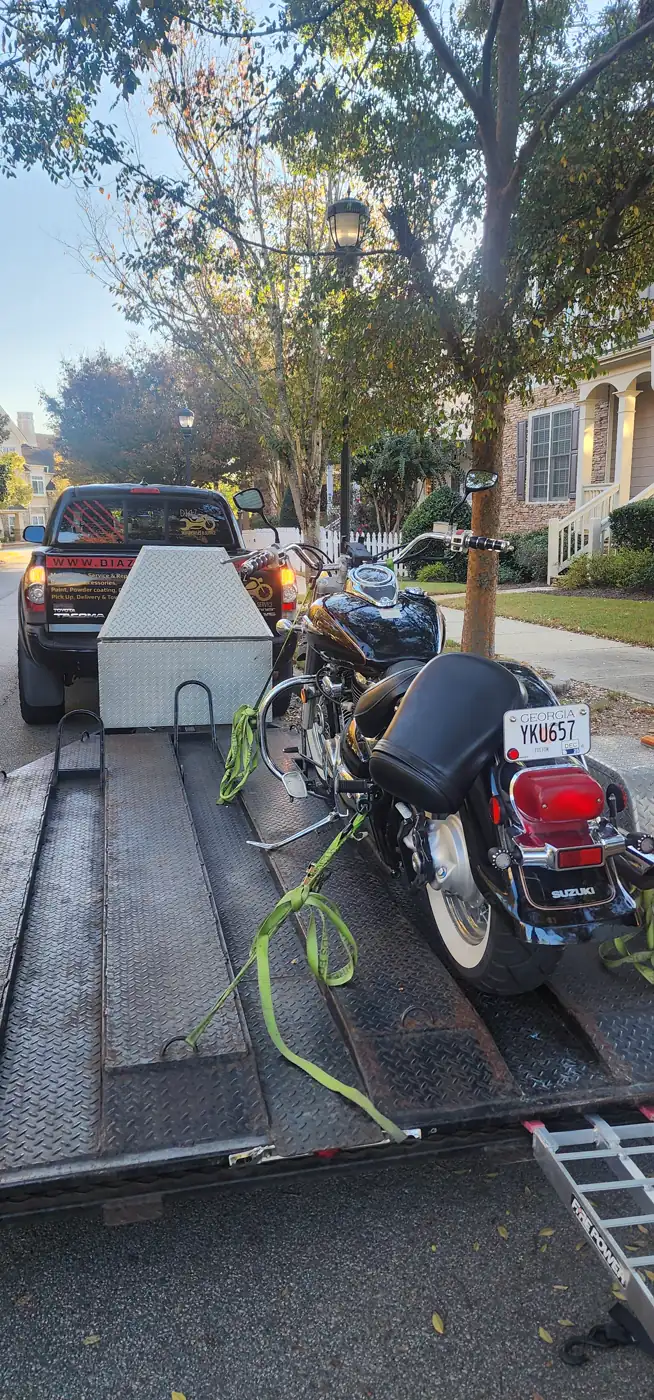
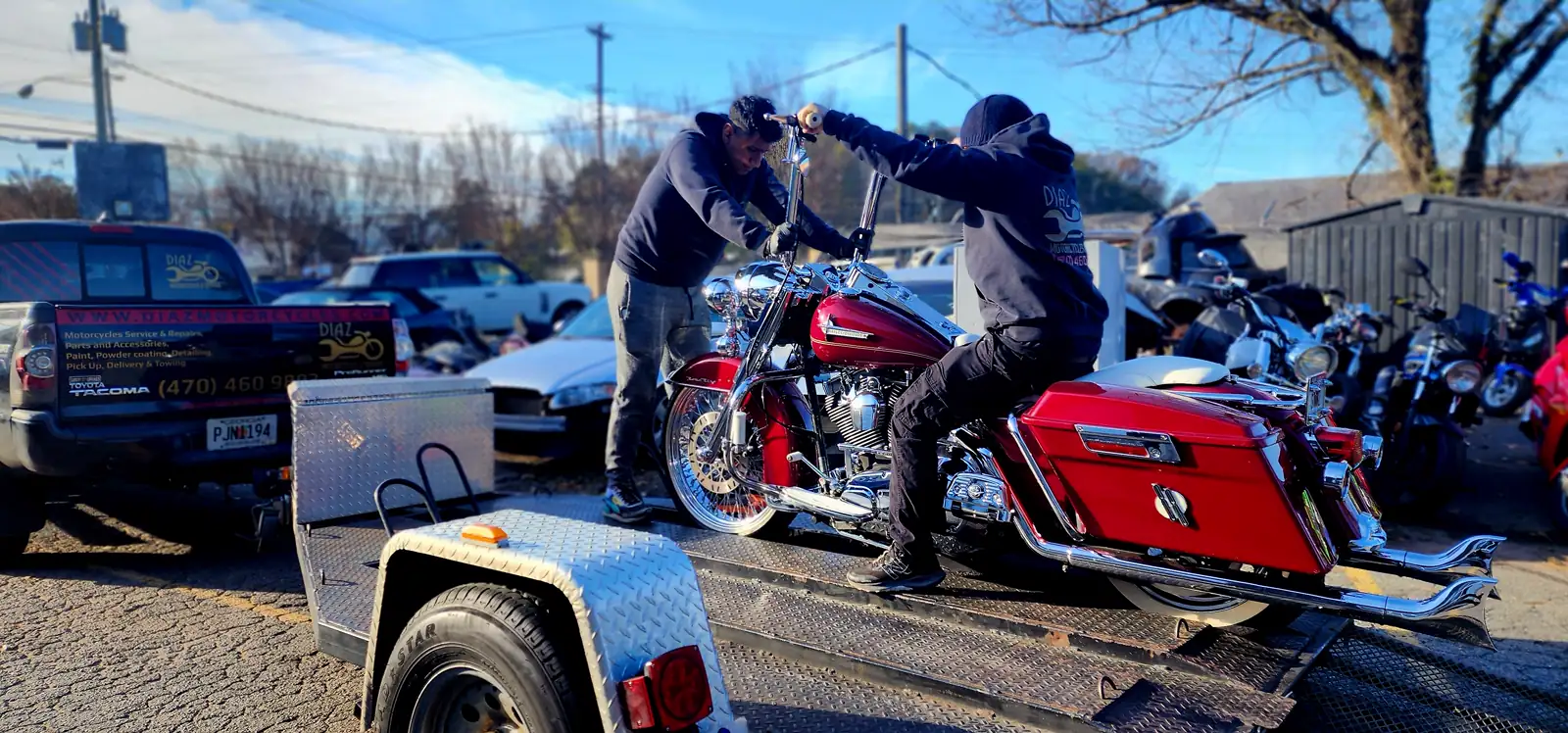
Here’s why it works anyway. Most working folks in Paulding already commute east into Cobb every morning on the exact road that runs to us. The bike drops off on the way in and gets picked up on the way home — no special trip, no lost Saturday. If your schedule doesn’t cooperate, ask us about coming to get it instead. And when you do come, bring the whole list: tires, brakes, fluids, that fork seal you’ve been ignoring. One trip, several jobs, done.
There’s no full-line motorcycle dealership in Paulding County, which is a strange thing for a county this size. Riders here end up affiliating outward — a lot of them with Southern Devil Harley-Davidson up on US-411 in Cartersville, about forty to forty-five minutes north and home to H.O.G. Chapter #1593. That’s a genuinely good option if you ride a Harley, want a club scene, and need warranty or recall work. It’s just a different direction on the map, and a different kind of visit.
The roads shape the work more than people realize. US-278 and GA-6 carry heavy truck traffic through Dallas and Hiram, so you get rutting and tar snakes that squirm under a front tire on a hot afternoon. The rural west side toward Yorkville and Braswell is chip-sealed, with loose gravel gathered at every driveway and real shoulder drop-offs. Add a construction county’s mud tracking, gravel spill and steel plates on Cedarcrest Road and Bill Carruth Parkway, plus freeze-thaw potholes peaking February through April, and tires, bearings and suspension get a workout most suburbs don’t hand out.
| Situation | Better fit | Why |
|---|---|---|
| Warranty still active | Dealer | The brand covers its own parts and labor |
| Open recall | Dealer | Factory work, factory expense, factory records |
| Brand-new model, factory-only software | Dealer | Some tools and updates aren't released outside the network |
| Routine service, fluids, chain, brakes | Independent | Same tech twice, plain answers, jobs bundled into one visit |
| Tires, wear parts, older bike | Independent | No warranty to protect, and part choice opens way up |
| Something odd you can't describe | Independent | Diagnosis time is the whole job, and it needs a real conversation |
Neighborhood to neighborhood, the bikes tell the same story. Seven Hills sends us clean, low-mileage cruisers and baggers with dry-rotted tires and tired brake fluid. Newer streets over in Timberlands on the west side bring garage space, second bikes, and half-finished projects that need one hard part solved. Established Paulding County subdivisions like Fieldcrest send the everyday stuff — commuters, mid-size standards, a sportbike or two that lives out on 278.
MAKE THE TRIP COUNT
Batch it. Tires, brakes, fluids, chain, that one electrical gremlin — all in one drop-off. One visit beats four, and your Saturdays stay yours.
And then there’s the part that’s just about riding again. Saturday morning, out before the heat sets in, the west Paulding two-lanes rolling and curving through horse property toward the Polk line. Maybe a stop at High Shoals Falls if you’re stringing together the Quad County Figure Eight, maybe a slow roll past the Shiloh Trail Covered Bridge because it’s still worth looking at. That’s the whole point of any of this. Nobody services a bike for the paperwork. Every fluid change and every chain adjustment is really just buying back mornings like that one, where the only thing on your mind is the next curve.
What good looks like when you get it right
A well-kept bike is quiet in a specific way. The chain hums instead of clacking. The brakes bite at the same spot every time, not a half-inch deeper than last week. It fires on the first button press in March after sitting since Thanksgiving. You stop doing that little mental inventory at every stoplight, wondering what that noise was. That quiet is the actual product. It’s the difference between a bike you ride and a bike you keep an eye on. If you want the full rundown of what the work covers, it’s the same list we run whether you rolled in from Hiram or Rockmart.
The riders who get the most out of this treat maintenance like a season, not an emergency. January and February are the storage window — battery tender on, fuel stabilizer in, off-season projects handled while nobody’s in a hurry. Then March hits fifty-five degrees and the bike is ready before the good weather is. Skills age the same way parts do, so plenty of our friends pair a spring service with one of the MSF rider courses and start the season sharp on both ends.
So, the recommendation one more time, with no hedging. Warranty, recall, or factory-only software: go to the dealer, and don’t let anybody talk you out of it. Everything else — the upkeep, the wear parts, the odd noise, the bike that’s been sitting since fall — bring it to an independent shop that will actually tell you what can wait. That’s the whole call on dealer vs indie service Dallas, GA riders have to make, and it’s simpler than the internet makes it sound.
One trip, several jobs, a bike that starts when you press the button. That tick you’re hearing right now is still a ten-minute fix. It won’t be in May.
Questions Dallas and Paulding County riders ask us
What's the real difference between a dealer and an independent shop?
Structure, mostly. A dealer is tied to one brand, carries that brand’s tools and software, and handles warranty and recall work the factory pays for. An independent shop works across brands, chooses parts more freely, and usually keeps the same technician on your bike visit after visit. Both can employ excellent techs — the difference is who owns your bike’s history.
Which one should I pick for my bike?
If it’s under warranty, has an open recall, or needs factory-only software, the dealer is the right answer every time. For routine service, wear parts, tires, brakes and anything on an older bike, an independent shop is the better fit for most Paulding riders. Bikes past the warranty window almost always land on the independent side.
Is upgrading parts during a service actually worth it?
Sometimes yes, sometimes it’s just shiny. Tires, brake pads and chains are where an upgrade changes how the bike feels the same day you ride it. Cosmetic parts are fine to want, they just don’t make the bike work better. We’ll tell you which bucket a part falls into before anything gets ordered.
Which lasts longer, dealer service or independent service?
Neither one wins on the sign out front. Longevity comes from the same three things everywhere: fluids changed on the schedule your owner’s manual sets, wear parts replaced before they damage their neighbors, and someone catching the small stuff early. A shop that knows your bike’s history will spot patterns a rotating cast of techs won’t.
Which is right for the way I actually ride?
If you rack up highway miles out on 278 and lean on warranty coverage, the dealer relationship earns its keep. If you ride weekends on the west-side two-lanes, keep a second bike in the garage, and do some of your own wrenching, an independent shop is a better match. We’re happy to handle only what you’d rather not do yourself.
Is the drive from Paulding County worth it for maintenance?
Not for one small job on its own, and we won’t pretend otherwise. It’s worth it when the bike drops off on your existing commute east into Cobb, or when you batch several jobs into a single visit. If neither works with your schedule, ask us about coming to get the bike instead.
We take care of riders across Paulding, Cobb, Bartow, Douglas and Polk counties, and plenty of them come from Dallas, GA and neighboring Hiram. Powder Springs and Marietta riders make the run east regularly, while folks in Acworth and Kennesaw come down from the north side. We also see bikes from Douglasville and Villa Rica along the I-20 side, Cartersville up US-411, and Rockmart, Taylorsville, Braswell and Yorkville out on the rural western two-lanes. If you’re somewhere in that arc, you’re close enough for us to be your shop.
ONE TRIP, EVERY JOB
If you’re in Dallas, GA or anywhere in Paulding County, text or call us with your list before you make the drive. Tell us what the bike is doing, what you’ve been putting off, and when you need it back. We’ll build one visit around all of it — and if the timing doesn’t work, ask about us coming to get it.
470-460-9883Diaz Motorcycles and Service, LLC · 847 Barnes Mill Road, Marietta, GA 30062