Service Shop Peachtree City — How to Choose
A few plain questions will tell you more about a shop than any five-star average ever will.
You know the tone. So you roll the bike in, you describe the sound you’ve been hearing since that ride down to Pine Mountain, and the guy at the counter gives you a little smile. Not a mean one. Still, Just the one that says he already decided you don’t know what you’re talking about. Then he names a part before the bike has ever seen a lift. Plus, that moment is what sends riders hunting for a better service shop Peachtree City can actually rely on. You asked a question. You got a verdict.
Here’s the thing, though. That first minute tells you almost everything. Someone who asks what changed — when the noise started, whether it does it cold or hot, what the road was doing — is someone who plans to look. Meanwhile, Someone who skips straight to the answer is guessing. Of course, Guessing is the most expensive thing in any shop, and it never once shows up on the invoice. In fact, the good news is that you can spot the difference before you ever hand over a key.
Why even decent shops end up sounding like that
For example, most of the time it isn’t ego. It’s volume. Even so, a busy service counter runs a lot of people through in a day, and after the hundredth “it’s making a weird noise,” the brain starts sorting bikes into buckets instead of hearing riders. What’s more, Stack a full schedule on top of that and the fast answer beats the right one. After that, we understand how a shop gets there. We just don’t think it’s a good enough reason to hand you a diagnosis that somebody else’s bike earned.
None of that makes other shops villains, either. Dealers do real work, and factory tooling and factory training genuinely matter, especially on a newer bike with a warranty still attached. Cycle City Power Sports sits about twenty-five minutes west in Newnan and carries Honda, Kawasaki, Suzuki and Yamaha, which makes it a sensible stop for plenty of PTC riders. If your machine is a current model and the question is warranty, a franchise counter is often the right door. The picture gets thinner past that.
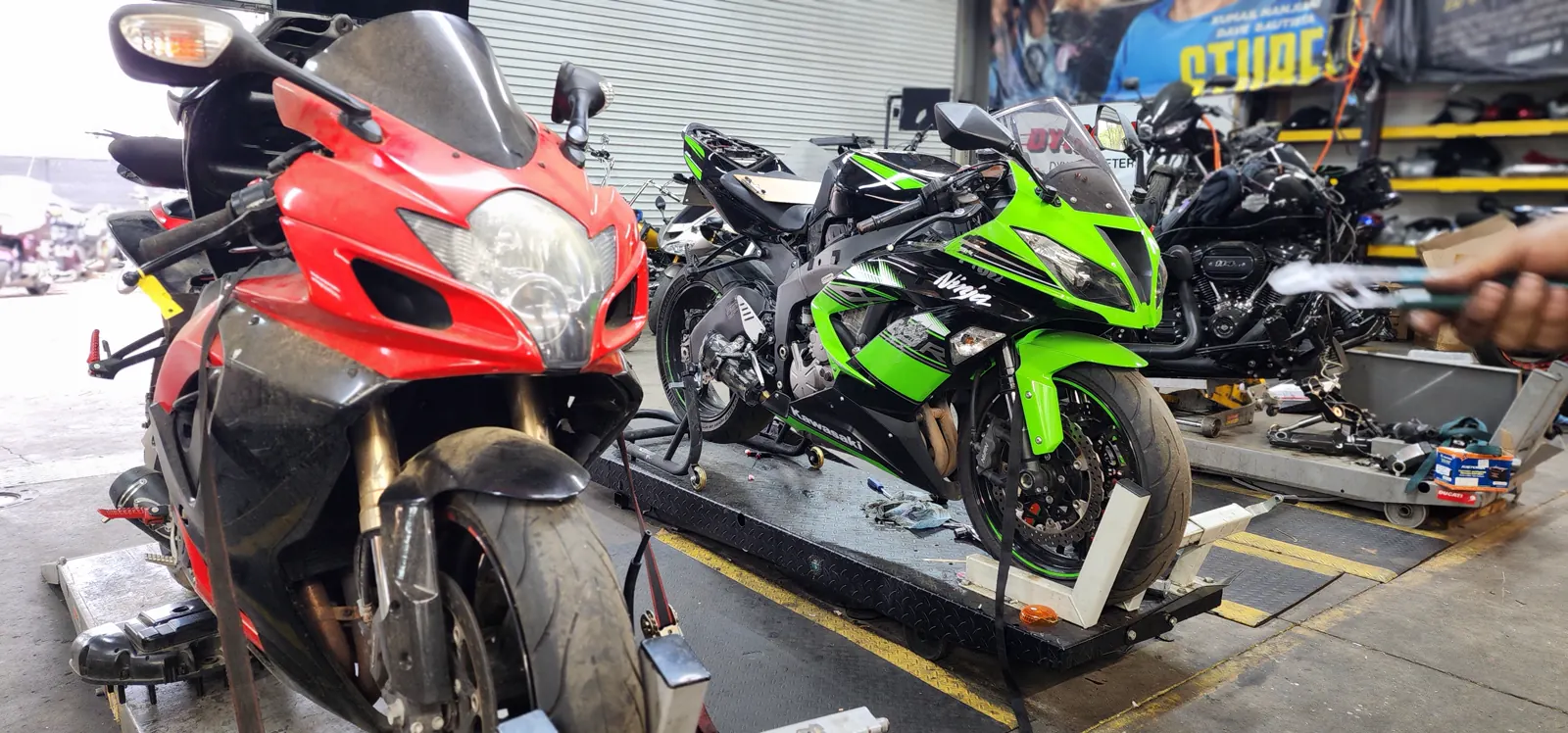
Past that means the bike that’s twelve years old and still perfect. It means the bagger with a stone chip in the tank that’s been nagging at you for two seasons. It means the project sitting under a cover at the back of the garage, half finished, waiting on somebody with time. That kind of work is patient work. Patient work needs bench space, lift time, and a tech who’s allowed to slow down.
Questions that separate a careful shop from a fast one
You don’t have to be a mechanic to run this test. You only have to listen to how somebody answers you.
- Ask what they’d check first. A careful answer names a test — a compression check, a fluid sample, a spin of the wheel to watch the chain and sprockets move. A rushed answer names a part.
- Ask what they found on the last bike like yours. Shops that touch a lot of machines have stories. Shops that guess have opinions.
- Ask to see the old parts when the job is done. Anybody proud of the work hands them over without blinking.
- Ask what happens if the first fix doesn’t solve it. You want a plan, not a shrug.
- Ask who is actually turning the wrench on your bike and how long they’ve been at it. It’s a fair question, and a good shop likes hearing it.
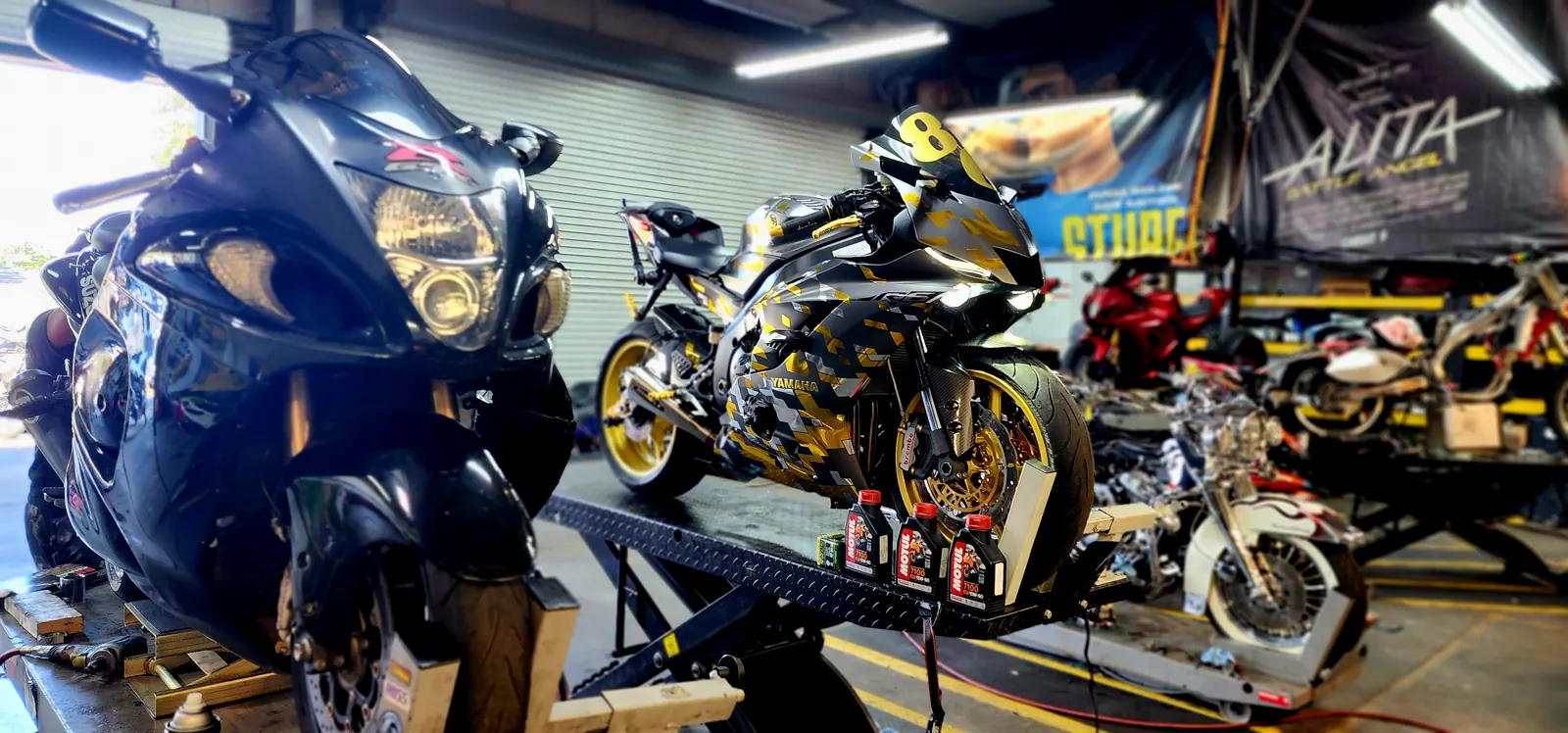
Look at the floor too, if they’ll let you see it. Spotless isn’t the goal, because a working bay is never spotless. Order is the goal. Tools within reach. Bikes strapped down straight. Tires racked on the wall instead of ordered one at a time when somebody finally needs one. Our maintenance page lays out everything we cover, and it’s worth a scan before you call anyone at all, because it hands you the vocabulary to ask sharper questions at any counter you walk up to.
How we work out what's actually wrong
We start with your story. What you noticed, when it started, and what the bike was doing at the time. Then we ride it if it’s safe to ride, because half of what a machine has to say only comes out with weight on it and heat in the engine. After that it goes up on the lift and we go hands-on: wheels spun, chain checked cold, pads measured, fluids looked at in good light instead of squinted at through a sight glass in a dim corner. Only then do we tell you anything.
Now flip it around and look at it from the bike’s side. A motorcycle almost never breaks all at once. It gets a little dry, then a little loose, then a little hot, and every step feels normal because it arrived slowly. Chain slack creeps. Pads thin out a millimeter at a time. Oil stops being oil and becomes a dark liquid that used to be oil. Nothing announces itself. That’s exactly why catching small things early is easier, and cheaper, than chasing big ones later.
So the honest version of maintenance is a little boring, and boring is the whole point. A wheel bearing caught while it’s just slightly rough is a small afternoon. The same bearing found after it takes the hub with it is a very different week. Same story with a chain that eats a sprocket, or brake fluid that quietly stops doing its job in July heat. Small stays small far longer than most riders expect.
What a service actually includes, in plain words
Service isn’t one thing, so it helps to see it laid out. On a normal maintenance visit, here’s roughly what a bike gets.
- Oil and filter changed, with the old oil actually examined instead of just dumped. Metal flake in the pan is information.
- Chain cleaned, adjusted and lubed, with sprocket teeth checked for hooking. Belt and shaft bikes get their own version of this.
- Brakes opened up far enough to measure pad thickness and inspect the rotors, plus a look at the fluid, which ages whether you ride or not.
- Tires checked for tread depth, age, cupping and pressure, because a garage-kept bike can carry perfect tread on tires that are simply old.
- Coolant, fork oil and the rest of the fluids inspected, topped or replaced on their own schedule.
- Battery load-tested, charging system checked, and every light, fuse and switch clicked through.
- A full walk-around for loose fasteners, cracked hoses, dry cables, weeping seals and anything rubbing where it shouldn’t.
How often should all that happen? Your owner’s manual sets that, not us and not a forum thread. Every manufacturer writes its own intervals, and they shift by model, by year and by how the bike gets used. What we’ll do is read yours with you and build a plan around how you actually ride. If a valve check is coming due, we’ll show you where it sits in the book and walk you through how we handle that job before you commit to a thing.
The Peachtree City part of this
Here’s the local reality, and we won’t dress it up. There’s no verified motorcycle dealership or repair shop inside the PTC city limits, so finding a service shop Peachtree City riders can use has always meant leaving town. That means the “we’re closer” argument doesn’t really exist for anybody here. Our shop sits up in East Cobb, roughly fifty-some miles north depending on the route, which is realistically an hour to an hour and a half behind the wheel. That’s an estimate off the map, not a stopwatch, and nobody makes that trip for an oil change.
So we don’t ask you to. Nothing naturally routes a PTC resident toward Cobb County — you’re heading north on GA-74 to I-85 for the airport, or east on GA-54 toward Fayetteville, and that GA-54 and GA-74 corner is where the whole city’s errands pile up anyway. Add the classic left turn across traffic there and it’s not anybody’s favorite intersection. A run up to us is a planned errand or it’s a truck trip, plain and simple.
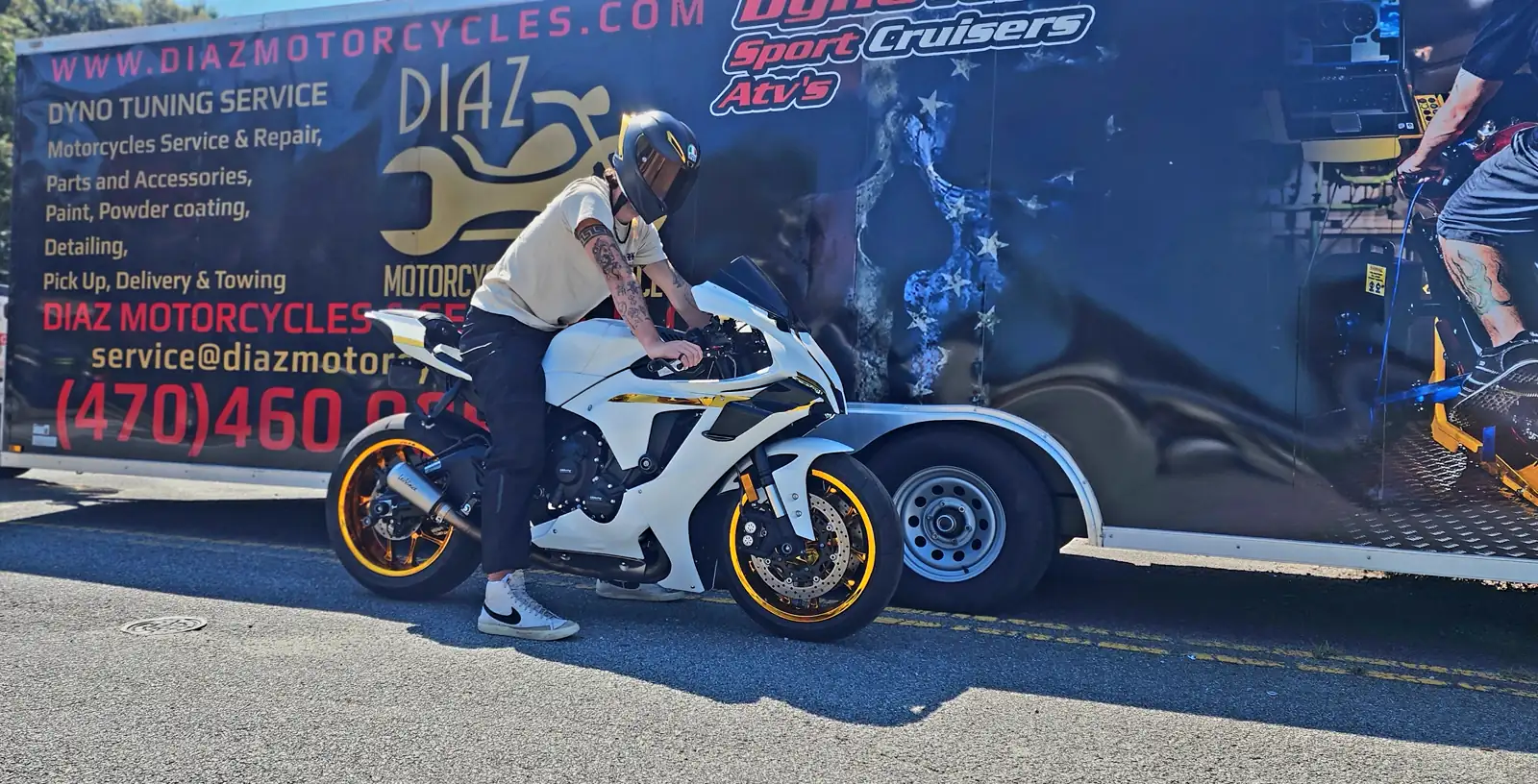
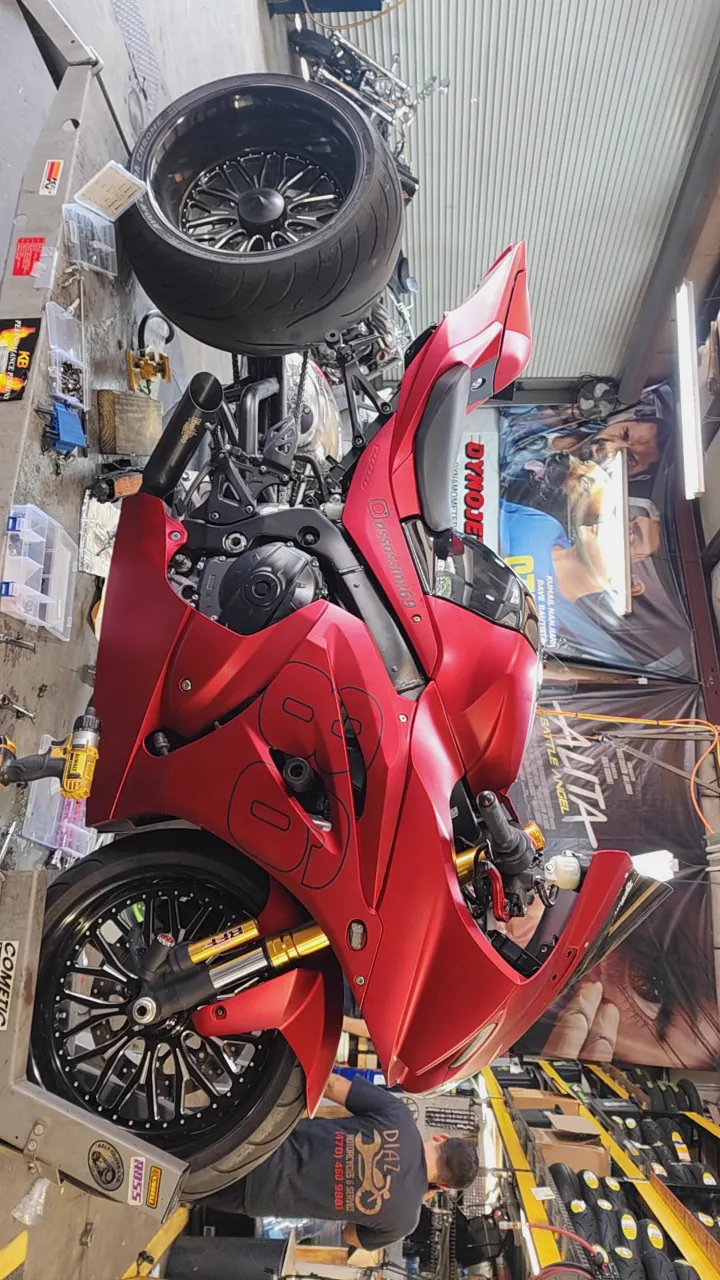
There’s a detail in all this that changes how you’ll ride out of here. We paint in-house. There’s a booth in the building, so the same shop that services your bike can also chase out that stone chip, redo a scuffed fairing, or take a tired cruiser back to something you’d happily stand next to at a show. As far as we can find, nobody in Fayette County paints motorcycles. That’s no knock on anyone down there — it’s simply a thing that isn’t offered nearby.
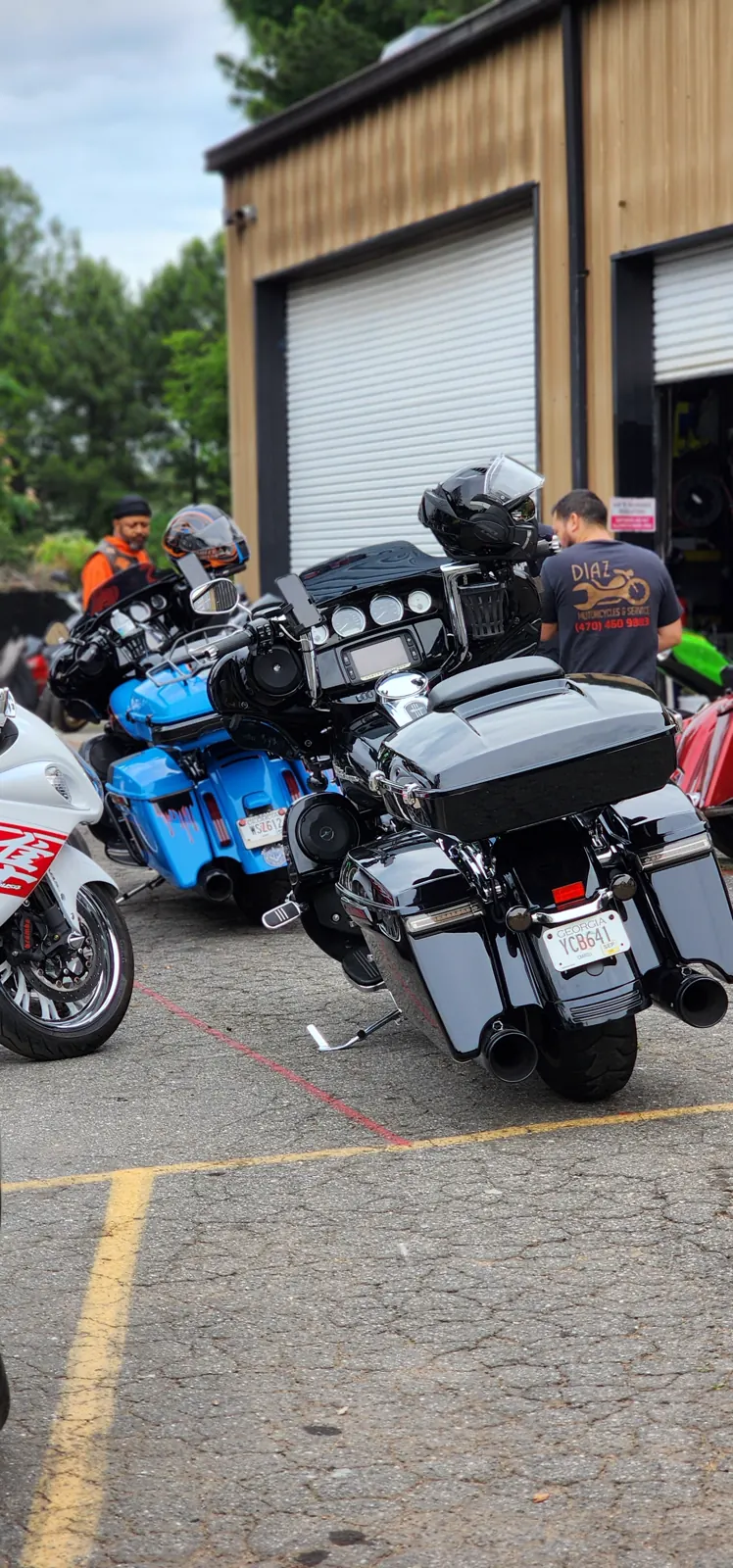
That changes the math on the drive for a town full of hobby bikes. Nobody hauls a machine an hour for fresh oil. Plenty of people will haul one for paint, for a restoration, or for the kind of detailing that makes a fifteen-year-old bagger look like the day it left the crate — and while it’s here, the service gets done too. That’s the honest case for a shop this far out, and it’s the same case riders over in Cartersville make when they point a truck our way.
WE COME GET IT
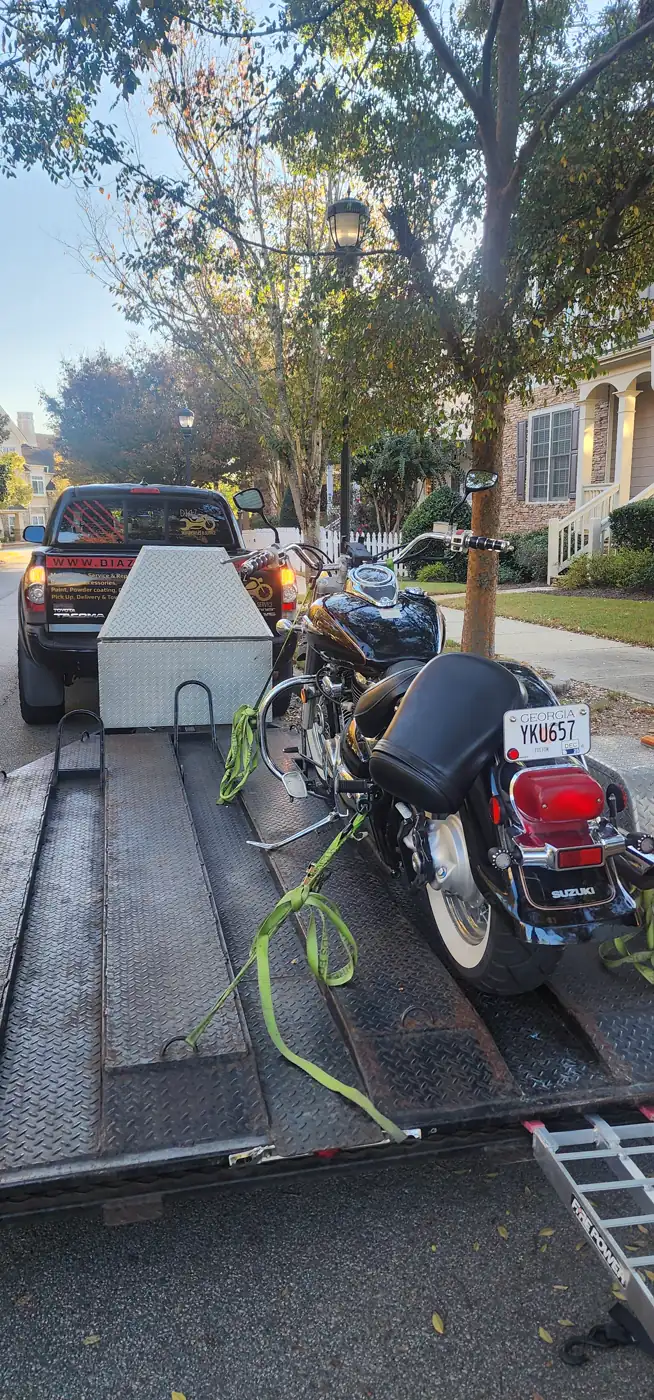
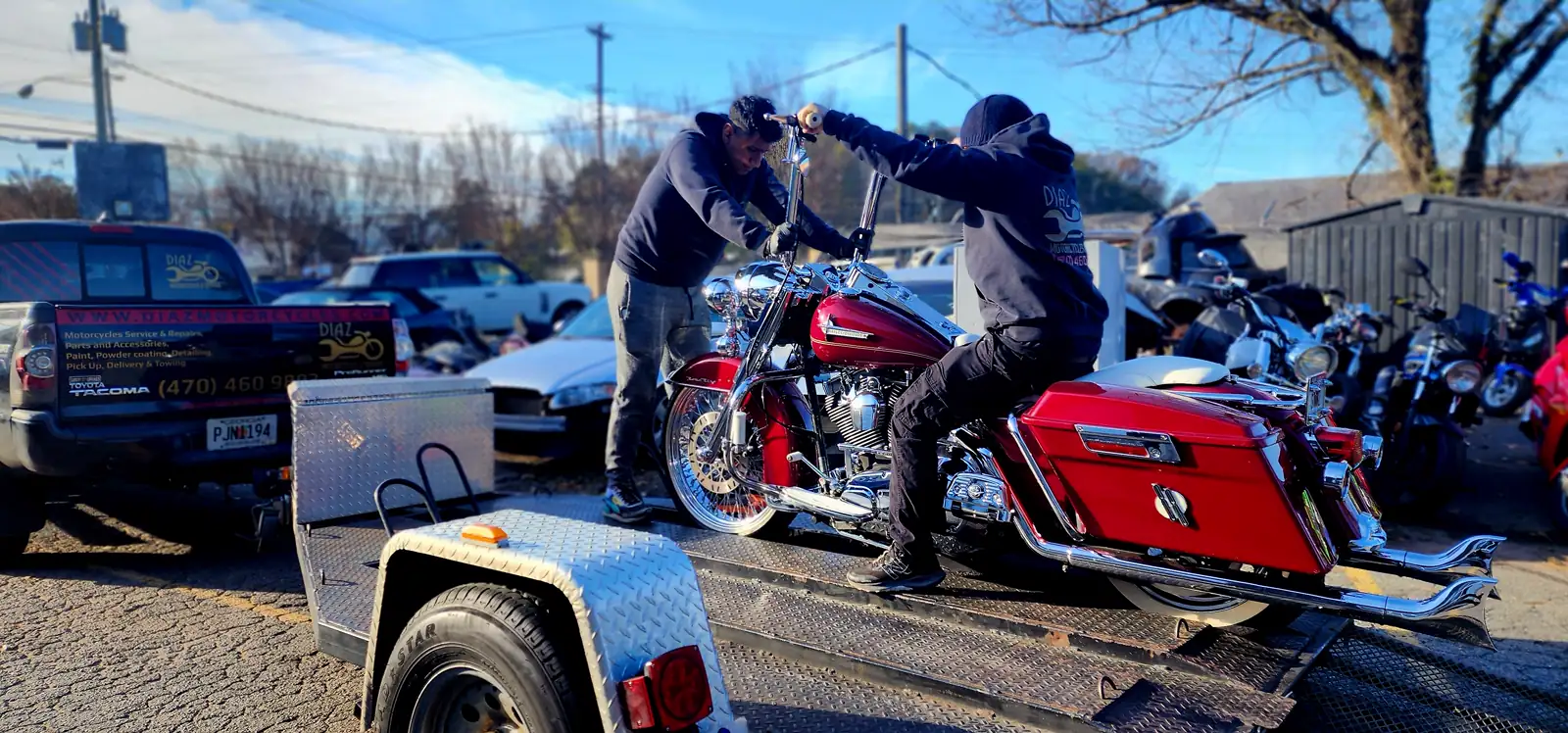
We pick bikes up around Fayette and Coweta and bring them back when the work’s done. Batch it — service, tires, a paint repair, that noise you’ve been meaning to mention — and one trip covers a whole season.
We know this map better than you’d guess. Bikes come to us from Aberdeen, from the Kedron Estates and Kedron Hills side, and from Wilshire Estates, and they all look about the same rolling off the trailer: garage-kept, low miles, covered, parked on a tender all winter. You see them out on a clear Saturday near McIntosh Trail Recreation Complex, where the walking trails, the BMX track and the dog park keep that lot humming, or sitting by Atlanta Regional Airport – Falcon Field while somebody watches the small planes drop in.
Those low miles are a mixed blessing, though. A bike that sits is a bike whose fluids age without ever getting properly hot, whose tires harden, and whose battery slowly gives up in silence. Summer down there does its own work — ninety-degree afternoons, thick humidity and near-daily storms are rough on seals, gaskets and batteries. Heavy canopy holds moisture on shaded curves long after the sun returns, and wet leaves, acorns and sap on a curvilinear street with a cart path crossing in it are a fine reason to want your brakes exactly right.
One more thing catches good riders off guard, so it’s worth saying out loud: fluids age on a calendar, not an odometer. Brake fluid pulls in moisture, coolant loses its bite, and fork oil turns to dark syrup, and none of it cares that the bike only saw four hundred miles last year. We put the full rundown on it together if you want the details. And if you’re newer to riding, or coming back after a long layoff, an MSF Basic RiderCourse is one of the better days you can spend before the season really opens up.
A good shop earns your trust with questions, not with confidence.
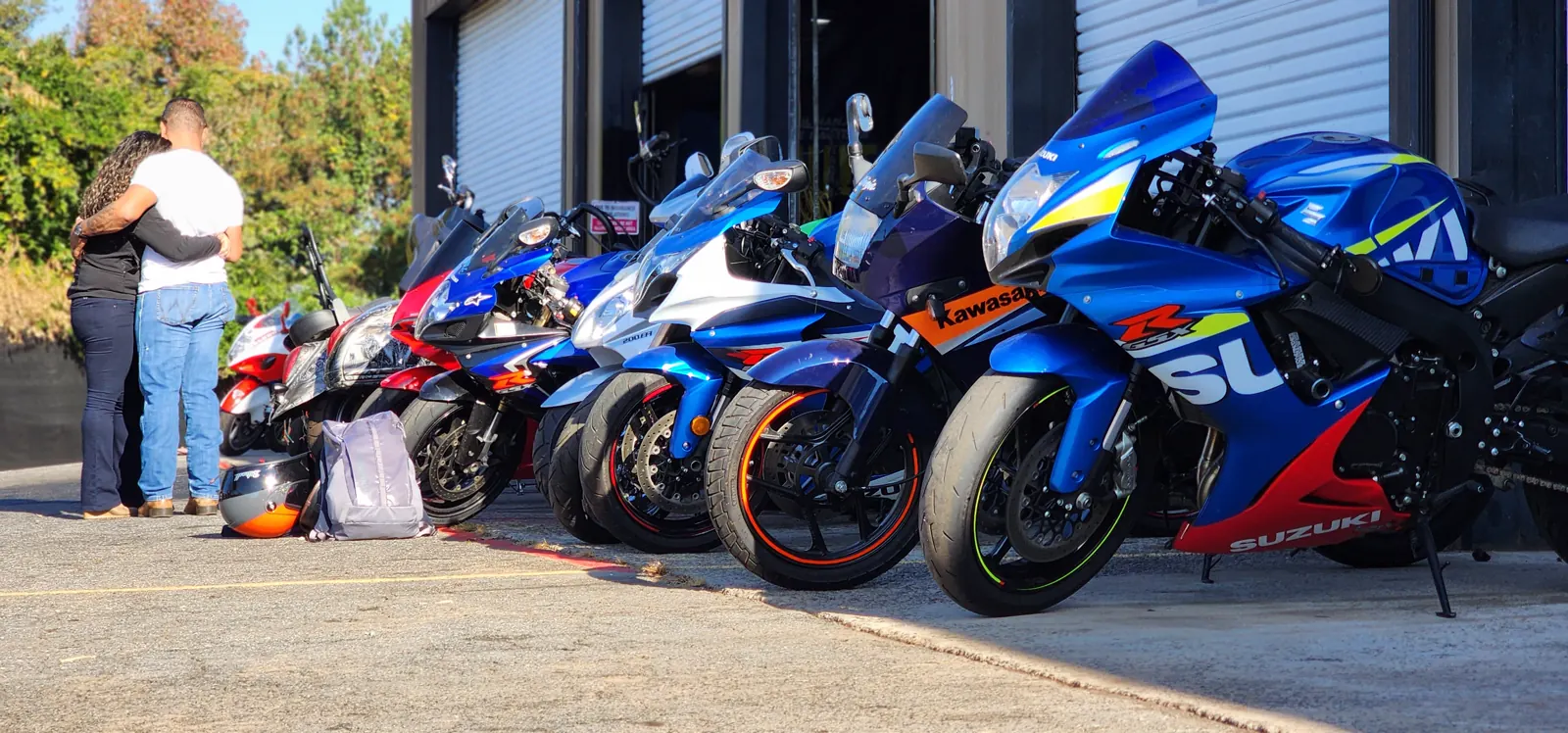
Here’s what we’d love you to take away from all this. Choosing a shop isn’t a leap of faith. It’s a short conversation, a handful of plain questions, and a look at how people treat a bike that isn’t theirs. Ask them. Ask us too, honestly — we’d much rather answer twenty questions now than have you wondering later. Whether you’re pointing the bike toward Pine Mountain, FDR State Park and the GA-190 ridge with Callaway Gardens waiting at the end, or you just want it right before spring, you should feel good handing somebody the key.
Questions Peachtree City riders ask us
How far out do you actually serve?
Well past Cobb County. We work on bikes from all over the south metro, Peachtree City very much included. Distance stops being the deciding factor once transport is part of the deal, and it usually is for riders down your way.
Can you pick up my bike?
Yes, and for Peachtree City that’s normally how it goes. We come get the bike, do the work, and bring it back to your garage. It saves you a trailer, a Saturday and a trip up GA-74 to the interstate.
How do I know your diagnosis is right?
Because we show you. You’ll hear what we checked, what we found, and what the old parts looked like, and we keep them for you to see. If a symptom could have two causes, we’ll tell you both instead of picking the convenient one.
What makes you different from a dealer?
Dealers are good at what they’re built for, especially warranty work on current models. We’re built for everything past that — older bikes, custom builds, restorations, and in-house paint, which is hard to find anywhere near Fayette County. Same building, same techs, start to finish.
How do I pick a good shop in general?
Ask what they’d check first and see whether they name a test or a part. Ask who’s touching your bike. Ask to see the old parts afterward. A shop that welcomes those questions is a shop that’s already doing the work properly.
Is it worth traveling for maintenance alone?
Honestly, no, and we won’t pretend otherwise. What makes the trip worth it is batching — service plus tires plus a paint or detail job in one visit. Add pickup and delivery and the whole thing costs you a phone call instead of a day.
We take care of riders all around the south metro, starting in Peachtree City and running out through Fayetteville, Tyrone, Brooks and Woolsey. Head west and we’re picking up bikes in Newnan, Sharpsburg and Senoia, where the back roads make a good excuse to ride even when the bike’s overdue. North and east we cover Fairburn, Union City and Palmetto, plus Jonesboro and Riverdale on the Clayton side. If your town sits somewhere in that stretch and isn’t named here, ask us anyway — the truck goes a lot of places.
TELL US WHAT IT'S DOING
Send us a text and describe the noise, the leak, the wobble, or the paint you’ve been meaning to fix. We’ll ask a few real questions, tell you what we’d check first, and set up a pickup so your Peachtree City garage stays a garage instead of a waiting room. No pressure and no lectures — just a straight answer about your bike.
470-460-9883Diaz Motorcycles and Service, LLC · 847 Barnes Mill Road, Marietta, GA 30062