Dealer vs Indie Service Atlanta — Which Is Right
Two good options, one honest recommendation, and the exact situation where the other one wins.
Of course, you’re crawling south on the Downtown Connector at the wrong end of rush hour. In fact, Clutch in, boots down, twelve lanes of brake lights ahead of you. For example, the idle sags a little every time you creep forward. Even so, the fan kicks on and never kicks off. What’s more, and somewhere under the tank there’s a faint tick you’ve never heard before, and now you can’t unhear it. That is the moment most riders open their phone, and it’s the moment the dealer vs indie service Atlanta question stops being a forum argument and starts being your Tuesday.
Good news first. Neither answer is a trap. After that, a dealer can take beautiful care of your bike. So can a good independent shop. Also they’re simply built for different jobs, and once you see how each one is built, the choice gets easy. Instead We’ll lay both out straight, tell you which one we’d point a friend toward, and name the exact case where the other one wins.
First, what your bike is actually telling you
Bikes rarely break all at once. They drift. Besides a chain goes a little loose, then a little dry, and then it snatches when you roll off the throttle at a red light. Actually Brake fluid darkens and the lever creeps closer to the bar. That’s why Tire pressure bleeds off a pound a month until the front end feels vague turning into a driveway. None of that is dramatic. Either way All of it is your bike raising its hand.
That’s why small stuff beats big stuff. A stretched chain caught early costs you a chain. Left alone, it takes the front sprocket, the rear sprocket, and sometimes a case cover with it. Brakes, tires, coolant, valve clearances — same pattern every time. Parts wear on their own schedule, and that schedule has never once checked your calendar.
PLAIN TRUTH
A service isn’t magic. It’s a trained person putting eyes and hands on every wear item at once, while looking is still the cheap part.
Why Atlanta riding speeds all of it up
In-town miles are hard miles. Georgia law keeps you fully inside one lane, so filtering and splitting are both off the table here, which means a hot afternoon on the Connector is a long session of clutch, fan, and idle. Add an event day around Mercedes-Benz Stadium on Northside Drive and that crawl gets longer. Your engine, clutch pack, and battery all feel it before you do.
Then there’s the pavement. Streetcar rails sit embedded in Edgewood, Auburn, Peachtree, Luckie, and Jackson, and Peachtree Street carries stretches of utility trench under steel plate. The city runs a Pothole Posse and a public resurfacing dashboard, which tells you plenty on its own. This surface diet eats fork seals, wheel bearings, rims, and steering-head bearings faster than suburban roads ever will.
Riding style stacks on top. Short hops around Moreland Avenue and the east-side grid keep small-displacement bikes and supermotos on cold oil and heat-cycled batteries. The curving garden-suburb streets of Ansley Park beside Piedmont Park and the Victorian blocks of Inman Park are lovely and low-speed, which is easy on tires and rough on carbon. Up in Tuxedo Park, near the Governor’s Mansion and a few minutes from the Atlanta History Center on West Paces Ferry Road, big touring bikes and premium European machines idle through estate streets that never let them stretch out. And with most in-town riders parking on a condo deck with no outlet for a tender, batteries quietly die in the dark.
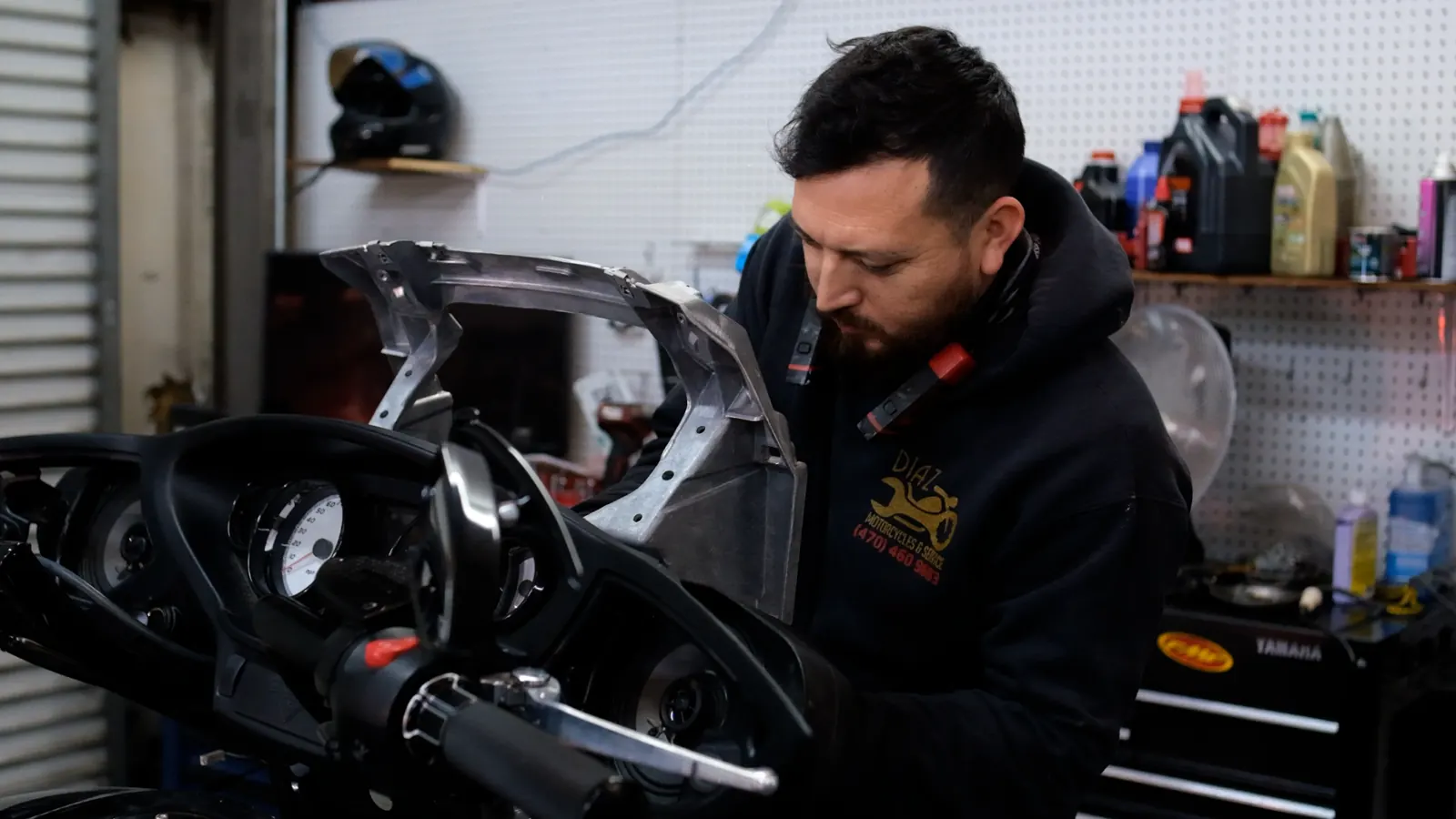
The internet will tell you one thing. The bikes tell us another.
Search this topic and you’ll get two loud camps. One says dealers are the only safe hands. The other says dealers are a markup with a lobby. Neither matches what rolls through our doors. What we actually see is bikes that were serviced by someone paying attention, and bikes that weren’t. The sign on the building matters far less than whether a real person looked at the whole machine.
How either shop should figure out what's wrong
Good diagnosis starts with a ride or at least a full warm-up, because plenty of faults only show up hot. Then codes get pulled, fuel trims get read, and the bike goes on the lift. Wheels get spun by hand. Fork legs get wiped for weep. Chain slack gets measured, not eyeballed. Fasteners get checked in the spots vibration loves. Only after that does anybody start naming a repair.
That order matters. A surging idle and a hot-running engine can point at a lean condition, and if that’s where your symptoms sit, we wrote the full rundown on it so you can see the whole picture before anyone touches your bike. Guessing is what turns a small ticket into a long one.
The last piece is communication. You should get plain notes, photos of the worn part, and a straight answer about what’s urgent versus what can wait a season. In-town riders tell us constantly that they judge a shop by whether it texts back. Honestly, that’s a fair test.
What each one is genuinely built for
The dealer
A dealer is built around one brand. That’s a real advantage. Factory training, factory diagnostic software, factory parts on a shelf, and warranty and recall work that nobody else can legally perform. If your bike is new, still covered, or has an open recall, a dealer is the obvious call. Brand-specific service bulletins land in their inbox before they land anywhere else.
The independent shop
An independent is built around riders. We see every brand, so we see patterns across brands. There’s no service advisor layer between you and the person holding the wrench. We can source parts from more than one place, reuse what’s still good, and say plainly that a job can wait. On older bikes, modified bikes, and anything that needs judgment instead of a flowchart, that flexibility does real work.
| What you need | Dealer | Independent |
|---|---|---|
| Warranty or recall work | Yes, only place | No |
| Brand-new model year | Strong | Depends |
| Out-of-warranty routine service | Fine | Strong |
| Older or modified bike | Depends | Strong |
| Talking to the actual tech | Rare | Normal |
| Dyno tuning and ECU flash | Rare | Strong |
| Paint, bodywork, restoration | Sent out | In house |
What a real service actually covers
People picture an oil change. A proper service is much wider than that, and it’s the width that saves you money later. Here’s the honest list:
- Oil and filter, plus a look at what came out of the drain plug
- Chain slack, chain lube, and sprocket teeth checked for hooking
- Brake pad thickness, rotor wear, and fluid condition at both ends
- Tire pressure, tread depth, age, and any cupping or flat-spotting
- Coolant strength and level, hoses squeezed for softness
- Battery health under load, plus charging output at the terminals
- Air filter, cables, levers, and every light on the bike
- Fork seals, wheel bearings, and steering-head play checked by hand
- Torque on the fasteners that Atlanta pavement likes to loosen
On intervals, we’ll always point you to your owner’s manual rather than a number we made up. Manufacturers set those distances for a reason, and they vary a lot by bike. Ask us and we’ll read yours with you. For deeper reading on rubber, Michelin’s motorcycle tire resources explain wear and pressure better than most shop counters do.
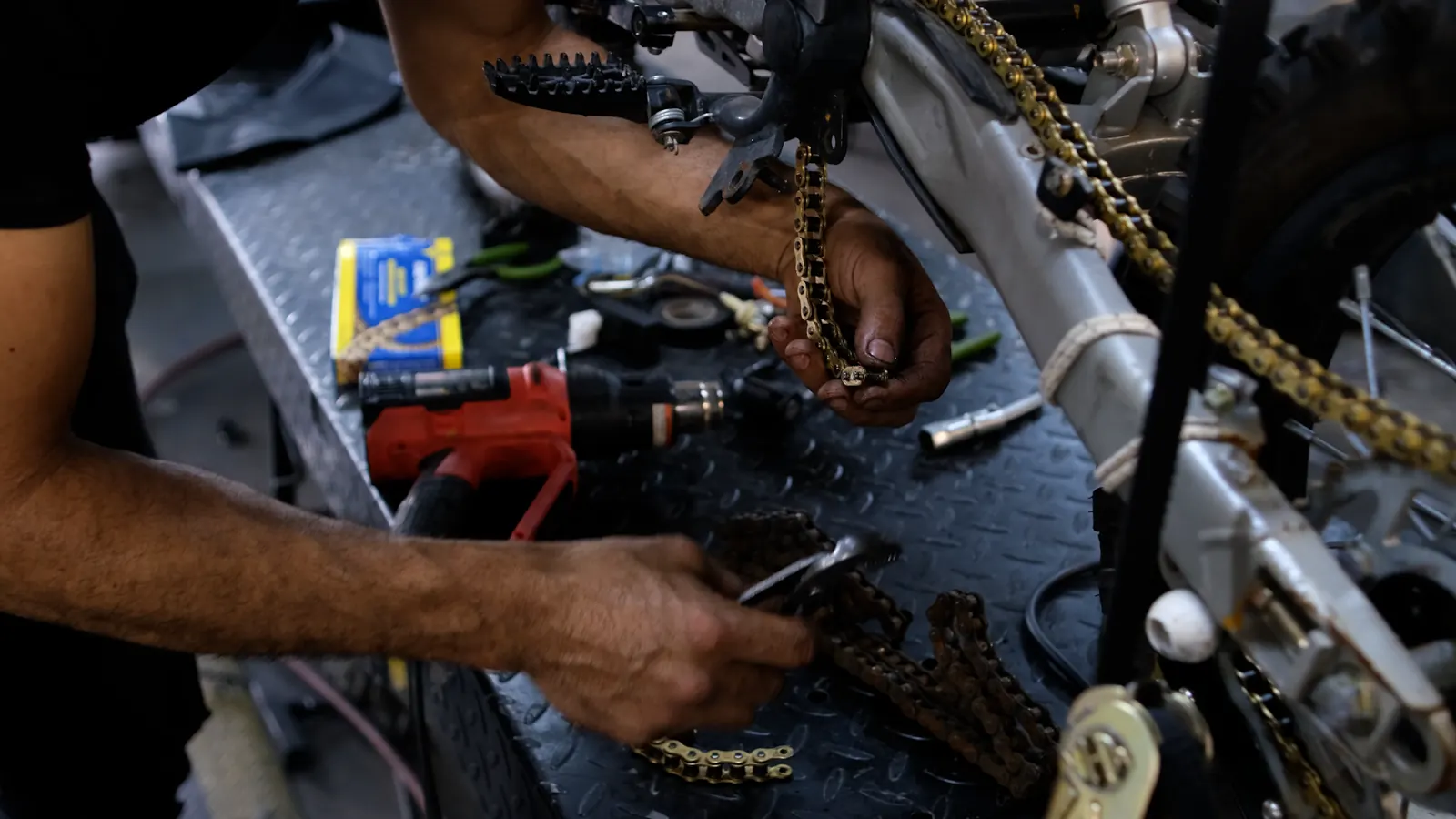
Our recommendation, with no fence-sitting
For most in-town riders, here’s where we land on dealer vs indie service Atlanta: if your bike is out of warranty, ride it to a good independent and stay there. You get one shop that knows your history, one tech who remembers your bike, and honest triage instead of an upsell menu. Continuity is the whole prize. A shop that has seen your chain three times knows exactly how fast it’s stretching.
Now the other side, because it’s real. Take it to the dealer when the bike is under warranty, when there’s an open recall, when a factory-only software update or proprietary tool is required, or when the model is so new that parts simply haven’t reached the aftermarket yet. In those cases the dealer isn’t the safer bet, it’s the correct one. Anyone who tells you otherwise is selling something.
There’s a middle path too, and plenty of friends we’ve helped ride it. Warranty and recall work goes to the dealer. Everything else — fluids, chains, tires, brakes, tuning, bodywork — lives with an independent. Nothing stops you from switching either direction later, and nothing about using one voids anything with the other.
A quick story, because it makes this concrete. A rider from Inman Park brought us a mid-size naked bike that had been in for an oil change twice in a year and still felt off — heavy clutch pull, weird surge at low rpm, front end chattering over rail crossings. Two visits, two receipts, no fix. It wasn’t anybody’s fault. Nobody had been asked to look past the oil.
We put it on the lift and looked at the whole bike. Fork seals were weeping. The chain was tight in one spot and loose in another. Clutch cable was dry as a stick. One afternoon later, all three were sorted, and the surge went with them. That rider didn’t need a different brand of shop. He needed one that looked at everything at once. That’s the real difference under all the noise.
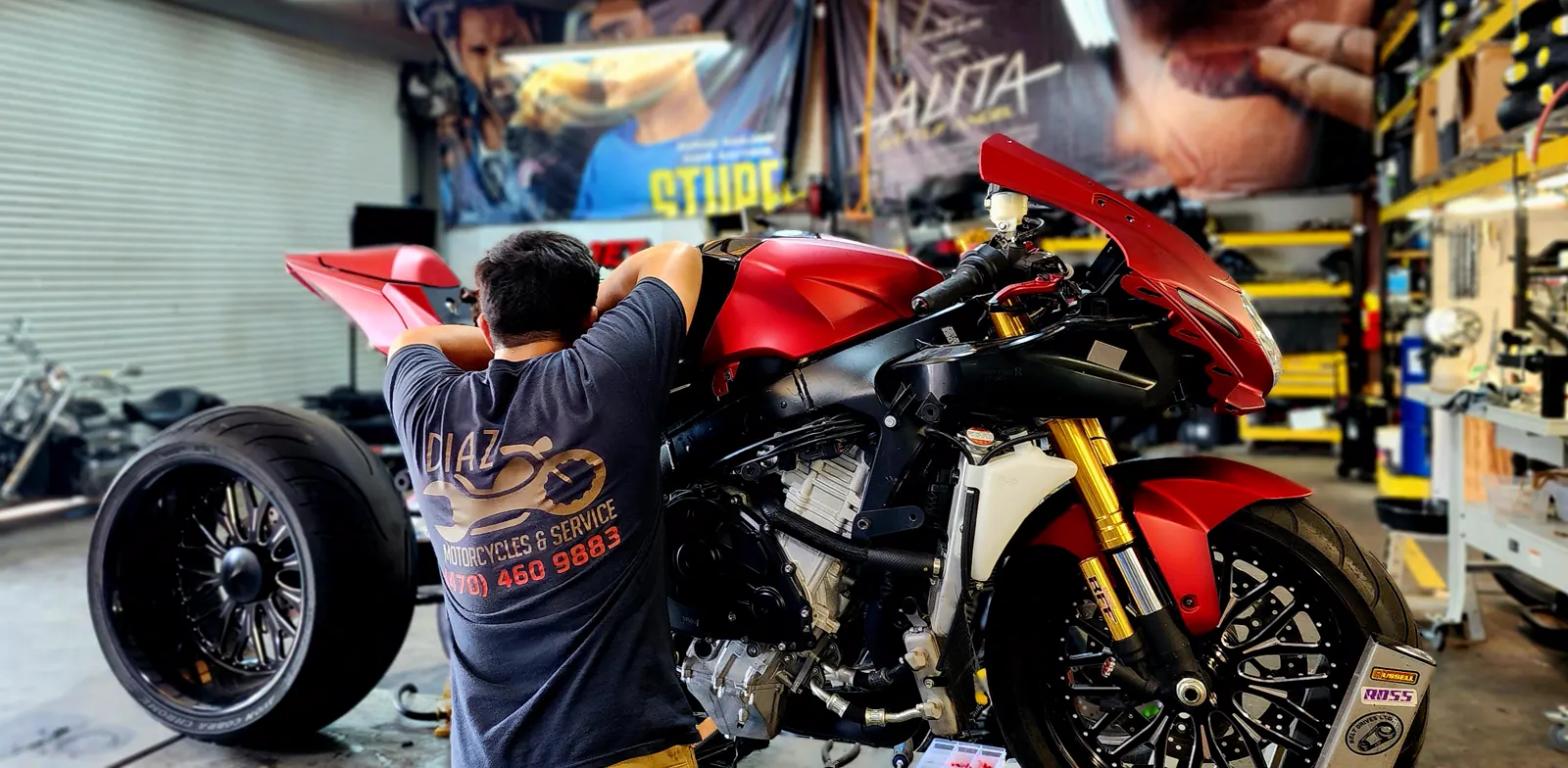
The drive out to Marietta, told straight
We’re not going to pretend we’re around the corner. From Buckhead we’re about thirteen miles and twenty to thirty minutes. From West Midtown it’s around fourteen miles, from Midtown roughly sixteen, from Old Fourth Ward about eighteen, and from East Atlanta Village closer to twenty-one miles and up to an hour when everything goes wrong. Add another twenty to forty minutes at peak. No rider makes that ride just for oil.
Here’s the part nobody mentions, though. Service capacity in this metro sits mostly outside the perimeter, so ITP riders are driving out no matter which shop they pick. Our nearest premium-European neighbor, BMW, Ducati and Husqvarna Motorcycles of Atlanta, also known as Wooly’s Cycles of Atlanta, sits at 1581 Cobb Parkway SE, a few minutes from our door. Same drive, same direction. For Buckhead and West Midtown riders especially, Marietta is often the closer option, not the farther one.
We also solve the distance instead of arguing about it. We’ll come get the bike and bring it back, so the trip costs you a text instead of an afternoon. Batching helps too: tires, chain, fluids, and a tune all in one visit rather than four. And some work is simply worth the ride, like dyno tuning, ECU flash work, and our in-house paint booth and restoration bench, which is a combination you won’t find in town. Here’s everything we cover, and here’s how we handle that job for riders in your part of the city.
If you want the same comparison from a different angle, riders over in Newnan face a nearly identical choice with a different map around it. And if you like reading about wrenching in general, RevZilla’s Common Tread is a good place to spend a rainy July afternoon, and July here has plenty of those.
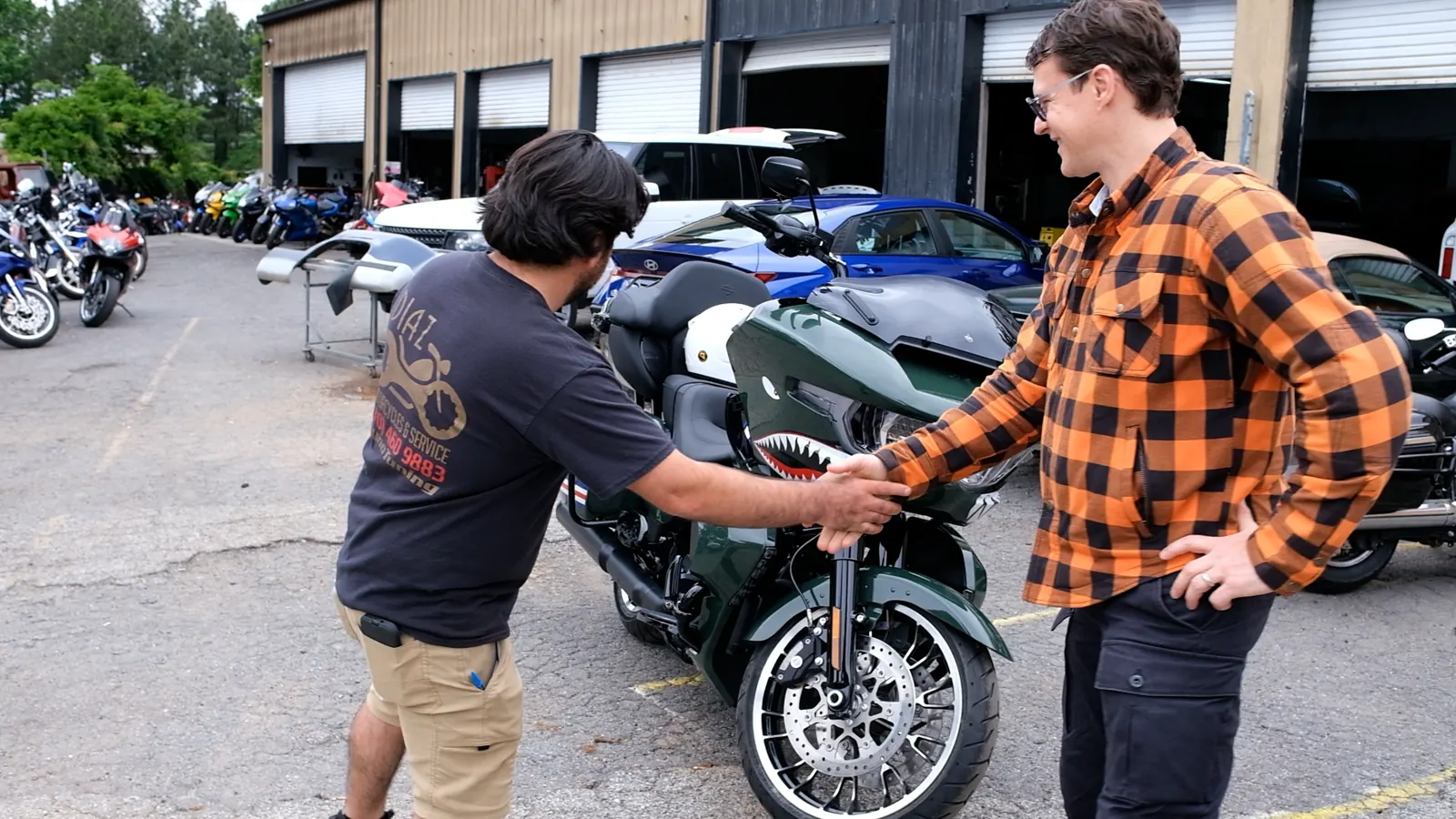
What it feels like when it's handled
The best outcome here isn’t dramatic. It’s quiet. The tick is gone, the idle holds steady at the light, the fan cycles like it should, and the chain runs smooth when you roll off. You stop listening for trouble and start noticing the ride again. That’s the whole point of catching things while they’re small. Relief is the real product here, and it costs a lot less than drama does. A bike you trust changes how you plan a Saturday, because you stop building an escape route into every ride. You just go.
So pick the shop that fits your bike’s situation, not the loudest opinion online. Under warranty, go see the dealer. Out of warranty and riding in town, find one independent and let them learn your bike. Either way, you deserve notes you can read, photos you can see, and somebody who texts you back the same day.
Questions Atlanta riders ask us
Which one should I pick?
If your bike is still under warranty or has an open recall, pick the dealer. If it’s out of warranty and you ride it in town, pick one good independent and stay with them. Continuity beats brand loyalty once the coverage runs out.
What's the real difference between a dealer and an independent?
A dealer is organized around one brand, with factory training, factory software, and factory parts on hand. An independent is organized around riders and sees every brand, so it spots patterns across bikes and can talk to you directly about what’s urgent. Both can do excellent work. They’re just built for different jobs.
Which one keeps a bike running longer?
Neither, by itself. What actually extends a bike’s life is consistency — the same shop seeing the same machine over and over, so wear gets tracked instead of rediscovered. A tech who has measured your chain three times knows how fast it’s stretching. That’s the thing that adds years.
Which is right for the way I ride?
Short in-town trips around Moreland Avenue and the east-side grid are hard on chains, batteries, and suspension, and that kind of wear rewards a shop you can reach quickly and often. Long touring miles out of Buckhead lean toward brand-specific parts availability. Tell us how you actually ride and we’ll tell you honestly which way to go.
How often should my bike be serviced?
Your owner’s manual sets the interval, and we’d rather point you there than invent a number, since it varies a lot by model. What we’ll add is that Atlanta miles are harder than the manual assumes, with heat, stop-and-go, and rough pavement all stacking up. When in doubt, come in a little early rather than a little late.
Can I switch shops later?
Absolutely, and in either direction. Using an independent doesn’t void your warranty, and using a dealer doesn’t lock you in forever. Keep your receipts and service records, hand them to whoever works on the bike next, and you’re fine.
We take care of riders all over the metro, starting with Buckhead and Midtown and running out through Decatur, Brookhaven, and Chamblee on the east side. Sandy Springs and Tucker riders find us easily, and folks in Smyrna, Vinings, and Mableton are practically neighbors. East Point riders come up the west side, and of course Marietta is home. If you’re in-town and the drive feels long, say the word and we’ll come get the bike instead.
TELL US WHAT IT'S DOING
Text us what your bike is doing and where in Atlanta you keep it. We’ll tell you straight whether it’s a dealer job or ours, give you a real plan, and set up pickup and delivery if the drive out to Marietta doesn’t fit your week. No pressure, no guessing.
470-460-9883Diaz Motorcycles and Service, LLC · 847 Barnes Mill Road, Marietta, GA 30062