Dyno Tune vs Stock Mableton — The Real Answer
Two honest options, who each one really fits, and the one we'd pick for most South Cobb riders.
Then again, that little pop on the way down from a light started back in spring. Even so, you heard it, shrugged, and rode anyway. Meanwhile, it’s July, the pavement is throwing heat back at your boots, and the pop has company: a stumble right off idle, a surge when you hold steady throttle, a cooling fan that seems to run all the way down Veterans Memorial Highway. In fact, that said, Give it one more month and nothing dramatic happens. The bike just gets less fun. You ride it less, then it sits, and a machine that sits is a machine that needs even more work later. For example, that slow fade is what pushes so many riders into the question of a dyno tune vs stock Mableton bikes roll out of the crate with.
The stuff riders notice first
After that, Almost nobody calls us and says the fuel mapping is off. They call because something feels wrong and they can’t name it. What’s more, Good news: the symptoms are pretty consistent, and they point at real, fixable things. Here’s the short list we hear most from South Cobb riders.
- Popping or crackling when you close the throttle coming down a hill
- A flat spot or hesitation just off idle, usually worst when the bike is cold
- Surging or hunting at a steady cruise, like the bike can’t pick a speed
- Running hot in stop-and-go traffic, with the fan on more than off
- Jerky on-off throttle in slow corners and parking lots
- Soot on the pipe tip, or plugs that come out dark and sooty
None of those mean your bike is broken. They mean the fuel and spark schedule your bike was born with doesn’t match what your bike is actually doing right now, in this heat, with this exhaust, at this altitude, with your hand on the grip. That’s a solvable mismatch, not a death sentence.
What those symptoms mean, in plain words
Your engine wants a certain amount of air and a certain amount of fuel, mixed at about the right ratio. Lean means too much air for the fuel going in. A lean bike often runs hot, pops on decel, feels snatchy at small throttle openings, and hesitates before it pulls. Modern bikes leave the factory a little lean on purpose, because emissions rules are strict and the factory has to build one map for every rider in every climate. That’s not a scandal. It’s just a compromise that was never written for a July afternoon in Georgia.
Rich is the flip side: too much fuel for the air. A rich bike smells strong, sooties the plugs and the pipe tip, and can feel soft and lazy at the top instead of sharp. Riders usually go rich by accident, after bolting on a slip-on or opening up an airbox and never touching the fuel side. The bike doesn’t get faster from parts alone. It gets confused, and confused engines waste fuel and heat.
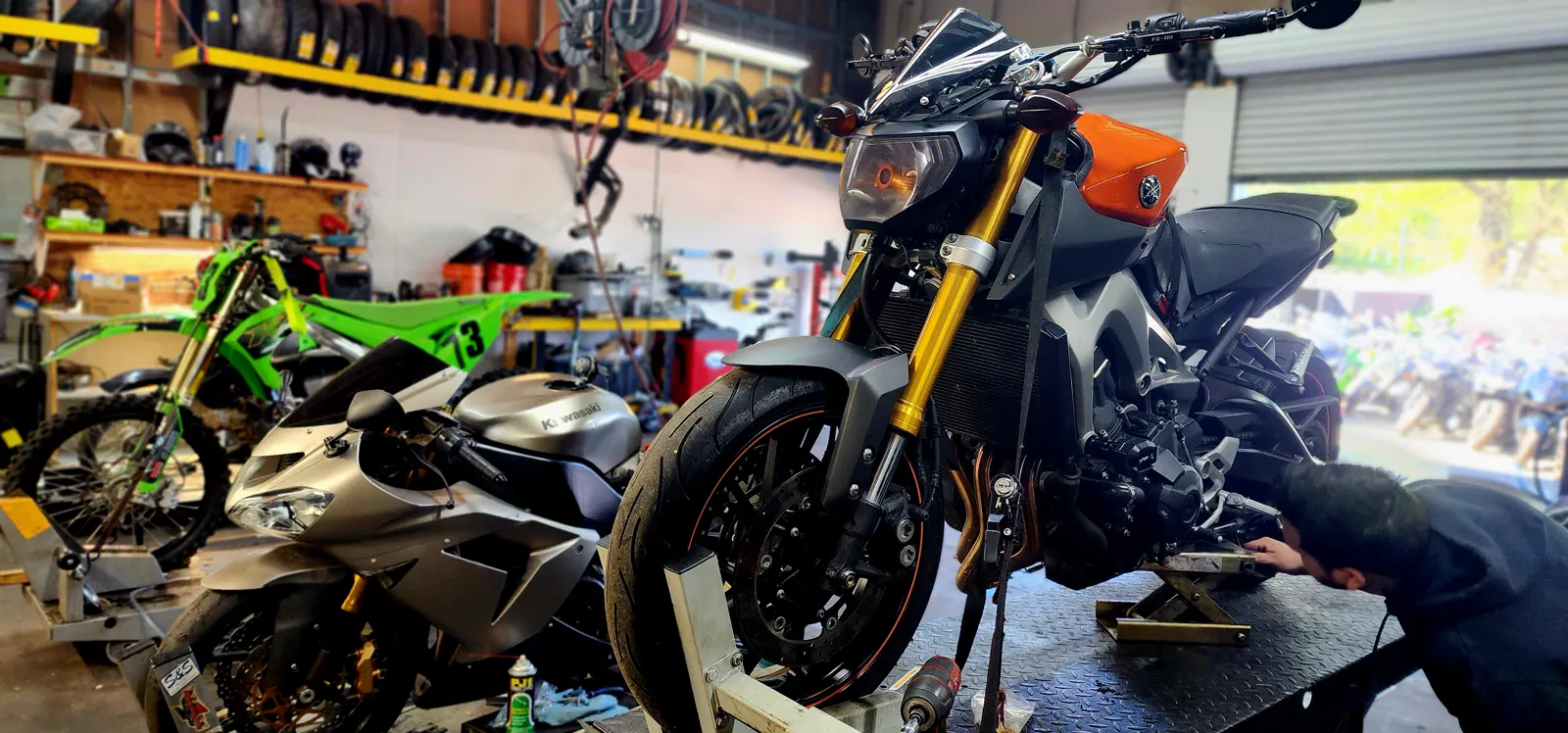
What a dyno actually measures
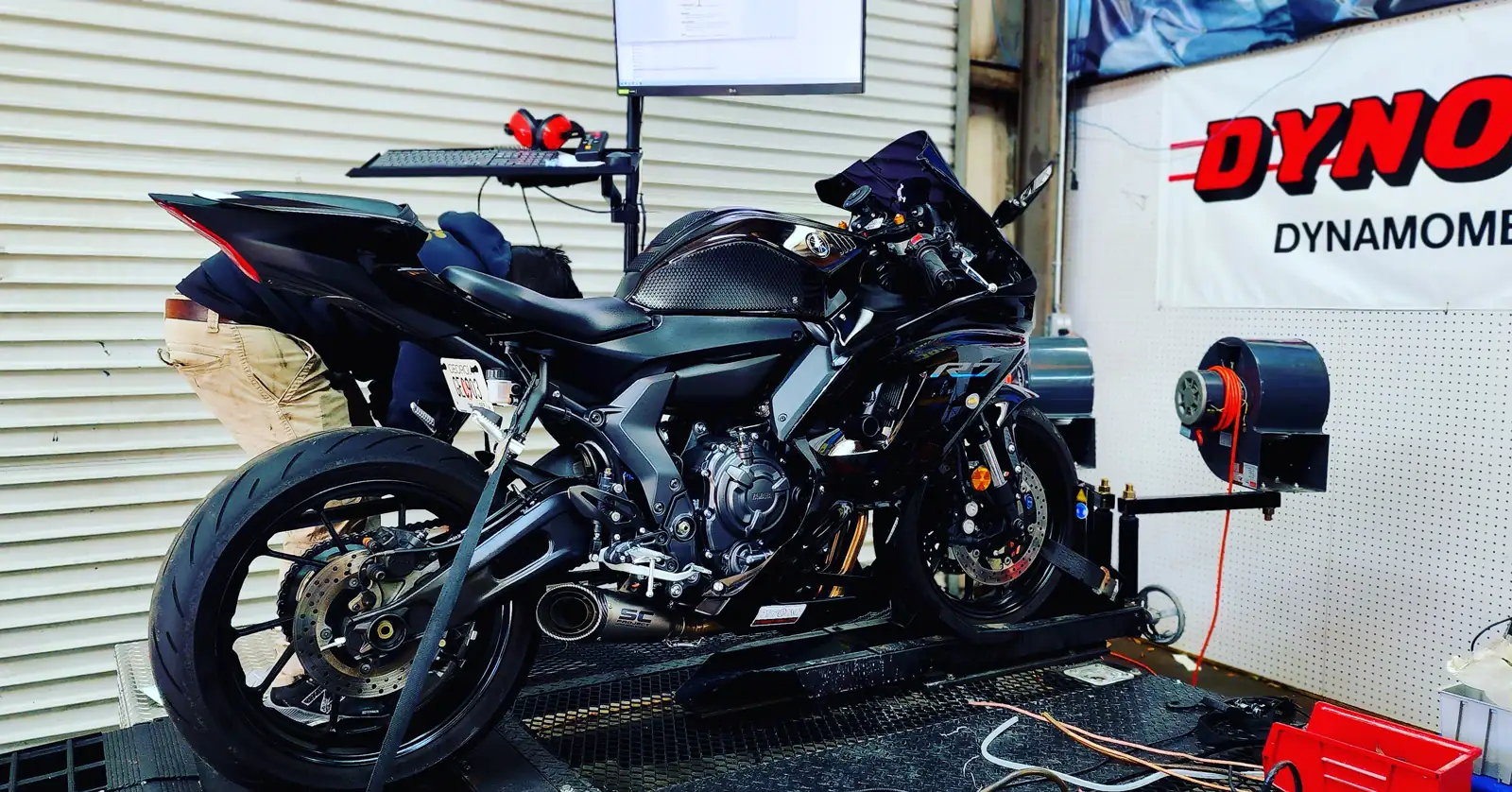
A dyno is a big drum in the floor. Your rear tire sits on it, the bike gets strapped down, and a fan blows air across the engine so it thinks it’s moving. When you roll the throttle on, the drum has to spin, and the machine measures exactly how hard your rear wheel pushes it. From that push and how fast the drum speeds up, the software works out torque, and horsepower falls out of the math. So a dyno doesn’t guess. It weighs your engine’s actual effort, in the room, on the day.
At the same time, a sniffer sits in your exhaust and reads the air-fuel ratio at every single point in the pull. That’s the part riders care about most, even if they don’t know it yet. The graph tells us where the bike is starving, where it’s drowning, and where the throttle feels ugly. Then we change the fuel and timing numbers, run it again, and watch the line get smooth. Repeat until it stops improving. That’s the whole trick, and there’s no shortcut around it.
Stock: who it's genuinely right for
Let’s be fair to stock, because stock is right for a lot of people. If your bike is fully factory, still under warranty, ridden mostly to work and back, and it runs clean, you already have a map built by engineers with a budget bigger than most towns. It’ll start in the cold, idle in traffic, and hand you predictable throttle. Leave it alone and spend the money on tires and brake pads, which change how a bike feels far more than most riders expect.
- Bone-stock exhaust, stock airbox, stock filter
- Newer bike still inside its factory coverage
- Short daily miles, mild throttle, no track days
- You’re saving up for suspension or rubber first
A custom tune: who it's genuinely right for
Now the other side. The moment you change what goes in or what comes out, the factory map is describing a bike you no longer own. Slip-on, full system, high-flow filter, cams, a big-bore kit, even a different sprocket setup on a bike that watches wheel speed. Every one of those shifts the air side, and the fuel side needs to follow. A custom tune is just teaching your bike what it’s wearing now.
There’s a second group too, and it’s bigger than people think: riders with a totally stock bike that simply feels wrong. Snatchy throttle in slow corners, heat soak in traffic, decel popping loud enough to embarrass you at a crosswalk. Smoothness is a legitimate reason to tune, and honestly it’s our favorite reason, because the rider notices it every single mile. If you want the plain breakdown of the pieces involved, we wrote up how the work adds up so nothing shows up as a surprise.
Here's what a good shop checks that a rushed one skips
Not all tuning is the same, and this is where a decision gets made for you whether you like it or not. A rushed tune is somebody loading a canned file off a laptop and handing you the keys. It might feel better. It might also be a map written for a bike in a different climate with different parts. A real tune starts with a health check, because a dyno will happily record a sick engine and give you a beautiful graph of its sickness.
- Plugs pulled and read, so we know how it’s been burning
- Air filter, intake boots and clamps checked for leaks that fake a lean condition
- Exhaust joints and gaskets checked, since a leak upstream lies to the sniffer
- Valve clearance and compression considered before we chase fuel numbers
- Cooling system, fan and coolant condition verified before long pulls
- Baseline run recorded first, so you can see the before and the after
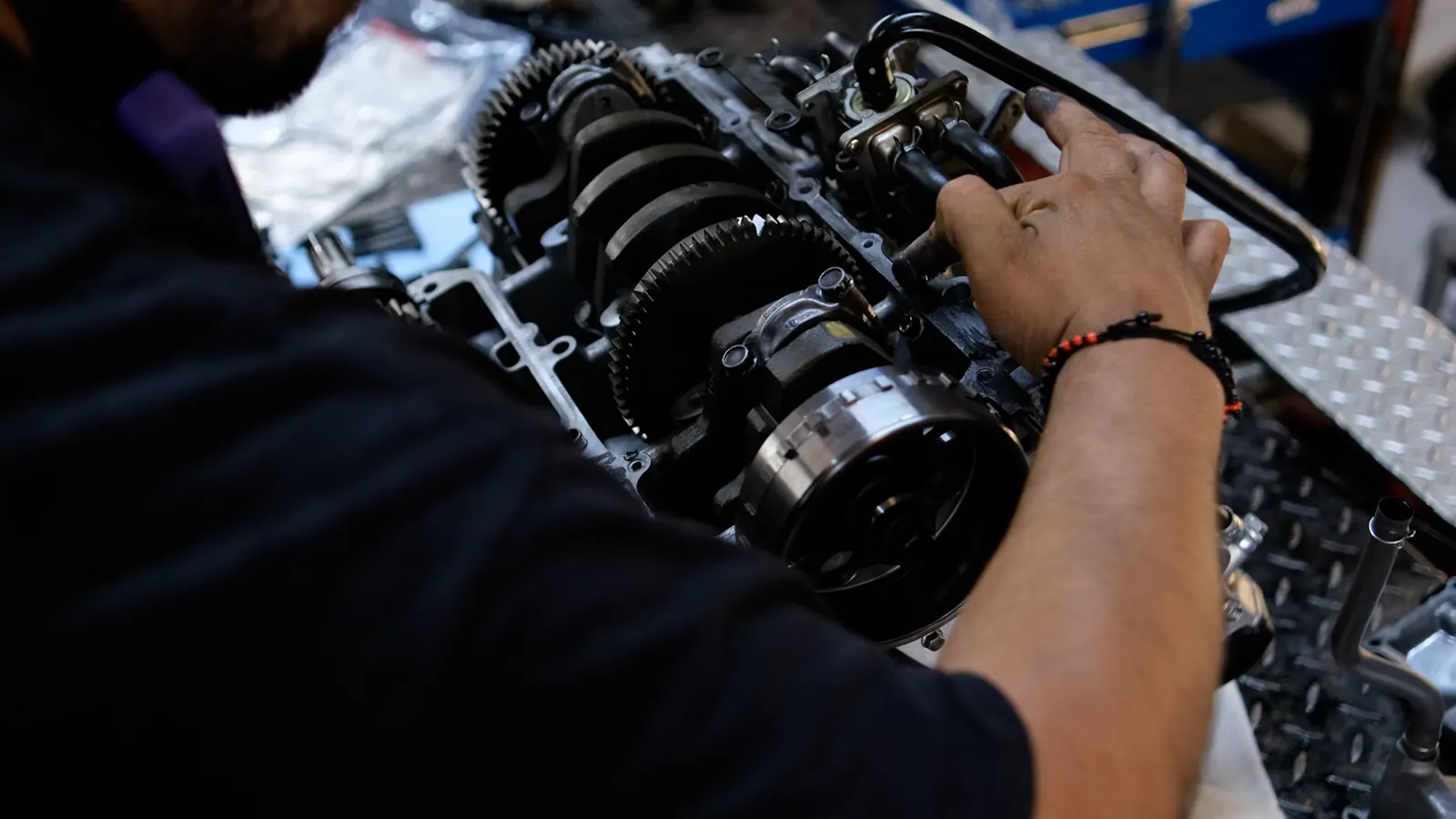
That order matters. Fix the mechanical stuff, then map it, and the map stays true. Do it backwards and you’ve paid to memorize a problem. When you’re ready to see the process end to end, here’s what you get when you bring it in, from the first baseline pull to the printed sheet you take home.
Our recommendation, straight
You asked for a real answer, so here it is. If your bike has any aftermarket exhaust or intake on it, get it tuned. Not someday. Now, before another summer bakes in the habit of riding around the flat spot. A bolt-on without a matching map is half a modification, and the half you skipped is the half that makes it feel good. If your bike is stock and runs clean, stay stock and put the money into tires, brakes and suspension. That’s the whole dyno tune vs stock Mableton debate in one honest paragraph.
Parts change what your bike can do. A tune changes what it feels like doing it.
The middle case is the interesting one. Stock bike, no mods, but it’s cranky in traffic and pops on every downhill. Tune it. You won’t be chasing numbers, you’ll be buying manners, and manners are what you feel at every light on Mableton Parkway. Our friends who do this almost never talk about peak power afterward. They talk about how the bike stopped fighting them.
When stock wins anyway
Here’s the situation where we’ll tell you to leave it be, even though tuning is what we do. Brand-new bike, still covered, no mods, and you want to keep every bit of that coverage clean. Flashing an ECU can be reversible, but the safest play on a fresh machine is to ride it stock through the coverage window and revisit later. Same answer for a bike with a mechanical problem you haven’t sorted yet, and for a rider whose real complaint is worn tires or a sagging shock. A tune can’t fix a chassis, no matter how nice the graph looks.
Timing: when to book it
February through April is our busiest stretch, because every bike in South Cobb wakes up at once and wants a battery, fresh fuel, tires and fluids. Dealer counters get buried in that window too. So if you’d rather have a relaxed appointment and time to talk through the graph, late summer and fall are quietly the best months. Tuning in the heat also hands us the hardest conditions to test in, which is a gift. A map that behaves in a Georgia August behaves in October without breaking a sweat.
Mableton riders, Mableton roads
Mableton is really two riding towns sharing a zip code, and both show up on our dyno. Out toward Vinings Estates and Vinings Plantation, the bikes are well-optioned baggers and European machines that live in clean garages and come out on good weekends. Over in neighborhoods like Queen Mill and along the parkway corridors, we see higher-mileage cruisers, sportbikes and daily commuters, plenty of them parked outside under a cover. Different bikes, same complaint: the factory map was never written for this heat or these bolt-ons. Georgia doesn’t allow lane splitting either, so a bike sits in the same traffic as a car, and a hot, snatchy engine in that traffic is miserable in a way a smooth one simply isn’t.
Road surface plays in too. Truck traffic has shoved and rutted plenty of pavement here, and after a hard rain the low spots near the creeks collect washed gravel and silt. On that stuff, abrupt throttle isn’t just annoying, it’s work. Riders who loop the streets by Riverline Park before a longer day feel it right away. And if your idea of a good Saturday is running north to SR 60 toward Suches and looping Wolf Pen Gap Road on SR 180, roughly two to two and a half hours out, you want an engine that meters fuel politely at small throttle openings. That’s a full day of tight corners, and a jerky bike turns it into a chore.

Here's how this played out for someone over by Heritage Park
A friend we helped lives near Heritage Park, close enough to walk the trails along Nickajack Creek past the old mill ruins on a rest day. He’d put a slip-on on his sportbike two seasons earlier and loved the sound for about a week. Then came the decel popping, the heat in traffic, and a low-speed throttle that felt like a light switch. He’d been told to just live with it. He rode less. His bike sat, and then the battery died, which is exactly how a small annoyance turns into a real repair.
We put it on the dyno, read the baseline, found it lean through the whole midrange, and mapped it properly. Nothing exotic. He picked it up, rode it home, and texted that night to say it finally felt like the bike he thought he’d bought. He’s been riding it every weekend since. If you’re curious whether the same logic holds a few miles east, we walked through how this plays out in East Cobb with a different mix of bikes.
What you walk away with
The point of all this isn’t a bigger number to brag about. It’s a bike that does what your wrist asks, every time, in traffic and in the mountains. You’ll get a printed sheet showing before and after, and you’ll know exactly what changed and why. Most riders find they stop thinking about the engine at all, which is the highest compliment a tune can get. Here’s what that service actually involves if you want the full walkthrough, and if you’d rather sharpen the rider before the bike, the MSF rider courses are worth a weekend.
Getting here is easy from anywhere in Mableton. It’s about 13 to 16 miles, call it 25 to 35 minutes, up South Cobb Drive through Smyrna into Marietta, then east on Roswell Road to Barnes Mill Road. Plenty of riders pass big pre-owned lots like WOW Motorcycles on Cobb Parkway on the way and don’t realize that browsing inventory and custom mapping are two different jobs. We do the second one, in house, for whatever brand you ride.
SHORT VERSION
Modified bike? Tune it. Stock bike that runs clean? Keep it stock and spend on tires. Stock bike with bad manners? Tune it for the smoothness, not the numbers.
Questions Mableton riders ask us
Which lasts longer, a stock map or a custom tune?
Both last as long as the bike does, because neither one wears out. What changes is the world around the map: new exhaust, a different filter, a big elevation change, or major engine work. Stock never adapts to those. A custom tune can be updated whenever your setup changes, so in practice it stays accurate longer.
Which one is right for my kind of riding?
If you commute short hops and never touch the bike, stock is fine and we’ll say so. If you ride long days in the mountains, sit in real traffic, or have any bolt-on parts, a tune pays you back every mile. Smooth low-throttle response matters most exactly where riding is hardest.
Can I switch later, or is this permanent?
You can go either direction. An add-on fuel controller like a Power Commander can be removed and the bike goes back to how it was. An ECU flash is usually reversible too, and we save your original file before we touch anything. Nothing we do paints you into a corner.
Which one do you actually recommend?
Modified bike, tune it, no hesitation. Stock bike that runs clean, leave it and put the money into tires, brakes and suspension first. Stock bike that runs hot, pops or feels snatchy, tune it for the manners. That’s the honest split we give friends.
Does the bike I ride change the answer?
It changes the method more than the answer. A Harley bagger, a Yamaha triple, a GSX-R and a European twin all take different hardware and different targets. The decision rule stays the same: match the map to the parts and the climate. We tune all of them on the same dyno.
Will a tune void my warranty?
On a brand-new bike still under factory coverage, we usually tell riders to wait, because that’s the safest play. Once coverage ends, or if your bike already has aftermarket parts on it, the conversation changes. For factory procedures and specs we work from official sources like Harley-Davidson service information rather than guesswork.
We tune and service bikes for riders all over the west side of the metro. Mableton is a short run up through Smyrna and Vinings, and we see just as many bikes from Austell, Powder Springs and Clarkdale as we do from Marietta and Fair Oaks. Riders come east from Douglasville, Lithia Springs and Hiram, north from Atlanta, and over from the Cumberland side when their dealer can’t map a bike that isn’t its own brand. If you can ride it here, we can put it on the dyno.
LET'S SETTLE IT ON THE DYNO
Text us what you ride, what’s bolted to it, and what it’s doing that bugs you, and we’ll tell you straight whether a tune is worth it for your Mableton bike or whether stock is already doing its job. No pressure either way. If it’s worth doing, we’ll strap it down, run a baseline, and show you the graph before we change a single number.
470-460-9883Diaz Motorcycles and Service, LLC · 847 Barnes Mill Road, Marietta, GA 30062