Dyno Tune vs Stock Marietta — Which Is Right
Two honest options, who each one really fits, and the one we'd pick for most riders in Cobb County.
It’s Saturday morning and the garage door is up. The bike caught on the second try, coughed once, then settled into an idle that hunts up and down like it can’t make up its mind. You blip the throttle. There’s a flat spot right where you need it, that little hesitation just off closed throttle in second gear. Nothing is broken. Nothing is leaking on the concrete. It just doesn’t feel right, and that’s usually the morning a rider starts reading about dyno tune vs stock Marietta shops and wondering whether a custom map is worth the trouble. Here’s the good news up front: the answer is simpler than the forums make it sound.
We’re going to lay out both sides fairly. Stock is a real, defensible choice for a lot of bikes, and we’ll tell you exactly when it wins. A custom tune is the right call for other bikes, and we’ll tell you when that’s true too. Then we’ll give you our actual recommendation instead of shrugging at you.
Start with the symptoms, not the answer
Almost every rider who calls us about tuning is describing one of a short list of feelings. See if any of these sound like your bike.
- A hunting or surging idle, especially in the first few minutes after a cold start
- Even so, a flat spot or stumble just off closed throttle, usually between about 3,000 and 4,000 rpm
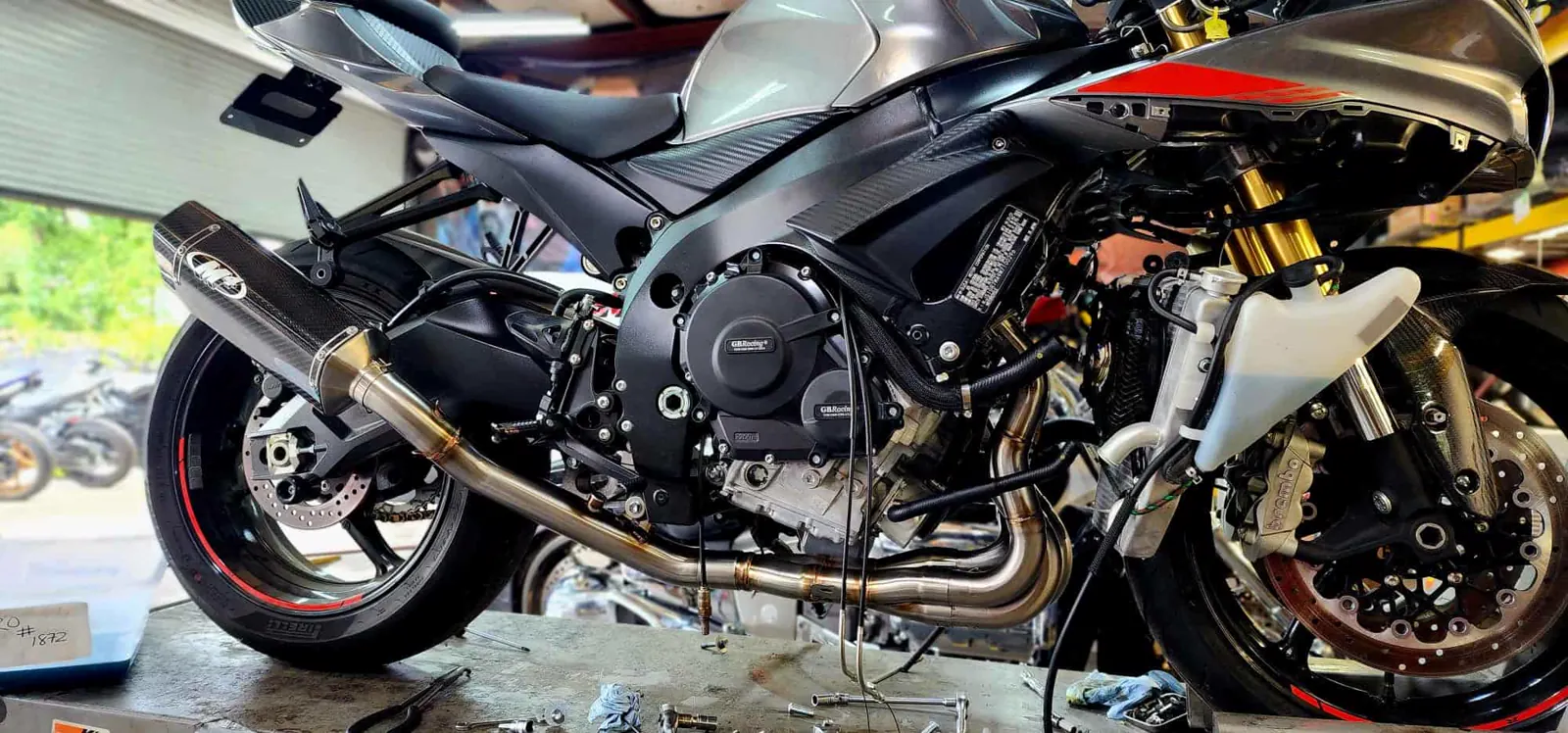
- Popping and crackling on deceleration that got louder after a slip-on exhaust went on
- Heat coming off the engine that feels harsher than it used to, especially stuck in traffic
- A snatchy on-off throttle that makes smooth low-speed riding harder than it should be
- Fuel mileage that quietly dropped, or a bike that fouls plugs faster than it ought to
- The bike feels fine, honestly, but you added an intake or exhaust and want to know if you left something on the table
That last one matters as much as the rest. Plenty of riders are not chasing a problem at all. They’re just curious whether the parts they bolted on are pulling their weight.
What those symptoms are actually telling you
Your engine wants a certain amount of air mixed with a certain amount of fuel. Too much air for the fuel and we call it lean. Too much fuel for the air and we call it rich. Neither one is a moral failing on your bike’s part. It’s just arithmetic that drifted.
Lean, in plain words
A lean engine is a thirsty engine. It runs hotter, it surges at steady throttle, and it can stumble when you crack the throttle open because there isn’t enough fuel to answer. Slip-on pipes and free-flowing air filters both let more air through, so a bike that was fine from the factory can go lean the day you install parts. Nobody did anything wrong. The computer simply doesn’t know about the new hardware yet.
Rich, in plain words
A rich engine is drowning a little. It fouls plugs, it can smell strong at idle, and your mileage sags. Sometimes riders end up here because a previous owner installed a fuel controller and dialed it in by feel rather than by measurement. Guessing rich feels safer than guessing lean, so a lot of hand-set maps land there.
So what does a dyno actually measure?
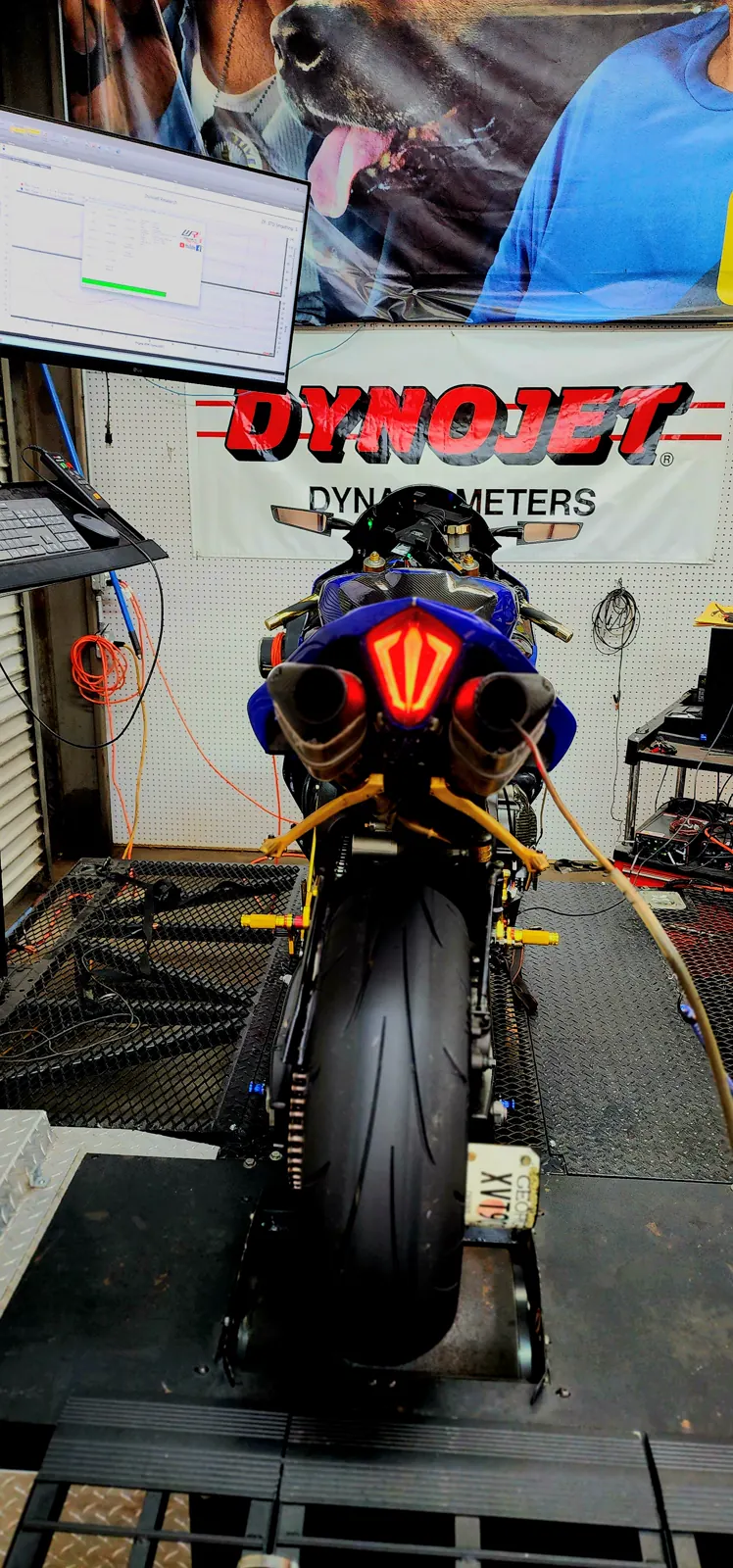
Think of a dyno as a treadmill for the bike. We strap the bike down on a big steel drum, the rear wheel spins the drum, and the machine measures how hard the wheel pushes against it. That gives us a real power and torque curve instead of a feeling. At the same time, we put a wideband oxygen probe in the exhaust, which reads the air-fuel mixture at every single rpm. Now we can see the whole picture: where the bike makes power, where it goes lean, where it goes rich, and exactly where that flat spot you feel lives on the chart.
THE SHORT VERSION
A dyno doesn’t add power by itself. It’s a measuring tool. What adds power and smoothness is the change we make once we can finally see what’s happening.
The case for leaving it stock
Manufacturers spend serious money getting a bike to run well in a wide range of conditions, and a stock map is a genuinely good compromise. If your bike is fully stock, still under warranty, runs clean, and you ride it to work and back, stock is doing its job. Save your money for tires and a helmet you actually like wearing.
Stock also wins if you’re planning to sell the bike soon, or if you’re the kind of rider who wants zero variables in the system. There’s real peace of mind in a bike that any dealer can plug into and recognize on the first try.
The internet will tell you one thing. The bikes tell us another.
Search any forum and somebody will insist every bike needs a tune the moment it leaves the showroom, and somebody else will insist tuning is snake oil. Both of those people are talking about bikes in general. We’re looking at yours specifically, on a drum, with a probe in the pipe. The bikes that roll through our door sort themselves into clear groups fast, and the groups don’t match the forum consensus in either direction.
The case for a custom tune
A tune earns its keep when something has changed from what the factory assumed. Exhaust, intake, cams, a big-bore kit, a different fuel, a bike that’s been modified by two owners before you. In those cases the stock map is answering a question your engine is no longer asking.
It also earns its keep when the complaint is rideability rather than power. Smoothing out an abrupt throttle transition doesn’t show up as a big number on a chart, but you feel it every time you ease through a parking lot. Big peak numbers are fun at the bar; a bike that behaves in first gear is fun every day.
Our recommendation, no fence-sitting
Here’s how we settle dyno tune vs stock Marietta arguments in the shop: we look at what’s bolted to the bike.
If your bike is stock and healthy, leave it stock. Ride it. Come see us for valves and fluids and tires. That’s the honest answer and it costs you nothing.
If your bike has an exhaust, an intake, or any engine work on it, get it tuned. Not eventually. That’s the group where we consistently see lean spots, harsh heat and a throttle that fights the rider. Fixing it is a known job with a known outcome, and it’s the same job whether the bike is a Sportster or a liter sportbike. If you want the mechanics of it before you decide, here’s what that service actually involves.
And here’s where stock wins even for a modified bike: if the only change is a slip-on muffler on a modern fuel-injected bike with closed-loop control, and the bike genuinely runs clean with no surging or stumbling, you can leave it alone with a clear conscience. That happens more often than tuning shops like to admit. We’d rather tell you that than sell you something you don’t need.
What happens when you bring the bike in
- We ride it or run it first and listen to your description of the problem. Your words matter here.
- The bike gets strapped down on the dyno and warmed up properly. A cold engine lies to us.
- We make a baseline pull and watch both the power curve and the air-fuel reading.
- Then we make changes, either by flashing the ECU directly or through a Power Commander style fuel controller, depending on the bike.
- We pull again. And again. Each pass moves the mixture closer to where it should be across the whole rev range.
- You get the before and after chart, plus a plain-English explanation of what changed and why.
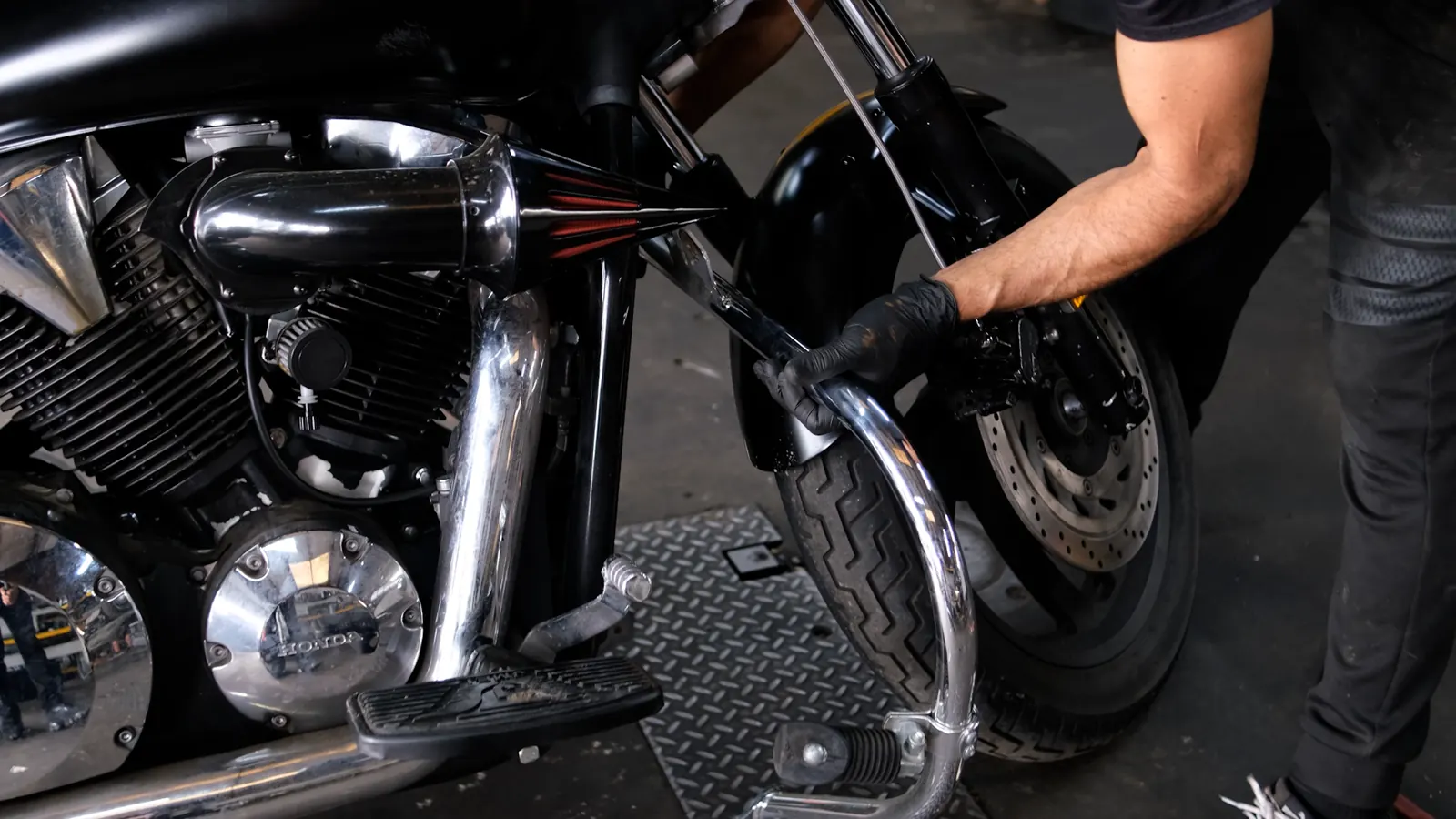
ECU flashing rewrites the bike’s own computer, which is the cleanest approach when the platform supports it. A piggyback controller sits between the computer and the injectors and adjusts fuel on the way through, which is the right tool on older or locked systems. We’ll tell you which one your bike takes before we start, not after. For Harley owners who like to read ahead, the factory publishes Harley-Davidson service information for their models.
How long it takes
Most tunes are a single-day job, and many are a few hours. The variables are how far off the starting point is and whether we find something that needs fixing first. A tune can’t correct a vacuum leak, a tired plug, a clogged filter or a slipping clutch. If we find one of those, we call you before we spend your time on mapping.
That last part matters around here. The most common complaint we hear about big service departments is a flat book rate and a wait measured in weeks, so we book real appointments and give real estimates.
Why this question hits different in Marietta
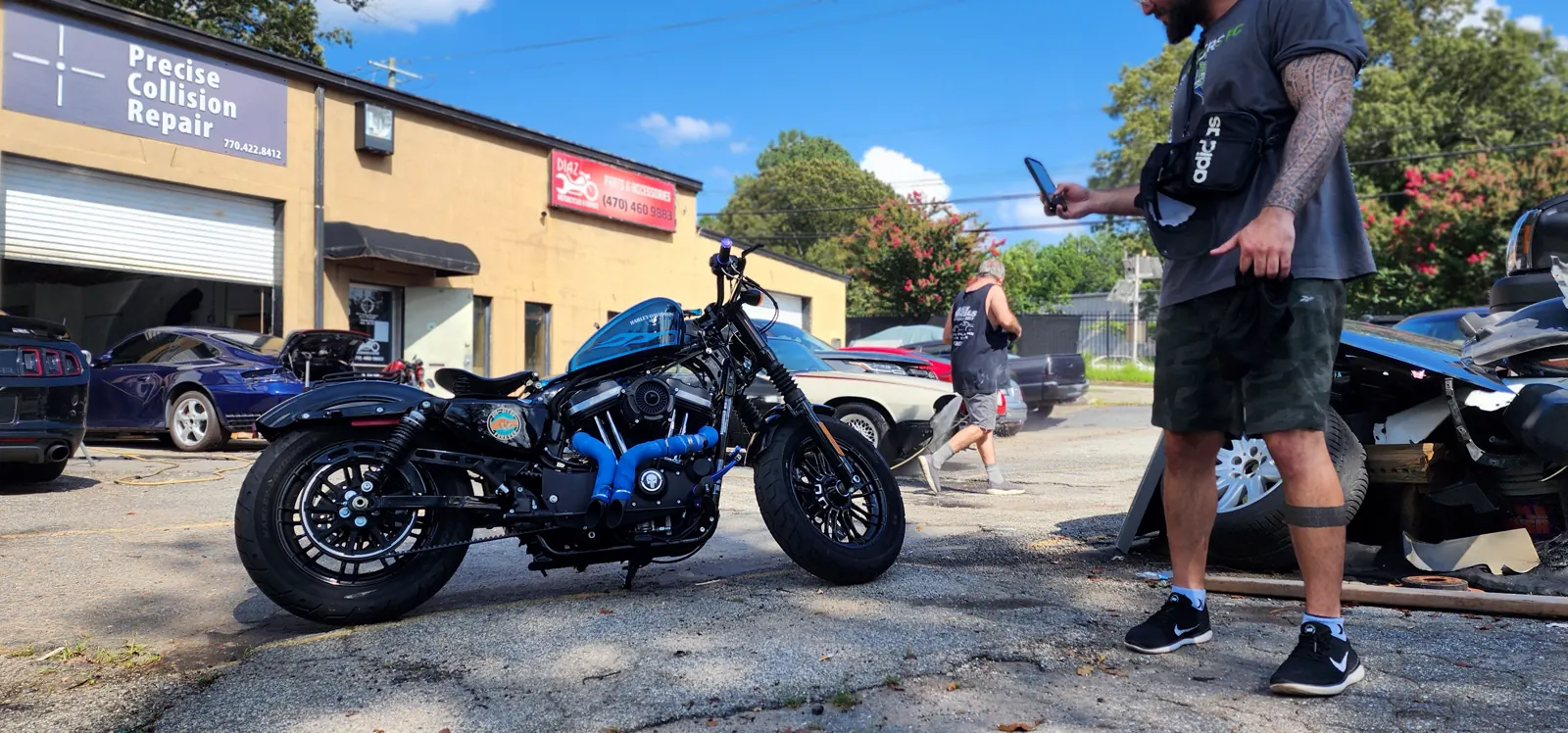
Marietta has one of the densest clusters of motorcycle retail in metro Atlanta, with five significant dealers spread along about four miles of Cobb Parkway plus Hellbender Harley-Davidson over on South Cobb Drive. The mix that riders over in Alpharetta deal with is different. Here, you can buy almost anything on two wheels within a few minutes of the Big Chicken. WOW Motorcycles at 522 Cobb Pkwy N alone is billed as America’s largest pre-owned powersports dealer with more than 600 units, and it sits about three miles from us. What’s harder to find in all that density is a shop that does real custom mapping in-house rather than sending it out.
The riding here also shapes the answer. Georgia doesn’t allow lane splitting, so a Marietta commuter sits in the same I-75 stop-and-go as everyone else. The Northwest Corridor Express Lanes run thirty miles of reversible Peach Pass toll lanes on I-75 and I-575, southbound in the morning and northbound in the afternoon, which helps if your schedule matches the flow and does nothing for you if it doesn’t. Either way, a lot of local bikes spend real time idling in July heat. A lean map is worst exactly there, sitting still with no air moving over the cylinders.
Then there’s the other half of local riding. Two hours north sits the Georgia Triangle, the Suches loop, SR-60 up to Suches, Wolf Pen Gap Road over to Vogel State Park and US-19 back down, with Two Wheels of Suches in the middle of it. That road asks a bike for smooth, predictable throttle at part-load in tight corners. A flat spot you barely notice on Roswell Road becomes a real annoyance on a mountain switchback.
Meanwhile, a quick story, because it makes this concrete. A friend we helped rides out of a house near Hardage Farm and commutes past Kennestone to a shift job. His bike had a slip-on and a hand-set fuel controller from a previous owner. He described it as fine, except it got hot in traffic and hunted at idle. On the dyno, the mixture was lean through the exact rpm band he used every morning and rich up top where he almost never rode. Ninety minutes of mapping later, the idle sat still, the heat calmed down, and he said the bike finally felt like it wanted to be ridden slowly. We didn’t change a single part on that motorcycle.
What you'll actually feel afterward
People expect a tune to feel like a rocket. Usually it feels like relief instead. The bike starts cleanly, holds a steady idle while you wait at the light by the Marietta History Center in the old Kennesaw House on the Square, and pulls without the little hitch you’d learned to ride around. Roll-on throttle gets predictable. Heat gets more reasonable. Power gains are real, but the manners are the part you notice on day one.
Rider skill is the other half of the equation, and it’s the cheaper half. If you want the bike and the rider both dialed in, MSF rider courses pair well with a freshly tuned machine.
One more thing before you decide
Bikes that live outdoors under a cover, which is most bikes in the apartment corridors along Franklin Gateway, Delk Road and Powers Ferry, get a second problem stacked on the first. Stale fuel and a gummy fuel system produce symptoms that feel exactly like a bad tune. Same with pollen season, when March and April counts often run above 1,500 grains per cubic meter and quietly load up an air filter. We look at all of that before touching a map, because tuning around a dirty filter just bakes the dirt into your numbers.
Whether you’re rolling in from a driveway in the Whitlock Avenue Historic District, where 82 acres and 101 contributing buildings have been on the National Register since 1989, or from a townhome in Barrett Greene off the Barrett corridor, we’re about three miles from the Square and eight to twelve minutes away via Roswell Road. No point in the city limits is more than about twenty minutes out. If you want to read further first, we wrote the full rundown on it, and you can also browse the full list of what we do.
Questions Marietta riders ask us
Which one should I pick?
If your bike is completely stock and runs clean, stay stock and spend your attention on tires and maintenance. If it has an exhaust, an intake, or engine work, get it tuned. That’s the line we draw, and we’ll tell you honestly which side your bike falls on before we start.
What's the real difference between stock and a custom tune?
A stock map is a compromise written for every bike of that model in every climate. A custom tune is written for your engine, your parts and your fuel, using measurements from your bike on the dyno. The biggest difference most riders feel is smoothness, not peak power.
Which one lasts longer?
Both last indefinitely as long as the hardware stays the same. A tune doesn’t wear out. What changes it is a new exhaust, a new air filter setup, or engine work, and any of those means the map should be revisited. A correct tune can actually be easier on the engine than a lean stock map with aftermarket pipes.
Which is right for my kind of riding?
Commuters stuck in I-75 traffic benefit most from fixing low-rpm mixture and heat. Mountain riders headed toward Suches benefit most from clean part-throttle response in corners. Track riders want the whole curve optimized. Tell us how you ride and we’ll aim the tune at that.
Can I switch back later?
Yes. We save your original map before we change anything, so a flashed ECU can be returned to factory settings. A piggyback fuel controller can simply be unplugged and removed. Nothing about tuning is a one-way door.
Do I need a dyno, or can you just load a canned map?
Canned maps exist and they’re better than nothing, but they’re written for an average bike. Without a wideband probe reading your exhaust, nobody knows whether that map fits your engine. The dyno turns opinion into measurement, which is the whole point.
Our shop sits a few minutes from Marietta Square, and riders reach us easily from East Cobb, Kennesaw, Smyrna, Acworth, Powder Springs, Mableton, Austell and Vinings. We also see plenty of bikes come down from Woodstock, over from Roswell and Sandy Springs, and out from Dallas along the Dallas Highway side of the county. If you’re anywhere in Cobb County or just past its edges, you’re close enough for a same-day drop-off.
LET'S MEASURE IT, NOT GUESS IT
Bring the bike by our Marietta shop and tell us what it’s doing. We’ll look, we’ll measure, and we’ll tell you straight whether a tune is worth it or whether stock is already treating you fine. No pressure either way, and you’ll leave knowing exactly what your engine is doing.
470-460-9883Diaz Motorcycles and Service, LLC · 847 Barnes Mill Road, Marietta, GA 30062