Dyno Tuning Cost Kennesaw — Full Breakdown
What actually happens on the rollers, what makes one tune bigger than another, and why an honest shop won't guess before it sees your bike.
It’s early, the bay door is still half up, and a red sportbike is sitting on our rollers with the tie-downs pulled tight. Its owner is standing by the toolbox with his helmet still in his hand, because he rode down from Kennesaw and he wants to hear the thing pull. Then the fan spins up, the room gets loud, and the first question out of his mouth is the same one we hear every week about dyno tuning cost Kennesaw riders should budget for. So here’s the whole thing, start to finish, in plain words.
First, the honest answer: there is no menu price for this, and any shop that fires a number at you over the phone is guessing. Tuning is sold in time and parts, not in stickers. Some bikes need an hour of pulls and a fresh map. Others need the tank off, the airbox out, and a whole afternoon of small changes chased one at a time. Same service on the invoice, very different day in the shop.
Second, the split matters. Parts are the hard stuff you can hold: a fuel controller, a plug-in harness, an auto-tune module, filters, plugs, sometimes an O2 sensor bung welded into a pipe. Labor is everything else, and on a tune, labor is usually the bigger half. You’re paying for a person who knows what a wobbly fuel curve looks like and knows how to flatten it. Meanwhile the parts just sit there and do what they’re told.
Third, we won’t quote it sight-unseen, and we’d rather explain why than pretend. Two identical model years can walk in with completely different histories. One has a stock exhaust and 4,000 easy miles. The other has a full system, a drilled airbox lid, and a mystery map somebody loaded in a garage three owners ago. Guessing on that is how riders end up feeling lied to, and we like sleeping at night.
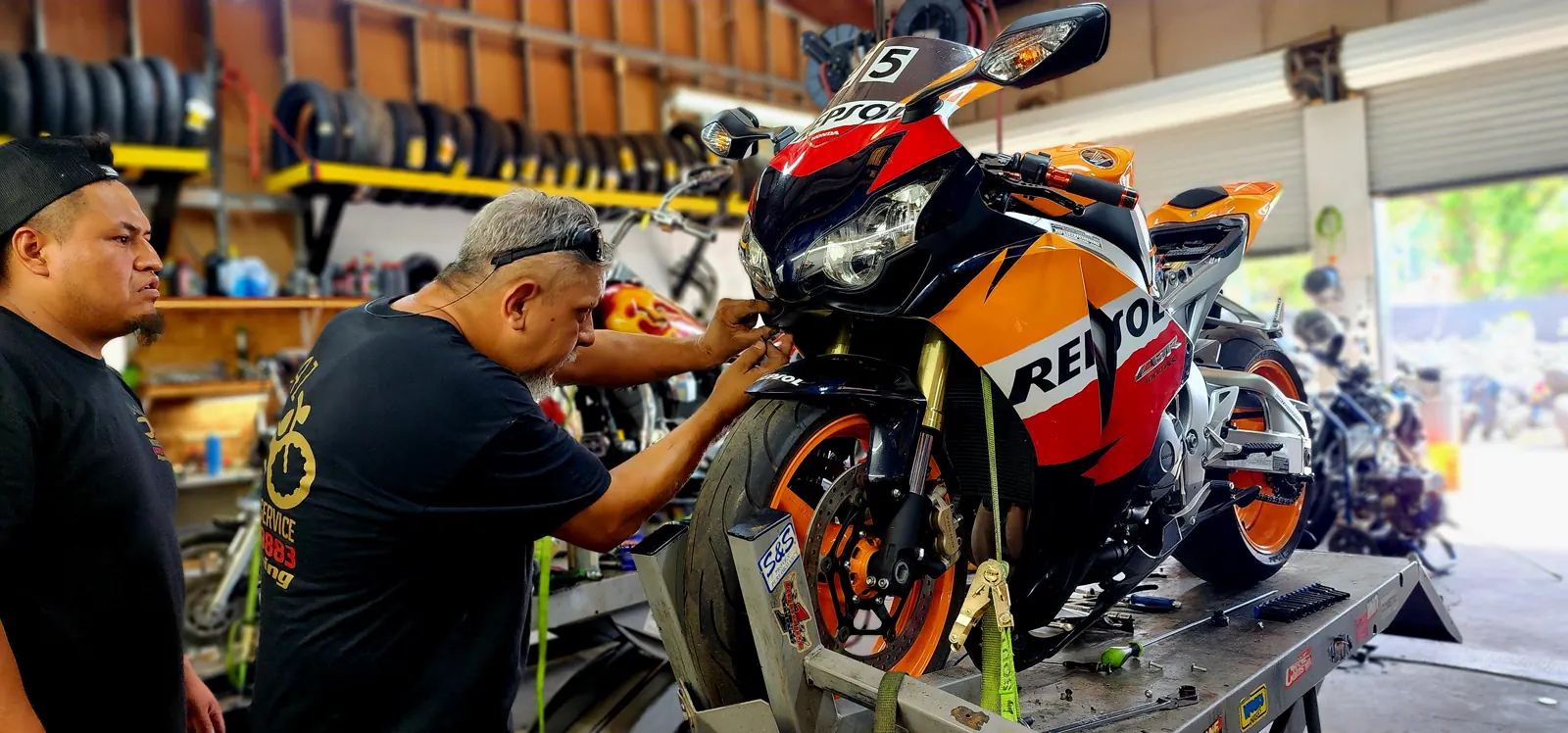
What a dyno actually measures
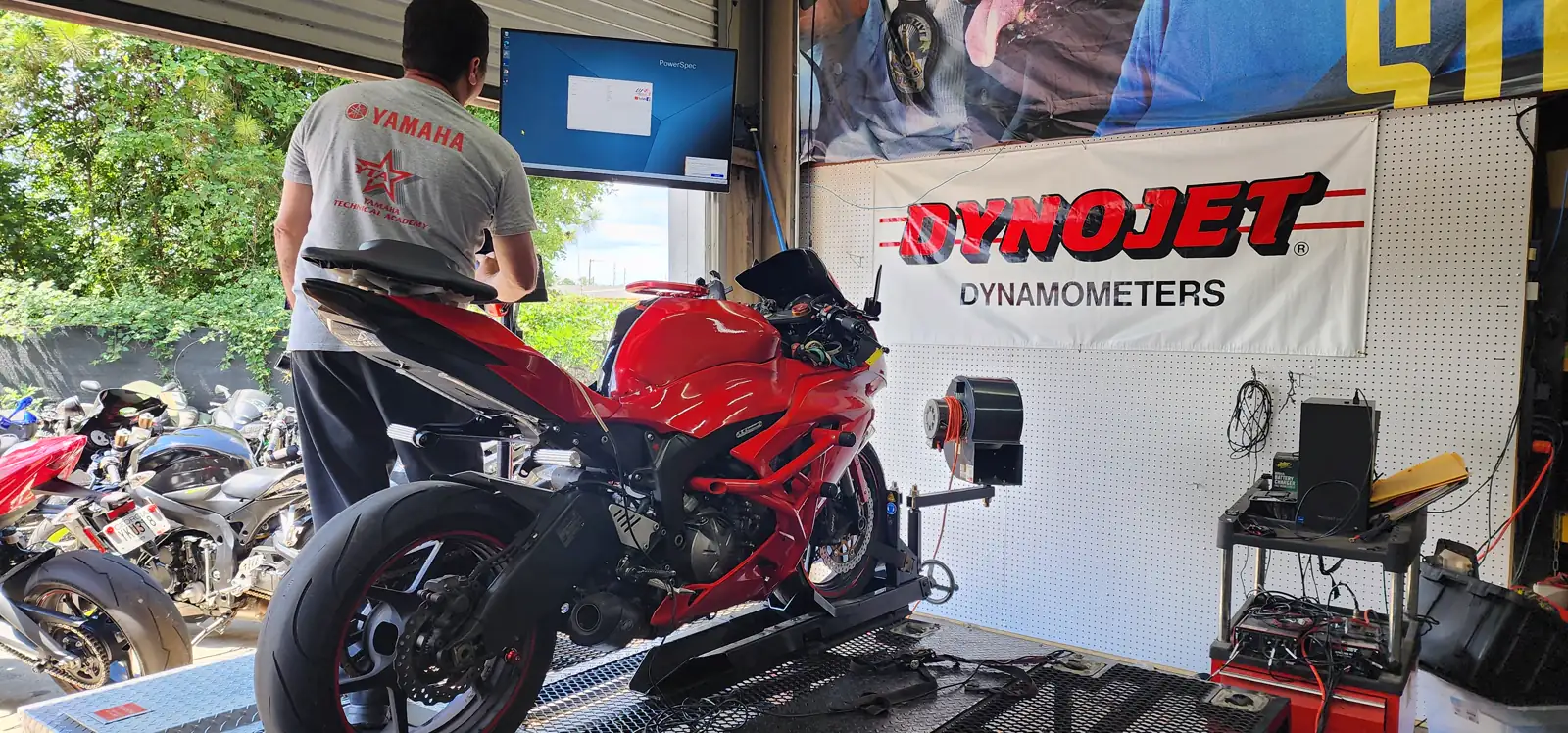
Picture a very heavy steel drum set into the floor. Your rear tire sits on it, straps hold the bike down, and a big fan blows air at the radiator so nothing cooks. When you roll the throttle on, the wheel has to spin that drum up. The dyno watches how fast the drum picks up speed and does the math from there. That’s it. It isn’t magic and it isn’t a video game score.
At the same time, a small probe sits in your exhaust and sniffs what’s coming out the back. That probe reads the air-fuel ratio, which is just the recipe your engine is cooking with at that exact moment. Every engine wants roughly the same recipe under load. Your bike’s computer is trying to hit it, and the tune is us checking its homework across every throttle position and every rpm.
Running lean means too much air and not enough fuel. It feels like a hesitation off idle, a flat spot at part throttle, popping on decel, and extra heat you can feel through your boots in July. Running rich is the opposite: too much fuel, so it feels lazy, smells heavy, fouls plugs, and eats your range. Neither one is a disaster, and both are fixable. If you want the longer story on the lean side, we wrote up what usually causes it.
Here’s what riders usually notice before they ever call us:
- A dead spot right where you crack the throttle in second gear
- Surging at a steady cruise, like the bike can’t pick a speed
- Snap-crackle popping every time you close the throttle for a light
- Heat that gets uncomfortable in slow traffic and never used to
- Fuel range that quietly got worse after an exhaust or filter change
There’s a second failure that hides behind the first one. The bad map is what you feel, but underneath it there’s often something mechanical that’s been quietly setting the whole thing up. Tired plugs. A throttle body that isn’t synced with its neighbor. So a clogged filter after a summer of Cobb pollen. A chain so loose it’s adding its own hesitation to every roll-on.
That matters because a tune will happily paper over a mechanical problem. We can add fuel until a weak cylinder feels fine on the rollers, and you’ll ride away smiling, and in six weeks you’ll be right back where you started. So we don’t do that. We fix the mechanical side first, then we tune, and the tune sticks. It’s less exciting on paper. It’s a lot better on the road.
What we check before the straps come out
The inspection is short, but it decides how big the job is. Nothing here is padding. Every item on this list has, at some point, saved a customer a second appointment.
- Spark plugs pulled and read, because the color tells us how the bike has actually been running
- Air filter and airbox checked, since a restricted filter changes every number we’re about to take
- Throttle bodies or carbs checked for sync, so all cylinders start the conversation together
- Exhaust checked for leaks, because a leaky header lies to the sniffer and ruins the data
- Coolant, oil and clutch checked, since we’re about to ask the engine to work hard
- Any existing map or piggyback module read and written down before we touch a single thing
After that we do a baseline pull. Nothing changed, nothing tweaked, just a clean picture of the bike exactly as it arrived. That baseline is your proof later. It’s also how we know whether the job is a quick map refresh or a real session, and it’s the first honest conversation about hours. You can see the full list of what we do on the tuning side if you want the menu of services first.
Why one bike takes longer than another
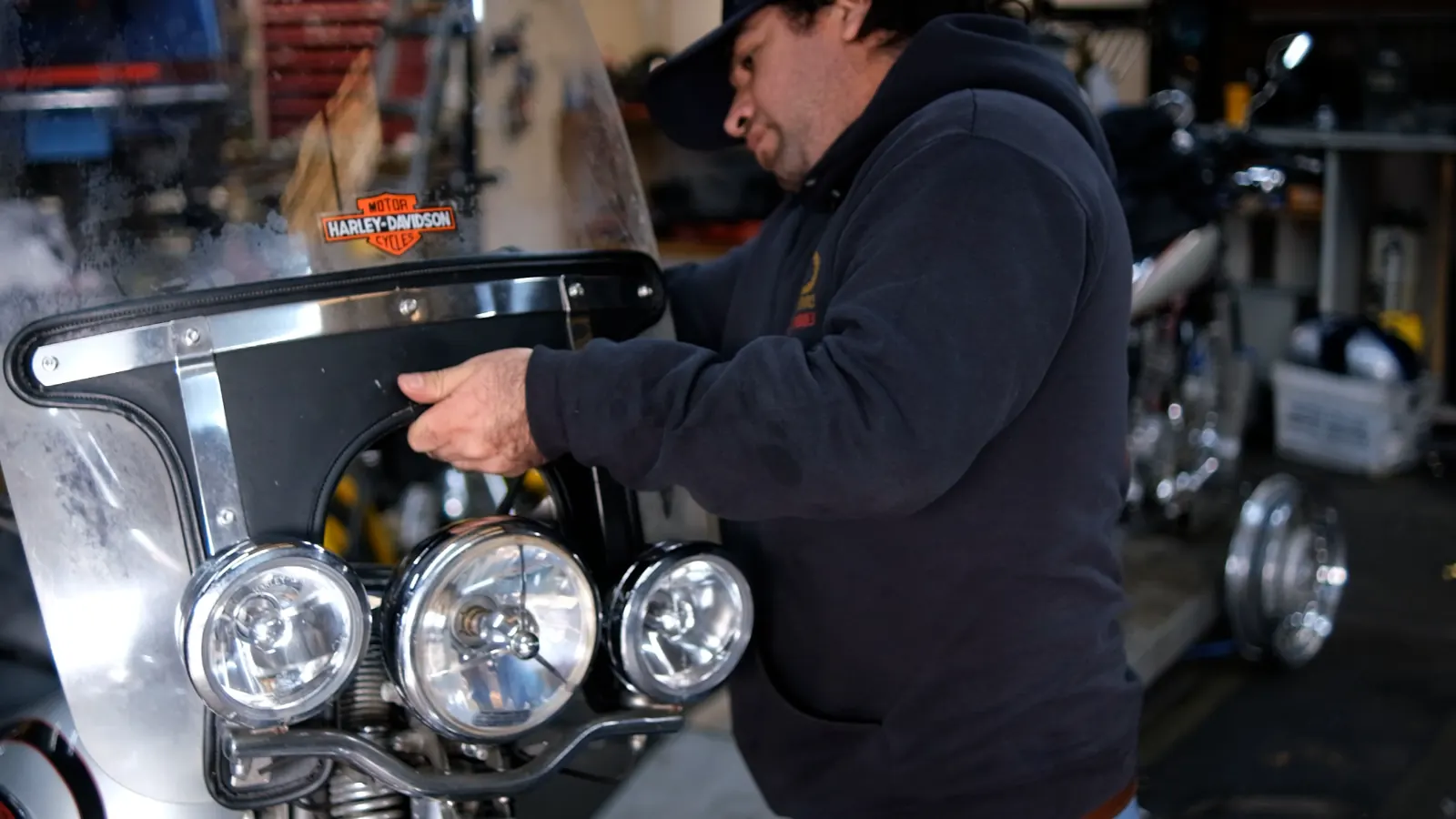
Access is the quiet driver of almost every tuning invoice. On a naked bike, the wiring we need is basically sitting there waiting. Still, On a full-fairing sportbike, panels come off first. On a dressed bagger, we’re pulling bodywork and finding room for a controller before we’ve done a single pull. Same tune, more hands on the wrench, and that’s before we talk about what the engine wants.
The other driver is how the bike lets us in. Some ECUs flash easily and take our changes without complaint. Others are locked down and have to come out of the bike and go on the bench. Some riders are better served by a Power Commander style controller that adds fuel on top of the factory brain. We’ll tell you which road yours is on, and we’ll tell you before the work starts, not after.
| What changes the hours | Shorter job | Longer job |
|---|---|---|
| Bodywork | Naked or standard, wiring exposed | Full fairings or a dressed bagger |
| Intake and exhaust | Slip-on only, stock airbox | Full system, air kit, filter change |
| The computer | Flashes in the bike | Locked ECU, bench work needed |
| History | Stock and documented | Unknown map from a previous owner |
| Condition | Fresh plugs, good sync, clean filter | Mechanical issues found on inspection |
Notice that none of those lines are about the brand badge on the tank. A tidy Harley can be a shorter day than a neglected sportbike. We’ve had ADV bikes off the I-575 corridor come in filthy and tune beautifully, and we’ve had garage queens fight us for an afternoon. The bike’s life story matters more than its logo.
Mistakes to avoid
The most common one is bolting on parts in the wrong order. Riders add an exhaust in March, a filter in May, and a controller in July, then tune in August after three separate changes have been fighting each other all summer. Do the hardware first, all of it, then tune once at the end. Your wallet and your right wrist will both thank you.
The second one is chasing a number instead of a feeling. A peak figure looks great in a group chat, but you ride the middle of the rpm range every single day. A tune that smooths out part-throttle cruising and kills the surge is worth more on Barrett Parkway than any headline number. We’d rather hand you a bike that’s easy to ride hard than a printout to argue about.
BEFORE YOU BOOK
Tell us every part that’s been added and every map that’s been loaded, even the ones you’re not sure about. Nobody gets judged here. It just saves an hour of detective work, and that hour is yours.
The third one is skipping the paperwork. Ask for your before-and-after sheets and keep them with the bike. When you sell it, that folder is worth real money to the next owner, and it’s the difference between “it’s been tuned” and proof. Riders in Peachtree City run into the exact same thing, and we broke down what Peachtree City riders run into in its own post.
Picture the version of this where you caught it early. The hesitation showed up two weeks after the slip-on went on. You booked a session, we found a lean spot and a filter that was done, and you got a clean map before the heat of July ever put a load on it. No fouled plugs, no cooked afternoon in traffic, no wondering whether the noise you hear is normal. Just a bike that answers the throttle the same way every time you touch it.
Kennesaw, specifically
You’re about 11 to 14 miles out, call it 22 to 30 minutes, either I-575 and I-75 south to Roswell Road or Barrett Parkway east to Sandy Plains and then Roswell Road. That’s not a hardship, and honestly it’s the same drive you’d make to an independent like CayloR-Made Motorsports over on Rosewood Circle. Everything serious already leaves Kennesaw, so when you’re weighing dyno tuning cost Kennesaw to Marietta, distance isn’t the deciding factor. Capability is.
The riders we see from up your way fall into a few clear camps. There are the cruisers and baggers that live in big garages around Pinetree Country Club, where the homes sit on wide lots along that 18-hole course next to KSU. There are the sportbikes and first bikes packed into the Chastain Road corridor, courtesy of the third largest university in Georgia. Then there are the families out in Summerbrooke near Town Center at Cobb, where a bike shares the garage with two cars and gets ridden hard on good weekends.
Road surface shapes what we find, too. Big Shanty Road is a rural-origin road that got widened and patched over decades, so it carries uneven seams and sunken utility cuts that shake fasteners loose and rattle exhaust hangers. Riders coming out of Heritage at Kennesaw Mountain, over next to the battlefield park, tend to warm up on those patched surfaces before heading for the rolling stuff. Burnt Hickory Road is where the same loop gets fun, and it’s also where a flat spot in your fuel curve stops being an annoyance and starts being genuinely irritating.
There’s also the traffic reality. Georgia doesn’t allow lane splitting, so you sit in the I-75 grind and your engine soaks heat with no airflow. A rich, sloppy map makes that worse. A clean one makes summer traffic noticeably calmer. If you’re newer to riding here, the Georgia Class M licensing page is worth a read, and IIHS motorcycle research is a solid, no-drama place to understand rider risk.
January and February are our favorite months for this work. It’s quiet, the schedule is open, and you can have your bike sorted before the first genuinely warm Saturday. Grab breakfast on Main Street in downtown Kennesaw, wander the restored core while the farmers market season gets going, and let us handle the boring part. Then the first good ride of the year is just a good ride.
What you ride away with
When a session goes right, the difference isn’t loud. It’s smooth. The throttle stops arguing at small openings. The bike pulls the same way every time instead of surprising you. Heat drops in slow traffic. Fuel range comes back. You stop riding around a flat spot without realizing you’d been doing it for months.
A good tune doesn't make your bike louder. It makes it obedient.
You also ride away knowing something most riders never learn about their own machine. You’ll know what your air-fuel ratio was doing, where it was off, and exactly what we changed. That’s not a small thing. That’s the difference between owning a bike and understanding one, and it’s a good feeling to carry down Burnt Hickory on a cool morning.
If you want to see the whole scope laid out with a different city’s example, our Mableton write-up covers what the work covers in detail. Otherwise, text us what you ride and what’s been added to it. We’ll tell you straight whether you need a session, a map refresh, or nothing at all. Sometimes the honest answer is nothing at all, and we’re fine saying so.
Questions Kennesaw riders ask us
How long does dyno tuning take?
Most straightforward jobs are a single day, and simple map refreshes on a bike we already know can be quicker. Bikes needing bodywork removal, a controller installed, or a bench flash usually need us to keep it overnight. We’ll give you a real time window after the inspection and baseline pull, not before.
Is it mostly parts or mostly labor?
On a typical tune, labor is the bigger half. Parts might be a fuel controller, a plug-in harness, plugs or a filter, and those are fixed items you can hold in your hand. The rest is skilled time on the rollers and at the keyboard, which is where the actual result comes from.
Does the type of bike change the work?
It changes it a lot, though not the way people expect. Access matters more than brand: a naked bike is faster to get into than a full-fairing sportbike or a dressed bagger. How the computer lets us in matters too, since some ECUs flash in the bike and others have to come out for bench work.
What happens if you find something else wrong?
We stop and call you before doing anything extra. Sometimes it’s small, like a filter or a set of plugs, and tuning without fixing it would just hide the problem. If it’s bigger, we lay out your options and you decide. Nothing gets added to your bill without a yes from you first.
How do I avoid surprises?
Tell us everything that’s been changed on the bike, including work you did yourself and any map a previous owner loaded. Then let us do the inspection and baseline pull before committing. Those two steps catch nearly every surprise before it becomes one, and they cost you nothing but a little patience.
Should I do all my parts first, or tune as I go?
Do the hardware first, then tune once at the end. Tuning after each individual bolt-on means paying for the same session several times over and chasing changes that fight each other. Plan the whole build, install it, then bring it in and we’ll dial the finished package.
We tune bikes for riders all over northwest Georgia, starting right here in Marietta and reaching up through Kennesaw, Acworth and Emerson toward Cartersville. Woodstock and Canton riders drop down I-575 to us regularly, and we see plenty of machines from Powder Springs, Hiram and Dallas on the west side. East Cobb, Smyrna and Mableton round out the regulars, and honestly, if you’re willing to make the ride, we’re happy to see you.
LET'S GET YOUR BIKE HONEST
If your bike hesitates, surges, or just doesn’t feel the way it did before the exhaust went on, text us what you ride and what’s been added. We’ll tell you straight whether a dyno session makes sense for you. It’s a short ride down from Kennesaw, and we’ll have your before-and-after sheets ready when you pick it up.
470-460-9883Diaz Motorcycles and Service, LLC · 847 Barnes Mill Road, Marietta, GA 30062