Dealer vs. Indie Service Peachtree City: The Honest Comparison
Two good options, one real recommendation, and the situation where the other one wins.
You usually hear it before you see it. On the other hand a faint tick from the top end at idle. A dry rasp from the chain when you walk the bike backward out of the garage. Sometimes it isn’t a sound at all, it’s a feel — the front lever pulling a half inch farther than it did back in April, or a clutch that grabs a little later than your hand expects. Those are small signals, and they’re how a bike asks for help. Once you catch one, you land at the same fork in the road every rider here hits eventually: authorized dealer, or indie service Peachtree City riders drive out of town for. We’ll give you a straight answer on both, plus the reasoning behind it.
The short answer, no fence-sitting
Here it is without the dance. If your bike is still under factory warranty, if there’s an open recall, or if it needs a manufacturer-only software update, take it to the dealer. That’s their lane and they own it outright. Great South Harley-Davidson over in Newnan is a full authorized Harley-Davidson retailer about twenty-five minutes west of PTC, and for warranty work on a late-model Harley that’s the right door to walk through. No independent shop on earth can stamp a factory warranty claim, and any shop that hints otherwise is telling you a story.
Now the other side of the coin. Once a bike is out of warranty — and most bikes sitting in a PTC garage are — an independent shop is usually the better call. The same hands touch your bike every visit. You get to talk to the person actually holding the wrench, not a note passed through a counter. And when the work runs past routine into custom paint, engine detail, or a full restoration, the independent side is often the only side that does it at all.
Dealer for warranty and recalls. Indie for everything else. The rest of this page is just the reasoning.
That’s our recommendation and we’ll stand behind it. Even so, we want you to see the whole argument, because riders around here read the entire page, compare specs, then ask a sharp question. Good. That’s how you should buy anything with your name on the title.
What actually drives the work
Two bikes can roll in wearing the same badge on the tank and need completely different things. That isn’t luck or mystery. It comes down to four plain factors: age, miles, how the bike is stored, and what you use it for. Get those four straight and the service list writes itself.
Start with the book. Your owner’s manual sets your service intervals — not us, not a forum post, not the guy at the gas pump who has strong opinions about oil. Every manufacturer writes its own schedule, and a Goldwing’s schedule looks nothing like a Ducati’s. If the book went missing years ago, most makers publish the information online, and Harley riders can pull factory specs straight from the Harley-Davidson service information site. We’d rather quote your manual back to you than invent a number that sounds impressive.
Then storage, because this is where PTC bikes are unusual. Almost every bike here lives indoors, covered, often on a tender, in a two- or three-car garage. That’s fantastic for paint and chrome, and it’s why bikes from around here show up looking a decade younger than the odometer suggests. But low miles carry their own quiet problems. Fuel goes stale. Tires age out by date whether you ride them or not. Brake fluid pulls in moisture, seals dry out, and battery terminals get chalky. Time wears on a stored bike more than distance does. The happy part: every one of those is an easy catch when somebody actually looks.
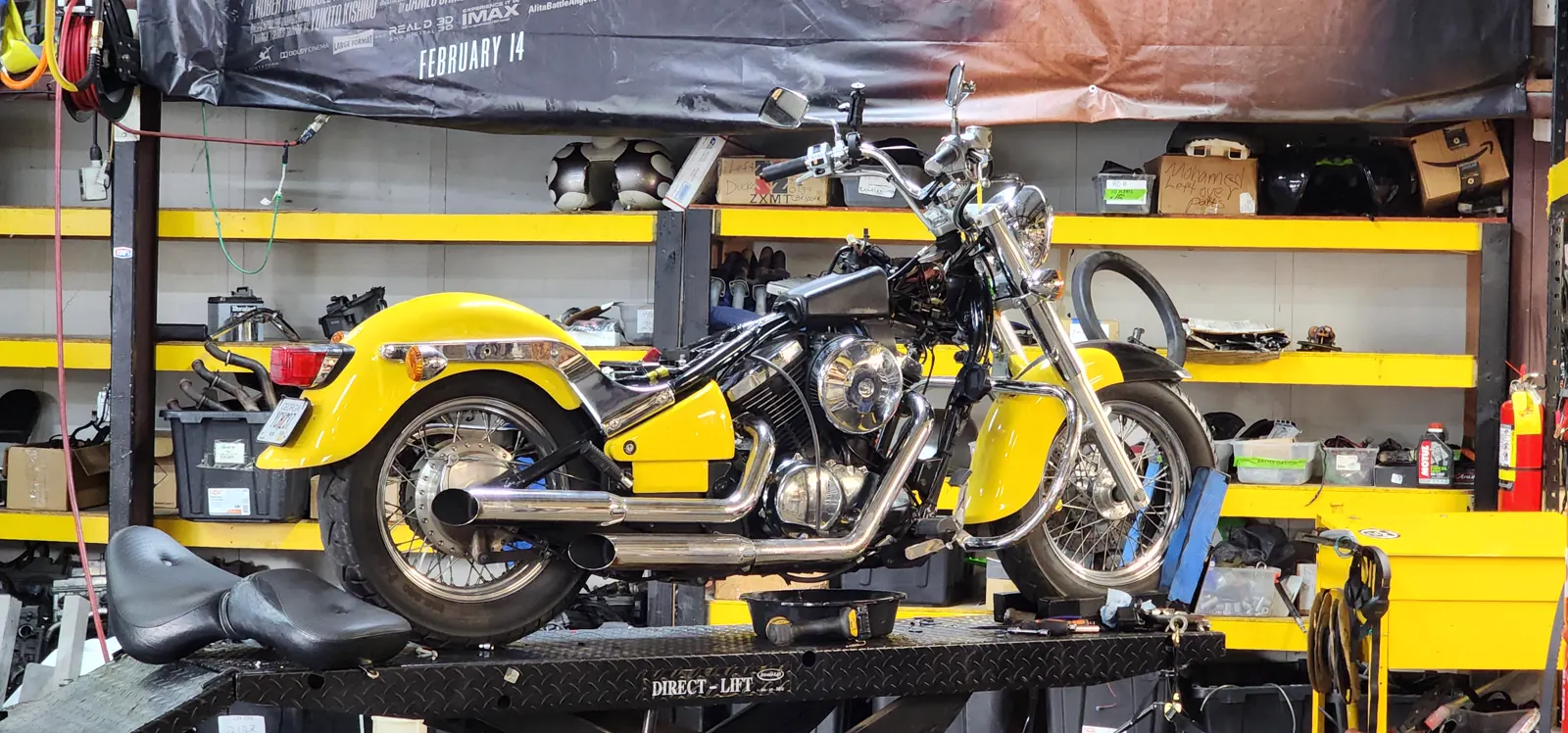
Use matters too. A bike that runs down to Senoia on a Saturday morning — about twenty minutes southwest, historic downtown, easy parking, lunch, then home — lives an easy life mechanically. Short rides, gentle heat cycles, no abuse. The one part that hates that pattern is the battery, which never gets a long enough run to fully recover. A bike that tours for six hours at a stretch has the opposite profile: happy battery, hard-working tires, fluids that see real heat.
What we actually check on a service
Here’s the question we’d ask if you were standing in the shop with us: what do you want this bike to be in five years? A clean weekend machine you still love riding, or a project you keep meaning to get to? Your answer changes what we recommend far more than the badge on the tank does.
Either way, a real service isn’t a mystery ritual. It’s a checklist, and you deserve to see it before anyone touches your bike. Here’s the core of ours.
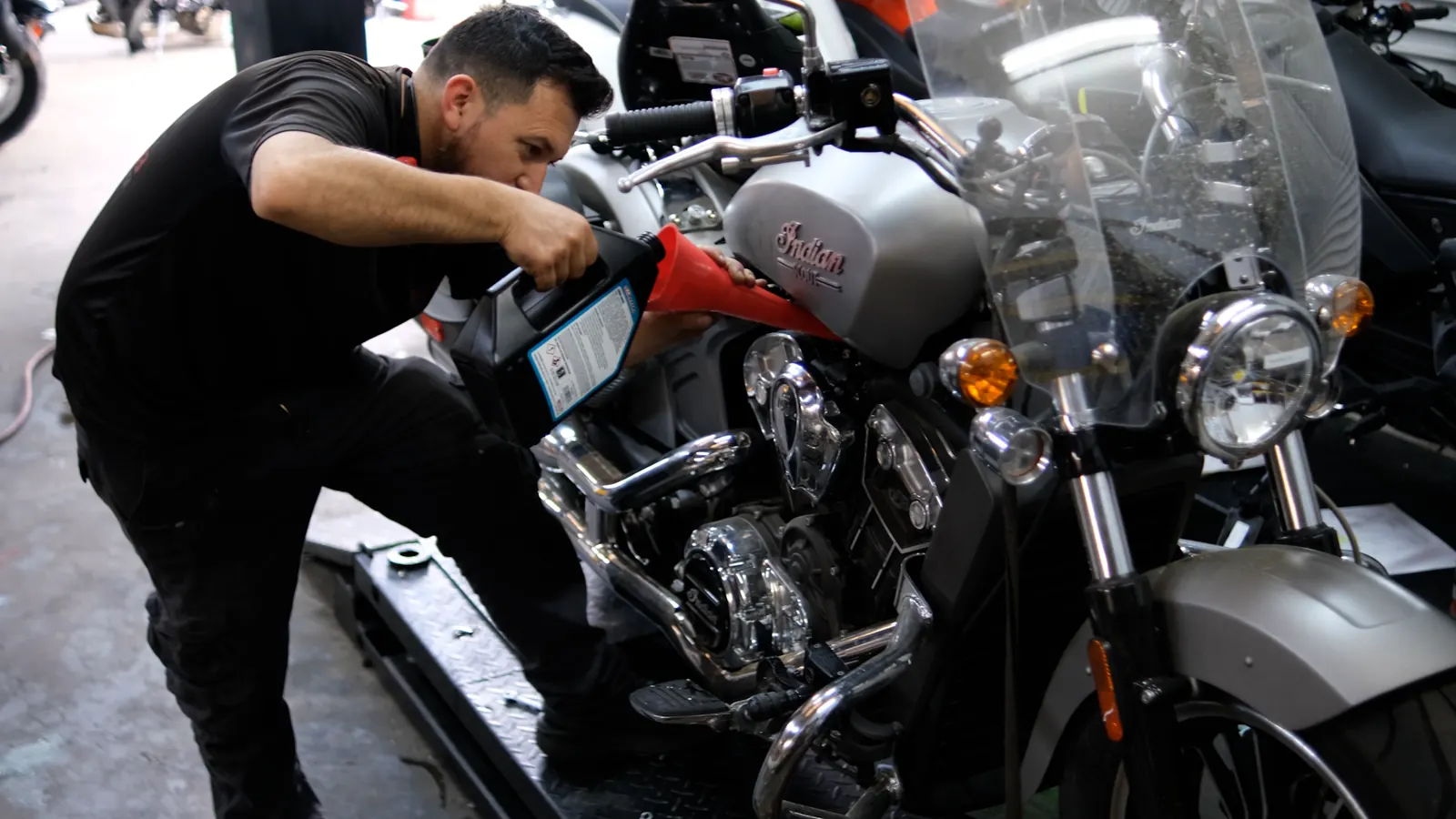
- Oil and filter, drained warm so it carries the junk out with it, then refilled to the spec your manual calls for.
- Chain or belt — tension, wear, alignment, and a proper clean and lube instead of a squirt and a prayer.
- Tires, checked for tread depth, uneven wear, cracking in the sidewall, and the date code stamped on the rubber.
- Brakes: pad thickness, rotor condition, lever and pedal feel, and fluid that’s clear instead of iced-tea colored.
- Fluids across the board: coolant, fork oil, final drive where the bike has one, and clutch fluid on hydraulic setups.
- Battery and charging system, tested under load rather than just poked with a meter while it’s sitting still.
- Cables, controls, and pivots — throttle free play, clutch pull, and every lever moving the way it should.
- Lights, switches, horn, and the wiring behind them, because electrical gremlins love a bike that sits.
- Fasteners, suspension travel, wheel bearings, steering head, and anything that’s worked itself loose.
- A road test, which is where the honest answers live. Some faults only show up at speed.
None of that is exotic. It’s just thorough. If you want the longer version of what falls under routine work, we lay out the work we do in house in plain language, and we’re happy to walk through any line item on the phone before you commit to anything.
Mistakes we'd love you to skip
We’ve seen the same handful of misses over and over, and every one is avoidable. None of them make you a bad owner. They’re just habits that quietly cost people a riding season.
- Waiting for a noise to get loud. Small sounds are cheap sounds. Loud ones have usually taken a friend along with them.
- Judging tires by tread alone. Rubber hardens with age, and a garage-kept bike can wear out its tires without ever wearing down the tread.
- Topping off fluids forever instead of replacing them. Brake fluid especially — once it’s dark, adding fresh fluid on top doesn’t fix what’s underneath.
- Splitting one bike across four shops. Nobody ends up knowing the machine, and the history disappears.
- Skipping the road test. A bike can pass every static check and still feel wrong in the first left-hander.
Brake fluid is the one we harp on most, because it’s invisible, it’s easy, and it changes how the bike stops. If you’re curious what a proper flush and bleed involves, we’ve written up how we handle that job step by step. And if you’re weighing shops in general, our notes on what separates a good shop will save you a few phone calls.
SEASON PREP
March through May is the busy stretch here, and the pollen is the reason. It coats paint, clogs air filters, and settles into every seam. A spring service plus a real wash beats scrubbing yellow dust off chrome in July.
Why Peachtree City rewrites the math
This is where Peachtree City is genuinely different from other towns. In most places, the motorcycle is at least part-time transportation. Not here. With more than a hundred miles of multi-use paths carrying golf carts, walkers, and bikes on a network kept physically separate from the roads, short local trips already have a vehicle — and motorcycles aren’t permitted on those paths anyway. So the bike in a PTC garage almost never commutes. It’s a hobby, a Saturday, a thing you look at on the way to the car.
That single fact changes everything about how these bikes should be maintained. Around Aberdeen, one of the five original villages, we see well-kept machines with modest odometers. Same story over in Kedron, where the Kedron Estates and Kedron Hills streets hide some seriously nice metal behind closed doors, and out through the Smokerise communities where garages run deep. These aren’t beaters. They’re kept things.
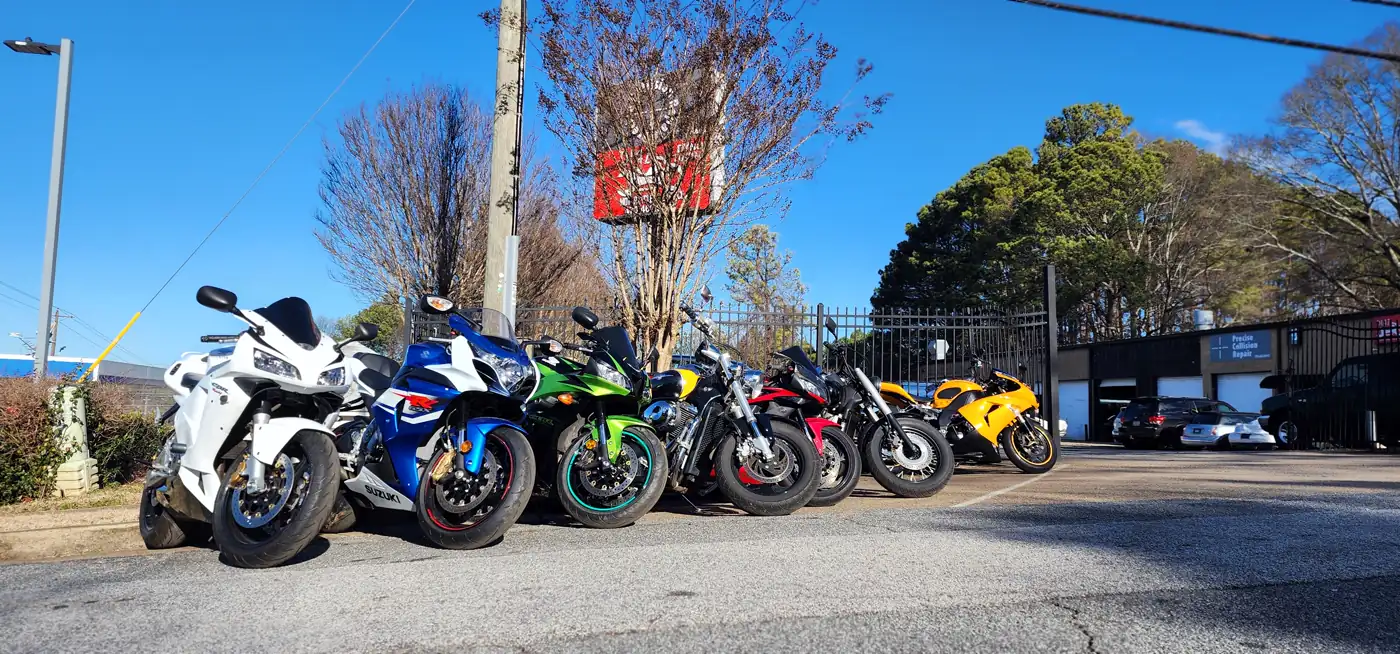
There’s a nice parallel a few minutes from home. The Commemorative Air Force Dixie Wing Museum keeps warbirds at Falcon Field flying, not because it’s efficient, but because those machines are worth keeping right. That’s the same instinct that has somebody rolling a covered bike out on the first warm Saturday. And for a reminder of what careful upkeep protects, ride out toward the Flat Creek Nature Area, five hundred acres of preserve with boardwalk access, and notice how quiet a well-sorted bike sounds out there.
One more local truth worth saying out loud: there’s no verified motorcycle dealership or repair shop inside the Peachtree City limits. Every rider here is already driving somewhere for service, so the usual “but they’re closer” argument barely applies. Picking indie service Peachtree City riders can count on is about direction, not distance.
About the drive — we won't pretend
We’re in East Cobb, on Barnes Mill Road. Getting to us from PTC means heading north on GA-74, onto I-85, around the perimeter, and up I-75. It’s roughly an hour or more each way depending on when you leave, and nothing about a Peachtree City routine naturally routes you our direction. So no, we don’t expect anybody to ride an hour and change for an oil change, and we’d think less of a shop that pretended otherwise.
Here’s how it actually works instead. First, we’ll come get the bike — pickup and delivery is the normal arrangement for our Fayette County friends, not a favor. Second, batch the work. If the bike’s coming to us anyway, do the service, the tires, the fluids, and the detail in one visit rather than four. Third, and most importantly, save the trip for work worth traveling for. Routine oil changes aren’t worth an hour. Restoration is. So is custom paint, engine work, and the kind of finish detail that turns a stored project into the best-looking bike at the Saturday meetup — and we haven’t found a shop doing that kind of work anywhere in Fayette County.
| Your situation | Better choice | Why |
|---|---|---|
| Bike under factory warranty | Dealer | Only an authorized retailer can process a warranty claim. |
| Open recall notice | Dealer | Recall work is performed and recorded by the manufacturer's network. |
| Out-of-warranty routine service | Independent | Same tech every visit, direct conversation, flexible scheduling. |
| Older or discontinued model | Independent | Dealers focus on current lines; indies keep working on what came before. |
| Custom paint, restoration, detail | Independent | It's specialty craft work, and it's rarely offered at a dealership. |
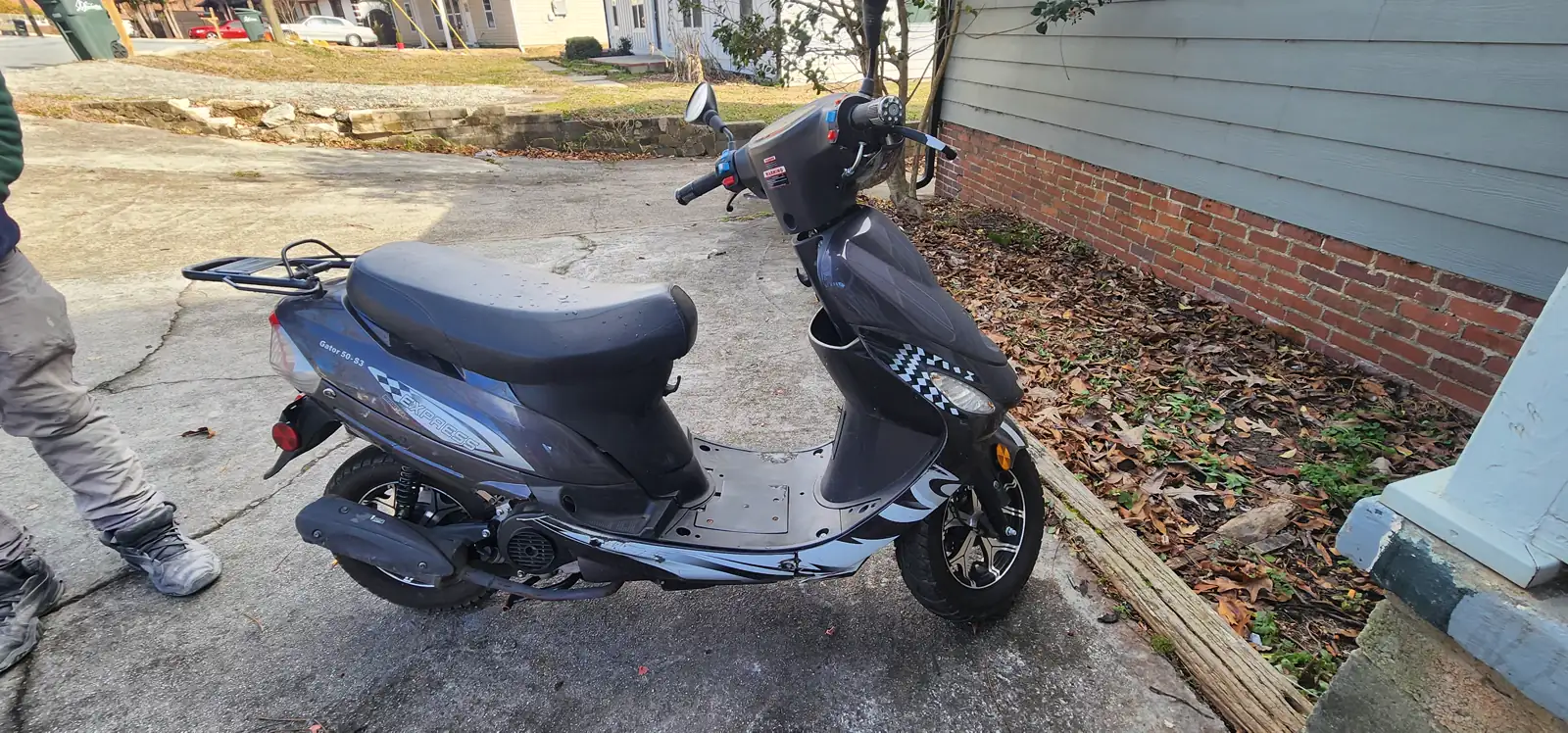
| You want it handled without the drive | Independent | Pickup and delivery turns the distance into somebody else's problem. |
If you’d like to see how this same comparison plays out on the other side of the metro, we walked through the Douglasville side of things in a separate post. Different town, different drive, and the answer lands in nearly the same place.
Where this leaves you
You should finish this knowing exactly which door to pick. Warranty, recall, factory software: dealer, every time, and Newnan is a short hop for that. Everything else on a bike you plan to keep goes the other way, toward the indie service Peachtree City riders land on anyway, because continuity of care beats convenience and the deeper work doesn’t exist at most dealerships. Switching later costs nothing but a phone call, so you’re not locked in.
Then go ride it. Spring is when the roads here get good, and the hazards worth respecting are local ones rather than bad pavement — cart path crossings, curvy streets with short sight lines, dappled shade that hides a wet patch, acorns and leaves on the shaded curves, and deer that treat the greenbelt like their own front yard. If it’s been a few seasons since you sharpened up, the MSF rider courses are a genuinely good afternoon.
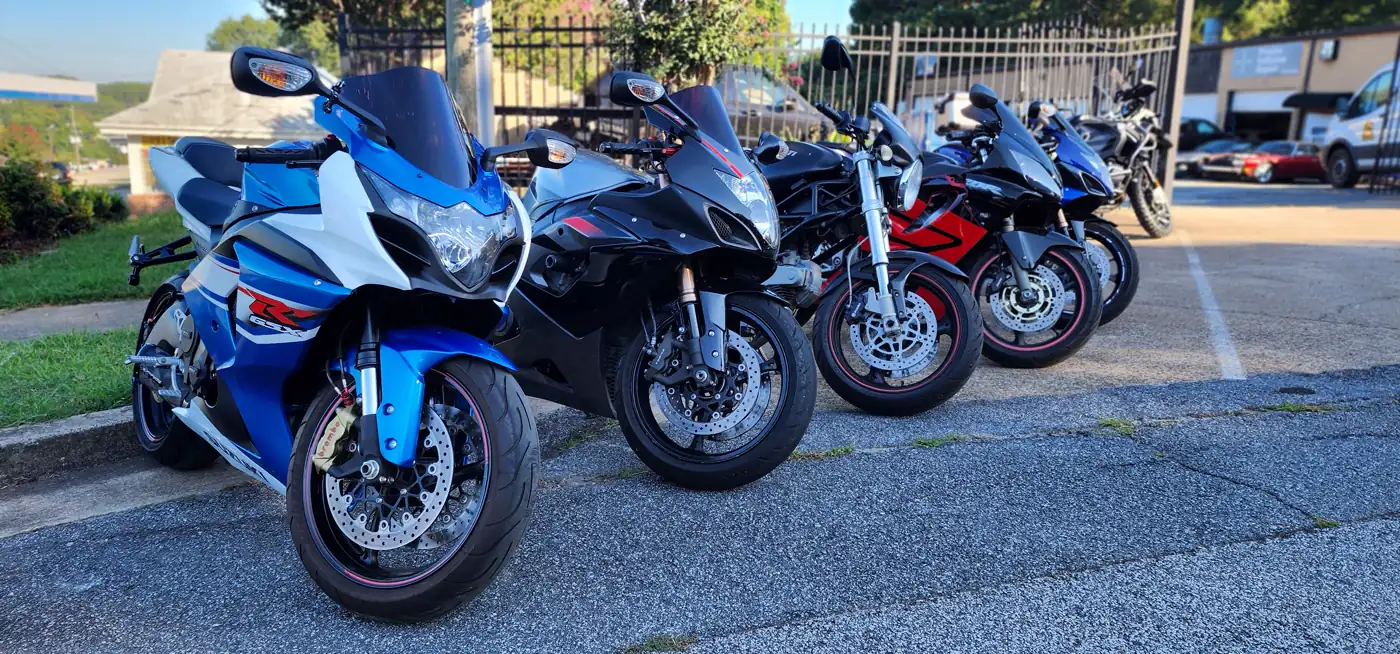
A well-maintained bike gives you something you can’t buy back later: the confidence to just go. No mental checklist at the driveway, no wondering about the front brake, no bargaining with a noise. Catch the small stuff early and it stays small. That’s the whole trick, same as it was at that first tick from the top end.
Questions Peachtree City riders ask us
What's the real difference between dealer service and an independent shop?
A dealer is authorized by one manufacturer, so it handles warranty claims, recalls, and factory software for that brand. An independent shop works on many brands and isn’t tied to a single maker’s parts catalog or process. The parts and fluids can be identical; the difference is authorization, continuity, and how much of the job you get to see.
Which one keeps a bike running longer?
Neither one wins by default — the schedule wins. A bike serviced on time at either shop will outlast a bike that skips seasons at the fanciest place in town. What tends to help long term is the same tech seeing your bike repeatedly, because they notice the small change since last visit. That’s easier to get at an independent shop.
Which is right for the way I actually ride?
If your bike is new, under warranty, and you ride it hard enough to hit intervals quickly, the dealer relationship is worth keeping. If it’s a garage-kept weekend bike with low miles, an independent shop is usually the better fit, because your needs lean toward age-based items like fluids, tires, and battery health. Most Peachtree City bikes fall into that second group.
Can I switch from the dealer to an indie shop later?
Yes, and it’s simple. Bring or send whatever service records you have and we’ll pick up the history from there. Routine maintenance performed by an independent shop does not void a factory warranty on its own, so keep your receipts and you’re fine either way.
Do I really have to drive to Marietta for this?
Not usually. We pick up and deliver for Fayette County riders, so the bike makes the trip and you don’t. For routine work, batching several jobs into one pickup is the sensible move, and for restoration or paint the bike is with us a while anyway.
So which do you recommend?
Dealer for warranty, recalls, and factory-only updates. Independent for everything else, especially older bikes, deep service, custom paint, and restoration. If you’re unsure which bucket your bike sits in, call us and describe it — we’ll tell you honestly, even when the answer is the dealership.
We take care of riders all over the south metro and out past it. That means Peachtree City and its neighbors in Fayetteville and Tyrone, plus Newnan, Senoia, and Sharpsburg to the southwest, and the smaller Fayette communities of Brooks and Woolsey where the roads get quiet in a hurry. North of there we regularly help friends in Union City, Fairburn, and Palmetto, and east toward Jonesboro and Riverdale. Pickup and delivery covers all of it, so the distance stays our problem instead of yours.
TELL US WHAT IT'S DOING
Heard a new tick, felt the lever go soft, or finally ready to bring that garage project back to life? Text or call us and describe it in your own words — no jargon required. We’ll tell you straight whether it’s a dealer job or ours, and if it’s ours, we’ll arrange pickup from your Peachtree City garage and bring the bike back sorted.
470-460-9883Diaz Motorcycles and Service, LLC · 847 Barnes Mill Road, Marietta, GA 30062