Motorcycle Repair Cost Marietta — What You Pay
A plain-English walk through what makes one repair job bigger than another, and why an honest shop looks first.
You’ve had the bike a long time. Long enough that you know its sounds, its smells, and the exact spot where the paint got kissed by a garage door. So when it starts acting funny, you’re not shopping for a replacement. You’re trying to keep this one alive. That’s usually the moment somebody looks up motorcycle repair cost Marietta, and what they actually want isn’t a number on a screen. They want to understand what they’re paying for, and why one job is twice the work of another. Good news? That part is simple to explain.
We work on bikes for a living over on Barnes Mill Road, just off Roswell Road. Every week somebody rolls in with a machine they’ve owned longer than their car, their couch, and in a couple of cases their dog. And every week the same question comes up: what makes this job big or small? So let’s walk the whole thing, start to finish, in plain words. By the end you’ll be able to read an estimate like you read a fuel gauge.
The myth: there's a price list taped to the wall
Here’s the thing. Most folks picture a menu behind the counter, like a barber shop. Brake job, one number. Valve check, another number. It’s a comforting idea, but bikes don’t work that way, and neither do the shops that treat you right. Two bikes can roll in with the exact same complaint and still be two completely different afternoons.
Why? Because the fix is rarely the hard part. Getting to the fix is. On a lot of machines, the failed part costs less than a nice lunch, yet it’s buried under bodywork, a fuel tank, an airbox and a wiring harness. Meanwhile the same part on a bare-bones bike is right there in the open, hanging out where anybody can reach it. Same repair on paper. Very different job in real life.
- How much has to come off before a wrench can touch the failed part
- Whether the part is common or has to be chased down and waited on
- Whether anything nearby is worn out too, so it makes sense to do it once
- How old the fasteners are, since a seized bolt turns ten minutes into an hour
- Whether the bike has been apart before, and how carefully it went back together
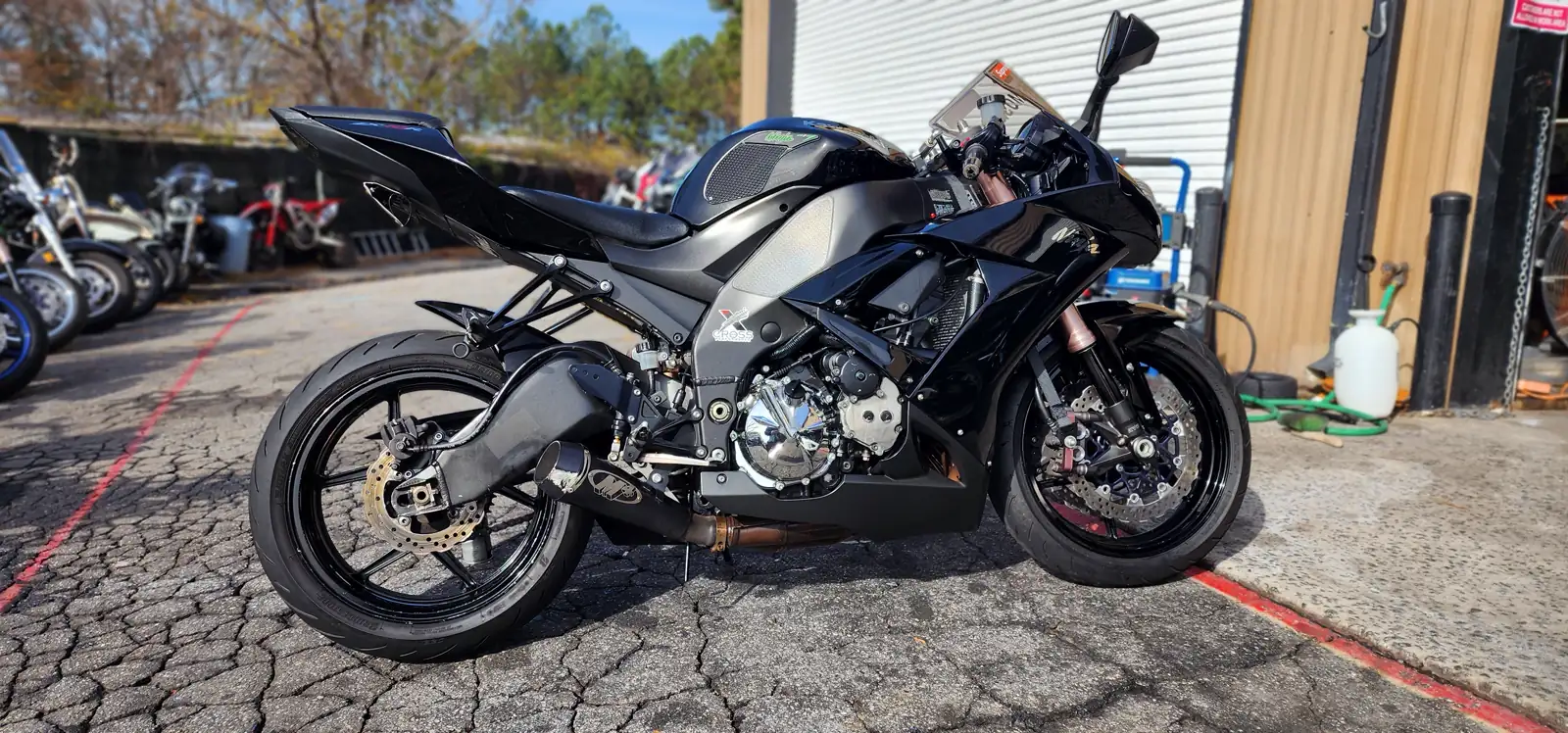
So when a shop hands you a flat number over the phone before anybody has laid eyes on the bike, they’re not being generous. They’re guessing, and guesses get corrected later, usually in the wrong direction. A real estimate comes from looking, and looking takes a few minutes on a lift.
Real talk: that’s why we won’t quote a mystery noise sight-unseen. A rattle can be a loose heat shield, or it can be a cam chain tensioner. Until we hear it ourselves, anything we say is just a confident-sounding story, and you deserve better.
The reality: access is the job, and parts are the passenger
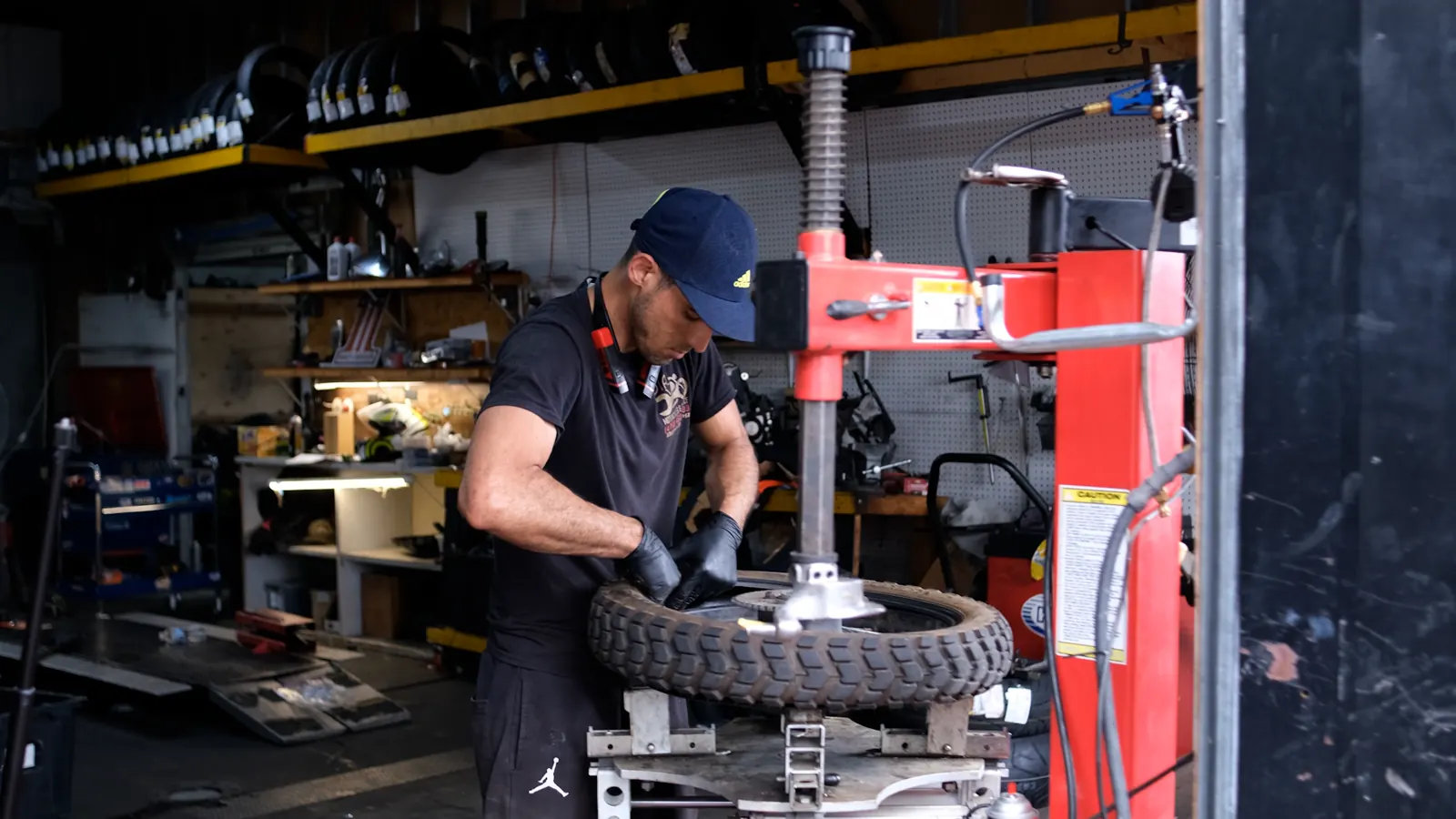
Every repair breaks into two buckets. There’s the stuff we install, and there’s the time it takes to get there and put it all back correctly. Parts are the easy bucket to understand, because a part is a physical thing in a box. Labor is the bucket people underestimate, though it’s usually the bigger half.
Think about a chain and sprocket set on a commuter bike. The parts are simple. But the job also means pulling the rear wheel, checking the cush drive, cleaning years of road grime off the swingarm, setting alignment, and torquing everything to spec. In fact the careful part at the end is what makes the new chain last, so rushing it would be silly.
Now flip it. A fuel pump on a big touring bagger might be a pricier part, yet the labor is shorter because the tank comes off in a friendly way. That’s why a smaller-sounding job can cost more than a big-sounding one. The bike decides, not the name of the repair.
THE SHORT VERSION
Parts are what you keep. Labor is what makes them work. A fair estimate shows you both, so you can see exactly where the work went.
The timing on this matters more than the fix does. A chain that’s stretched but alive is a maintenance item. That same chain, ignored for another season, can take out sprockets and chew a case cover, and now three parts are involved instead of one. Nothing dramatic, nothing scary — it’s just that small jobs stay small when you catch them early, and every rider we’ve helped who came in early paid for less work than the one who waited.
What actually happens when your bike comes in
People imagine a garage as a black box. It isn’t. Here’s the honest order of operations, the same way we’d do it for a friend.
- You tell us the story. When it started, what it sounds like, what you were doing. Riders are better witnesses than they think.
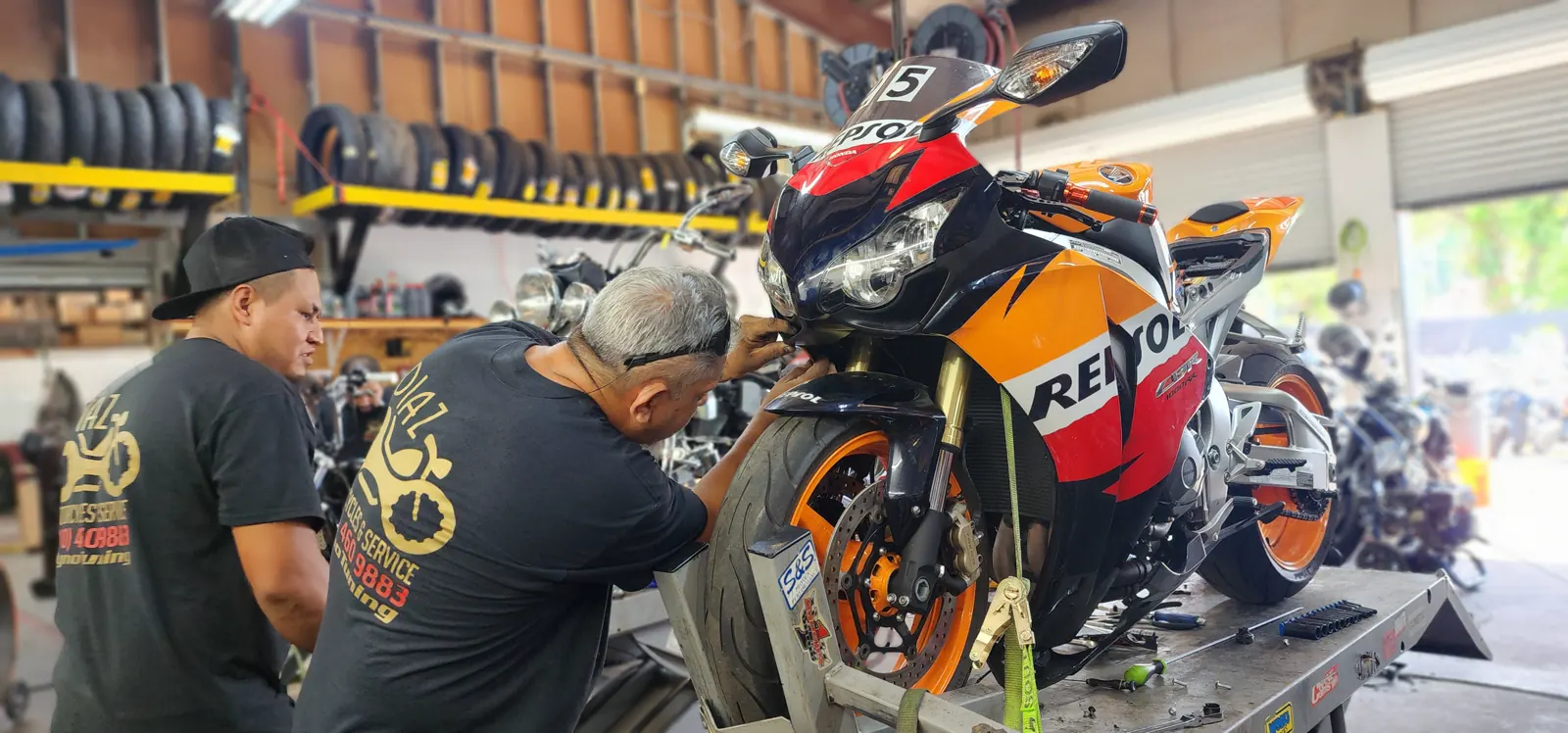
- We ride it or run it, if it’s safe to. A noise you describe and a noise we hear are two different pieces of information.
- Up on the lift. We check the obvious suspects first, because the obvious answer is right most of the time.
- We look at the neighbors. If we’re already in there, we check what’s nearby so you don’t pay for the same access twice.
- You get the estimate, split into parts and labor, with a plain sentence about what each line is for.
- You decide. Do it all, do the safety items now and the rest later, or sit on it. It’s your bike and your call.
- We do the work, then we test it. Then we tell you what we found along the way, including anything to watch next season.
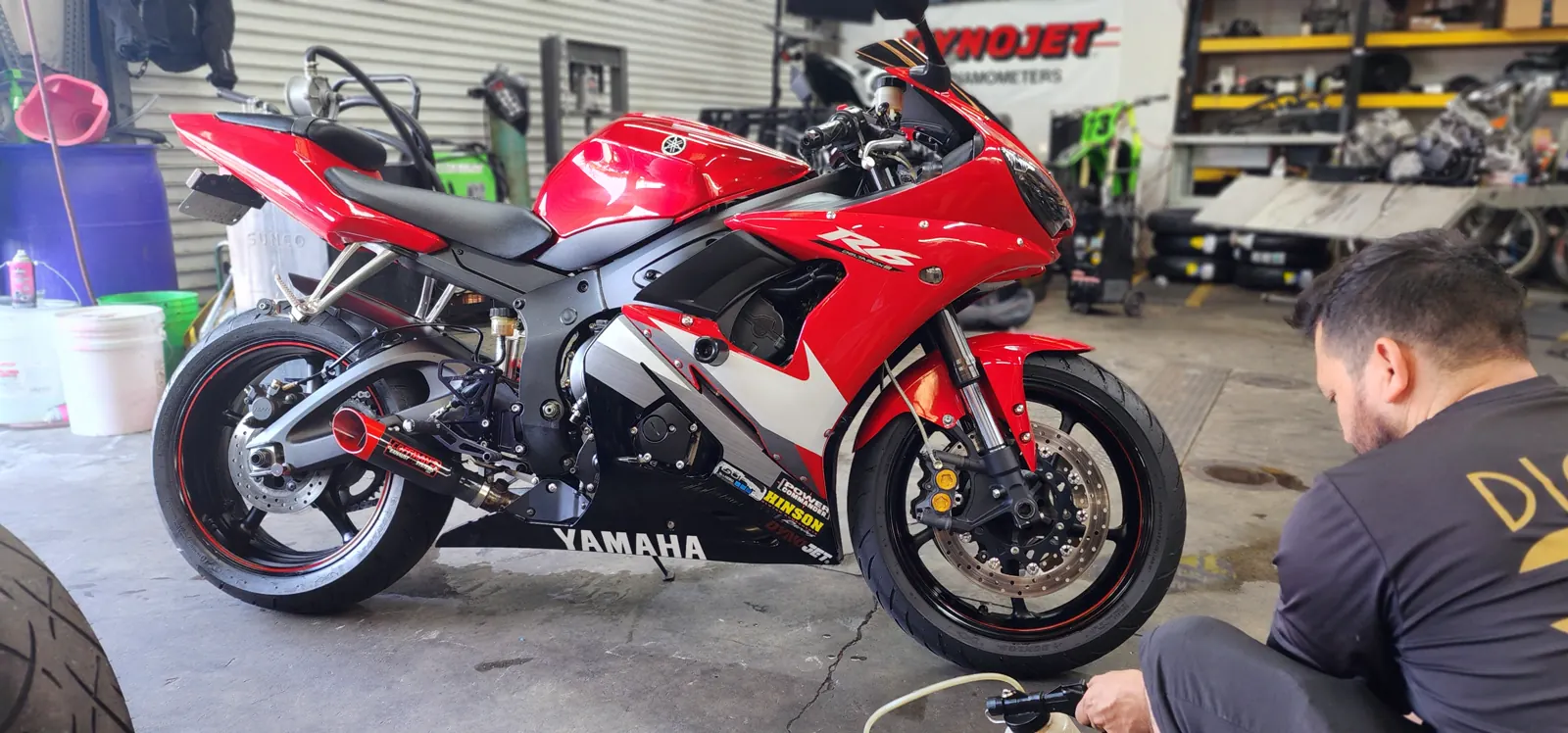
That fourth step saves more than anything else on the list. For example, if the front wheel is already off for a tire, checking the fork seals and wheel bearings adds almost nothing. Doing it as a separate visit next month means paying for that teardown twice. So we group work by access, not by category.
Also, nothing on that list happens without your yes. If we open something up and find a surprise, you get a phone call, not a bigger bill at the end.
How to tell a good shop from a guessing shop
You’ve probably noticed that every shop says the same nice things on the internet. So judge behavior instead of words. There’s a longer piece on what separates a good shop, but here’s the quick field test you can run in one conversation.
- Questions come before answers. A shop that quotes instantly isn’t listening.
- The estimate splits parts and labor instead of landing as one lump sum.
- You get shown the old part, or a photo of it, without having to ask.
- Somebody tells you what can wait. If everything is urgent, that’s selling, not fixing.
- Explanations use words you already know, and nobody gets twitchy when you ask why.
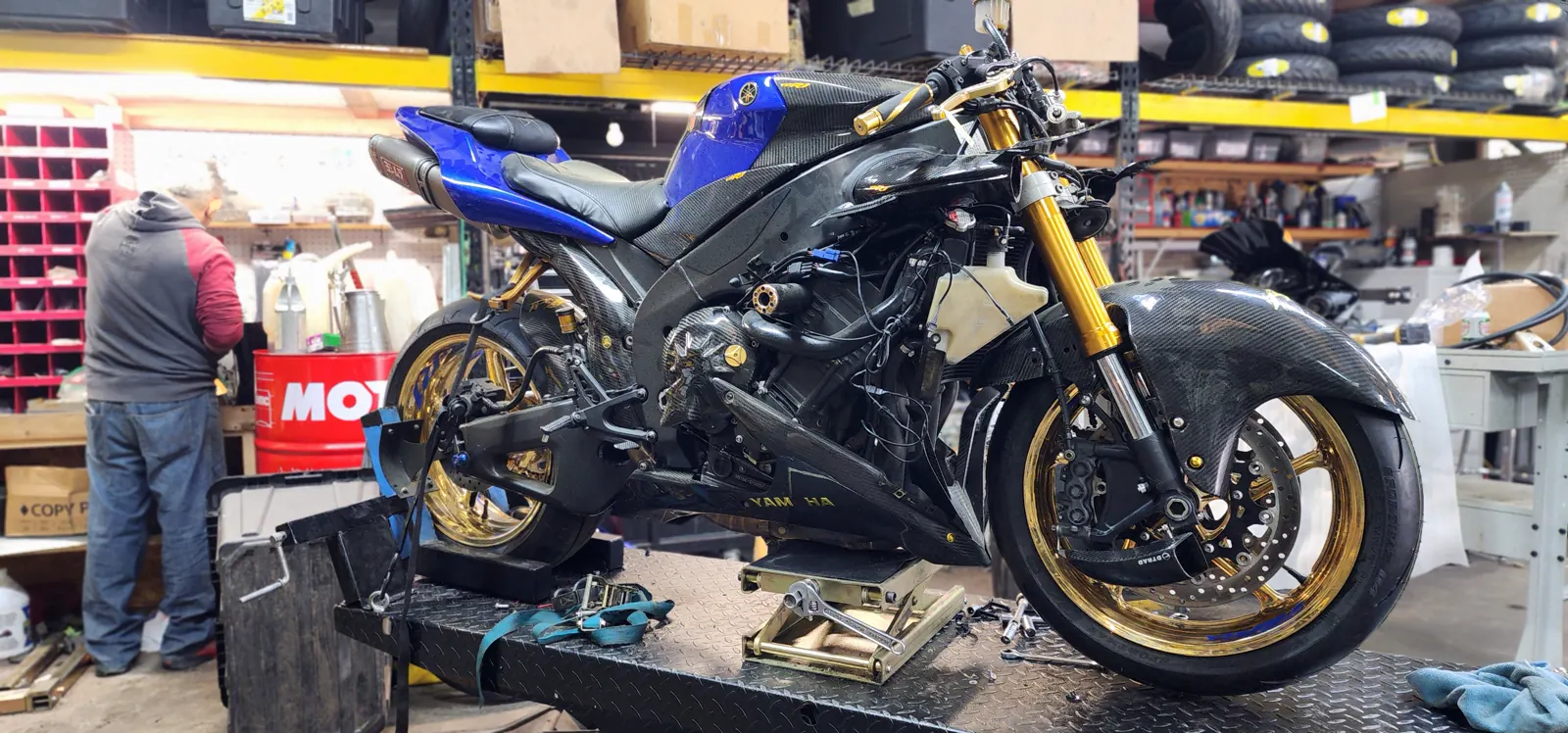
The other thing to weigh is capability. Marietta is thick with dealers, and they’re good at what they do. Wooly’s Cycles of Atlanta over on Cobb Parkway South is Georgia’s top-volume BMW and KTM Group dealer, and they also carry CFMOTO. Still, the common gripe we hear about dealer service departments is a flat book rate and a wait measured in weeks. Independents can be quicker, though only if they actually have the equipment.
That’s why we lean into the work the multi-line shops don’t keep in-house: dyno tuning, ECU flashing, Power Commander setup, in-house paint, and full restorations. When a bike needs a tune rather than a part, guessing at a laptop is expensive. A dyno turns that into measured facts, which is cheaper for you and less stressful for everybody. Paint is the same story — there’s a whole write-up on how we handle that job if that’s where your bike is headed.
A guess is free. Correcting a guess never is.
A bike came in from Whitlock Avenue Historic District with exactly this. Long-term owner, garage-kept, and a machine he clearly loved. The complaint was a soft front end and a weep at the fork. He’d been quoted seals over the phone somewhere else, which sounds reasonable. But once it was up on the lift, the tubes were pitted from a pothole hit, and new seals on pitted tubes would have failed by fall. So the real fix cost him a little more up front and saved him doing the whole job twice. He rode out grinning, which is the actual point.
Marietta things that quietly change the work
Where you ride shapes what wears out. Georgia doesn’t allow lane splitting, so local commuters sit in the same I-75 stop-and-go as everybody else. That’s brutal on clutches, brake pads and cooling capacity, and highway mileage doesn’t tell the true story. Surface streets aren’t gentler either, because Roswell Road, Cobb Parkway, Canton Road and South Cobb Drive are stoplight-to-stoplight, which grinds chains and sprockets and cooks air-cooled engines in July.
Then there’s pavement. Cobb DOT grades roads on an Overall Condition Index and is building a six-year resurfacing plan funded largely by 2022 SPLOST money, which is genuinely good news. Even so, older Marietta arterials go a long time between passes. Potholes and expansion joints are a leading cause of bent rims, blown fork seals and knocked-out alignment, plus the railroad crossings running through the Square district catch riders who are looking at the shops instead of the tracks.
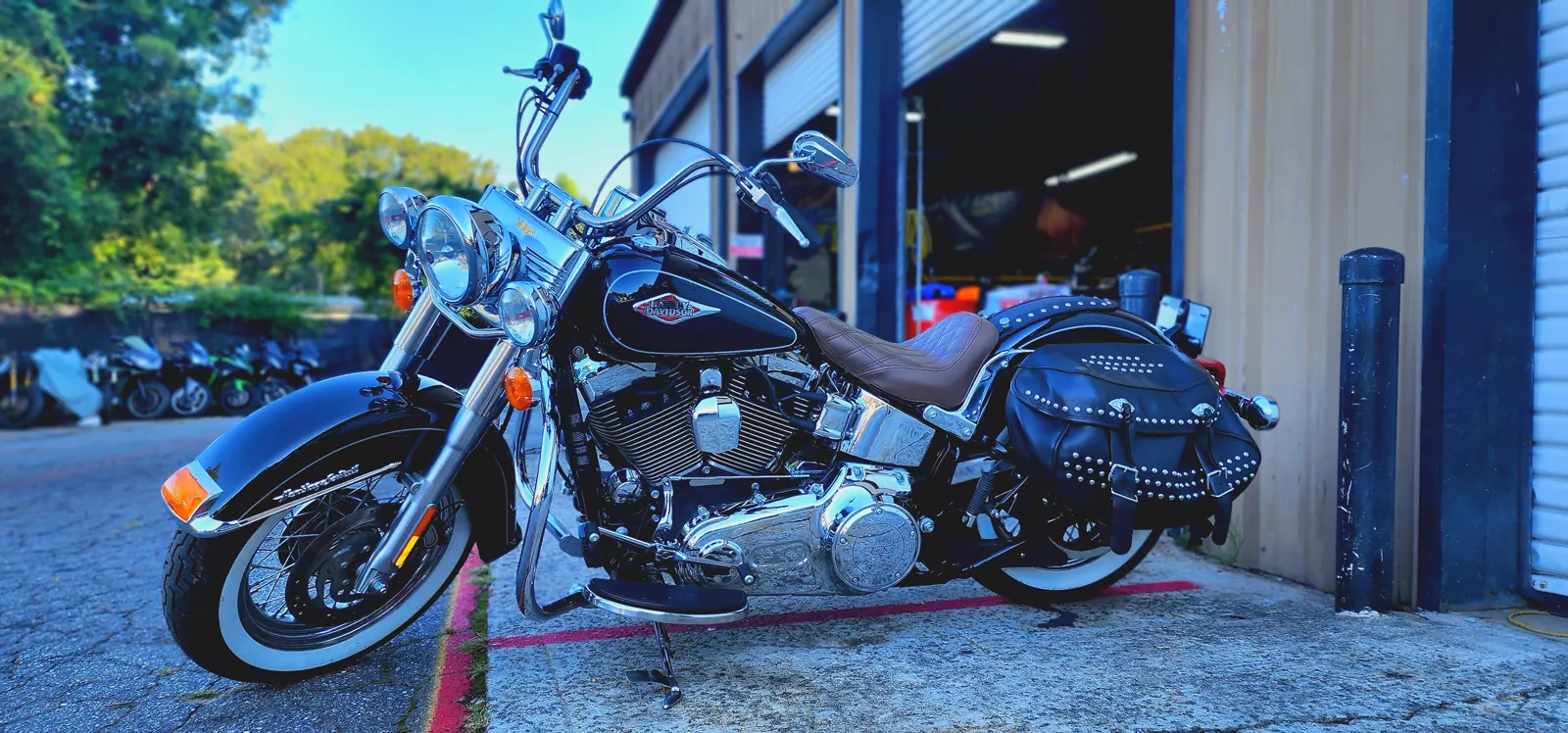
Storage matters too. Plenty of homes around Historic Marietta and Marietta Country Club have a garage, and those bikes age slowly. But this city also has a big apartment and townhome population along Franklin Gateway, Delk Road, Powers Ferry and Roswell Road, where bikes live outdoors under a cover. Those machines arrive with tired batteries, gummy fuel systems and corrosion. None of it is a disaster, though, since a battery tender and a little fuel discipline head off most of it.
Season plays a part too. Tree pollen runs from late February into May, and March and April counts often climb past 1,500 grains per cubic meter. That yellow film packs into air filters and makes a healthy engine feel lazy. Of course a filter is easy to stay ahead of, so this is a fix, not a worry.
Where we sit, and how the day actually goes
We’re on Barnes Mill Road, about three miles from the Square, roughly eight to twelve minutes up Roswell Road. Honestly, no point inside the city limits is more than about twenty minutes out. If you’re giving somebody directions the local way, we’re past the Big Chicken and down toward the quiet side, not far from Marietta National Cemetery. Nobody around here has ever needed a street name once the Big Chicken enters the conversation.
Riders here are a broad mix, and we like that. V-twin baggers head out Dallas Highway. Student sportbikes come in off Cobb Parkway. There’s a real vintage Japanese restoration crowd too, plus European sport-tourers and ADV bikes getting prepped for the Georgia Triangle. If the Suches Loop is on your calendar — SR-60 up to Suches, Wolf Pen Gap Road across to Vogel State Park and US-19 home — tell us before we start. A bike that’s fine for errands isn’t automatically ready for two hours of mountain switchbacks.
Because folks here compare notes and often wrench on their own bikes, we’d rather explain than posture. If you want to do the easy half yourself and hand us the ugly half, that’s a completely fine plan. Plenty of the riders we’ve helped do exactly that. You can see everything we cover and pick your line. And if you’re comparing what things look like a few exits up, we broke down the Acworth side of things as well.
One last practical note. Keep your title and registration tidy through the Georgia Department of Revenue, especially on an older bike you plan to keep or restore. And if you want riding resources beyond the wrench side, the American Motorcyclist Association is a solid place to start.
What this all adds up to
So the honest answer about motorcycle repair cost Marietta riders should expect is this: it’s driven by access, by parts availability, and by how long the problem has been allowed to run. None of that is mysterious once somebody shows you the bike on the lift and points at the thing. Since you’ve owned yours a long time, you already know more about it than any estimate does.
You should be able to walk out understanding what got fixed, what it cost you in parts versus time, and what to keep an eye on next season. That’s the whole deal. Then the bike goes back to being the bike, the one you know by sound, and you go back to riding it.
Questions Marietta riders ask us
Why won't you quote me over the phone?
Because a quote without eyes on the bike is a guess, and guesses get corrected later. The same symptom can be a loose heat shield or something much deeper. So we look first, then tell you what’s real. You’ll get the estimate before any work starts, not after.
What's actually included in the work?
Parts, labor, and the testing afterward. Labor covers getting to the failed part and putting everything back to spec, which is usually the bigger half of the job. We also check nearby wear items while we’re already in there. That way you’re not paying for the same teardown twice.
How long will my bike be here?
Simple maintenance is often same-day or next-day. Bigger jobs depend mostly on parts, since some pieces for older or European bikes have to be chased down. We’ll give you a realistic window up front and call you if it moves. Nobody enjoys the silent-shop experience, so we don’t run one.
Is more of it parts or labor?
It depends entirely on the bike. A cheap part buried under bodywork is a labor-heavy job, while a pricier part in an easy spot is a labor-light one. That’s why two bikes with the same complaint can land in very different places. Your estimate splits the two so you can see it plainly.
Does the type of bike change the work?
Yes, quite a bit. Sportbikes hide service points under fairings, baggers have more to remove but often more room to work, and vintage Japanese bikes bring seized fasteners and hunting for parts. ADV and European bikes sometimes need specific tools or a tune rather than a part. We work on all of them, so tell us what you ride and we’ll tell you what to expect.
Can I do part of the job myself?
Absolutely, and lots of riders here do. Handle the easy half in your garage and bring us the part that needs a lift, a dyno or special tooling. We’ll be straight with you about which is which. There’s no ego tax for showing up with your own wrenches.
We take care of riders all over Cobb County and the northwest side of the metro. Along with Marietta itself, we regularly see bikes from East Cobb, Kennesaw, Smyrna, Acworth, Powder Springs, Mableton, Austell and Vinings, plus riders who come down from Woodstock or over from Roswell and Sandy Springs. Folks out toward Dallas make the trip too, usually because they want dyno work or paint handled in one place instead of three. If you’re within a reasonable ride of the Big Chicken, you’re in our neighborhood.
BRING IT BY AND WE'LL LOOK
If your bike is telling you something and you’d rather understand it than worry about it, roll it down Barnes Mill Road here in Marietta. We’ll put it up on the lift, show you what we find, and split the estimate into parts and labor so nothing is a mystery. Text or call whenever it’s convenient, and bring the whole story with you.
470-460-9883Diaz Motorcycles and Service, LLC · 847 Barnes Mill Road, Marietta, GA 30062