Motorcycle Repair Douglasville — What to Expect
How we diagnose a bike before we quote it, and why Douglas County commuting is hard on the parts nobody looks at.
Even so, the alarm goes off, the seat is still cold, and there are forty minutes of stop-and-go between your driveway and the parking deck. That is a real Douglas County morning. Meanwhile, Heat off the pavement, expansion joints on I-20, truck ruts you feel through the bars, and a red light every quarter mile once you drop onto Bill Arp. In fact, that said, your bike feels every bit of it. For example, Chains stretch, pads glaze, coolant cooks, and the center of the rear tire goes flat and square while the edges still look brand new. So when a rider goes hunting for motorcycle repair Douglasville can actually count on, it is usually because the bike finally said something out loud. After that, here is the good part: most of it is simple, and most of it is a one-visit fix.
The short answer, before anything else
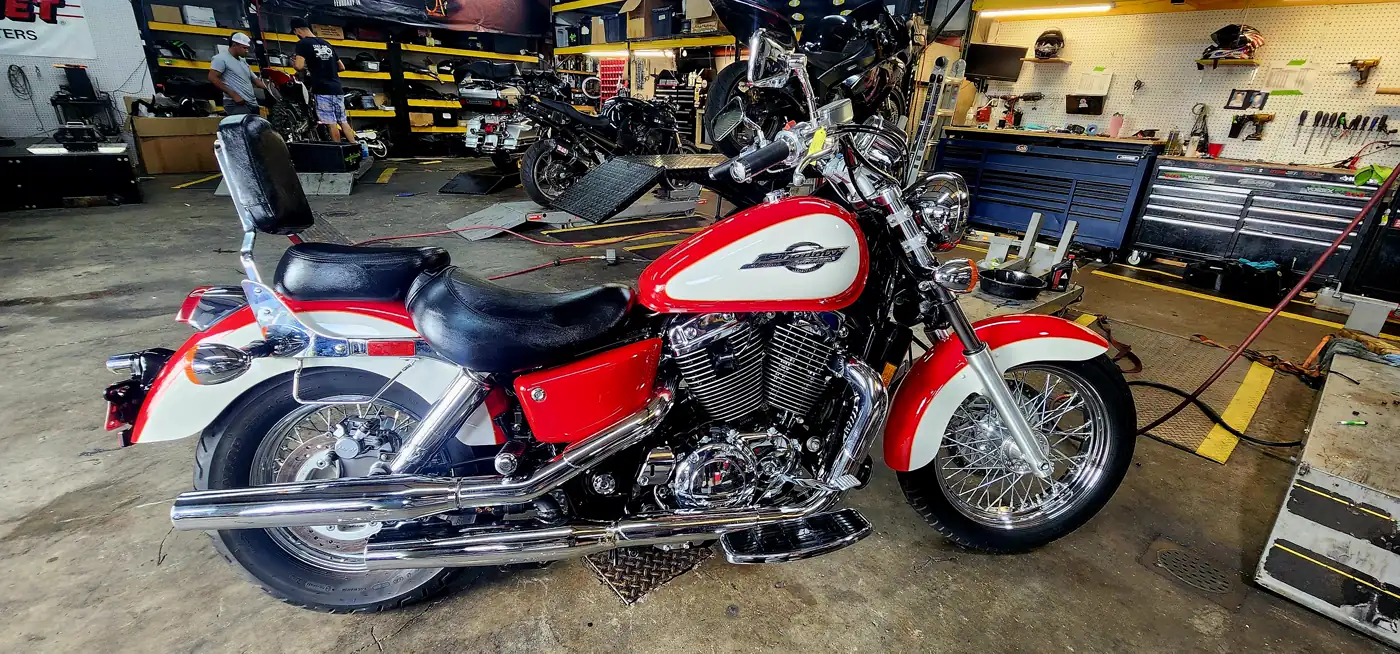
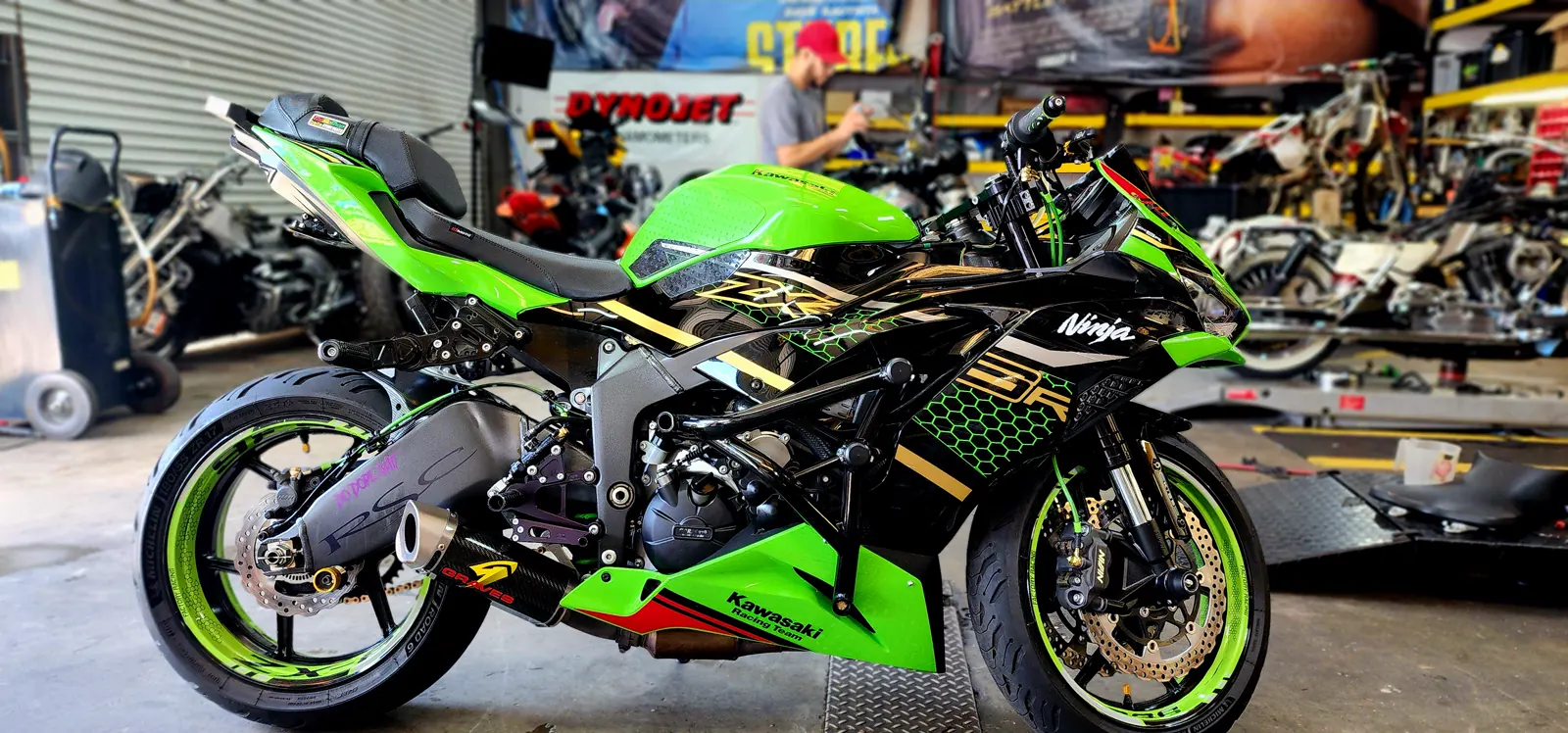
What’s more, we are a full-service motorcycle shop in Marietta. We fix the thing that is wrong, we service the things that wear out, and we tell you which is which before we touch a wrench. So and Better yet, that covers sportbikes, baggers, metric cruisers, scooters, dirt bikes, and the old project bike that has been under a tarp since your kid was in middle school. If it has two wheels and an engine, it has a home on one of our lifts.
- Diagnostics — you describe it, we find it, we show you
- Maintenance — oil, filters, chains, brakes, fluids, valves, tires
- Repair — electrical, charging, fuel, clutch, suspension, cooling
- Tuning and dyno work for bikes that have been modified
- Custom paint in our own booth, which almost nobody nearby offers
Who is it for? Riders who want a straight answer. You do not need to know what a stator does or why your fuel smells like old varnish. You just need somebody to look, say the actual words out loud, and hand you a plan you can say yes or no to. That is the whole promise. If you want the long version of what you get when you bring it in, it is spelled out there in plain language.
What actually drives the work out here
Douglas County roads are hard on bikes in a very specific way. I-20 through the county carries a huge amount of truck and logistics traffic, and trucks leave a signature: rutting, grooved pavement, hard expansion joints, dropped debris, and the occasional shredded tire carcass sitting in your lane. Thornton Road is one of the heaviest truck corridors in the west metro, and the pavement there is polished slick and rutted from all that weight. Suspension takes the beating first. Wheel bearings and fork seals come next.
Then there are the signalized retail intersections. Around Arbor Place Mall, along Bill Arp, and out on Fairburn Road, the pavement at the stop bars is polished smooth and painted heavy with arrows and crosswalk bars. Dry, no problem. Add rain or a spring pollen film and those painted sections turn into the slickest ten feet of your ride. Riders who commute through them daily wear out front pads faster and cook front tires faster, because every approach is a controlled squeeze.
South Douglas is a different animal. Those rural roads are chip-sealed, which means loose gravel washes into the corners and the shoulders drop off sharper than they look. Freeze-thaw potholes peak from February into April, and the county has year-round utility cuts from data-center and warehouse construction. None of that is scary. It just means your bike is doing more work per mile here than the same bike would somewhere flat and smooth, and the service intervals in the owner’s manual were not written with Bill Arp in mind.
WAKE-UP SEASON
February and March are our busiest stretch, and it is not a coincidence. Bikes come out of garages and out from under covers with dead batteries, varnished fuel, sticky calipers, low tires, and paint that faded a shade over winter. Book that work early and you ride the first good weekend instead of watching it happen.
Storage matters more than people expect. If you are in Chapel Hills with the golf course out the back window, or in Tributary at New Manchester where the trails run out toward the state park, or in one of the newer Brookmont homes, you probably have a garage and a bike that stays dry. Plenty of riders along the I-20, Fairburn Road, and Thornton Road corridor live in apartments and townhomes with no secure storage at all, so the bike sits under a cover in an open lot. Same bike, same year, wildly different condition at the four-year mark. Covered outdoor storage means we look harder at corrosion, connectors, and brake hardware.
That’s the common version. The real story is a little different. Most riders assume mileage is what kills parts, so they count odometer numbers and feel fine at low totals. Out here, the killer is not distance. It is heat cycles and idle time. A twelve-mile crawl on I-20 westbound in the afternoon puts more stress on a clutch, a radiator, a battery, and a chain than forty easy miles ever will, because the engine is hot and the airflow is not. Lane splitting is illegal in Georgia, so nobody is escaping that heat by sliding between cars. You sit in it, and the bike sits in it with you.
So we read bikes by condition, not by the number on the dash. A commuter with low miles and three years of afternoon traffic can need a chain, a battery, a coolant flush, and a brake service all at once, while a weekend bike with double the miles looks nearly new inside. Once you understand that, the whole maintenance schedule stops feeling random. It starts feeling like something you control.
How we diagnose before we quote
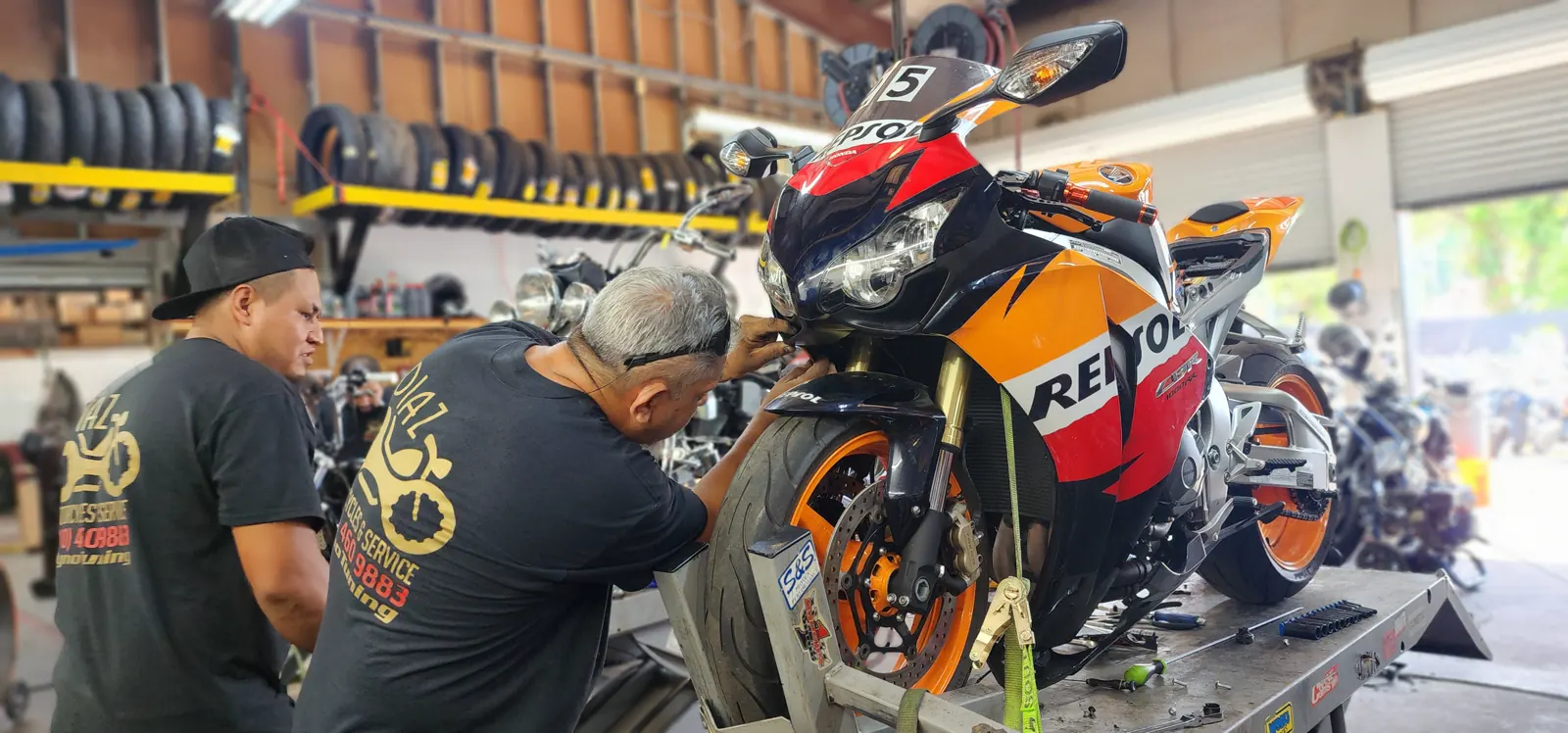
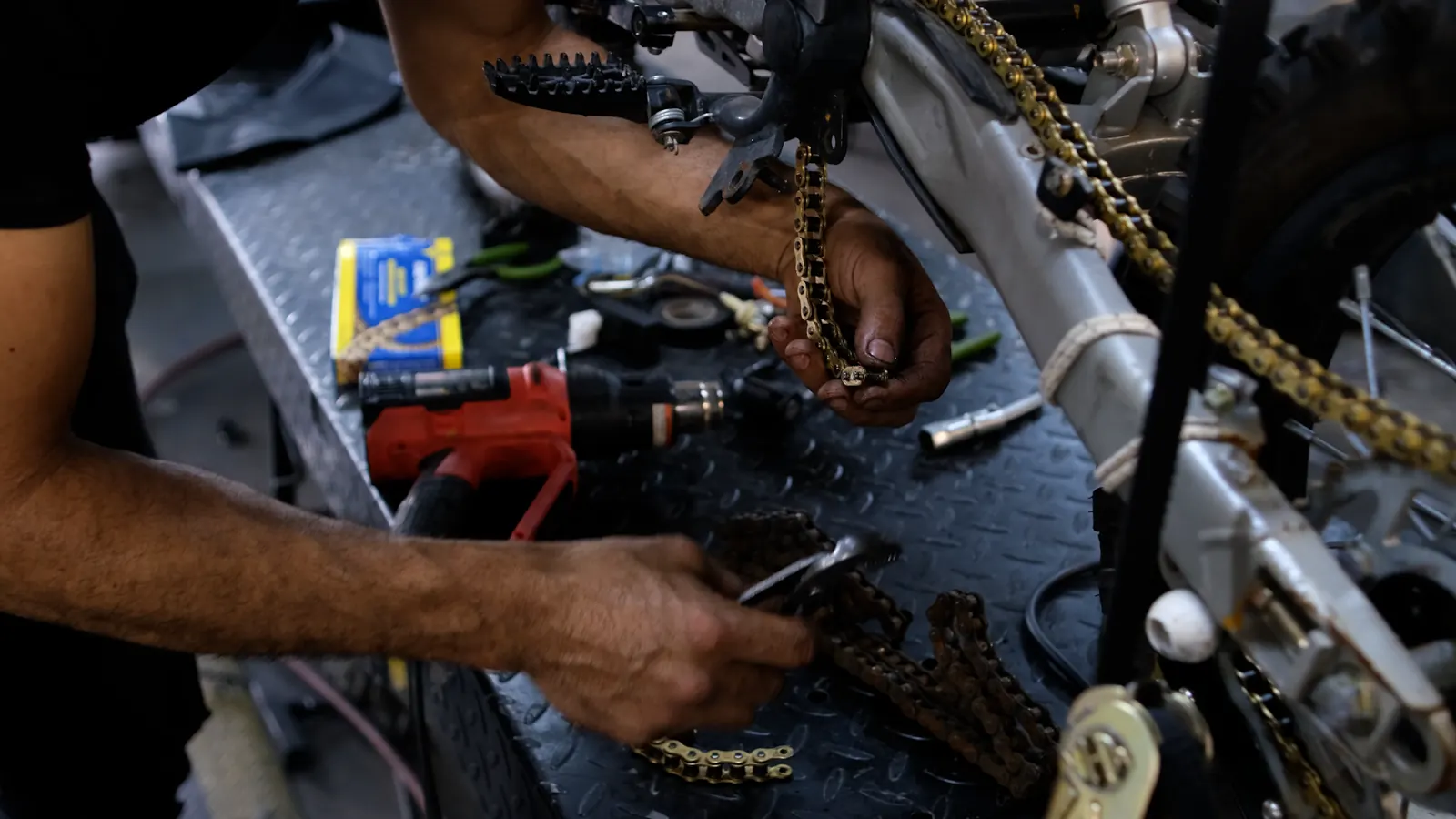
Nobody should hand you a number before somebody has actually looked at the bike. A quote given over the phone from a symptom is a guess wearing a nice shirt. Our order of operations is boring on purpose, and boring is exactly what you want when your bike is apart.
- You tell us what it does, when it does it, and what changed right before it started
- We ride it or run it and try to make the symptom happen on our terms
- We check the basics that fake other problems — battery health, charging output, fluid condition, chain and sprocket wear, tire condition, brake drag
- We put a meter or a scan tool on it instead of guessing, and on modified bikes we put it on the dyno
- We separate what is broken now from what is wearing out soon, in writing
- We call or text you with findings and a plan, and nothing gets done until you say go
That last step is the one riders tell us they remember. You get the diagnosis, the recommendation, and the honest split between must-do and can-wait. Then you decide. If you want the full checklist of what separates a good shop from a shop that just replaces parts until the noise stops, that breakdown is worth ten minutes of your time.
Mistakes worth skipping
None of these are embarrassing. Every one of them has walked through our door on a bike we ended up loving. They are just the shortcuts that cost the most time later.
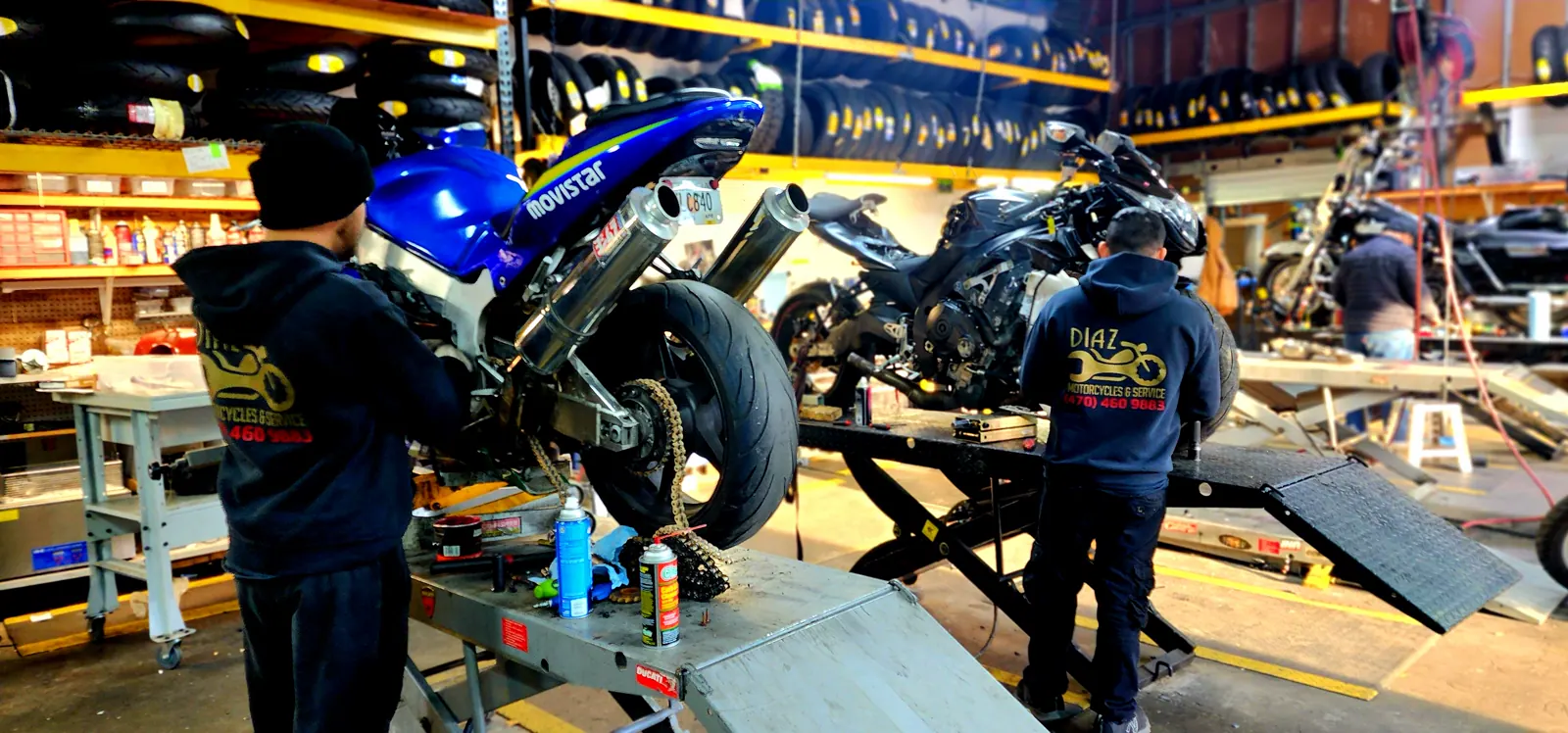
- Adding chain lube to a chain that is already stretched past adjustment — lube does not put metal back
- Chasing a no-start with parts instead of testing the battery and charging system first
- Leaving ethanol fuel to sit all winter, then blaming the carbs or injectors in March
- Topping off a coolant leak instead of finding it, especially on a bike that idles in traffic daily
- Running a tire that is squared off in the middle because the edges still look fine
- Skipping a valve check on a high-revving four because it has not made noise yet
If you want to get smarter about your own bike between visits, RevZilla’s Common Tread is genuinely good reading and free. We are not worried about you learning things. A rider who understands the machine asks better questions, and better questions make our job easier.
A quote before a diagnosis is a guess wearing a nice shirt.
The Douglasville part of this
Douglasville is not short on riders. It sits right in the middle of metro Atlanta’s west-side motorcycle culture, and it shows in what people ride: sportbikes everywhere, baggers with real audio systems and custom paint, metric cruisers, and a growing pile of scooters and small-displacement bikes. Weekends, a lot of that traffic points toward Sweetwater Creek State Park, where the mill ruins and the lake sit on twenty-five hundred acres of trails, or out on GA-166 and Chapel Hill Road southeast toward the Chattahoochee, which is about six and a half winding miles and the best close-to-home twisty run in the county.
You already have options nearby, and we are not going to pretend otherwise. Southeast Motorcycle over on Spring Street is a real regional destination that pulls customers from five states, and Atlanta Harley-Davidson on Thornton Road runs the west metro bike night. Good shops are good for everybody. What we hear from Douglasville riders is that the narrow stuff is harder to find locally: in-house custom paint, dyno tuning and ECU work, and a shop that genuinely specializes in Japanese sportbikes. Those are the jobs that put a Douglas County plate on our lift.
One rider off GA-5 / Bill Arp Road put it better than we could. He said he did not mind driving for a shop, he minded not knowing. He had been quoted three different things by three different people for the same rattle, and none of them had ridden the bike. We rode it, found a chain and a loose sprocket carrier, showed him the play with our hands, and he watched the whole thing. He drove home relaxed, and he has been back twice since with a friend’s bike in the truck.
About the drive: we are roughly twenty-eight to thirty-two miles out, which usually runs forty to sixty minutes depending on the hour. Skip the obvious route. Instead of taking I-20 east to I-285 north, run Thornton Road and GA-6 north to the East-West Connector and come into Marietta that way. The I-20 and I-285 interchange is one of the worst congestion points in Georgia, and there is no reason to donate your afternoon to it. Riders coming from the north side sometimes ask about the Cartersville side of things, and the answer is the same either way — we plan around your schedule, not ours.
What you walk away with
Here is the feeling we are actually going for. You should leave knowing exactly what your bike needed, what it will need next, and roughly when. Not a mystery invoice. Not a shrug. A plan you could explain to a friend in the Arbor Place parking lot without looking anything up. That is what good motorcycle repair Douglasville riders keep coming back for really means: the bike runs right, and you are the one making the decisions.
We keep notes on your bike, so the next visit starts where the last one ended. Chain adjusted in March, pads at half in March, fluid due by fall. That history is why the second visit is always faster than the first. Big jobs get the same treatment — if you are curious how a bigger project actually runs start to finish, how we handle that job walks through it step by step.
Starting is the easy part, and we made it easy on purpose. Text us a couple of photos and a sentence about what the bike is doing. That is enough for us to tell you whether it sounds like a same-day fix, a scheduled service, or something we want to see in person before anybody says anything definite. No forms, no phone tree, no waiting on hold while your lunch break disappears. Just a text, an answer, and a bike you can trust on the ride home.
Questions Douglasville riders ask us
How do I get a quote?
Text us what the bike is doing and send a photo or two. We will tell you what it likely is and what we need to confirm it. A firm number comes after we have the bike in front of us, because a quote from a symptom alone is a guess. You approve everything before we start.
Do you work on older bikes?
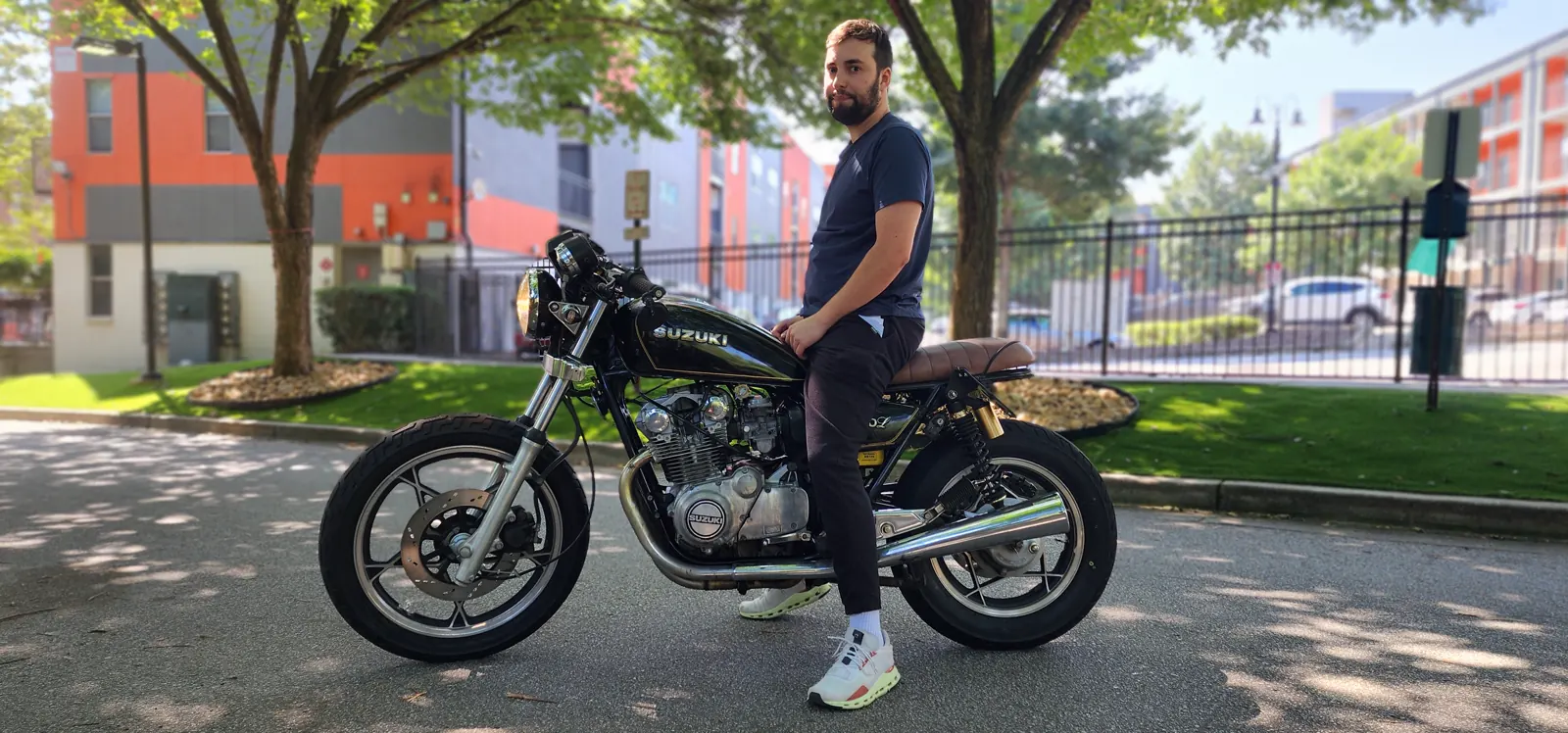
Yes, and we like them. Older carbureted bikes, garage-kept projects, and machines that have not run in years are all welcome. Parts availability is the only real limit, and we will tell you up front if something is going to be hard to source. Plenty of the bikes we are proudest of came in on a trailer.
What if it needs more than expected?
We stop and call or text you first. Nothing extra gets done without your okay, ever. Sometimes a teardown reveals something we could not see from outside, and when that happens you get photos and a plain explanation of what it changes. You stay in charge of the decision.
What does a standard service include?
A typical service covers oil and filter, chain and sprocket inspection and adjustment, brake pad and fluid check, tire condition and pressure, coolant, battery and charging output, and a look at the fasteners and controls. We write down what is fine, what is close, and what is due. That list is yours to keep.
How long does it take?
Routine maintenance is often same-day or next-day if the parts are on the shelf. Diagnostic work depends on how quickly the symptom shows itself, and intermittent electrical gremlins can take longer because we have to reproduce them. Special-order parts add time, and we will give you a realistic window before you leave.
Is it worth driving from Douglasville to Marietta?
That is your call, and it comes down to the job. For a routine oil change, probably not. For custom paint, dyno tuning, sportbike-specific work, or a repair that two other people have already guessed at, riders tell us the drive pays for itself. Take Thornton Road and GA-6 to the East-West Connector rather than the I-20 and I-285 interchange.
We ride with and wrench for riders all over the west and northwest metro, so a drive from Douglas County is normal around here. Along with Douglasville, we regularly see bikes from Lithia Springs, Villa Rica, Austell, Hiram, Powder Springs, Mableton, Dallas, Winston, Smyrna, and Temple, plus the Fairplay area on the south end of the county and everywhere around our home base in Marietta. If you are somewhere in between, text us and we will tell you the easiest way in.
TEXT US ABOUT YOUR BIKE
If your bike is doing something new, send us a text with a photo and a sentence about what changed. We will tell you what it sounds like, what we would check first, and when we could get you in. Douglasville riders make the drive to Marietta all the time, and the first step costs you nothing but a few seconds of typing.
470-460-9883Diaz Motorcycles and Service, LLC · 847 Barnes Mill Road, Marietta, GA 30062