Motorcycle Service Cost Acworth — What You Pay For And Why
What a real service covers, what makes one job bigger than another, and why an honest shop looks before it answers.
Meanwhile, it’s a little past nine at night. The garage light is still on, the bike is up on the stand, and you just noticed the chain looks drier than it did a month ago. You’re not worried exactly. Of course, you just want some idea of what you’re walking into before you call anybody. So you pick up your phone and type the same words half of northwest Cobb has typed at one point or another: motorcycle service cost Acworth. Then you scroll, and every answer is either a shrug or a sales pitch.
We’d rather hand you the real thing. Below is what a service actually covers, what makes one job bigger than the next, and why a shop worth your time won’t give you a firm number over the phone. Read it once and you’ll walk into any shop in Georgia asking sharper questions than you did last week.
What You're Really Asking
In fact, Nobody searches that at nine at night because invoices are fun. You’re asking three things at the same time. Is my bike okay? For example, Will this shop be straight with me? Even so, and am I about to get surprised by something I didn’t plan for?
All three have answers, and none of them are complicated. A motorcycle service isn’t a mystery ritual performed behind a curtain. It’s a list of small checks, a few fluids, and one person paying very close attention while the bike sits up on a lift.
The honest version goes like this. Routine service is one of the smallest things a motorcycle will ever ask of you. Neglected service is one of the biggest. Everything between those two points is what you’re really pricing when you search motorcycle service cost Acworth.
The Honest Answer Nobody Wants To Give
Take a chain. A chain that gets cleaned and adjusted on schedule stays a chain. A chain that gets ignored stretches, and once it stretches it starts chewing the sprockets, so now you’re buying a chain, two sprockets and the labor to fit all of it. Brakes work the same way. Swapping pads with meat left on them is a quick, cheap, boring afternoon. Running pads down to the backing plate takes the rotor along for the ride.
Small problems are cheap and boring. Big problems used to be small problems.
That’s the whole reason we push routine work so hard. It isn’t an upsell. It’s the difference between a bike that’s ready the week the weather turns nice and a bike stuck on a lift while your friends ride up toward Red Top Mountain State Park without you.
What A Service Actually Includes
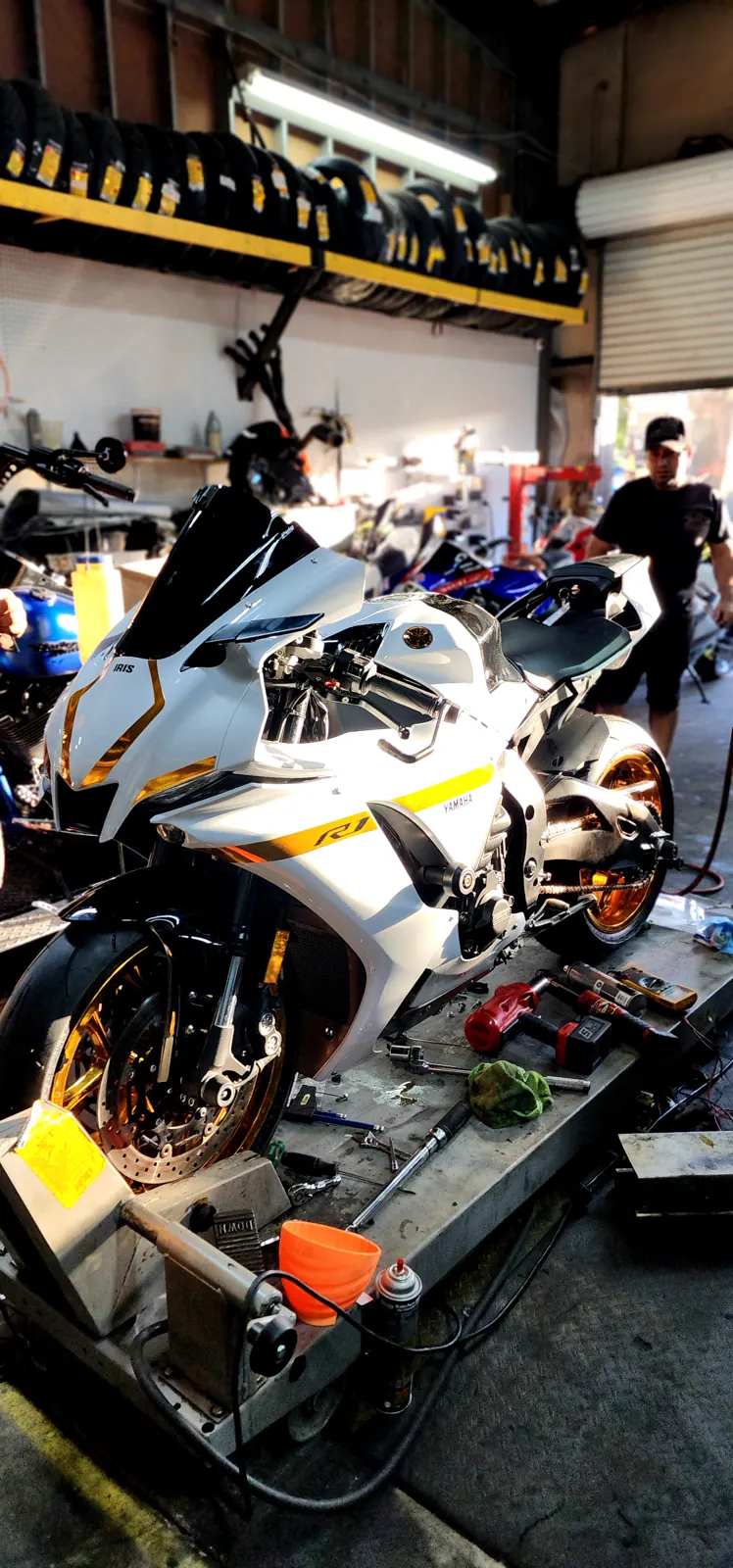
Strip away the shop talk and a full service is a checklist. Here’s what a real one covers on most street bikes.
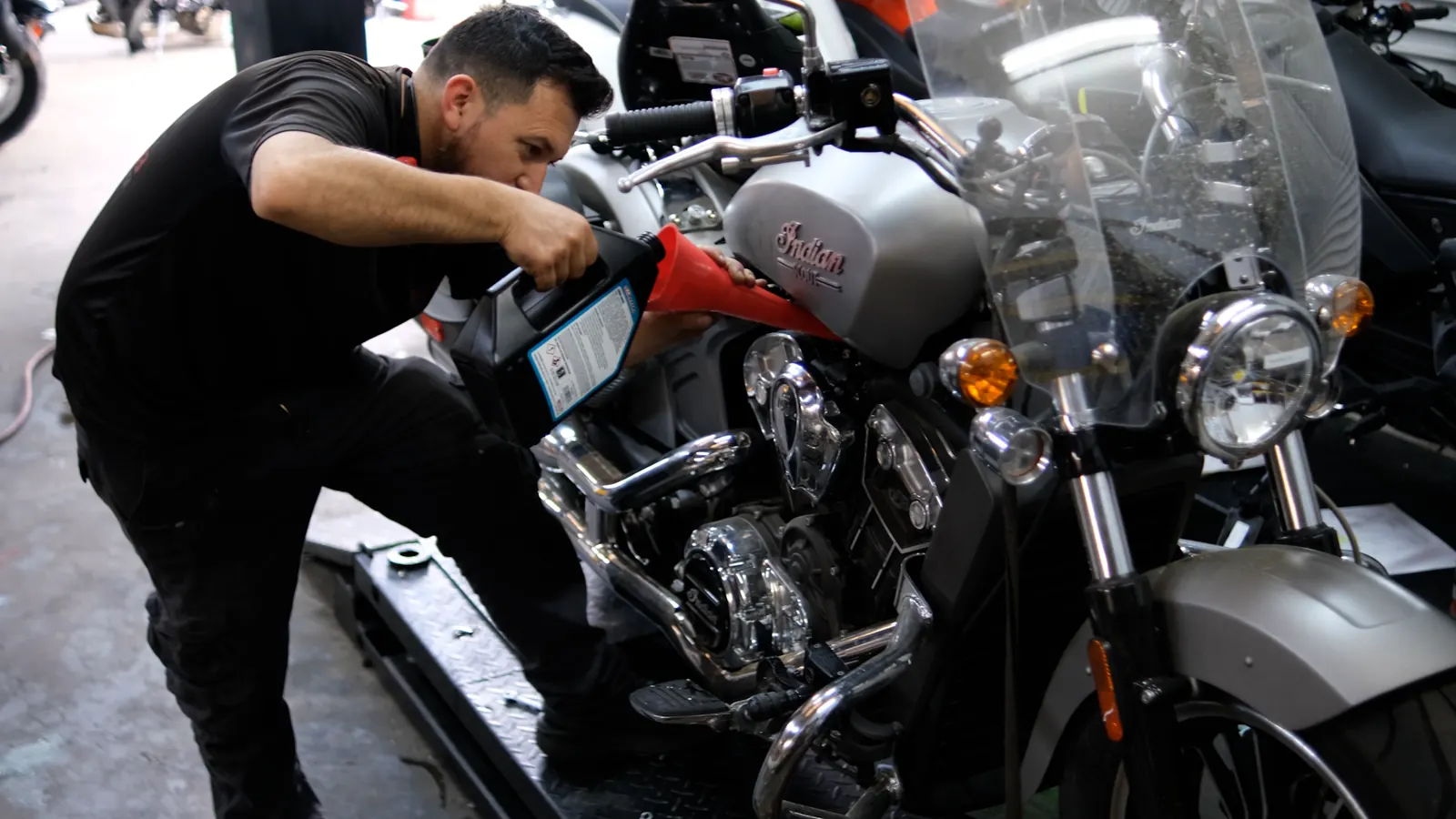
- Oil and filter, drained warm so the old stuff actually comes out
- Chain cleaned, adjusted and lubed, or belt tension checked on a belt-drive bike
- Brake pads measured, fluid checked, calipers looked over for sticking pistons
- Tires checked for pressure, tread depth, age, cupping and flat spots
- Air filter pulled and inspected, because dust hides where you can’t see it
- Coolant level and condition on liquid-cooled bikes
- Battery tested under load instead of just eyeballed
- Fasteners, controls, cables, levers and lights checked and adjusted
- Fork seals, shock and steering head bearings inspected for play or weeping
How often should all that happen? Your owner’s manual sets that schedule, not us and not the internet. Every manufacturer writes its own plan around its own engine, and a big twin cruiser and a high-revving sportbike don’t live by the same calendar at all. Bring the manual, or just tell us the year, make and model, and we’ll work to whatever the factory says.
THE ONE RULE
If you remember nothing else, remember this. The schedule in your owner’s manual is the schedule. Miles ridden matter, but time sitting matters too, and both of them count against you.
What Makes One Job Bigger Than Another
Access
Access is the quiet one. Every bike hides its parts a little differently. A naked bike hands you the engine on a plate. A full-fairing sportbike wants bodywork off first, and a loaded touring bagger wants bags, guards and covers moved before anybody gets near a spark plug. The oil change itself takes about the same time on both. Getting to it does not.
Parts Versus Labor
Parts are parts. A filter is a filter, and anybody can price one in thirty seconds flat. Labor is time, and time is where bikes differ wildly. Two riders can ask for the identical service and end up with two very different tickets, purely because one bike gives up its secrets easily and the other one puts up a fight.
Something changes once you know what to look for. When you can picture the checklist, a service stops feeling like a black box and starts feeling like a grocery list. You can stand in your own garage, look at your own bike, and make a fair guess at which items are going to come up this time. That is not a small thing. That is control.
Condition When It Rolls In
Then there’s the shape the bike shows up in. A bike ridden every week is usually just the checklist and out the door. A bike that sat for three seasons is a different animal: sulfated battery, varnished fuel, a caliper that’s decided to stay put, tires with flat spots and something living in the airbox. None of that is a disaster. It’s just more hands-on time, and it’s the single biggest reason two identical models get two different answers.
How The Job Actually Goes, Start To Finish
There’s no mystery to the order. This is how it happens, every single time.
- You tell us how the bike’s been behaving, what’s changed lately and what you’ve noticed. Weird noises count. So do hunches.
- The bike goes up on the lift with both wheels off the ground, because half the checks are impossible with weight sitting on the tires.
- We run the full inspection and write down everything we find, including the parts that are perfectly fine. Especially those.
- We call you before doing anything beyond what you already approved. No exceptions and no surprise line items.
- The work gets done, fasteners get torqued to spec, and fluids get checked twice instead of once.
- The bike gets a real road test, not a quick rev in the parking lot.
- You get the bike back with notes on what’s coming next, so your next visit isn’t a guessing game.
Why We Won't Quote It Sight Unseen
This one frustrates people, so let’s be plain about it. A number handed over the phone, before anyone has laid eyes on the bike, is a guess dressed up as a promise. Sometimes the guess lands low, and then the shop either eats it or calls you with news you didn’t want. Sometimes it lands high, and then you paid extra for the privilege of a fast answer. Neither one is a good deal for you.
So we do it the other way around. Tell us the year, make, model and roughly how the bike’s been used, and we’ll walk you through what the service covers and what we expect to find. Once it’s here and up in the air, you get a real answer with real findings behind it. If you want the longer version of what separates a good shop from a fast one, we wrote that out too.
That approach doesn’t change with the address on your mail. We broke down the Cartersville side of things in its own post, because riders up that way ask the exact same questions with slightly different bikes in the garage.
Bikes That Ask For More
Some jobs sit outside the routine list entirely. Performance work is the obvious one. If your bike’s been modified, or you’re chasing a fueling problem that no amount of maintenance will ever fix, that’s a different bench and a different conversation. Specialist work already leaves Acworth no matter which shop you start with, so here’s how we handle that job when it lands with us.
Dual-sports and dirt bikes run their own rhythm too. Around the lakes and the trail systems, those bikes eat air filters and chains at a pace no street bike will ever match. Same checklist underneath, different wear pattern on top, and a whole lot more washing before anybody touches anything.
Tires come up constantly as well, and they deserve the attention. Rubber ages whether you ride or not, and a tire that’s been sitting still in a warm garage for years isn’t the tire that left the factory. Groups like the Motorcycle Industry Council track just how many bikes are out there, and NHTSA crash data is a fair reminder of why those two small contact patches get checked before anything else on the bike.
The Part That Has Nothing To Do With Parts
Now for the part that has nothing to do with parts at all. What most riders remember about a shop isn’t the invoice. It’s whether somebody explained the bike to them. Whether the phone call came before the work instead of after. Whether the person handing back the keys could say, in plain words, what they found and what they’d keep an eye on come spring.
That’s the piece we care most about. You can see how our crew approaches it on our maintenance page, but the short version is simple. We tell you what we find, we tell you what can wait, and we never pretend a bike needs something it doesn’t. Riders with a full toolbox at home can smell an upsell from across the room, and honestly, good. It keeps everybody sharp.
Riding Out Of The Lake City
Acworth riders have it good, and most of them know it. Bikes here almost never live outside. The subdivisions came with two- and three-car garages, and out toward the Paulding and Cherokee edges the lots get big enough for a detached shop behind the house. Which is exactly why the most common problem we see from Acworth isn’t hard miles at all. It’s sitting still.
The riding itself is mostly open road. Old US-41 runs north through Emerson toward Cartersville, quiet and unhurried next to the interstate beside it. Weekend loops swing past South Shore Park, where tall pines lean over the picnic tables and somebody is always after bass or crappie on Lake Acworth. Around the lake area, cottages and lakefront homes share the same beach and boat ramp.
Road surfaces change with the county your mailbox sits in. Historic Downtown Acworth means railroad crossings and shaded blocks along the Main Street district, where Victorian and mid-century homes near the lake make it easy to forget the interstate is close. Out on Cedarcrest Road, the Paulding growth corridor runs rougher, with shoulder drop-offs, loose gravel at driveway aprons and tar snakes that turn greasy in July. Riders from Governors Towne Club live in both worlds, since that gated golf community straddles Cobb and Paulding.
Getting to us is about twenty miles from downtown Acworth, call it a half hour down I-75 to Roswell Road. From the Bentwater side past Cedarcrest, it runs closer to forty-five minutes. That’s a normal errand around here. You still don’t have to make it, though. We’ll come get the bike and bring it back.
The nearest Harley dealer sits about twenty minutes north in Cartersville, at Southern Devil Harley-Davidson, and plenty of Acworth riders make that run. Once you’re driving somewhere anyway, though, the question stops being distance and starts being capability.
What You Should Walk Away With
Here’s the takeaway. Understanding motorcycle service cost Acworth riders deal with has very little to do with memorizing numbers. It’s knowing the checklist, knowing that access and condition drive the work, and expecting your shop to show you findings before it asks you for a decision.
Do the small stuff on the schedule your manual gives you. Ask for the inspection notes and keep them. Fix what’s genuinely worn, skip what isn’t, and repeat. Give that a couple of seasons and your bike goes back to being the best part of your Saturday.
Small things caught early. That’s the entire trick, and it always was.
Questions Acworth riders ask us
Does the type of bike change the work?
It changes the time far more than the checklist. A cruiser, a sportbike and a dual-sport all need oil, brakes, tires and drive checks. The difference is how much has to come off before we can reach any of it, and how quickly each bike wears certain parts. A trail-ridden dual-sport goes through air filters and chains much faster than a highway bagger does.
What happens if you find something else while it's apart?
We stop and call you. Nothing extra gets touched without your okay, no matter how small it seems to us. You’ll hear what we found, whether it’s urgent or can wait until next service, and what we’d do if it were our bike. Then you decide, and we go from there.
How do I avoid surprises?
Two habits handle almost all of it. First, follow the service schedule in your owner’s manual instead of waiting for a noise. Second, ask for written inspection notes every visit and keep them with the bike. After a couple of services you’ll have a running picture of what’s wearing and roughly when it’ll need attention.
What makes one job bigger than another?
Access, condition and time. Access is how much bodywork stands between the technician and the part. Condition is what the bike’s been through, especially long stretches of sitting in a garage. Time is the result of both. Parts themselves are usually the predictable piece of the puzzle.
Why can't you just quote it over the phone?
Because a phone quote is a guess with a confident voice. Two bikes of the same year and model can arrive in completely different shape, and one may need three things the other doesn’t. We’ll gladly explain what the service covers and what we expect to find. The firm answer comes once the bike is up on the lift and inspected.
Do I have to ride it down from Acworth?
Nope. We pick up and deliver, locally and out of state, so the bike can go straight from your garage to our lift and back again. That’s especially handy if the reason it needs service is that it hasn’t started in a while. Just call and tell us where it’s parked.
We take care of riders all across northwest Georgia, from Acworth and Kennesaw down through Marietta and Powder Springs, out west to Dallas, and north through Emerson, Cartersville and Adairsville. Folks in Woodstock and Canton run down to us regularly, and we make the trip out to Euharlee, Taylorsville and White just as often. If your bike lives anywhere in that stretch, pickup and delivery is on the table, so distance never has to be the reason a service keeps getting pushed to next month.
LET'S GET YOUR BIKE SORTED
Text or call us with the year, make and model of your bike and how it’s been running lately, and we’ll walk you through exactly what a service covers before you commit to anything. If you’re in Acworth or anywhere around the lakes, we’ll come pick the bike up, do the work, and bring it back ready to ride.
470-460-9883Diaz Motorcycles and Service, LLC · 847 Barnes Mill Road, Marietta, GA 30062