Motorcycle Service Cost Alpharetta — Full Breakdown
What a service actually includes, what makes one job bigger than the next, and why an honest shop won't hand you a number over the phone.
Here’s something most shops would rather not say out loud: nobody can tell you what your bike needs before they’ve had hands on it. Not us, not anybody. A service isn’t one job. Either way it’s a stack of small ones, and which ones apply today depends on how the bike has been ridden and how long it’s been sitting. So when a rider asks about motorcycle service cost Alpharetta shops should be quoting, the truthful answer starts with two questions of our own. What’s the bike, and when did somebody last put a wrench on it? Everything after that is pretty predictable, and we’re going to walk you all the way through it.
What you're really asking
When you ask what a service runs, you’re not really asking for a number. You’re asking whether you’re about to get taken. In short that’s a fair thing to want to know. At the same time Riders up here read reviews, compare shops and call with a plan already half-written, so we’ll skip the sales voice entirely and just show you the machine behind the estimate.
As a result a service is a checklist, not a mystery box. Oil and filter. On the other hand Chain or belt and the rest of the final drive. Brake pads, brake fluid, rotors. Tires, pressures and build dates. Air filter, plugs, coolant, battery. Cables, levers, lights, fasteners. So every one of those is an ordinary little job on its own. What you’re actually asking is which ones your bike needs right now, and how hard your bike makes them to reach.
The honest answer: parts you can look up, labor you can't
Parts are the easy half. A filter is a filter. Actually a set of pads is a set of pads. Still, those numbers are printed on a box in a warehouse somewhere, and any shop worth your afternoon will happily show you the box, the part number and the old part it replaced. Plus, there’s nothing clever hiding in that column.
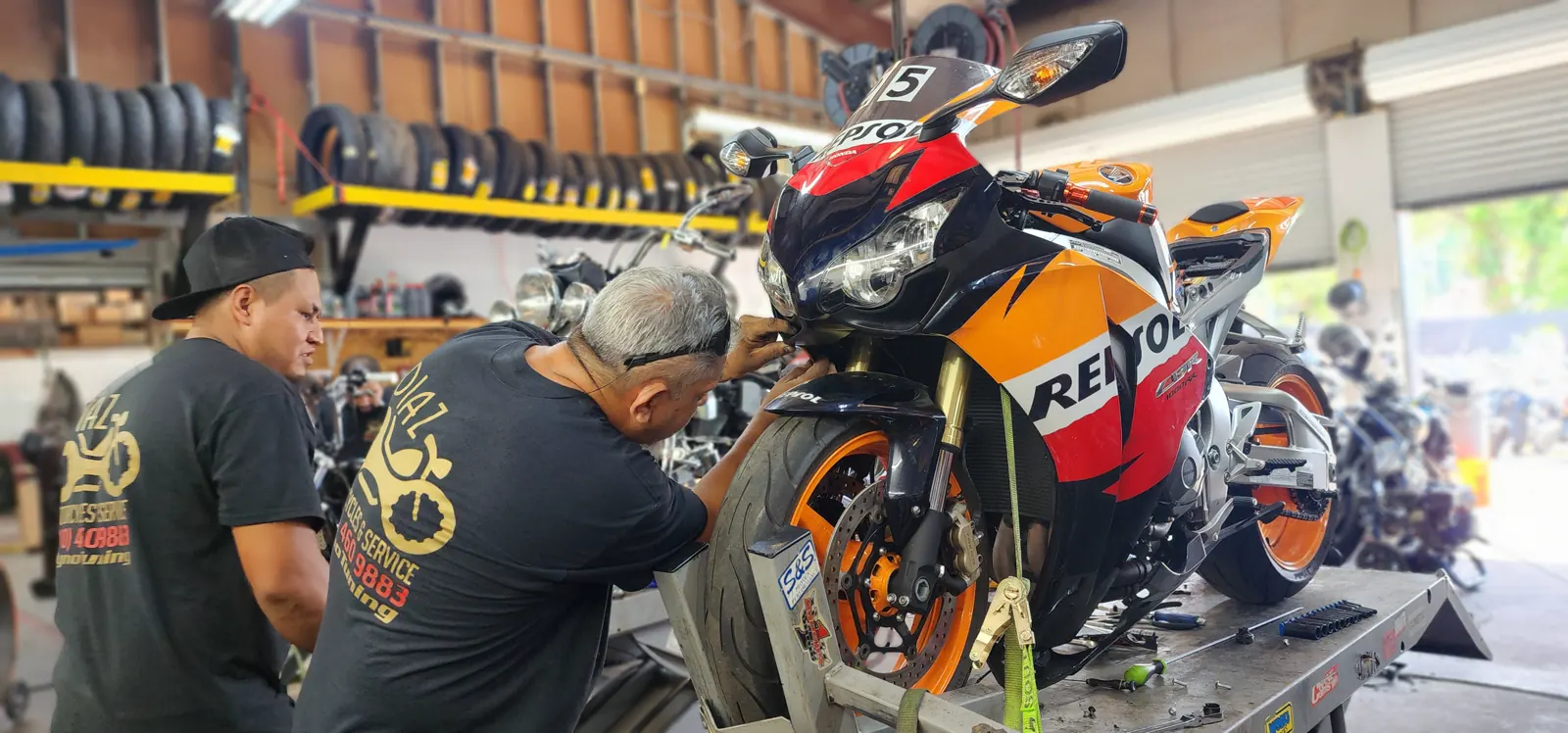
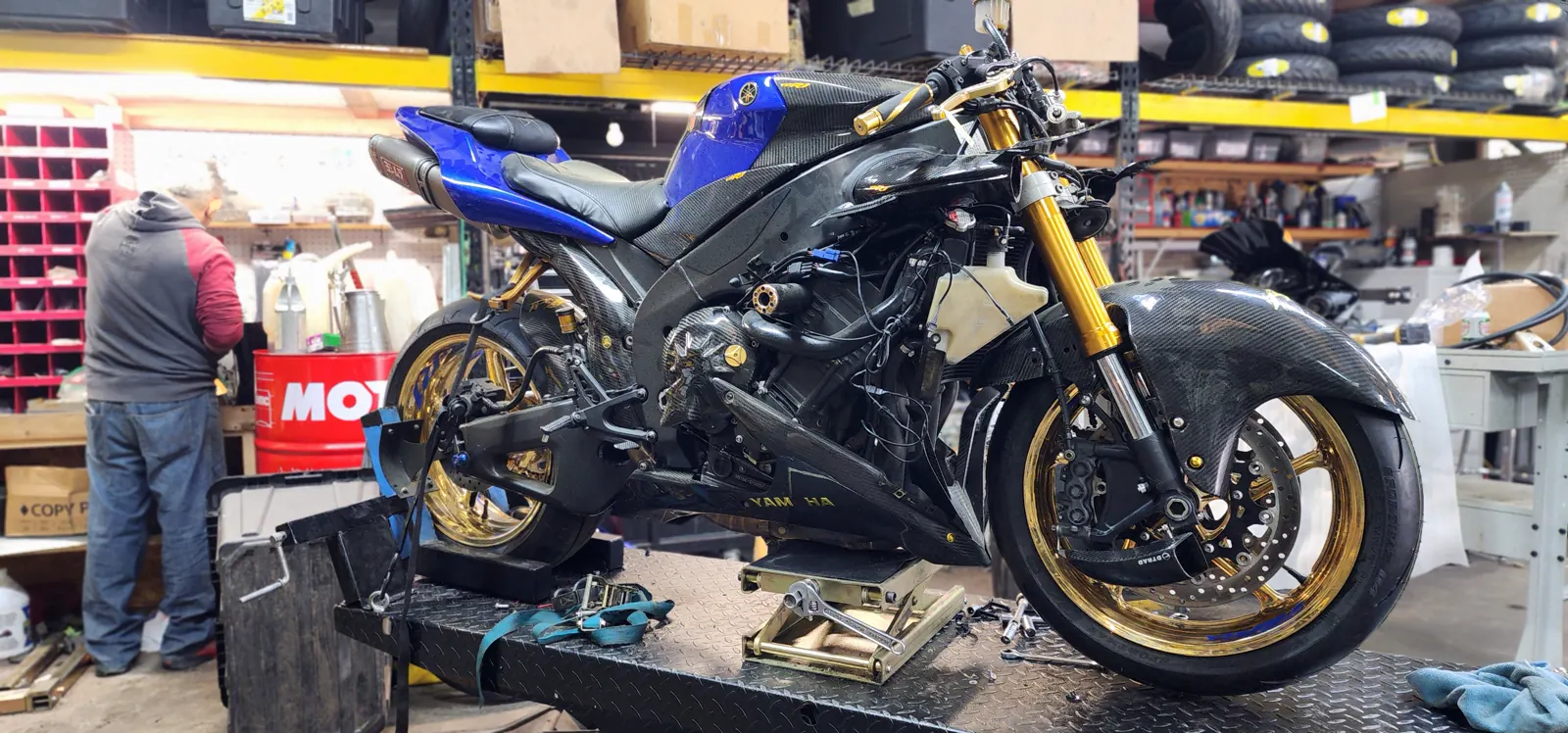
Meanwhile, Labor is the half that surprises people, because labor mostly isn’t about the wrenching. It’s about access. Of course, Cracking a drain plug takes about four seconds. In fact, Getting to that drain plug on a fully faired sportbike can mean pulling lowers, unclipping a header shield, moving a coolant line and then putting all of it back with the right fastener in the right hole at the right torque. The work is quick. For example, the undressing and redressing is the job.
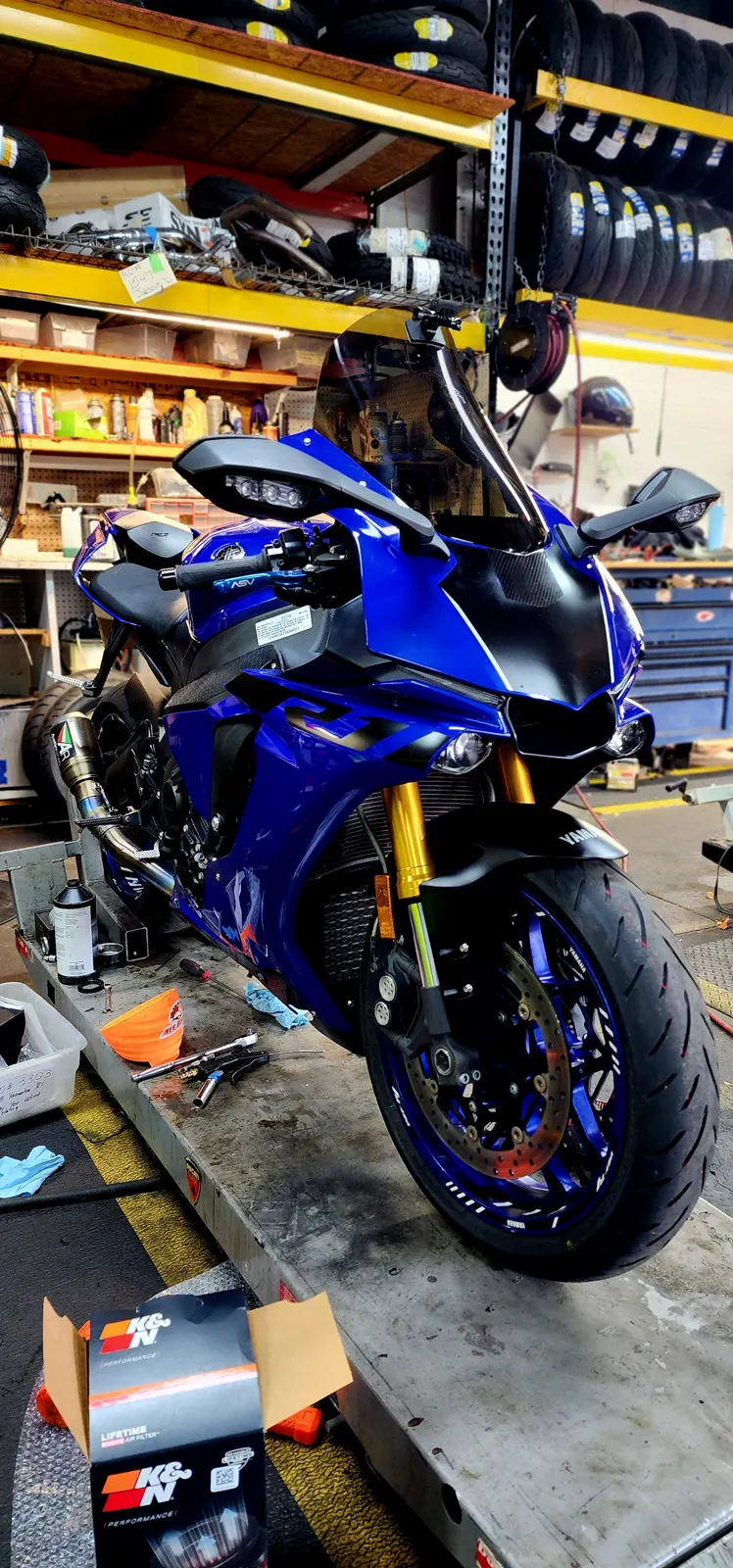
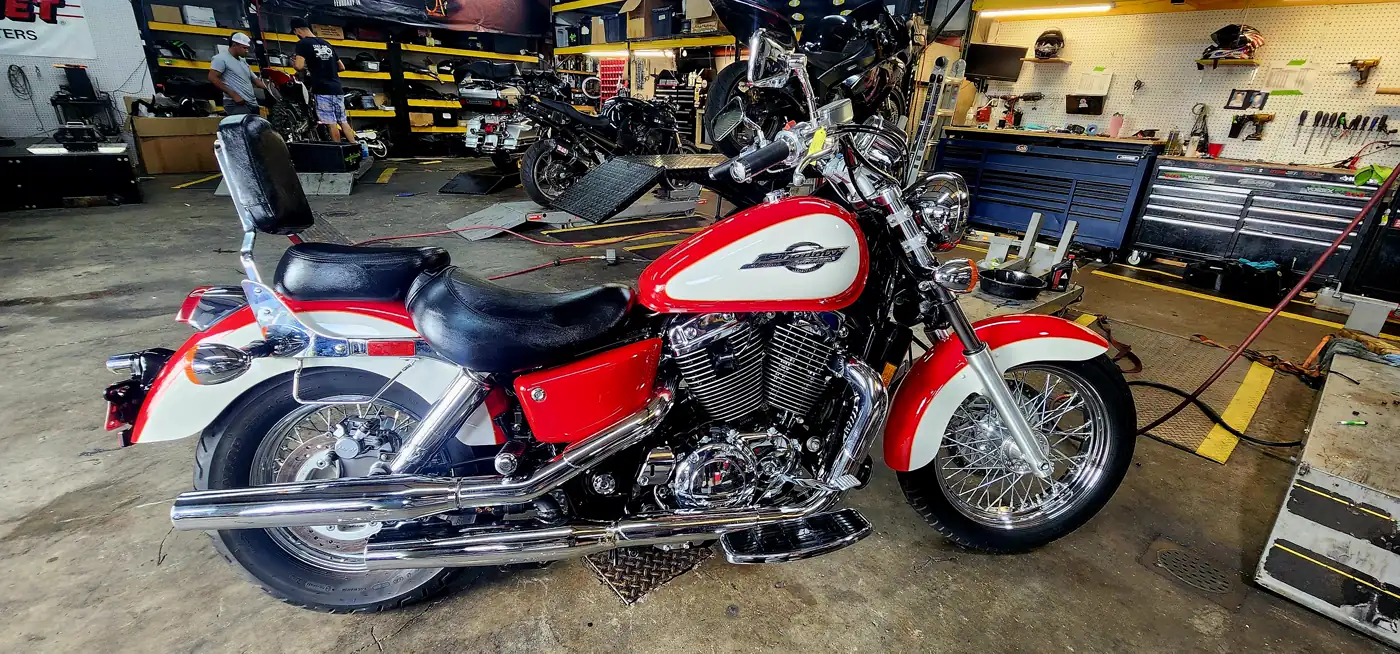
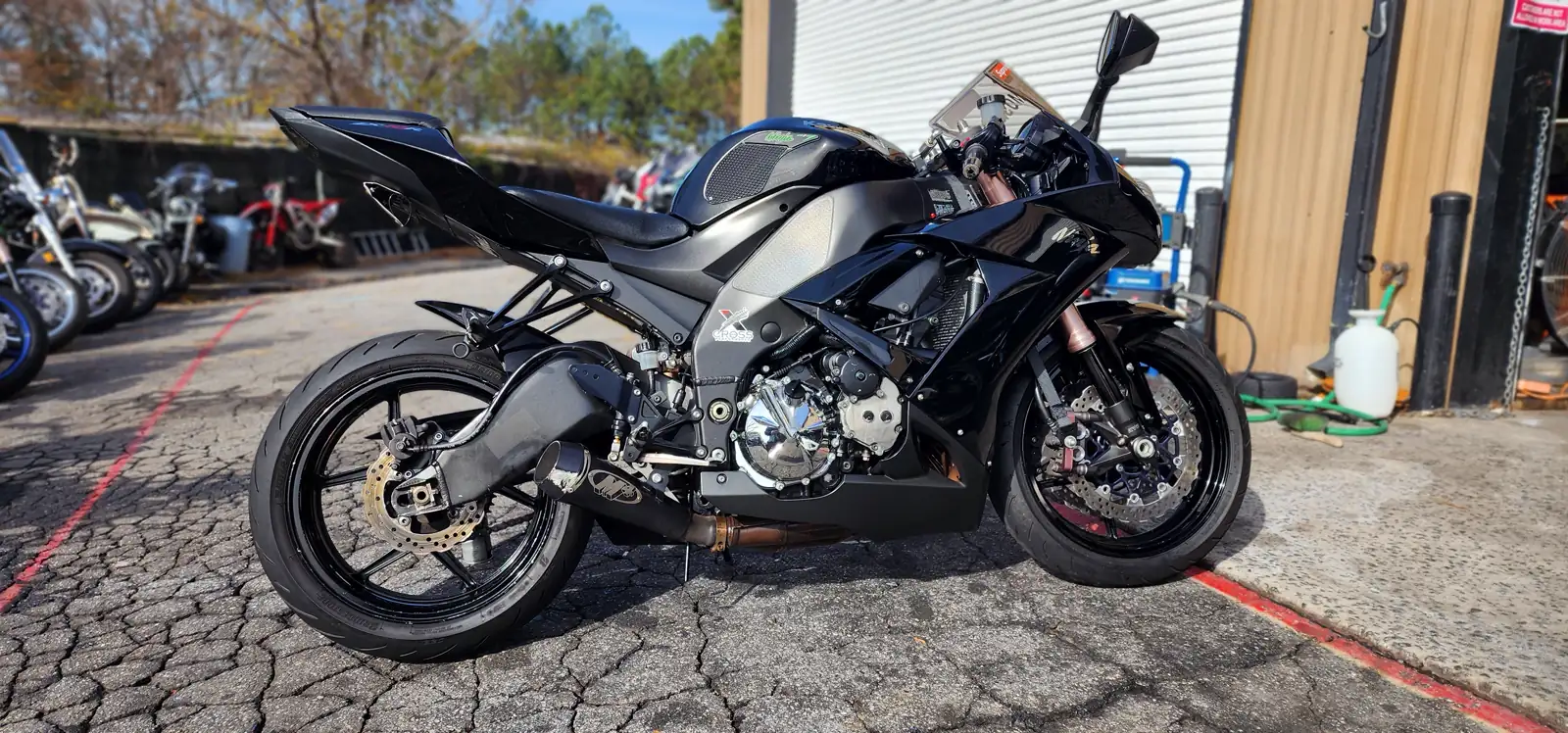
That’s why the same words can mean four different jobs. Even so, a naked standard hands you the engine on a plate. That’s why a liter-class sportbike wraps it in plastic. A bagger buries fasteners under hard luggage and a seat you have to unbolt. An adventure bike puts a skid plate and a crash bar between you and everything you came for. Identical checklist, wildly different clock.
So two friends can ride out of the same subdivision, ask for the same service, and hear two different answers. Neither one got a special deal. Their bikes are just built differently, and honest pricing follows the machine instead of the mood.
What actually changes the size of a job
- How much bodywork stands between a tool and the part underneath it
- How long it’s been since the last real service, not the last quick oil top-off
- Whether the bike has been sitting, and for how many months
- Corrosion and seized fasteners, which turn a five-minute step into a careful one
- Parts availability, which matters most on older bikes and restoration projects
- What we find once something is apart, which is the only honest wildcard on the list
Notice that only the last one is unpredictable, and even that one shrinks when a bike gets looked at regularly. Catching a chain before it eats a sprocket, or a pad before it scores a rotor, is the cheapest wrenching that exists. It’s a small job today or a bigger one in the fall. That’s the whole game.
Small things caught early stay small. That's not a sales pitch, it's just how metal works.
Now, the part nobody mentions until you're already paying for it
Sitting still is harder on a motorcycle than riding it. Nobody puts that on a brochure. Around here it matters more than almost anywhere, because this is a garage-kept market through and through. Windward alone is a 3,400-acre master plan built around Lake Windward, the city’s flagship community, and a lot of those three-car garages hold a bike that gets loved in April and forgotten by November.
Fuel goes stale. Batteries quietly give up. Injectors and carbs gum with varnish. Tires flat-spot in one place and age out on the sidewall date while the tread still looks brand new. Spring rolls in, the bike cranks funny, and the rider assumes something broke. Usually nothing broke at all, and what usually causes it is simply time passing in a quiet garage.
Good news: that whole category is cheap to prevent and satisfying to fix. Fresh fuel, a tender on the battery, a proper wake-up service, and the bike you parked is the bike you get back. We’ve had friends roll in convinced they needed an engine and leave needing a battery and a coffee.
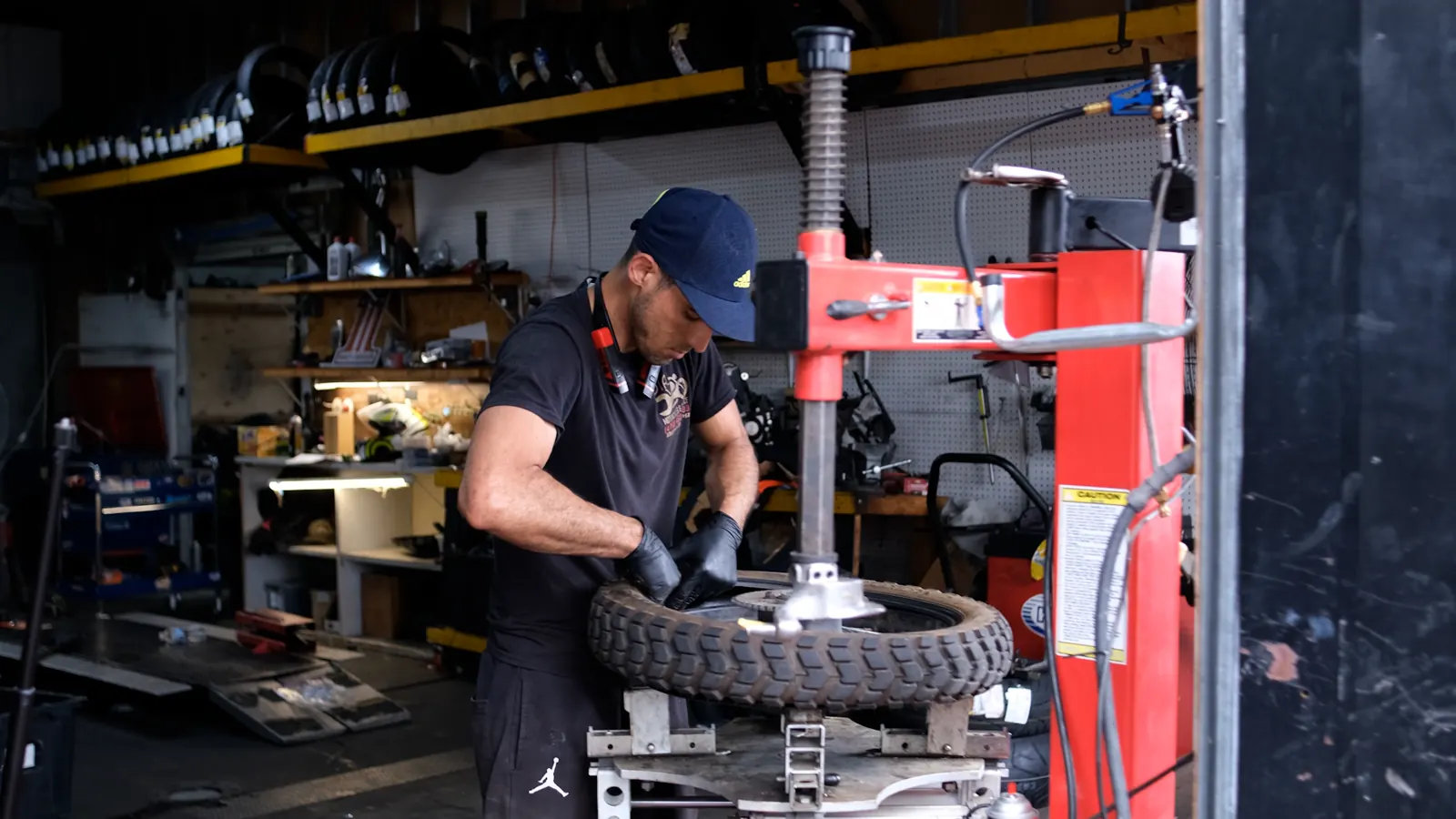
Tires and brakes deserve their own paragraph, because they’re the two systems where waiting genuinely costs you something. You don’t need to read NHTSA crash data to know that rubber and pads are what keep the story boring. Around here that goes double in late March, when pollen film makes painted lines and manhole covers slick, and again in fall when shaded back roads collect pine needles.
Our roads add their own flavor. Tar-snake patching along the older Roswell corridor turns greasy in the first ten minutes of rain, and redevelopment leaves plating and gravel where it wasn’t last week. Tires that were fine two seasons ago aren’t automatically fine now. That’s not a scare, just a reason to check the date code while the wheel is off.
How the job actually runs, start to finish
Here’s the whole process with nothing hidden. It’s the same for a Softail, a Multistrada or a twenty-year-old project bike, and it’s the same order every time, which is exactly what makes it possible to talk honestly about what we take care of here before a single fastener moves.
- We talk first. What is it, how do you ride it, what does it sound like, and when was it last serviced?
- The bike goes on the lift and gets a full look-over — fluids, tires, brakes, chain or belt, bearings, cables, lights, leaks.
- We build a written list and split it in two: needs it now, and will need it before long.
- You get that list before anything happens, in plain words, with the reasoning attached.
- You pick what gets done. Nothing on the list moves without your yes.
- We do the work, road test it, and hand it back with notes on what to watch next season.
That third step is the one people remember. Splitting the list into now and later is how you stay in control of the pace. Some riders green-light everything and get it over with. Others do brakes today and tires after the mountains cool off. Both are fine, and neither one gets a lecture from us.
Why we won't quote it sight-unseen
Because a number given blind is a guess wearing a suit. Over the phone we can’t see pad thickness, chain slack, a fork weep, a date code, or the fastener somebody rounded off in 2019. A real motorcycle service cost Alpharetta riders can hold us to comes from a lift, not a phone. So we’ll describe the process and the parts gladly, then look at the bike before anybody says a number out loud.
The same goes for intervals. Your owner’s manual sets the schedule for your specific model, and no shop should be pulling a mileage figure out of thin air to sound authoritative. We read your manual with you if you don’t have it handy. It’s a lot of the same story what Mableton riders run into shows from the other side of the metro, which is a decent sign the math isn’t personal.
If you want the long version of the checklist itself, what the work covers lays out every system we touch on a full service. The short version: fluids, friction, rubber, spark and fasteners. Everything else on a bike is decoration bolted to those five things.
And then there's the part that's just about riding again
Nobody services a motorcycle because they love invoices. They do it because September and October are the best two months of the year up here, and a bike that’s been sorted feels completely different underneath you. Cool air, clean throttle, brakes that bite the same way twice.
That’s what the Suches Loop is for. The US 19, GA 60 and GA 180 triangle out of Dahlonega, past Neel’s Gap and Blood Mountain, is the reason half the garages in this city have a bike in them at all. It also happens to be the least forgiving place to discover soft brake fluid or a chain that needed love. Leaf season is glorious and slick in equal measure, and a fresh service is what turns that road back into fun instead of homework.
The local part, told straight
North Fulton is dealer-rich and independent-poor. Killer Creek Harley-Davidson sits at 11480 Alpharetta Hwy in Roswell and is home to H.O.G. Chapter #0746, which is easily the most visible organized riding group in the area. Down the same stretch at 10885 Alpharetta Hwy, Mountain Motorsports Roswell carries Honda, Suzuki, Yamaha, Sea-Doo, Can-Am and Ducati. Both are solid operations, and we’d never pretend otherwise.
Here’s the gap, though. A garage in this city rarely holds one bike. It holds a tourer, a sportbike and something vintage that only runs when it’s happy. No single brand-locked service department can take care of all three, so riders end up splitting their bikes between counters and repeating their story every time. Groups like the Motorcycle Industry Council have tracked this sport for decades, and multi-bike households are nothing unusual — they’re just badly served by single-brand shops.
Now the honest bit about us. We’re in East Cobb, roughly 18 to 22 miles away. That’s 30 to 40 minutes off-peak and 45 to 60 at rush hour, because no freeway connects us directly. Most riders come down Old Milton or Rucker to GA 9 south through Roswell, then GA 120 west. Nobody is making that drive for an oil change, and we’d think less of you if you did.
WE COME GET IT
Pickup and delivery is the whole answer for Alpharetta. We trailer the bike from your garage, do the work, and bring it back. You never make the drive at all.
So the realistic version looks like this. Either we pick the bike up, or you batch several jobs into one trip so the drive earns its keep — service plus tires plus the dyno time plus the paint or restoration work you’ve been putting off. That’s the work worth travelling for, and it’s the work the dealers on Alpharetta Hwy generally aren’t set up to do across brands.
Timing helps too. If you’re coming to us yourself, aim for the middle of the day and steer clear of Encore Parkway on a concert night, since the amphitheatre access road snarls fast and is under continuing redevelopment on top of that. Riders over near Exit 11 already know the drill.
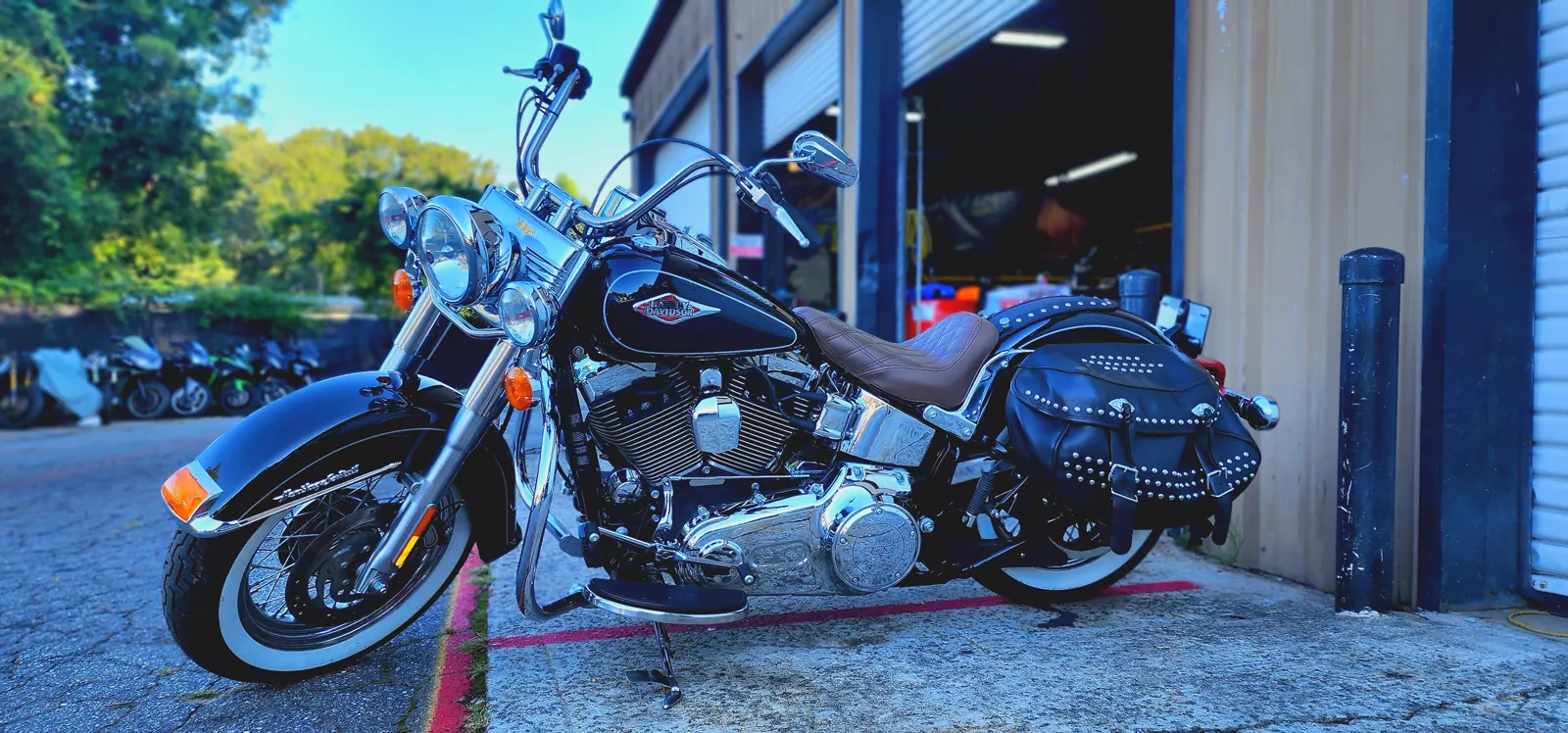
The pickup logic works the same whether the garage is behind one of the 42 luxury homes at Voysey in downtown Alpharetta or in Pennbrooke, where the 200-plus homes date to the late 1990s and the bikes have usually been in the family about as long. HOA-friendly, no trailer parked out front for a week, no explaining yourself to anybody.
What you should walk away with
A service is parts you can verify plus labor that tracks how buried those parts are. The size of the job moves with bodywork, time, sitting and corrosion. A shop that gives you a written list before touching anything is a shop you can plan around, and a shop that promises a firm number sight-unseen is telling you something about itself.
That’s the whole breakdown. No mystique, no upsell script, no lecture about last winter. Just a checklist, a lift, a conversation, and a bike ready for the mountains before the leaves turn.
Questions Alpharetta riders ask us
How do I avoid surprises on a service?
Ask for the list in writing before any work starts, split into what needs doing now and what can wait. We do that on every bike as a matter of course. Nothing gets touched until you say yes to it, so there’s no moment where the job quietly grows on its own.
What makes one job bigger than another?
Mostly access. A naked bike hands you the engine, while a fully faired sportbike or a loaded bagger means bodywork and luggage come off first. Time and sitting matter too, because a bike parked for a long stretch usually needs fuel, battery and tire attention on top of the normal checklist.
Why can't you quote it over the phone?
Because we can’t see pad thickness, chain slack, tire date codes or a rounded-off fastener from here. We’ll gladly explain the process, the parts involved and what usually applies to your model. Then we look at the bike and give you a real number instead of a guess we’d have to walk back.
What's included in a full service?
Fluids, friction, rubber, spark and fasteners covers it. That means oil and filter, brake pads and fluid, chain or belt and final drive, tires and pressures, air filter, plugs, coolant, battery, plus cables, levers, lights and a torque check. Your owner’s manual sets the interval for your specific model, not us.
How long does it take?
A straightforward service is usually a same-day or next-day job. Bikes with heavy bodywork, seized hardware or parts that have to be ordered take longer, and older or vintage machines are the most likely to wait on a box in the mail. We tell you the timeline when we hand you the list.
Do I really have to ride to East Cobb from Alpharetta?
No, and we don’t expect you to. We pick bikes up in Alpharetta and bring them back when the work is done. If you’d rather come to us, batch a few jobs into one visit so the drive is worth making, and skip Encore Parkway on a concert night.
We take care of riders all over the north side, starting with Alpharetta and running through Roswell, Milton, Johns Creek and Crabapple, where most of our pickups happen. From there we cover Sandy Springs and Dunwoody to the south, Cumming and Suwanee up the corridor, Duluth to the east, and Woodstock and East Cobb over on our side of the map, with the shop itself sitting in Marietta.
TELL US WHAT IT IS AND WHEN IT LAST GOT TOUCHED
Text or call us with your bike and its history, and we’ll tell you exactly what a service looks like on that machine. If you’re in Alpharetta, we’ll come get it, do the work, and bring it back to your garage — no drive, no guessing, no surprise line items.
470-460-9883Diaz Motorcycles and Service, LLC · 847 Barnes Mill Road, Marietta, GA 30062