Motorcycle Service Cost Kennesaw — Full Breakdown
Parts are the predictable half. Here's what actually moves the number, explained in plain words.
In short ask ten riders what makes a service bill move and nine say the same word: parts. Oil. A filter. Actually a chain. A set of pads. At the same time Add them up, sprinkle a little labor on top, and the math feels solved. As a result it’s a comfortable belief, and it’s also backwards. When riders ask us about motorcycle service cost Kennesaw shops quote, parts are rarely what moves the number. Reaching those parts is. On the other hand a filter costs what a filter costs. So the hour it takes to get to that filter can look completely different from one bike to the next.
Still, that myth is easy to fall for, and honestly, we get why. Plus, you can price a chain and sprocket set online in a minute. Meanwhile, you can find a filter in two clicks. The napkin math looks clean. Then a real plan comes back looking nothing like the napkin, and it feels like something got padded. Nothing got padded. Of course, the napkin just skipped the biggest variable on any motorcycle: how much has to come apart before a wrench ever touches the part you came in for.
Where the parts myth comes from
Cars taught us this one. In fact, On most cars, the oil filter hangs in the open and the plugs sit right on top. Bikes are packed tighter. For example, every engineer who drew your bike was fighting for space, weight and shape at once, so the good stuff ends up tucked behind bodywork, under a tank, or in a spot only a wobble extension and a patient human can reach. The part is still cheap. Even so, the path to it is the story.
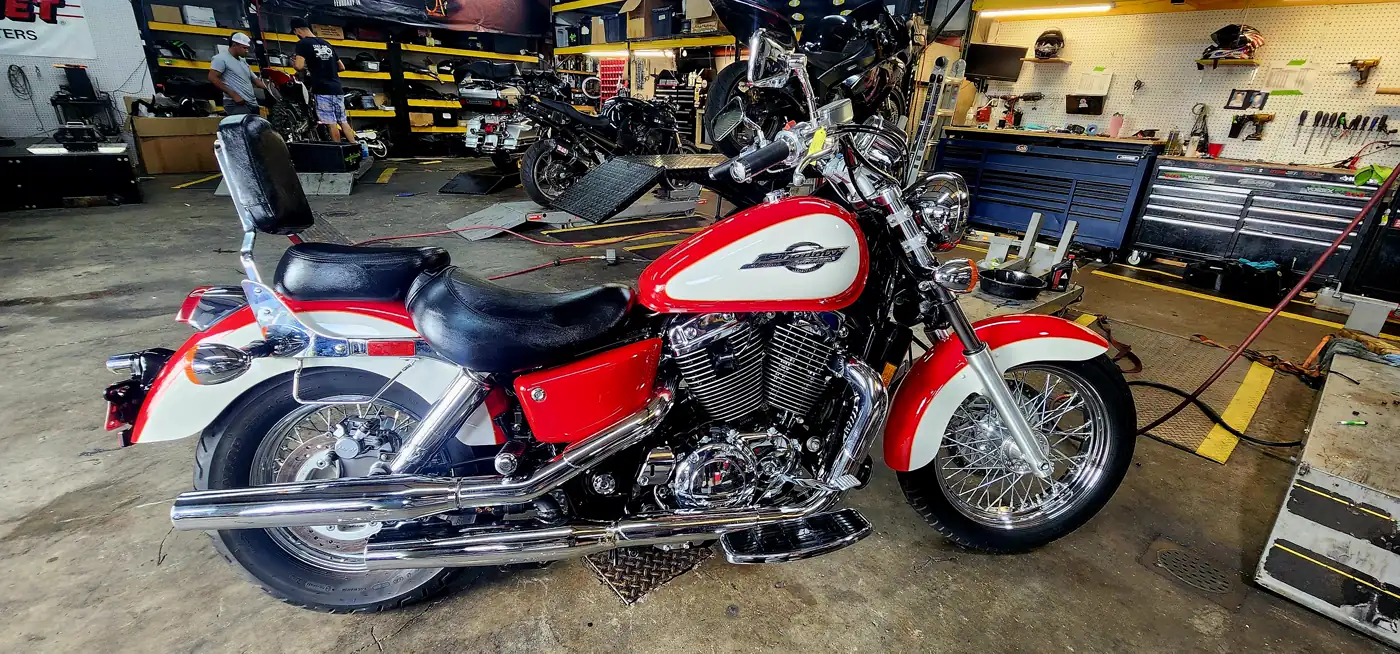
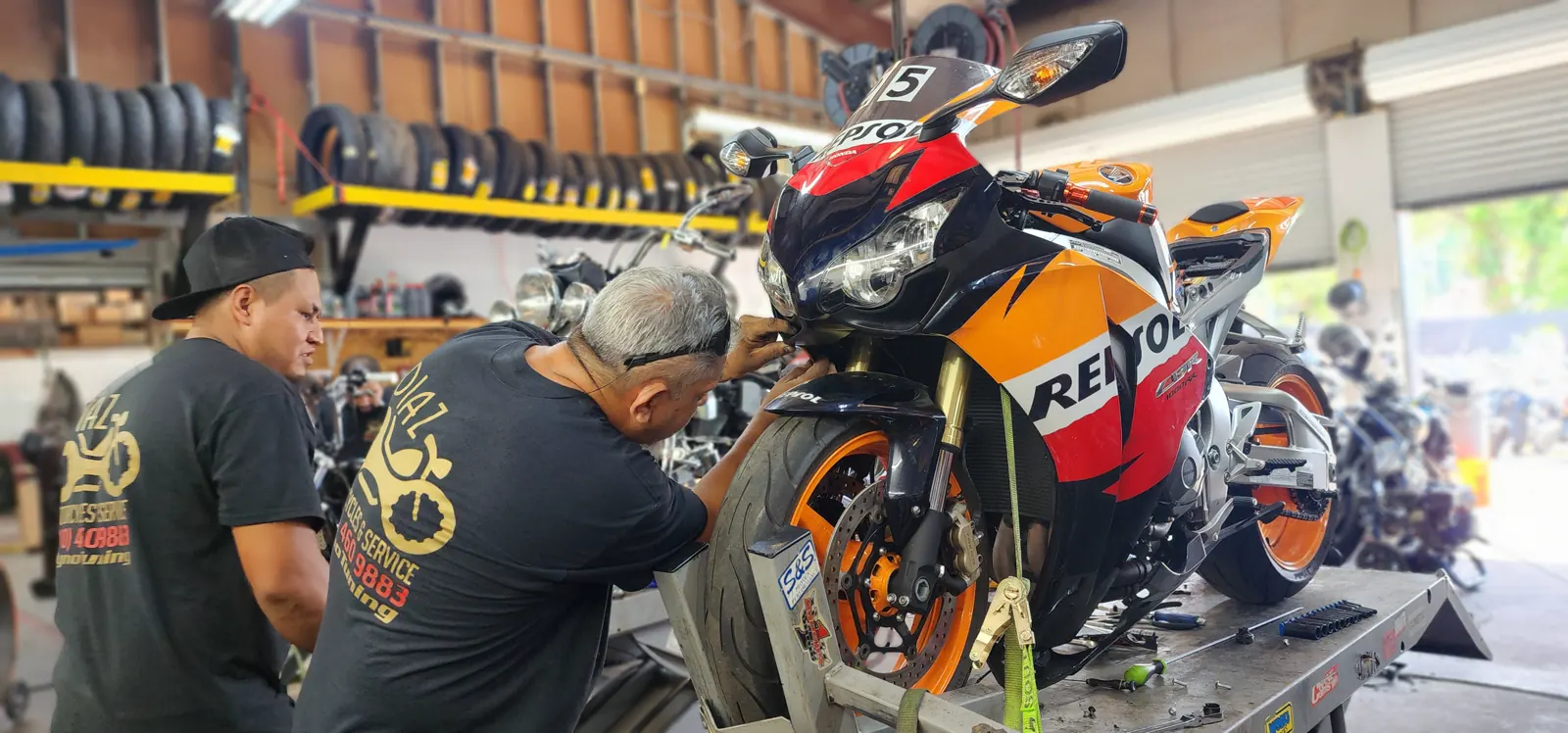
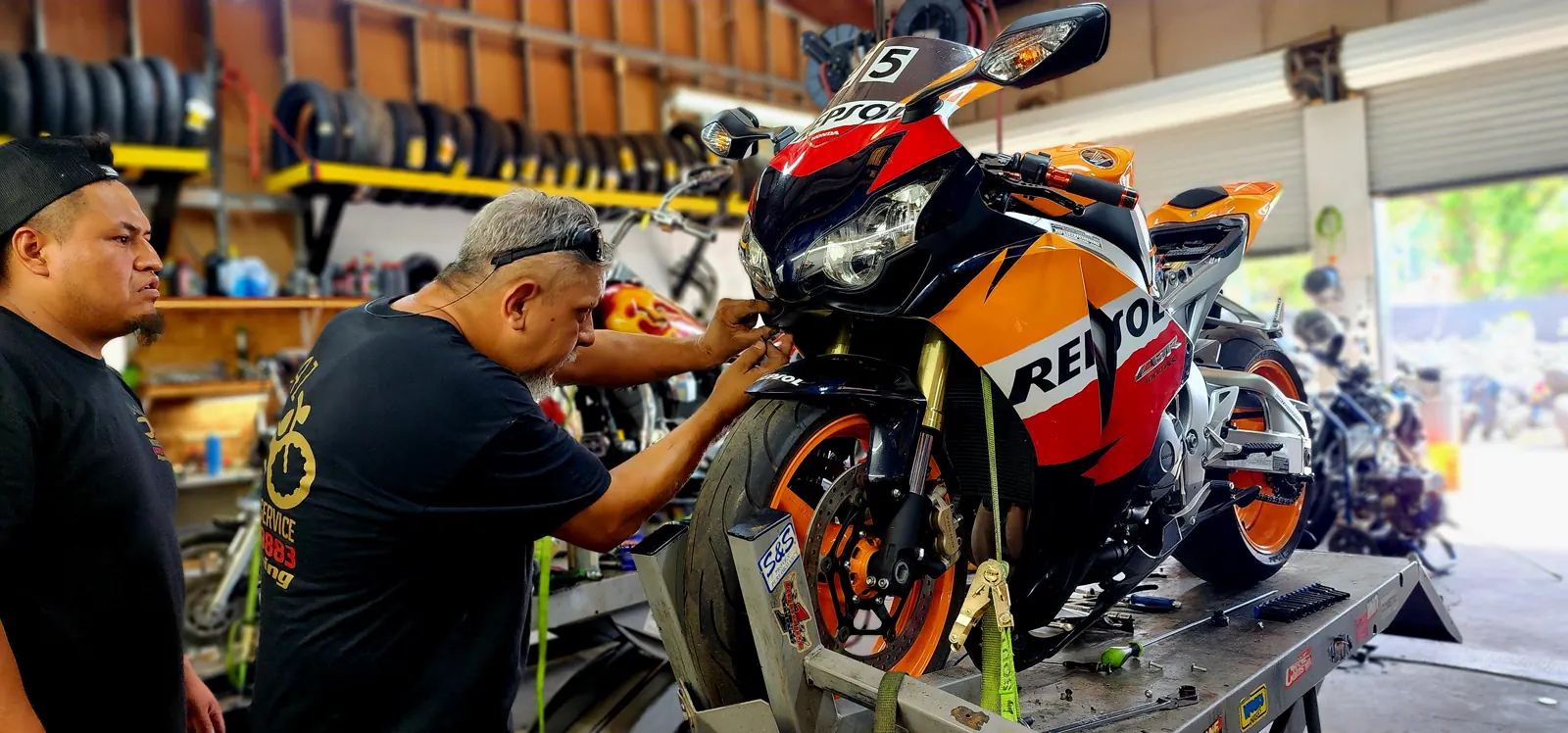
What’s more, two riders can roll in the same week needing identical maintenance and leave with two different plans. After that, one rides a bare naked bike where the valve cover sits right there in the breeze. Also the other rides a fully faired sportbike where that cover lives under a stack of plastic panels, each held by fasteners in awkward places, and every panel has to go back on straight. Same job on paper. Very different afternoon.
The reality: access is the real driver
Instead Access is our word for everything that comes off before the work starts, plus everything that goes back on after. It isn’t glamorous. It is most of the job. Once you see access clearly, service pricing stops feeling mysterious and starts feeling like arithmetic you can follow.
- Bodywork. Besides Fairings, tank covers and side panels come off first and go back on last, without a scratch.
- Layout. Actually some engines wear their filter and plugs in the open. That’s why Others hide them behind a header or a frame rail.
- Condition. Either way Bolts that have lived outside all year fight back. Garage-kept hardware usually breaks loose on the first try.
- Add-ons. In short Crash bars, luggage, a big windshield and aftermarket pipes each add steps in both directions.
- History. At the same time a bike that’s been kept up is quick to work on. As a result a bike that’s been waiting takes longer, because small problems stack.
That last one matters more than people expect. A chain that’s been cleaned and adjusted comes off easy. A chain ridden through a wet winter and left to dry takes patience, and it usually took the sprockets with it. When a bike shows up with five small things overdue at once, the work isn’t harder because anybody made it harder. It’s harder because time did. We wrote a whole piece on overdue service and what usually causes it, and none of it is as grim as it sounds.
What a service actually includes
A service isn’t one job. It’s a list of small checks in a set order, so nothing gets missed and nothing gets guessed at. Here’s what a full maintenance visit looks like in plain words, with the jargon left in the toolbox.
- Oil and filter. Drained warm, refilled to spec, filter swapped, drain plug torqued instead of gorilla-tightened.
- Chain and sprockets. Cleaned, checked for tight spots, set to the right slack, teeth inspected for hooking.
- Brakes. Pad thickness, rotor wear, fluid color and level, plus the lines and how the lever feels.
- Tires. Pressure, tread depth, wear shape and date code, because rubber ages even when a bike sits.
- Cooling and air. Coolant level and strength, radiator fins, air filter condition.
- Controls and electrics. Cables, levers, throttle return, lights, horn, switches and battery health.
- Chassis. Wheel bearings, steering head, fork seals, shock, and a torque check on the fasteners that matter.
Intervals are the one thing we won’t make up for you. Your owner’s manual sets them, and those numbers are specific to your engine, not to a figure somebody pulled out of the air at a parts counter. Bring the manual or the model details and we’ll work straight from it. For the full walkthrough of what happens in our bays, it’s written out step by step.
The visit, start to finish
Here’s the whole day, front to back, so none of it surprises you.
- You tell us the story. What it’s doing, when it started, how you ride. That saves everybody time.
- The bike goes up on the lift. We get hands on it before anyone talks about a plan.
- We inspect and write it down. Every item gets a note: good, watch it, or do it now.
- We call you with what we found, ranked by what actually matters.
- You pick the plan. All of it, the safety items now, or the big one today and the rest later.
- The work happens. Torque specs, fresh fluids, proper adjustment, old parts set aside for you to see.
- It gets a test ride. Brakes, shifting, heat, idle, how the front end feels.
- You get the notes. What we did, what we didn’t, and what to keep an eye on next season.
This is the point where a lot of riders make the wrong call. Step four hands you a list, and the temptation is to knock out only the cheapest item and ride away feeling clever. Sometimes that’s genuinely fine. Often the item you skipped is the one quietly eating a bigger item, like worn pads scoring a rotor or a dry chain chewing teeth off a sprocket. The fix is simple and it’s not a lecture: ask which item protects another item. We’ll tell you straight, and we’ll say when something can honestly wait.
SMALL THINGS FIRST
Catching a worn pad is a five-minute conversation. Catching it after it’s carved the rotor is a longer one. Same rider, same bike, very different week.
Why an honest shop won't quote it sight-unseen
We’d love to hand you a firm number on the first phone call. It would be easier for both of us. The trouble is that a phone quote is a guess wearing a promise costume, and the guess rests on things nobody can see through a phone: fastener condition, past repairs, which fluid went in last time, whether a previous owner fitted a part that almost fits. That’s why a real motorcycle service cost Kennesaw estimate starts with eyes on the machine.
What we can give you on that call is the shape of the job. Scope, likely time, what would make it bigger, what would make it smaller. Then we look at the bike and confirm. If the plan changes, you hear about it before one extra bolt comes out. That’s the whole trick to avoiding surprises, and it isn’t clever, it’s just picking up the phone. Riders one town over hit the same wall, and what Powder Springs riders run into reads almost word for word the same.
How to tell you're in a good shop
- They ask questions before they give you a number.
- That’s why they show you the old parts instead of just describing them.
- They tell you what can wait, not only what can’t.
- Either way they write down what they didn’t do, so your next visit starts informed.
- They never make you feel dumb for asking why something takes as long as it takes.
That last one is the real tell. Curiosity isn’t a nuisance, it’s a rider taking care of a machine, and machines pay that attention back. Ask why a job runs the way it runs and you’ll get the actual reason, not a shrug. If you’re thinking about adding a tune while the bike is already on the lift, what the work covers is spelled out too, so you can decide before you ever book.
What Kennesaw does to a bike
Bikes here wear in a pattern. Georgia doesn’t permit lane splitting, so a Kennesaw commuter sits in the I-75 grind with the clutch working, the brakes working and the cooling system pulling overtime in July. Chastain Road supplies the rest, a signal-dense corridor through the KSU side of town that jumps from busy to packed the week a semester starts or ends. Stop, go, heat, repeat. That’s hard on clutches, brakes and air-cooled engines, and it shows as wear long before it shows as a problem you can hear.
Storage splits the city neatly in two. Out in Ridenour, built from 2004 onward around a retail village with a greenway running toward the Kennesaw Mountain trails, pocket parks and ponds, most bikes sleep in a garage three minutes from I-75. Same deal in the subdivisions off Due West Road, which locals name by the road rather than by any individual subdivision. Around Downtown Historic Kennesaw, older single-family homes near Main Street sit close to the apartment corridor by campus, and plenty of those bikes live outside under a cover. A large mixed-use development got approved for that core in late 2024, so downtown will be busy for a while. Garage bikes come to us with sitting problems. Covered bikes come with weather problems.
Then there’s the pavement. Cobb County grades its roads and is working through a six-year resurfacing plan, but Kennesaw’s rural-origin routes like Stilesboro, Due West, Big Shanty and Old 41 were widened and patched over decades. They carry uneven seams, sunken utility cuts and shoulder drop-offs. Add steel plates, milled surfaces and loose gravel around the Barrett Parkway work and the downtown redevelopment corridors, plus railroad tracks that turn slick in rain if you cross them at an angle, and your suspension, bearings and tires do more work here than the odometer lets on.
The fun part, and why it matters
Nobody keeps a bike healthy just to sit in traffic. The payoff here is the I-575 gateway, which puts Kennesaw riders closer to north Georgia twisties than anyone in south Cobb, plus Old US-41 north toward Acworth and Cartersville when you’d rather skip Cobb Parkway. Riding is basically year-round with a peak from March through November, and one warm February Saturday still fills Old Highway 41. For the community side of the sport, the American Motorcyclist Association is a solid place to start.
Kennesaw Mountain National Battlefield Park sits right there too, roughly 2,923 acres with well over seventeen miles of trails climbing to an 1,800-foot summit, on ground that saw some of the heaviest fighting of the Atlanta Campaign. That’s a park for boots and a water bottle. The Kennesaw Aquatic Center and Adams Park handle the rest of a family weekend. Here’s the thing we wish every rider knew a season earlier: the bikes that get used like this, often and happily, are the healthiest bikes we see. Regular miles keep seals wet, batteries charged and fluids moving. Sitting is what quietly does the damage.
Parts are predictable. Access is what decides your day.
What you walk away with
The goal is a rider who knows what the bike needs and why, instead of guessing. You should leave with clean fluids, correct adjustments, a written list of what’s healthy and what to watch, and no mystery about how the plan got built. Understanding motorcycle service cost Kennesaw riders deal with comes down to three things: access, condition and time. Once you can see those three, the whole thing stops being a black box and starts being a schedule you control.
Getting to us is easy enough. From most of Kennesaw it runs about 11 to 14 miles and 22 to 30 minutes, either I-575 to I-75 south and across to Roswell Road, or Barrett Parkway east to Sandy Plains and then Roswell Road. Prefer not to ride it in? A trailer works fine, and Mini Boss Mobile Mechanic runs appointment-only and covers Kennesaw if a mobile visit suits you better. One thing worth doing early: if the bike is a recent used purchase, get the title and tag squared away through the Georgia Department of Revenue so paperwork isn’t standing between you and a good Saturday.
Questions Kennesaw riders ask us
How do I avoid surprises on a service?
Tell us everything you know about the bike up front, including anything a previous owner changed. Then ask for the plan in writing before work starts. We call you the moment anything changes, so you approve the scope before a bolt moves. Surprises come from silence, not from bikes.
What makes one service bigger than another?
Access, mostly. A bare naked bike gives up its filter and plugs quickly, while a fully faired sportbike needs its bodywork off first and back on straight afterward. Condition matters just as much, because corroded fasteners and neglected chains add real time. Two identical models can be hours apart for those reasons alone.
Why can't you quote it over the phone?
Because a phone quote is a guess, and we’d rather give you the truth. We can’t see fastener condition, past repairs, fluid history or mismatched parts from a phone call. What we can give you is the shape of the job, the likely time, and what would push it either direction. Then we confirm it with the bike in front of us.
What's actually included in a full service?
Oil and filter, chain and sprocket inspection and adjustment, brake pads, rotors and fluid, tire pressure, tread and age, coolant and air filter, cables, controls, lights and battery, plus a chassis check on bearings, steering head and fork seals. It finishes with a torque check and a test ride. You get notes on everything, including the parts we left alone.
How often should my bike get serviced?
Your owner’s manual sets the intervals, and we won’t invent a mileage number for you. Those figures are specific to your engine and how it’s built. Bring the manual or your exact model details and we’ll build the schedule from there. Riding style and storage shift things a little, so we’ll factor those in too.
How long does a service take?
A straightforward maintenance visit on an accessible bike is usually a same-day job. Add bodywork, stubborn hardware, or parts we need to order and it stretches, sometimes into a second day. We’ll give you a realistic window when you drop it off. If that window moves, you’ll hear from us rather than wonder.
We take care of riders all over the northwest metro, starting at home base in Marietta and reaching up through Kennesaw, Acworth, Emerson and Cartersville along the I-75 corridor. Woodstock and Canton riders come down I-575 to us regularly, often on their way back from a north Georgia weekend. To the west and south we look after Powder Springs, Dallas, Hiram, Mableton and Smyrna, and East Cobb riders make the hop across without much trouble at all. Wherever you park it, the plan is the same: eyes on the bike, honest notes, and no mystery.
BRING IT IN, GET A REAL PLAN
If your bike is due, overdue, or you just want a straight answer about what it needs, text or call us and we’ll get it on the lift. Kennesaw riders are about 22 to 30 minutes out, whether you take I-575 to I-75 south or run Barrett Parkway east to Sandy Plains. Tell us the story, and we’ll tell you exactly what we find, what it protects, and what can honestly wait until next season.
470-460-9883Diaz Motorcycles and Service, LLC · 847 Barnes Mill Road, Marietta, GA 30062