Overdue Service Peachtree City — Why It Happens
A bike that sat all winter isn't broken. It's just behind on a short list, and that list is easier to catch now than in July.
At the same time the first truly warm Saturday always shows up before the calendar admits it. As a result Sun on the driveway, damp pine smell drifting off the greenbelt, and a cover coming off a bike that hasn’t turned a wheel since fall. You hit the starter. On the other hand it groans, catches for half a second, then quits. So that slow, tired crank is the most common sign of overdue service Peachtree City riders bring us every spring. Still, it almost never means what a rider fears it means.
So let’s put the good news first. Plus, a bike that sat is not a broken bike. Meanwhile, it’s a bike whose fluids, battery and rubber all aged at once while nothing moved. Of course, that’s normal, and the fix is usually a short list. In fact, Catch it in March and it stays short. Ride on it until July and it grows.
The myth: a garage-kept bike doesn't need much
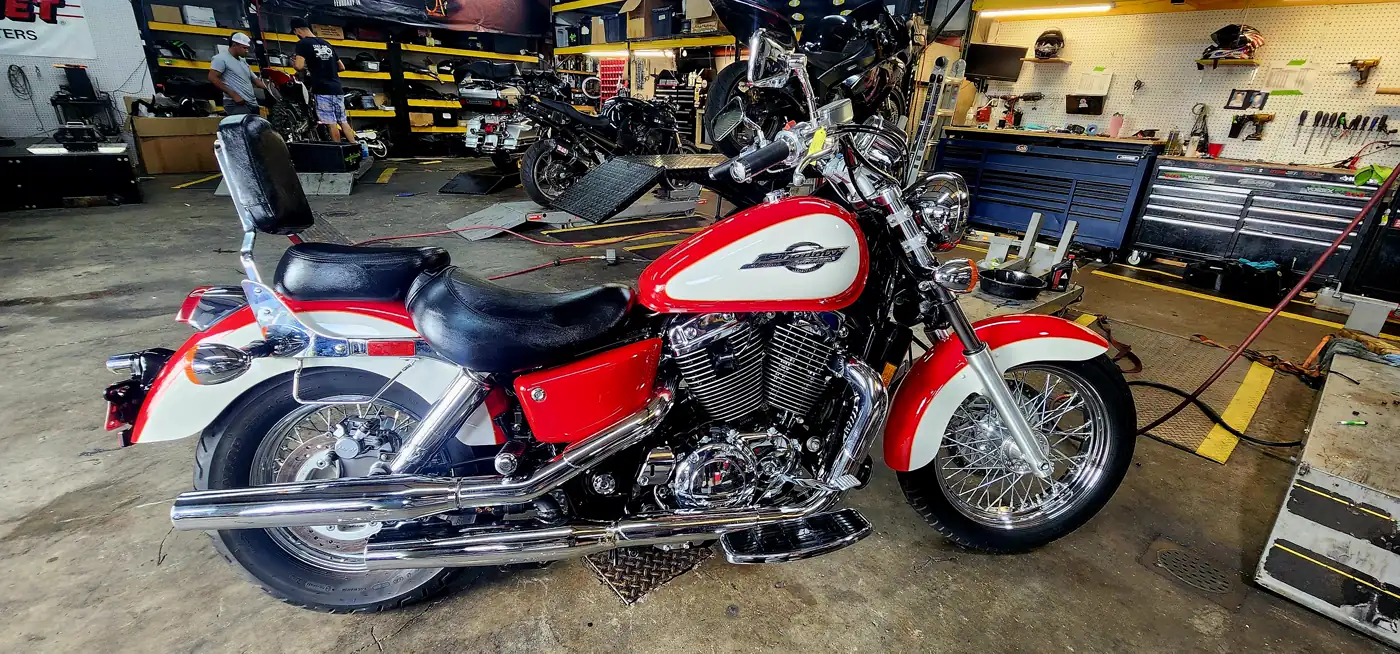
PTC is a garage city. Two-car, three-car, tender on the battery, cover on the tank, tire pressure checked more often than most people check their own blood pressure. Bikes here get treated better than a lot of cars get treated anywhere else. So the myth makes complete sense. If it’s clean, indoors and barely has miles on it, surely it’s ready to go.
Mileage is only one clock, though. For example, Time is the other one, and it never stops. Oil takes on moisture whether the odometer moves or not. Even so, Brake fluid pulls water out of the air through the lines. What’s more, Tires harden and show fine cracks along the edges while the bike sits perfectly still. After that, Fuel goes stale and leaves varnish in tiny passages. Also a low-mileage bike can be four seasons behind and look showroom-fresh the whole time.
Instead that’s the honest reason overdue work sneaks up on careful owners. Nothing looked wrong. Besides the tender kept the battery cheerful all winter. Actually Nobody has ever built a tender for brake fluid.
What's really going on under there
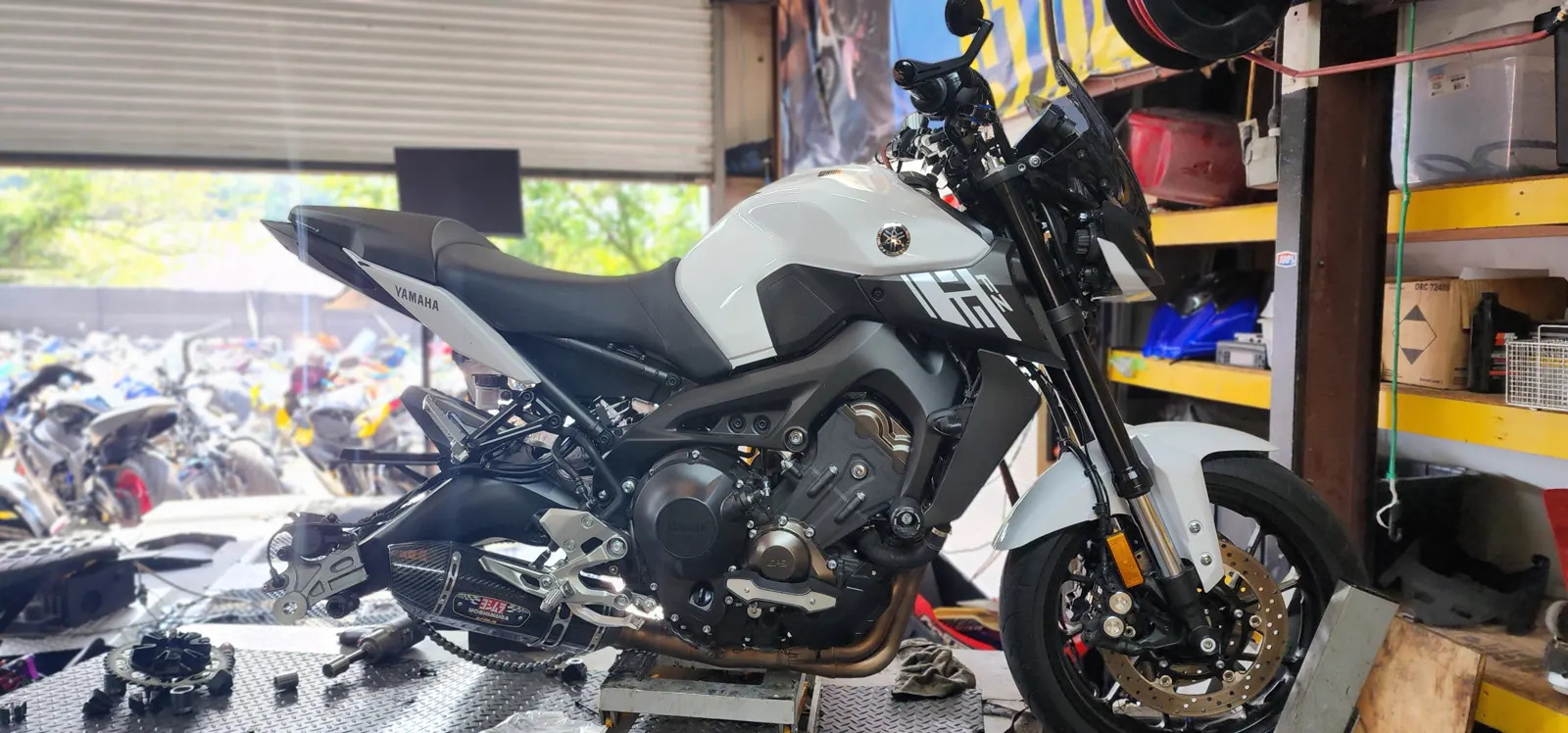
That’s why Riders describe the symptom about six different ways. Slow crank. Won’t idle without the throttle. Stumbles at a stop sign but pulls fine at speed. Front brake feels wooden. Chain sounds dry. Either way Overdue service Peachtree City riders bring us usually traces back to a handful of causes, in a pretty predictable order.
- Battery first. It’s the most common cause by a mile, and a tender can’t save one that was already tired going in.
- Old fuel next. Gas left sitting leaves varnish in jets and injectors, so the bike starts but won’t idle clean.
- Oil past its date. It looks fine on the dipstick and protects poorly once it’s taken on moisture over a long sit.
- Brake fluid with water in it. That’s the wooden lever feel, and it’s why caliper pistons start to drag.
- Chain and sprockets. A dry chain develops tight spots, and worn teeth start to hook instead of standing straight.
- Tires. Age, pressure and flat spots from sitting on one patch of rubber matter more than tread depth here.
- Air filter and plugs. Quick, cheap, and often the last thing between a rough idle and a clean one.
None of that is exotic. It’s the same list on a bagger from Braelinn Courts and on a project bike that’s been under a sheet since a couple of owners ago. The parts differ. The order rarely does.
When it's fine to ride and when it isn't
This is the part riders actually want answered, so here it is plainly. Some of that list is a nuisance. Some of it is a hard stop.
- Ride it, book service soon: weak crank that still fires, slightly rough idle, a dirty filter, a chain that needs cleaning and adjusting.
- Short, careful ride only: tires holding pressure but past their years, oil a season or two old, a minor stumble at low rpm.
- Don’t ride it: any brake lever or pedal that goes soft or spongy, or a caliper dragging hard enough to heat the wheel.
- Skip it too: a chain with tight spots you can feel by hand, or one loose enough to slap the swingarm.
- Don’t ride it: cracked sidewalls, a tire losing air overnight, or fuel weeping anywhere near the engine.
Brakes and tires are where waiting stops being a money question and becomes a safety one. Everything else can usually hold for a good weekend. Those two can’t, and any shop that says otherwise isn’t doing you a favor.
Here’s the part that surprises people, though. Two bikes with the same symptom can need completely different work. A Goldwing that sat three years in a Kedron garage and a Ducati ridden hard through November can both show up with the same rough idle. On the Goldwing it’s varnished fuel and a tired battery. On the Ducati it’s a clogged filter and cooked plugs. Same complaint, two different bills of work, which is why a real diagnosis beats a parts guess every time.
We’ve had friends come to us after paying for a battery, a fuel cleaning and a set of plugs somewhere else, only to find the cause was a corroded ground strap hiding under a bracket. Nobody looked. Everyone guessed.
What a real service actually includes
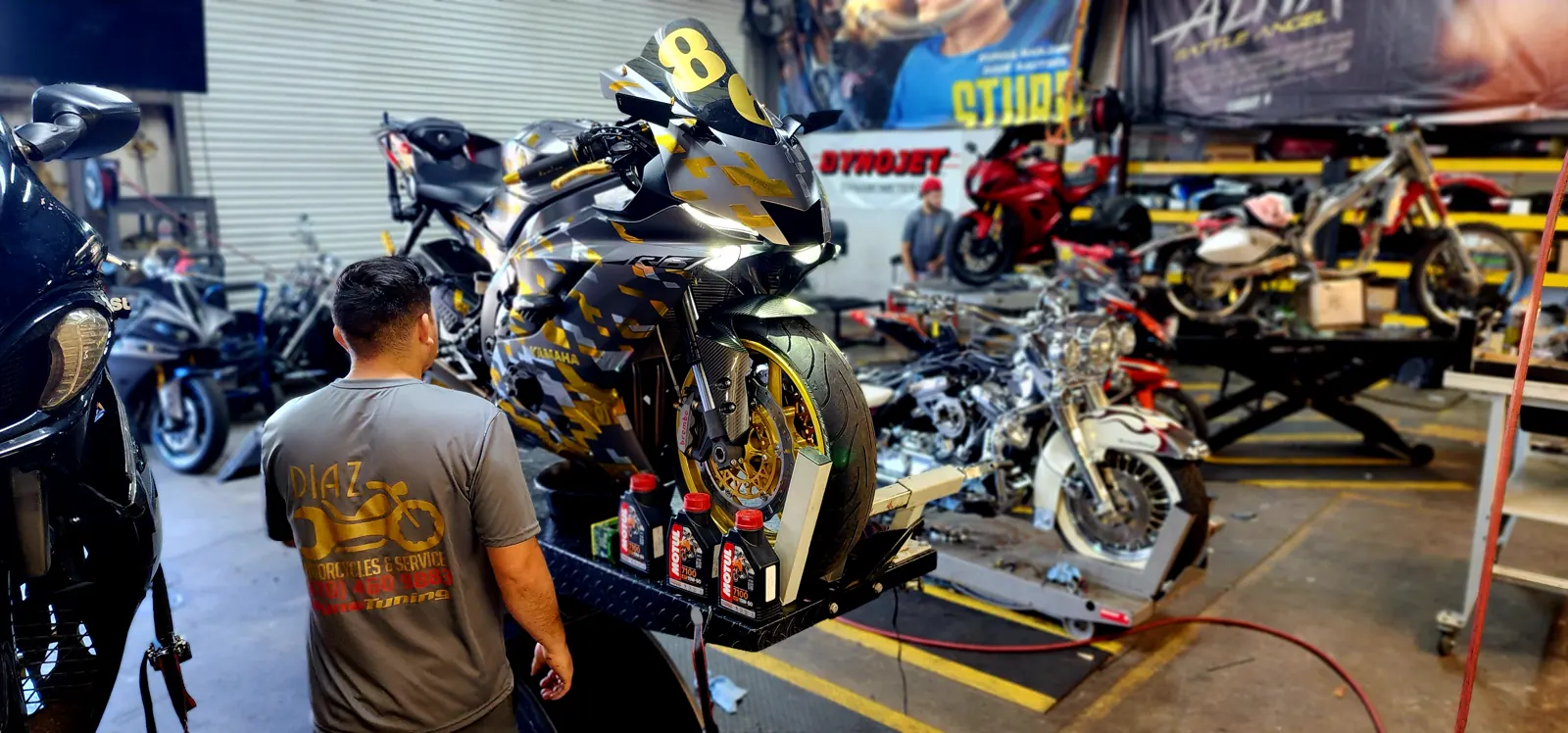
“Service” is a vague word, so let’s make it concrete. Your owner’s manual sets the real intervals for your specific bike, and we follow that book rather than a number we made up. Here’s what actually gets touched.
- Fluids: engine oil and filter, plus coolant, brake and clutch fluid. Brake fluid gets tested, not eyeballed.
- Fuel system: fresh fuel, and cleaning of jets or injectors if the sit was long enough to leave varnish.
- Electrical: battery load test, charging output, ground straps and connectors checked for corrosion.
- Brakes: pad thickness, rotor condition, caliper pistons freed and lubricated, lines checked for swelling.
- Drive: chain cleaned, lubed, tensioned and measured for stretch, sprockets inspected, or final drive checked on shaft bikes.
- Tires: date codes, pressure, wear pattern and any flat-spotting from storage.
- Controls: cables, levers, throttle free play, steering head, suspension travel, and a torque check where it matters.
- A road test, because a bike that passes on the lift and misbehaves on the street hasn’t passed.
That’s the honest scope. If you want the full breakdown of what the work covers, we’ve written that out in detail. Nothing on the list is glamorous. All of it is the difference between a bike that starts every time and one you have to negotiate with.
Cost depends on the bike, the sit time and what we find once things are apart, and we’d rather explain what changes the total than throw a number at you before we’ve seen it. A twin that sat one winter and a four-cylinder that sat five years are not the same job, and pretending otherwise helps nobody.
How to tell a good shop from a parts-swapper
You’re handing somebody the keys to a bike you’ve kept better than most people keep their living rooms. That earns you the right to be picky. A few things separate a real shop from a counter that sells parts with labor attached.
- They diagnose before they quote, and can tell you how they found the cause.
- They show you the old part. Not a description of it, the actual part, on the bench.
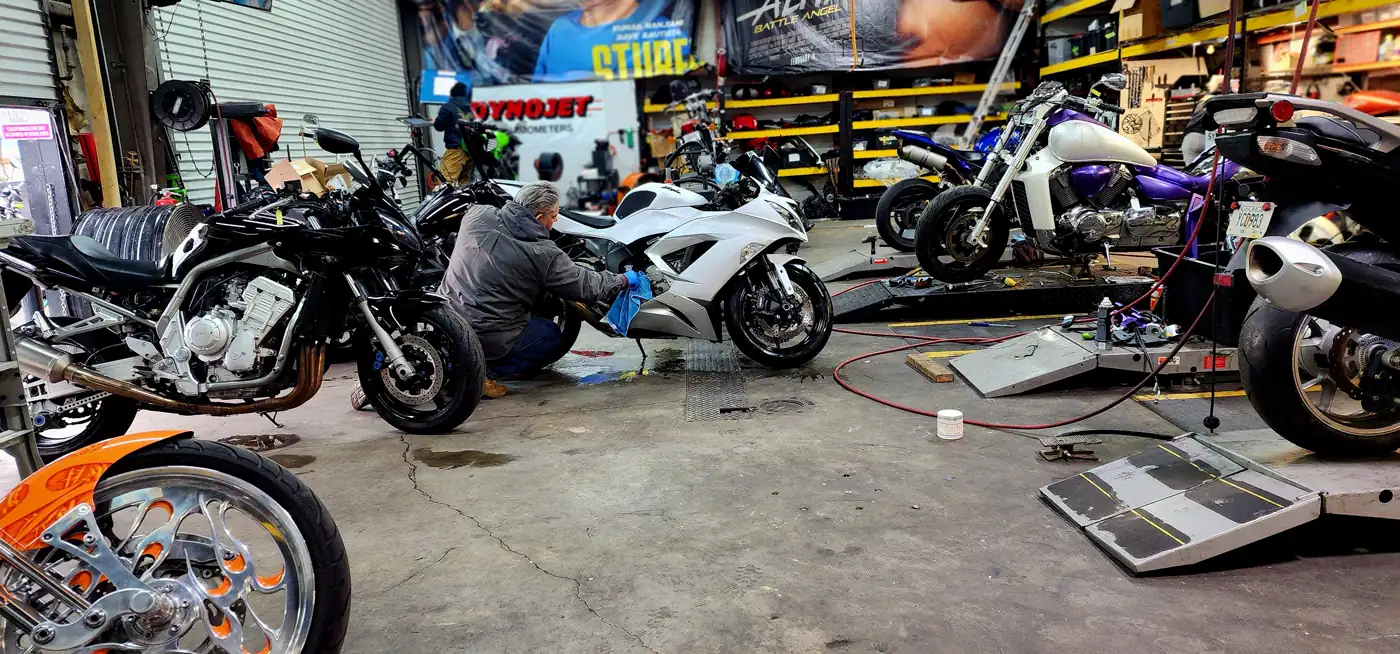
- They tell you what can wait. A shop that says everything is urgent is selling, not fixing.
- They know your make. Air-cooled twins, BMW boxers and modern inline fours fail in different ways.
- They write it down. A record of what was done and when matters at resale on a collector-grade bike.
- They give a straight answer about timing, including when the answer is “not this week”.
That last one matters more than riders expect. A shop that’s honest about its schedule is honest about everything else. This isn’t a Peachtree City problem, by the way. It’s the same story across the metro, and what Atlanta riders run into looks a lot like what happens down here, minus the traffic.
A shop that says everything is urgent is selling, not fixing.
One more thing, and it’s the part riders thank us for later. When a bike has been sitting, the smartest move isn’t fixing only what’s broken. It’s resetting the clock on everything that ages by time instead of miles, in one visit, so the next few years are just riding. Fluids, filter, brake fluid, plugs, chain, tire dates, battery. Do it all at once and you stop playing whack-a-mole every spring.
For riders down here, batching is the whole game. If the bike is coming to us anyway, that’s the moment to knock out the deferred stuff you’ve been squinting at. A fresh set of tires. The scuffed tank panel. The pipe you bought two years ago and never mounted. Anything built or tuned during that visit can also get verified after, the way Dynojet’s dyno center describes, so you’re not guessing about fueling on the way home.
The Peachtree City part nobody says out loud
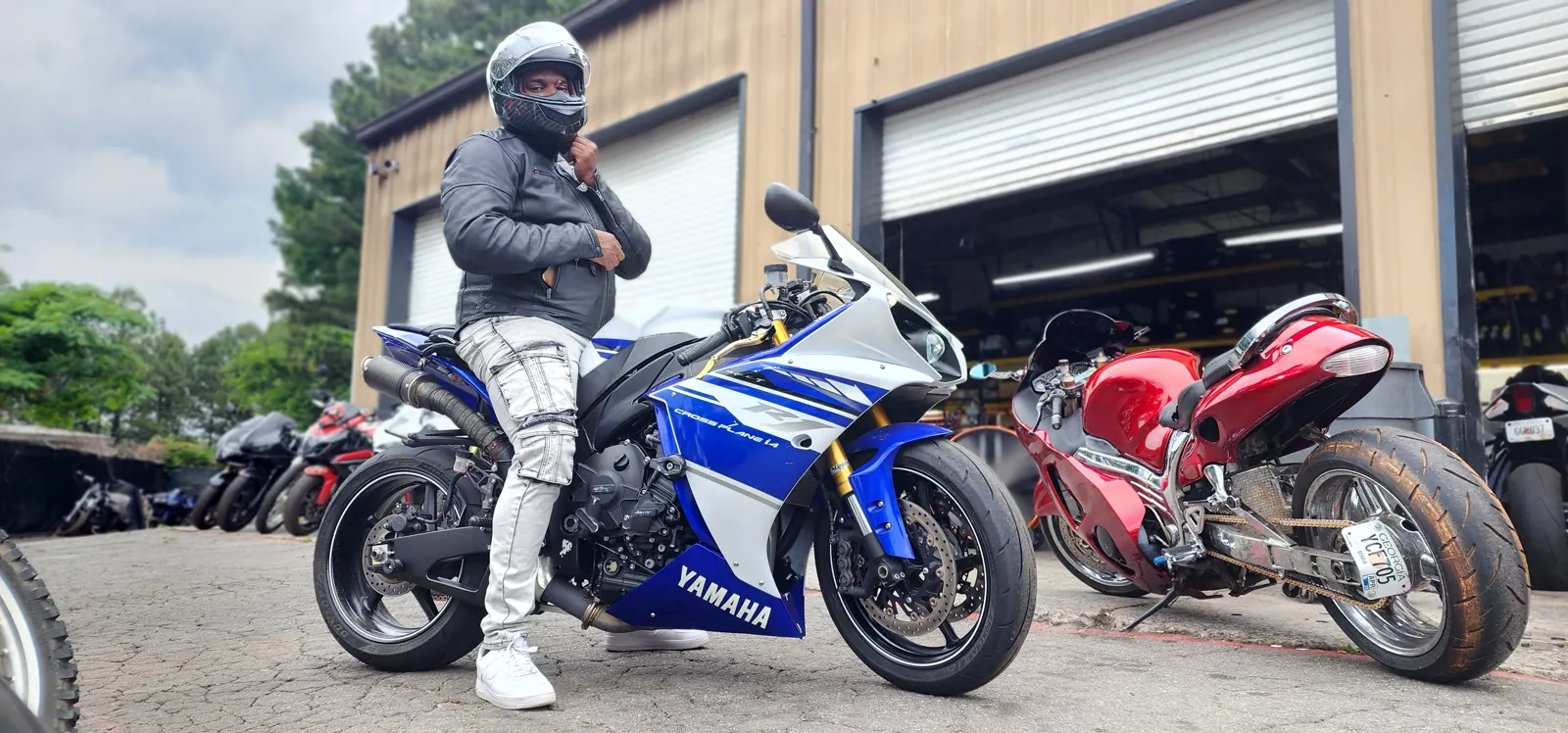
PTC was designed around not driving. A hundred-plus miles of cart paths, cart-owning households on nearly every street, and villages that work as their own little worlds. Somebody in Aberdeen orients by village, not by compass. So does somebody down in Braelinn Green, or out on The Peninsula where the lots run right up to Lake Peachtree. It means the motorcycle in the garage is almost never a commuter. It’s the fun thing. The thing you keep nice.
It also means there’s nothing inside the city set up to service it. Riders here already leave town to get work done, so the closer-is-better argument barely applies. There’s a Yamaha dealer about fifteen minutes over in Fayetteville, Cycle Specialty, handling sales, parts and service. We’re a long way north of that. Reaching our bench in East Cobb means GA-74 up to I-85, only about twelve to eighteen minutes from most of PTC, then the long way around the perimeter. Figure roughly an hour to an hour and a half each way, and that’s an estimate off the map, not a stopwatch reading.
So we won’t pretend you’d make that run for an oil change. You wouldn’t, and you shouldn’t have to. The truck is how overdue service Peachtree City riders keep postponing finally gets done. You leave the garage door up, we roll the bike on, and it comes back clean and sorted. In a city that runs at fifteen miles an hour on purpose, transport isn’t an apology, it’s the point, and it’s why our motorcycle maintenance services get booked by riders who never set foot in the shop.
The work worth the distance is the work nobody nearby is doing anyway. Restoration on a bike that’s been covered since the last owner. Custom paint. Detailing on a machine that’s more display piece than daily ride. That’s what lives in PTC garages by the hundred, and it’s what we build our week around.
What the good version looks like
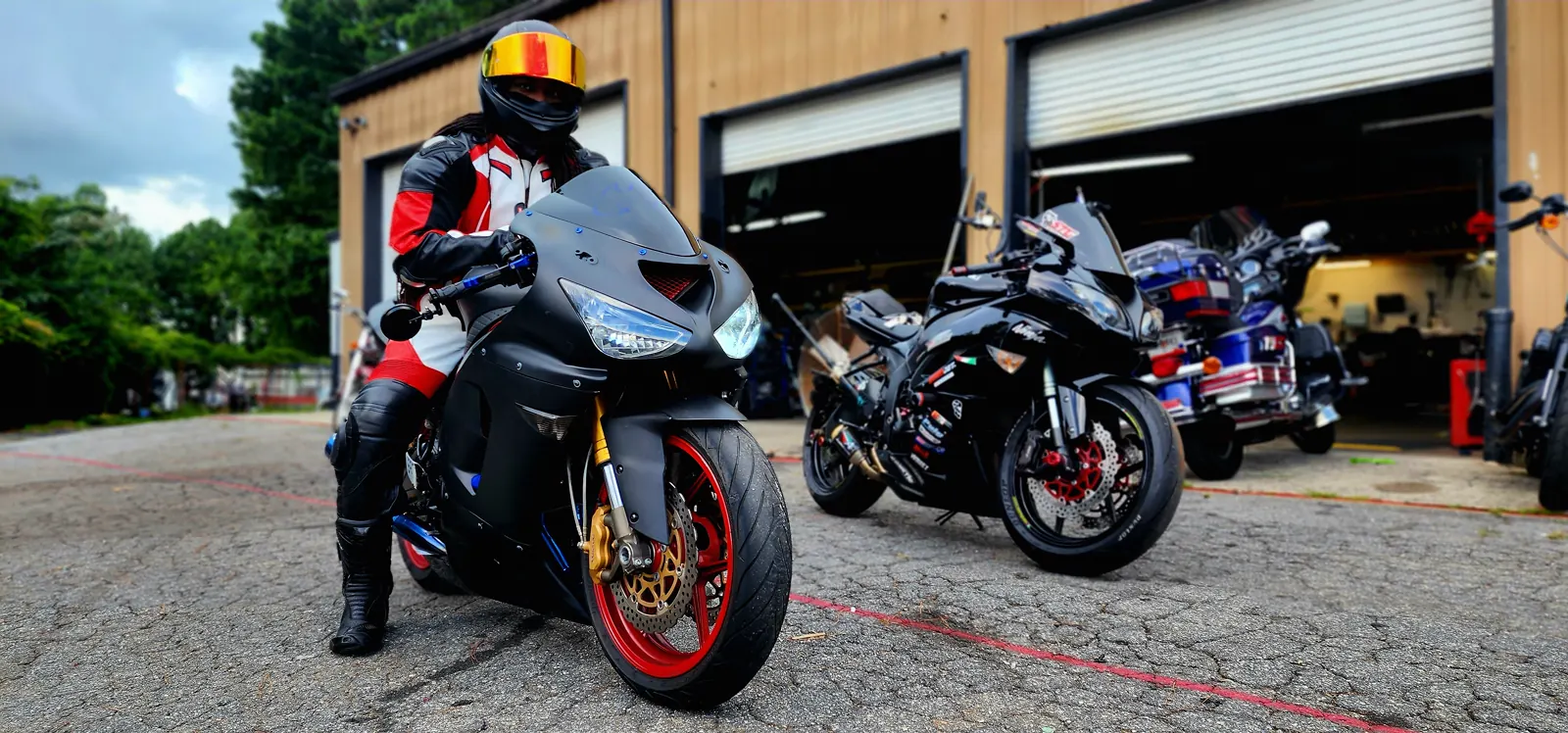
Here’s where it lands. It’s a Saturday in the fall, the bike fired on the first press, and you’re heading somewhere worth the ride. Maybe it’s an easy morning loop past the Line Creek Nature Area on the western edge, where the creek corridor feeds the Flint and marks part of the Coweta line. At the same time Maybe it’s a walk on the boardwalk through the five hundred acres of Flat Creek Nature Area with the bike parked and cooling. Maybe it’s the real one, an hour south to Pine Mountain, FDR State Park and the GA-190 ridge, with Callaway Gardens close enough to make a day of it.
Whichever it is, you didn’t spend the morning wondering. You knew the fluids were fresh, the brakes were solid and the tires were current, because somebody wrote it down. That’s not luck. That’s ownership, and it’s a genuinely good feeling to be the person whose bike is simply right. Watch the shaded curves for wet leaves and acorns, keep an eye out for deer near the greenbelt, and if you want to sharpen the rider as much as the machine, MSF rider courses are worth a weekend.
THE SHORT VERSION
Time ages a bike even when miles don’t. Brakes and tires are the two things you never ride on and hope. Everything else batches into one visit, and you don’t make the drive.
Questions Peachtree City riders ask us
Will it get worse if I just keep riding it?
Some of it will, yes. A dry chain wears its sprockets, a dragging caliper cooks a rotor, and stale fuel leaves more varnish the longer it sits in there. The good news is that most of it gets worse slowly, so you usually have time to plan rather than panic. Brakes and tires are the exception, and those get handled first.
How urgent is it, really?
That depends on which symptom you have. A rough idle or a weak crank is a book-it-soon item, not an emergency. A soft brake lever, a chain with tight spots, or a tire losing air overnight means the bike stays parked until it’s looked at.
What happens if I ignore it for another season?
Usually the small list turns into a bigger one. Fuel varnish that would have cleaned up easily starts needing carbs or injectors pulled, and a chain that only needed adjusting takes the sprockets with it. Nothing catastrophic in most cases, just more work than you needed to do.
How do you find the actual cause?
We start with the symptom you describe, then test rather than guess. Battery load and charging output, fuel condition, compression if it’s called for, brake fluid moisture, and a hands-on check of the drive and controls. Then we road test it, because some faults only show up under load.
Could it be something completely different?
It can be, and that’s exactly why we don’t quote from a phone description. Corroded grounds, a failing side-stand or clutch switch, a sticking petcock, or a mouse nest in an airbox all imitate more common problems. Finding the real cause is cheaper than replacing three parts that were fine.
Do we really have to drive the bike up to Marietta?
No. We bring the truck to your driveway, take the bike, do the work, and bring it back. Most riders here batch several jobs into that one pickup, which is the smartest way to use it, and it means the distance stops being your problem.
We pick up and deliver all through the south metro, so riders in Peachtree City and Fayetteville use us the same way, without the drive. That goes for Tyrone and Brooks just up the road, Woolsey out east, and Senoia, Sharpsburg and Newnan over in Coweta County. Heading north toward the perimeter, we regularly load bikes in Fairburn, Union City and Palmetto, plus Jonesboro and Riverdale on the Clayton side. If your town isn’t on that list but you’re in the neighborhood, ask anyway. The truck goes where the bikes are.
WE COME GET IT
Text us what your bike is doing and how long it sat, and we’ll tell you straight whether it’s a ride-it-carefully situation or a park-it-now one. If it’s time for service, we’ll schedule a pickup in Peachtree City, handle the whole list in one visit, and bring the bike back sorted. You never have to make the drive.
470-460-9883Diaz Motorcycles and Service, LLC · 847 Barnes Mill Road, Marietta, GA 30062