Paint Cost Sandy Springs: What Really Drives the Price
Bought a used bike with mystery paint? Here's what a real repaint involves, and why an honest number never comes over the phone.
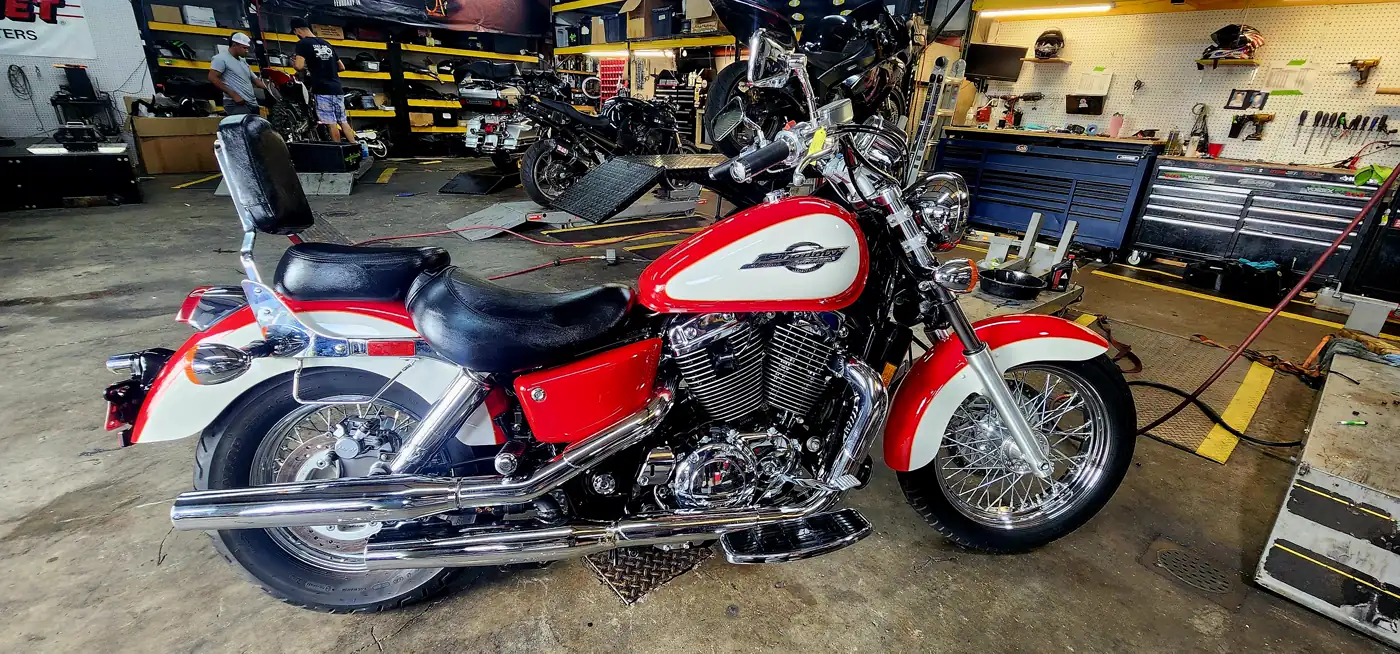
As a result you bought the bike used, and the photos looked great. Then you rolled it into the sun at home and really saw it. On the other hand the tank doesn’t quite match the fairings. So there’s a cloudy patch near one seam. Still, Somewhere under the gloss, a chip got touched up with a brush. Plus, you’re standing there wondering what a proper repaint would take. Meanwhile, that question is the real reason people search for paint cost Sandy Springs, and it deserves a straight answer instead of a number pulled out of the air.
Of course, here’s the thing about a used bike with mystery paint. You don’t know if the last owner babied it or dropped it. In fact, a respray can hide a repair, and a repair can hide a story. For example, None of that makes the bike bad. Even so, it just means the finish is a puzzle, and you’re the one holding the pieces now. What’s more, Good news: every one of those pieces is readable once you know the signs.
The paint is telling you where it's been
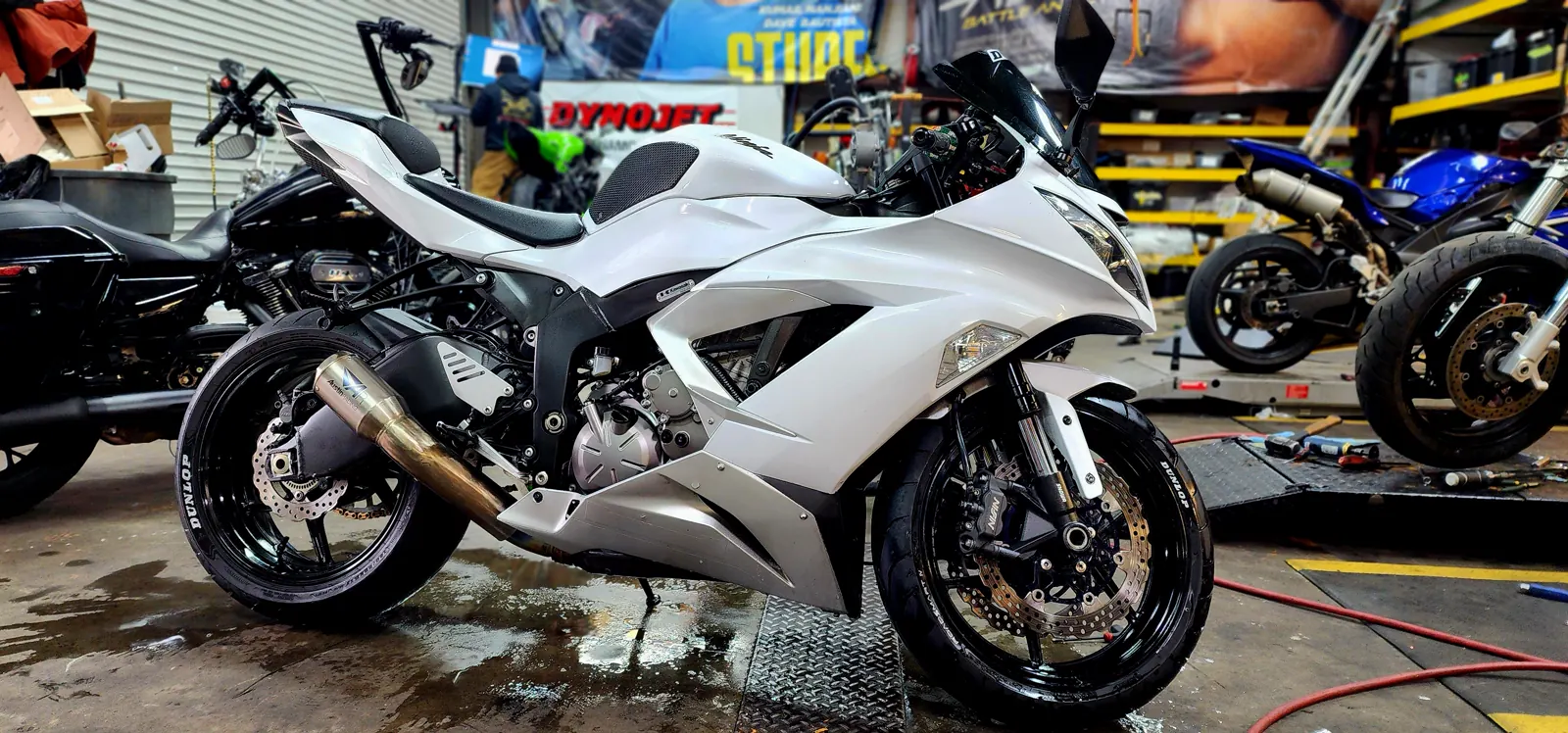
Before we talk about price, look hard at what you actually have. Paint leaves clues. Once you know what to look for, the bike basically starts talking to you. Grab a flashlight, roll the machine into daylight, and run your eyes slowly across every panel. Take your time on the tank, the fairings, the fenders, and the little side covers most people skip.
- A tank that doesn’t quite match the side fairings, like two slightly different whites
- Cloudy or milky patches, usually near a seam or an edge
- Orange-peel texture that feels rough instead of glass-smooth
- Chips touched up with a brush, sitting proud of the surface
- Overspray fog on rubber, chrome, or the edge of a bolt head
- Fading or chalky color on the parts that face the sun most
None of that means you got burned. Plenty of great bikes wear a quick respray from a previous owner. But each sign points to a different amount of work, and that is exactly what shapes the final number you’ll hear.
What each of those signs actually means
Let’s translate. Below is the quick version of what those clues usually point to once a bike is up on the bench and under good light.
| What you see | What it usually points to |
|---|---|
| Colors that don't match panel to panel | A prior repair or a partial respray that was never blended |
| Cloudy patches near seams | Clear coat that lifted, or moisture that got trapped underneath |
| Rough, orange-peel texture | Paint sprayed too fast or without enough prep and leveling |
| Brush-touched chips | A quick fix over a rock chip or a drop, not a real repair |
| Overspray on chrome and rubber | A rushed job where nothing got masked off properly |
| Chalky, faded panels | Years of sun with no clear coat left to protect the color |
See the pattern? A straight color change on clean panels is one kind of job. Matching a fresh repair into faded factory paint is another animal entirely, because now we’re chasing a color that has been sitting in the sun for years. Cracked plastic and hidden filler add hours before a single drop of color ever goes down. The paint you actually see is only the last five percent of the work.
One more thing worth knowing. Sunlight is your best tool here. Shade hides a multitude of sins, but direct light makes a bad blend jump right out at you. That’s exactly why we push a bike outside before we say a word about it. What looks flawless in a dim garage can tell a totally different story on the driveway at noon.
Here's where the real cost lives
Here’s where it gets interesting — and where most advice online falls apart. Every calculator that spits out one flat figure for a repaint is guessing. The truth is that the price of paint has almost nothing to do with the paint. Materials are a small slice. What you’re really paying for is time, skill, and a whole lot of patient prep. Sanding, filling, blocking, and masking eat up far more hours than spraying color ever will.
And the finish you choose changes everything about the labor. A solid color is fairly direct. A candy finish is see-through color layered over a bright base, so the depth comes from how many coats go down and how evenly they land. Metallic and flake need consistent spraying or the sparkle blotches. Add an airbrushed mural or a run of hand pinstriping, and now you’re paying for an artist’s hours, not just a painter’s.
So what makes one job bigger than the next? A few things stack up fast, and none of them have to do with how fancy the can of paint is.
- How many panels get painted — a tank alone versus tank, fairings, fenders, and covers
- The finish you want — a straight color versus candy, metallic, or deep flake
- Graphics, airbrushed murals, or hand pinstriping layered in
- Bodywork hiding under the old paint — dents, cracked plastic, filler, or rust
- Matching a repair to existing paint, which is fussier than a full color change
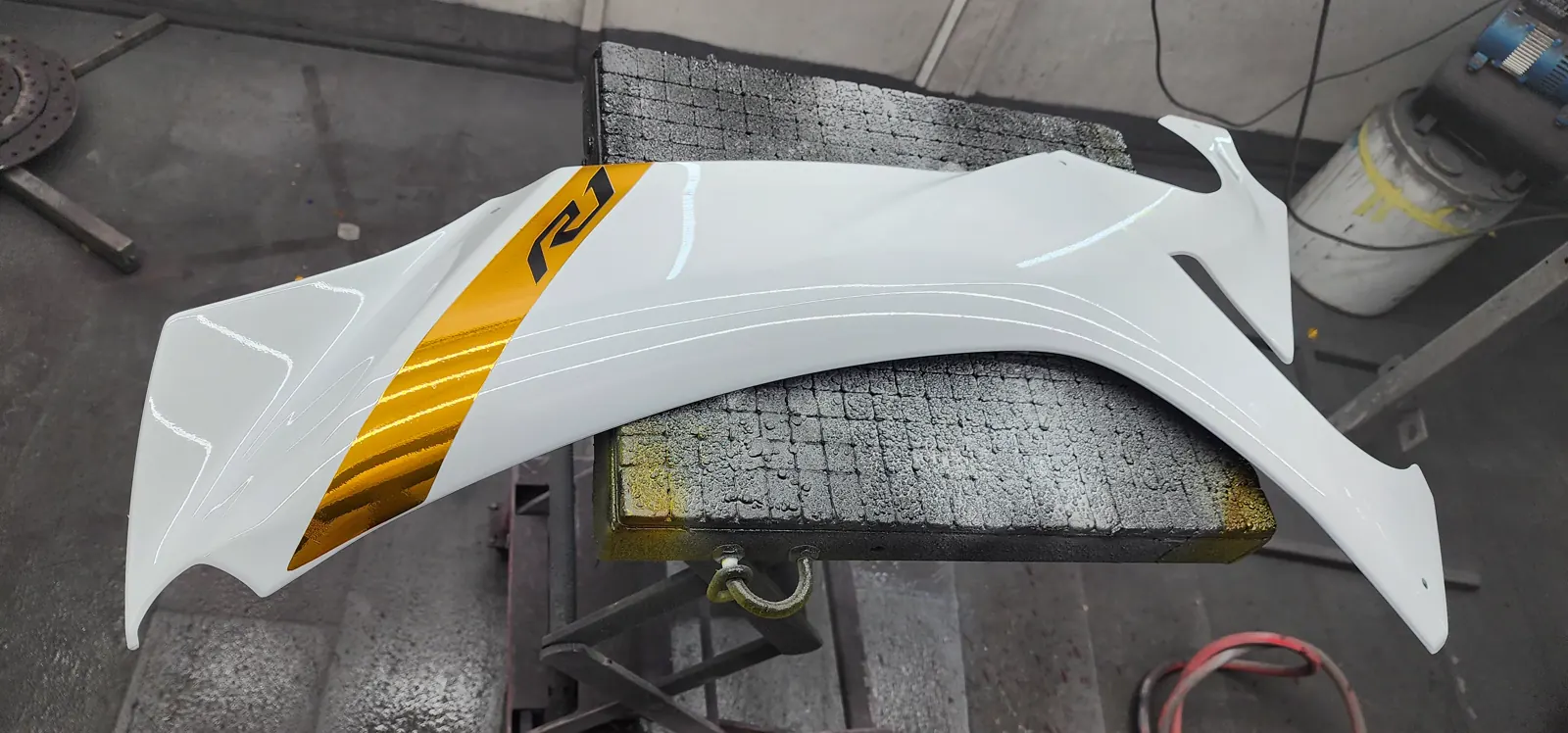
This is also why an honest shop won’t hand you a number over the phone. When someone asks for a paint cost Sandy Springs riders can actually trust, the real answer is that we can’t give one until we’ve seen the bike. We need to strip a corner, check for filler, test how the color has aged, and count the panels. A quote given sight-unseen is either padded high to stay safe or lowballed to win you, and both of those cost you in the end.
Color matching deserves its own note. Factory paint fades in a very specific way, and a fresh, perfect version of that same color will actually look wrong sitting next to it. Matching means tinting the new paint to the aged panel and blending it into the next natural break, so your eye never catches the edge. It’s slow, careful work, and it’s exactly where cheap jobs give themselves away.
Paint is the last five percent. Prep is the whole job.
What happens once it's on the bench
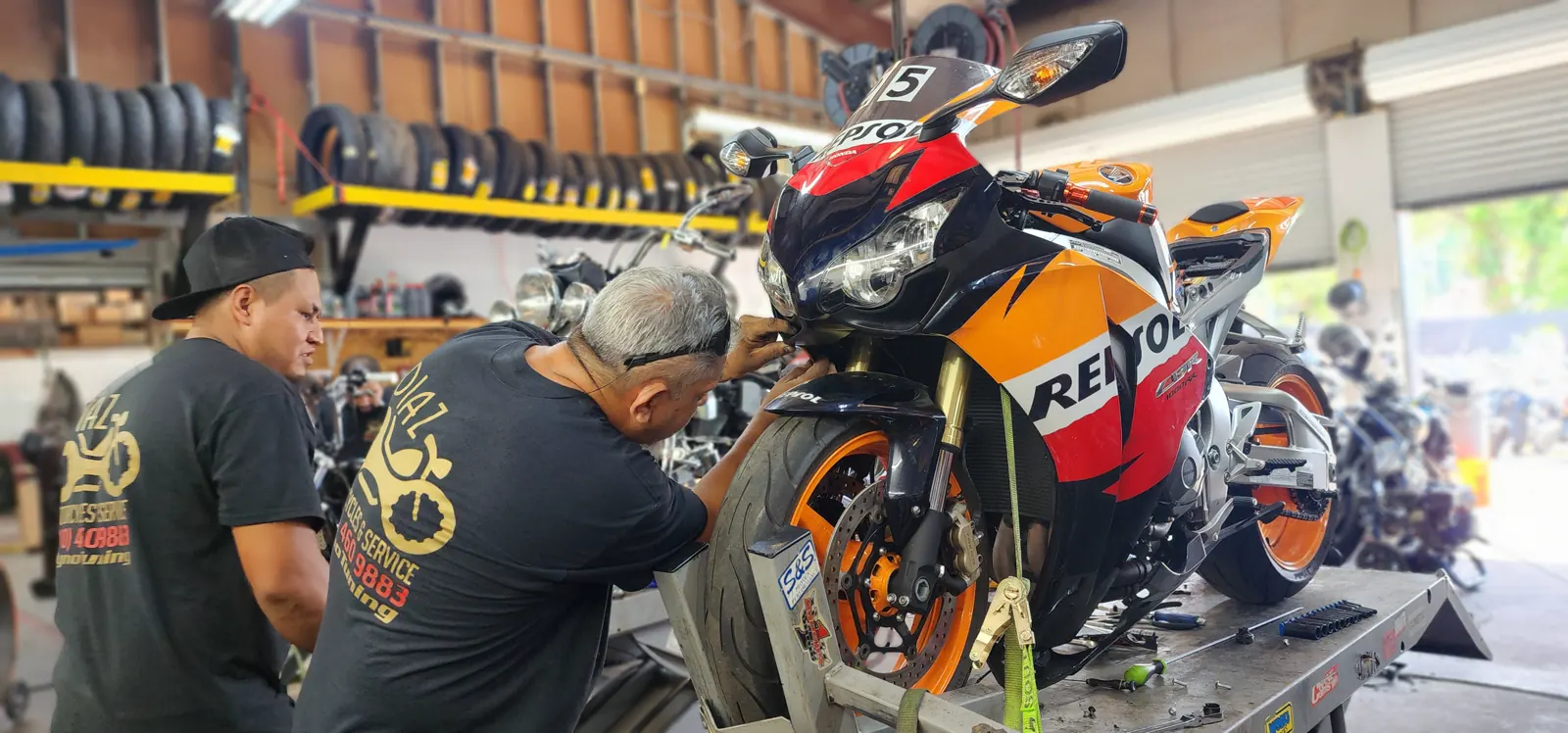
Say you drop the bike off. Here’s the actual path it walks, start to finish, in our own booth. We paint in house under the Diaz Custom Works name, so your parts never leave the building or get farmed out to a stranger across town.
- Teardown and inspection — panels come off and go under good light so we can see everything
- Strip and bodywork — old paint comes off, then dents, cracks, and filler get sorted
- Primer and blocking — we build a dead-flat base, sanding it smooth by hand
- Base coat — your actual color goes down, whether that’s a pearl, candy, metallic, or flake
- Graphics and pinstriping — any airbrush work or hand lines get laid in at this stage
- Clear coat — the gloss and armor go over everything to lock in the color
- Cure, wet-sand, buff, and reassemble — the finish gets its depth, then the bike goes back together
ALL IN-HOUSE
Your tank and panels never leave our shop. We prep, spray, and clear everything in our own booth under the Diaz Custom Works name, so one crew owns the whole job from teardown to final buff.
Two of those steps do the heavy lifting. The base coat is your color — the candy, the pearl, the metallic, the deep flake that flips in the light. The clear coat goes over it, and that’s the part that gives paint its glass-like depth and gloss. Clear is also the armor. It’s what takes the sun, the bug hits, and the wash swirls so your color stays rich underneath. Skip good clear and the prettiest base in the world goes dull in a single season.
If you want the full picture of what you get when you bring it in, we lay it out plainly. It’s the same care we describe when we walk newcomers through what that service actually involves, because the process doesn’t change from one bike to the next — only the details do.
Why a good paint job takes the time it takes
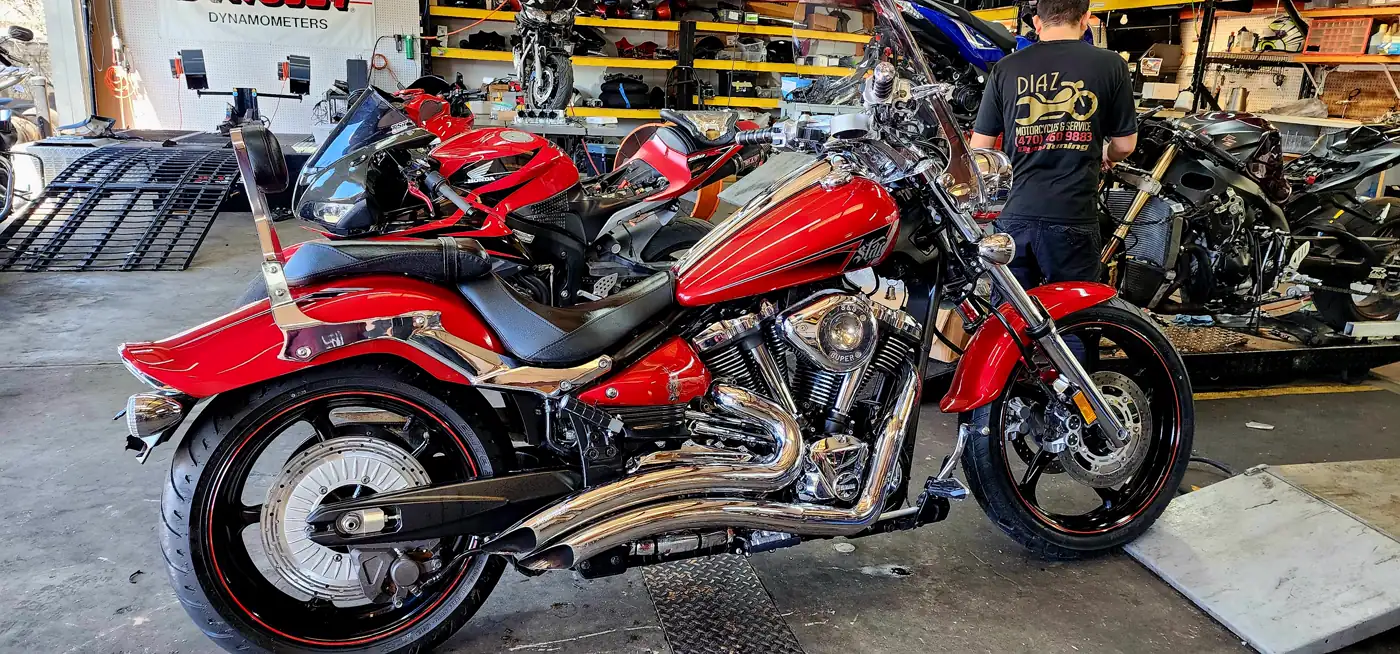
Riders always ask how long. The honest answer is that it depends on the work, and I mean that. Paint is a stack of layers, and every layer needs to cure before the next one goes on. Rush the cure and you trap solvents, which leads to that cloudy, hazy look down the road. Bodywork on cracked plastic or a dented tank adds days on its own. A single-color job on clean panels moves quicker than a candy finish with airbrushed graphics and hand pinstriping, because each of those is its own careful stage. We’d rather take the time and hand you a finish that lasts than rush it and hand you regret.
There’s no shortcut worth taking. Every skipped step shows up later — as peeling clear, a lifting edge, or color that dulls in a season. Doing it once, correctly, is a lot cheaper on your patience than doing it twice.
The riders who’ve been through it get it. The friends we’ve helped will tell you the wait was the easy part, once they saw their bike come out looking better than the day it left the factory.
What this looks like from Sandy Springs
Sandy Springs has a quiet problem: there’s no motorcycle shop inside the city limits. So you’re already driving somewhere for anything serious. The good news is that we’re close. From most of the city it’s a short hop across the Chattahoochee — take Johnson Ferry Road west into East Cobb and you’re at our door, usually inside half an hour, with no interstate needed. Riders coming off the Riverside side get here even quicker.
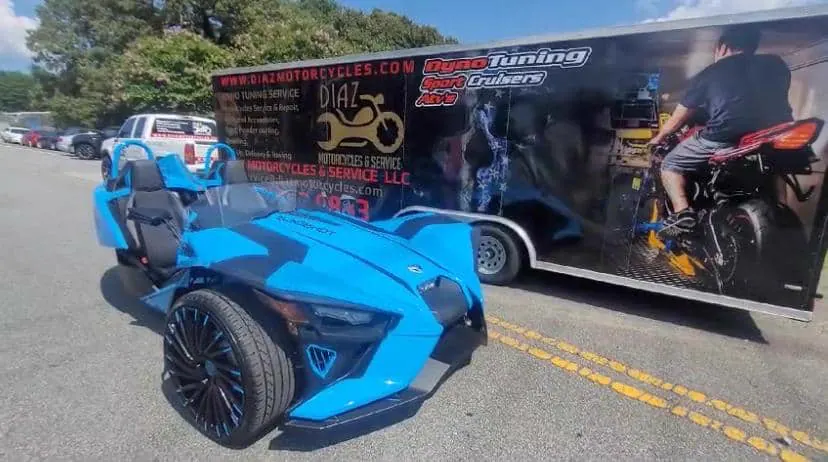
We see bikes from all over town. There are garage-kept touring bikes and premium cruisers up in Huntcliff and the Dunwoody Panhandle, where the big estate lots sit near the river. There are commuters over by Glenridge Close, close to the hospital cluster, who keep a bike in a condo deck with nowhere to work on it. For a lot of those folks, hauling a whole machine isn’t easy — so we’ll grab just the tank and panels, or the entire bike, and bring it back when the paint’s done.
Picture it done. You meet friends near the Sandy Springs Performing Arts Center and the Byers Theatre for a show, and your tank throws color under the streetlights. You roll past the Abernathy Greenway Linear Park with its Playable Art Park sculptures, and your bike looks like it belongs in the display. Riders here care about their machines the way IIHS motorcycle research shows most owners do, and a finish like that is well worth protecting. Curious how this plays out in Kennesaw? The math is the same, just a different zip code.
Timing helps too. Fall, from September into early November, is the best riding of the year around here and prime leaf season up north. If you want fresh paint for those mountain runs, it pays to plan ahead of the rush, since everybody wants their bike sharp at the same time.
Once the color’s on, you’ll pick a finish, and the tradeoffs between them matter more than folks expect. Then comes the fun part. GA-400 north out of the Perimeter is your launch ramp to the mountains — once you’re squared away with your Georgia Class M licensing, you’re in the foothills within the hour. For most owners, the real paint cost Sandy Springs comes down to is simple: good work, done once, that you never have to redo.
What changes once it's actually sorted
Here’s what changes once it’s actually sorted. That mystery bike you weren’t sure about becomes yours. The paint isn’t hiding anything anymore, because now you know every layer that’s under there. A custom paint job is the most personal thing a rider does to a machine — it’s your color, your story, your name on it in a way no bolt-on part can match. You stop apologizing for the mismatched tank. Instead, you start pointing it out. And that feeling, honestly, is the whole reason we keep this work in-house instead of shipping it off.
So if you’ve been staring at a secondhand bike wondering what’s really under that respray, you’re not crazy, and you’re definitely not alone. Bring it by. Let’s read the paint together and give you a number that’s actually true.
Questions Sandy Springs riders ask us
What if you find something else once the paint's off?
It happens, especially on a used bike. When we strip a panel, we sometimes find filler, a hairline crack, or a repair the last owner hid. We stop and call you before we do anything extra, so you’re never surprised by the work or the number. You decide what gets fixed.
How do I avoid surprises on the final price?
Bring the bike in for a real look. Once we can strip a corner, check for bodywork, and count the panels, we walk you through the whole plan face to face. There’s no guessing, and no phone estimate that falls apart later once we open it up.
What makes one paint job bigger than another?
The number of panels, the finish you pick, and what’s hiding under the old paint. A single color on clean plastic is quick. Candy, flake, graphics, pinstriping, or dents and cracked panels each add careful hours. That’s really the whole ballgame.
Why can't you just quote it over the phone?
Because we’d be guessing, and guessing helps nobody. Paint price is mostly prep and bodywork, and we can’t see either one over the phone. A quick look in person beats any number we could make up sight-unseen, every single time.
What's included when you paint my bike?
The full job — teardown, prep and bodywork, primer, base color, any graphics or pinstriping, clear coat, cure, wet-sand, buff, and reassembly. It all happens in our own booth, so one crew owns your bike from start to finish.
Do you really pick up the bike from Sandy Springs?
We do. Plenty of riders here store bikes in condo decks or carports with no room to work. We’ll grab the whole machine or just the tank and panels, then bring it back when the paint’s done. That takes the drive off your plate entirely.
We paint bikes for riders well beyond Sandy Springs. Neighbors in Roswell, Dunwoody, and Brookhaven roll in regularly, along with folks from Atlanta and Buckhead who want real in-house work instead of a job farmed out across town. We’re an easy trip for East Cobb, Vinings, and Marietta riders, and we see plenty of bikes come in from Alpharetta, Chamblee, Smyrna, and Doraville too.
LET'S READ THE PAINT TOGETHER
If you’ve got a Sandy Springs bike with mystery paint or a color change on your mind, bring it by Diaz Motorcycles in Marietta. Text or call us, or just ask about pickup right from your Sandy Springs driveway, and we’ll read the paint together and give you a number that’s actually true. No phone guesses, no pressure.
470-460-9883Diaz Motorcycles and Service, LLC · 847 Barnes Mill Road, Marietta, GA 30062