Repair Cost East Cobb: What Actually Drives the Bill
A plain-English walk through what a motorcycle repair really involves, from the first weird noise to the day you ride it home.
It’s Saturday morning in your garage. The coffee is hot, and the light through the door is perfect, but your bike is not cooperating. You thumb the starter and get a sad click, or a cough, or nothing at all. So you pull out your phone and type repair cost East Cobb, hoping a tidy number falls out of the screen. A number does fall out, of course. It just isn’t your number, because nobody who wrote it has ever laid eyes on your bike.
Good news? There really is an honest answer to that question. It just starts in your garage, with your machine, on the day it decided to act up. Every job has a shape to it, and once you can see that shape, the whole thing stops feeling like a mystery. So let’s walk it together, start to finish.
Start with the symptom, not the search bar
Almost every bike that rolls through our door arrives with a story, and the stories rhyme. Something changed. Maybe it’s a sound, or a smell, or a feel through the bars that simply wasn’t there last spring. Riders over in Indian Hills tell us the same handful of stories that riders in Chimney Springs tell us, and honestly that’s great news, because repeat stories mean known fixes.
Here’s the short list we hear most often from East Cobb garages:
- It cranks and cranks but never fires, even though the battery was fine last year.
- It fires up, but then it dies the second you touch the throttle.
- The front brake feels grabby, or else the lever goes soft and lazy.
- The chain slaps, clicks, or binds in one tight spot while you roll it.
- There’s a drip, a puddle, or a wet shadow on the garage floor.
- It runs, but it gets hot and cranky at every light and feels down on power.
- Something smells like stale fuel, the way a lawn mower smells in February.
Notice what those have in common. None of them are dramatic, because bikes rarely fail like a movie explosion. Instead they get a little worse each weekend until one morning they simply say no. That slow slide is why a symptom list beats a search result, since the symptom is the only thing that points at the actual work.
What each of those symptoms usually means
Cranks but won't fire
Nine times out of ten this one is about sitting, not about damage. East Cobb bikes are overwhelmingly garage-kept, since two- and three-car garages came standard on these 1970s-through-90s lots. That’s wonderful for rust and terrific for theft, but it’s rough on batteries and rougher on fuel. Gas turns to varnish, and then varnish gums up the small passages, so the bike loses its appetite. Don’t worry, though, this one’s usually an easy fix.
Fires, then dies at the throttle
Same root cause, just further along. The bike can idle on the little bit of fuel it still gets, but ask for more and the supply isn’t there. So the fuel system gets the attention: filter, pump, injectors or jets, plus whatever has been sitting in the tank since last fall. Because the parts themselves are usually healthy, this often becomes a cleaning job instead of a replacement job.
Grabby brakes and a lazy lever
Brakes hate two things: sitting still and moisture. East Cobb hands them both, since the heavy tree canopy holds wet leaves, acorns, pine straw and shade damp on the pavement long after the rest of the county has dried. Also, a bike parked all winter lets moisture creep into old brake fluid. As a result, pistons stick and pads drag. Still, fresh fluid and clean pistons bring that lever right back to crisp.
Chain slap and tight spots
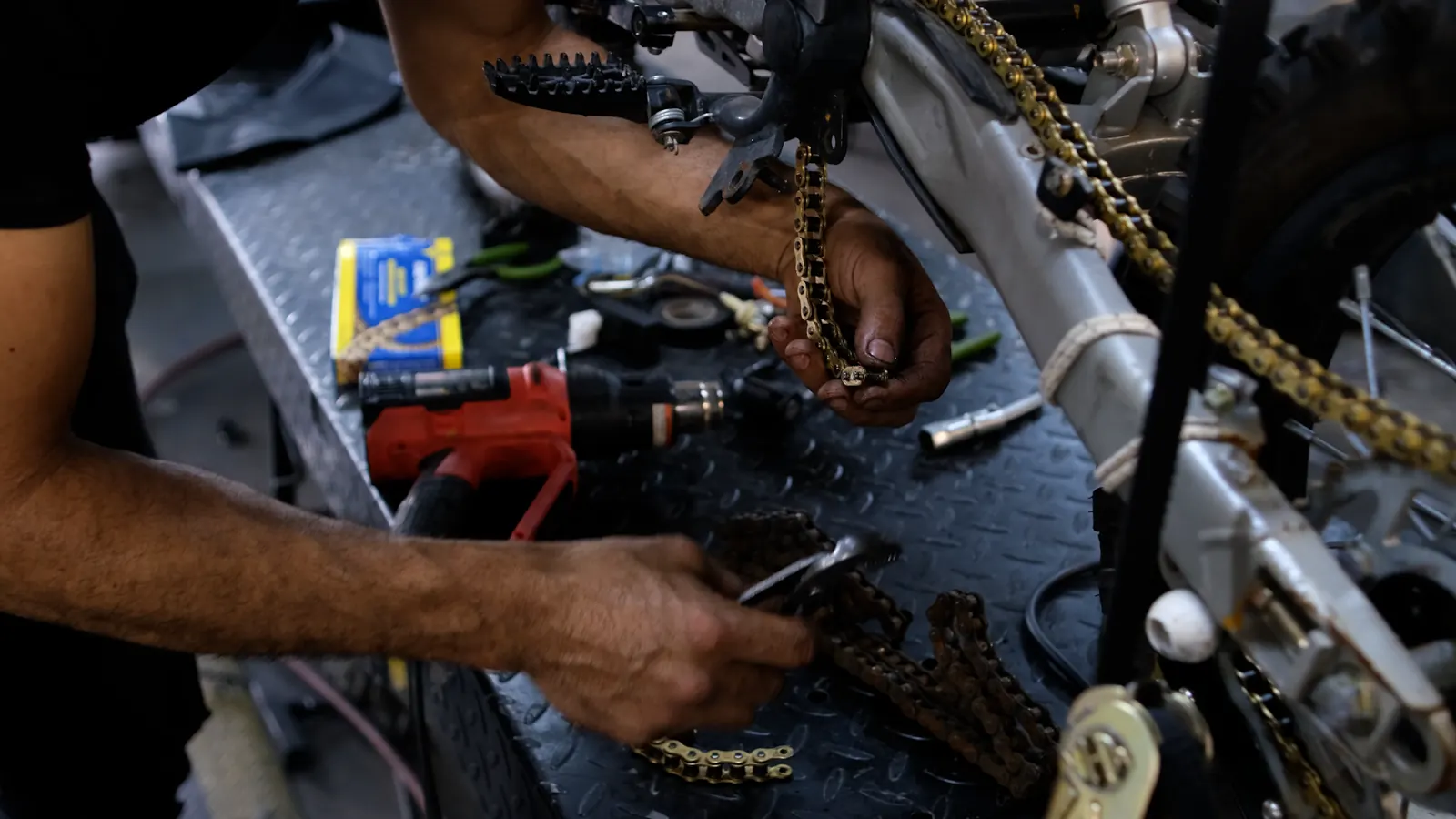
Roll the bike a foot at a time and feel for a place where the chain binds. That tight link is a chain telling you it’s done, and sprockets wear along with it, so the two usually travel as a set. It isn’t glamorous work. Even so, a fresh O-ring chain and clean sprockets change how a bike feels more than almost anything else.
Drips on the concrete
Fork seals, gaskets, coolant hoses, or a weeping case. Figuring out which one is harder than it sounds, because oil travels. It can leave the bike in one spot and then land somewhere else entirely. So the area gets cleaned, and the bike gets run and watched. Fast guesses here are exactly how people pay for the same repair twice.
Hot and cranky in stop-and-go
Georgia doesn’t permit lane splitting, and East Cobb has no interstate running through it. So the rare rider who does commute grinds through signal-heavy arterials like Johnson Ferry and Roswell Road, while the clutch, brakes and cooling system take that beating. Most folks here don’t commute by bike at all, though, which is precisely why their bikes sit and pick up sitting problems instead.
The internet will tell you one thing. The bikes tell us another. Online averages get built from national data, mashed across every make and model, so they never once account for the machine on your lift. A Gold Wing and a vintage air-cooled twin do not live in the same universe. Neither does a BMW GS with a sensor fault and a Harley bagger that just needs waking up after a long nap.
The bike decides the job. Not the search result, and not the average.
That’s why every conversation opens the same way: what does it do, when did it start, and how long has it been parked? Those three answers narrow things down fast. For the deeper version of that conversation, here’s what that service actually involves from the first phone call onward.
What actually happens once it's here
People picture a mechanic vanishing behind a curtain, but real work is a lot more boring than that, and boring is good. So here’s the honest order of operations on a normal repair:
- First we talk, and you tell us what it does, when it started, and how long it sat.
- Then the bike goes on the lift for a full look-over, not just a peek at the complaint.
- Next comes reproducing the symptom, because a symptom we can see is a symptom we can fix.
- After that comes access, which sometimes means removing parts that have nothing to do with the problem.
- Everything gets tested and measured, since swapping parts and hoping is not a plan.
- Then you get a call with what we found, what we’d recommend, and what can safely wait.
- Parts get ordered, and of course you hear right away if one is going to be slow.
- The work gets done, buttoned up, and torqued to spec.
- Finally it gets run, road tested, and cleaned up before it goes back to you.
Step four is the one that surprises people, so let’s sit with it for a second.
Access is the part nobody sees
Two bikes can need the exact same part and still be completely different jobs. On one, the part sits right there in the open. On the other, it lives under the tank, behind the airbox, past a wiring loom and beneath a subframe that has to come off first. Same part, same box, but a wildly different amount of hands-on time. That, more than anything, is why no honest shop hands you a number over the phone.
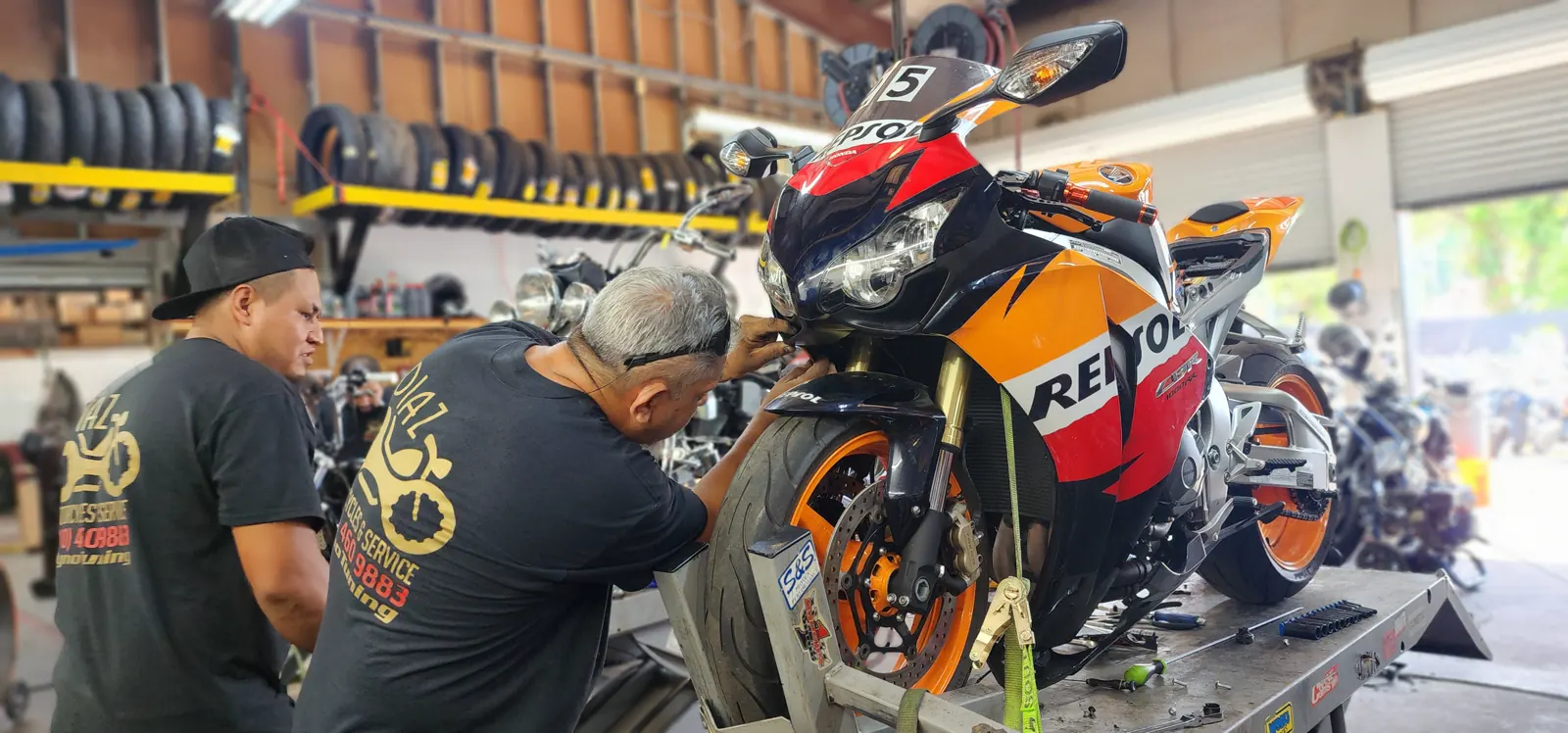
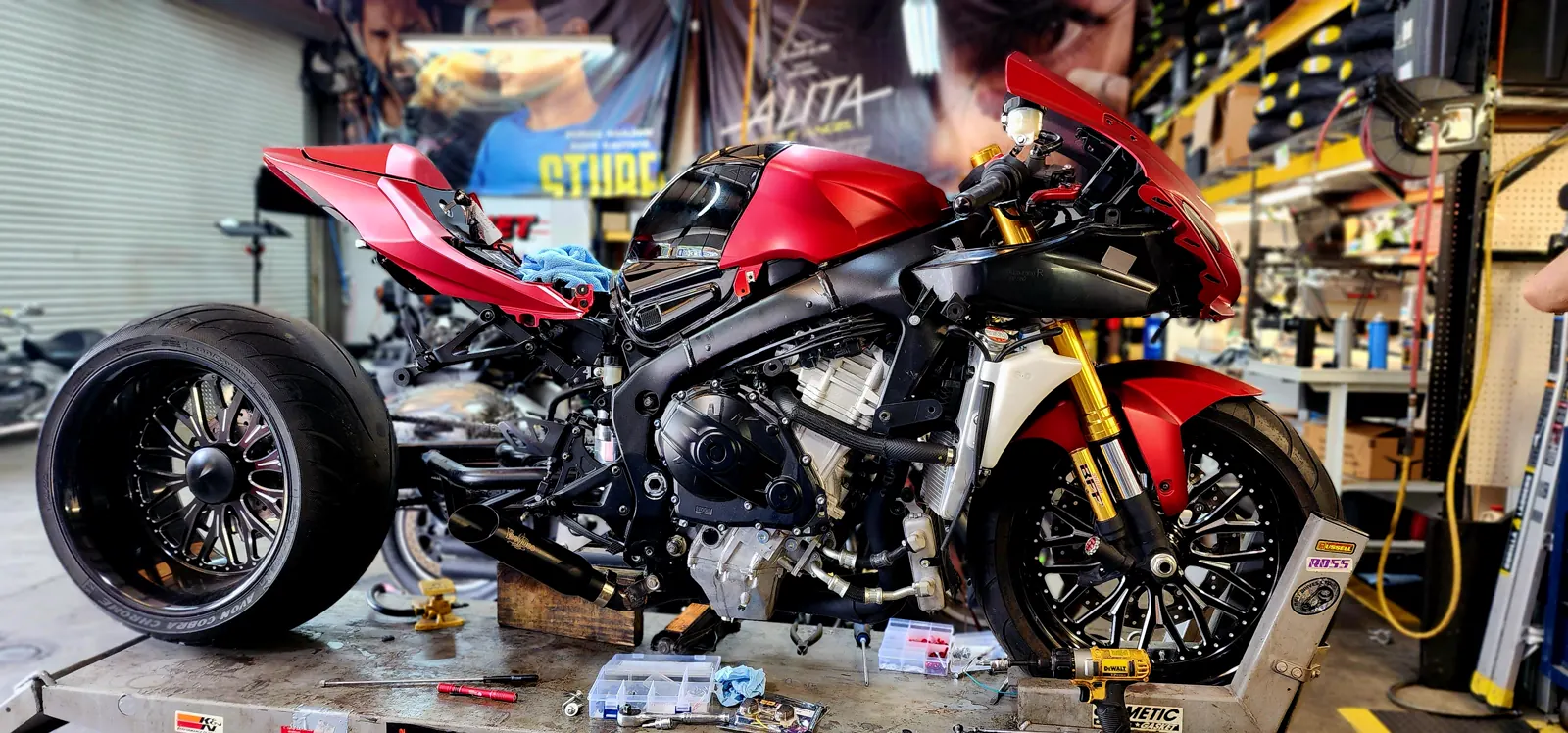
So think of any repair as two buckets. One bucket is parts, and parts are what they are, since a chain is a chain and a seal is a seal. The other bucket is labor, which is really just access plus diagnosis plus doing the job right. Fairings, tanks, exhausts and bodywork all live in the labor bucket, even though none of them are broken. In fact, on a fully faired sportbike, reaching the problem can take longer than fixing it.
THE SHORT VERSION
Parts are about the machine, while labor is about access. Two identical parts on two different bikes can mean two very different afternoons, and that’s exactly why a real look beats a phone guess.
Why we won't quote it sight-unseen
Real talk: a number could get thrown at you on the phone, and plenty of places do it. But a phone quote is a guess wearing a nice shirt, so it only goes one of two ways. Either it lands high and you feel squeezed, or else it lands low and somebody has to make an awkward call later. Neither one is a good day for anybody, so we skip the theater and look at the bike instead.
Folks around here appreciate that, because East Cobb riders research. Most of the households we serve hold a degree or two, so they read reviews before they call, and they want to know which brand of part is going into their machine. That’s why the why gets explained every single time. You’ll hear what turned up, what we’d do about it, and what could honestly wait until fall. Then you decide, not us.
Time matters more than almost anything here, too. Nobody in Chimney Springs or East Hampton is out to shave pennies off a repair, since what they want is a straight timeline and zero surprises. That’s the standard we hold ourselves to. For the whole scope of what you get when you bring it in, it’s laid out plainly, and none of it is a mystery.
How long it takes
Simple jobs stay simple. A battery, a chain and sprockets, a fluid service, a brake refresh — those are in-and-out work. Fuel cleanups on a bike that napped through two winters take longer, though, because cleaning is patient work and rushing it means doing it again. Deeper engine work is its own animal, so if that’s where you’re headed, here’s the full rundown on it.
Parts are the other clock. Common bikes have parts everywhere. However, vintage machines, older British and air-cooled Japanese bikes, and some European models can mean a wait, so you hear about that up front. Meanwhile, we’re not far away. The shop sits physically inside East Cobb, roughly two to five miles and under fifteen minutes from most of the community, about ten minutes from the Johnson Ferry and Lower Roswell hub, while nothing here is more than about twenty minutes out.
That means drop-off is an errand, not an expedition. Plenty of friends we’ve helped leave the bike, then run over to The Avenue East Cobb for an hour among those fifty-odd stores and restaurants with parking right out front, and they get a call before they’re done browsing. Riders farther out drive a bit longer, of course, and if that’s you, here’s what riders over in Roswell deal with on their side of the map.
A quick story, because it makes this concrete. A friend we helped had a big touring bike that had been parked since the fall, and it cranked, coughed, and quit. He’d read online that it was probably a major fuel system teardown, so he had already talked himself into a rough week. Then it went on the lift, and the culprits were stale fuel and a tired battery. He was rolling before the next weekend. Same symptom the internet screamed about, yet a completely different job, because somebody actually looked.
Why East Cobb bikes break the way they do
This has never been a high-density commuter market. Instead it’s a garage-kept, weekend-and-toy market, full of premium touring bikes and cruisers, Harley baggers, Indian and Gold Wing class machines, BMW GS and RT sport-tourers, Ducatis, KTMs, low-mileage sportbikes and the occasional beautiful old air-cooled thing. Those bikes get ridden on Saturday mornings, on north Georgia trips, and out to Marietta Square for dinner about ten minutes west. Then they sit, and sitting is its own kind of wear.
Sitting brings tired batteries, fuel varnish, flat-spotted tires, seized brakes, dry-rotted rubber, and now and then a nest tucked into an airbox. None of that is a scary list, though. In fact, every item on it is a known job with a known fix, and most of it never happens at all when the bike gets woken up properly each spring.
The roads add their own flavor. Cobb DOT grades pavement on an Overall Condition Index and is building a six-year resurfacing plan funded largely by 2022 SPLOST revenue, and East Piedmont Road is one of the corridors the county has publicly noted for resurfacing work. Even so, older subdivision streets and the creek-crossing stretches of Sewell Mill, Paper Mill and Terrell Mill still hide patched sections, sunken utility cuts and steep creek-bottom dips. As a result, suspension, wheels and fork seals feel every one of them.
Then there’s pollen. Late February through May, counts often push past 1,500 grains per cubic meter, and under this canopy it gets severe. Since that’s genuinely hard on clear coat, a spring wake-up here is as much about finish as it is about mechanicals. These bikes are somebody’s pride and joy, so of course the paint gets treated like it matters.
What being close actually buys you
There are other places to get work done, and some of them are institutions. Hellbender Harley-Davidson at 993 S Cobb Dr in Marietta has been a motorcycle destination on that site since 1986, though it’s a solid twenty-two to twenty-eight minute run from the East Cobb core. Most other service bays sit a similar distance out and a county crossing away, plus plenty of them are closed two days a week. So the market for a full-capability shop actually inside the community has been wide open for years.
Being inside East Cobb changes the little things. You can swing by after work instead of blocking out a whole morning. We can also put the bike on the dyno, flash an ECU, or sort out a Power Commander setup for owners who want their machine tuned properly, while the multi-line dealers generally aren’t built for that. Plus, when your Saturday plan is that documented fifty-three mile run from Emerson past Red Top Mountain and Lake Allatoona toward Canton, with sweepers, twisties and elevation change about an hour away, you want the bike sorted by Friday night.
What you walk away with
When it’s done right, you get more than a fixed bike. You also learn what was wrong, what got done, and what’s coming next season, so nothing sneaks up on you later. Riding gets its confidence back, which is the entire point. If you’re new to two wheels or bringing a rider along, the Georgia Class M licensing page is worth a read, while the IIHS motorcycle research library is a genuinely useful rabbit hole.
So the honest answer about repair cost East Cobb riders keep searching for is this: it depends on your bike, your symptom, and how much has to come off to reach the problem. That isn’t a dodge. Instead it’s the only answer that respects your machine and your time, and that’s why you’ll get a straight number after we look. Bring it in, let us see it, and let’s get your Saturday back.
Questions East Cobb riders ask us
What makes one repair job bigger than another?
Access, mostly. Two bikes can need the identical part, but on one it sits right there while on the other it’s buried under a tank, an airbox and a subframe. Diagnosis time matters too, because a clear symptom is quicker to chase than a vague one. So the part often isn’t the story — reaching it is.
Why won't you quote it over the phone?
Because a phone quote is a guess wearing a nice shirt. It either lands high and you feel squeezed, or else it lands low and somebody makes an awkward call later. Instead we look at the bike, confirm what’s actually wrong, and then give you a real number you can trust.
What's included when you do the work?
A full look-over, not just a poke at the complaint. We reproduce the symptom, confirm the cause, then tell you what turned up and what can wait. After that the job gets done and torqued to spec, plus it gets run, road tested and cleaned up before you see it again.
How long will my bike be there?
Simple work like batteries, chains, fluids and brakes moves fast. Fuel cleanups on a bike that sat through a couple of winters take longer, since rushing that step means doing it twice. Parts can be the real clock on vintage or European machines, so you hear about that up front instead of watching days pile up.
Is more of the work parts or labor?
It swings both ways. A chain and sprocket job leans toward parts, while a buried sensor on a fully faired sportbike leans hard toward labor. That’s why it gets split out plainly for you, so you can see exactly where the work is going before you say yes.
My bike sat all winter in the garage. Is it damaged?
Almost never. Garage-kept bikes here get stale fuel, tired batteries, sticky brakes and flat-spotted tires, and every one of those is a routine fix. In fact, a proper spring wake-up usually prevents the whole list. So bring it in, and you’ll be riding again quickly.
We’re right here in East Cobb, so most riders reach us in under fifteen minutes, while folks around Marietta and Roswell are close behind. We also take care of riders coming from Sandy Springs, Kennesaw and Woodstock, plus Smyrna and Vinings on the south side. Alpharetta and Dunwoody riders make the run regularly, and we see machines trailered down from Canton and Acworth all season long. Atlanta riders round it out, especially the ones heading north for a weekend loop who want the bike sorted before they go.
BRING IT IN AND GET A REAL ANSWER
You don’t have to guess what’s wrong with your bike, and you definitely don’t have to trust a number from a stranger on the internet. So text or call us, tell us what it’s doing, and we’ll get it on the lift right here in East Cobb. Then you’ll hear exactly what turned up, what it takes to fix it, and how soon you’re riding again.
470-460-9883Diaz Motorcycles and Service, LLC · 847 Barnes Mill Road, Marietta, GA 30062