Service Shop Sandy Springs — How to Choose
The honest criteria for judging a bike shop, and what a real service actually includes.
Still, call around and ask what a service costs, and every shop will hand you a confident answer in about four seconds. Plus, here’s the honest part nobody enjoys saying out loud: none of those answers mean anything yet. Meanwhile, Nobody has put a hand on your chain. Of course, Nobody has spun your wheels or measured how much pad is left. So picking a service shop Sandy Springs riders can actually trust starts with a simple test — which one is willing to admit that before taking your keys?
We’re not being cute about it. In fact, a number given over the phone is a guess wearing a nice suit. For example, two bikes can roll in the same week, same model, same year, and need completely different work, because one lived under a carport off Hammond Drive and the other lived in a dry garage. Even so, the shop that quotes fastest isn’t automatically the best shop. What’s more, Sometimes it’s just the one most comfortable guessing.
Start with what your bike is already telling you
Bikes are terrible liars. Long before anything breaks, a bike starts leaving little notes. After that, most riders feel those notes and file them under “later.” Later is where small, cheap jobs go to grow up into big ones.
- Also the chain sounds dry and gritty at low speed, or you can see rust creeping between the links
- The engine surges or hunts a little at steady throttle, like it can’t quite decide
- The front brake lever pulls closer to the grip than it used to
- A light scrape or squeal shows up when you slow down
- Cold starts take noticeably longer than they did last month
- The bike feels vague in a corner, or wanders a bit on a straight road
- A shimmy comes through the bars after you cross a patched seam
- Oil looks dark and thin in the sight glass, or the level has quietly dropped
None of that means your bike is in trouble. Every item on that list is a normal wear signal, and every one of them is easy to handle while it’s still only a signal. Small stuff caught early stays small stuff, and the bike you get back feels new again for the price of a boring Tuesday.
What each of those signs usually means
A dry, gritty chain is the most common thing we see, and it’s the easiest win in motorcycling. Chains stretch, collect grit and dry out fast in stop-and-go traffic. Clean it, lube it, set the slack right, and the bike feels five years younger. Let it go long enough, though, and the chain takes the sprockets with it, which turns a short job into a parts order and a wait.
Wandering and vagueness almost always trace back to tires. Pressure drops on its own, a little every month, and a soft tire makes a good bike feel tired. Age counts too, since rubber hardens whether you ride or not. A bike that sat all winter under a cover can show plenty of tread and still have grip like a hockey puck.
A lever that creeps toward the grip is talking about pads or fluid. Pads wear down, and brake fluid pulls in moisture over time, which is what makes a lever go soft and spongy. Both are things you’d rather have handled before a downhill stop on Roswell Road decides to test them for you.
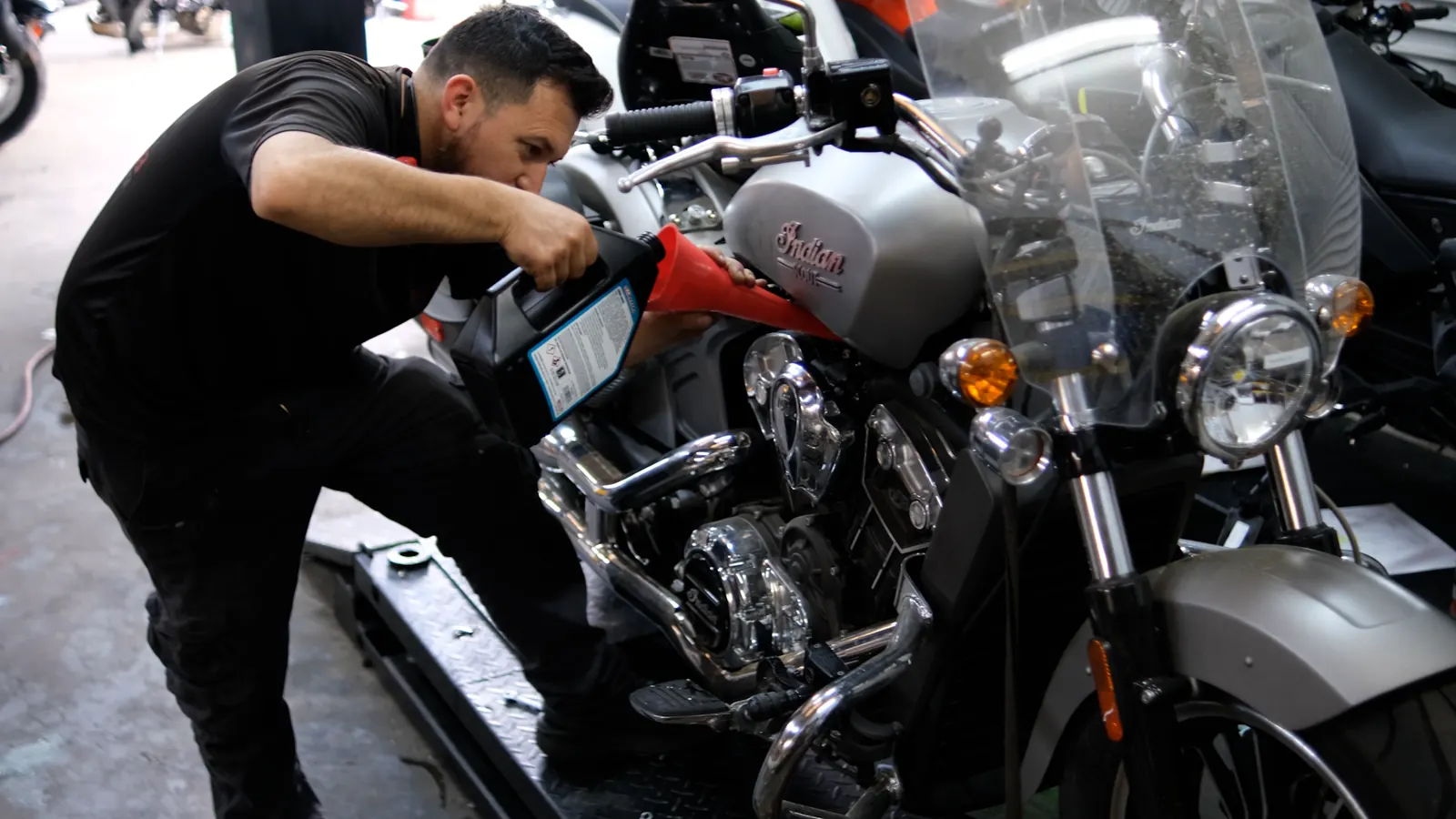
Dark oil and slow cold starts tend to travel together. Oil doesn’t only lubricate — it carries heat and grit away from parts that hate both. Fresh oil and a new filter change how a motor sounds at idle. If your bike has been parked more than ridden lately, it’s worth seeing how we handle that job, because waking a bike up is not the same appointment as a routine service.
Slow cranking is usually the battery, not the starter. Batteries hate two things: heat and sitting still. This city serves up plenty of both. A bike parked on a condo deck or an open lot with no outlet anywhere near it bleeds charge all winter, and by spring the battery is finished. The good news is that this is a test, not a mystery. A load test takes minutes and gives a straight yes or no.
Before we go further, one thing worth clearing up. We’re never going to tell you your bike needs service every so many miles, because we don’t know your machine better than the people who designed it. Your owner’s manual sets the interval, and it’s usually written two ways — by mileage and by time, whichever arrives first. Riding style, heat, dust and long parked stretches all move the real-world answer around. Any shop that recites a universal mileage number without opening your manual is selling a schedule, not a service.
THE ONE RULE
Your manual sets the interval. A good shop reads it with you and tells you honestly where your bike sits against it right now.
What actually happens once the bike is on the lift
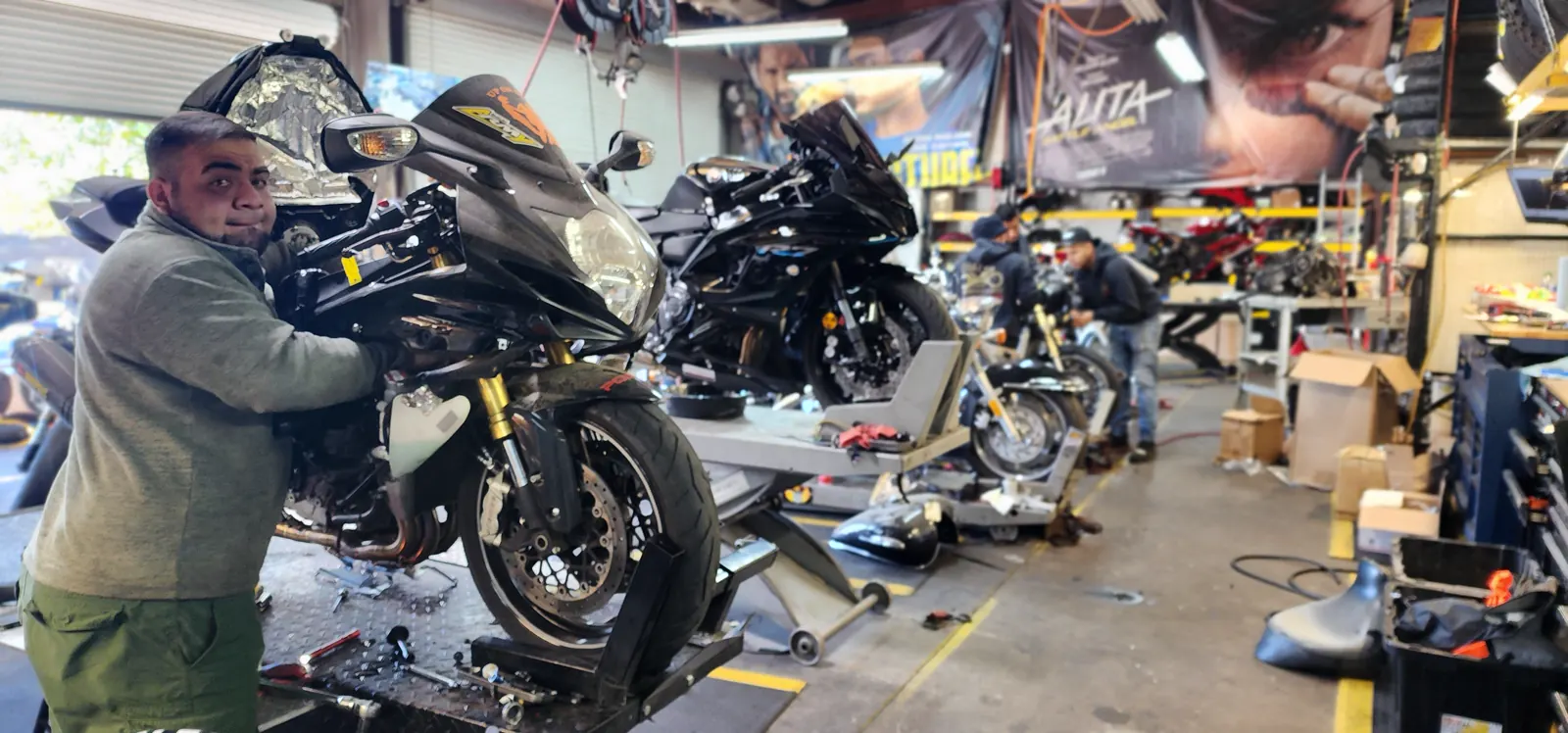
Service isn’t a secret ritual performed behind a curtain. It’s a checklist, worked in order, by somebody who has done it a few thousand times. Here’s the plain-words version of a routine visit.
- We roll it in, listen to it run, and write down everything you told us at drop-off
- Old oil and filter out, correct oil and a fresh filter in, drain plug torqued to spec
- Chain cleaned, lubed and set to proper slack, with sprockets checked for hooked teeth
- Tires checked for pressure, tread depth, age and damage, and wheels spun for wobble
- Brakes opened up enough to measure pad life, inspect rotors and read the fluid
- Cables, levers, controls, lights, fluids and fasteners checked and adjusted
- Battery load tested, charging output measured, then a test ride before we call you
That’s the base. Anything beyond it earns a phone call first, with a photo when a photo helps. You should never find out about extra work by reading an invoice. If you’d like the item-by-item version of what you get when you bring it in, it’s written out in normal words, without the code language.
How to judge a shop before you hand over the keys
Here’s the part a rider in Riverside or River Chase actually came for. Every service shop Sandy Springs riders consider looks wonderful on its own website, because websites are easy. Behavior is harder to fake. So judge behavior.
- They ask what the bike has been doing lately, then let you finish the sentence
- They tell you what they don’t know yet, and exactly how they plan to find out
- They call before extra work, not after it’s already on the bill
- They show you the old part, or a picture of it, without you having to ask
- They write what they did in words you could repeat to a friend at a red light
- They give a real timeline, including the dull part where a part has to ship
- Their reviews describe specific work rather than a chorus of “great guys”
Dealers deserve credit where it’s due. Warranty work, recalls, factory tooling and brand-specific software all live there, and on a newer bike that relationship is genuinely worth keeping. Mountain Motorsports over in Marietta, roughly fourteen miles west of you, runs the multi-line high-volume model well. The tradeoff with any high-volume operation is the calendar, though. When your bike is one of many, your Tuesday has a habit of becoming next Tuesday.
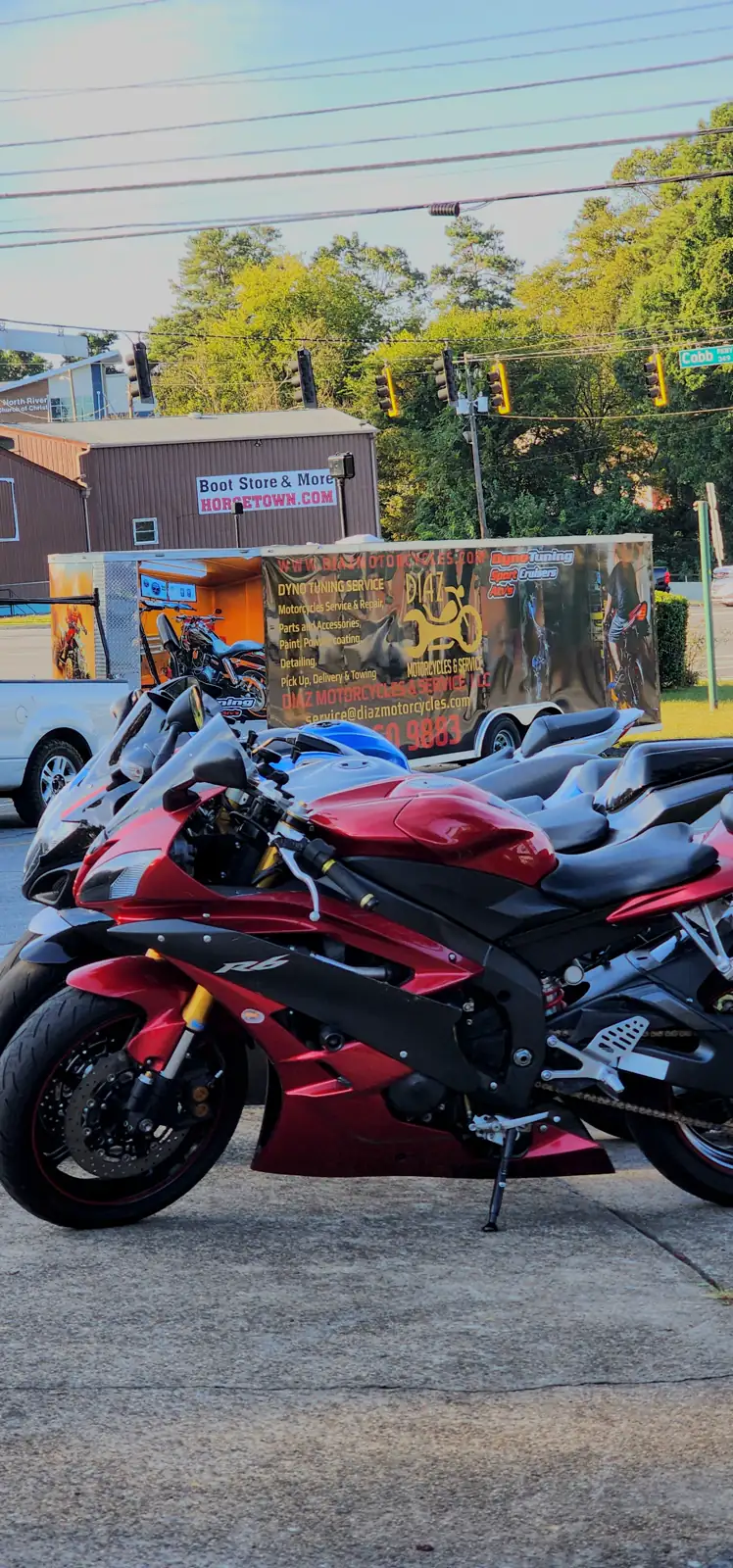
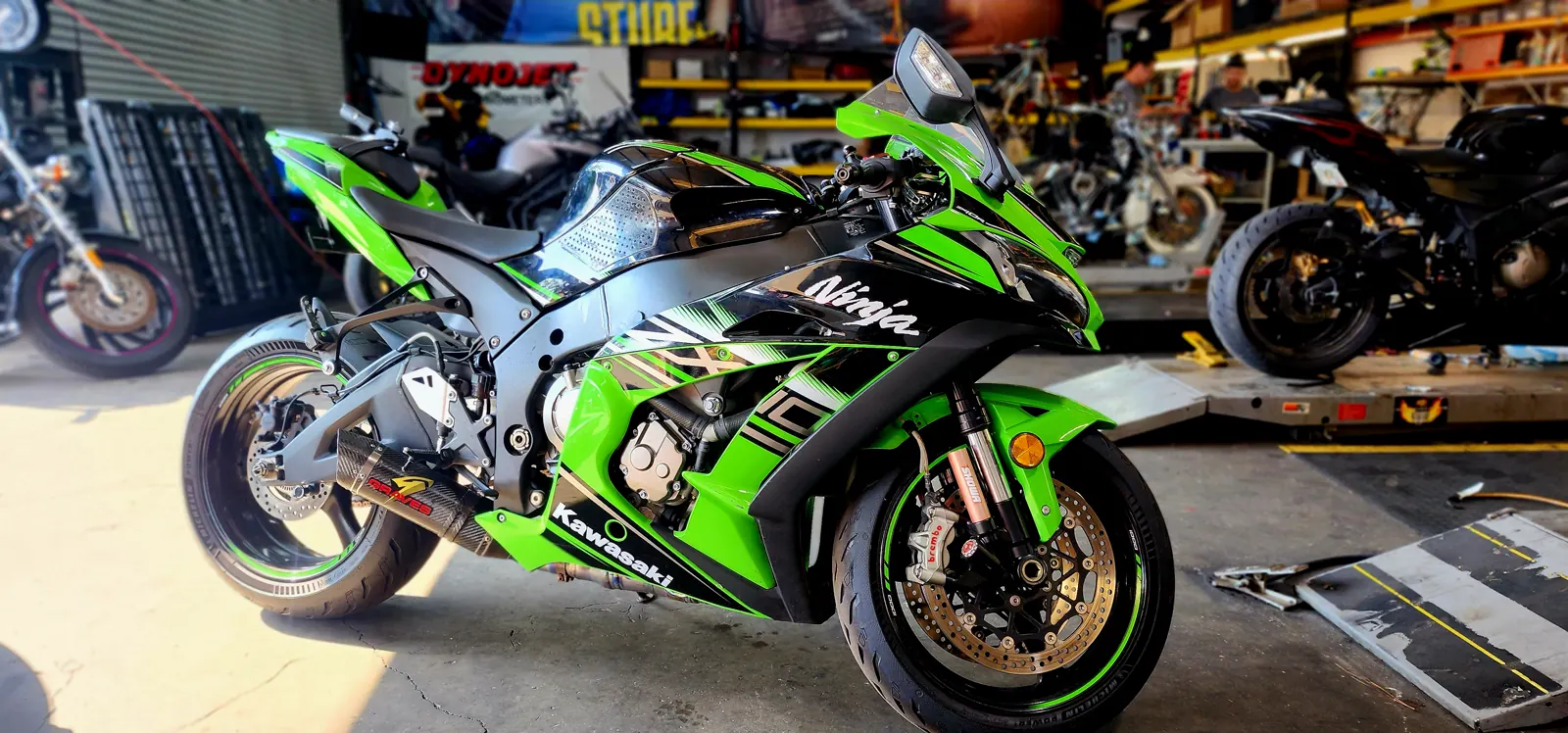
An independent trades that volume for attention. Around north Fulton, dyno tuning, ECU flash work and Power Commander setup have been a dealership-or-nothing proposition for years, which is a strange gap in a market full of liter bikes and European twins. We built straight into it. Tuning, bodywork and paint, restoration on the older Hondas, Triumphs and Guzzis sitting in 1970s garages, plus transport, all under one roof, so your bike stops getting passed between three different vendors.
Timing beats mileage almost every time
The best week to book is the week before you need it. March and April are the wake-up wave around here — dead batteries, stale ethanol fuel, flat-spotted tires, sticky brakes and chains that seized quietly while nobody was watching. Everybody discovers this on the same warm Saturday. Book in February and you get your pick of days. Wait for that Saturday and you’re in line behind every other rider who just had the same idea.
There’s a reason we bring this up on nearly every intake. This city carries an enormous share of rental housing — the mayor has cited more than sixty percent of the housing stock, spread across ninety-six apartment complexes — and close to one in five of those apartment units dates back to the 1970s. That means carports, surface lots, condo decks, street parking, full sun and nowhere at all to plug in a battery tender. HOA rules usually rule out working on the bike on site, too. So storage here isn’t a footnote. It’s the entire reason pickup and delivery is a real product rather than a nice bonus.
We come get the bike. The enclosed trailer shows up, the bike goes in, and you head to your desk at Perimeter Center or one of the hospital garages without rearranging your week. When the work’s done, it comes back. If two or three things have been stacking up — a service, a tire, a scuff in the paint — batch them into one visit and one pickup. That’s the cheapest way to own a bike, and easily the least annoying.
The Sandy Springs part of the math
Let’s be straight about geography. There’s no motorcycle dealership or established dedicated bike shop inside the city limits, which means every rider here is already driving somewhere for service. From the Riverside side we’re roughly eight to eleven miles out, usually eighteen to twenty-eight minutes on Johnson Ferry Road heading west across the Chattahoochee into East Cobb, with no I-285 required at all. So From River Chase it’s about the same run. From the riverfront homes in River Shore Estates, you’re mostly just taking your normal Saturday ride and ending it at a lift.
That ride also explains a lot of what rolls through our door. Roswell Road, Hammond Drive and the older interior streets carry heavy traffic on aging pavement, with utility-cut patches, seams and manhole lips that beat up a stiff sportbike. Add the long-running construction footprint at the GA-400 and I-285 interchange, with its lane shifts, temporary tar-snake surfaces and steel plates, and bent rims or knocked-out alignment stop being unusual. Georgia DOT keeps the lane-shift notices current, which is worth a glance before a Monday commute.
The fun part is that good roads are still right outside your door. A slow lap out to Morgan Falls Overlook Park, with the dam and the overlook sitting off Roswell Road, is a great way to hear exactly how your bike behaves at low speed — chain noise, brake drag, a soft fork. And a bike that runs right can turn a nothing errand past Abernathy Greenway Linear Park, the playable art park with its sculptures spread over six and a half acres, into a decent excuse for the long way home. For statewide rider news, the American Motorcyclist Association is a solid place to keep an eye on things.
We hear these same questions all over the metro, not only on this side of the river. The conversation with riders over in Douglasville sounds nearly identical. And if you want the west-side version of how to compare shops, we wrote the full rundown on it for Mableton too. Same criteria, different drive, same conclusion.
What you should walk away with
You don’t need to become a mechanic. You need a shop that explains things the same way twice, calls before it spends, and hands the bike back better than it arrived. Everything past that is decoration, and decoration has never tightened a chain.
A good shop doesn't sell you a number. It shows you the bike.
So take the little signals seriously while they’re still little, let your manual set the schedule, and choose the shop that’s honest about what it can’t know yet. Do that, and owning a bike here stops feeling like a gamble. It goes back to being what it’s supposed to be — a machine that’s ready whenever you are.
Questions Sandy Springs riders ask us
How far do you serve — is Sandy Springs too far from the shop?
Not far at all. We’re roughly eight to eleven miles away, which usually runs eighteen to twenty-eight minutes on Johnson Ferry Road west across the Chattahoochee into East Cobb. You don’t need I-285 to get here. From the Riverside and Powers Ferry side it’s often under fifteen minutes.
Can you pick up my bike?
Yes, and it’s one of the main reasons riders here call us. We run an enclosed trailer, so we can collect a bike from an apartment lot, a carport or a condo deck without you taking time off. It comes back the same way when the work is finished. If your building has rules about work on site, pickup solves that entirely.
How do I know the diagnosis is right?
Ask to see it. We’ll show you the worn part, or send a photo if the bike is already in pieces, and explain what it does in plain words. Nothing beyond the agreed work happens without a call first. A second opinion is always fair game, and any shop worth trusting will say the same.
What makes you different from a dealership?
Dealers are the right call for warranty work, recalls and brand-specific software, and we’ll tell you when that’s the better path. Where we’re different is everything under one roof — dyno tuning, ECU flash and Power Commander work, bodywork and paint, restoration on older machines, and transport. Your bike stops bouncing between vendors, and it stops waiting behind a sales floor’s calendar.
How do I pick a good shop in general?
Watch how they talk before they touch anything. Good shops ask questions, admit what they haven’t seen yet, call before extra work and write invoices you can actually read. Reviews that describe specific repairs tell you far more than reviews full of adjectives. Price is the last thing to compare, not the first.
How often does my bike really need service?
Your owner’s manual sets that, and it’s typically written by mileage and by time, whichever comes first. We won’t invent a number for you. What we will do is read your manual with you, look at how the bike has been stored and ridden, and tell you honestly where you stand against the schedule.
Diaz Motorcycles works on bikes from all over the north side of the metro. Riders come to us from Sandy Springs, Roswell, Dunwoody and Alpharetta, along with Brookhaven, Chamblee and Doraville on the east side of the arc. We see plenty of machines from Atlanta and Buckhead, and we’re a short hop for anyone in East Cobb, Vinings, Smyrna or right here in Marietta. If you’re outside that ring and the drive feels long, ask about pickup — the trailer covers a wider circle than most people expect.
LET'S LOOK AT THE BIKE
If you’re comparing shops in Sandy Springs, start with a conversation instead of a quote. Text or call us, tell us what the bike has been doing, and we’ll tell you what we’d check first and what we can’t know until it’s on a lift. If getting it here is the hard part, we’ll come pick it up.
470-460-9883Diaz Motorcycles and Service, LLC · 847 Barnes Mill Road, Marietta, GA 30062