Summary:
What Is Motorcycle Dyno Tuning
Think of dyno tuning as a diagnostic conversation with your engine. A dynamometer—dyno for short—is a machine that measures your motorcycle’s torque and horsepower while monitoring the air-fuel ratio in real time. Your bike gets strapped onto rollers, and as it runs through different throttle positions and RPM ranges, the dyno records exactly how your engine is performing.
But the dyno itself doesn’t tune anything. It’s a measuring tool. The real work happens when our skilled motorcycle mechanics use that data to adjust your fuel delivery, ignition timing, and throttle response until everything is dialed in. The goal isn’t just more power—it’s the right power, delivered smoothly, efficiently, and safely across your entire RPM range.
How does dyno tuning work for motorcycles
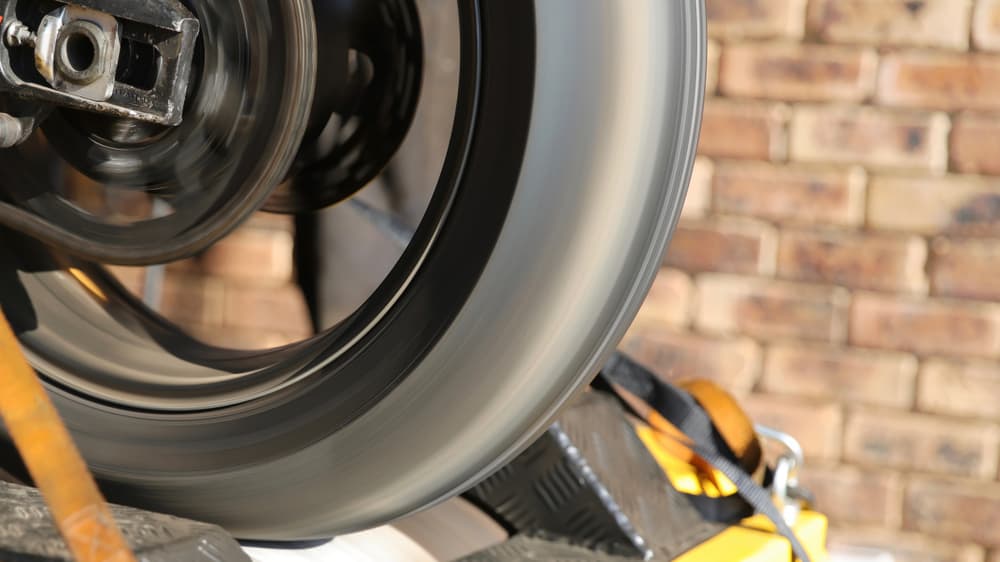
The process starts with your bike secured to the dyno. The front wheel sits in a chock, and the rear tire rests on a large drum connected to sensors and a resistance system. This drum measures torque—the actual rotational force your engine produces. Horsepower is calculated from that torque and engine speed.
While your bike runs, wideband oxygen sensors placed in the exhaust track your air-fuel ratio at every throttle position and RPM. This is where motorcycle diagnostics become precision work. Most engines perform best with an air-fuel ratio somewhere between 13.0 and 13.4 parts air to one part fuel. Too lean—meaning too much air, not enough fuel—and you risk overheating, power loss, and engine damage. Too rich—too much fuel—and you’re wasting gas, fouling plugs, and losing performance.
Our technicians run your bike through controlled scenarios: steady cruising loads, hard acceleration, different gear ranges. Each run generates data. That data reveals exactly where your engine is running lean, rich, or just right. From there, adjustments get made to the fuel map—the instructions your ECU or fuel controller uses to decide how much fuel to inject at any given moment.
This isn’t guesswork. It’s not a one-size-fits-all flash tune downloaded from the internet. It’s your bike, your modifications, your fuel, your altitude, your riding conditions—all accounted for. Because even two identical motorcycles from the same year can behave differently based on break-in, wear, and environment. That’s why riders across Cobb County, GA choose custom dyno tuning over generic solutions.
Do you need to retune after installing exhaust or air filter
Here’s what happens when you bolt on a new exhaust system. That exhaust is designed to flow more freely than the stock setup. Less restriction means more air moves through your engine. Sounds good, right? More air should mean more power.
Except your fuel system was programmed for the stock exhaust. It’s still delivering fuel based on the old airflow. Now you’ve got more air and the same amount of fuel. That’s a lean condition. Your engine runs hotter. Throttle response gets jerky. You might hear popping on deceleration or feel flat spots when you roll on the gas. In extreme cases, sustained lean running can cause serious engine damage—burned valves, scored pistons, expensive problems.
The same thing happens with a high-flow air filter. You’re allowing more air into the combustion chamber, but the fuel delivery hasn’t been told about it. Your bike’s ECU has some ability to adapt, but it’s limited. Most factory systems can’t compensate enough to keep everything safe and optimal when you make real changes.
And it’s not just about parts. Altitude matters. Temperature matters. Humidity matters. Fuel quality matters. A tune that works perfectly in Colorado at 6,000 feet won’t run the same in Cobb County, GA at 1,000 feet. The air is denser here. Your engine needs different fueling to match.
This is why dyno tuning isn’t optional if you care about performance and longevity. It’s the step that makes all your upgrades actually work together. Without it, you’re essentially guessing. And your engine pays the price. Quality motorcycle service includes making sure modifications actually improve your ride instead of creating new problems.
Fuel Efficiency Gains From Proper Engine Tuning
Most people think dyno tuning is about chasing peak horsepower. And sure, that’s part of it. But the real-world benefit most riders notice first? Fuel efficiency. A properly tuned engine uses less throttle to do the same work. If your bike needed 20% throttle to cruise at 60 mph before tuning, it might only need 12% after. That’s not a small difference. That’s fewer stops at the pump and more miles per tank.
This happens because your engine is no longer fighting itself. When the air-fuel ratio is dialed in, combustion is clean and complete. You’re not dumping excess fuel into the exhaust or running so lean that power drops and you have to compensate with more throttle. Everything is balanced. It’s one of the most overlooked aspects of proper motorcycle repair.
Understanding air fuel ratio and motorcycle fuel economy
The air-fuel ratio is everything. It’s the foundation of how your engine runs. The stoichiometric ratio—the chemically perfect balance—is about 14.7 parts air to one part fuel. At that ratio, all the fuel burns completely with all the available oxygen. That’s maximum efficiency.
But engines don’t always run at stoichiometric. For power, most bikes run richer—around 12.5 to 13.5. That extra fuel keeps combustion temperatures down and ensures complete power delivery under load. For cruising, leaner ratios work fine because you’re not demanding much from the engine.
The problem is when your ratio is wrong for what you’re asking the engine to do. If you’re cruising and the engine is dumping in fuel like you’re at wide-open throttle, you’re wasting gas. If you’re accelerating hard and the mixture is too lean, you’re losing power and creating heat.
Dyno tuning maps your fuel delivery across the entire operating range. Light throttle cruising gets leaned out for efficiency. Mid-range acceleration gets optimized for smooth response. Wide-open throttle gets the fuel it needs for maximum safe power. The result is a bike that sips fuel when you’re relaxed and delivers when you need it—without compromise in either direction.
Riders often report 10-15% improvements in fuel economy after a proper tune. That’s real money over the life of your bike. And it’s not from riding slower or babying the throttle. It’s from the engine finally running the way it was supposed to.
Symptoms of running rich or lean on a motorcycle
Running rich means too much fuel. You’ll smell it—that heavy gasoline odor. You might see black smoke from the exhaust. Spark plugs foul quickly, coated in black soot. Throttle response feels sluggish because the engine is drowning in fuel it can’t burn efficiently. And you’re burning through gas faster than you should be.
Running lean is worse. Lean conditions create excessive heat. You might hear popping or backfiring when you let off the throttle. Power feels flat or inconsistent. The engine might ping or knock under load. Over time, this heat can warp valves, score cylinder walls, and cause catastrophic damage. Lean running is how engines get destroyed.
Both conditions kill performance and waste money. Rich running wastes fuel. Lean running risks expensive repairs. And neither feels good to ride. The throttle doesn’t respond smoothly. Power delivery is unpredictable. You’re constantly compensating, adjusting your inputs, fighting the bike instead of riding it.
This is especially common after installing an aftermarket exhaust without retuning. The increased airflow leans out the mixture. Factory ECUs try to adapt, but they’re limited. They might add a little fuel here and there, but they can’t rewrite the entire fuel map to match your new setup. You’re left with a bike that’s technically running but not running right.
Dyno tuning fixes this. It measures exactly where you’re rich and where you’re lean, then adjusts fuel delivery to hit the target ratio at every point. The result is an engine that runs clean, makes proper power, and lasts longer because it’s not cooking itself from the inside.
Getting your motorcycle dyno tuned in Cobb County GA
If you’ve added parts, if your bike doesn’t feel as responsive as it should, or if you just want to know your engine is running optimally—dyno tuning is the answer. It’s not a luxury service reserved for racers. It’s practical maintenance that pays for itself in fuel savings, performance, and engine longevity.
The process takes a few hours. You get real data about your bike’s performance. And you leave with a tune built specifically for your motorcycle, your modifications, and your riding conditions in Cobb County, GA. No generic maps. No guesswork. Just a bike that runs the way it’s supposed to.
We handle dyno tuning for all makes and models at Diaz Motorcycles and Service, LLC—cruisers, sport bikes, vintage machines, everything. Our team understands that tuning isn’t just about the numbers on a dyno sheet. It’s about making your bike better to ride. Reach out to discuss what dyno tuning can do for your motorcycle.