Faded Motorcycle Paint Gainesville — How to Fix It
That chalky, washed-out tank has a cause and a fix. Here's what's really going on, and how we make it right.
You found a good deal. Somebody was selling a bike, the price felt fair, and you rode it home grinning. Nobody handed you the full backstory, though. You have no idea if it slept in a garage or baked in a driveway all summer. Now you’re standing over it in the sun, and the color looks tired — chalky, thin, dull in spots that should shine. That washed-out look is what riders around here call faded motorcycle paint Gainesville shops see roll in almost every week, and the good news is it has a cause you can name and a fix that actually works.
So let’s slow down and read the bike. A used motorcycle can’t tell you where it’s been, but the paint can. Before you assume the worst, it helps to know exactly what you’re looking at, because “faded” covers a few different problems that look similar from ten feet away and very different up close.
What you're actually seeing
Walk around the bike in good daylight and look at the tank, the fenders, and the fairings. Most faded paint shows up as one or more of these:
- A chalky, powdery haze that dulls the color, worst on the parts that face up at the sky
- Color that’s clearly lighter or pinker on top than it is under the seat or on the shaded sides
- A cloudy, milky film sitting over the color instead of a wet, glassy shine
- Fine spider-web cracking in the clear coat, like crazed glass, only visible when the light hits right
- Peeling or lifting edges where the clear is flaking away from the color underneath
- Dull, sanded-looking patches near the tank cap, the seams, or anywhere a strap has rubbed
Take a phone photo and zoom in. A tank that just needs a good polish looks different from one where the clear coat is failing, and knowing which camp you’re in changes everything about the fix. That’s the whole point of this post — to help you tell them apart before you spend a dime.
What each symptom is telling you
Here’s the plain-words version, most common first, because you’d rather understand your bike than get talked at.
Sun and UV — the number one culprit
By far the most common cause is simple sunlight. UV rays break down the pigments and the clear coat over time, and red and pink shades fade fastest of all. If your color looks lighter on the top surfaces and richer in the shade, that’s UV, plain and simple. A bike that spent a couple summers uncovered in a driveway will show it, and that’s true whether it lived here or two states over before you bought it.
Oxidation and a dying clear coat
That chalky, powdery haze is oxidation. The clear coat is the sacrificial layer on top, and it slowly wears out from sun, heat, and weather. Early on, oxidation is just a surface film, and a real polish can cut through it and wake the color back up. Left too long, though, the clear keeps thinning until it starts to crack or peel — and once it’s cracking, polishing won’t save it anymore. The color underneath is now exposed, and it needs new clear over it to be protected again.
Road wear and chemistry
Then there’s everything the road throws at your paint. Bug guts and bird droppings are acidic and etch the clear if they sit. Highway grit sandblasts the front of the tank and the leading edges. If you commute or ride a lot on the interstate, that grime and UV combo works together, and the front of the bike fades faster than the back. Gainesville’s own highways are rough on paint — more on that in a minute.
So — is it safe to ride like this?
Here’s the part that actually matters for your weekend. Faded paint, by itself, is a looks problem, not a safety problem. A chalky tank won’t hurt you. So if all you’ve got is dull color and some haze, ride the thing — go enjoy it, the fix can wait for the right time.
There’s one exception worth watching. If the clear is peeling and lifting in big flakes, or the paint is bubbling, that can mean rust is starting under a steel tank, or bodywork is coming loose. That’s not an emergency, but it is a sign the bare surface is now exposed to weather, and it’ll get worse the longer it waits. And of course, none of this touches the parts that do keep you safe — your tires, brakes, and lights. If you’re getting back on a used bike you don’t fully know yet, a quick refresher like the MSF Basic RiderCourse never hurts, and it’s smart to check your rubber against Dunlop’s technical resources before a long mountain run.
There’s a version of this that’s cheap and a version that isn’t. If your paint just needs a polish, that’s the cheap end — a good detailer or a patient afternoon with the right pads can pull years off a hazy tank. But if the clear is cracked or peeling, polishing is a dead end, and the honest answer is that the panel needs to be refinished. Knowing which one you’re facing before you start is how you avoid throwing good work at a bad surface.
What actually happens at the shop
When a faded bike comes to us for real refinishing, most of the work you never see. And that’s the part people underestimate every single time. Prep is the job. Paint is just the last five percent.
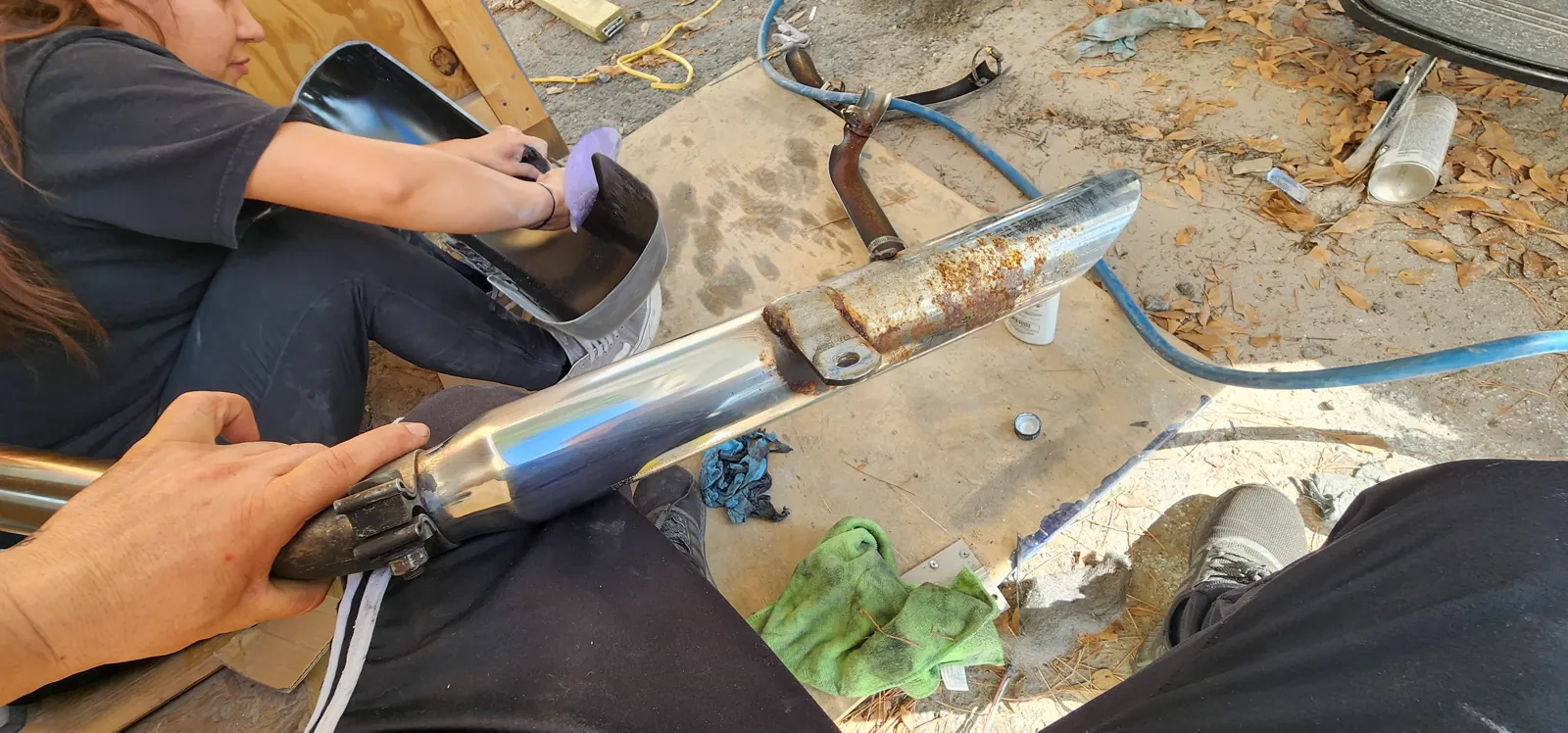
First we strip and clean the panels down to a sound surface. We fix any dings, chips, or bad old bodywork, because every flaw you leave will show right through fresh paint, only worse. Then we sand and prime so the new coats have something to grab. Only after all that goes down the base coat — the color itself — followed by the clear coats that give it depth and gloss and protect the color from the sun that faded it the first time.
Those clear coats are where the magic lives. Base coat is flat and thin on its own; it’s the clear on top that gives the paint that wet, glassy, look-into-it depth. On a candy or a metallic finish, we’re laying color and flake in stages, and you can watch the tank come alive as the flake catches the light and the gloss builds coat over coat. If you’re weighing a shiny finish against a flat one, we get into the tradeoffs between them in another post — the short version is that gloss hides less and shows off more, while matte reads tough and modern.
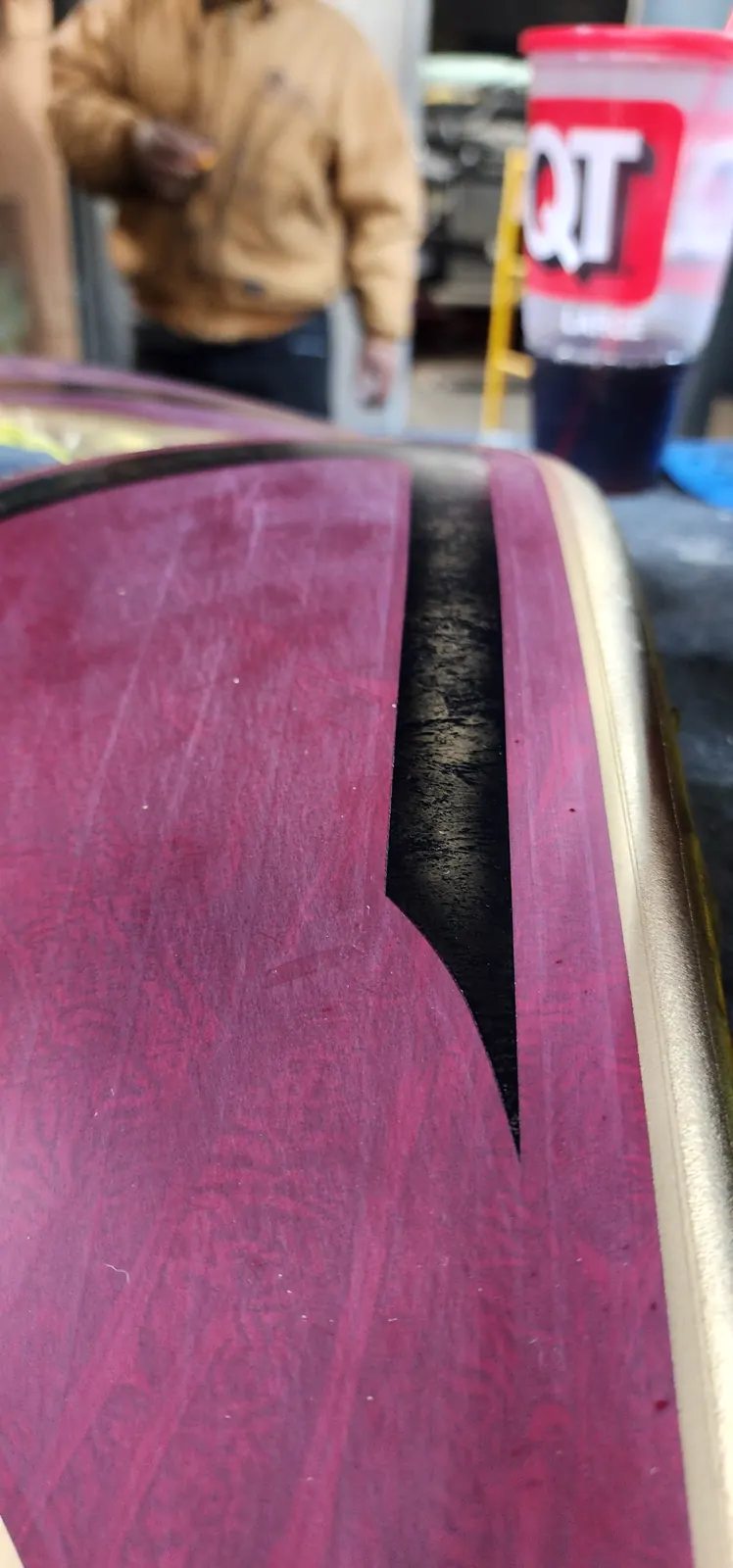
Matching a repair to your existing paint is its own craft. If only one panel is damaged, we can blend new color into the old so the fix disappears — no easy trick when the rest of the bike has already faded a little, because we’re matching where the paint is now, not where it started. This is exactly the kind of in-house work almost nobody around metro Atlanta still does under their own roof. We paint in our own booth, branded Diaz Custom Works, and that means we control every step instead of farming your tank out to a stranger. If you want the whole menu, here’s the full list of what we do.
How long does it take?
Honest answer: it depends on the work. A single-panel blend is a different animal than a full custom repaint with airbrushed graphics, murals, and pinstriping. Prep can’t be rushed, base and clear coats need time to flash and cure between passes, and a real custom job takes as long as it takes to be right. Anyone who quotes you a hard number of days before they’ve seen your bike is guessing. What we can promise is that we’ll look at your panels, tell you straight what they need, and give you a real timeline for your job — not a made-up one.
Prep is the job. Paint is the last five percent — and it only looks that easy because the hard part is already done.
Why this looks different in Gainesville
Gainesville sits right at the mouth of the North Georgia mountains, and that changes how paint lives and dies up here. Folks don’t commute much on two wheels; riding is a Saturday-morning thing, often straight up US-129 north toward Cleveland and Blairsville on a stretch riders call a roller coaster of turns and elevation changes. A bike that gets ridden hard and then parked in the sun between rides fades faster than one that stays covered.
A lot of used bikes in Hall County pass through shops like Gainesville Cycles, a pre-owned dealer about ten minutes from downtown. You buy the machine, not its history. If it spent a summer uncovered near I-985 — that’s US-23 running up through town, fast, heavily trucked with poultry and freight, and known for debris and blown retreads — then between UV and flying road grit, the paint already took a beating before you ever signed for it. That combination, by the way, is exactly how this plays out in Woodstock too, just a different set of highways doing the damage.
Where your bike sleeps matters as much as where it rides. The historic mill villages — Chicopee Village with its tree-lined streets and matching 1920s cottages, and New Holland Village with its old duplexes walkable to downtown — were built long before anyone thought about parking a motorcycle, so a lot of those homes have no garage to hide a bike in. Newer subdivisions like Nottingham Forest, Windsor Forest, and Windsor Woods, full of 1970s and 80s ranch and split-level houses, usually do. A covered bike keeps its color for years; an uncovered one gives it up to the sun.
And paint always shows in public. Ride downtown to the Gainesville Square on Main Street SW — the courthouse district that hosts the April Art Walk — and park next to a fresh custom job, and a tired tank jumps out at you. Same story at the Gainesville campus of the Atlanta Botanical Garden on a pretty weekend: good light is honest, and it makes faded paint look every bit as faded as it is. That’s usually the moment folks decide it’s time.
Something worth knowing before you book anywhere: no verified shop in Hall County runs an in-house paint booth. Plenty of good places handle routine service, but real custom paint gets farmed out or skipped. That’s why riders bring the interesting work our way, and it’s why the distance is less of a deal than you’d think.
We’re down in Marietta, and yes, that’s a stretch from Gainesville — roughly 55 to 62 miles, call it 65 to 85 minutes depending on whether you take the lake route through Cumming or drop down the interstate. We don’t expect you to ride a faded bike all that way and back. We’ll pick up the whole motorcycle, or just the tank and panels if that’s all the job needs, and bring them home when they’re done. For a custom paint job, dropping off the parts is normal anyway, so the miles between us stop mattering. If you’re new to custom work and want to see what that service actually involves, we’ve broken the whole thing down step by step.
The bottom line for your bike
So take that used bike you weren’t sure about and give it a real look. If the color is just dull and hazy, you likely bought a polish job, and a good afternoon brings it back. If the clear is cracking or peeling, the honest move is to refinish those panels — and a proper refinish, done right in a real booth, will outlast the paint the factory ever put on it. Either way, faded motorcycle paint Gainesville riders deal with all the time isn’t the end of that bike. It’s the start of the version of it you actually wanted.
A custom paint job is the most personal thing a rider does to a machine. It’s the difference between a bike you own and a bike that’s yours. So when you’re ready to bring the color back — or take it somewhere it’s never been — we’d love to see what you’re working with.
Questions Gainesville riders ask us
How do you figure out what's causing the fade?
We look at the panels in good light and check whether it’s surface oxidation or a failing clear coat. A chalky haze that polishes off is one thing; cracked or peeling clear is another. We can usually tell you in minutes which camp your bike is in, and that decides whether it needs a polish or a real refinish.
Could it be something other than sun damage?
Sometimes, yes. Bird droppings and bug guts etch the clear if they sit, harsh chemicals or a bad wash can cloud it, and peeling near a steel tank can hint at rust starting underneath. That’s why we look before we quote — the fix for etching is different from the fix for a worn-out clear coat.
Is it safe to ride with faded paint?
Almost always, yes. Faded paint is a looks problem, not a safety one, so go enjoy the bike. The one thing to watch is clear coat that’s peeling in big flakes or paint that’s bubbling, which can mean bare metal is exposed. That won’t strand you, but it’ll get worse the longer it waits.
What actually causes motorcycle paint to fade?
Sunlight and UV are the top cause by far, and red and pink shades go first. After that it’s oxidation as the clear coat wears out, plus road grit and acidic grime on bikes that see a lot of highway. Storing a bike uncovered speeds all of it up.
Can I fix faded paint myself?
If it’s just surface oxidation, often yes — a careful polish with the right pads and compound can cut the haze and wake the color up. But once the clear coat is cracked or peeling, no amount of polishing brings it back, and the panel needs to be refinished. When you’re not sure, send us a close-up photo and we’ll tell you straight.
Do I have to bring the whole bike to Marietta?
No. We pick up the entire motorcycle, or just the tank and panels if that’s all the job touches, and return them when they’re finished. For a custom paint job, dropping off the parts is normal, so the drive from Hall County isn’t a reason to skip the work you want.
We paint for riders all across Northeast Georgia, not just the city of Gainesville itself. That means folks in Oakwood and Flowery Branch along the lake, Braselton and Buford down toward the raceway, and Sugar Hill just past them. It means the mountain-side towns too — Clermont, Lula, Murrayville, Chestnut Mountain, and Dahlonega up in the foothills. Riders coming through Cumming on the lake route and out toward Talmo are just as welcome. Wherever you are in Hall County and the surrounding area, we’ll come get the bike.
LET'S BRING THAT COLOR BACK
That faded tank in your Gainesville garage doesn’t have to stay that way. Send us a close-up photo and we’ll tell you straight whether it needs a polish or a real refinish — no guessing, no pressure. When you’re ready, we’ll pick up the whole bike or just the panels, paint it right in our own booth, and bring it home looking better than the day it was built. Text us to get started.
470-460-9883Diaz Motorcycles and Service, LLC · 847 Barnes Mill Road, Marietta, GA 30062