Faded Motorcycle Paint Woodstock — Why It Happens
That dull patch on your tank didn't come from nowhere. Here's what's really going on, and when it's fine to keep riding.
It probably started small. One afternoon the sun hit your tank a certain way, and a patch on top looked a little flat next to the rest of the finish. You wiped it with your thumb, figured it was dust, and rode off. But it didn’t wipe away. That slow, quiet dulling is what riders mean when they talk about faded motorcycle paint Woodstock bikes get more often than folks expect, and the good news is that the cause is almost always simple and the fix is very real.
The short answer first
Faded paint is oxidation. The clear coat sitting on top of your color is a thin, sacrificial layer, and over time the sun, heat, and open air slowly break its surface down. As that top skin gets rough and cloudy, less light bounces straight back at your eye. So the color reads flat instead of deep. It’s a surface problem, not an engine problem, and that difference matters a lot for what you do next.
Here’s the part that should take the weight off your shoulders: faded paint is almost never a safety issue. Your bike runs the same. Your tank still holds fuel. Nothing structural is failing because the red looks a little tired. You can ride it up Interstate 575 today and be perfectly fine. The only real risk shows up when fading hides something underneath, and we’ll get to that, because knowing the difference is the whole game.
What actually drives the fading
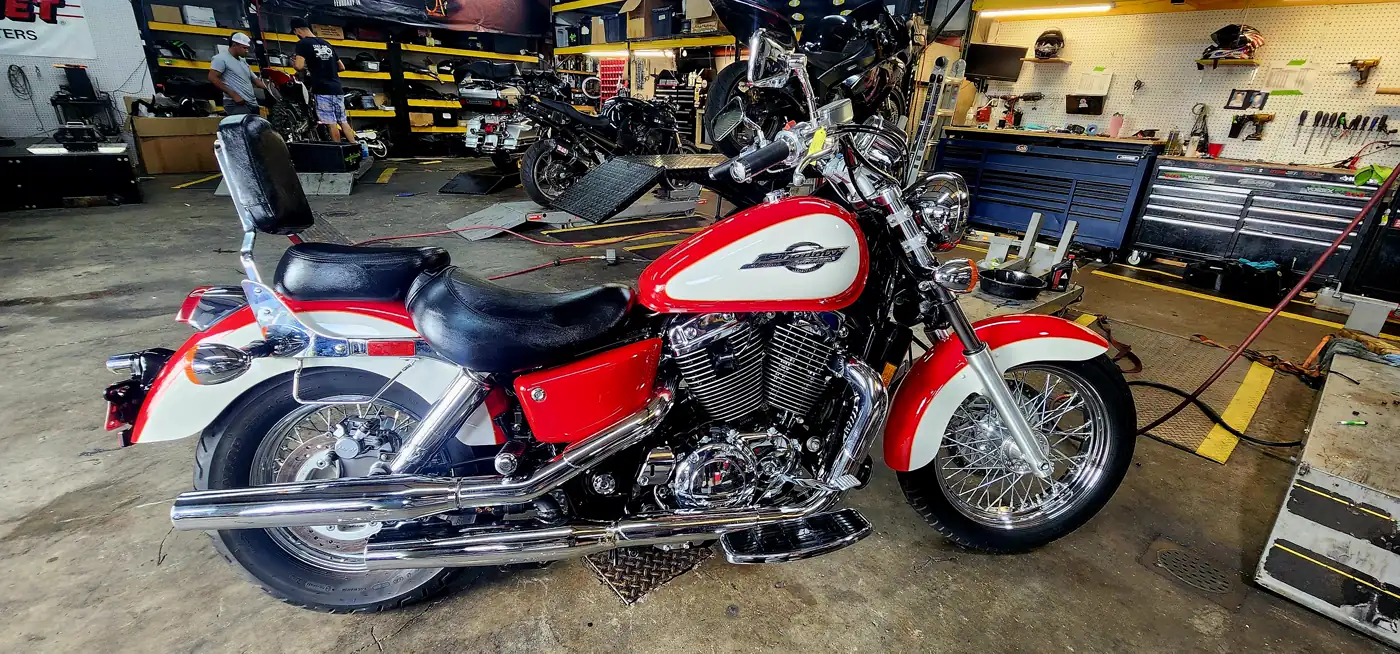
The biggest culprit is sunlight, and specifically the UV in it. UV chews through clear coat the way it chews through anything left outside. If your bike sits in a lot at The Outlet Shoppes at Atlanta on a bright Saturday, the tank and the tops of the fenders are catching the most direct hit, which is exactly where fading shows up first. That’s not a coincidence. Fade follows the sun, so the panels that face straight up always go before the ones tucked into shade.
Heat speeds the whole thing along. A dark tank baking in a summer parking lot can climb far hotter than the air around it, and heat makes the clear coat brittle faster. Then there’s the everyday stuff most riders never think about: bug guts, bird droppings, tree sap, and road grime all sit acidic on the surface and eat little pits into the finish if they’re not cleaned off. Skip the wax for a couple of seasons, and you’ve pulled off the one layer that was taking the abuse for you.
So the common causes, most frequent first, look like this:
- Sun and UV exposure — the number one reason, hits flat upward-facing panels hardest
- No wax or sealant — nothing is protecting the clear coat from daily wear
- Heat cycling — a dark tank in the sun expands and contracts and gets brittle
- Acidic gunk left on the surface — bugs, sap, and droppings etching in over time
- Cheap or thin factory clear coat — some bikes just came with less to give
Notice what’s not on that list: bad luck. Fading isn’t random. It’s the predictable result of light and time working on a finish that stopped getting protected. That’s actually great news, because a predictable problem is a fixable problem.
What we check when a faded bike rolls in
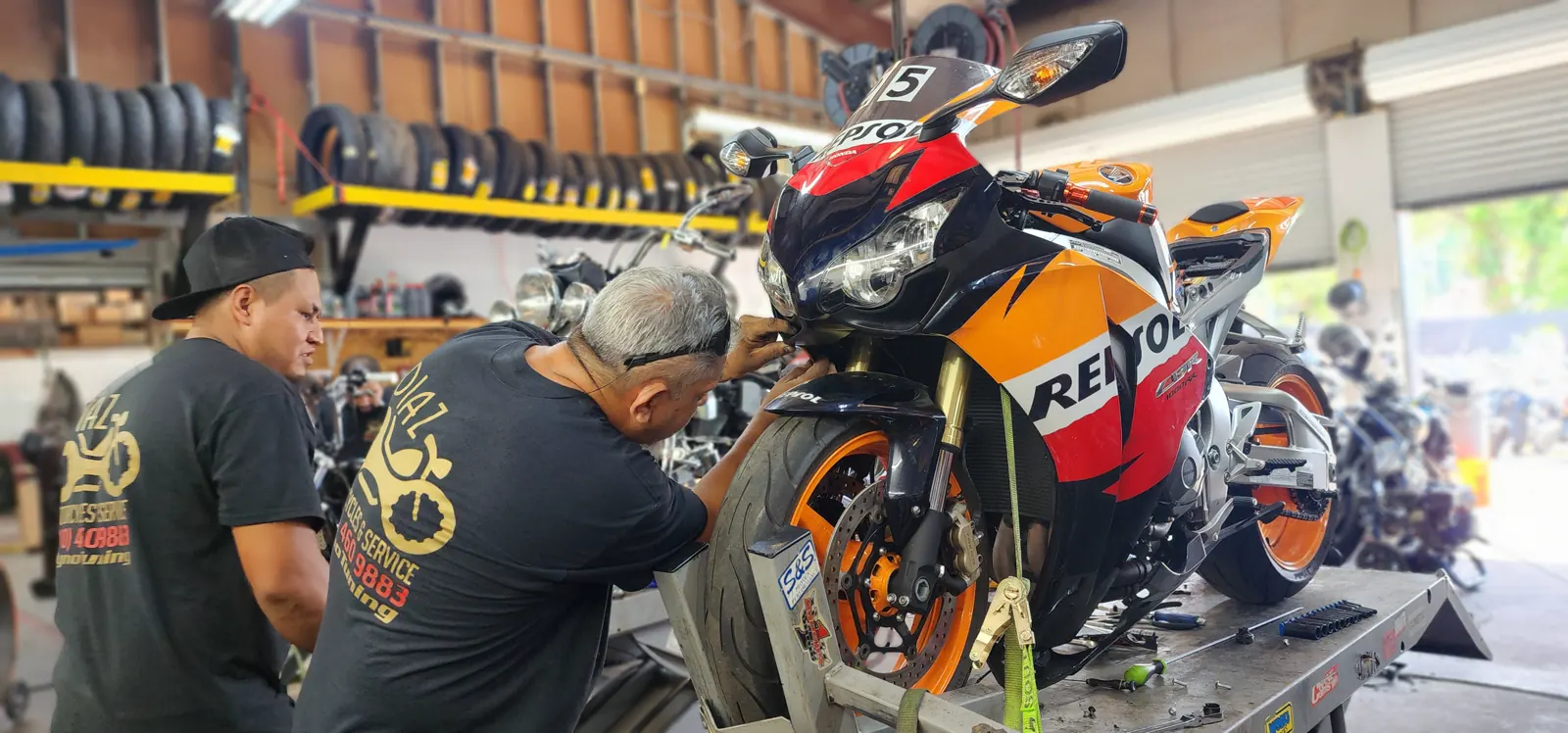
This is the point where a lot of riders make the wrong call. They see a dull tank and assume the paint is ruined and the whole panel needs to be redone. Sometimes that’s true. Often it isn’t. The first thing we do is figure out how deep the damage goes, because the answer changes everything about the fix.
We start by reading the clear coat. If only the very top of it has oxidized, the color underneath is still perfectly good, and a careful machine polish can cut away the dead surface and bring the gloss right back. That’s the happy outcome, and it happens more than you’d guess. But if the clear coat has failed all the way through — if it’s flaking, peeling, or has gone chalky and white — polishing won’t save it, because there’s no healthy layer left to shine. At that point the panel needs new clear, or new paint entirely.
We also check for anything hiding under the fade. A dull spot that’s actually the early edge of rust bubbling up from a stone chip is a different animal than plain oxidation. Same with a hairline crack in a fairing that’s been letting moisture creep under the paint. Those aren’t cosmetic, and catching them early is the whole reason we look closely instead of just buffing and sending you off. If your bike gets ridden hard on gravel-dusted back roads, a quick look at Dunlop’s technical resources on tire and surface wear is a decent reminder of how much grit a bike actually eats out there.
The mistakes that turn a small job into a big one
Most fade damage gets worse because of what riders do after they notice it, not before. So let’s head those off. The biggest one is reaching for a harsh household cleaner or an abrasive rubbing compound and going at the tank by hand. On healthy paint that might buy you a week of shine. On thin, oxidized clear coat, you can cut straight through what’s left and expose bare color, which turns a polish job into a repaint.
Another common miss is letting a faded spot sit through the winter. Fading opens the door, and moisture walks through it. Once water is getting under a compromised finish, you’re on the clock before rust or lifting starts, and that’s a much bigger repair than the fade you started with. If you’re weighing whether it’s worth handling now or later, our breakdown of what changes the total is an honest look at how the scope of the job drives the work, and Marietta owners run into the very same fork in the road — here’s what Marietta riders run into when they wait a season too long.
The last mistake is a mismatch panic. A rider gets a scratch touched up somewhere cheap, the shade is off, and now the repaired piece stands out worse than the fade did. Matching color to an aged finish is genuinely tricky, because the old paint has drifted from its original shade as it weathered. Getting it right takes the right eye and the right booth, which is a big reason we keep our paint work in-house instead of shipping it out and hoping. If you want the full list of what we do, that page lays it all out.
Fade follows the sun. The panels that face straight up always go first — which is exactly why we can predict it, and fix it.
Why Woodstock bikes fade the way they do
Woodstock riding is destination riding. Nobody up here is splitting lanes to work, because Georgia doesn’t allow it and I-575 southbound doesn’t offer any mercy in the morning. Instead the bikes get saved for the good stuff — a run up I-575 north to GA 515, the Appalachian Highway, and on toward Jasper, Ellijay, and Blue Ridge, where real mountain roads are barely an hour out. That means bikes here rack up hard miles in bursts, then sit for weeks between rides.
Here’s the thing we wish every rider knew a season earlier: those idle weeks are when fade quietly gets ahead of you. A bike parked in the sun between rides is taking UV damage the whole time it sits, even though it isn’t moving. The riders who beat fade are the ones who store smart, and Woodstock is honestly built for it. The 1990s master-planned neighborhoods out here came with two- and three-car garages as standard, so folks in Towne Lake Hills and the Eagle Watch golf community usually have real indoor space with a workbench and a trickle charger already in it.
That’s a big edge. A bike kept in a garage in Cherokee Bluffs, Cherokee Forest, Cherokee Hills, or one of the other older county-named subdivisions simply fades slower than one that lives under a carport. If you’ve got the garage, use it, because it’s doing more for your paint than any wax could. And when the color does finally dull the way even garaged bikes eventually do, the fix is close. We’re about 15 to 19 miles south, roughly half an hour down I-575 and I-75, which is a short hop for work this specialized.
Speaking of specialized: real custom paint has no local match up here. Woodstock has plenty of motorcycle businesses, but they’re all narrow — suspension only, one brand only, or a dealership locked to its own badge. The nearest Harley store, Hellbender Harley-Davidson on South Cobb Drive in Marietta, sits about 20 to 24 miles south and markets straight to Woodstock, but a branded dealer counter isn’t where you go for a candy repaint or a color change. In-house custom paint is the gap, and it’s the thing we lead with. If you’re sorting out where the dealer road ends and an independent shop picks up, our take on what the work covers spells out the honest difference.
What a real fix looks like
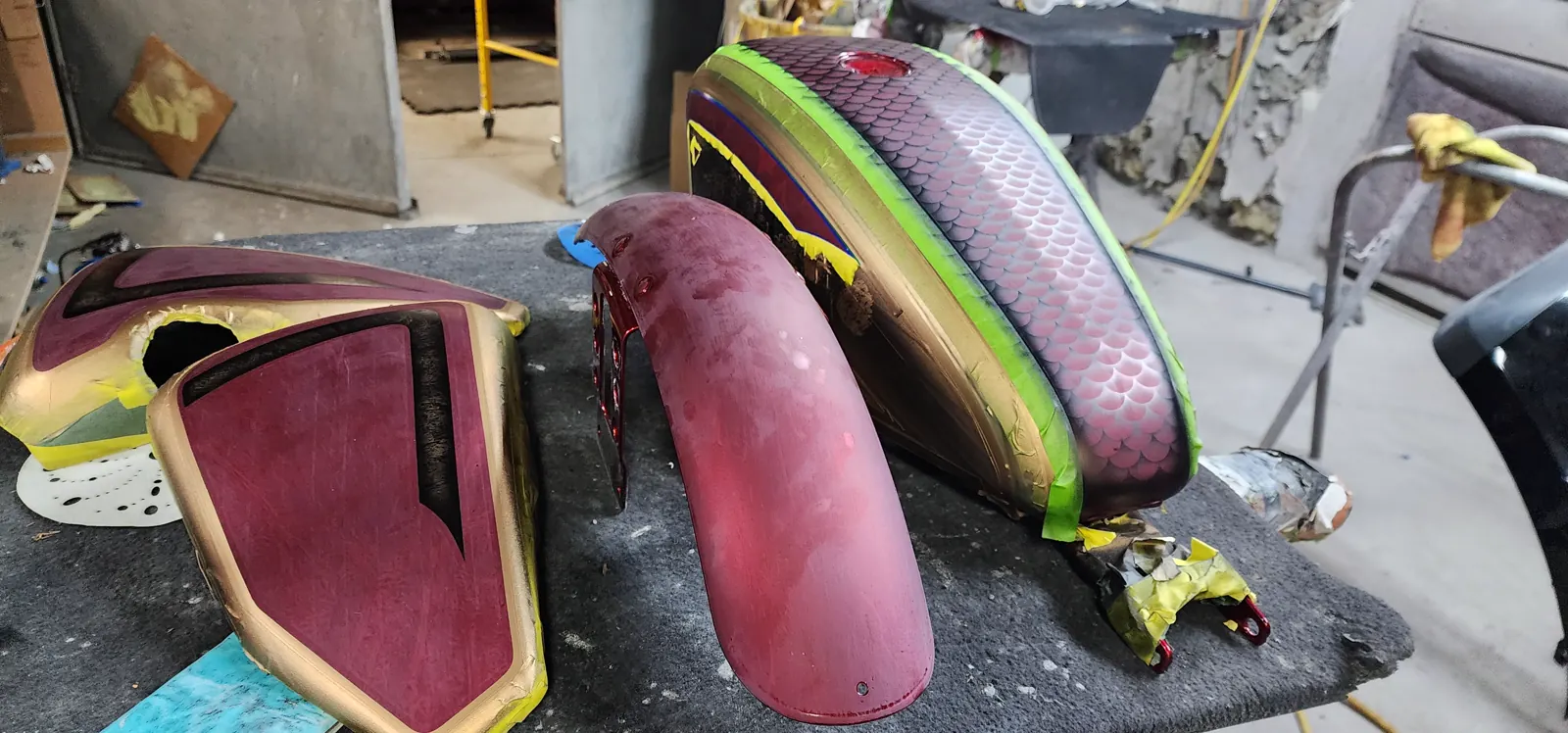
When fading is only skin-deep, the outcome is quick and satisfying: a machine polish cuts the dead clear, the depth snaps back, and you seal it so it lasts. When the clear coat is gone, we go the full route — strip, prep, and repaint in our own booth. And prep is where the magic actually lives. Most people think paint is all about the color coat, but a finish is only as good as the sanding and bodywork underneath it. Rush the prep and the shine won’t hold, no matter how nice the color goes down. That’s why a real custom job takes the time it takes; it depends on the work in front of us, not a stopwatch.
The color itself is built in layers — a base for the shade, then clear coats over it for depth and gloss, and with candy or metallic finishes, extra tinted layers that make the flake catch light and shift as you walk around the bike. Done right, a fresh tank in the sun doesn’t just look clean. It looks deep, like you could reach into it. That’s the whole point of doing paint by hand instead of settling for a faded panel you’ve stopped noticing.
A finished bike parked downtown near the 1912 Woodstock Depot, the old Louisville & Nashville station that hasn’t seen a passenger train since 1949, still turns heads a century later. Good paint does that. And if fixing the fade has you thinking about a color change or graphics you’ve always wanted, that’s a fun conversation to have — a fresh finish is the most personal thing a rider ever does to a bike, and it should feel like yours. New to riding these roads or getting back on after a break? The MSF Basic RiderCourse is a solid tune-up before you chase those mountain miles.
So if you’re staring at a dull patch that’s slowly grown on you, take a breath. Faded motorcycle paint Woodstock riders bring us is almost certainly cosmetic, you’re almost certainly fine to ride, and the color is almost certainly recoverable. The move is simple: stop scrubbing at it, keep it out of the sun when you can, and let someone look before winter moisture turns a polish job into a repair. Clear head, easy fix. That’s how this one usually goes.
Questions Woodstock riders ask us
Could my dull tank actually be something other than fade?
Yes, and it’s worth ruling out. Plain oxidation is a uniform, cloudy dulling on upward-facing panels. If the dull spot is bubbling, flaking, or centered on an old stone chip, that can be rust or clear coat lifting instead, which is a real repair rather than a cosmetic one. When you’re not sure, a quick look tells us which one you’ve got.
Is it safe to ride with faded paint?
Almost always, yes. Fading is a surface issue on the clear coat, so it doesn’t touch how your bike runs, brakes, or holds fuel. The only time to pause is if the fade is hiding rust or a crack underneath. Barring that, ride it as much as you want.
What causes motorcycle paint to fade in the first place?
Sun and UV are the main driver, followed by heat, and then by going too long without wax to protect the clear coat. Acidic grime like bug guts, sap, and bird droppings left sitting on the surface speeds it up. It’s the flat, upward-facing panels that fade first because they catch the most direct sun.
Can I fix faded paint myself at home?
A gentle wash and a fresh coat of quality wax can help mild dulling and protect what’s left. But reaching for harsh compounds or household cleaners on thin, oxidized clear coat can cut straight through it and make things worse. If a soft polish doesn’t bring the shine back, that’s the sign the clear coat has failed and it’s time for pro help.
Will faded paint get worse if I ignore it?
It can, especially through winter. Once the clear coat is compromised, moisture can work its way underneath, and that’s how a simple fade turns into rust or lifting. Catching it while it’s still surface-level keeps the fix small. Waiting a season is what usually grows the job.
Do I have to bring the whole bike in for paint work?
Not always. For a lot of paint jobs we can work with just the tank and panels, which makes the trip from Woodstock easy since you’re not hauling the whole machine down. It depends on the work involved, and we’ll tell you straight which route fits your bike before anything starts.
We take care of riders all across the north metro, so distance from our Marietta booth is rarely the deciding factor. Beyond Woodstock and the Towne Lake corridor, friends we’ve helped roll in from Canton, Acworth, and Kennesaw, along with Marietta itself and neighboring East Cobb. We also see plenty of bikes from Roswell, Alpharetta, and Milton to the east, plus Holly Springs, Ball Ground, and Cartersville when a rider wants real custom paint done in-house instead of shipped out to a stranger.
BRING THE COLOR BACK
If your tank’s been looking tired, don’t let another Woodstock summer bake it flat. Text us a photo of the fade and we’ll tell you honestly whether it’s a quick polish or a repaint — and we can often work with just the tank and panels so you’re not hauling the whole bike down. Clear head, real fix, color you’re proud of again.
470-460-9883Diaz Motorcycles and Service, LLC · 847 Barnes Mill Road, Marietta, GA 30062