Motorcycle Repair Sandy Springs — What It Costs, and How We Figure It Out
A plain guide to what breaks, what it means, and how we price the fix before we touch a wrench.
It’s a clear Saturday morning. For example, Helmet on, gloves on, a couple of free hours in front of you. After that, you thumb the starter and the bike answers with one sad little click, then nothing. You try again. Same click, quieter. What’s more, the bike sits there in the carport looking perfect and doing absolutely nothing. That’s usually the moment a rider pulls out a phone and searches motorcycle repair Sandy Springs while still standing next to the bike, half-dressed for a ride that isn’t happening. Here’s the good part: that click is one of the most common things we see, and it’s rarely the disaster it feels like.
We’re Diaz Motorcycles, an independent full-service shop in Marietta. We work on bikes all day, every day. Cruisers, baggers, sportbikes, adventure bikes, dirt bikes, older stuff with carbs and character. This post is for the rider who is done researching and ready to hand the bike to somebody competent. So we’ll skip the fluff and walk you through what your symptom probably means, what actually happens once your bike is on our lift, how long it takes, and how we land on a price without playing games.
Start with the symptom, not the guess
Almost every rider shows up with a theory. That’s fine, and honestly it’s helpful. But a theory and a symptom aren’t the same thing, and the symptom is what we can test. So before you call anybody, take thirty seconds and write down exactly what the bike is doing. Not what you think is wrong. What it does, when it does it, and what it sounded like the last time it worked right.
Here’s the short list we hear most from riders around Sandy Springs, and it barely changes from one spring to the next.
- One click, or a fast machine-gun clicking, and no crank
- That said, it cranks fine but won’t fire, especially after sitting all winter
- Meanwhile, it starts, then dies the second you close the choke or roll on throttle
- Rough idle, popping on decel, or a stumble in one part of the rev range
- A hot-side smell, a wet spot on the garage floor, or steam at a stoplight
- A wobble, a shimmy at highway speed, or a wheel that no longer tracks straight
- Chain noise, a clunky shift, or a lever that feels different than it did last month
- Brakes that feel spongy, grabby, or that pull to one side
None of those are mysteries to us. Every one of them has a short list of likely causes and a test that proves which cause it is. That’s the whole job, really. Test, don’t guess.
What each of those symptoms usually means
Clicking, or no crank at all
Nine times out of ten this is the battery, the connections at the battery, or the starter relay. Batteries hate two things: sitting unused and living through a Georgia summer. If your bike sleeps in a surface lot or a condo deck with no outlet nearby, the battery never gets topped off, and it slowly gives up. The fix is quick and the parts are common. We test the charging system too, because a fresh battery on a weak stator is a very expensive way to be stranded twice.
Cranks but won't fire
This one is usually fuel, and usually fuel that’s been sitting. Pump gas with ethanol in it doesn’t age well. After a few months it turns into varnish that gums up injectors, pilot jets and fuel filters. On a carbureted bike we clean and rebuild. On fuel injection we test pressure, check the pump, and pull codes. Either way, we can tell you inside an hour whether we’re dealing with stale fuel, a spark problem, or something further in.
Runs, but not right
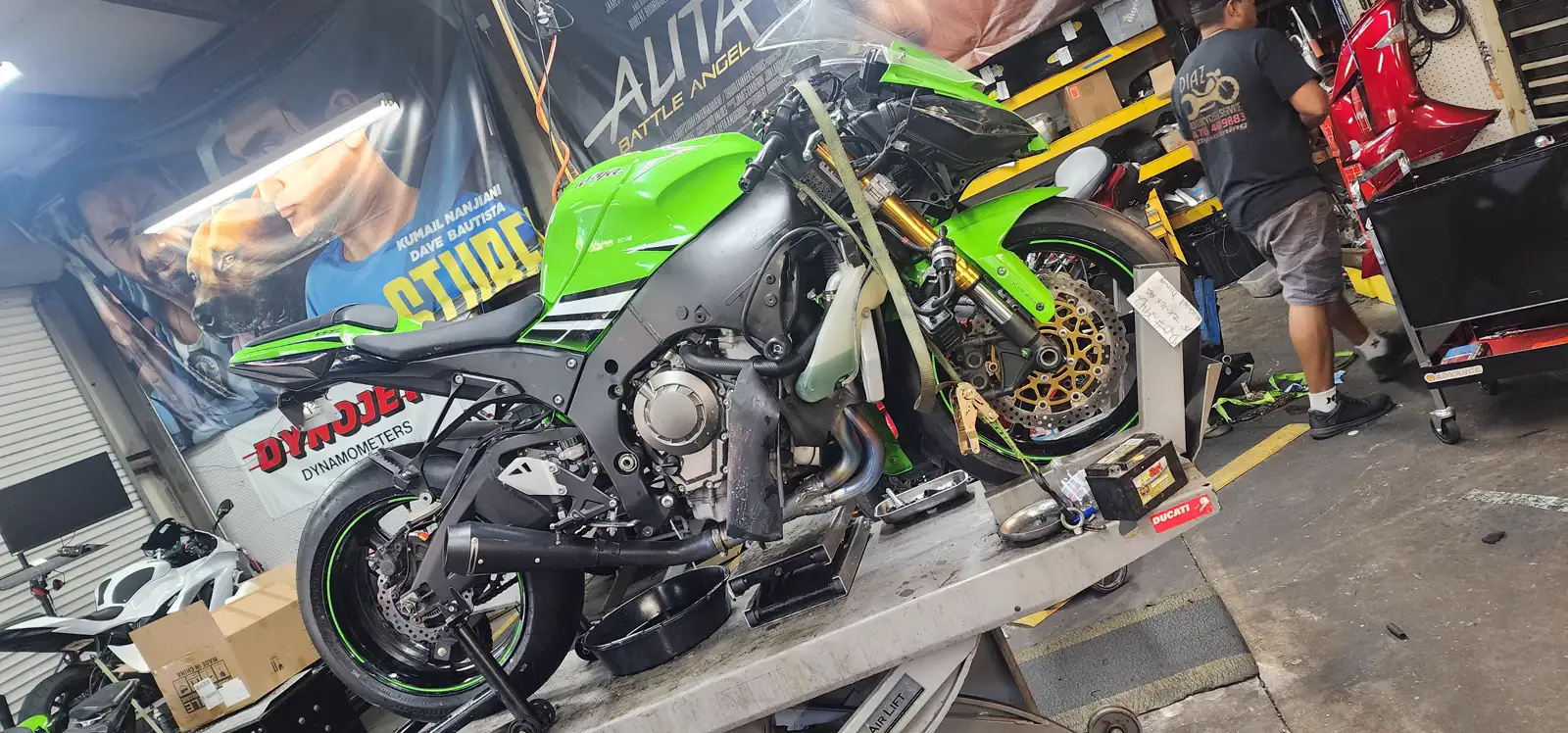
Rough idle, popping on decel and a flat spot in the midrange all point the same direction: air, fuel or spark is off somewhere. Vacuum leaks, tired plugs, a clogged filter, a lazy sensor, or a previous owner’s mystery tune. Sportbike riders often land here after somebody added an exhaust and never touched the fueling. We’ll get it back on a proper map so it pulls clean.
Leaks, heat and steam
A wet spot is information. Where it sits, what color it is, and whether it shows up hot or cold tells us a lot before the bike ever comes off the trailer. Coolant, fork oil, brake fluid and engine oil all behave differently. None of them are things to ride around on, and all of them are ordinary work for a shop that does this daily. If you want the deeper version of why that problem shows up, we wrote a whole piece on how we chase leaks and electrical gremlins.
Wobbles, wheels and alignment
This one is very Sandy Springs. Roswell Road and Hammond Drive carry heavy traffic on pavement that’s been cut, patched and re-patched for years, and the seams and manhole lips will bite a stiff-suspension sportbike. Add the long-running construction footprint where GA-400 meets the Perimeter, with its lane shifts, tar snakes and steel plates, and bent rims stop being unusual. We check runout, bearings, spokes and alignment before anybody starts talking about tires.
A symptom is a fact. A theory is a hope. We work from facts.
The internet will tell you one thing. The bikes tell us another. Forum threads are full of confident people who fixed one bike one time and now believe every similar bike has the same problem. Sometimes they’re right. Often they aren’t, and a rider ends up buying three parts to solve a problem that one part would have handled. Sites like RevZilla’s Common Tread do good, careful work, and we’re happy when riders read up. Just don’t order parts off a hunch. Let the bike answer the question first.
What actually happens when your bike gets here
We diagnose before we quote. Always, no exceptions. Here’s the order it happens in, so there are no surprises.
- You text us the symptom and a photo or two. We tell you whether it sounds simple or deep, and roughly what week we can get to it.
- The bike gets here, by you or by us on our trailer. Nothing gets touched until it’s logged in with your notes attached.
- A tech reproduces the symptom. If it only misbehaves warm, we get it warm. If it only does it under load, we load it.
- We test the likely causes in order of probability, fastest first. Codes, pressure, spark, compression, voltage drop, whatever the symptom calls for.
- You get a text with what we found, what it takes to fix it, and the number. Find a second thing? You hear about that separately and you decide.
- You approve. We fix. We test-ride it before it goes back, because a repair isn’t done until the bike proves it.
That fourth step saves riders the most. Any shop can throw parts at a bike until the symptom disappears. We’d rather spend the first hour being sure, because that hour is what keeps the rest of the bill honest.
So what does it cost?
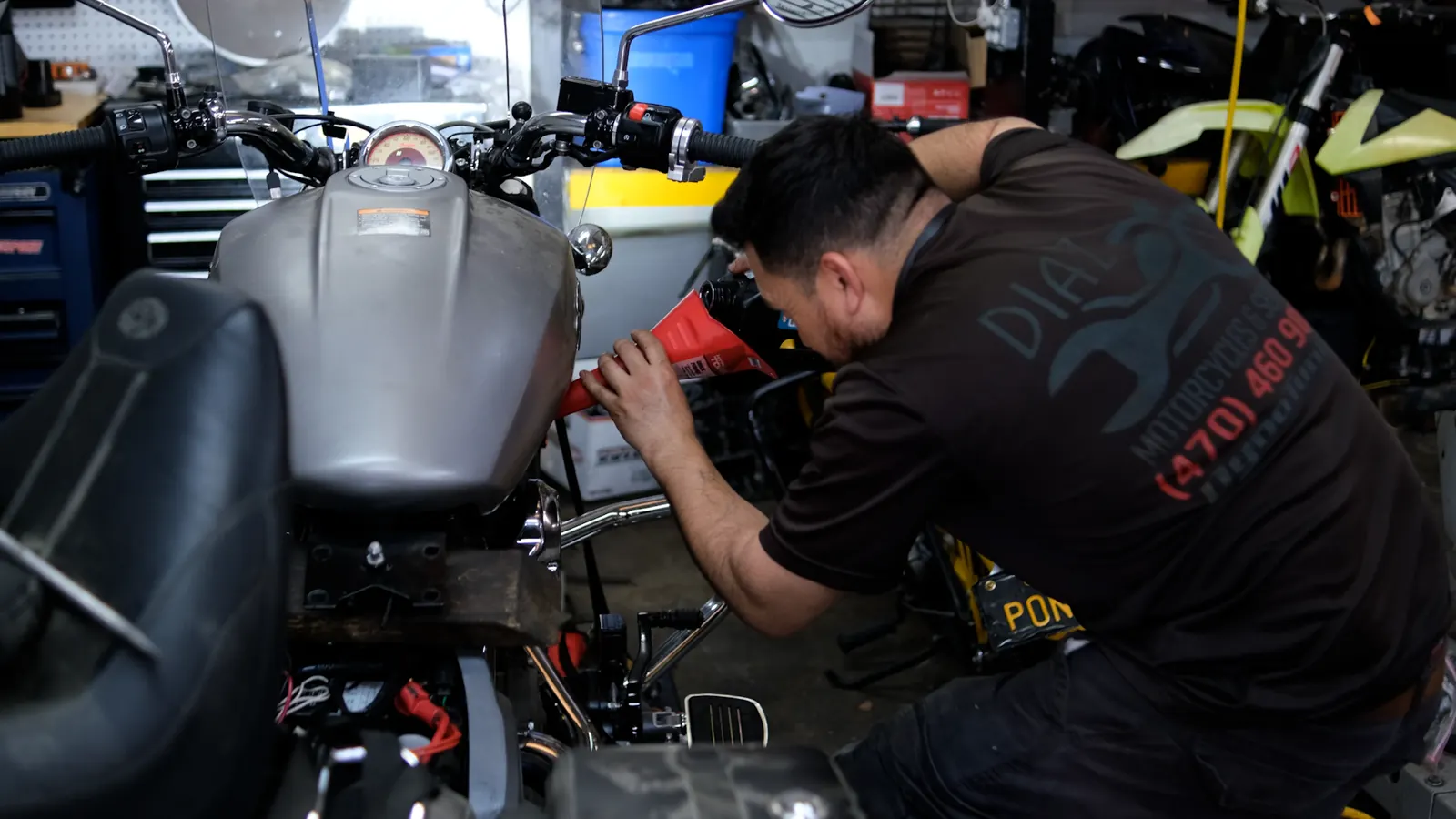
Honest answer: it depends on what the bike is doing, and we won’t pretend otherwise. What motorcycle repair Sandy Springs riders get from us is the number before we start, in plain language, with parts and labor separated. If the fix turns out simpler than expected, the number goes down. That happens more than you’d think.
Routine service is predictable. Fluids, filters, plugs, chain and sprockets, brake pads, tire mounting, valve checks. Those have known times and known parts, so we can quote them over text before you ever load the bike. Repairs are the variable ones, which is exactly why we diagnose first. Take a look at the work we do in house and you’ll see the range, from a battery and a fresh set of plugs all the way to engine work with the cases split on the bench.
HOW WE QUOTE
Diagnosis first, number second, wrench third. You approve every line before we touch it, and if we find something new mid-job, you get a separate call — not a surprise at pickup.
How long it takes
Most maintenance is same-day or next-day. Batteries, fluids, brakes, chains, tires, plugs. Diagnostic work usually gets you an answer within a day of the bike landing here. Repairs depend on parts, and parts depend on the brand and the model year. Common Japanese and Harley parts move fast. Certain European components and older restoration pieces take longer, and we’ll tell you that up front instead of letting you wonder.
Spring is our busiest stretch, because riding season here runs roughly March through November and everybody wakes their bike up in the same two weeks. If you’re the type who rides through the mild fifty-something days in January, you already know the secret: winter is the easy time to get on the schedule. The bikes that come in during February tend to go home fastest.
The Sandy Springs part of this
Sandy Springs is its own city, incorporated in 2005, with its own City Hall sitting right there at City Springs next to the City Green lawn. In fact, it has a 1,070-seat main house at the Sandy Springs Performing Arts Center, where the Byers Theatre draws crowds all season. What it does not have is a motorcycle shop inside the city limits. So every rider here is already driving somewhere for service. The only real question is which direction.
North takes you up GA-400 to Killer Creek Harley-Davidson in Roswell, which is a fine dealership if you ride a Harley and want dealership pricing on a brand-locked bench. West takes you to us. From the Riverside side, Johnson Ferry Road runs you across the Chattahoochee into East Cobb and lands you at our door in under fifteen minutes. Even so, From most of the city it’s roughly eight to eleven miles and eighteen to twenty-eight minutes, with no Perimeter driving required at all. From Perimeter Center, figure twenty-five to thirty. That last part matters more than the mileage, because nobody wants to sit on the top end of 285 with a bike in a trailer behind them.
We see a real cross-section from this city. Garage-kept baggers and BMW touring bikes out of Huntcliff, where the estate lots run right up toward the river. Premium cruisers and adventure bikes from the Dunwoody Panhandle, where houses back up to the Chattahoochee near Island Ford and half the ranch stock is mid-renovation. Mid-size nakeds and commuter sportbikes from the apartment corridors, ridden daily to office decks and hospital garages by folks working at places like UPS, Mercedes-Benz USA and Cox. Different bikes, same need: somebody nearby who does this for a living.
There’s one more thing this city does to bikes, and it’s worth naming. More than half the housing stock here is rental, spread across dozens of apartment communities, and a big share of those buildings date back to the seventies. That means carports, surface lots, street parking and no outlet anywhere near the bike. No outlet means no tender. No tender means a dead battery every spring and fuel that’s been quietly turning to syrup all winter. It’s not your fault, and it’s not a bike problem. That’s a parking problem. It’s also why we haul bikes for people instead of asking them to solve it themselves.
A quick story, because it makes this concrete
A friend we’ve helped keeps his bike in a condo deck off the Riverside side. Last March it wouldn’t start, and a guy at work told him it was definitely the stator and he’d be looking at real money. He was ready to just sell the thing. He texted us a photo instead, we picked the bike up on a Tuesday morning, and by that afternoon we had an answer: a dead battery, corroded ground, and a tank of gas that had been sitting since October. Charging system tested perfect. He rode it home Thursday and put a tender on his shopping list.
We tell that story a lot, because the shape of it repeats constantly. The scary diagnosis from the internet, the simple reality on the bench. Not every job ends that way, and when the news is bigger we say so plainly. Still, the fix is smaller than the fear surprisingly often. If you want to know how to judge any shop, the full rundown on it lays that out, and riders over in Peachtree City deal with much the same list.
What you walk away with
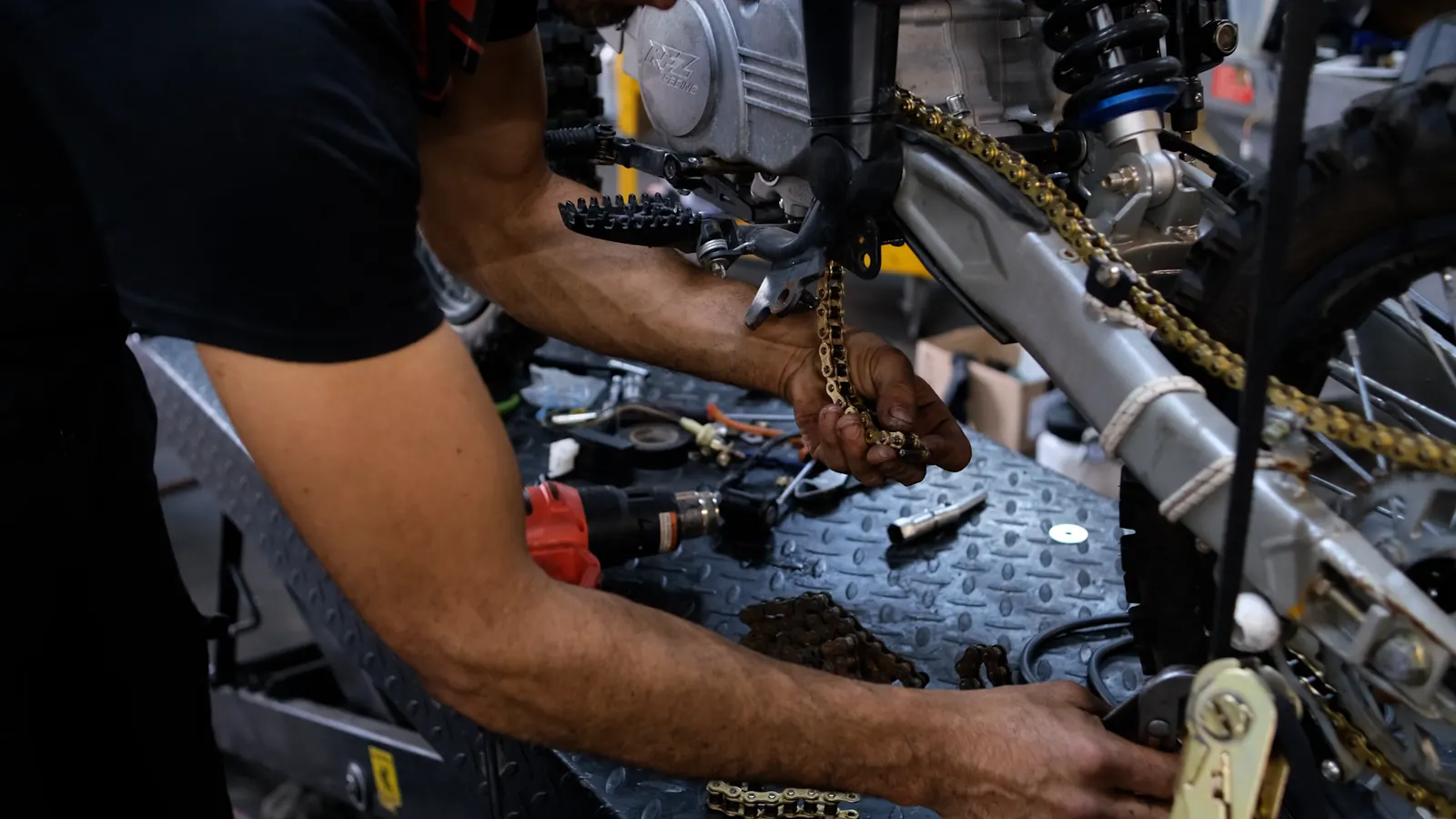
A bike that starts on the first press. A shop you can text instead of a phone tree. A number you heard before the work started, not after. Riding is supposed to be the good part of your week, and groups like the Motorcycle Industry Council track how long riders hang onto bikes now, which just means maintenance is the whole ballgame.
So text us the symptom. Send a photo if you’ve got one. We’ll tell you what it probably is, what it’ll take, and when we can get to it. If getting the bike to Marietta is the hard part, say so and we’ll come get it.
Questions Sandy Springs riders ask us
What does your repair service actually include?
Everything from routine maintenance to real teardown work. Fluids, brakes, chains, tires, plugs, valve checks, electrical and charging diagnosis, carb and fuel injection work, suspension, wheels and alignment, plus engine work when it comes to that. We also do tuning, bodywork and paint, and full restorations. If it rolls on two wheels, we’ve probably had one on the bench.
How long will my bike be in the shop?
Most maintenance goes same-day or next-day. Diagnostic work usually gets you a clear answer within a day of arrival. Repairs depend on parts availability, and that varies by brand and model year. We’ll give you a realistic window when we call with the diagnosis, and we’ll update you if anything changes.
Do you work on my brand?
Almost certainly yes. Harley, Honda, Yamaha, Kawasaki, Suzuki, Ducati, Triumph, KTM, BMW, plus older bikes that dealers won’t touch anymore. We’re independent, so we’re not locked to one badge. Send us your year, make and model in a text and we’ll confirm before you load up.
Do I need an appointment?
It helps a lot, especially in spring when everyone wakes their bike up at once. Text us first and we’ll get you a slot instead of leaving you waiting. Quick things like a battery or a tire can often be squeezed in the same week. Winter is the easiest time to get on the schedule.
Can you pick up my bike?
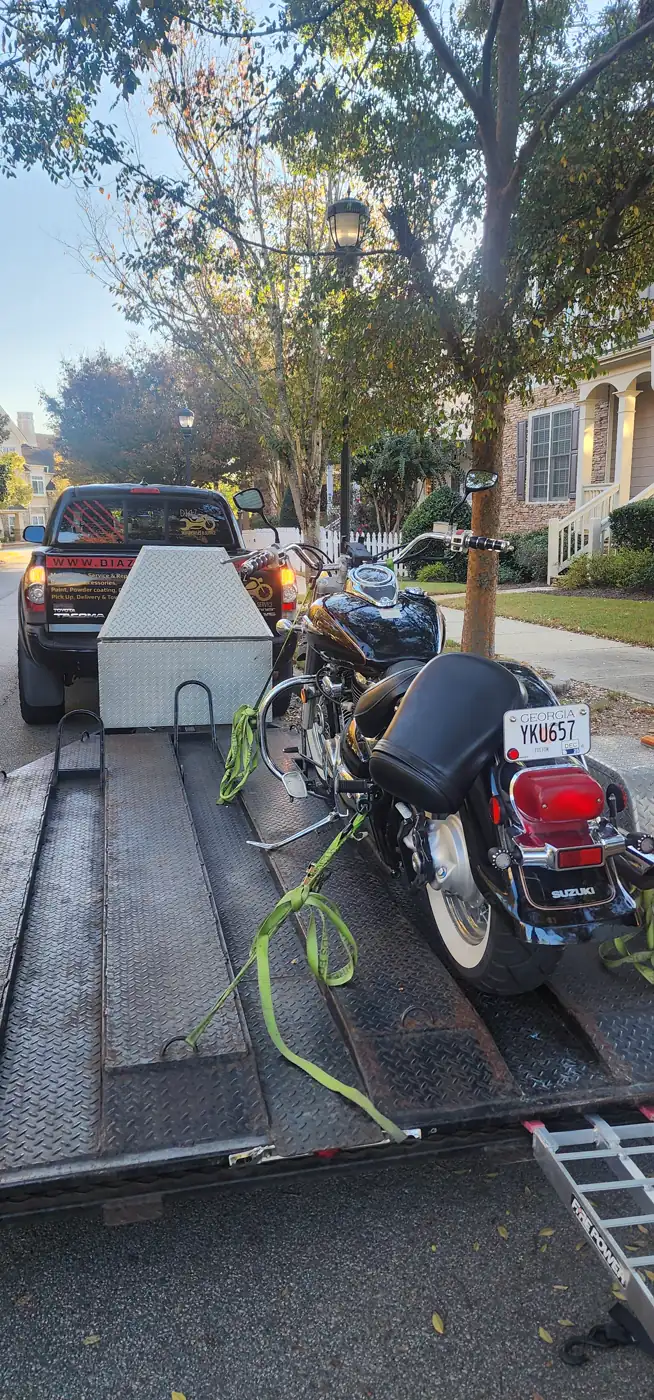
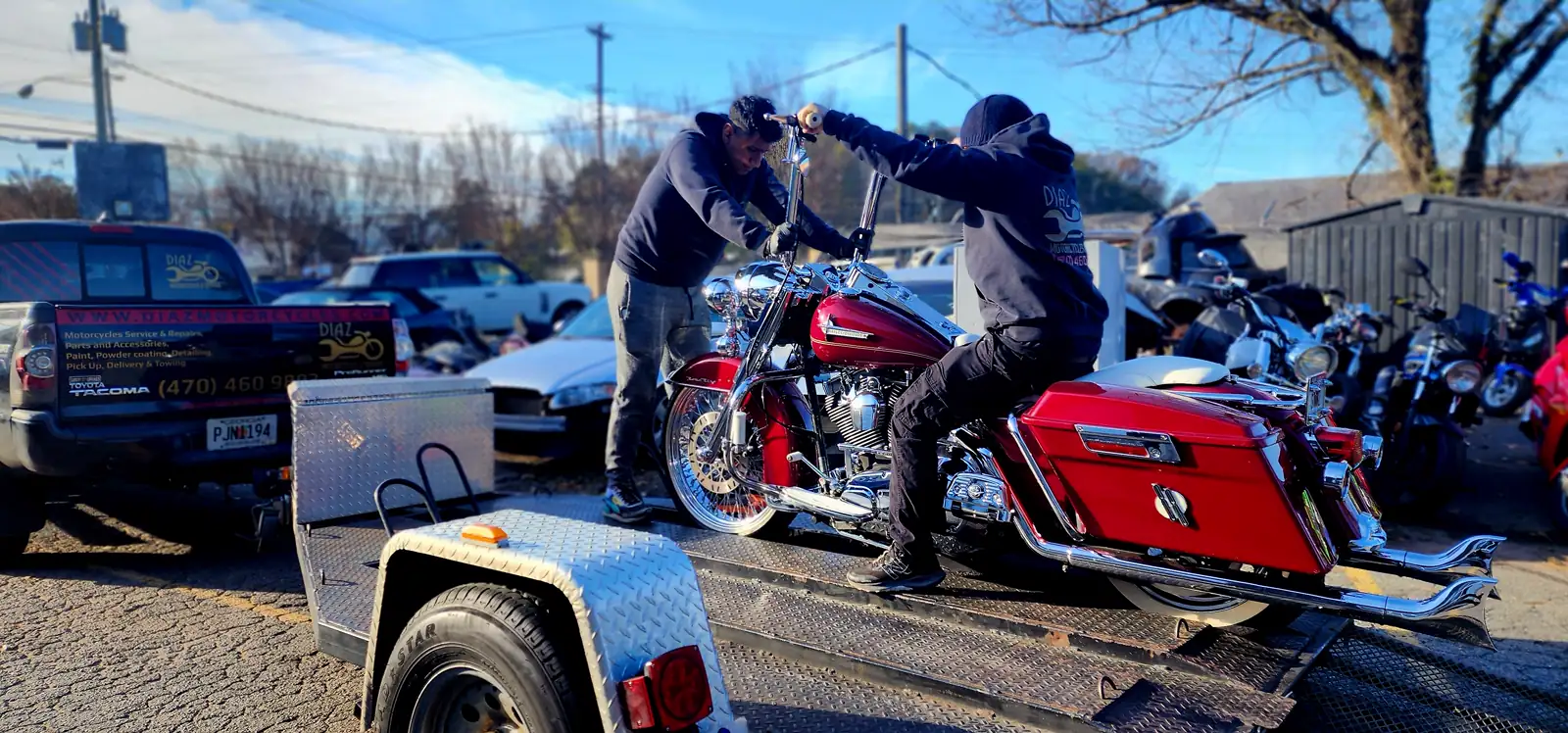
Yes, and we do it constantly for Sandy Springs riders. A lot of folks here park in apartment lots, carports or condo decks where working on a bike isn’t allowed and a dead one isn’t going anywhere. We’ll come get it on the trailer and bring it back when it’s done. Just tell us where it’s parked and how to reach the spot.
How do you decide what to charge?
We diagnose first, then quote, then wrench. You’ll hear the number with parts and labor separated before anything gets taken apart. If we find a second issue mid-job, that’s a separate conversation and a separate approval. No surprises at pickup, ever.
We take care of riders all over the north side. Sandy Springs is one of our regulars, along with Roswell, Dunwoody, Brookhaven and Chamblee just across the way. We see plenty of bikes from Atlanta and Buckhead, and East Cobb and Vinings riders are practically neighbors. Marietta is home base, Smyrna is a short hop, and we get steady work from Alpharetta and Doraville too. If you’re within a reasonable haul of the shop, we’ll either see you here or come to you.
TEXT US THE SYMPTOM
If your bike is sitting in a Sandy Springs carport, condo deck or apartment lot doing something it shouldn’t, text us. Tell us what it does and when it does it, send a photo if you’ve got one, and we’ll tell you what it probably is and when we can get to it. Can’t get it here? Say the word and we’ll come pick it up.
470-460-9883Diaz Motorcycles and Service, LLC · 847 Barnes Mill Road, Marietta, GA 30062