Dyno Tune vs Stock Smyrna — Compared
A straight recommendation for commuter riders deciding whether to leave the factory map alone or have it rewritten for the bike they actually own.
Even so, your alarm goes off, and you’re on the bike by 7:40 with the helmet liner still cool from the garage. Meanwhile, By 7:52 you’re stopped dead on a four-lane road, heat rolling off the engine and into your boots, watching a brake light two feet from your front tire. In fact, that said, Fifteen minutes door to door, and maybe nine of those minutes are spent not moving at all. That is the ride most people around here actually do every single day. It’s also why the dyno tune vs stock Smyrna question deserves a real answer instead of a shrug.
The short answer, before anything else
If your bike has been changed from the way it left the factory in any way — a slip-on exhaust, a free-flowing air filter, different sprockets, even a header swap — get it tuned. That’s not a close call. If your bike is fully stock, still under factory warranty, and you’re happy with how it pulls, leave it alone and put your attention into tires and chain care instead. For example, those two sentences cover about ninety percent of riders. After that, the rest of this post is us showing our work, because you should never take a shop’s word for something you can check yourself.
We’ll also tell you flat out where stock wins, since a recommendation you can’t argue with isn’t a recommendation. It’s a sales pitch.
What a stock map is really doing
What’s more, every modern bike ships with a fuel map. So and Better yet, Think of it as a lookup table living in the ECU, the little computer behind your tank. Still, Thousands of times a second it asks the same question: at this throttle position, at this engine speed, at this air temperature, how much fuel should the injectors squirt? The factory answers that question once, at the factory, for every bike of that model on earth.
That’s a brutal job. Plus, one map has to work in Phoenix heat and Minnesota cold. It has to pass emissions testing. Of course, it has to survive the worst gas somebody might pour in. Then again, it has to keep the catalytic converter alive for years. So engineers pad it. They run parts of the map lean to clear emissions numbers, then run other parts rich so nothing melts when a rider redlines it up a mountain in August. Neither setting was chosen because it felt good.
Lean means not enough fuel for the air coming in. A lean bike gets hot, surges at steady throttle, pops on decel, and feels like it’s fighting you at low speed. Rich means too much fuel. A rich bike smells like unburned gas, fouls plugs, gets soft on top, and drinks more than it should. Neither one breaks your bike tomorrow. Both make it a worse thing to ride today.
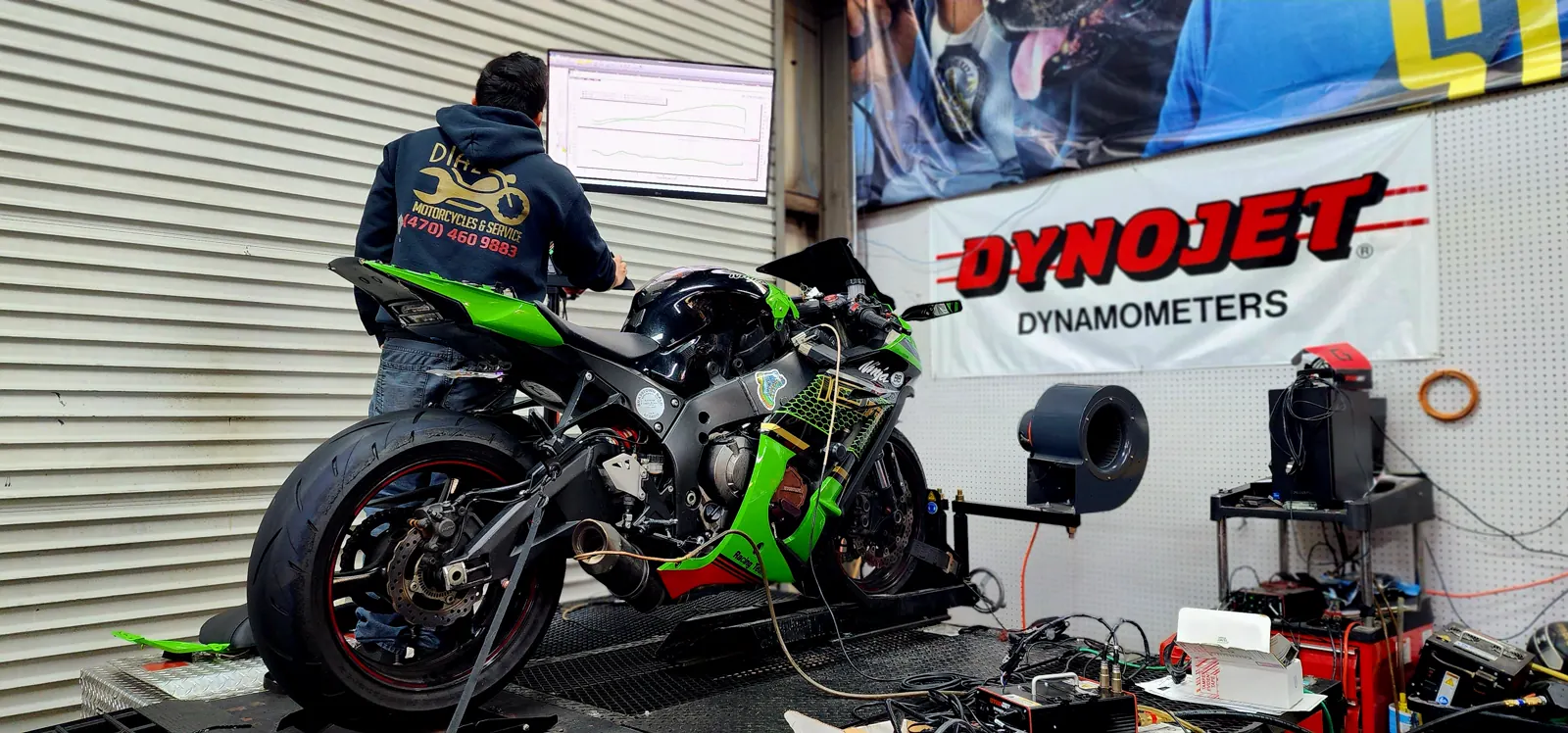
A dyno is just an honest scale for all of that. Your rear wheel sits on a heavy drum. We spin it, and the machine measures exactly how hard your engine can push that weight, at every single engine speed, while a sniffer in the exhaust reads how much unburned fuel is going out the back. No guessing. No butt-dyno. Just numbers on a screen you can look at with us, which is the whole point of how we handle that job.
What changes when we rewrite the map
People expect tuning to be about big numbers. Honestly, the headline number is the least interesting part. What you feel first is everything below half throttle, which is where a commuter lives all week long.
- Steady-throttle surge at neighborhood speeds goes away, so the bike stops nodding at you in traffic
- Off-idle response gets crisp, which makes stop-and-go far less tiring on your clutch hand
- Engine heat drops in the lean spots, and you notice that most in July
- Fueling gets smooth right where you roll on out of a corner, so the bike feels planted instead of jumpy
- Fuel economy often improves, because rich areas stop wasting gas out the pipe
- The power that was already in there arrives in one clean pull instead of a couple of steps
We do this a few ways depending on your bike. Some machines take a full ECU flash, where we rewrite the factory computer directly. Others get a piggyback unit like a Power Commander that sits between the ECU and the injectors and adjusts fuel on the fly. Older carbureted bikes get jets and needles, tested on the same drum. Different tools, same goal: make your specific engine happy instead of an average one.
WHAT A DYNO ACTUALLY MEASURES
Force at the rear wheel, over engine speed, plus what your exhaust is telling us about the fuel mix. That’s it. Everything else is a person reading the graph and deciding what to change.
That’s the common version. The real story is a little different.
Most riders think tuning is something you do after you buy loud pipes. In practice, the bikes that gain the most on our dyno are the boring ones. A five-year-old commuter with a clogged air filter, a weak fuel pump and a lazy oxygen sensor will show a mess on the graph long before we touch a single map value. The dyno finds the problem, and sometimes the fix is a part, not a tune. We’d rather tell you that than sell you a map that papers over a sick engine.
What we check before we change anything
A tune sits on top of everything else your bike is doing, so all of it has to be right first. Here’s the order we work in.
- Read stored fault codes and confirm the sensors are actually reporting sane values
- Check air filter, spark plugs, and any intake leaks that would throw off the mix
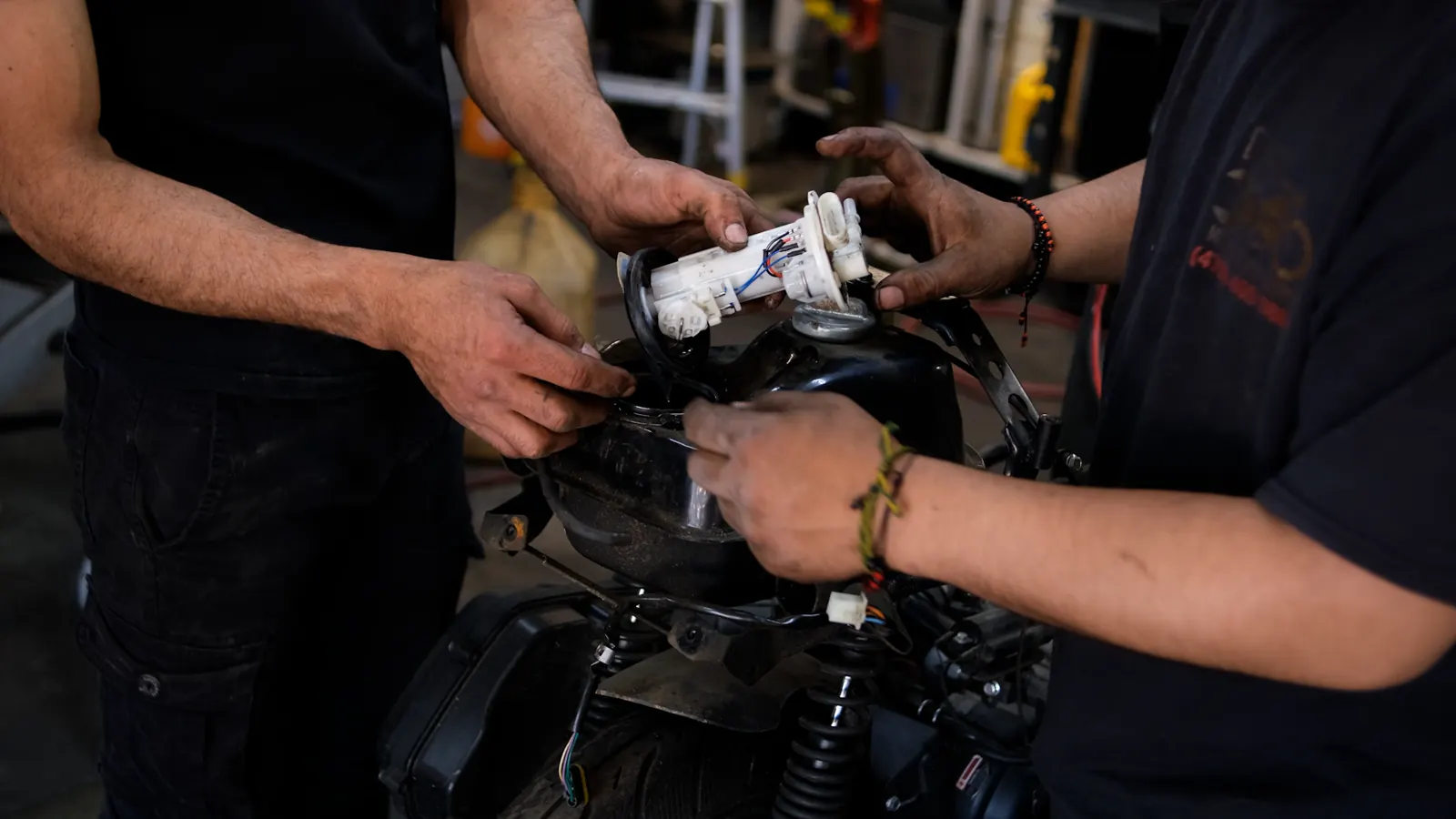
- Confirm fuel pressure and pump health, since a weak pump fakes a lean condition
- Inspect chain, sprockets and tire pressure, because drivetrain drag lies to a dyno
- Warm the engine fully and take a baseline run, untouched, so you can see where you started
- Make changes, run again, compare, repeat until the graph and the mix both look right
That baseline run matters more than anything. It’s your before picture. Without one, any shop can hand you a good-looking graph at the end and you’d have no way to know what it means. If you want a longer read on what separates a good shop, we wrote that one out too.
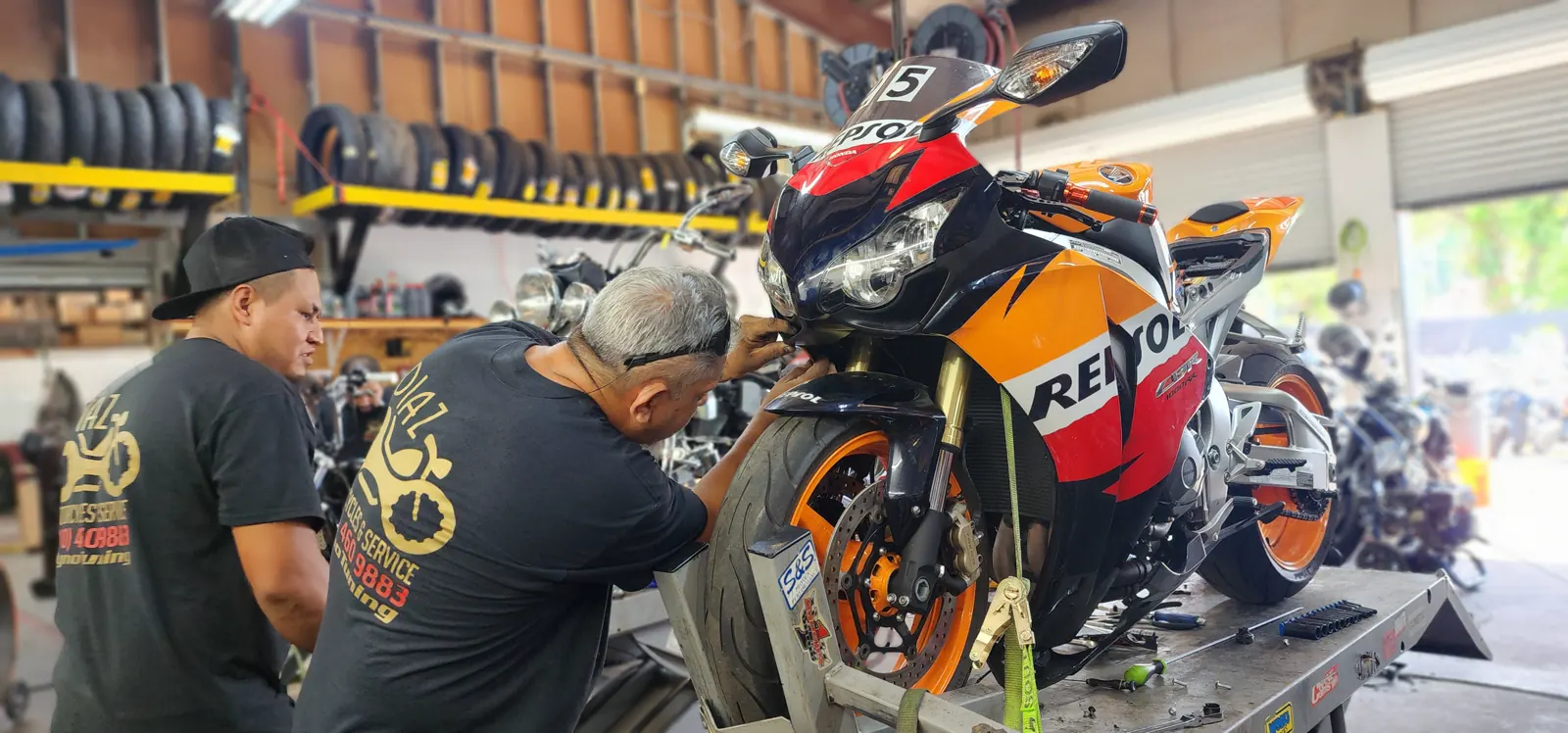
A fair bit of this happens off the drum, too. Fairings come off, connectors get checked, and somebody usually ends up on their knees with a flashlight tracing an intake boot. It’s not glamorous work. It is the difference between a tune that holds up for years and one that feels great for a month and then drifts, and we’d rather do it once and do it right.
Mistakes that cost people real money
Nobody makes these on purpose. They just seem reasonable at the time.
The big one is buying a downloaded map off the internet for your model and calling it done. Your bike is not the bike that map was built on. Different mileage, different altitude, different fuel, different exhaust, different wear. A generic map can absolutely run your engine leaner than the factory ever did, and that’s the one version of this where you’re worse off than stock. The good news is it’s fully reversible — bring it in, we’ll flash it back and start from a measured baseline.
Second mistake: adding a full exhaust system and no tune at all. That’s the classic. More air out with the same fuel in means lean, and lean in the exact rev range you use pulling away from a light. Third: chasing a peak horsepower figure you’ll use for about four seconds a year, while leaving the part of the map you touch ten thousand times a day untouched. We’d rather build you a bike that’s a pleasure below 6,000 rpm.
Why this hits different in Smyrna
Smyrna riders commute more than anybody else we serve. You’re minutes from Cumberland, The Battery and the in-town offices, and parking a bike downtown beats parking a car every day of the week. That’s a great life. It’s also a specific kind of engine use, and Georgia doesn’t allow lane splitting, so your bike sits in the same baking traffic a car does with none of the airflow.
Short trips make it sharper. A fifteen-minute run from a townhome near Market Village to a desk never fully heats the engine or burns off the moisture inside it. Ride a lean, hot map on that schedule all summer and the bike feels tired by August. A rider in Bellhaven Chase doing that loop daily gets more out of a tune than a weekend-only rider in Bryerstone with a garage-kept bike and a hundred miles a month on it.
Then there’s the other half of your riding. Sunday morning, coffee near Jonquil City Park, then a run out west on Dallas Highway and the roads along the Silver Comet corridor toward Paulding and Polk counties, where the turns come tight and quick. That riding asks for smooth throttle above all else. So does picking your way through the cobblestone streets of the Historic Vinings District at walking pace. One map, two very different jobs — which is exactly the thing a custom tune is good at and a factory compromise isn’t.
One rider off I-75 put it better than we could. He rides the eastern edge of the city through Cumberland most mornings, where the concrete-to-asphalt transitions hammer his suspension, and he told us his bike used to feel like it was arguing with him at every crawl. After the tune, he said, it finally acted like it wanted to be there. That’s the honest measure of this work. Not a number — a mood.
So which one should you pick
| Your situation | Our call |
|---|---|
| Any exhaust, intake or gearing change | Tune. Not optional. |
| Fully stock, under warranty, ride occasionally | Stay stock. Spend on tires. |
| Stock but daily commuter with hot-running complaints | Baseline dyno run first, then decide |
| Bike over about eight years old, feels lazy | Diagnose on the dyno before any map work |
| You want the bike to feel good, not to win a number | Tune, and aim it low in the rev range |
Where does stock genuinely win? Newer bike, no modifications, low mileage, and a rider who’s happy. Some machines leave the factory with genuinely good fueling, and paying to chase a small gain there is money better spent on rubber, brake pads and a class. The MSF rider courses will do more for your riding than any map ever will. Harley owners can also cross-check factory specs through Harley-Davidson service information before deciding anything.
A tune doesn't add a personality to your bike. It stops the factory from hiding the one it already had.
Getting to us is easy enough. From Market Village it’s about eleven miles, roughly twenty-two to twenty-eight minutes, usually South Cobb Drive or Atlanta Road north into Marietta and then east on Roswell Road. Hellbender Harley-Davidson sits closer to you on South Cobb Drive, about ten minutes out, and has been a motorcycle destination on that site since 1986 — a great stop if you ride a Harley and want a dealer near home. We’re the multi-line option with the dyno in the building, and you can read about the work we do in house or check the Mableton side of things if you’re riding in from that direction.
What you walk away with
You get your before-and-after graphs, an explanation of what we changed and why, and a bike that behaves the same way on Monday morning as it did on the drum. No mystery, no black box. If we run yours and the numbers say leave it alone, we’ll tell you that and hand you the sheet anyway, because you paid for information and information is what you get.
That’s really the heart of dyno tune vs stock Smyrna riders keep weighing. It isn’t loud versus quiet or fast versus slow. It’s a bike set up for everybody versus a bike set up for you, on the roads you actually ride, in the heat you actually sit in. Once you’ve seen your own graph, the choice stops being a debate and starts being obvious.
Questions Smyrna riders ask us
Which do you actually recommend?
Tune it if anything on the bike has been changed from stock, and especially if you commute daily. Leave it stock if the bike is new, untouched, and already feels good to you. We’ll give you the same answer in person that we’re giving you here.
Does my bike change the answer?
Yes, quite a bit. Older bikes and anything with a modified exhaust or intake gain the most. A newer machine with well-sorted factory fueling and no modifications gains the least. Bring the bike by and a baseline run will settle it in about the time it takes to drink a coffee.
Is the upgrade worth it if I only ride to work?
Commuters are honestly the best case for it. All the improvement lives in low-throttle, low-speed fueling, which is exactly where a fifteen-minute stop-and-go ride spends its life. Less surge, less heat, less clutch work in traffic.
What's the real difference between a flash and a Power Commander?
A flash rewrites your factory ECU directly, so it’s the cleanest result when your bike supports it. A Power Commander sits between the ECU and the injectors and corrects fuel as you ride, which is the right call on bikes that can’t be flashed. Both end up tested on the same dyno.
Can a tune hurt my engine?
A measured tune done on a dyno with an exhaust gas reading is safer than a lean factory map, because we can see what the engine is actually getting. A random downloaded map with no testing is the risky version. That’s the one we’d steer you away from every time.
Can I go back to stock later?
You can. We keep your original map, and putting it back is straightforward, which matters if you’re selling the bike or handling a warranty question. Nothing about this is a one-way door.
We take care of riders all over the west and north side of the metro, starting right here in Marietta and running out to Smyrna, Vinings, Mableton and Austell. Plenty of our regulars ride in from Atlanta, Buckhead and Sandy Springs, and we see just as many from East Cobb, Fair Oaks and Kennesaw. If you’re out toward Powder Springs or Douglasville, the ride over is a pleasant one, and we’ll have coffee on.
TEXT US YOUR BIKE AND MODS
Tell us what you ride, what’s been changed on it, and how your Smyrna commute feels right now. Text is easiest and we answer fast, so you don’t have to call during a meeting. We’ll tell you honestly whether a dyno tune will do something for your bike or whether stock is already treating you fine.
470-460-9883Diaz Motorcycles and Service, LLC · 847 Barnes Mill Road, Marietta, GA 30062