Dyno Tuning Powder Springs Riders Can Actually Feel on the Road
What a dyno really measures, why your bike runs lean or rich, and how we find out before anyone talks price.
The coffee was still hot in the travel mug. So and Better yet, Helmet sitting on the seat, tank filled the night before, the whole day mapped out since Wednesday. Then the bike lit off, coughed twice at the end of the driveway, and dropped into a lumpy idle that fell on its face every time the throttle closed. Four tries later, the group rolled off without you and the garage door came back down. Still, that Saturday is the real reason riders start searching for dyno tuning Powder Springs shops. Not for a bragging number. For a bike that behaves.
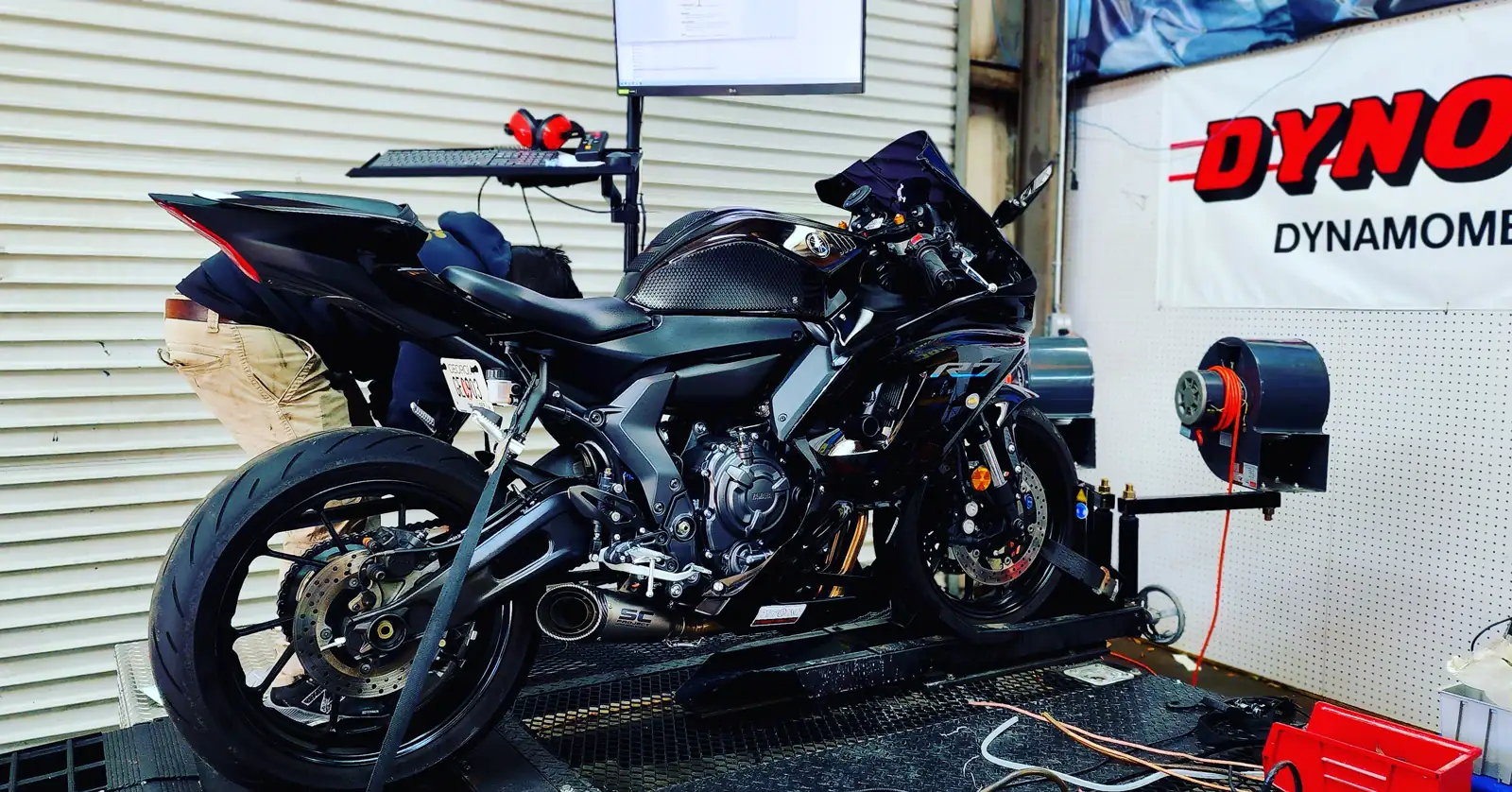
So here’s the plain version of what a dyno is. Plus, it’s a heavy steel roller set into the shop floor. Of course, we strap your bike down, the rear tire spins that roller, and sensors measure how hard your engine can push it at every point in the rev range. While that’s happening, a probe sits in the exhaust and reads what’s coming out the back. Then again, Put those two together and we get an honest picture of what your engine is doing everywhere — not just at the one spot on Macland Road where you happen to notice something feels off.
Even so, you don’t need a physics class to use that information. Think of a treadmill with a stopwatch and a breath test attached. The roller shows how much work the engine is doing, and the exhaust probe shows whether it’s getting the right mix of air and fuel while it does that work. Almost everything in what we take care of here comes down to reading those two things carefully and then adjusting the numbers the bike runs on.
The problem almost always starts small
Nobody wakes up and decides their bike needs a tune. It sneaks up. First it’s a little hesitation off idle. Then a surge at steady throttle in fourth gear, the kind where the bike keeps nudging you forward and backward like it can’t decide. What’s more, Then popping and snapping on deceleration coming down a hill. Then the fan runs constantly while you sit at a light, your right leg cooking, and you start wondering whether you should shut it off.
Gas mileage slips too. The bike still starts, and it still rides, which is exactly why riders live with it for two full seasons and tell themselves it’s just how this model is. Good news: this is one of the most fixable problems on a motorcycle. Nothing is broken. The engine is simply being fed wrong, and feeding is adjustable.
Lean, rich, and why your bike picked one
An engine wants air and fuel in a fairly specific ratio. Too much air for the fuel and we call it lean. Too much fuel for the air and we call it rich. Both make the bike unhappy, just in different ways.
A lean bike runs hot, surges at small throttle openings, snaps and pops on the overrun, and sometimes stumbles off idle. A rich bike smells strong, fouls plugs, feels lazy, and drinks fuel like it’s mad at you. Riders call a lean bike twitchy and a rich bike soggy. Both descriptions are fair.
Why do bikes leave the factory lean in spots? Emissions rules, mostly. A manufacturer has to certify one map that passes testing in every climate and every fuel grade on the planet. That map is a compromise, and compromise tends to live in the exact places you ride most: light throttle, cruising rpm, stop-and-go heat.
Then there’s the second cause, and this one is self-inflicted in the most enjoyable way. Somebody adds a slip-on exhaust, a high-flow air filter, maybe a full system. The engine breathes more freely now, but nobody told the computer that. It keeps delivering the same fuel it did when the bike was stock, only now more air is moving through. The result sounds better and runs worse, which is a frustrating combination.
Powder Springs bikes carry a third factor, and it has nothing to do with parts. Bikes here live indoors. Homeownership in the city runs high and the housing stock is single-family with garages, so most bikes sit next to a truck in a two-car garage in a place like Amberton or Oakleigh from late November until the weather breaks. That’s great for paint and terrible for fuel. Gas goes stale, injectors get lazy, and a bike that was borderline in October is cranky by March.
Most people stop reading here. That’s the expensive mistake. Because the next part — what a shop does before touching anything — is the part that decides whether you get a real fix or an expensive guess.
How we diagnose before we quote
We don’t quote a tune off a phone call. We can’t. Two bikes of the same model, same year, same exhaust, can need meaningfully different work depending on how they’ve been ridden and stored. So the first thing that happens is measuring, and the measuring is what tells us what to say next.
- Basics first. Plugs, air filter, valve clearance history, chain and sprockets, tires, any stored codes. A tune can’t fix a mechanical problem, and we’d rather find one now than chase it later.
- Baseline pull on the dyno. That’s the bike exactly as it sits today, recorded, with the exhaust probe reading air-fuel through the whole rev range.
- We read the map against the pull, so we can see where the bike is lean, where it’s rich, and whether the trouble spots match what you told us you feel.
- We tell you what we found in plain words. If the honest answer is that the bike doesn’t need a tune, that’s the answer you get.
- Only then do we talk about the work and the timeline.
WHY THE BASELINE MATTERS
That first pull is your before picture. When the tune is done, we do it again and hand you both. You should never have to take a shop’s word for whether something changed.
What the actual fix involves
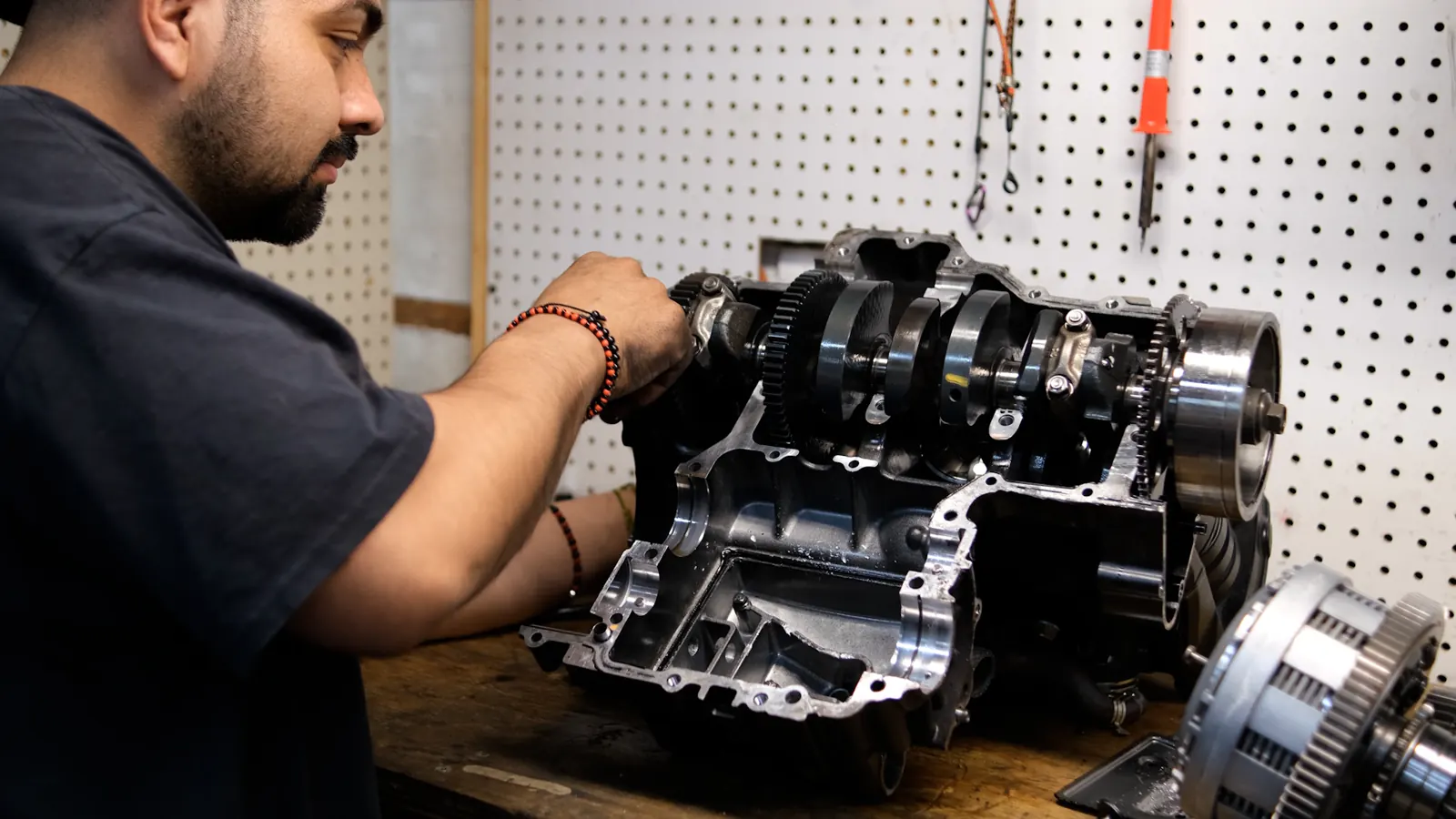
There are two main paths, and which one fits depends on your bike. Both change the same thing: how much fuel the engine gets, and when the spark fires, at every combination of throttle position and rpm.
ECU flashing
Here we rewrite the software on the bike’s own computer. Nothing gets bolted on, nothing hangs off the subframe, and the original wiring stays original. On many modern bikes, a flash also lets us adjust things a piggyback box can’t touch, like rev limits, throttle response, and how aggressively the fans kick on. When the bike supports it, this is usually the cleanest route.
Power Commander and piggyback units
A Power Commander sits between the ECU and the injectors and adjusts the fuel signal on the way through. It’s a proven approach, it’s reversible in an afternoon, and it works on plenty of bikes whose factory computers are locked down tight. If you’re weighing the two options, we walk riders through the tradeoffs between them before anybody spends a dime.
Either way, the work isn’t one pull and a handshake. We make a change, pull again, read the numbers, change again. That loop repeats until the fueling is clean everywhere — including the boring parts nobody puts on a chart, like steady cruise and the first crack of throttle out of a stop sign. Those boring parts are where you actually live.
A dyno sheet is a receipt. The real test happens the first time you roll out of your own driveway.
West Cobb riding, and why tuning matters more here
This is West Cobb, and it’s OTP, and the riding profile out here is specific. Bikes aren’t commuters. Georgia bans lane splitting and filtering, so a rider stuck on US 278 sits in the same jam as everybody else and gains nothing for the trouble. Mileage piles up in bursts instead — a long Saturday, then two weeks of nothing.
That pattern punishes a badly fueled bike. A lean spot you’d never notice on a daily 20-minute hop becomes miserable on a four-hour day. Nowhere does it show up faster than on the Georgia Triangle. Run SR 60 up toward Suches and then loop Wolf Pen Gap Road and SR 180, and you’re spending hours on tight second and third gear corners, rolling on and off the throttle hundreds of times. A bike with a surge at small throttle openings turns that ride into work. A bike that’s been tuned properly makes the same road feel like it was built for you.
Closer to home, the roads themselves add wear. Macland Road, GA 360, is the main west Cobb connector toward Marietta and Dallas Highway, and it carries construction traffic, school traffic, and everything in between. Macland and its neighbors show edge break, patched utility cuts, and gravel wash at intersections. This is real-world riding, not a magazine test loop, and your bike should be set up for the roads you actually have.
There’s also a straightforward local gap. Powder Springs has no motorcycle dealership and no large independent full-service shop inside the city limits. New construction keeps filling in — Croftside is the busiest listing community in town right now, and plenty of those garages will have a bike in them within a year — but specialist work still means leaving the city. Suspension riders often head north to Traxxion Dynamics on Rope Mill Parkway in Woodstock, about thirty miles up. For dyno tuning Powder Springs riders have a closer option: roughly 15 to 18 miles, generally half an hour or so, up Powder Springs Road or Macland Road into Marietta, then east on Roswell Road to Barnes Mill Road.
And a small note about the trail, since it comes up. The Silver Comet Trail’s Powder Springs trailhead is one of the busiest access points on the whole 59-mile rail-trail, and it’s bicycles and pedestrians only — never a motorcycle route. It’s a fine landmark for directions and a terrible shortcut. Downtown, Skint Chestnut Brewing Company is where a lot of local plans get made, and we’ve had more than a few bikes come in Monday because of a Friday night conversation there.
The part riders underestimate
The last piece is the one people underestimate. It isn’t peak power. It’s heat and low-throttle manners.
A lean cruise map makes a bike run hot, and hot bikes are miserable in July on a suburban arterial with a light every quarter mile. Fixing the fueling in that narrow band — small throttle, moderate rpm — changes your summer more than anything that happens at redline. The bike stops radiating at your shins, the fan stops screaming, and the whole machine feels calmer under you.
Same story with throttle response. Most of riding is tiny throttle inputs: leaving a stop, settling into a corner, holding a line. When those inputs are clean, the bike feels like it’s reading your mind. Otherwise you’re constantly correcting, and after two hours you’re tired without knowing why. That’s the part nobody puts in a headline number, and it’s the part you’ll notice in the first mile.
None of this is exotic, either. This is the same work we do across the whole area, and you can see how this plays out in Dallas for riders on the other side of the county line.
What you get at the end
You get a bike that starts and idles without drama. Throttle that answers the moment you ask. Heat that stays sane in traffic. Fuel economy that usually improves rather than falls, because an engine fed correctly wastes less. And two dyno sheets, before and after, so the improvement is something you can look at instead of something you have to believe.
You also get to keep the parts you already bought. That exhaust you liked the sound of finally does its job. If you want the deeper walkthrough, we broke down what that service actually involves step by step in an earlier post.
One more thing worth saying to newer riders. If you’re still working through Georgia Class M licensing, get the license sorted and the seat time banked first. A tuned bike is easier to ride smoothly, but it’s no substitute for practice.
So if your bike stumbled on you this spring, or it’s been sitting since November and you want it right before the next long Saturday, text us. Tell us the year, the model, what you’ve changed, and what bugs you about how it runs. We’ll tell you what we think we’re looking at and how soon we can get you on the rollers.
Questions Powder Springs riders ask us
Do you tune my brand of bike?
Almost certainly. We work on Harley, Indian, Honda, Yamaha, Kawasaki, Suzuki, Ducati, Triumph, BMW, KTM and the metric cruisers in between. What matters more than the badge is whether the bike allows an ECU flash or needs a piggyback unit like a Power Commander. Text us the year and model and we’ll tell you which path yours takes.
Do I need an appointment?
Yes, for dyno time. The dyno is one machine and each bike gets several hours on it, so we schedule it rather than run first come, first served. You’re always welcome to stop by and talk it through first. Text ahead and we’ll tell you when the room is open.
Can you pick up my bike?
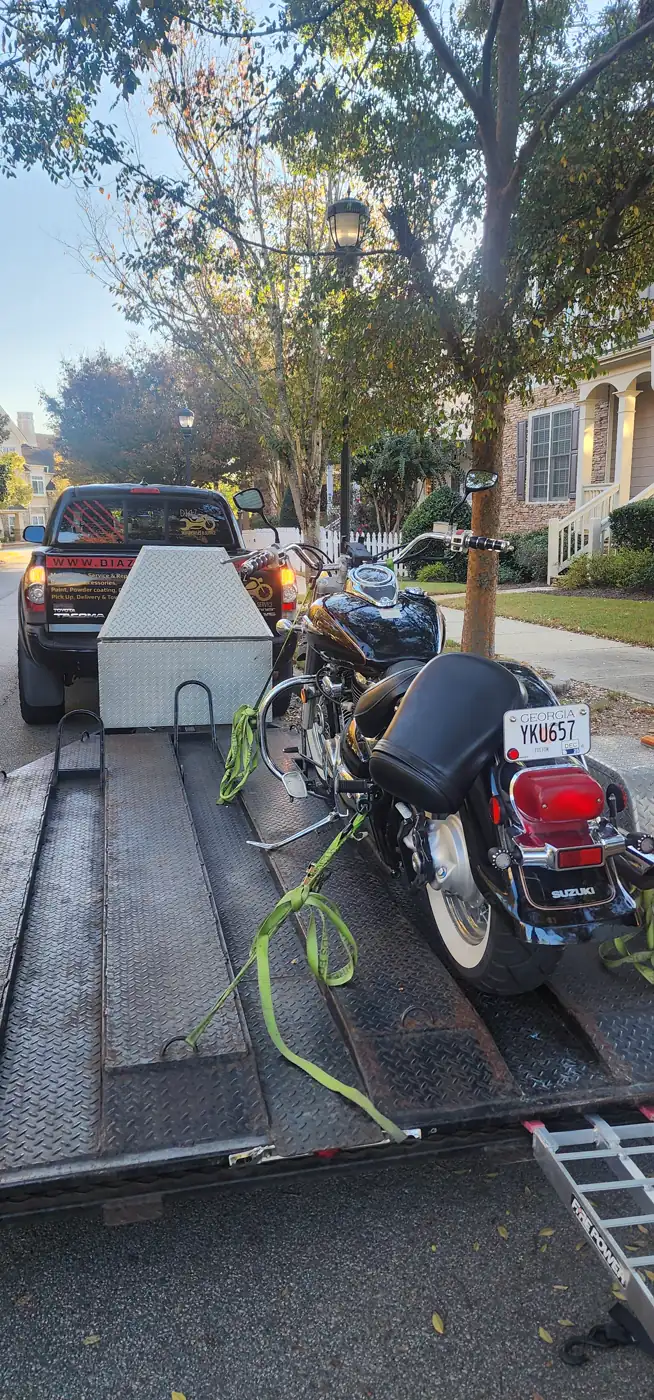
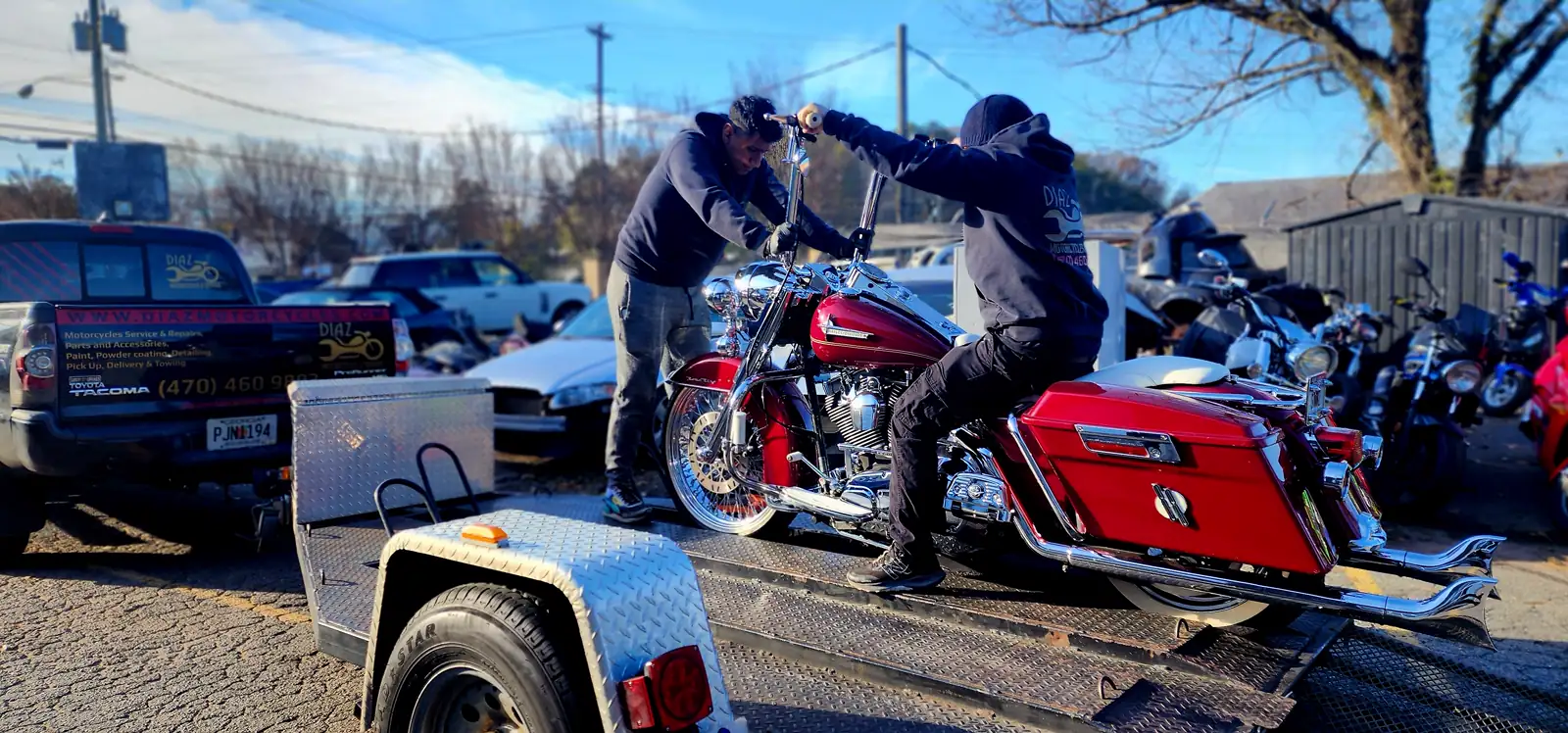
We can arrange transport for riders around Powder Springs and the rest of west Cobb, which helps a lot when the bike won’t run well enough to make the trip up Macland Road. Just tell us where it is and whether it starts. If it’s a garage-find that hasn’t turned over in years, mention that too so we bring the right gear.
How do I get a quote?
Text us the year, model, mileage, every modification, and what the bike is doing that you don’t like. That gets you a straight ballpark. The firm number comes after the baseline pull, because that’s the point where we actually know what your engine needs instead of guessing from a description.
Do you work on older bikes?
Gladly. Carbureted bikes can be dialed in on the dyno too — we’re reading jetting and needle position instead of a fuel map, but the process is the same. A lot of west Cobb garages have a project that’s been parked for a decade, and waking those up is some of our favorite work.
Will a tune hurt reliability?
Done properly, it usually helps. Most factory maps are lean in the cruise range for emissions reasons, and lean means heat. Getting the mixture right lowers running temperature and puts less stress on the engine. We tune for a bike that lasts, not for a screenshot.
We take care of riders all over west Cobb and the counties around it. Beyond Powder Springs, we regularly see bikes from Marietta, Austell, Mableton, Smyrna and Kennesaw on the Cobb side, plus Hiram and Dallas out toward Paulding. Riders from Douglasville, Lithia Springs and Villa Rica come up the other way, and we see plenty from Clarkdale and Fair Oaks as well. If you’re within a reasonable ride of the shop, you’re in our area — and if the bike isn’t running well enough to make the trip, ask us about transport.
TEXT US AND LET'S GET IT RIGHT
If your bike surges, runs hot, or has never felt right since the exhaust went on, we can help. Text us the year, model and what it’s doing, and we’ll tell you what a baseline pull is likely to show before you commit to anything. Powder Springs is a short run up to the shop, and your next long Saturday deserves a bike that answers the throttle every single time.
470-460-9883Diaz Motorcycles and Service, LLC · 847 Barnes Mill Road, Marietta, GA 30062