Dyno vs Stock Powder Springs — How to Choose
A plain-English look at what a dyno tune really changes, who actually needs one, and when leaving your bike stock is the smarter call.
The first properly warm Saturday in west Cobb has a sound to it. Garage doors rolling up all down the street. Somebody’s leaf blower two houses over. Then your bike, cranking a beat longer than it should, catching, and settling into an idle that just isn’t right. You blip the throttle and it hangs, then drops. That is usually the morning a rider starts asking the dyno vs stock Powder Springs question for the very first time. Leave the bike exactly how the factory set it, or have someone map it for the way you actually ride it?
Good news first, because there is plenty of it. Nothing about that rough morning means your engine is hurt. It means the bike is guessing, and guessing badly, about how much fuel to send. That is a fixable thing, and the fix is not mysterious.
The myth: stock is safe and tuned is risky
The story most riders have heard goes like this. Factory settings are the safe choice, and tuning is what you do when you want to squeeze out more power and accept a shorter engine life. Half of that is true. The other half causes a lot of unnecessary worry.
Here is the part nobody explains. A factory map is not built for you. It is built for every owner of that model, everywhere the bike is sold, on every grade of fuel, at every altitude. On top of that, the map has to pass emissions testing. To clear both bars at once, manufacturers lean out the mixture in the exact rev range you spend most of your Saturday in. Not because they want to. Because the rules say so.
So a stock bike is not neutral. It is already tuned, just tuned for an imaginary average rider who does not live on your street. That is the honest starting point for this whole comparison.
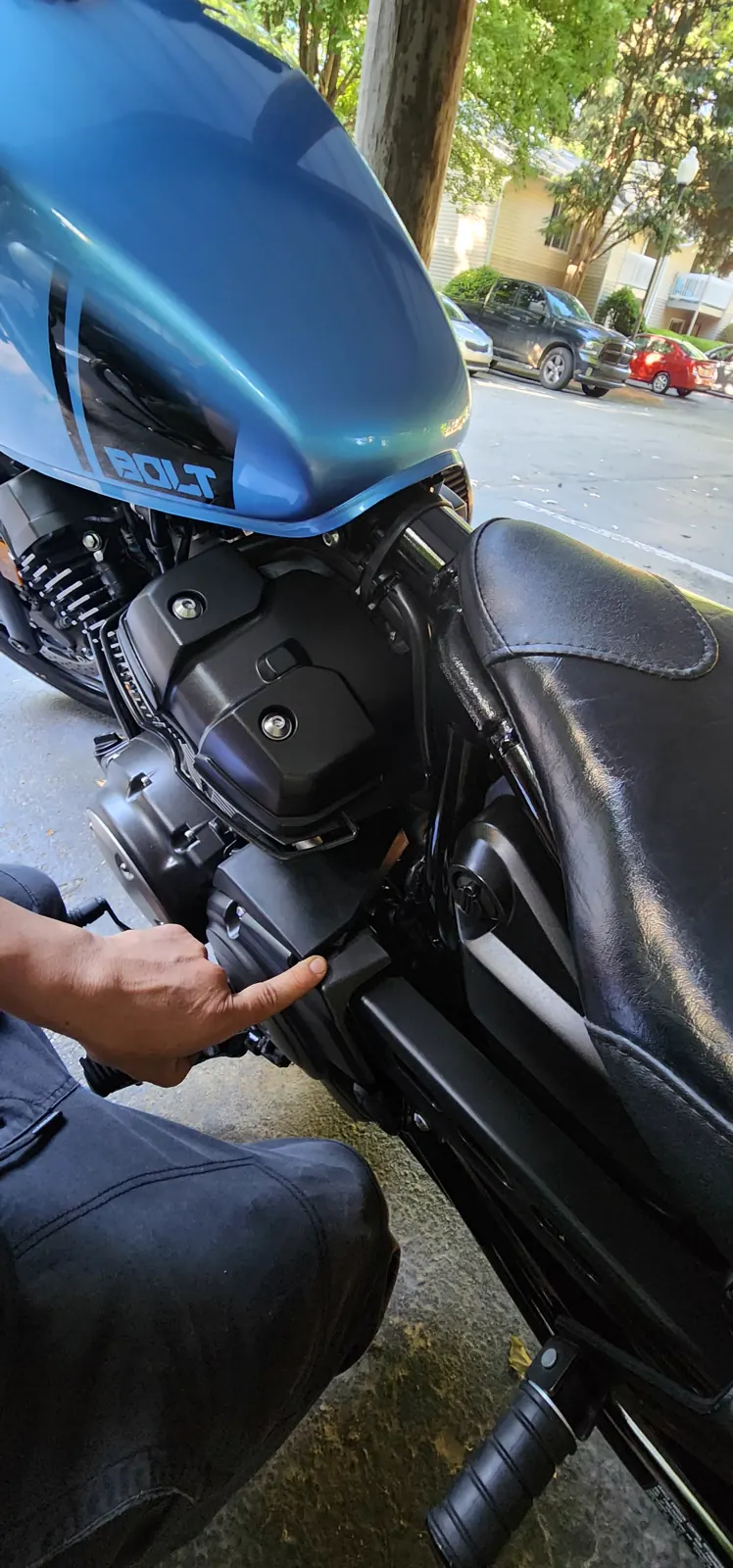
What a dyno actually measures
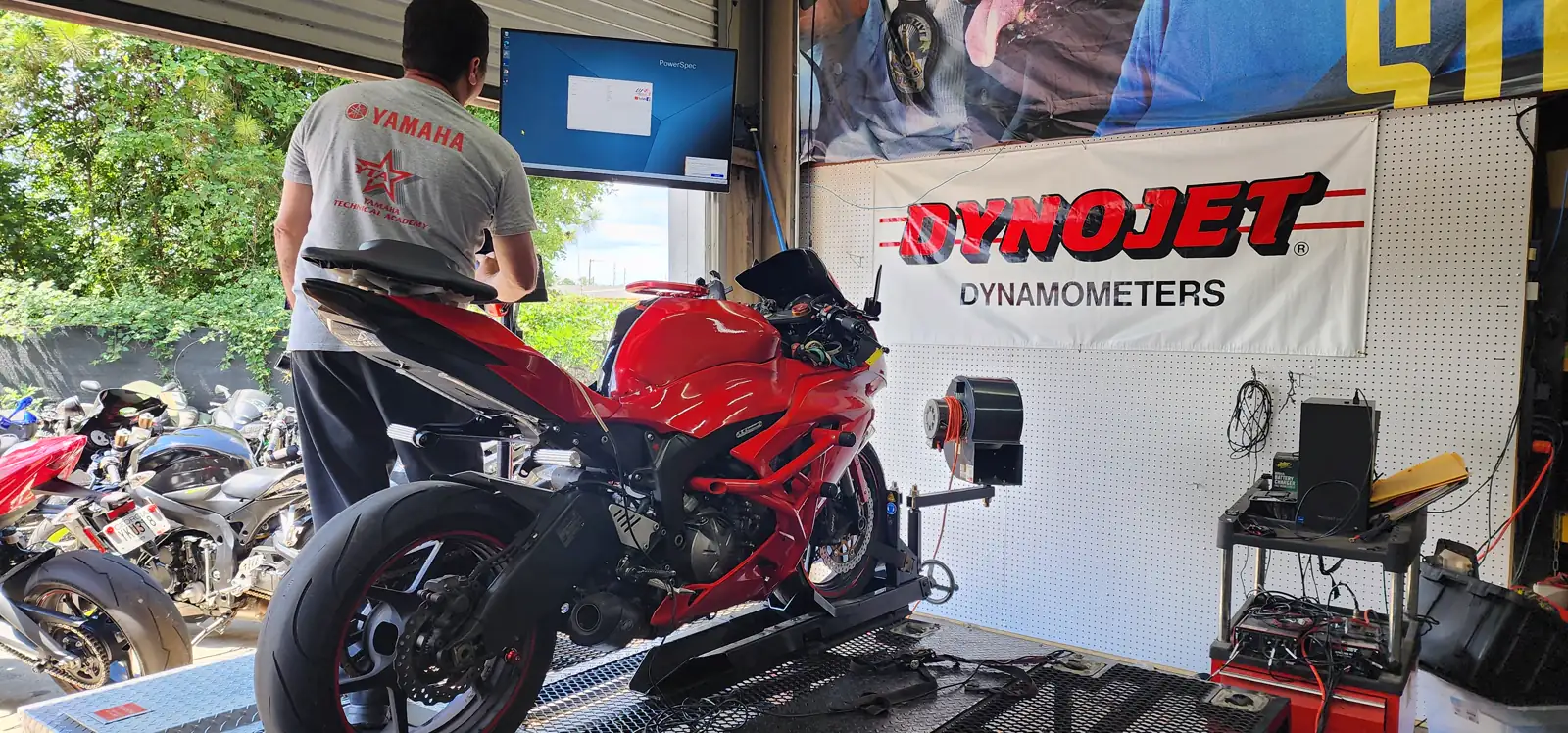
A dyno is a roller in the floor. Your bike gets strapped down on top of it with the rear wheel sitting on that roller. Then the bike gets run through the gears while standing still. The roller has a known weight, so the machine can watch how quickly your rear wheel spins it up and work backward to the force your engine is making. That is your torque. Torque and engine speed together give horsepower. Nothing magic about it.
But the power graph is honestly the least useful thing a dyno gives us. The part that matters for how your bike feels is a sensor in the exhaust reading the air-fuel ratio, moment by moment, at every throttle position and every rev. That reading is the whole story. It tells us where your engine is starving and where it is drowning, in numbers instead of opinions.
IN PLAIN WORDS
Lean means too much air and not enough fuel. The bike runs hot, surges at steady throttle and pops on deceleration. Rich means too much fuel. The bike feels heavy and lazy, fouls plugs and stinks. Neither one is a disaster. Both are just numbers we can move.
Riders feel lean long before they can name it. Heat coming off the engine at a light on Florence Road. A surge at a steady sixty. That hesitation right where you crack the throttle to pass. If you want the longer version of what usually causes it, we wrote that one out separately.
Why your bike drifts off the factory map anyway
Even a bone-stock bike does not stay where it started. Air filters load up. Exhausts age. Fuel here changes blend with the season. And most bikes in this part of Cobb County live a stop-and-go life on Hopkins Road and Brownsville Road, crawling behind school traffic and construction, which is the exact condition a factory map handles worst.
Then there is the obvious one. The moment anyone bolts on a slip-on exhaust, a high-flow filter, or opens up the air-box, the engine breathes differently. The computer keeps sending the same fuel it always did to an engine now pulling more air. That is a lean condition you created on purpose without meaning to.
There’s a second failure that hides behind the first one. Riders here store bikes indoors, in a two-car garage next to the truck, and ride in bursts rather than every day. That is a good thing for the paint and a rough thing for the fuel system. A bike that sits from November to March comes out with stale fuel, gummed passages and a battery that no longer holds a proper charge. Weak spark and dirty injectors mimic a bad tune almost perfectly. So a bike that feels flat in March might not need a map at all. It might need a spring wake-up first.
That is why any shop worth your time will check the boring stuff before it charges you for the interesting stuff. Plugs, filter, battery health, valve clearance, throttle bodies. Tuning a bike with a tired ignition is like tightening a belt on a pair of pants that already fell apart.
The actual process, start to finish
- Health check first. Plugs, filter, valve clearance, battery, leaks. If something is wrong here, we fix it and re-evaluate before touching the map.
- Baseline run. The bike goes on the roller stock, and we record power, torque and air-fuel ratio exactly as it sits. Now we have a real before, not a memory.
- Read the trouble spots. The graph shows us where the mixture goes lean and where it goes fat, tied to specific throttle openings and revs.
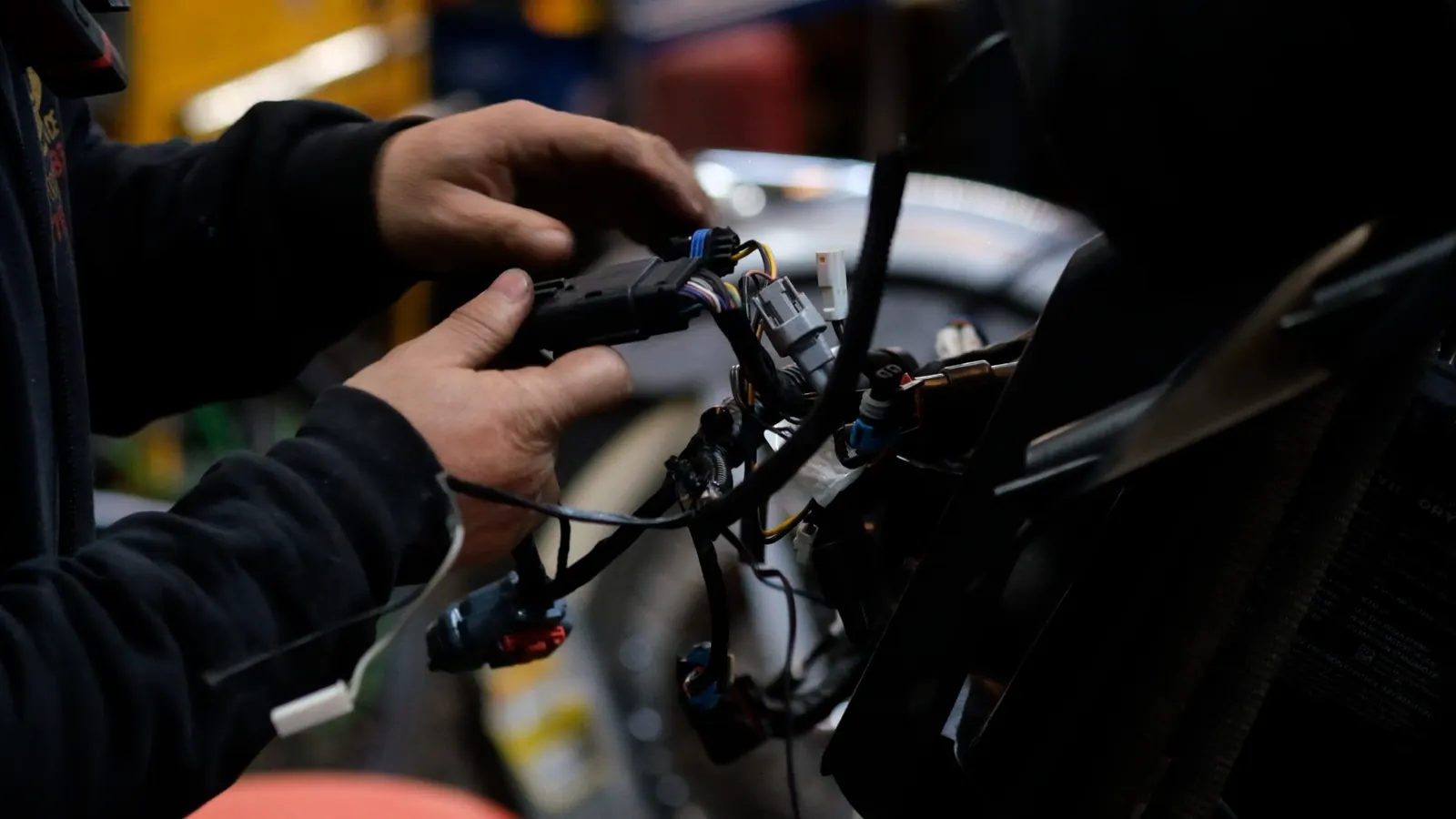
- Change how fuel is delivered. Either an ECU flash that rewrites the bike’s own instructions, or a Power Commander that sits in the wiring and adjusts the signal on its way through.
- Run it again. And again. Small correction, new run, read the numbers, correct again. This part is patient work, not a single heroic pull.
- Road-check and hand it back with the sheets. You should leave holding printed runs, not a verbal promise.
An ECU flash is the cleaner answer on most modern bikes because it edits the original brain directly, including things a piggyback box cannot reach, like throttle response and rev limits. A Power Commander is the better answer on older or oddball bikes whose computers cannot be safely rewritten, and it comes off in minutes if you sell the bike. There is no universal winner between the two, which is exactly why we look at your bike before recommending one. You can see everything we cover on the tuning side, and what the work covers in more depth if you like detail.
A tune is not extra power bolted on. It is your engine finally getting the fuel it was already asking for.
How to tell a good tuning shop from a laptop and a confident voice
- They run a baseline before changing anything. No baseline means no proof.
- They give you the sheets. Before and after, printed, yours to keep.
- They ask what you ride, not just what you own. Weekend two-lane riding and around-town errands want different maps.
- They talk about air-fuel ratio and rideability at least as much as peak power.
- They say no sometimes. If your bike needs plugs and a valve check first, a good shop tells you that instead of selling you a map.
- They own the dyno. If tuning gets shipped out, nobody in the building can chase a small problem on Tuesday afternoon.
That last one is the real dividing line around here. Plenty of shops on the Cobb Parkway strip sell and service bikes well. WOW Motorcycles, over at 522 Cobb Pkwy N in Marietta, is a large pre-owned powersports dealer roughly seventeen to nineteen miles northeast of Powder Springs, and there is nothing wrong with buying a bike there. Custom mapping in-house is simply a different specialty. Ours is a shop that keeps the dyno, the flashing tools and the paint booth under one roof.
So which one should you pick?
Here is our straight answer on dyno vs stock Powder Springs, no fence-sitting. If your bike has any intake or exhaust change at all, get it tuned. Not eventually. That bike is running lean right now, and it will keep feeling rough and running hot until the fuel matches the air. Get a tune.
If your bike is fully stock and you ride mostly errands around town, stay stock and spend that money on tires, brake fluid and a proper spring service. You will feel that more than you would feel a map. Honestly, fresh rubber changes a bike’s manners more than most riders expect, and Michelin’s motorcycle tire resources lay out why.
The interesting middle is a stock bike ridden hard on long days. If you point the bike north for the Georgia Triangle, running SR 60 up toward Suches and looping Wolf Pen Gap Road and SR 180, you spend hours in exactly the rev range factory maps lean out worst. That is a day and a half of riding, an hour and a half to two and a half hours out before the good part even starts. A tune there is not about bragging. It is about a throttle that answers cleanly through two hundred corners while you are getting tired.
| Your situation | Better call |
|---|---|
| Any exhaust, filter or intake change | Tune it |
| Fully stock, short around-town rides | Stay stock |
| Stock, but long mountain days | Tune it |
| Bike sat all winter and feels flat | Service first, then decide |
| Stock bike under factory warranty | Stay stock, talk to us first |
| Older or vintage bike, no flashable ECU | Piggyback tune |
When stock genuinely wins
We will say the quiet part out loud, because you deserve a real answer instead of a sales pitch. Stock wins when a bike is new, unmodified and under warranty, and the owner has no interest in arguing with a dealer about anything later. Stock also wins on a bike you plan to sell inside a year. And stock wins when the budget is finite and the tires are aging, because tires are not optional and a map is.
Picture the version of this where you caught it early. Same bike, same warm Saturday, except the surge never showed up because the fueling got sorted the same week the pipe went on. No summer of telling yourself it is probably fine. No standing in the garage in Amberton, listening to it hunt at idle, wondering if this is the year something expensive happens. Just a bike that starts, settles and pulls. That is the whole prize, and it is not a dramatic one. It is just peace.
West Cobb, specifically
Powder Springs has no motorcycle dealership and no large full-service independent inside the city. That leaves riders in Stonebridge at Mud Creek and the newer houses going up in Croftside choosing between small operators and dealerships twelve to twenty miles out. For oil and tires that is fine. For custom mapping there is no local option at all, which is why this trip is worth planning rather than squeezing in.
Getting to us runs roughly fifteen to eighteen miles. Most riders take Powder Springs Road or Macland Road northeast into Marietta, then east on Roswell Road to Barnes Mill Road. Figure around a half hour depending on lights and school traffic, though treat that as an estimate rather than a promise. Tuning is not a wait-in-the-lobby job anyway, so plan on leaving the bike.
One more piece of local reality. Georgia bans lane splitting and filtering, so nobody here gains a thing by commuting on US 278, the C.H. James Parkway spine everybody names. That means bikes in this city accumulate miles in bursts, then sit. Bursts and sitting are hard on fueling, which is why so many west Cobb bikes feel their worst on the first ride of the season and their best about three rides later.
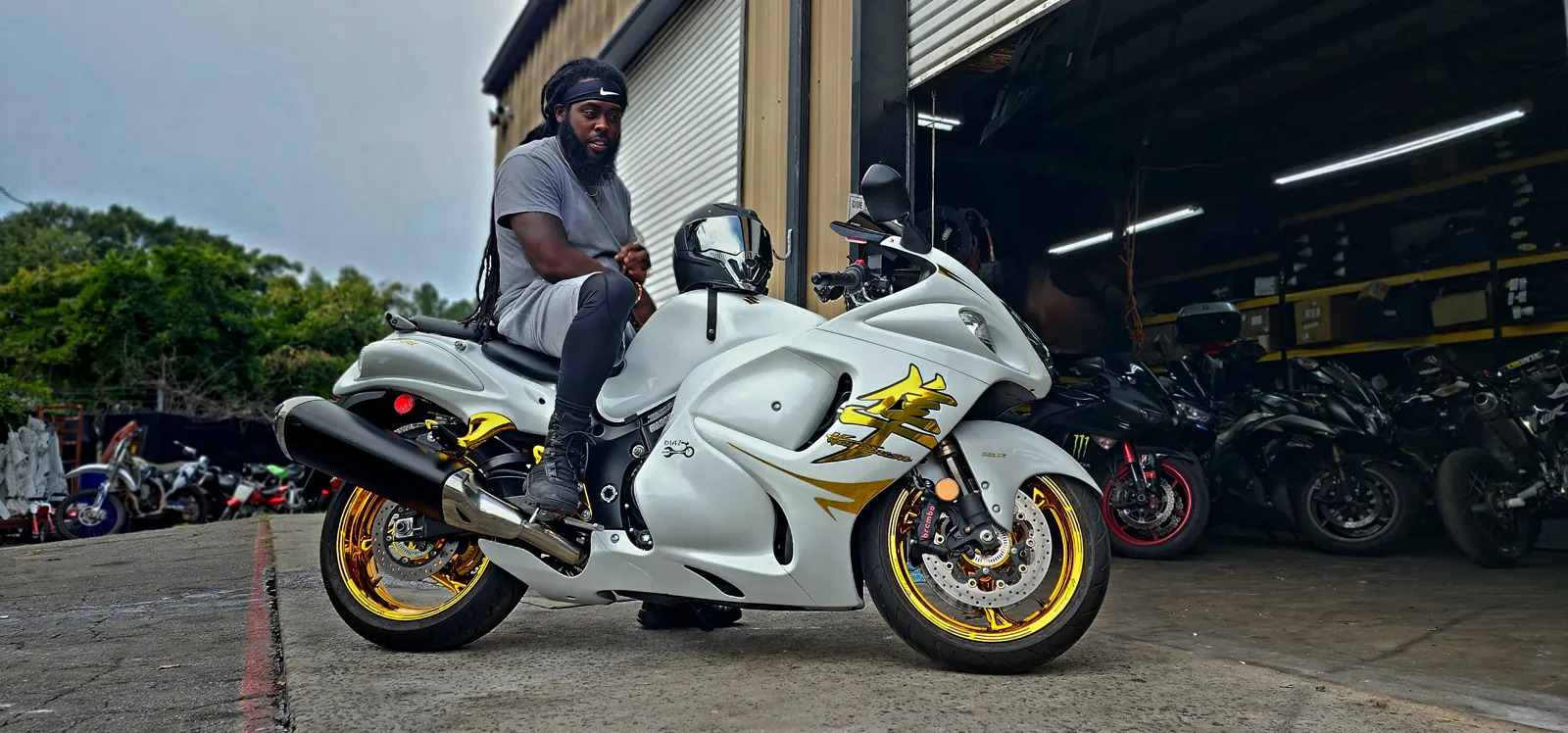
What the good outcome looks like
You get the bike back with paper in your hand. Then comes the first honest test, which is not a drag race. It is a Saturday morning loop out past Wild Horse Creek Park with the fifty-three acres and the ball fields already busy, throttle steady, engine quiet and even underneath you. No surge. No heat coming up at the light. Later you park outside Skint Chestnut Brewing Company downtown, and when somebody asks what you did to it, the true answer is small and satisfying. You did not add anything. You just stopped it from guessing.
Riders in other cities land in the same spot, and it is worth seeing what Gainesville riders run into for comparison. For a broader take on how modification and fueling interact, RevZilla’s Common Tread covers it well.
However you answer the dyno vs stock Powder Springs question, you will know your bike better than you did last spring. That is not a small thing to own.
Questions Powder Springs riders ask us
Which one is right for how I ride?
Start with what you have changed. If the exhaust, filter or intake is not factory, tuning is the right call because the fueling no longer matches the airflow. If everything is stock and your rides are short and local, staying stock is genuinely fine. Long mountain days on a stock bike sit in the middle, and that is a conversation worth having.
Can I switch later, or is this a one-time decision?
You can absolutely switch later. Nothing about running stock now closes the door on tuning next season. A piggyback unit comes back off in minutes, and a flashed ECU can usually be returned to factory settings. We keep your baseline runs on file so there is always a reference point.
Which do you actually recommend?
For a modified bike, we recommend tuning without hedging, because a lean modified engine runs hot and feels rough every single ride. For a stock town bike, we recommend skipping it and putting that attention into tires, fluids and a spring service. We would rather tell you no than sell you a map you will not feel.
Does my particular bike change the answer?
It does. Modern bikes with flashable computers usually get a clean ECU flash, which reaches things a piggyback cannot touch. Older bikes, vintage projects and some cruisers do better with a Power Commander because their computers are not safely rewritable. Big-power sportbikes tend to show the biggest change, while small commuters show the least.
Is the upgrade worth it if my bike runs okay now?
Okay is doing a lot of work in that sentence. Many riders describe a surge or a flat spot as normal because they have never ridden the same bike mapped properly. If the bike truly runs smooth, cool and clean, stay stock and enjoy it. If you are working around a quirk, that quirk is usually fueling and it is usually fixable.
My bike sat all winter and feels terrible. Do I need a tune?
Probably not yet. Stale fuel, a weak battery and dirty injectors imitate a bad tune almost exactly, and that is the most common spring complaint we hear. We check the basics first and get the bike healthy. If it still feels off after that, then the dyno tells us why.
We take care of riders across west Cobb and the counties around it. Powder Springs sits right in the middle of that, with Marietta, Austell, Mableton and Smyrna a short ride away, and Hiram, Dallas and Douglasville just as easy on a Saturday morning. We also see plenty of bikes from Kennesaw, Lithia Springs, Villa Rica, Clarkdale and Fair Oaks, and riders regularly plan a tuning drop-off around a longer day out. If you are within reasonable riding distance of Marietta, come see us.
LET'S SETTLE IT ON THE ROLLER
Not sure whether your bike needs a map or just a good spring service? Text or call us and describe how it feels. We will tell you straight, even when the answer is stay stock. Powder Springs riders make the run to our Marietta shop all the time, and most of them leave holding printed dyno sheets and a bike that finally stopped guessing.
470-460-9883Diaz Motorcycles and Service, LLC · 847 Barnes Mill Road, Marietta, GA 30062