Motorcycle Dyno Tuning Woodstock: What It Costs and What It Actually Fixes
A plain-English look at what happens on the dyno, why bikes run lean or rich, and how we price the work before you commit.
You usually hear it before you can explain it. For example, the bike surges at a steady throttle, pops on the way down, or feels flat right where it used to pull hard. If that sounds like your bike, motorcycle dyno tuning Woodstock riders ask us about is the fix, and the answer is simpler than the internet makes it sound. After that, we strap your bike to a dyno, measure what the engine is truly doing at every throttle position, and then rewrite its fuel and spark instructions so it runs clean everywhere you actually ride.
What’s more, that’s the whole service in a paragraph. No secret sauce. A dyno is a measuring tool, not a horsepower vending machine, and the number on the screen is a byproduct. What you’re really buying is a bike that behaves.
Who’s it for? Anybody who changed something. A slip-on or a full exhaust, a high-flow filter, cams, a big-bore kit, different gearing. It’s also for riders who changed nothing at all and just want the stumble gone, because plenty of bikes leave the factory with a cautious map built to pass a test rather than to please you at 4,000 rpm on a two-lane road.
A bike from Towne Lake that wouldn't behave
That said, a rider out in Towne Lake brought us a big adventure bike last spring. Nice machine, well kept, garage-stored the way most bikes are in those 1990s master-planned neighborhoods where a three-car garage came standard. He’d added an exhaust and a filter over the winter. The bike started fine, idled fine, and then fell on its face in the middle of the rev range every single time.
He had done what most sharp riders do first. Even so, he read forums. He downloaded a map somebody swore by. He tried a second one. The bike got different, but it never got right, and by the time he called us he was convinced something inside the engine was failing. It wasn’t. Nothing was broken at all. The engine was simply being told to do something that didn’t match the air it was now breathing.
What a dyno actually measures
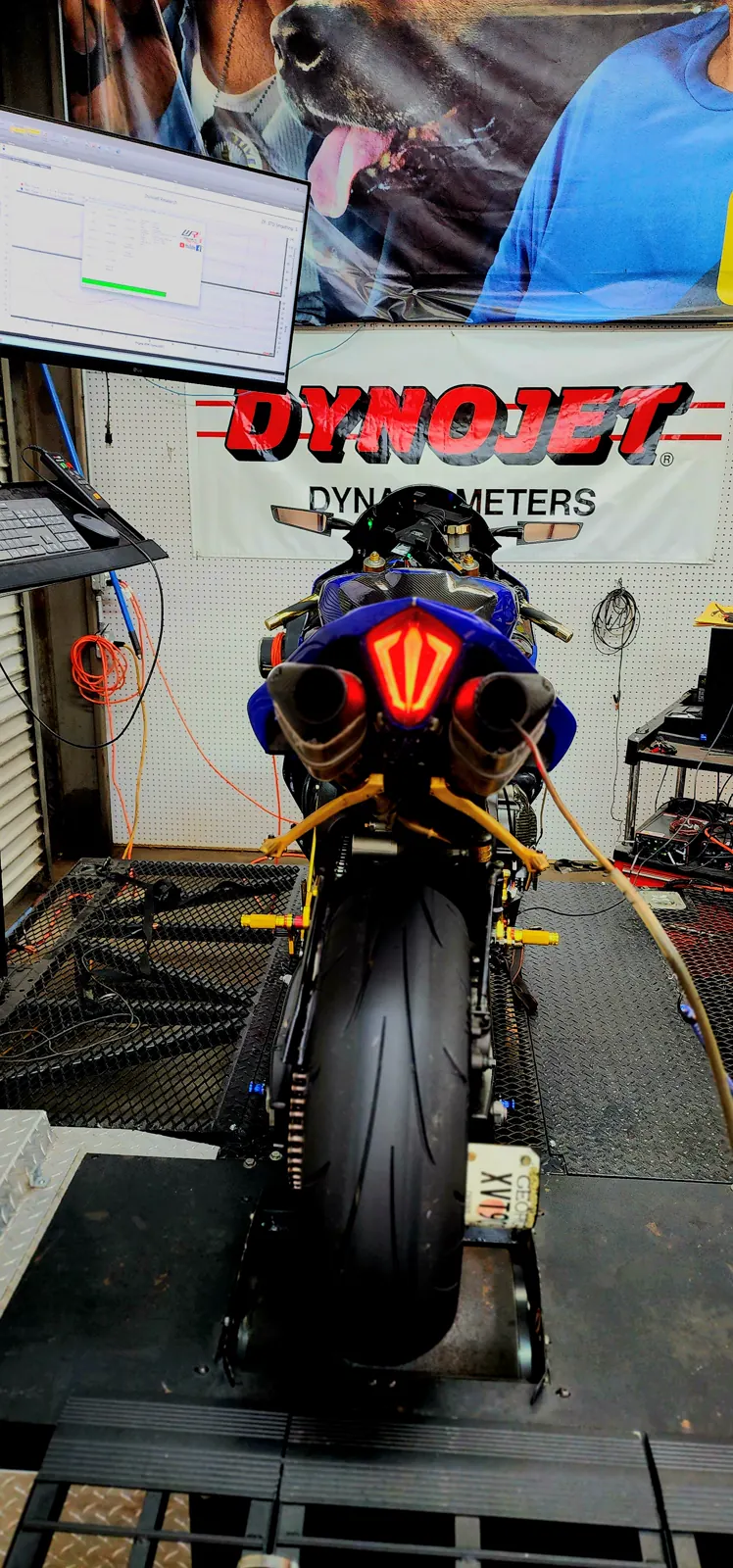
Picture a treadmill for motorcycles. The rear wheel sits on a heavy steel drum, the bike is strapped down tight, and a technician runs it through the gears while the drum fights back. The dyno knows exactly how heavy that drum is, so it can do simple math on how fast the wheel spins it up. That math becomes your power and torque curve.
At the same time, we slide a wideband oxygen probe up the exhaust. That probe sniffs what comes out the back and tells us how much fuel the engine burned for the air it swallowed. So we get two pictures at once: how much the bike is making, and how honestly it’s making it. One without the other is guessing.
- Power and torque at the rear wheel, across the whole rev range, not just at the top
- Air-fuel ratio at every throttle opening, from a light cruise to wide open
- The flat spots, surges and hesitations you feel on the road, drawn as a shape you can see
- Whether a part you paid for actually did anything, which is sometimes the most useful answer of all
Lean, rich, and why it happens in plain words
An engine wants a certain amount of fuel for a certain amount of air. Lean means not enough fuel for the air coming in. Rich means too much. Lean bikes run hot, surge at steady throttle, pop loudly on decel and sometimes cough when you crack the throttle. Rich bikes feel lazy, foul plugs, smell strong and dirty the exhaust. If you want the longer version of why that problem shows up, we wrote a whole post on it.
Here’s the part nobody tells you. Your bike didn’t turn lean because it’s mad at you. Emissions rules push factory maps thin in the cruising range. Then you add a freer-flowing exhaust and a better filter, and now more air goes in while the computer keeps handing out the same fuel it always did. Same fuel, more air, leaner mixture. Good news: that’s a software problem with a software fix, and it’s about the most solvable thing that walks through our door.
HEAT IS A SYMPTOM
If your bike cooks your right leg in traffic and pops like popcorn on every downshift, that’s usually not a personality trait. That’s a fuel map asking for help.
The internet will tell you one thing. The bikes tell us another. Downloadable maps get shared like recipes, and on paper they seem reasonable, since a map from a bike with your exact exhaust ought to work on yours. In practice, no two bikes are twins. Build tolerances differ, injectors flow slightly differently, valve clearances drift with miles, altitude and humidity shift, and your gas isn’t the same gas that tuner was using. A borrowed map is a guess wearing a lab coat. Nearly every free file a rider finds while shopping for motorcycle dyno tuning Woodstock way was built on somebody else’s engine.
Your three real options
1. A canned or off-the-shelf map
Cheapest path, and sometimes it’s genuinely fine, especially on a stock bike with one small change. It’s a starting point built from an average bike. Averages help. Averages also miss, and when they miss you’re back to chasing a stumble with no data in hand.
2. An ECU flash
Here we rewrite the bike’s own factory computer. No extra box, no extra wiring. A flash can raise rev limits, sharpen throttle response, unlock timing and clean up the fuel tables the factory left thin. Modern bikes respond beautifully to this. For Harley riders, the factory publishes plenty of its own Harley-Davidson service information, and we work inside those specs rather than against them.
3. A Power Commander or piggyback module, dialed in on our dyno
This adds a small box that intercepts what the ECU tells the injectors and adjusts it. Where it earns its keep is custom mapping. We build the map on the drum, on your bike, cell by cell, until the air-fuel ratio reads right everywhere. That’s the real work. That’s also the piece most multi-line shops around Cobb Parkway hand off to somebody else, and it’s why what we take care of here stays in-house from start to finish.
How we diagnose before we ever quote you
We don’t price tuning off a phone call, because a phone call can’t tell us whether your problem is a map or a mechanical issue wearing a map costume. A clogged injector, a tired plug, a sticky throttle body, a small intake leak or a lazy fuel pump can all mimic a bad tune. Tuning around a real fault just bakes the fault in. So we look first, then we tell you a number, and the number doesn’t move after that unless you tell it to.
- You tell us what the bike does and where. Which gear, which rpm, hot or cold, steady throttle or hard pull.
- We list every part that’s been changed, plus anything a previous shop or a previous owner did.
- Meanwhile, we check the mechanical basics: plugs, filter, injector spray, throttle bodies, leaks and fuel delivery.
- We do a baseline pull on the dyno so we can see the curve and read the air-fuel ratio as it sits today.
- Then we call you with what we found, what it’ll take, and what it’ll run. You decide from there.
So what drives the price? Four things, mostly. Whether your bike needs a flash or an added module. How many cylinders we’re mapping and how many maps that means. Whether anything mechanical needs fixing before a tune is even honest. And how far your build sits from stock, since a bike with cams and a big-bore kit takes more pulls than a bike with a slip-on. None of that is a mystery once your bike is in front of us, and none of it gets tacked on later. Registration and tag questions, by the way, live over at the Georgia Department of Revenue and never on our invoice.
What it feels like after
This is the part riders underestimate. A good tune rarely feels dramatic in the parking lot. It feels obvious about ten miles in, when you stop bracing for the flat spot that used to live at a certain rpm. Throttle pickup gets crisp instead of vague. The surge at steady cruise disappears. Heat drops. Popping on decel calms down. Fuel mileage often improves a touch, since an engine that isn’t fighting itself doesn’t waste as much.
Where you’ll notice it most is exactly where Woodstock riders spend their good weekends. Run north and get on GA 52 past Fort Mountain State Park, where the mellow curves and long relaxing stretches toward the Cohutta Overlook ask for smooth, predictable throttle for hours at a time. A twitchy map is tiring up there. In fact, a clean one lets you stop thinking about the engine and start looking at the mountain horizon, which is presumably why you rode up in the first place.
A good tune doesn't shout. It just quietly removes every reason you were bracing.
A quick story, because it makes this concrete
A friend we helped from Deer Run rides a big touring bike, the kind that’s a joy on the highway and miserable when it runs hot in traffic. He’d had it tuned somewhere else years earlier and figured that was that. His actual complaint was small and specific: it stumbled pulling out of a parking spot, every time, and he’d started planning around it. He’d sat through a show at Woodstock Arts over on Elm Street and told us he spent the walk back to the bike dreading the pullout more than he enjoyed the play.
On our drum, his baseline read painfully lean in the low-throttle, low-rpm zone, which is precisely where a heavy bike needs fuel most. His old map had been built for a different exhaust than the one on the bike. We fixed the bottom of the map first, then blended it upward until the whole curve read clean. Nothing exotic. He texted us a week later from the lot at the Northside Hospital-Cherokee Amphitheater, sitting in the after-show crawl, to say the bike pulled away like a normal machine and his leg wasn’t roasting. That’s the win. Not a number, a Tuesday.
Getting your bike to us from Woodstock
You’re in Cherokee County, and we’re in Marietta, so the trip is about 15 to 19 miles and takes roughly 25 to 35 minutes. Take I-575 south to I-75 south, then east on Roswell Road to Barnes Mill Road. If the interstate is behaving badly, Bells Ferry Road drops you south into north Cobb without much drama. Riders coming from newer streets like Serenade or from anywhere along the Towne Lake corridor all funnel the same way, since I-575 is the spine of the whole county.
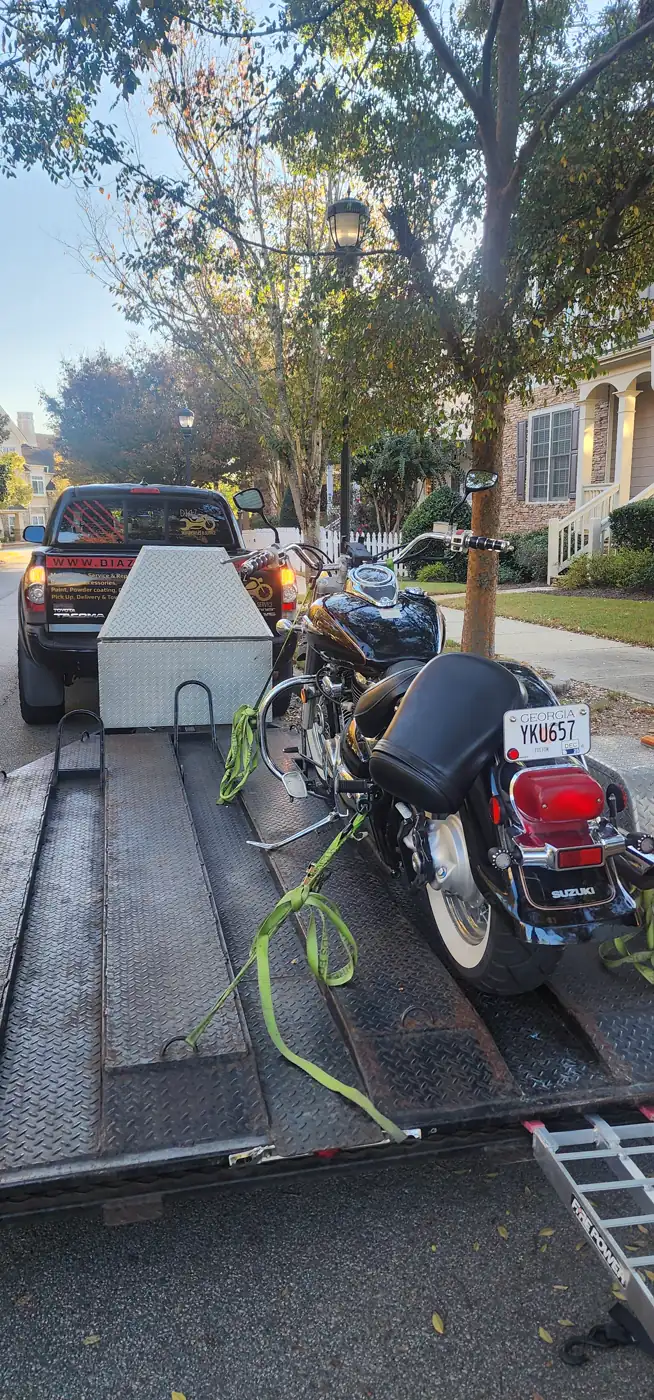
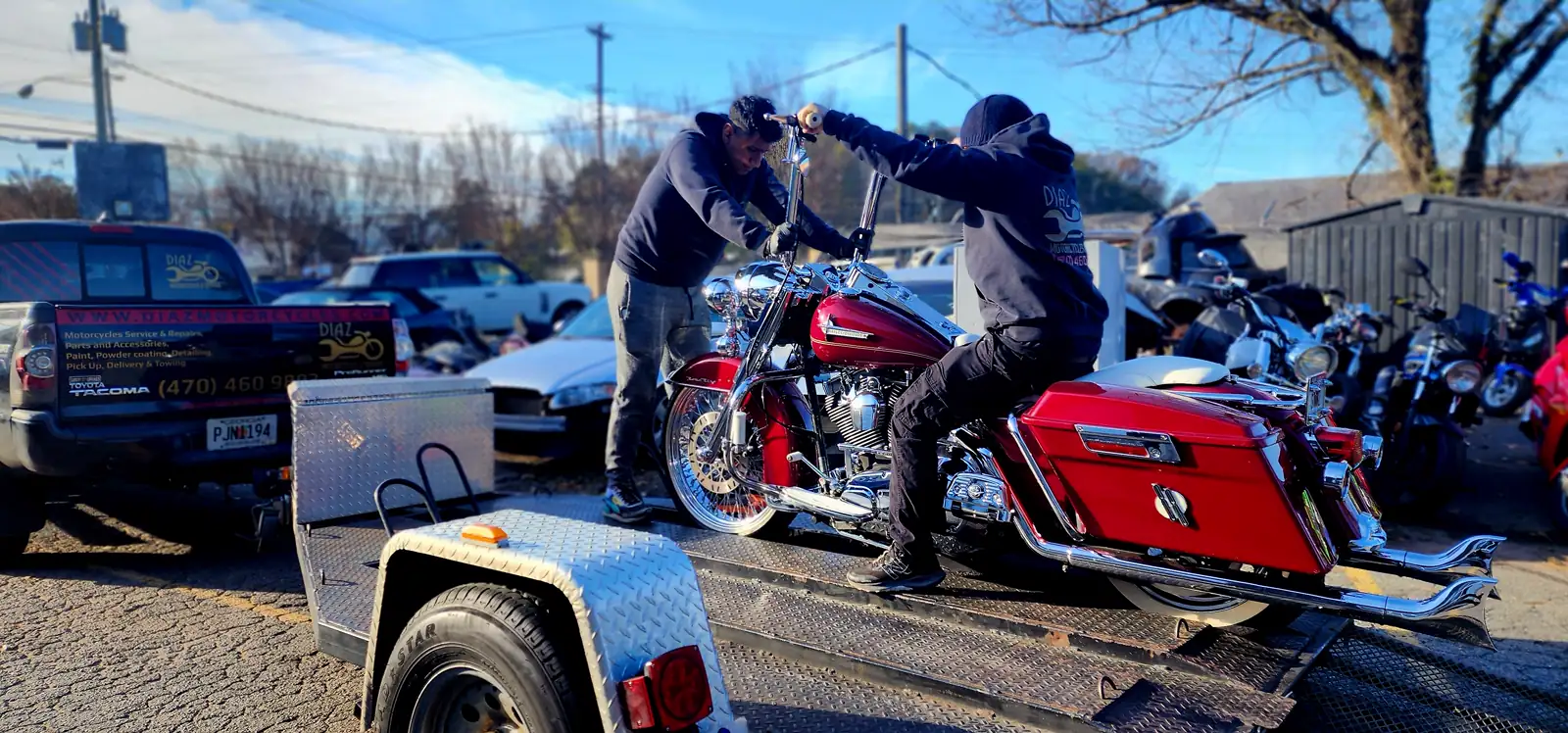
If the bike won’t make the trip, don’t sweat it. We pick up, we deliver, and we transport out of state when it comes to that. A rider who limps home from a mountain run shouldn’t have to solve a trailer problem before solving an engine problem. And yes, you can absolutely get a dyno session closer to home in some form. Hellbender Harley-Davidson down on South Cobb Drive, the shop a lot of folks still call Earl Small’s, markets to Woodstock too. The difference is scope. Woodstock has more motorcycle businesses than any city in our radius, but nearly all of them are narrow: suspension only, one brand only, Japanese only, or newer bikes only. We’re all brands, all ages, and we do the mapping ourselves.
That matters more here than most places. This is a technically literate riding town, with Traxxion Dynamics headquartered locally and a crowd that skews sport-touring, ADV and premium touring rather than stoplight racing. Folks ask hard questions, and we like that. If you want to compare notes, riders over in Smyrna ask us nearly the same things, and for the technical side of what a session involves we’ve written the full rundown on it.
One last note on timing. Late November through February is when most bikes here go quiet anyway, and that idle stretch is the smartest window for tuning or engine work. Book it in the cold and you’ll be sorted before the first good spring weekend.
Questions Woodstock riders ask us
What's actually included in a dyno tuning session?
We start with a full inspection and a baseline pull so we can see your power curve and read your air-fuel ratio as the bike sits. Then we build or flash a map and keep running pulls until the mixture reads right across the whole range. You leave with a bike that’s been measured, not guessed at, and we’ll walk you through the before-and-after graph so you can see what changed.
How long does it take?
Most tunes are a same-day or next-day job once the bike is on the drum. Heavily modified bikes take longer, because more changes mean more pulls and more fine-tuning. If we find something mechanical that needs fixing first, we’ll call you before we touch anything and give you a realistic timeline.
Do you work on my brand?
Almost certainly yes. We tune Harley, Honda, Yamaha, Kawasaki, Suzuki, BMW, Ducati, Triumph, KTM, Indian and Aprilia, plus plenty of older bikes that other shops turn away. Sport-touring and adventure bikes are a big part of what rolls in from Cherokee County, and baggers are right behind them.
Do I need an appointment?
It helps a lot, since the dyno can only hold one bike at a time. Text us and we’ll get you a slot that fits your week. If you’re in a bind and something opens up, we’ll squeeze you in, but planning ahead almost always gets you a better day.
Can you pick up my bike?
We can. Pickup and delivery are part of what we do, and we handle out-of-state transport when that’s what a bike needs. If your bike quit on a mountain run or simply isn’t safe to ride down I-575, tell us where it is and we’ll come get it.
Will a tune hurt my engine or my warranty?
A proper tune protects an engine, because a lean engine runs hot and hot is what wears parts out. We tune for a safe, healthy mixture first and performance second. Warranty terms vary by brand and by what you change, so ask us and we’ll tell you straight what your specific situation looks like.
We take care of riders all over the north metro, starting with Woodstock and the whole Towne Lake corridor, then out to Canton, Holly Springs and Ball Ground up the I-575 line. Closer to the shop, we see plenty of bikes from Acworth, Kennesaw, Marietta and East Cobb, and we’re an easy run for riders coming west from Roswell, Alpharetta and Milton. Cartersville folks make the trip too, usually with a trailer or with us picking the bike up. If you’re somewhere in between, just ask.
TEXT US ABOUT YOUR BIKE
If your bike surges, stumbles, pops or just doesn’t feel like it should, send us a text and tell us what it’s doing. We’ll tell you whether a tune is the answer before you ride down from Woodstock, and if it is, we’ll look at it first and quote you second. Can’t get it here? We’ll come get it.
470-460-9883Diaz Motorcycles and Service, LLC · 847 Barnes Mill Road, Marietta, GA 30062