Dyno Tune vs Stock Newnan — The Real Answer
You bought a used bike with a mystery past. Here's how to tell if it needs a tune, or if it's already fine just the way it is.
You found the bike online. Maybe it sat for years in a garage out toward Talaria Farms, wearing a coat of dust and a story the seller only half remembered. It fired up. It sounded mean. So you handed over the cash and rode it home. Now it surges at low speed, and it runs hot when traffic slows to a crawl, and you can’t tell if that’s normal or if something’s off. That, right there, is the dyno tune vs stock Newnan question. And you deserve a real answer to it, not a shrug and a maybe.
Here’s the honest part. Most used bikes never got a proper tune. Somewhere down the line, an owner bolted on a louder pipe, maybe a free-flowing air filter, snapped a photo, and called it done. The engine has been guessing ever since. Nothing is broken. The bike is just running on a factory map that was never built for the parts it’s wearing today. So it makes do. It runs a little hot, a little rough, and you feel it even if you can’t name it.
Good news, though. This is one of the most fixable things on a motorcycle. Once you know what your bike is trying to tell you, the choice between leaving it stock and putting it on the dyno gets a whole lot clearer. And no, you don’t need to be a mechanic to follow along. If you can read a fuel gauge, you can read the rest of this.
Start with what your bike is actually telling you
Before we compare anything, listen to the machine. Bikes are chatty. They tell you exactly how they feel if you know the signs. Grab a coffee and think about your last few rides. Did any of these show up?
- The engine runs hotter than you’d expect, especially in stop-and-go crawl along the Ashley Park shopping strip.
- You hear popping or crackling on the exhaust when you roll off the throttle.
- It surges or hunts at a steady cruise, like it can’t hold one speed cleanly.
- There’s a flat spot or a stumble right off idle when you first crack the throttle.
- You smell raw fuel, or the tailpipes and plugs look black and sooty.
- Gas mileage feels worse than it should, and the bike feels lazy up top.
Nod along to two or three of those, and your bike is basically waving a little flag. It doesn’t mean disaster. It means the mix of air and fuel isn’t dialed in. That’s the whole ballgame, and it’s very fixable.
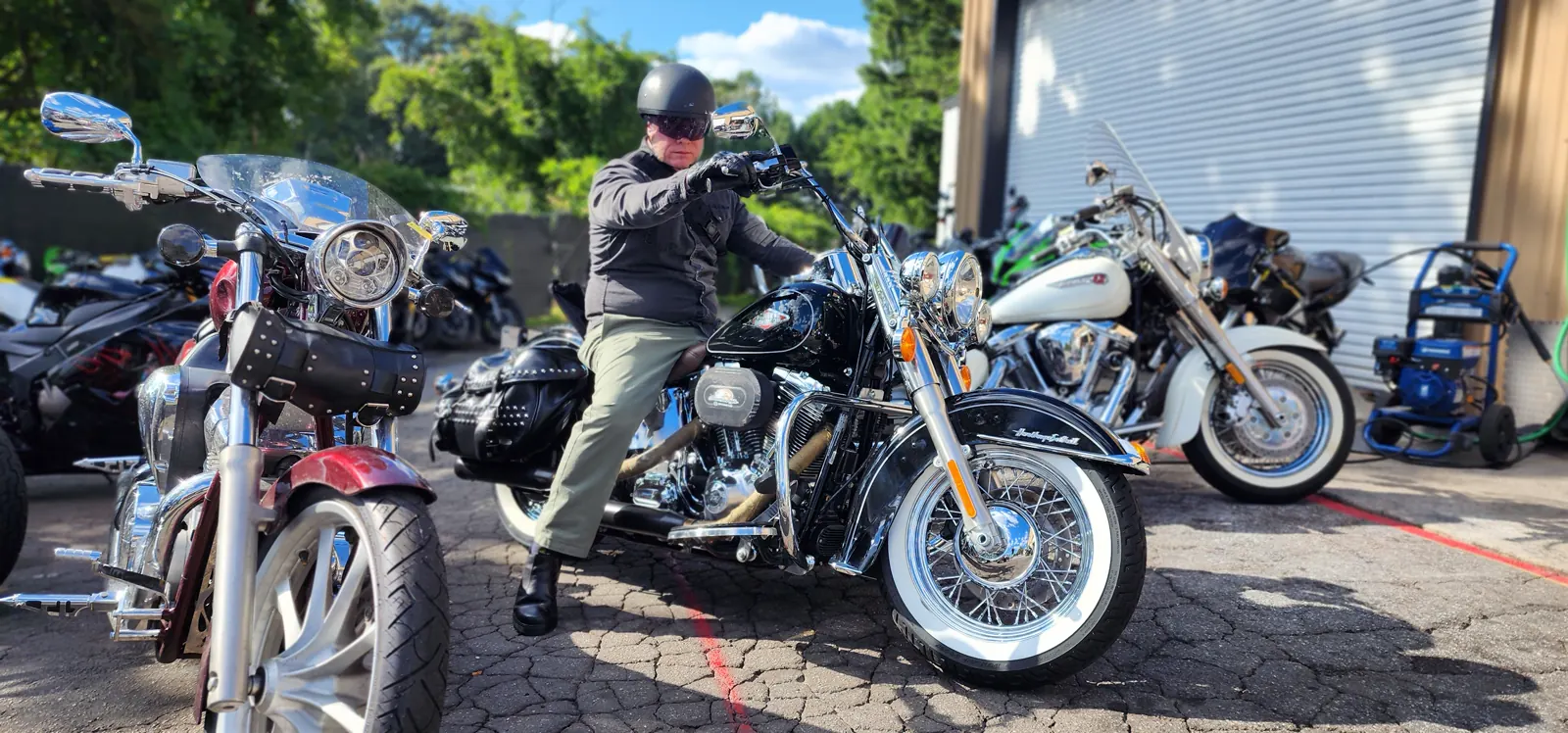
Lean, rich, and why your bike keeps guessing
Every gas engine burns a blend of air and fuel. When that blend has too much air and not enough fuel, we call it lean. A lean bike runs hot. It pops on deceleration, it surges, and over time all that heat is hard on the engine. When the blend has too much fuel and not enough air, we call it rich. A rich bike feels sluggish and lazy. It fouls plugs, it smells like a gas station, and it drinks more fuel than it should. Neither one is where you want to live.
So why does a bike run lean or rich in the first place? Simple. The factory writes one fuel map to cover every rider, every altitude, and every set of emissions rules in the country. It’s a compromise on purpose. Then someone adds a pipe or an intake, which changes how much air moves through, and the old map no longer matches. Now the bike is feeding the wrong amount of fuel at half the rev range. It guesses. And it guesses wrong more often than you’d think. If you want the longer version, here is how the work adds up.
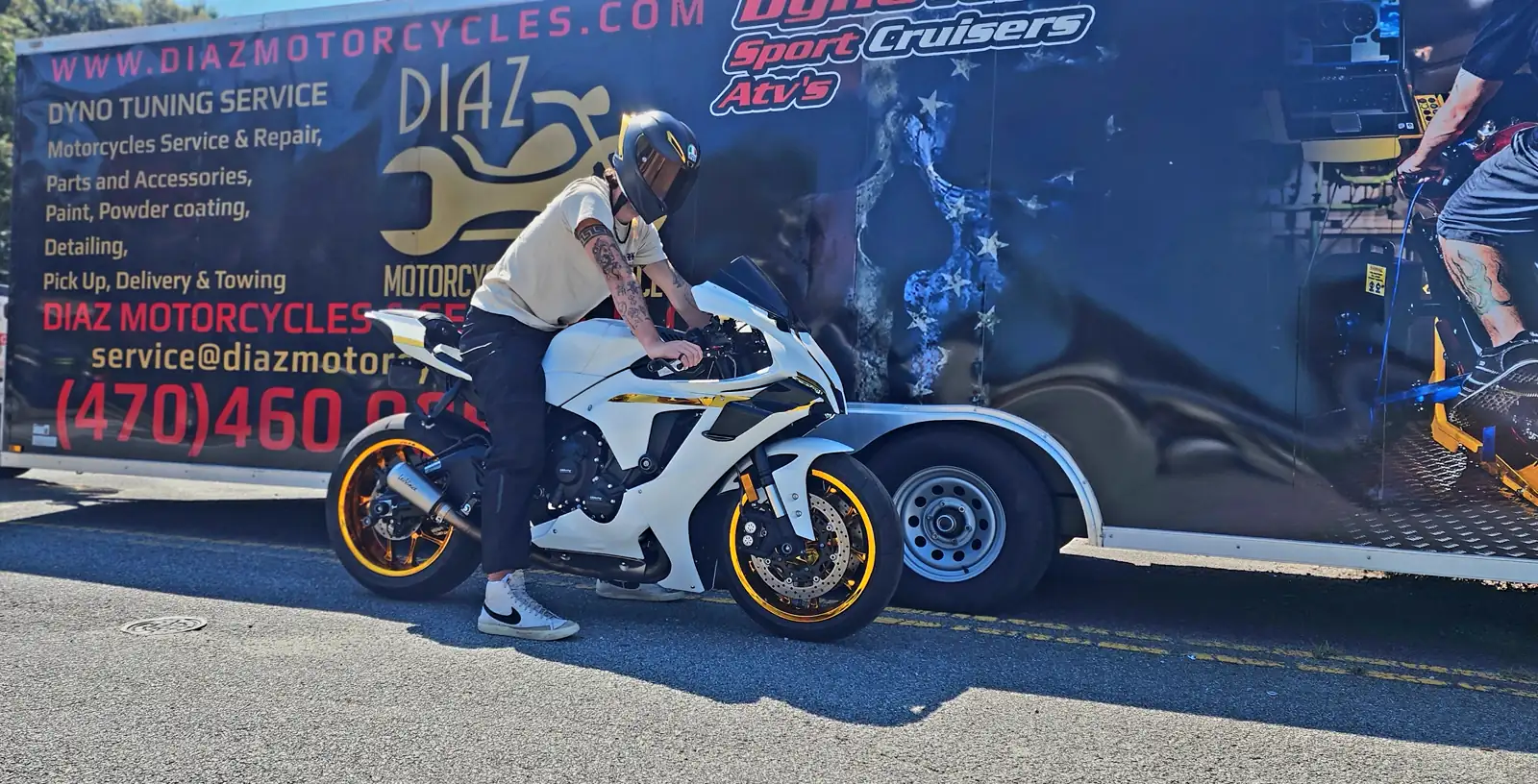
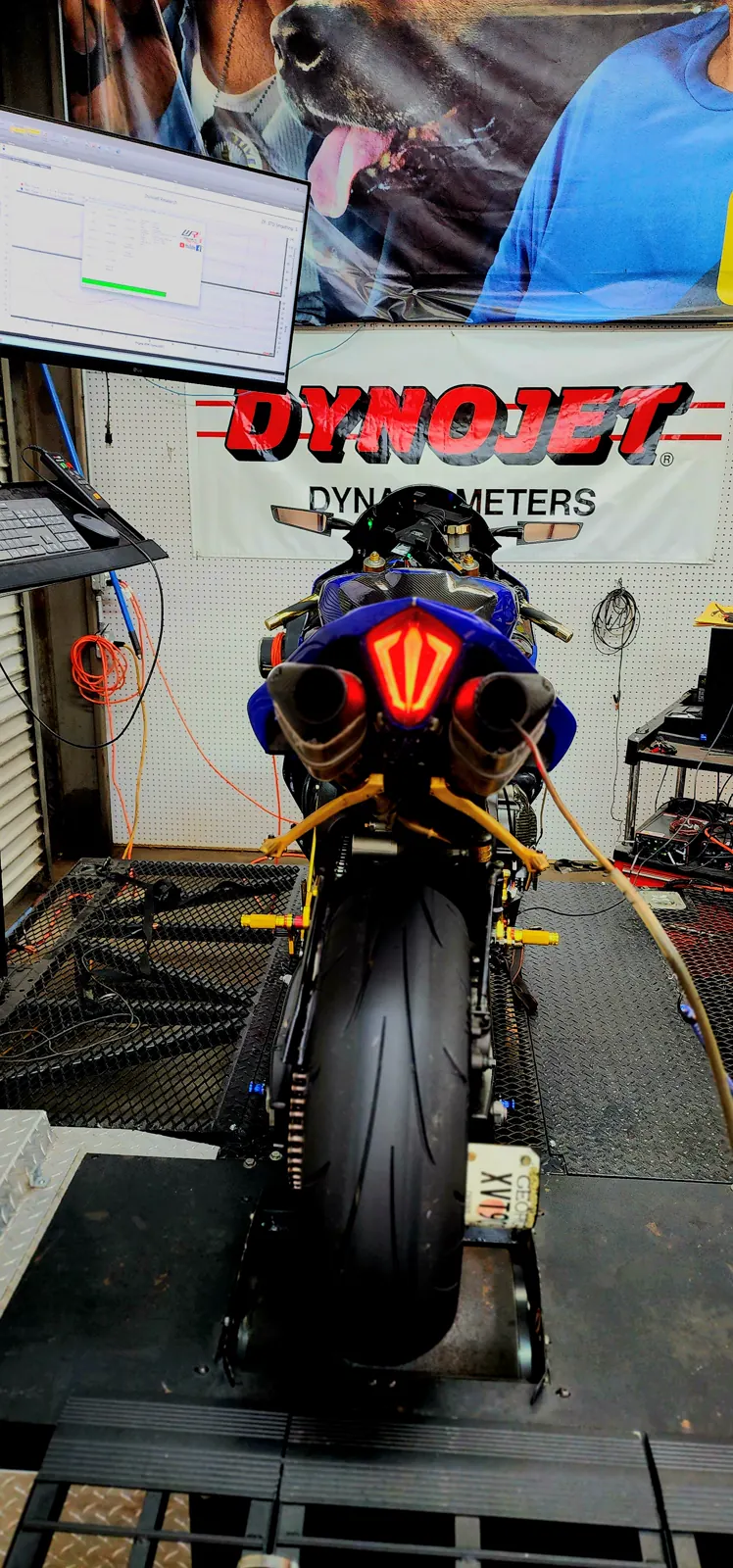
A dyno is the machine that stops the guessing. Picture a heavy steel drum set into the floor. We strap the bike down and let the rear wheel spin that drum, so the bike can “ride” while standing still. The dyno measures how much real power the engine makes at the wheel across the whole rev range. At the same time, a wideband probe slides into the exhaust and reads the exact air-and-fuel mix, moment by moment. No guessing. Just numbers on a screen, showing where the bike is lean, where it’s rich, and where it’s happy.
There’s a version of this that’s cheap and a version that isn’t. The cheap version is a canned map somebody downloaded off the internet and loaded onto your bike sight unseen. It’s a generic guess dressed up as a fix, and on a used bike with mystery mods, it can miss badly. The real version is a custom tune, measured on the dyno for your exact bike, your exact parts, and the air we breathe here in Georgia. One of those actually solves the problem you’re feeling. The other just moves it around.
You can see why the used-bike buyer gets stuck. That’s why you don’t know what the last owner changed. You don’t know what map is on there. You just know it feels a little wrong. Getting it on the dyno is how you finally find out, instead of trading guesses with strangers online.
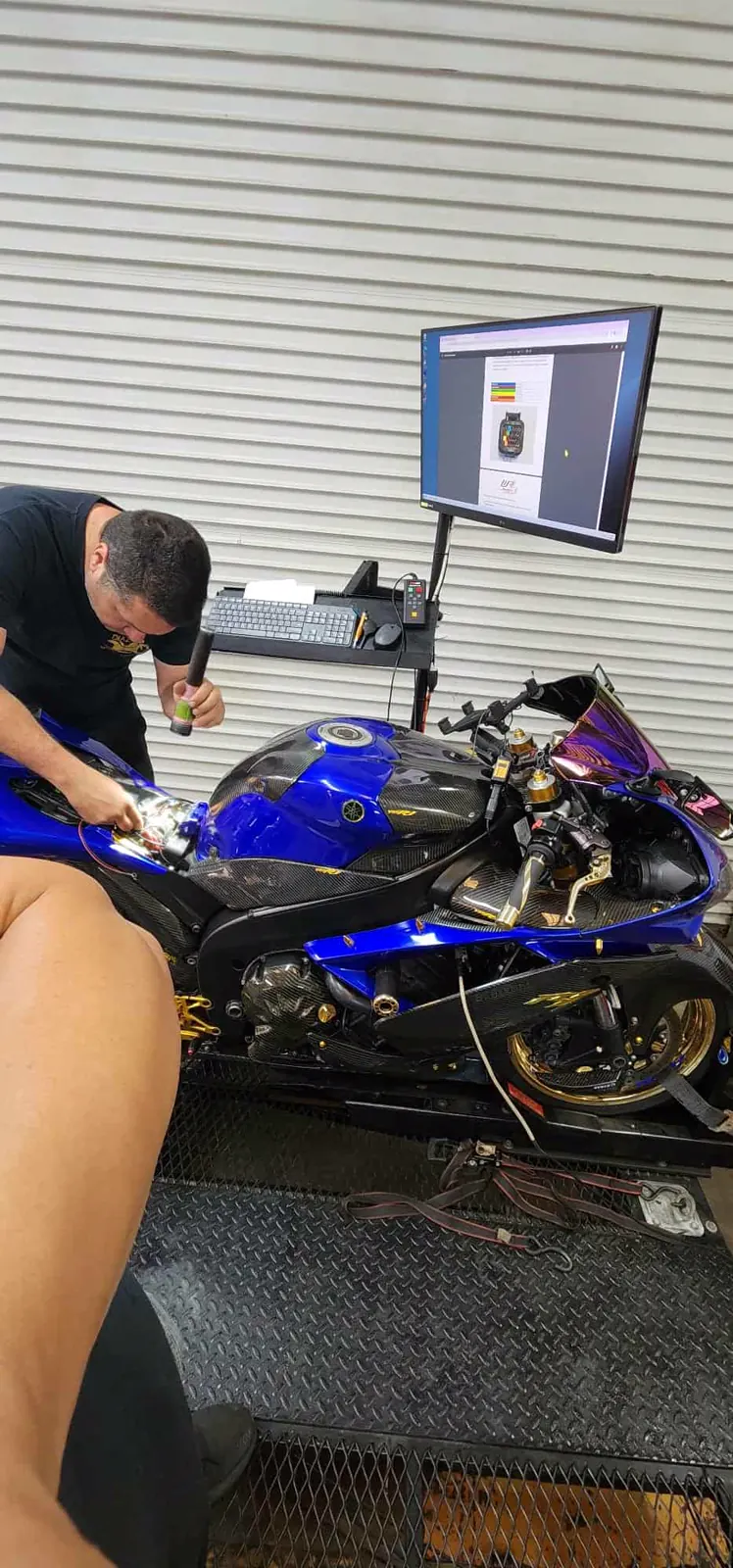
What actually happens at the shop
People picture something dramatic, like a rocket sled. It’s calmer than that. Here’s the real order of a dyno session, start to finish, so nothing feels like a mystery.
- We look the bike over first. Either way we check the pipe, the intake, the plugs, and whatever the last owner did or didn’t do.
- We strap it down onto the dyno and slide the wideband probe into the exhaust.
- In short we make a baseline pull to see exactly how it runs right now, warts and all.
- We read where it’s lean, where it’s rich, and where the throttle feels dead.
- At the same time we adjust the fuel and timing, either through an ECU flash or a Power Commander, depending on the bike.
- We pull again, check the mix, and repeat until the whole rev range is clean and smooth.
- You take it home and feel the difference on the very first ride.
That’s it. No smoke, no fireworks. The bike never leaves the room. And when it’s done right, the change is the kind you feel in your wrist before you even glance at any numbers. The throttle wakes up. As a result the surging quits. The heat settles down. You can also read the whole rundown on the full list of what we do if you want to see how a tune fits with everything else on the bench. And if you’re curious how the work adds up before you commit, we lay that out plainly too.
So which one wins: dyno tune vs stock?
Now the real question, laid out fair. There’s a clean case for staying stock, and there’s a clean case for tuning. Let’s give both their due, because the honest answer depends on your bike, not on what sells. If you want the longer version, here is how this plays out in Acworth.
Stock wins when your bike is truly bone stock and running clean. If nobody’s touched the pipe or the intake, if it starts easy, idles steady, holds a cruise without surging, and doesn’t cook you at a red light, then the factory did its job. Leave it be. A stock map on an unmodified bike is a fine, safe place to live, and there’s no prize for fixing something that isn’t broken. If you bought used and the bike checks out perfectly, that’s a win, and you get to keep your weekends free.
A tune wins the moment anything in the air path changed, or the moment the bike shows those symptoms from earlier. Added an exhaust? Tune it. Added an intake or a filter? Tune it. Bought used with mystery mods and a hot, surging feel? That’s the textbook case for the dyno. In the dyno tune vs stock call, a modified bike running on a factory map isn’t really “stock” at all. It’s a mismatch pretending to be stock, and the tune is what finally makes the parts and the map agree.
A modified bike on a factory map isn't stock. It's a mismatch wearing a stock costume.
Our straight recommendation? If your used bike is unmodified and runs sweet, keep it stock and ride happy. If it’s been changed, or it’s throwing off heat and surge and popping, book the dyno and let the numbers sort it out. Most secondhand bikes with a loud pipe fall into the second bucket, whether the seller mentioned it or not. That’s not us upselling. That’s just what the exhaust probe keeps telling us, bike after bike.
QUICK RULE
Bone stock and running clean? Leave it. Modified, hot, or surging? Get it on the dyno. The mods, not the badge, decide the answer.
Something worth knowing before you book anywhere. A dyno tune is only as good as the shop reading the screen. The machine gives numbers, but a person decides what to do with them. That’s where a real in-house dyno with a tech who tunes every week beats a canned download every single time. Most multi-line shops around the metro don’t do genuine custom mapping in-house. They order parts. We build and tune bikes, and the dyno lives right here in our shop, not down the road at somebody else’s.

How long each choice really lasts
Here’s a fair worry: does a tune fade, or is it a one-and-done? Good question. A proper dyno tune sticks. As long as you don’t swap major parts again, that map keeps doing its job for years. A stock map lasts just as long, of course, because it never changes either. So neither one “wears out” on its own. The real difference is the heat. A bike that runs lean and hot on a mismatched map is harder on itself over time, so tuning it isn’t just about feel. It’s about letting the engine run cool and easy for the long haul. Fix the mix, and you’ve done the engine a quiet favor it’ll repay for a long time. If you want the longer version, here is the full list of what we do.
If you want to see the same trade-off from another town’s angle, here’s how this plays out in Acworth, where riders ask us the very same thing. And if you’d like a closer look at the process itself, this piece walks through what that service actually involves, step by step.
The Newnan part of all this
Let’s talk about where you actually ride, because tuning is about your roads, not a lab. Around town, you’re crawling the GA-34 corridor, also called Bullsboro Drive and Newnan Crossing Boulevard, past Ashley Park and the big-box strips. That stop-and-go, turn-heavy grind is exactly where a lean bike shows its worst side, cooking your legs at every red light. A clean tune makes that slow crawl bearable instead of brutal. Then you drift down to the old Court Square in the Newnan Commercial Historic District, idling low through the heart of the City of Homes, and a well-mapped bike just purrs there instead of hunting and stalling.
But the real reward comes when you escape town. Head out to the Coweta and Meriwether back roads south, the empty rolling two-lanes on GA-16 and GA-54 toward Moreland, Greenville, and Warm Springs. Roll toward Senoia, about fifteen minutes southeast, where the weekend riders and the film-town tourists gather. That’s where a tuned throttle turns from a chore into pure joy, crisp and instant, no surge, no flat spot. A rider coming through the quiet streets near the Platinum Point Historic District on a smooth-running bike is a rider grinning inside the helmet. That feeling is the whole point of the tune.
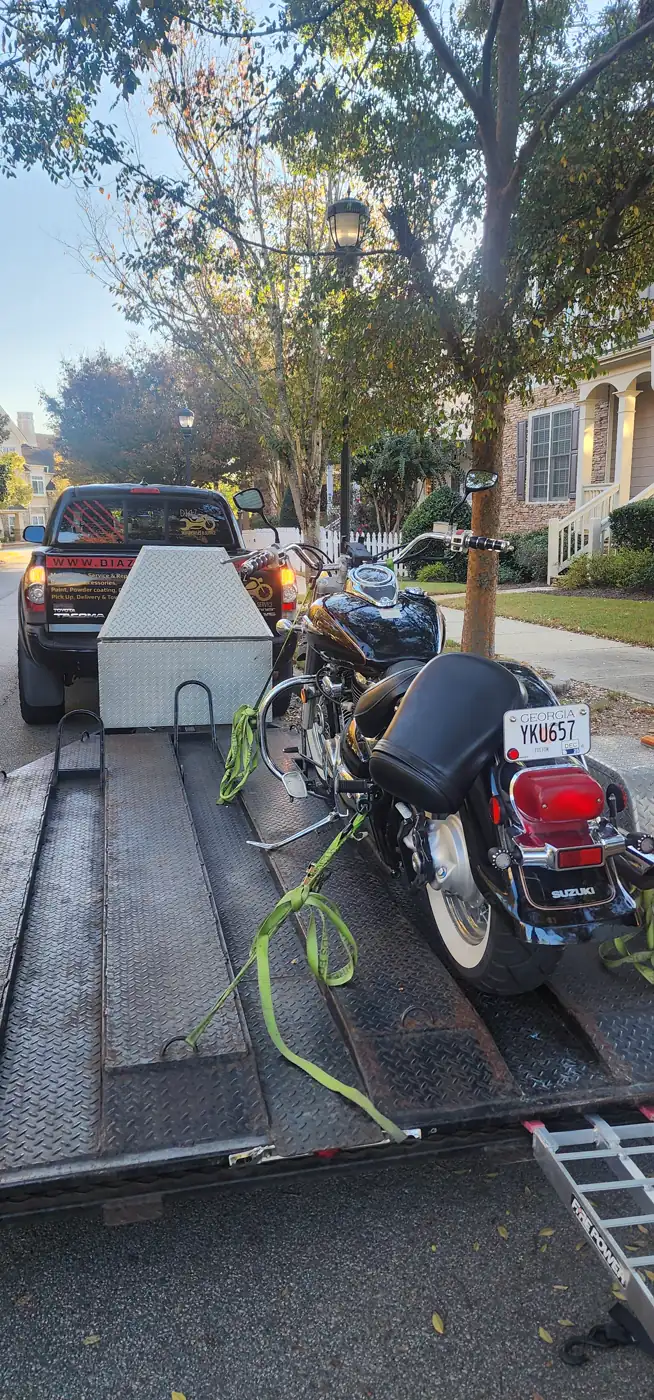
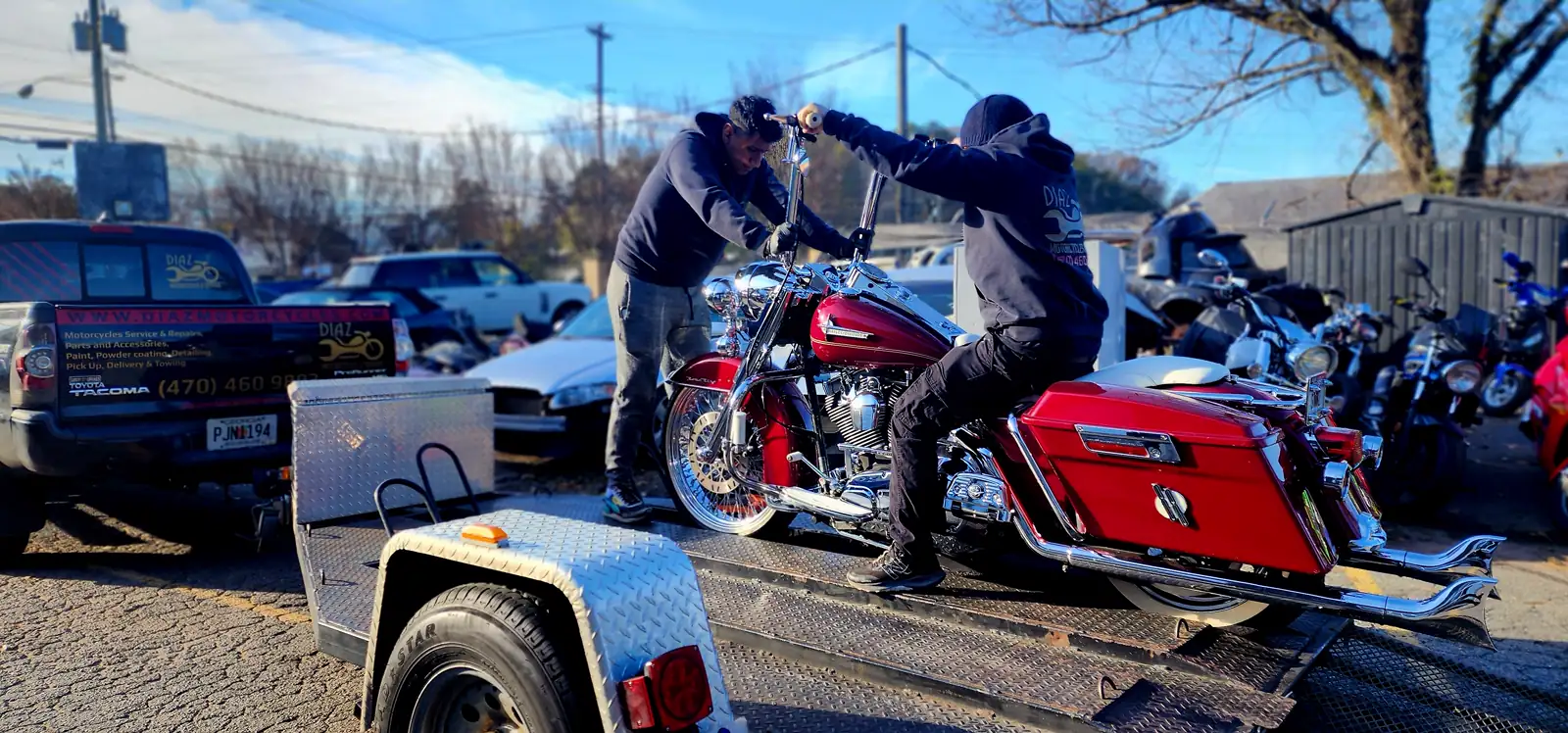
Now, we know Newnan already has its shops. Great South Harley-Davidson over at 185 Highway 16 E is a full authorized dealer, and it owns the cruiser service scene in Coweta County. For routine service close to home, that’s a solid stop, and we’d never pretend otherwise. But real custom mapping on an in-house dyno is a different animal, and that’s the gap we fill. We’re up in Marietta, an estimated forty-five to fifty-plus miles north depending on the route, roughly an hour’s drive give or take. We know that’s a trip. So we make it painless with pickup and delivery, because the tune should come to you, not the other way around.
One more note for the mixed garage. If you ride a Harley, the factory keeps its official service details public through the Harley-Davidson service information portal, which is handy for knowing your baseline before a tune. And if you want to get more out of every ride no matter what you ride, the MSF rider courses are time well spent. A sharper bike and a sharper rider make a fine pair.
So here’s your takeaway on the dyno tune vs stock Newnan choice. Listen to the bike first. If it’s unmodified and runs clean, stay stock and enjoy the ride. If it’s been changed or it’s showing heat, surge, and pops, get it on the dyno and let the wideband probe end the guessing. Either way, you walk away knowing exactly what you’ve got under you, which is a pretty good feeling on a bike you bought half on faith.
Questions Newnan riders ask us
Does my type of bike change the answer?
A little, yes. A Harley bagger, a metric cruiser, and a sportbike all tune differently. Some use an ECU flash and some use a Power Commander to add fuel. But the core idea is identical across all of them: read the real air-fuel mix on the dyno, then dial in the right amount of fuel and timing. The hardware differs. The goal never does.
Is a tune really worth it, or is stock good enough?
If your bike is truly unmodified and runs clean, stock is genuinely good enough, and we’ll tell you so. The tune earns its keep the moment you’ve added a pipe or intake, or the bike runs hot and surges. On a modified bike, a custom tune isn’t a luxury. It’s what makes the parts and the engine finally agree.
Which one should I pick for a used bike I just bought?
Start by checking whether anything was changed. A loud aftermarket pipe or a swapped filter almost always means the factory map no longer fits. If you find those, lean toward the dyno. If the bike is spotless, unmodified, and rides smooth, you may not need a thing. When you’re unsure, a baseline dyno pull answers it in one session.
What's the real difference between a tune and the stock map?
The stock map is one setting meant to cover every rider and every condition in the country, so it’s a compromise on purpose. A dyno tune is measured for your exact bike, your exact parts, and our local air. One is a broad guess. The other is a precise fit, and you feel that difference in the throttle.
Which lasts longer, a tune or leaving it stock?
Neither wears out on its own. A good tune holds for years unless you swap major parts again, and a stock map never changes either. The bigger deal is heat. A mismatched, lean-running bike is harder on itself over time, so tuning it can actually help the engine live an easier life.
Do I have to ride all the way to Marietta for this?
No. We know the drive from Newnan is a real trip, so we handle pickup and delivery. Your bike comes to our in-house dyno, gets tuned, and comes back to you. You never have to fight the freeway with a bike you’re still getting to know.
We tune and build for riders all across the south metro, not just Newnan. That includes Peachtree City and Tyrone to the east, Fayetteville and Sharpsburg, and the film-town crowd around Senoia. We help friends out in Moreland, Grantville, and Turin, along with Palmetto, Fairburn, and Union City up the line, and out west toward Carrollton. If you’re within reach of these roads and your bike feels off, we’re a text away.
STOP GUESSING, START RIDING
If your used bike runs hot, surges, or just feels a little wrong, let’s put it on the dyno and find out for sure. We come to Newnan with pickup and delivery, tune it on our own in-house dyno, and bring it back running the way it always should have. Text us your bike and your symptoms, and we’ll tell you straight whether it needs a tune or if it’s already good to go.
470-460-9883Diaz Motorcycles and Service, LLC · 847 Barnes Mill Road, Marietta, GA 30062