Motorcycle Service Cost Woodstock Riders Can Actually Plan Around
What a real service includes, why access drives the labor, and why an honest shop wants eyes on the bike first.
Your bike makes a sound. You can’t name it. You’re not sure if it’s a ten-minute fix or a Saturday gone, and you’d rather not guess wrong out loud in front of somebody holding a wrench. Good news: not knowing is normal. So Naming it is our job, not yours. Still, Riders call us every week and describe a noise with their mouth instead of a word, and honestly, some of the impressions are excellent. So the real question was never what broke. Plus, it’s what the work involves, and what drives motorcycle service cost Woodstock riders end up planning for.
Meanwhile, here’s the thing most price guides skip. Of course, a service isn’t one product with one sticker on it. In fact, it’s a set of tasks, and how big the job gets depends far more on how hard those tasks are to reach than on the parts themselves. For example, two bikes can need the same oil and the same filter and still land in very different places. Even so, Below, we walk the whole thing start to finish so you can see where the hours go.
One bike, one long winter, one loud Saturday
What’s more, a friend we’ve helped keeps his adventure bike in a Towne Lake garage, which is about as good as storage gets around here. Two-car garage, workbench, trickle charger, the whole setup. After that, he rides hard and he rides seasonally. Also From September through November he’s on I-575 north to GA 515 most weekends, running up toward Jasper and Ellijay, and then the bike sits from December to March while the mountains go cold and wet. Instead that pattern is normal in Cherokee County. It’s also the pattern that hides problems, because a bike that sits doesn’t complain, and a bike that runs hard for a long weekend complains all at once.
So one Saturday morning he fires it up for the first ride of spring, and there’s a grinding sound at the first stop sign. Besides he hears it again pulling out of the neighborhood. Actually By the time he’s rolling down Ridgewalk Parkway he’s riding with two fingers hovering over the lever, doing that thing where you listen so hard you forget to enjoy the ride. That’s why he called us that afternoon and opened with, “I don’t know what I’m looking at.” Perfect. Either way that’s the right call, and it’s an easy one for us to work with.
What we found was small. In short his brake pads had worn to the backing on one side, the chain had dried out over the winter and stretched past spec, and the fluid in the front reservoir had gone dark. None of that is dramatic. At the same time All of it was easy to catch and getting harder every mile. As a result Caught in March, it’s an afternoon on the lift. On the other hand Caught in July, a rotor joins the list.
The real cause is almost never the noise
Here’s what actually drives most of the work we do. So it isn’t abuse and it isn’t bad luck. It’s time. Rubber ages. Fluid pulls in moisture. Chains dry out. Batteries sulfate. None of that cares whether you rode or not, which is why the idle-weeks-then-hard-miles rhythm around here is so sneaky. Bikes in Woodstock don’t commute. Still, Georgia’s helmet law is universal, lane splitting and filtering are illegal, and nobody is enjoying I-575 southbound at eight in the morning.
That means your bike spends most of the year parked and then does its hardest work in short bursts. Plus, the mountain roads north of us add their own flavor: gravel washed into corners, leaves and pine straw in the fall, damp shaded pavement that never fully dries. Closer to home, all the construction along Ridgewalk means grit and mud tracked onto the road from site entrances, and grit is chain-and-brake food. Great for us. Less great for your sprockets.
THE HONEST VERSION
Small stuff is quick to fix and easy to schedule. That same small stuff, ignored for a season, drags in parts that were never on the list. That’s the whole game.
Most people stop reading here. That’s the expensive mistake. Once someone hears “oil, chain, brakes, tires,” they file it under boring and go back to riding. But the boring list is exactly where the savings live, because every item on it warns you before it fails. Brakes squeak before they grind. Chains grow tight spots before they let go. Tires cup before they surprise you. A service is really just a scheduled conversation with the parts that talk.
What a service actually includes, in plain words
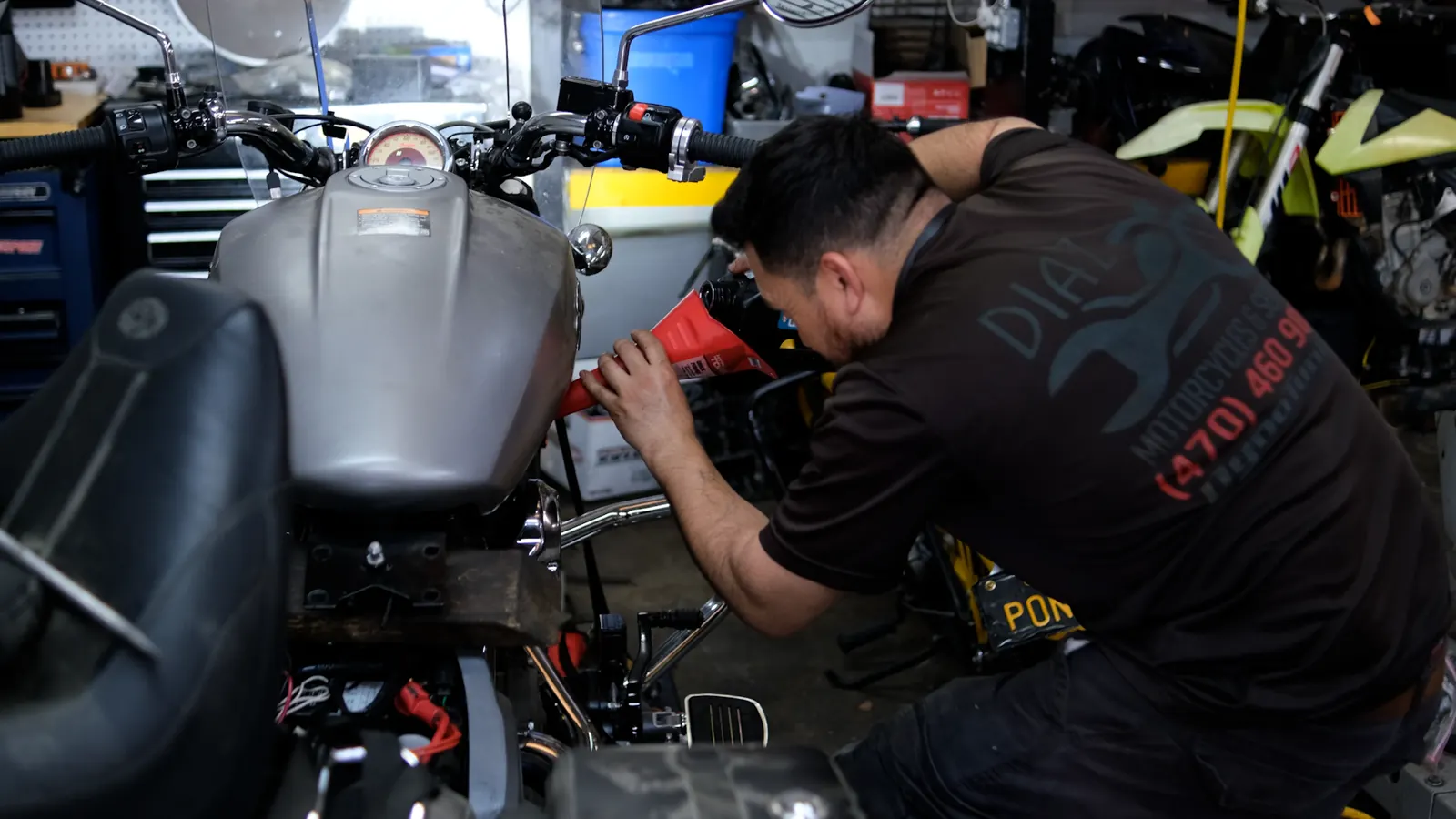
Shops love the word “service” because it can mean anything. Let’s kill the mystery. A routine service is a checklist, and that checklist exists because these are the parts that wear on a schedule. Your owner’s manual sets the intervals for your specific bike. We follow that manual, not a mileage number we made up.
- Fluids. Engine oil and filter, plus a look at brake fluid, clutch fluid and coolant. Dark, gritty or cloudy always means something upstream.
- Chain and sprockets. Clean it, check for stretch, set the slack, lube it. Sprocket teeth get checked for hooking, because a worn sprocket chews through a new chain fast.
- Brakes. Pad thickness front and rear, rotor condition, caliper pistons moving freely, and lines checked for cracks or swelling.
- Tires. Tread depth, pressure, age and wear pattern. Wear patterns are honest — they tell us about your suspension and alignment before you say a word.
- Controls and cables. Throttle free play, clutch feel, lever pivots, and every fastener that likes to loosen itself over a hard weekend.
- Electrical. Battery health, charging output, lights, and any connector living outside its comfort zone.
- Air filter, spark plugs and valve clearances when the manual calls for them, plus a road test so we hear the bike the way you do.
That’s the standard version. It isn’t glamorous and it isn’t supposed to be. If you want the fuller picture of what our team handles, that page lays it out task by task. Most of these jobs take minutes of actual wrench time. What changes the math is what stands between the technician and the part.
Parts, labor, and the thing nobody mentions: access
Here’s the part that explains almost every surprise on an estimate. Parts are parts, and a filter is a filter for everybody. Labor is time, and time depends on access. On a bare-bones standard, the oil filter sits right out in the open and the air box lifts off in a minute. On a fully faired sportbike or a loaded touring rig, that same filter might live behind bodywork, a heat shield and a panel that comes off in one specific order or not at all.
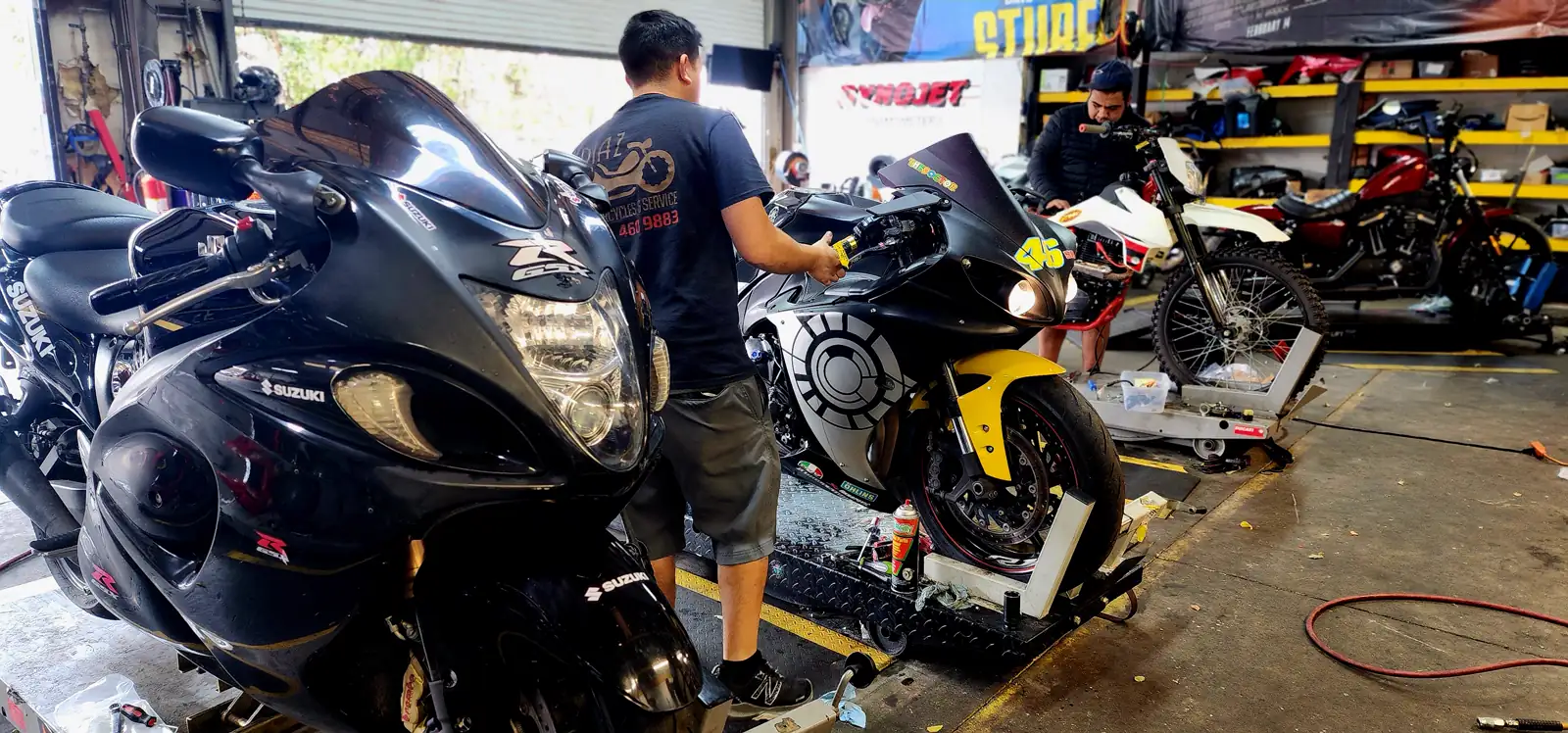
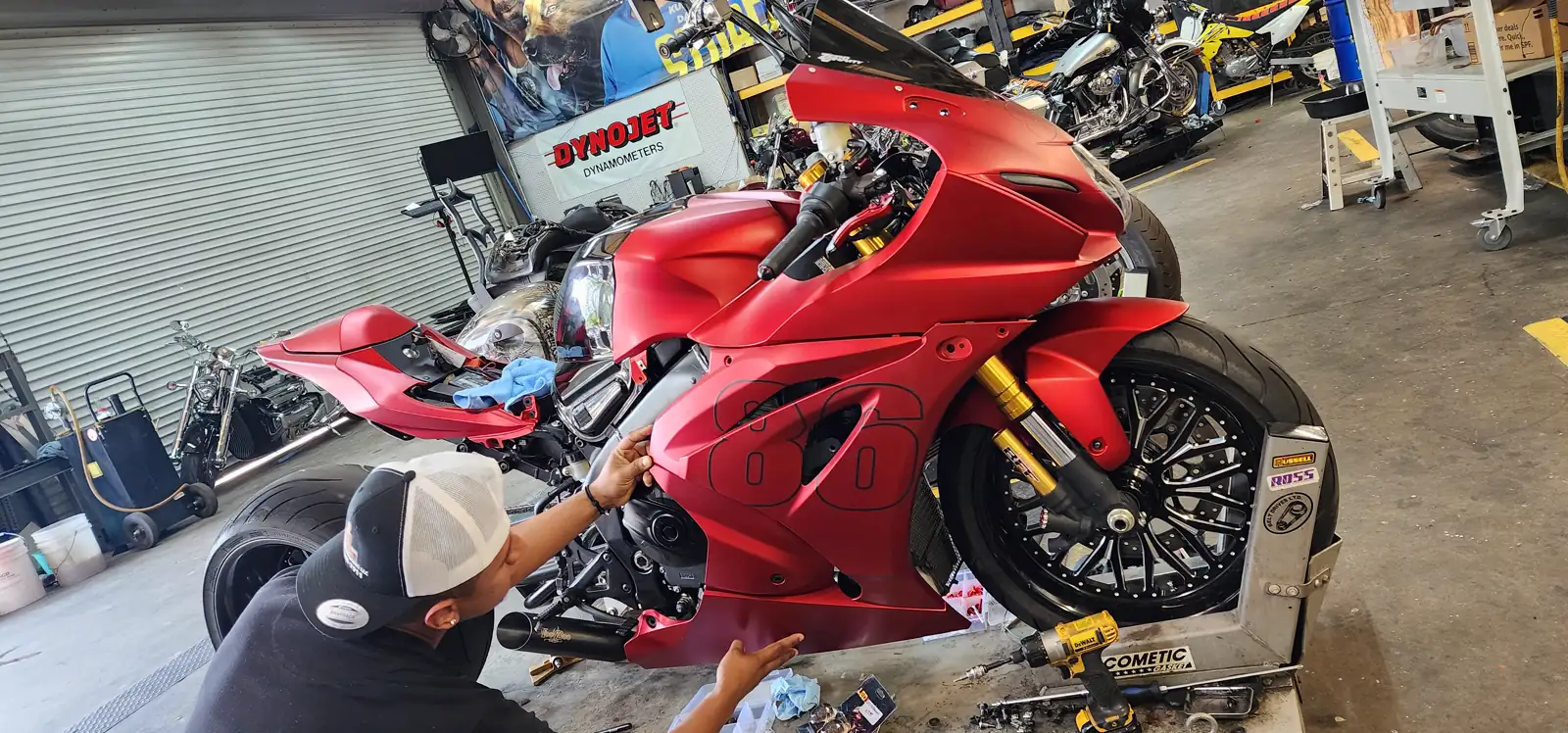
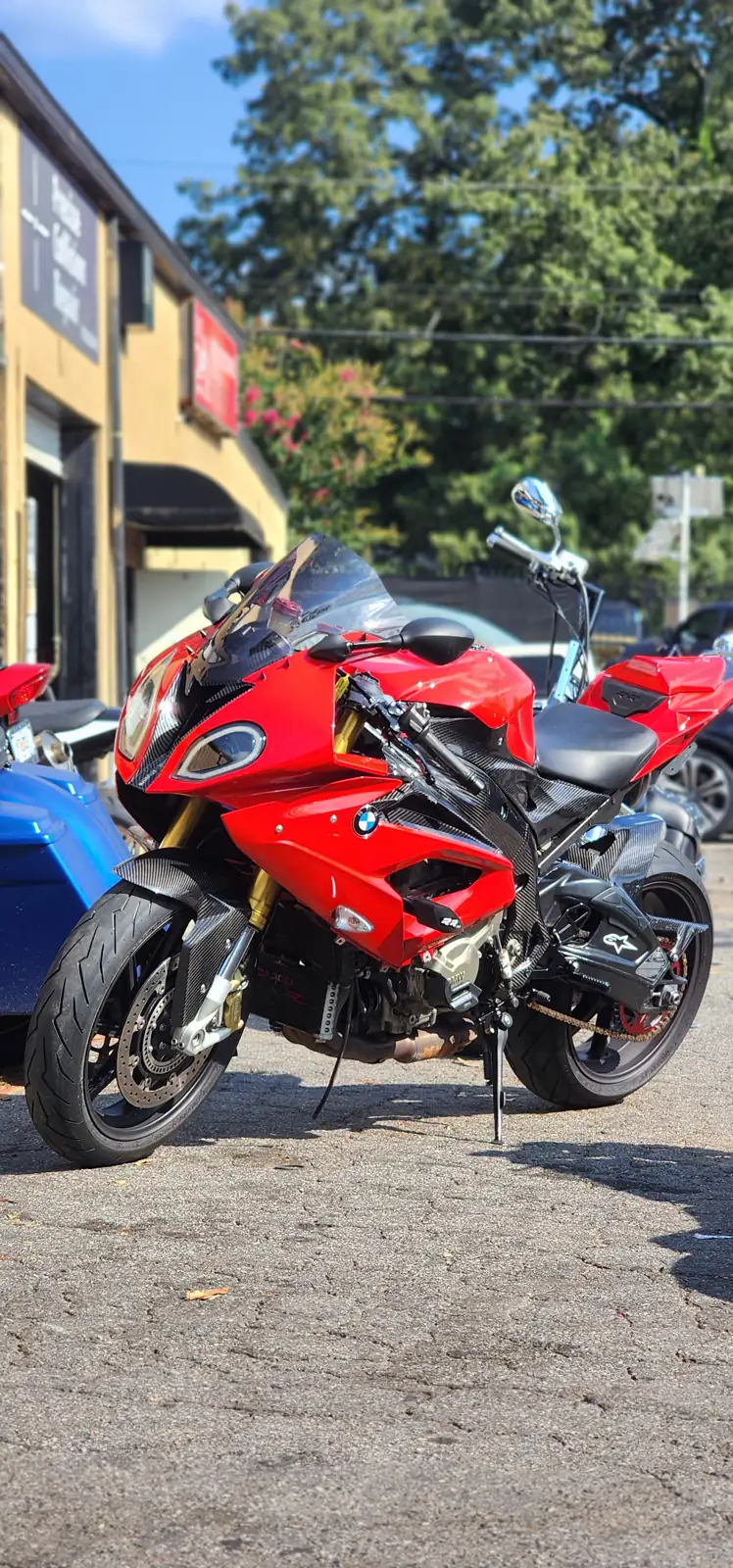
Take a Hayabusa on the lift with its fairings half off. The wrench work might be twenty minutes. Getting to it and putting it back correctly, every tab seated and no rattles, is the rest of the morning. A bagger is the same story with different plastic. Adventure bikes hide things under luggage racks and crash bars. That’s not a shop padding an hour, and it’s also why motorcycle service cost Woodstock riders compare on two estimates can differ with the same parts list.
- Bodywork and bags. Every panel that comes off is time off and time back on.
- Where the part lives. Some filters and plugs are a reach. Some are a small project.
- Fasteners and their history. Corroded, seized or previously overtightened hardware turns a quick job into a careful one.
- Specialty tools and specs. Some brands want a specific tool, a specific torque and a specific order.
- Condition on arrival. A maintained bike comes apart politely. A neglected one negotiates.
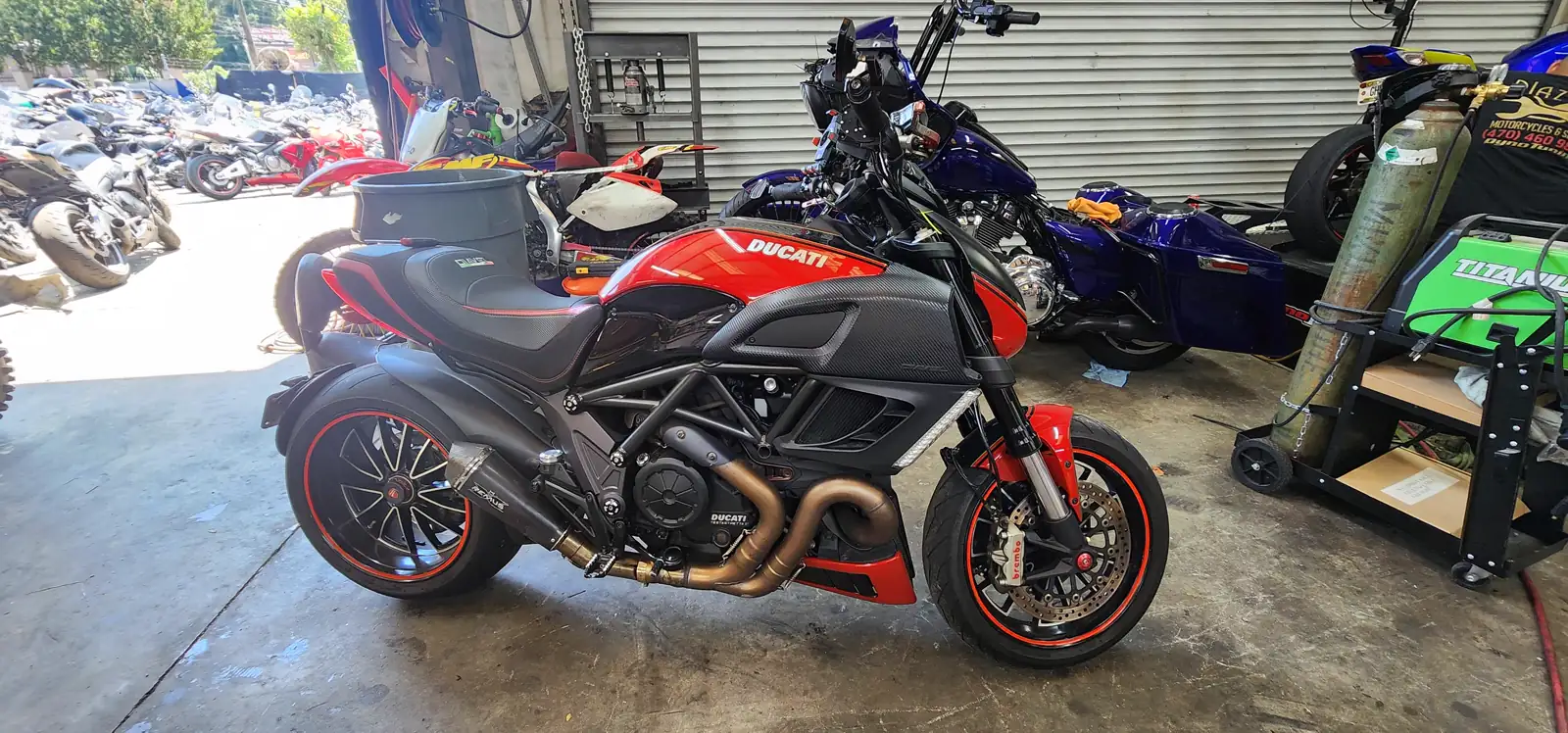
European bikes over-index around here. BMW, Ducati, Triumph, KTM and Aprilia all show up on our lifts regularly, and they often carry more layers between you and the maintenance item. That’s not a knock on them. It’s simply why an all-brands shop keeps the right tools and torque specs on hand instead of guessing.
Your options, honestly compared
You’ve got a few real choices here, and none of them is wrong. A brand dealership knows one brand deeply and has the factory tools, but it’s brand-locked and often booked out. The big multi-line stores are a solid option too; Mountain Motorsports in Roswell, about fifteen to twenty miles southeast, carries a wide lineup. As a result the shops inside Woodstock are strong but narrow — suspension only, or Japanese-only and under a certain age, or Harley and custom only. We wrote up the tradeoffs between them if you want the longer version.
Then there’s you. Plenty of riders here do their own basic work, and honestly, good. Those 1990s master-planned subdivisions came with two- and three-car garages as standard, so folks over in Kingsgate — Regency, Park and Glens at Kingsgate included — often already own a bench and a trickle charger. Oil changes and chain care are doable at home. Valve clearances, ABS brake bleeds and tuning are where handing it off saves your weekend.
Townhomes and newer walkable spots like South on Main are a different situation. Great location, no garage, nowhere to make a mess. Those riders lean on a shop more, and that’s exactly how we handle that job: simple drop-off, everything explained in plain words, and nothing touched that wasn’t discussed with you first.
How we decide, and why we won't quote it blind
The last piece is the one people underestimate. It’s the looking. An honest shop won’t hand you a firm number over the phone, and that isn’t us being cagey. A phone call gives us your best guess about a machine we’ve never touched. We can tell you what’s typical for the job. We can’t promise what your bike needs until your bike is in front of us and the wheels are off the ground.
Our process isn’t mysterious either. First we ask what you’ve noticed: sounds, feel, when it started, how the bike’s been stored. Then it goes on the lift and we work through it in the same order every time, because a consistent order is how you stop missing things. We measure instead of eyeballing — pad thickness, chain stretch, tread depth, charging output, tire pressure and tire age.
Then we report what we found in three buckets: needs it now, needs it soon, and it’s fine. You decide, and nothing gets touched without a yes. Groups like the Motorcycle Industry Council track how riders actually use their bikes, and NHTSA crash data underlines what every mechanic already knows: the parts that keep you stopping and steering are the ones worth staying ahead of. So when someone asks about motorcycle service cost Woodstock shops quote, our honest answer starts with questions back.
What it feels like after
Here’s what changes after a proper service, and it isn’t what people expect. It’s not power. It’s quiet. The lever comes back firm and predictable. On the other hand the chain stops that dry ticking at parking-lot speed. The bike catches on the first press instead of the second. You stop riding with one ear cocked, and you get back the part of riding that made you buy a motorcycle.
Practically, that’s a Saturday where you meet friends near Dupree Park, take the long way out along Rope Mill Road and Rope Mill Parkway past the old mill ruins, run a lap around the south end of Lake Allatoona, and never once think about the machine underneath you. That’s the real return on the work. Not a number on paper. A morning where the bike disappears and the road is the only thing left.
The outcome: you hold the plan
So here’s where you land. You don’t need to diagnose anything before you call. You need the shape of the job, and now you have it — parts are predictable, labor is access, and the small items you catch on schedule are the ones that never grow up. Bring the bike, tell us what you noticed, hear it back in three buckets, then pick. That’s the whole thing. You’re running the plan, not chasing it.
The cheapest repair is always the one you catch while it's still small.
Riders across Cherokee County run this same math every spring, and it plays out about the same way city to city — you can see how this plays out in Sandy Springs as well. Woodstock just does it with more mountain miles packed into fewer weekends. Keep the checklist honest, follow the intervals in your manual, and your bike will hold up its end of the deal.
Questions Woodstock riders ask us
What's actually included in a routine service?
Oil and filter, a check of brake, clutch and coolant fluid, chain and sprocket condition, brake pads and rotors, tires, controls and cables, and the electrical system. Air filter, plugs and valve clearances get added when your manual calls for them. We finish with a road test so we hear the bike the way you do.
How long does a service take?
A basic service on an easy-access bike is usually a same-day job. Faired sportbikes, baggers and loaded adventure bikes take longer because the bodywork has to come off and go back on correctly. If we find something extra, we call you before the clock keeps running.
Is more of the work parts or labor?
It depends almost entirely on the bike. Parts for routine maintenance are fairly consistent from machine to machine. Labor swings widely because it tracks access, and access is decided by how much sits between the technician and the item being serviced.
Does the type of bike change the work?
Yes, more than most riders expect. A naked standard gives you the oil filter and air box right away. A touring rig or a full-fairing sportbike hides the same parts behind panels, heat shields and brackets. The checklist stays identical; the time to reach it does not.
What if you find something else while you're in there?
We stop and tell you. Everything gets sorted into needs it now, needs it soon, and it’s fine, so you can choose what happens today and what waits. Nothing extra gets done without your okay, and if it can safely wait a season, we’ll say that plainly.
Can you give me a number over the phone?
We can tell you what’s typical for the job and what usually drives it one way or the other. A firm number needs eyes on the bike, because your age, mileage, storage history and last service all change the answer. That inspection is how you avoid surprises later.
We take care of riders all over the northwest metro, starting with Woodstock and the surrounding Cherokee County towns of Canton, Holly Springs, Towne Lake and Ball Ground. Plenty of our regulars ride down from Acworth, Kennesaw and Cartersville, and just as many come over from Marietta, East Cobb, Roswell, Alpharetta and Milton. If you’re within a reasonable ride of the shop, we’re glad to look at your bike.
BRING IT IN, WE'LL WALK IT WITH YOU
If your bike has been sitting all winter or you heard something new on your last run north, don’t try to name it first. Text or call us, tell us what you noticed, and set a time. It’s about fifteen to nineteen miles from Woodstock, roughly twenty-five to thirty-five minutes down I-575 to I-75 and east on Roswell Road to Barnes Mill Road, or you can take Bells Ferry Road south into north Cobb if you’d rather skip the interstate. We’ll put it on the lift, go through it in order, and tell you exactly what we see.
470-460-9883Diaz Motorcycles and Service, LLC · 847 Barnes Mill Road, Marietta, GA 30062