Overdue Motorcycle Service Roswell — What to Check
The bike made a new noise. Here's how to figure out what it's telling you, and whether it's safe to ride tonight.
It’s nine at night. The garage light is still on, your helmet is on the kitchen counter, and you’re typing some version of the same question: how bad is it, really, that I skipped it? What’s more, Maybe the bike made a noise on the ride home. After that, Maybe it just felt off in a way you can’t put words to. Nobody types that question when everything is fine. So if you’ve been searching for straight talk about overdue motorcycle service Roswell shops will actually explain, take a breath. Also Noticing is the hard part, and you already did it.
What you're really asking
Instead Almost nobody asks us a maintenance question straight. They ask a feeling question. Is my bike okay? Besides Am I about to be stuck on the shoulder of GA 400 in work clothes? Did I quietly ruin something? Actually those are fair questions, and they deserve a real answer instead of a shrug and a clipboard.
Here’s the version we hear most. A rider skips a service because life got loud. Work, kids, a stretch of rain. Then one day the bike does something new. A tick at idle. Even so, a clunk going into second. That’s why a front end that shivers under braking. Nothing dramatic. Just new. Either way and new is the word that keeps people awake.
In short the good news is that most “new” on a motorcycle comes from a short list of causes. Bikes are honest machines. They tell you what’s wrong long before they quit, as long as somebody is listening. At the same time that’s all a service really is — a scheduled listen, done with tools and a lift instead of guesswork in a dark garage.
The honest answer
So: is it bad? Usually not yet. As a result an overdue motorcycle service Roswell riders finally book almost always turns up ordinary wear that’s still simple and still reversible. Chains stretch. Pads get thin. Oil goes dark and tired. Brake fluid pulls in moisture from the air. Tires square off down the middle from long commuter miles. On the day you first notice any of that, none of it is a crisis.
What turns it into one is time. A dry chain doesn’t just wear itself out. It chews the sprockets, then it loads the countershaft seal, and eventually that seal weeps oil onto the back of your bike. That’s the pattern with nearly every skipped item. One tired part quietly introduces itself to the parts around it. Catching the first one is boring. Catching the fourth is a weekend and a parts order.
A skipped service doesn't break your bike. It just introduces the worn parts to each other.
One thing we won’t do is make up a mileage number for you. Every manufacturer sets its own service intervals, and yours are printed in the owner’s manual for your exact model and year. That book is the authority — not a blog post, not a forum thread, not the loudest guy at bike night. Lost your copy? Bring the bike by and we’ll pull the right schedule up with you before anybody touches a wrench.
What changes the answer
The real answer depends on which symptom you’ve got. Below is how we sort them, most common first, in the order we’d walk them with you.
A dry, grabby noise from the chain
You hear a scratchy sound at low speed, or you feel a surge when you roll on and off the throttle in traffic. Most of the time that’s a chain that’s dry, tight in one spot, or both. Chains don’t wear evenly. They develop tight links, and one tight link is enough to make a smooth bike feel jerky. It’s the most common thing we find on a bike that’s been sitting. A clean, a proper lube and a correct slack setting fixes more of it than riders expect.
A brake lever that comes back too far
The lever travels farther than it used to before the bike really slows. Nine times out of ten that’s old brake fluid that has absorbed moisture, pads down to the backing, or both together. Fluid is invisible work. Nobody sees it, nobody brags about it at a stoplight, and it quietly decides how your bike stops. Pads take a flashlight and thirty seconds to check yourself.
A shimmy, wobble or a bike that won't hold a line
You feel a light shake at highway speed, or the bike wanders in slow corners. Start with tire pressure, because an under-inflated tire changes steering more than almost anything else. After that we look at tread shape, wheel bearings, and whether the bike has taken a hard hit from a pothole. That last one matters around here. Roswell has real resurfacing work underway, and fresh construction seams and utility cuts are rough on rims. For a plain-language look at what worn tread actually looks like, Michelin’s motorcycle tire resources are easy to compare against your own bike.
Ticking, a rough idle, or a hard start
Usually that’s tired oil, a clogged air filter, or valve clearances that have drifted. Oil gone dark and thin stops cushioning the top end, and the top end is exactly where that tick lives. It’s also the cheapest fix on this page, which is a nice thing to say out loud.
A spot on the garage floor
Fork seals and countershaft seals are the leaks we see most, and both usually show up as a shiny film rather than a puddle. A weeping fork seal also puts oil right where your front brake lives, which is the part riders don’t think about.
That's the common version. The real story is a little different.
Most articles stop right about here with “get your bike serviced.” Fine advice. It also skips the only question you actually asked at nine o’clock at night: which of these can I ride on, and which one means park it until tomorrow? So here’s our answer, in the same words we’d use on the phone.
RIDE IT, BUT BOOK THE VISIT
Slightly noisy chain. Oil that’s overdue but still on the stick. A mildly rough idle. A slow-leaking tire you’re topping up every few days. Ride gently, skip the mountain plans, get it on a lift soon.
DON'T RIDE IT — CALL US
A brake lever that goes soft or pulls to the bar. A wobble that gets worse with speed. Tread at the wear bars or cord showing. A kinked chain link. A leak dripping onto a tire or a rotor.
Second list? That’s not a lecture, it’s just a tow instead of a ride. And if you landed on the first list, you can genuinely relax — you’re an appointment, not an emergency.
What a service actually includes
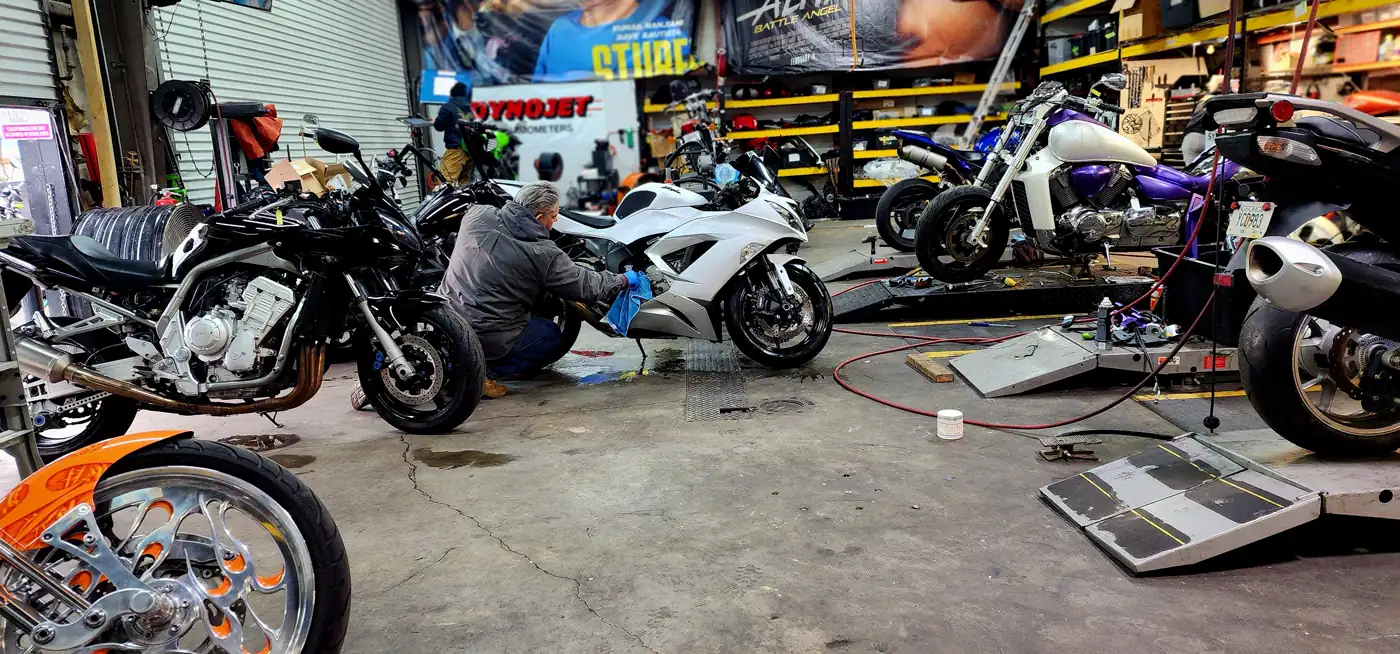
“Service” is a vague word, so let’s make it concrete. When a bike comes in behind schedule, here’s the order we work in and why.
- A full look-over before anything gets touched: tires, brakes, chain, fluids, cables, lights, bearings and fasteners.
- Oil and filter, because fresh oil changes what every other noise sounds like.
- Chain and sprockets — cleaned, lubed and set, or replaced together if the teeth have started to hook.
- Brakes: pad thickness, rotor condition, fluid color, and a bleed if the lever feels long.
- Tires: pressure, tread depth, wear shape, age and any pothole damage.
- Air filter, coolant, spark plugs and valve clearances as your manual calls for them.
- A road test, because a bike on a lift hides things a bike at speed can’t.
That last step is the one shops skip when they’re slammed, and it’s the one that catches the weird stuff. You get a call before the work, not after, with what we found and what can honestly wait. Plenty of overdue bikes need less than the owner braced for. The full picture of what our team handles runs from a basic catch-up service through the jobs most shops send away.
One more note, since it comes up constantly with modified bikes. If yours has an aftermarket exhaust and it’s felt flat or hot or thirsty ever since, that’s a fueling conversation rather than a maintenance one, and how we handle that job is a topic of its own. We’d rather sort the service first, then talk tuning with a healthy engine underneath it.
Why this looks different in Roswell
Roswell riders are educated buyers, and that’s not flattery. Alpharetta Highway is North Fulton’s motorcycle row, with several dealers plus Cycle Gear Roswell at 11230 Alpharetta Hwy inside about half a mile. You’ve seen flagship service departments. So we don’t have to sell you on doing it right, which makes our job easier.
It also means the bikes here work harder than average. Riders run GA 400 south to Perimeter and Buckhead year-round, then point the bike at the Suches loop on US-19 and GA-180 on a good Saturday, with GA 60 thrown in when there’s daylight left. Georgia doesn’t allow lane filtering, so commuting here is about parking and range rather than slipping between cars, though motorcycles can legally use the GA 400 HOV lanes. All of that adds up to tire, brake, chain and suspension wear, not just oil changes.
Then there’s where the bikes live. Most Roswell homes have a garage, but they’re older two-car garages already holding cars, with no lift room and no compressor. Around the Canton Street infill townhomes, bikes often sit under a cover in a shared lot instead. Both situations produce the same rider: someone who stores a bike properly and has nowhere to actually work on it. That’s what we’re for.
Geography helps too. From the Historic Roswell and Canton Street district it’s one road west — Roswell Road, GA 120 — across the Chattahoochee into East Cobb, call it fifteen or twenty minutes on a clear morning. From established subdivisions like Country Park and River Falls, or from Huntington Park, it’s the same simple run. Coming from the Holcomb Bridge and GA 400 side adds a bit, so time it around rush hour.
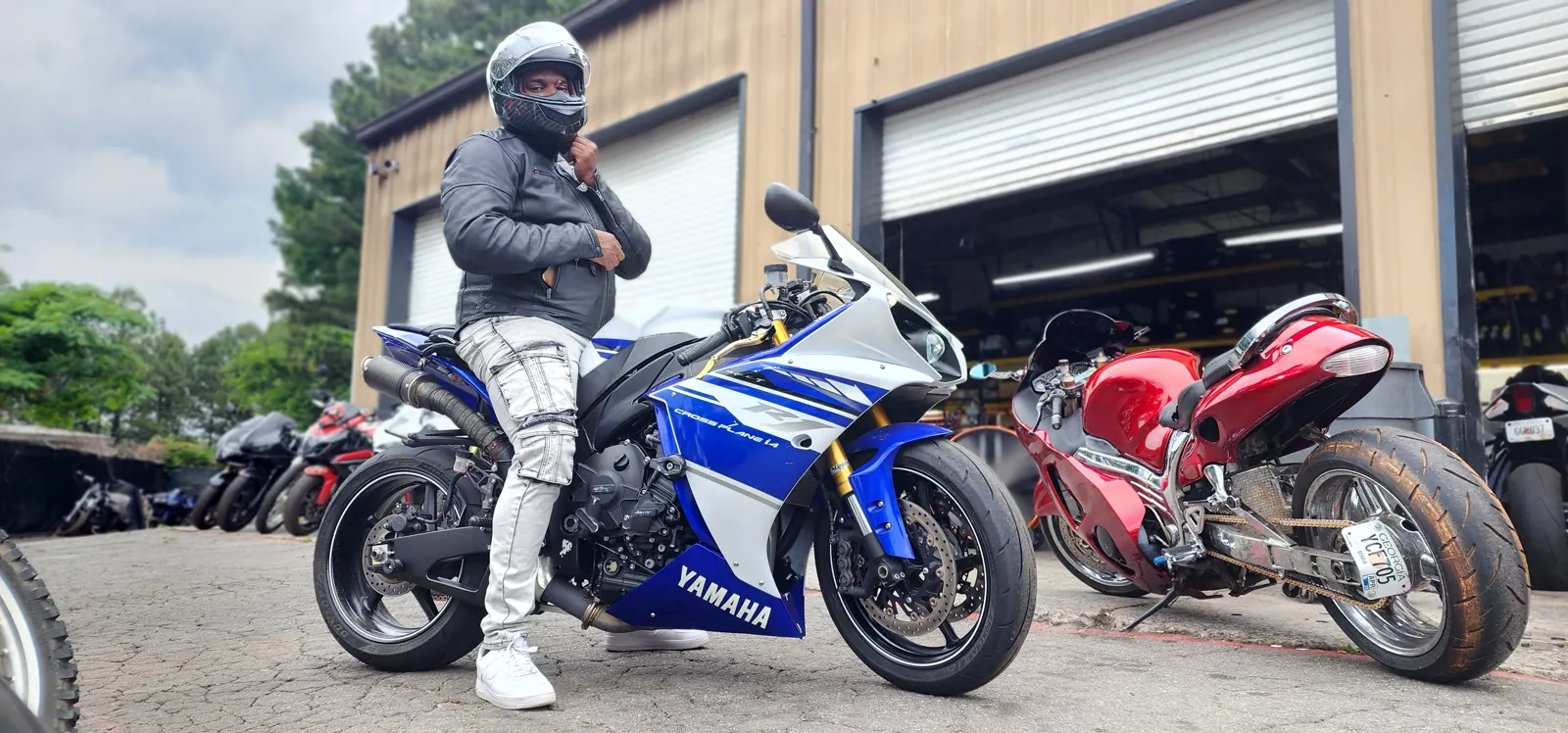
One rider off Roswell Road / GA 120 bridge and Johnson Ferry Road bridge put it better than we could.
He’d been putting a service off through most of a riding season, and the honest reason wasn’t the work or the wait. He didn’t want to be told something he wasn’t ready to hear. Once we walked him through what we actually found, the part that surprised him was how much of it was fine. “I’d been carrying it around in my head like it was worse than it was,” is roughly how he put it. Then he went and rode the river roads that weekend.
That reaction is common enough that it’s basically the point of this post. The Vickery Creek, Island Ford and Gold Branch units of the Chattahoochee River National Recreation Area all touch Roswell, and the roads out that way are some of the nicest riding you can reach without leaving town. A bike you don’t trust never goes there. A bike you do trust goes constantly. That’s the real return on a service — not a repair receipt, your weekend back.
You’ll see the same thing on a third Thursday between April and October, when Alive in Roswell takes over Canton Street from five to nine and bikes end up parked around the edges of it. Nobody rolls into that on a bike making a noise they can’t explain. Confidence is the whole hobby.
Where this leaves you
Here’s the outcome we want. You should be able to name your symptom, guess the likely cause, know whether it’s safe to ride tonight, and know what a shop will do about it. That’s control, and it’s very different from lying awake doing math about a noise.
If you’re deciding who gets the bike, that’s fair to research — what separates a good shop from a fast one usually comes down to whether they call before the work and whether they’ll tell you what can wait. Riders across the river handle the same catch-up jobs, and the Marietta side of things reads pretty similar once you get past the addresses. Road conditions matter too, and Georgia DOT is worth a look before you plan a long route through active work zones.
Whatever you decide, do the easy version tonight. Check tire pressure. Look at your pads with a flashlight. Grab the chain mid-run and see how far it moves. Read the service page in your manual. Five minutes turns an unknown into a to-do, and a to-do has never once woken anybody up at nine at night.
Questions Roswell riders ask us
What actually happens if I keep ignoring it?
Usually nothing dramatic for a while, and then several things at once. Worn parts wear the parts touching them, so a stretched chain starts eating sprockets and old fluid starts costing you brake feel. The work itself doesn’t get harder, it just gets longer. Fixing one item is a visit; fixing four is a project.
How do you find the cause if I can't describe the noise?
That’s normal, and it’s fine. We start with a full look-over of tires, brakes, chain, fluids and bearings before touching anything, then fresh oil, then a road test. Riding the bike tells us things a lift can’t. Most of the time we can hand you a plain-English answer the same day.
Could my symptom be something completely different?
It can, which is why we don’t diagnose over the phone with any confidence. A wobble can be a tire, a bearing, a bent rim or loose fasteners. The good news is that the checks are quick and they rule things out in a sensible order, cheapest and most likely first.
Is it safe to ride while I wait for an appointment?
It depends on the symptom. A slightly noisy chain, a mildly rough idle or oil that’s overdue is usually fine for a short, gentle ride. A soft brake lever, a worsening wobble, tread at the wear bars, or a leak near a tire or rotor is not. When in doubt, call us and we’ll tell you straight.
What causes most of this in the first place?
Time and miles, mostly, plus our roads. Long GA 400 commuter miles square off tires, stop-and-go traffic works brakes hard, and rough pavement and construction seams are tough on rims and suspension. Sitting is its own cause too, since chains dry out and fluids age even when the bike doesn’t move.
How do I know when my bike is actually due?
Your owner’s manual sets the intervals for your exact model and year, and it’s the only source we’d trust for a number. It also lists which items are inspection-only versus replacement. Don’t have the manual anymore? Bring the bike in and we’ll look up the correct schedule together before we quote anything.
We take care of riders all over the north metro, and Roswell folks make the short run west across the river constantly. Alongside Roswell we regularly see bikes from Alpharetta, Milton, Crabapple and Johns Creek on the North Fulton side, plus East Cobb, Marietta, Kennesaw and Woodstock once you’re across the Chattahoochee. Sandy Springs, Dunwoody, Mountain Park and Atlanta round it out. If you’re commuting or riding anywhere in that stretch, you’re close enough that dropping a bike off doesn’t eat your day.
TEXT US ABOUT THAT NOISE
If your bike is making a sound you can’t name, send us a text and describe it in your own words — riders do it every day and we’re used to translating. We’ll tell you whether it’s safe to ride over from Roswell or whether we should come get it, and we’ll get you a real answer before anybody starts turning wrenches. No lecture about how long it’s been. Just the bike, the list, and what can honestly wait.
470-460-9883Diaz Motorcycles and Service, LLC · 847 Barnes Mill Road, Marietta, GA 30062