Dyno Tune vs Stock Roswell — How to Choose
A straight recommendation for Roswell riders trying to decide whether to leave the bike alone or put it on the rollers.
It starts as a small thing. A soft spot in the throttle at one steady speed, the kind you feel on a warm evening ride down Old Alabama Road with the visor cracked. No misfire. No warning light. Just a half second where the bike used to pull clean and now it sort of thinks about it first. You ignore it for a week. Then you feel it every ride, and you start asking whether your bike is really doing what it was built to do. That question is what sends riders looking into dyno tune vs stock Roswell shops can actually explain in plain English.
The short answer, before anything else
Stock is right for a bike still wearing every part the factory bolted on, one that runs clean through the whole rev range. If that is you, keep your money in your pocket and spend it on tires instead. Factory calibration is not lazy work. Engineers spent real time on it. They just had to write one map that passes emissions rules, works in Phoenix heat and Michigan cold, and survives whatever fuel someone pours in.
A tune becomes the better call the moment you change how the engine breathes. A slip-on, a full exhaust, an air filter, a different sprocket, an ECU that has been living with a lean cruise map since it left the crate — any of those shifts the math the factory settled on. So the honest line is this: bolt-on parts without a tune is the version most people regret, and a tune on a truly stock, healthy, gently ridden bike is the version most people don’t need.
THE ONE-LINE VERSION
If the bike is unmodified and runs great, stay stock. If you’ve changed the intake or exhaust, or the bike surges and runs hot in traffic, get it on the dyno.
What a dyno actually measures
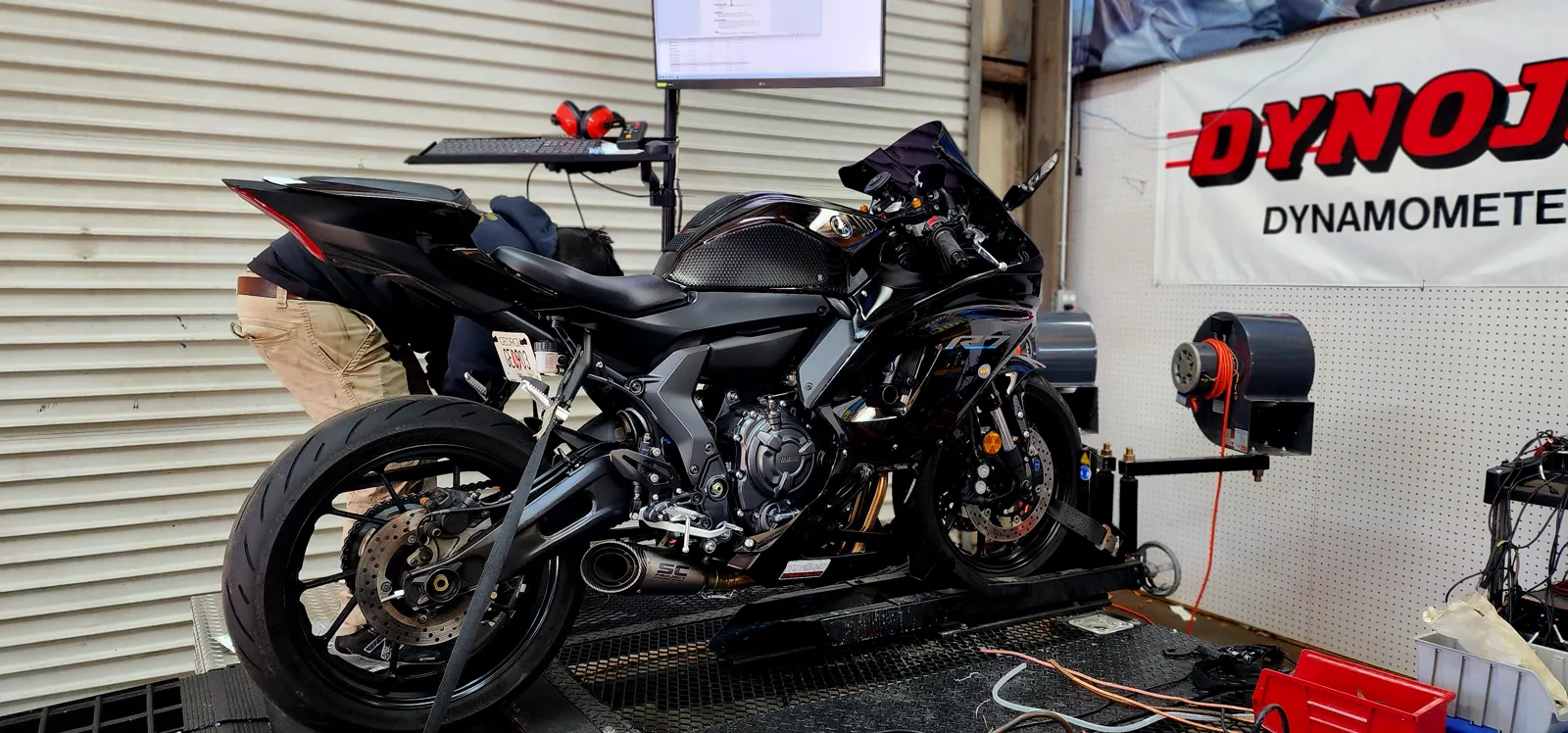
A dyno is a set of heavy steel rollers in the floor. We strap the bike down so it can’t go anywhere, then run it up through the gears with the rear tire spinning those rollers. They’re heavy on purpose. The machine watches how fast your engine speeds that weight up, and from that it works out how much force the engine really makes at every rpm. Nothing gets guessed. It’s measured, the way a scale measures flour.
At the same time, a probe reads the exhaust and tells us the air-to-fuel mix at every point in the run. That’s the part riders care about even if they’ve never heard the term. Your engine wants a certain amount of air for every drop of fuel. Too much air and not enough fuel is lean. Too much fuel for the air is rich. The dyno draws both the power curve and the fuel mix on the same screen, so we can point at the exact rpm where your bike goes flat and show you why.
Lean, rich, and what they feel like from the saddle
Lean means the engine is getting more air than the fuel map planned for. It runs hotter, it can surge at steady cruise, and it often pops on deceleration. Riders describe it as the bike feeling nervous. Rich is the opposite — extra fuel, a soft lazy throttle, sooty plugs, and fuel mileage that quietly gets worse. Neither one is a disaster on day one, and neither one is something you have to live with. Both are just numbers on a map, and maps can be rewritten.
Most modern bikes leave the factory a touch lean in the cruise range because emissions rules push them that way. Add a freer-flowing exhaust and the engine pulls in more air than the map expects, so it gets leaner still. That’s why a slip-on alone can make a smooth bike feel snatchy. If your bike already does this, here’s what usually causes it and how we sort it out.
A tune changes the instructions, not the hardware. We adjust how much fuel gets delivered at each rpm and throttle position, and on many bikes we also adjust ignition timing. On a fuel-injected bike we do that by flashing the ECU directly or by adding a Power Commander that sits between the ECU and the injectors. Either way, the parts on your bike stay the same. The bike just stops guessing.
What drives the work on a Roswell bike
Roswell riders are hard on bikes in a specific way, and it shows up in what we see on the rollers. This is not a town where bikes get started twice a summer. The Suches loop using US-19 and GA-180 is the standard weekend target, and riders around here run it enough that they know exactly how their bike behaves at mountain speeds. That means long stretches of steady throttle, then hard drives out of corners, then engine braking all the way down. A map that is a little off will annoy you on Roswell Road. Up there, it will annoy you for four hours straight.
Then there’s the other half of the mileage. GA 400 southbound to Perimeter and Buckhead is one of the few metro runs where people genuinely commute on two wheels year-round, partly because motorcycles can legally use the HOV lanes. Georgia doesn’t allow lane filtering, so commuting here means sitting in real traffic with heat coming off the engine. A lean cruise map is at its worst exactly there — hot, slow, stop and go. That is usually the ride that finally makes someone call us.
This is the point where a lot of riders make the wrong call. They feel the flat spot, decide the bike needs more power, and start buying parts. Then they bolt on the parts and the bike feels worse, so they buy a second set of parts. What was actually wrong was fueling, and fueling was the cheapest thing on the list to fix. We would much rather you spend on measurement first and hardware second, in that order, every time.
What we check before anything gets changed
A dyno is very good at telling the truth, which means it will happily show us a problem that has nothing to do with tuning. So we look the bike over before it ever gets strapped down. A tune written on top of a mechanical fault is a tune you’ll have to pay for twice, and nobody enjoys that conversation.
- Air filter condition, because a clogged filter changes the math before we start
- Spark plugs, coils and wires — worn plugs read like a fueling problem and aren’t one
- Exhaust leaks, which fool the oxygen sensor and give us a false reading
- Chain, sprockets and tire condition, since all of it is spinning under load
- Coolant, oil level and oil condition, because we’re about to work the engine hard
- Throttle bodies and cable free play, so the throttle position we log is the throttle position you asked for
- Any stored fault codes the ECU has been quietly holding onto
After that we do a baseline run. That’s the before picture — your bike, as it sits, with every number recorded. We keep it, because at the end you get to compare the two curves side by side. Nobody has to take our word for anything. If you want the whole scope of what happens in that bay, here’s the full list of what we do.
Mistakes worth skipping
The most common one is buying a map off the internet for a bike that isn’t yours. A downloaded map was written for someone else’s exhaust, someone else’s air filter, someone else’s altitude and someone else’s fuel. It might be close. Close is fine for horseshoes and less fine for an engine that runs hot all summer in Georgia.
The second is chasing a number instead of a feeling. A peak power figure is one dot on a long line. What you actually ride is the middle of that line — the part between walking speed and the rev range you use pulling out of a driveway on Willeo Road. A good tune usually makes the whole curve smoother and the bottom half stronger, and that is the change you’ll notice on every single ride.
The third is waiting. Riders put it off a whole season, then bring the bike in with a fueling issue and a heat issue stacked together. Different city, same pattern — it’s basically what Lawrenceville riders run into too. Good news: none of it is hard to unwind once the bike is on the rollers.
You don't ride a peak number. You ride the middle of the curve, every day.
Roswell context, and why riders here come across the river
Roswell has more motorcycle businesses per mile than almost anywhere in North Fulton. Alpharetta Highway is basically motorcycle row, and BMW Motorcycles of Roswell at 11240 Alpharetta Hwy is a 9,000 square foot flagship Motorrad store with factory-trained techs. If you ride a GS or a GSA, that store is a genuinely great answer and we’ll say so out loud. The catch is that it’s brand-exclusive by design. So if your garage has a BMW and an old Ducati and your kid’s scooter in it, you end up shop-hopping.
That’s the gap we fill. Riders come to us from the Historic Roswell and Canton Street district, from the Craftsman bungalows and newer infill townhomes there, and from the older established streets in Litchfield Hundred, usually because they want one shop that will take every bike they own. Crabapple and North Roswell send us a mix too — historic village homes on one side, brand-new construction on the other, and a surprising number of bikes that dealers won’t touch because of their age.
The ride over is simple. It’s one road most of the way — Roswell Road, which is GA 120, running west across the Chattahoochee into East Cobb. From the Canton Street area that’s roughly seven to nine miles, give or take traffic. Coming from the Holcomb Bridge and GA 400 side it’s a bit longer. Riders who’ve dropped kids at East Roswell Park for a soccer game already know that traffic pattern better than any map does.
One more local wrinkle. The city budgeted heavily for resurfacing in 2026, and Riverside Road, Canton Street and the river-side stretches are on the list, which means active construction and utility-cut seams. Azalea Drive and the roads down by the water are exactly where rims get bent and tires get chewed. So while the bike is here for a tune, we look at wheels and tires too. It’s a two-minute check that saves a second trip past Barrington Hall and back.
What changes after, and who should stay stock
Here’s the thing we wish every rider knew a season earlier: a tune is mostly a smoothness upgrade, not a lottery ticket. The headline is more power, sure. What you actually notice on the ride home is that the throttle stops surging at steady speed, the bike stops running so hot in slow traffic, deceleration popping calms down, and the engine picks up cleanly right off idle instead of stumbling. That’s the part riders talk about a year later.
So the recommendation, plainly. In the dyno tune vs stock Roswell debate, if you’ve added an exhaust, an air filter or a different intake, or the bike surges and gets hot in GA 400 traffic, put it on the rollers. Custom mapping on your bike, with your parts, in Georgia air, beats a generic file. For more detail, this covers what the work covers start to finish.
And the honest flip side, because a recommendation without one isn’t worth much. Stock wins for a fully unmodified bike under warranty that runs clean, especially if it’s newer and you mostly ride short suburban trips. Stock also wins when the bike has an unresolved mechanical issue — fix that first, then tune. On some Harley models the factory calibration is well matched to a stock setup, and the Harley-Davidson service information site is a fine place to check your own model before spending anything. And if what you really want is to ride better rather than faster, a day of MSF rider courses will do more for you than any map.
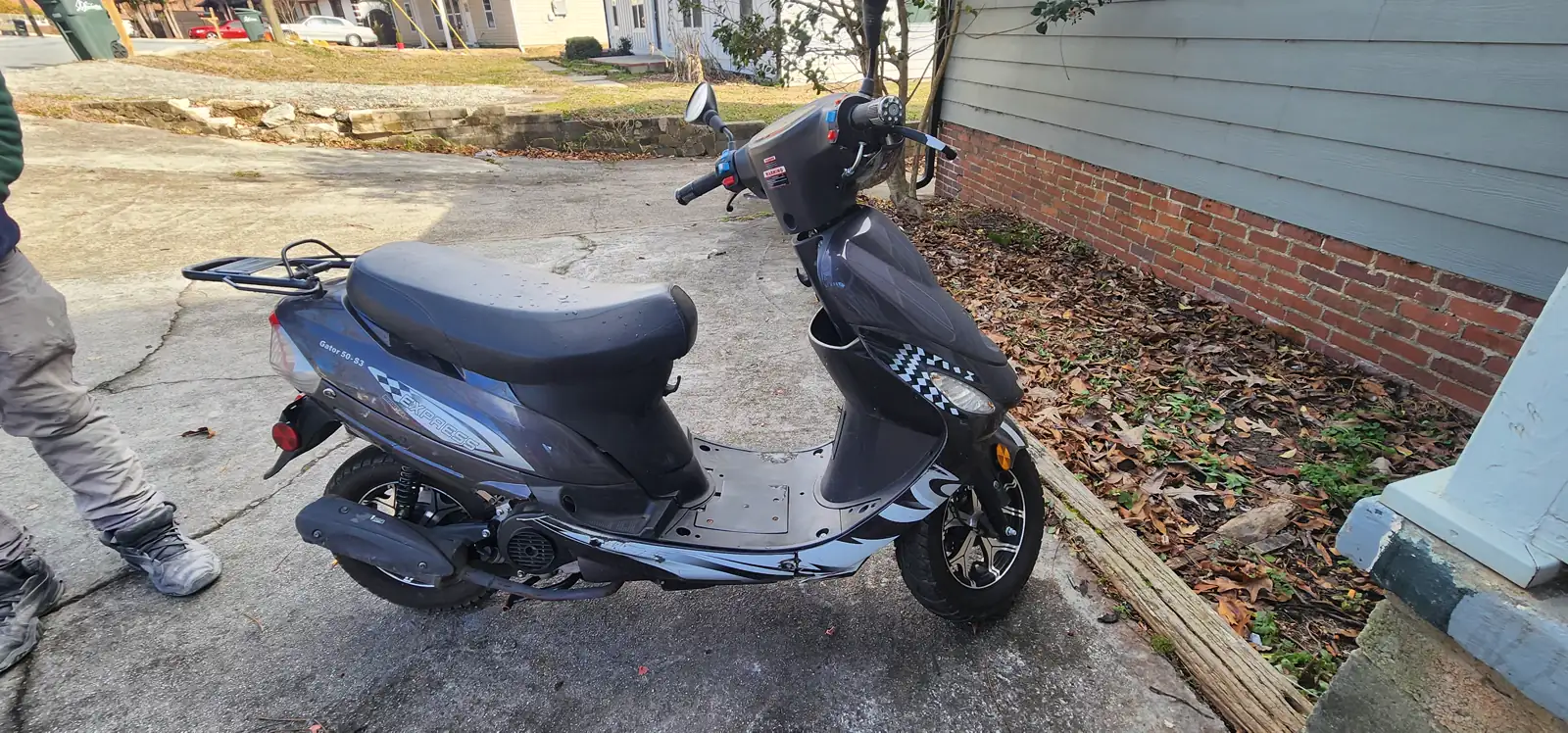
Whatever you decide, you should leave knowing why. We’ll show you the baseline curve, tell you what it says, and give you a real answer even when that answer is leave it alone. Clear beats impressive. Every time.
Questions Roswell riders ask us
Is the upgrade actually worth it on a mostly stock bike?
If the bike is truly stock and runs clean everywhere, usually no. Save it for when you change the exhaust, intake or filter. The exception is a bike that surges at steady cruise or runs hot in traffic, because that’s a fueling issue and a tune fixes it directly.
Which should I pick if I only ride on weekends?
It depends where you ride, not how often. Short neighborhood loops on a stock bike don’t need a tune. If your weekends look like the Suches loop on US-19 and GA-180, hours of steady throttle and hard corner exits will make any fueling flaw obvious, and a tune is worth it.
What's the real difference between an ECU flash and a Power Commander?
A flash rewrites the factory computer directly, so there’s no extra box on the bike and it can change more settings. A Power Commander is a small module that adjusts the signal going to the injectors and can be unplugged later. We pick based on your model, your parts and whether you want it reversible.
Which one lasts longer — a tune or leaving it stock?
A good custom tune doesn’t expire. It stays accurate until you change the hardware again, so a new exhaust or a big altitude change is the trigger for a revisit. Stock calibration lasts forever too, but it never adapts to the parts you added, which is exactly the problem.
Which is right for my kind of riding?
Commuters on GA 400 usually benefit most, because heat and steady-throttle surging are the two things a tune cleans up best. Touring and big cruiser riders notice smoother low-rpm pull. Riders on a newer, unmodified bike doing short trips are honestly fine as they are.
Do I need to bring anything with me?
Just the bike and any paperwork for parts you’ve added, like a receipt or a box for the exhaust. Knowing the exact part helps us start from the right place. Text us your model and what’s changed on it and we’ll tell you what to expect before you ride over.
We take care of riders from all over the north metro, and Roswell is a short hop across the river from us. Along with Roswell we regularly see bikes from Alpharetta, East Cobb, Sandy Springs, Marietta, Milton, Johns Creek, Woodstock, Dunwoody, Mountain Park, Crabapple, Kennesaw and Atlanta. Some folks ride over, some drop off on the way to work, and some ask us to come get the bike. All three work fine, and none of them require you to own a particular brand.
TEXT US YOUR BIKE AND YOUR PARTS LIST
If you’re a Roswell rider stuck between leaving the bike stock and putting it on the rollers, send us a text with your model, your mileage and anything you’ve bolted on. We’ll tell you straight which way we’d go and why, before you ride across GA 120. If the answer is leave it alone, that’s what we’ll say.
470-460-9883Diaz Motorcycles and Service, LLC · 847 Barnes Mill Road, Marietta, GA 30062