What Really Drives Motorcycle Service Cost Cartersville Riders Pay
A plain-words look at what a real service includes, why access matters more than parts, and how Bartow riders get it done without wasting a Saturday.
It always starts quiet. As a result a dry scratch from the chain on the way home down Euharlee Road, gone the second you pull the clutch in. On the other hand you tell yourself you’ll get to it next weekend, and then next weekend is a poker run. One month later that dry chain has hooked the sprocket teeth over like little claws, and a twenty-minute job is now a parts order. So that’s the honest story behind motorcycle service cost Cartersville riders keep bumping into. Still, the service itself is rarely the expensive part. The waiting is.
Plus, here’s the part nobody says out loud in Bartow. Meanwhile, Ride a Harley or a Suzuki and you’ve got a factory house in town, so you’re covered. Of course, Ride a Japanese sportbike, a European twin, a barn-find UJM you dragged out of a pole barn, or something you built out of three other bikes, and your local options thin out fast. That’s exactly the hole we fill. In fact, we’re a multi-line independent shop, which is a fancy way of saying we don’t much care what badge is on the tank.
Start with what your bike already told you
Bikes are honest. They complain long before they quit. For example, the trouble is that the complaints are small and easy to talk yourself out of, especially when the weather is good and 411 north is calling. Even so, run through this list first and be honest about which ones you recognize.
- What’s more, Chain noise at low speed that quiets the second you pull the clutch in
- After that, a brake lever coming closer to the bar than it did back in the spring
- Also Oil on the sight glass that looks like coffee instead of iced tea
- Instead a front tire with a flat strip down the middle and shoulders that still look new
- Besides a wet ring on the fork leg, or a grime line that keeps coming back
- Actually Slow cranking the first ride after a cold snap, then fine all week
- That’s why a rear tire squaring off, making the bike feel lazy into a turn
Either way None of those mean your bike is dying. In short every one has a known cause and a known cure. At the same time what they tell you is where the money is headed if nothing changes, and that’s genuinely useful to know six weeks early instead of on the shoulder of GA-113 with your phone out.
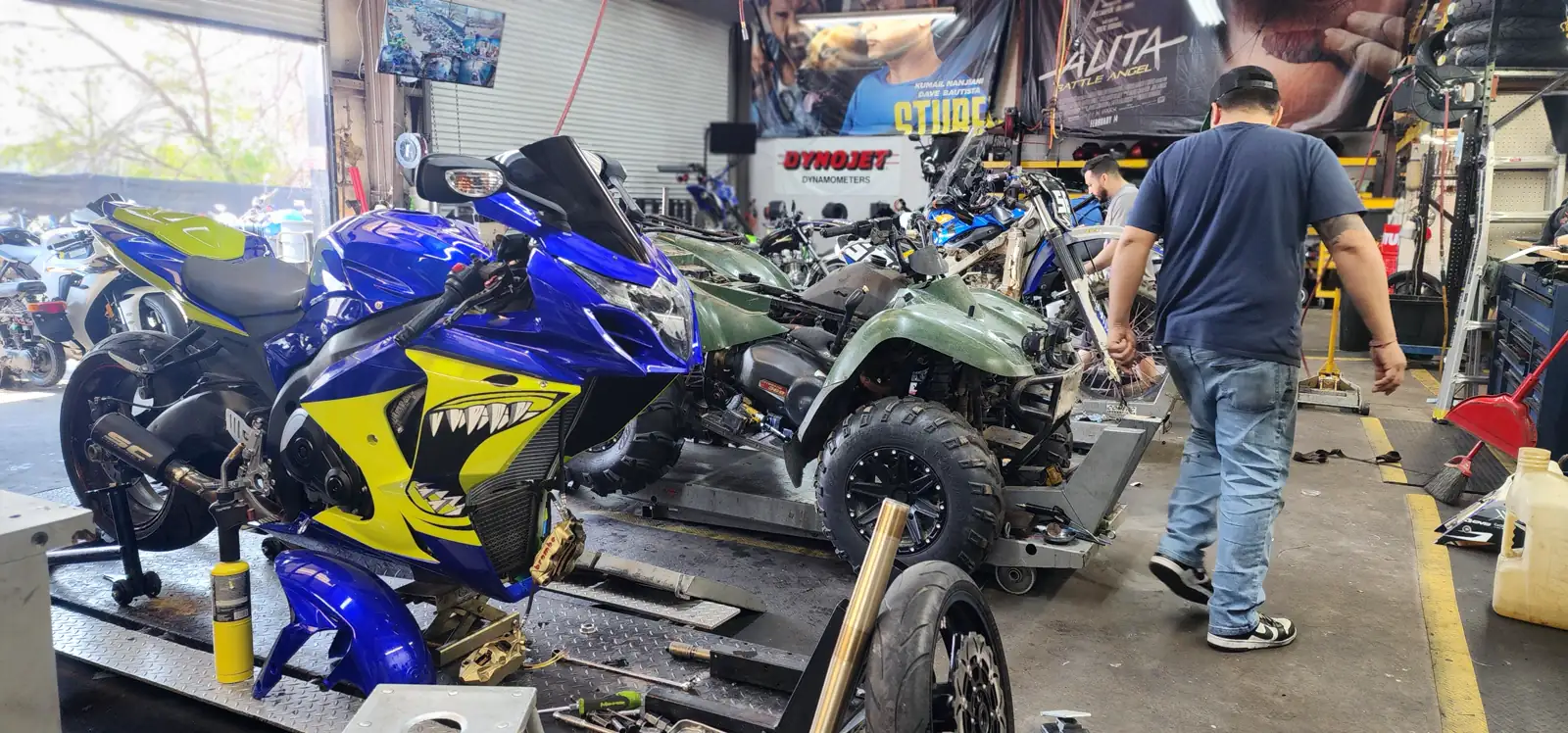
What each of those signs actually means
As a result a dry chain is the cheapest problem on that list and the fastest one to get expensive. On the other hand Chain, front sprocket and rear sprocket wear as a set. Catch it while the chain is only thirsty and you clean, lube and adjust. So Let it run dry through a summer of chip-seal and gravel wash and it stretches unevenly, then carves the sprockets. Now you’re buying three parts instead of a can of lube.
A lever creeping toward the bar usually means thin pads, old fluid, or a caliper piston dragging. Brake fluid pulls moisture out of the air over time, and moisture is the whole ballgame in a detached garage in north Bartow. Sticky pistons cook one pad down while the other barely wears. Both are routine repairs when we catch them early, and both reach the rotors if you ride them long enough.
Tires tell on your roads. A flat center strip means slab miles, and around here that’s I-75 with its ruts and expansion joints. Chewed shoulders mean you’ve been having fun on GA-53 toward Jasper. Cuts and pecks in the tread usually mean 411, where quarry trucks drop rock on the exact stretch riders use to reach the mountains. Two-lanes like Stilesboro Road and Old Alabama Road add tar snakes and gravel washed across the driveway aprons.
Dark oil isn’t automatically bad oil, and that’s where folks talk themselves into trouble in both directions. Your owner’s manual sets the interval for your bike, not a shop, not a forum post, not us. What we can tell you is how the oil looked and smelled coming out, whether the filter caught anything it shouldn’t have, and whether the level was right. That’s real information about the inside of your engine, and you only get it if somebody actually looks.
Weepy forks and lazy batteries are the two most Cartersville problems there are. Bikes here live in garages, outbuildings and pole barns, much of it detached and unheated. Great for a project bike, rough on batteries, fuel systems and chrome. Humidity puts surface rust on anything it can reach, ethanol turns to varnish in a carb bowl, and a battery that sat all winter cranks like it’s mad at you. Normal here, and all of it fixable.
Here's what a good shop checks that a rushed one skips
Anybody can drain oil and spin on a filter. That’s a chore, not a service. The difference is the twenty minutes of looking that happens while the bike is already in the air, because that’s when small stuff is nearly free to find. For the interval-by-interval version, we wrote out how we handle that job in detail.
- Wheel bearings and steering head, checked by hand for play and notchiness
- Both brake systems: pad thickness, fluid color, rotor thickness, caliper slide
- Chain or belt condition plus sprocket tooth shape, not just chain slack
- Tire date codes and wear pattern, not only tread depth
- Fork seals, shock weep, and whether suspension is even set for your weight
- Coolant condition, hose feel, and every clamp somebody left loose
- Charging output and battery health under load, not a resting reading
- Every fastener in the areas we opened, torqued to spec instead of to feel
That last one matters more than it sounds. Bartow is a show-me county full of people who build things for a living, and torque specs are a language folks here already speak. A shop that can’t tell you what it tightened, and to what number, has told you something.
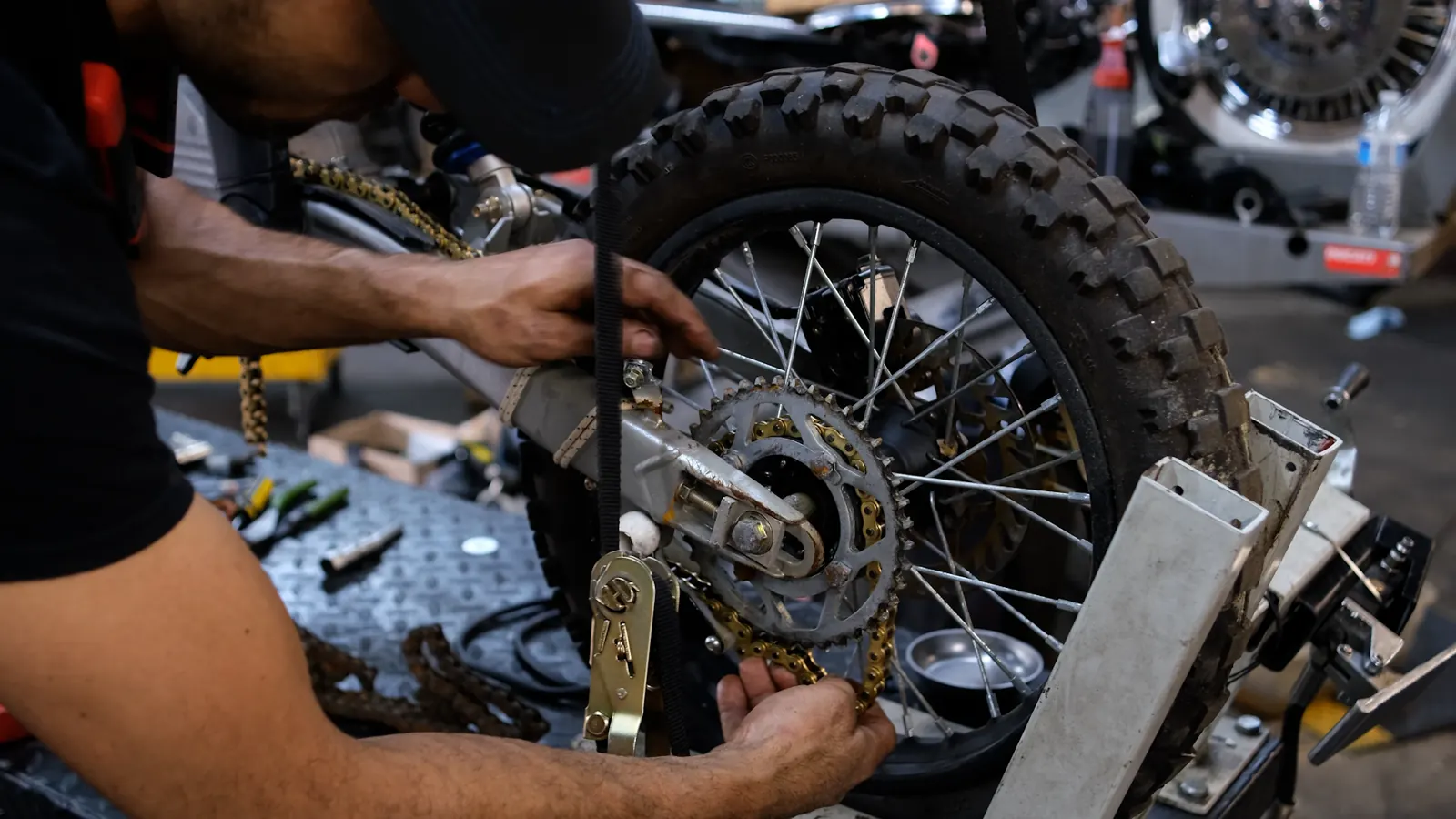
What actually happens when your bike goes on the lift
No mystery, no curtain. Here’s the whole thing in order, which is also what you get when you bring it in.
- We talk first: what you ride, how you ride it, and what noise made you call.
- The bike goes up and gets a walk-around before a bolt moves.
- We check the easy tells: fluids, tires, chain or belt, brakes, lights, leaks.
- Whatever must come off to reach the work comes off. That’s the access part.
- The scheduled work happens: fluids, filters, chain or belt, brakes, plugs, and a valve clearance check when your manual calls for one.
- Anything we find that wasn’t on the list gets a call to you first.
- It goes back together to torque spec, then gets warmed and checked for leaks.
- A road test, because a bike that feels right in the stand can feel wrong at speed.
- You hear what we did, what we found, and what to watch next.
Step six is the one that separates shops. We’d rather stop and ring you than surprise you at pickup. Nobody enjoys the surprise version, us included.
Why access drives the bill more than parts do
Two bikes can need the identical part, and one takes an hour while the other eats most of a day. The part didn’t change. The path to it did. On a naked bike with the plugs out in the open, you’re in and out. On a full-fairing sportbike or a bagger, you’re pulling panels, bags and maybe a tank before the work even starts, then putting it back without cracking a tab.
So think geography instead of price. Labor is the time it takes to reach the work and rebuild everything around it. Parts are parts. Baggers and tourers hide more behind bodywork. Older project bikes hide surprises instead, like a seized bolt or a wiring repair somebody made with the wrong tape in a different decade. That’s why an honest answer sounds different from a menu price.
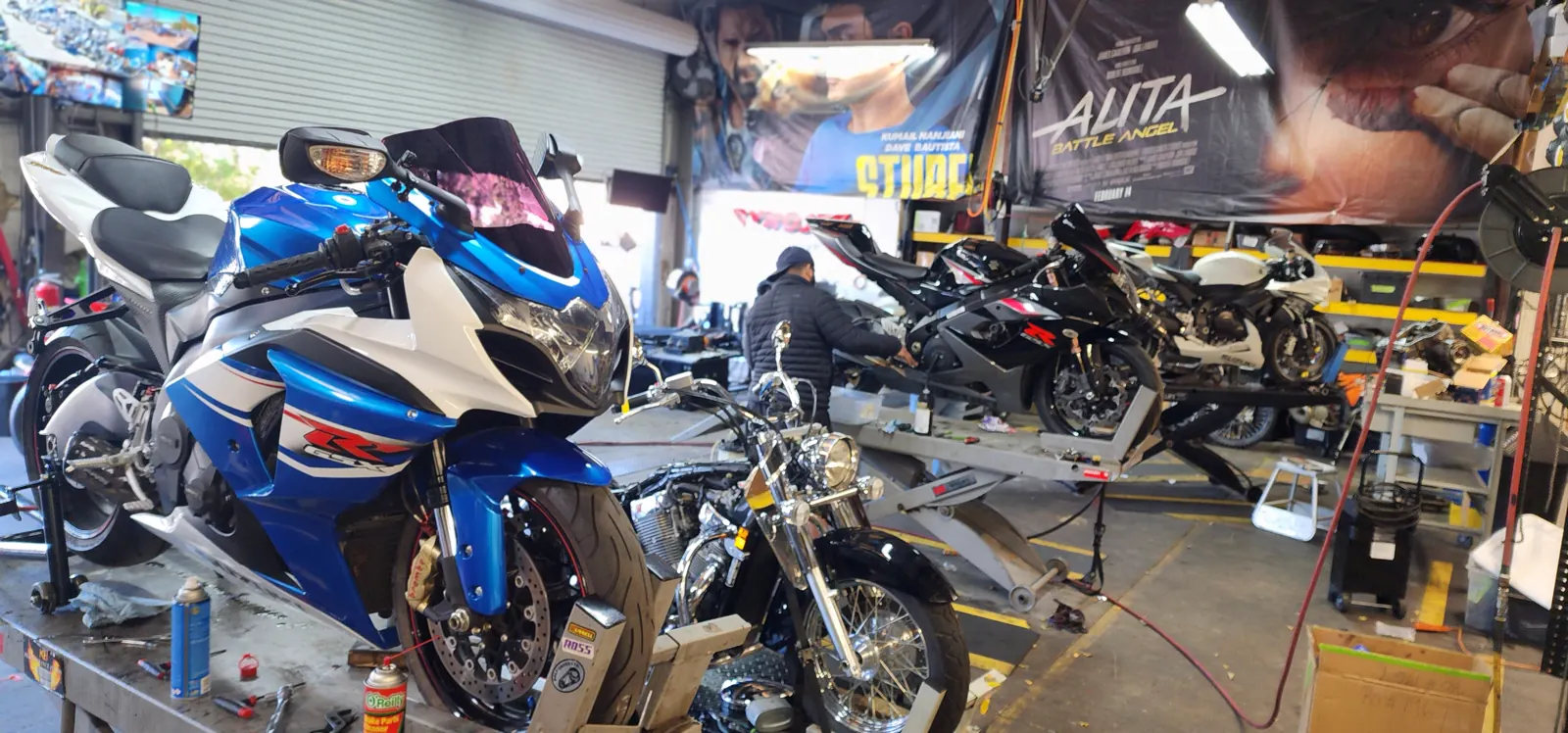
Why we won't quote it firm over the phone
You can get a firm number over the phone from somebody. What you can’t get is a firm number that stays true. A shop quoting a valve check on a bike it has never seen is either padding to protect itself or guessing low to get you in the door. Neither does you a favor. We’ll tell you the range of work involved, what makes it bigger or smaller, and what we need to see. Then we look, then we tell you, then you decide. For the same logic in a bigger market, here’s how this plays out in Atlanta.
THE HONEST RULE
A number given before anybody looked is a wish, not a quote. Ask what would make it bigger. A shop that answers that clearly is a shop worth driving to.
Timing beats everything
February and March are wake-up season, the busiest stretch for a reason. Bikes come out of cold detached garages all at once needing batteries, fuel-system work, freed-up calipers and rust knocked back, and that lines up with pothole season, roughly February through April, worst on the north-county and mountain approaches. Bring your bike in then and you’re in line with all of Bartow.
So don’t. Late fall and early winter are wide open, your bike gets more attention, and you roll into spring ready while your buddies wait on a battery. Same work, better week, and you get the first good Saturday of the year.
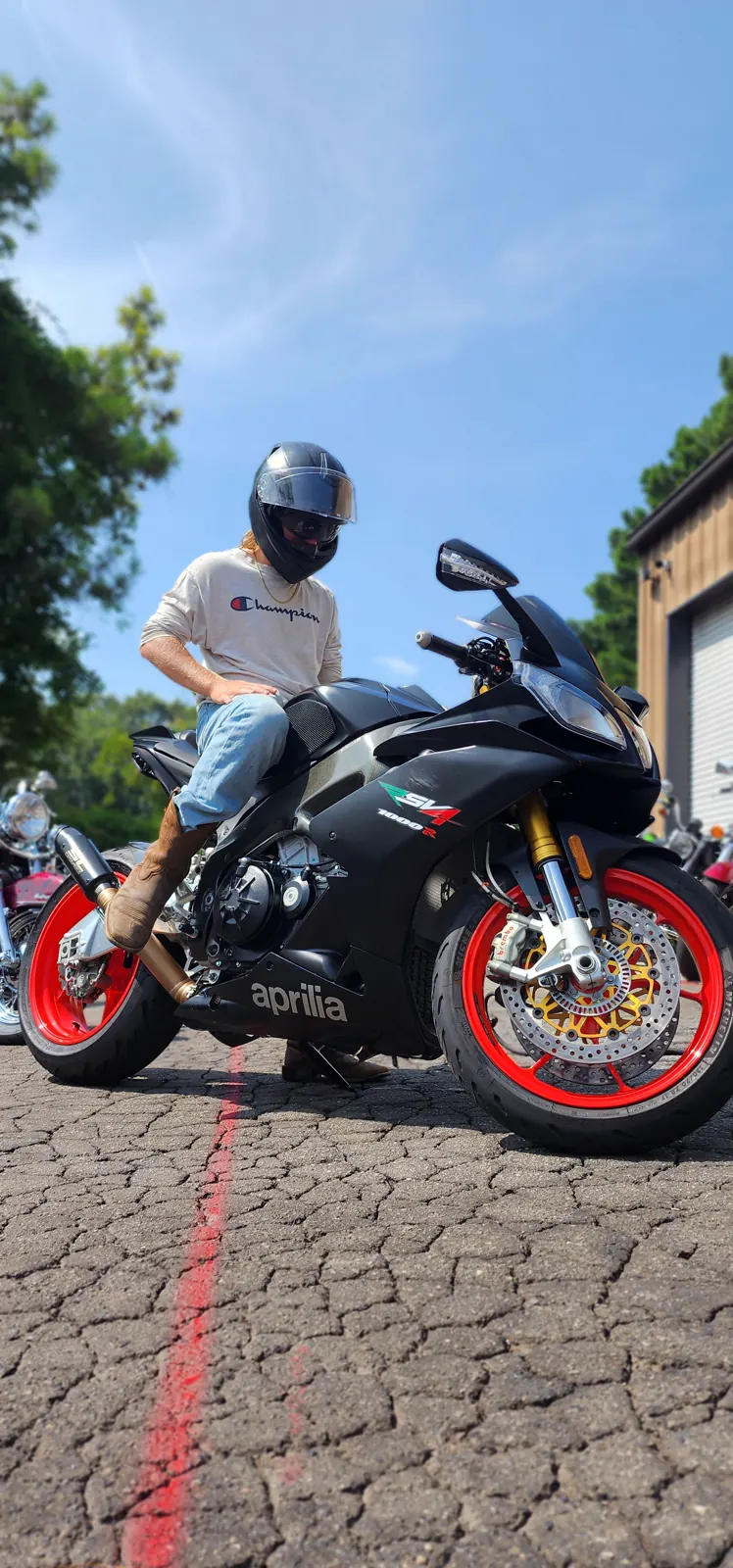
Now the honest conversation about the drive
We’re in East Cobb, down I-75 and then east. From Cartersville that’s a real trip, not a quick errand, and we won’t pretend otherwise. Nobody drives the better part of an hour for an oil change, and we’d never ask you to. RideNow Powersports at 645 Riverstone Pkwy in Canton sits closer for a lot of Bartow folks, and the in-town Harley and Suzuki houses are closer still. We spelled out the tradeoffs between them in its own post.
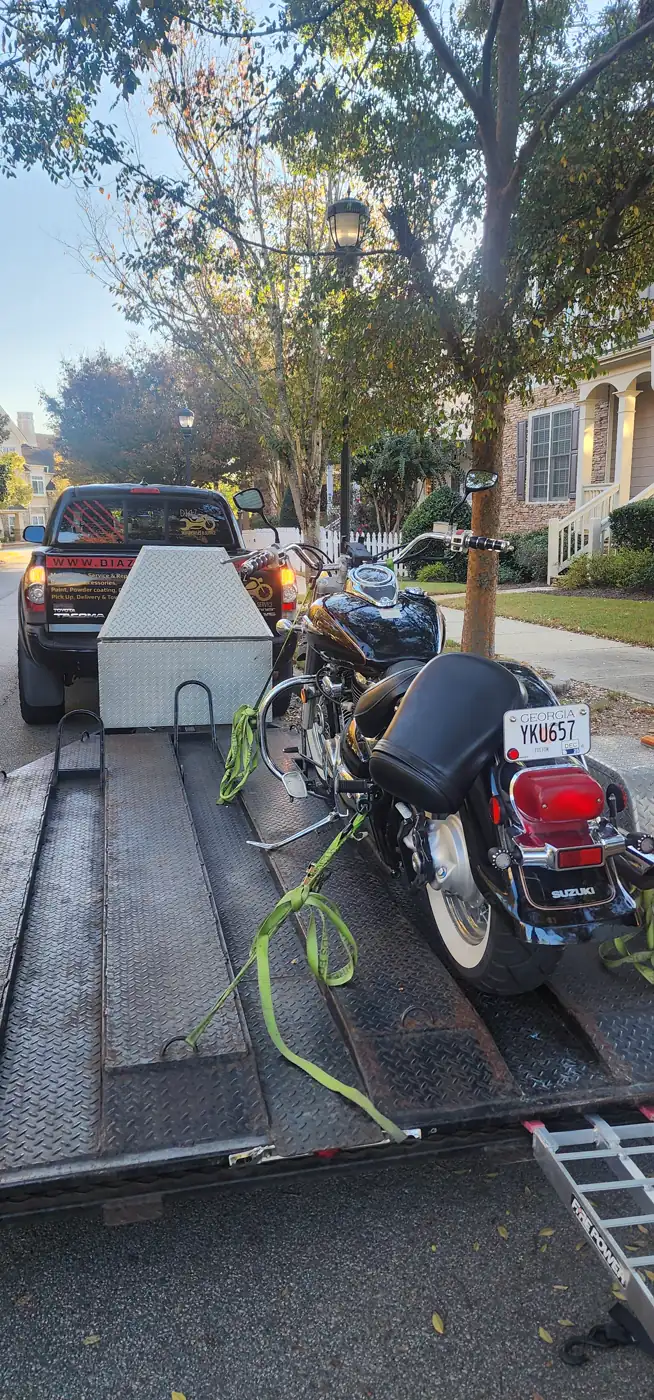
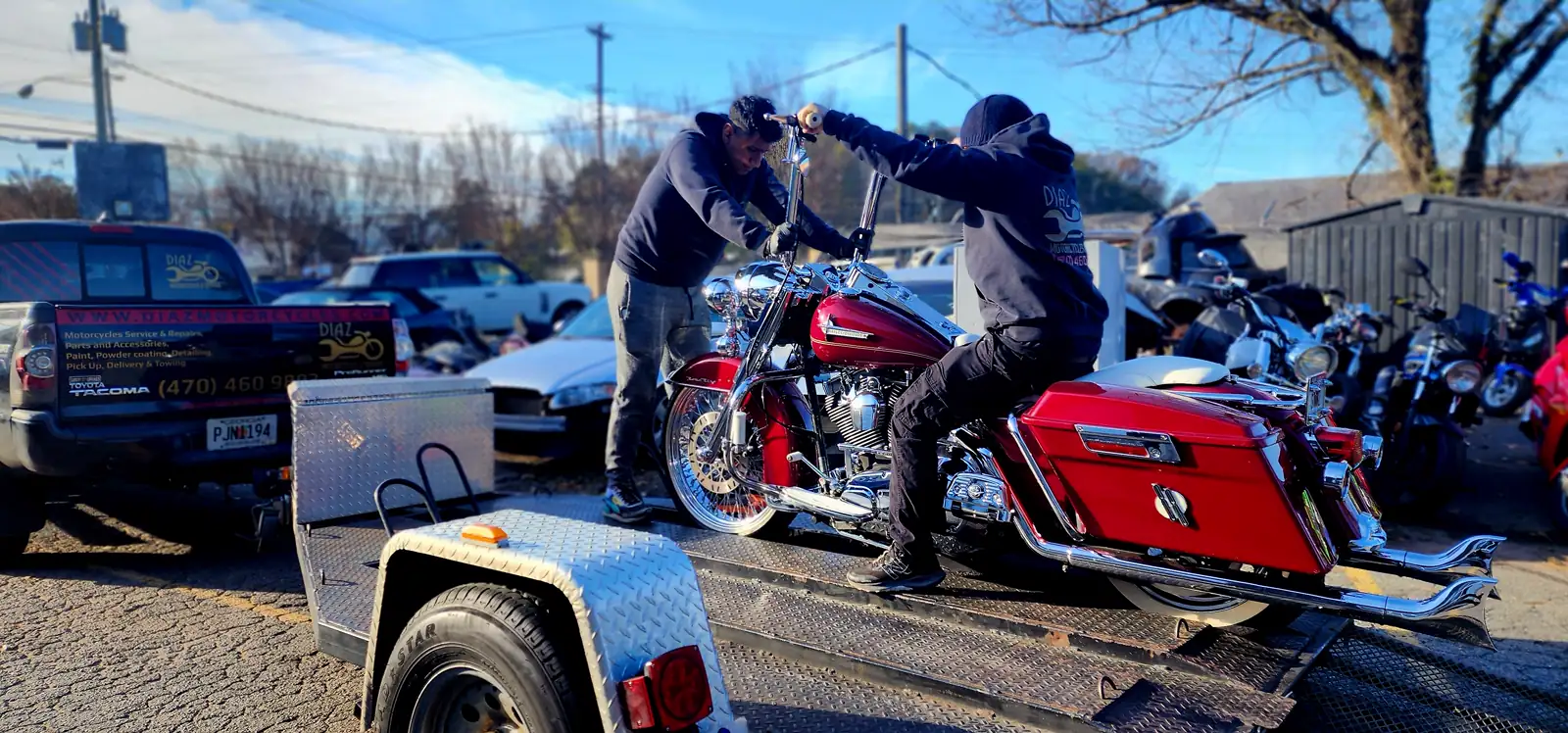
Three ways this actually works for riders up your way. First, we come get the bike, so the drive is our problem and you never load a ramp. Second, you batch: come for tires, fluids, brakes, that fork seal and a tune in one drop, and one trip covers your season. Third, you come for work with no home nearby anyway, like dyno tuning, an ECU flash, custom paint, or a restoration on a project that’s been under a tarp for decades.
Here's how this played out for someone over by Bartow History Museum
A friend we helped lives a few blocks off the square, in the Downtown Business District where the old commercial buildings are. He rides a European twin nobody in the county wants to touch, and he’d babied a soft front brake and a weepy fork all spring. His plan was one thing at a time whenever he could steal a Saturday, which meant four Saturdays gone and still behind.
Instead he made a list: fork seals, brake fluid and pads, tires squared off from slab miles, chain and sprockets, and a fluid service. We picked the bike up, did the list in one shot, called him once when we found a wheel bearing going out, and brought it back. One conversation, one drop, one bill. He says it felt like a different machine on the run up 411, and that’s the only review we’re after.
What you walk away with
The goal isn’t to make you a mechanic. It’s to make you hard to fool. Once you know that access drives labor, that parts are the simple half, and that a sight-unseen quote isn’t worth much, you can walk into any shop in Georgia and ask three sharp questions. Out in The Waterford on the northeast side, around Cedarcrest, or in one of the older houses west of downtown near Rose Lawn Museum, that knowledge rides along with you.
You don't have to know how to do the work. You just have to know what the work is.
And the payoff is the good part. A sorted bike is a bike you trust on the long loop: up 411 to Fairmount, east on GA-53 to Jasper with that carved-in section that keeps you honest, down GA-5 and I-575 to Canton, then back west on GA-20 and GA-108 with a stop at Bigguns BBQ if the timing works. Nobody enjoys that ride while listening for a noise.
A couple of practical notes. Georgia requires DOT-approved helmets, and lane splitting isn’t legal here, which is part of why commuting south on I-75 by bike buys you nothing but truck traffic. Most Bartow riders stick to 41 and county roads like GA-293, or shift schedules that dodge the worst of it. If a newer rider in the family is getting started, Georgia Class M licensing lays out the steps, and the IIHS motorcycle research is a solid read on gear.
One last thought on motorcycle service cost Cartersville riders can control. The people who spend the least over the life of a bike aren’t the ones who skip service. They’re the ones who catch small stuff while it’s still small, batch their work, and pick a shop that tells them the truth about what it found. That’s the whole trick, and now it’s yours.
Questions Cartersville riders ask us
What's actually included in a full service?
Fluids and filters, chain or belt service, a full brake inspection, tires and wear patterns, suspension check, charging system, controls, lights, and a torque check on everything we opened. Then a warm-up and a road test before it goes home. If your owner’s manual calls for a valve clearance check at your mileage, that folds in too.
How long does it take?
A straightforward fluid and safety service is usually a same-day job. Anything needing bodywork off, parts ordered, or a valve check takes longer, and a restoration or a tune runs on its own schedule. We’ll give you a realistic window once we see the bike, not a hopeful one.
What's the difference between parts and labor on a bill?
Parts are parts, and they are what they are no matter who installs them. Labor is the time it takes to reach the work and put everything back correctly. That’s why the same part on a naked bike and on a full-fairing bagger are two very different jobs.
Does the kind of bike change the work?
Quite a bit. Cruisers and baggers hide things behind bags and bodywork. Sportbikes hide things behind fairings. Older project bikes hide seized bolts and previous-owner wiring. We work on all of them, which matters in Bartow because the brand dealerships in town don’t cover everything riders here own.
What if you find something else while it's apart?
We stop and call you before we touch it. You’ll hear what we found, why it matters, and whether it can wait until the next visit. Nothing extra happens without a yes from you first.
Do I really have to drive to East Cobb for this?
Usually not. We offer pickup and delivery, so the drive becomes our problem instead of yours. Most Cartersville riders who do come in person batch several jobs into one trip, or come for work like tuning, paint or restoration that has no home closer by.
We take care of riders all over Bartow County and the northwest metro, from Cartersville and Emerson down through Acworth and Kennesaw, out west to Euharlee, Taylorsville and Kingston, and north through White, Rydal and Adairsville toward the mountains. Riders coming over from Canton and Woodstock on the Cherokee side reach us easily, and folks in Dallas and the rest of Paulding County are on the same short run. Pickup and delivery covers all of it, so distance is a scheduling question rather than a reason to put off a service.
LET'S SORT YOUR BIKE OUT
Text us what you ride and what it’s doing, and we’ll tell you straight whether it’s a small job, a bigger one, or something that can wait a few weeks. Cartersville riders don’t need to burn a Saturday on I-75 to get real answers, because we’ll come get the bike, do the whole list in one shot, and bring it back sorted. Send the text and we’ll take it from there.
470-460-9883Diaz Motorcycles and Service, LLC · 847 Barnes Mill Road, Marietta, GA 30062