Motorcycle Service Cost Atlanta — What You Pay
What a real service includes, what makes one job bigger than the next, and why an honest shop won't price your bike over the phone.
In fact, Eight in the morning on the Connector is not really riding. It’s a slow bake. For example, Clutch in, fan cycling, heat rolling off the pavement and up through your boots while the inbound wave creeps forward a car length at a time. Even so, Georgia keeps you sitting in it, too, because O.C.G.A. 40-6-312 says a bike stays fully inside one lane and never runs between rows of cars. So your engine does the waiting right along with you. What’s more, that daily grind is a big part of why motorcycle service cost Atlanta riders see can look so different from one bike to the next.
The straight answer, before anything else
A service isn’t one job. After that, it’s a stack of small jobs done in one visit, and the height of that stack is what moves the number. Oil and filter. Chain and sprockets. Brake pads and fluid. Also Coolant, air filter, spark plugs, valve clearance, cables, bearings, tire condition. Instead some bikes need two of those things. Some need nine. Besides Parts are only half the story anyway. Actually the other half is how long it takes a tech to reach them.
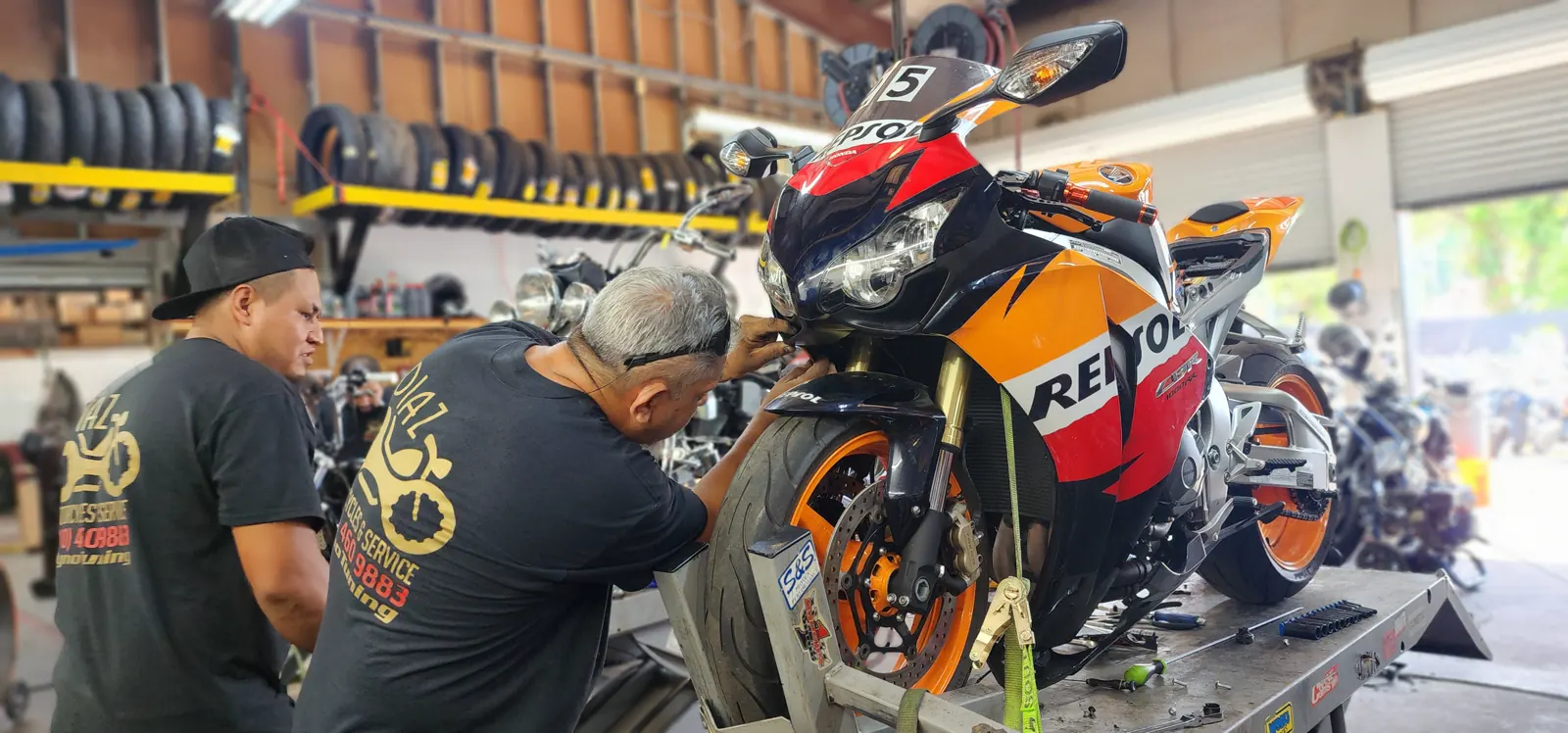
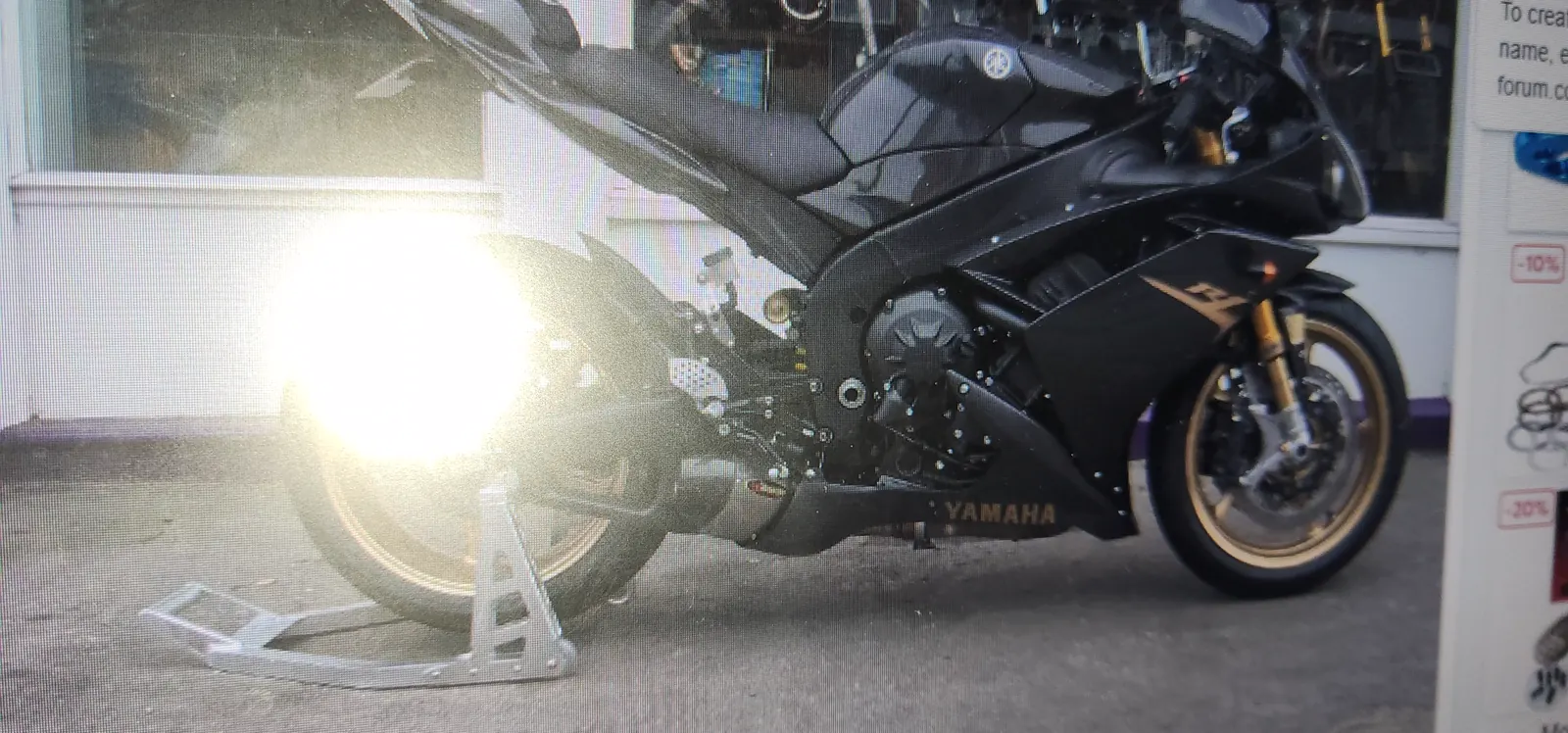
Access is the quiet driver. That’s why On a naked bike, the oil filter sits right out in the open and the plugs are a ten minute reach. Either way On a full-fairing sportbike, those same two jobs start with pulling panels, unclipping wiring, and laying out hardware so nothing wanders off. Same oil. Same filter. Very different afternoon. In short that’s how two riders with matching mileage can leave with two very different tickets, and nobody got a raw deal.
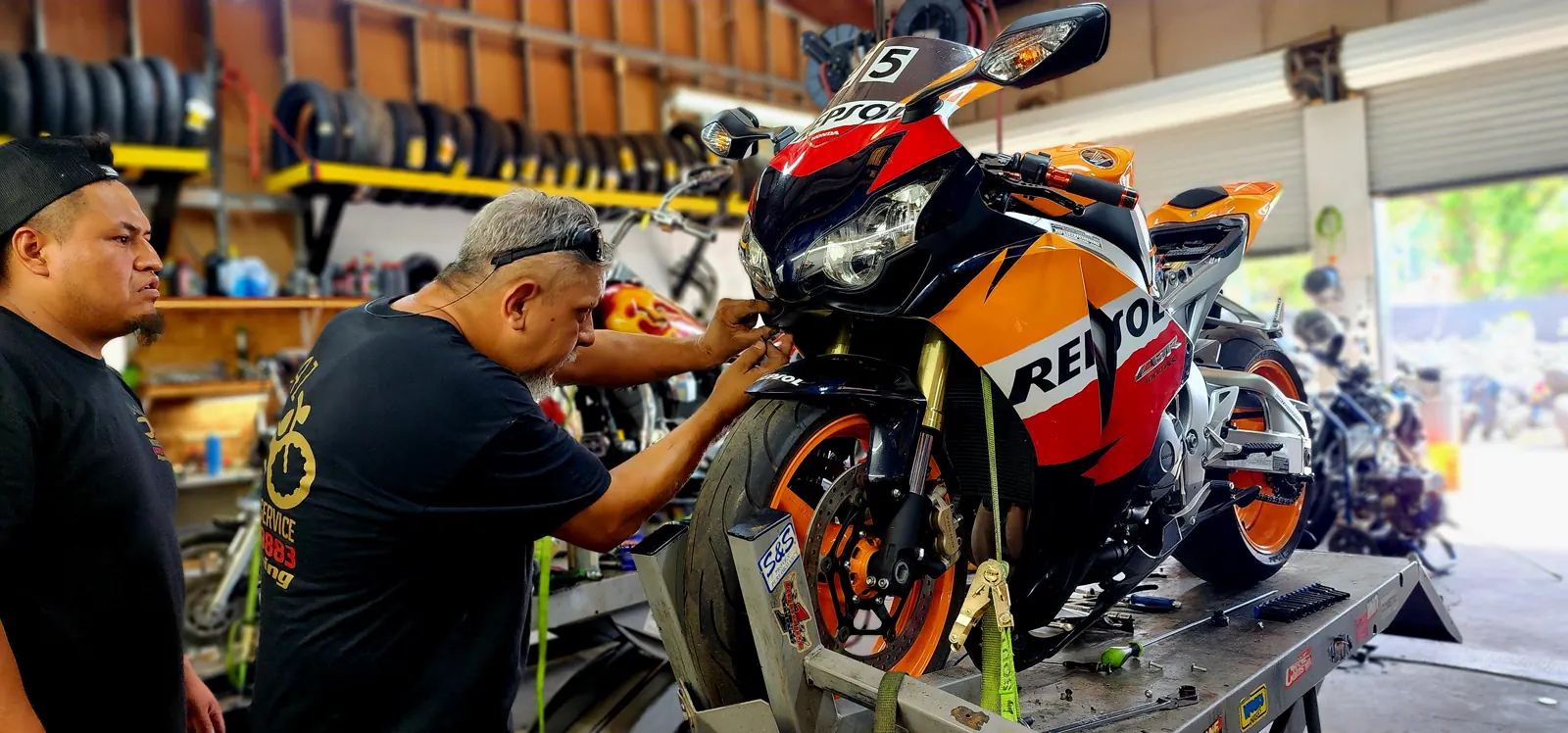
At the same time Parts cost what they cost, and that part is honest and boring. As a result Labor is where the real range lives, and labor is just time in a bay with a bike apart. On the other hand look at the work we do in house and almost all of it comes back to one trade: how much has to come off before the actual repair even starts. So a thermostat tucked behind a touring fairing can turn a twenty minute fluid swap into most of a day, and neither of us knew that until it was on the lift.
What makes one service bigger than another
Four things, mostly. Still, None of them are mysteries, and every one of them is something you can see coming once you know where to look.
- Access — fairings, tank, exhaust and airbox that have to come off before the real job starts.
- Condition on arrival — a clean, dry, well-kept bike moves fast; one that sat outside through pollen season and two Atlanta summers does not.
- Time since the last service — skipped intervals stack up, and old fluid quietly ages the parts around it.
- Bike design — some engines want the cam cover off and shims measured, others barely ask.
Your owner’s manual sets the intervals. Not us, not a chart taped to a wall, not a guy on a forum. Every manufacturer publishes its own schedule for oil, valves, coolant and brake fluid, and those schedules differ enough between brands that guessing would do you no favors at all. Bring the manual, or just tell us the year and model, and we work to what the factory actually says. That one habit takes most of the guesswork out of the conversation before it starts.
Here’s the part most riders never hear out loud. A shop doesn’t slow down because a job is hard. Meanwhile, a shop slows down because a job hides. Corroded fasteners. A seized bolt on an exhaust hanger. Of course, a fairing tab that cracked years ago and got glued by someone in a hurry. A wiring loom a previous owner rerouted with good intentions. None of that shows up in a phone call. All of it shows up on the lift, and it’s the whole difference between a morning and a day.
That’s the common version. The real story is a little different. Most of what makes a service grow in this city has very little to do with the engine at all. It has to do with what the street does to everything wrapped around the engine. Fork seals, wheel bearings, steering-head bearings, rims. In-town miles chew through those parts faster than suburban miles do, and they rarely say a word until a simple fluid job turns into a suspension conversation.
What we actually check
A full service should never be a mystery. You ought to know the list before the bike goes up, and you ought to get the list back with notes on it when the bike comes down. Ours runs in roughly this order, because each step tells us something about the next one.
- Fluids first — engine oil and filter, brake fluid front and rear, clutch fluid if it’s hydraulic, and coolant condition.
- Chain and sprockets — slack, alignment, tight spots, and whether the teeth have started to hook over.
- Brakes — pad thickness, rotor wear, caliper pistons moving freely, and the condition of every hose.
- Tires — tread depth, age, pressure, and any flat strip worn in by long stretches of straight-line crawling.
- Filters and plugs — air filter, plug condition, and what the plugs quietly tell us about how the engine is running.
- Everything that moves — cables, levers, bearings, fork seals, suspension sag, and fasteners brought back to spec.
- Electrical — battery health, charging output, and every light on the bike.
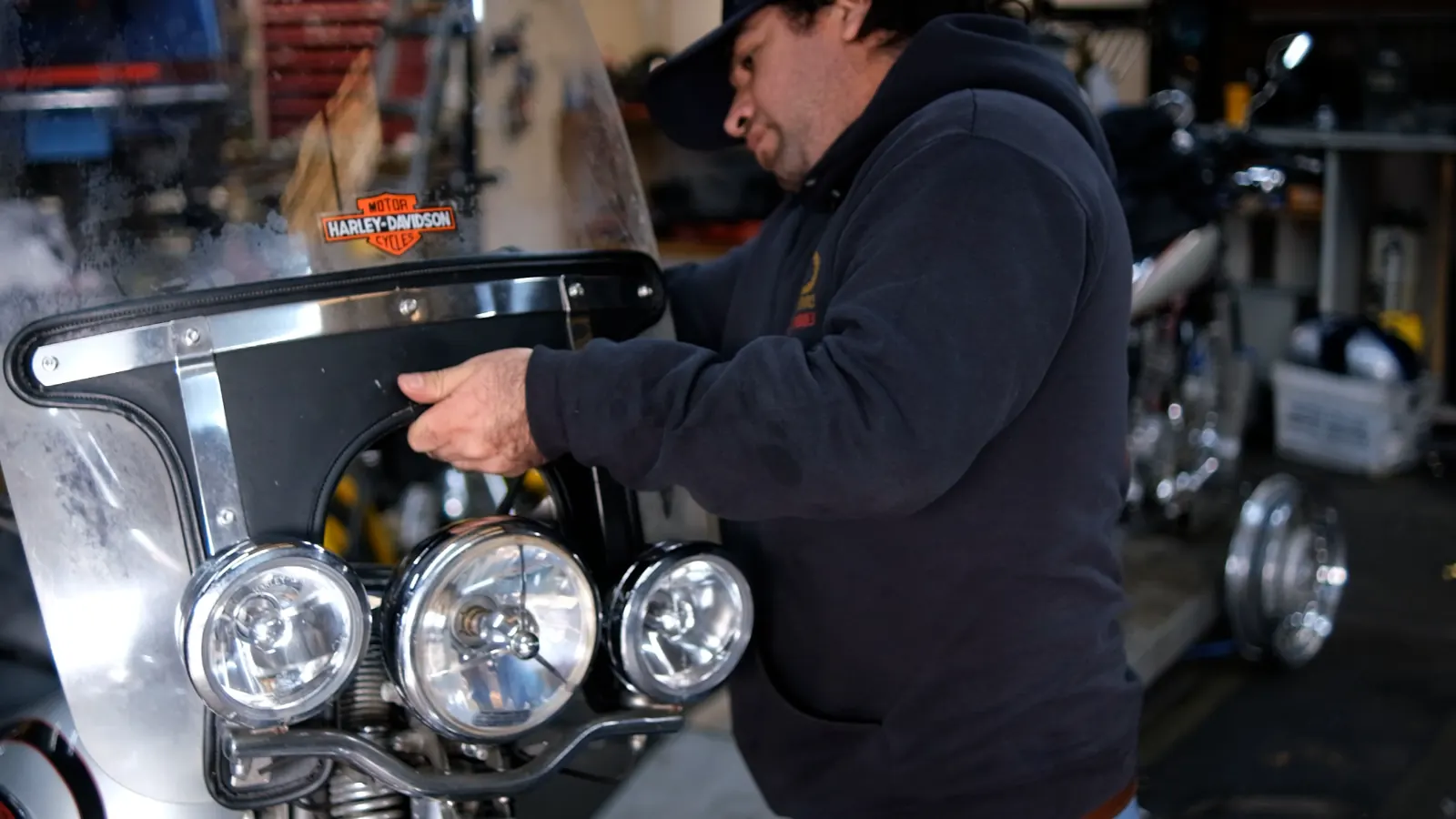
Tires and brakes get extra attention here, and not because we enjoy the drama. They’re the two systems doing the most work in stop-and-go traffic, and the two that give you the most warning if somebody’s actually looking. IIHS motorcycle research has spent decades on what keeps riders upright, and none of it argues with the boring answer: good rubber, honest pads, and a bike that behaves the same way today as it did yesterday.
Now the question everyone really wants answered. Why won’t we price the whole thing over the phone? Because the only truthful phone answer is a range so wide it helps nobody. We can tell you what a job usually involves, and we can tell you what we’d check first. Then we put eyes on the bike, write down what we find, and call you before anything gets done. It’s the same way how we handle that job works on the repair side, and riders tell us it’s the part they remember.
The small things that turn into big things
Almost every large bill we write started as something small that nobody caught. Not carelessness, just life. Here’s the short list of the ones we see most, and every one of them is easy to stay ahead of.
- Waiting for a noise — noise is late to the party, while fluid and wear show up early.
- Topping off instead of changing — old oil with fresh oil poured on top is still old oil.
- Chain lube with no cleaning first — grit sticks to lube, and grit works like sandpaper.
- A long winter on a flat battery, then asking the bike to fire up in March like nothing happened.
- Skipping brake fluid because the lever still feels fine — fluid pulls in moisture long before the lever ever tells on it.
Fix any one of those and you’ve already changed what next season looks like. That’s the good news buried in all of this: the cheap habits are the ones that matter most, and they take minutes. If you’re weighing shops right now, what separates a good shop is mostly whether they write things down and hand the notes back to you. Riders in town figure that out fast, since almost everyone finds a shop by search and referral rather than by driving past one.
Noise is late. Fluid and wear tell you first.
Atlanta wear is its own thing
Where you keep the bike changes the list more than mileage does. Up in Tuxedo Park, the Buckhead estate district around the Georgia Governor’s Mansion, bikes tend to live indoors and come in cosmetically perfect with fluids that quietly aged out anyway. Over in Lindbergh and Lindridge-Martin Manor it’s denser and apartment-heavy near MARTA, so bikes sleep on decks with no outlet for a tender. Kirkwood, the small town inside the big city, mixes Victorians and Craftsmans with detached garages or none at all, and covers and ground anchors do a lot of quiet work there.
One rider off Edgewood Avenue and Auburn Avenue put it better than we could. He said his bike didn’t get old, the street aged it for him. Those blocks carry embedded Atlanta Streetcar rails, and that flangeway gap is a documented crash mechanism for two wheels. Add Peachtree Street’s utility trenches under steel plates and you’ve got a surface diet that eats fork seals, wheel bearings, rims and steering-head bearings faster than suburban roads ever will. The city runs a Pothole Posse and a resurfacing dashboard, which tells you plenty on its own.
Heat is the other half. June through September, the urban heat island makes Downtown and the Connector hotter than the rest of the metro, and since filtering out of traffic isn’t legal here, your cooling system, clutch and battery absorb it. Then pollen season arrives from late February through May, and 2025 set an all-time record count of 14,801 on March 29. Whether you’re parked near the Atlanta History Center on West Paces Ferry Road or by Krog Street Market in that 1920s warehouse food hall off the Eastside Trail, the yellow finds your air filter.
Now the honest part about distance. We’re in Marietta, and you’re not. Figure roughly thirteen miles and twenty to thirty minutes from Buckhead, sixteen miles and twenty-five to forty from Midtown, and twenty-one miles and thirty-five to fifty-five from East Atlanta Village, plus another twenty to forty at peak. That’s real. It’s also not unusual, because there’s no dense cluster of full-service motorcycle shops inside the Perimeter, so ITP riders already drive that far for dealer service. The reverse commute up I-75 to East Cobb mid-morning runs against the inbound wave, which is the one traffic gift this city hands out.
MAKE THE TRIP WORTH IT
Three ways in-town riders handle the miles: we pick the bike up and bring it back on the trailer, you batch several jobs into one visit instead of three, or you save the drive for work worth driving for — dyno tuning, ECU flash, paint and restoration. Nobody rides twenty miles for an oil change alone, and we’d never ask you to.
Compare that to the OTP options and the picture gets clear. Killer Creek Harley-Davidson over at 11480 Alpharetta Hwy in Roswell has been open since September 1999 with nine service bays, a detail bay, a dyno and a machine shop, and they’re closed Monday and Tuesday. Good outfit. Still a haul from Kirkwood, and still built around one brand. Service capacity in this metro sits OTP along the northern arc, the west and the southeast, which leaves in-town riders structurally short on choices.
What you walk away with
A good service visit ends with you knowing more than you did that morning. You get the checklist with notes. You get told what’s fine, what’s getting close, and what can wait until next time without any drama. Nothing gets replaced that didn’t need replacing, and nothing gets quietly added while the bike’s apart. If we find something extra, you hear about it before a wrench touches it. Every time, no exceptions.
That’s really all motorcycle service cost Atlanta riders worry about comes down to: knowing why the number is the number. Bikes in the suburbs age differently, and the Lawrenceville side of things reads a little different because of it. In town, the wear pattern is short trips, hot traffic, rough pavement and no garage. Once you know that, you stop being surprised, and you start staying ahead of it.
One more thing worth having in order while you’re at it. If your endorsement needs sorting out, Georgia Class M licensing spells out exactly what the state wants. Bike sorted, paperwork sorted, and you get to spend the season thinking about where you’re headed instead of what’s about to go wrong. That’s the whole point.
Questions Atlanta riders ask us
Does the type of bike change the work?
It changes it a lot. A naked bike gives a tech direct access to filters, plugs and fluids, while a full-fairing sportbike or a dressed tourer needs bodywork removed first. The maintenance items themselves can be identical, but the time to reach them isn’t. Engine layout matters too, since some designs make valve checks a straightforward job and others make it an involved one.
What happens if you find something else while the bike is apart?
We stop and call you. You’ll hear what we found, why it matters, and whether it can safely wait until your next visit. Nothing extra gets done without a yes from you first. Most of the time the answer is easy, because a bike is already apart and the extra work is small.
How do I avoid surprises?
Bring your owner’s manual or tell us the exact year and model, and mention anything you’ve noticed even if it seems minor. Tell us how the bike is stored and roughly how you ride it, since deck parking in Midtown and a garage in Kirkwood produce very different wear. From there we inspect first, write it down, and talk before we start.
What makes one service bigger than another?
Four things: how much has to come off to reach the parts, what condition the bike arrived in, how long it’s been since the last service, and how the manufacturer designed the engine. A well-kept bike on schedule is quick work. A bike that sat outside through a couple of Atlanta summers usually needs more attention to the parts around the engine than the engine itself.
Why won't you quote a full service over the phone?
Because a truthful phone answer would be a range so wide it wouldn’t help you decide anything. We can absolutely tell you what a job typically involves and what we’d check first. Once the bike is on the lift we know what’s actually there, and then you get real numbers instead of a guess.
I'm in town and that's a real drive. Do I have to bring it myself?
No. We’ll come get the bike and bring it back on the trailer, which is how most of our in-town riders handle it. Plenty of folks also batch several jobs into one visit rather than making the trip more than once a season. Save your own ride out here for work worth the miles, like dyno tuning, an ECU flash, or paint and restoration.
We take care of riders across Atlanta and the metro, from Buckhead and Midtown down through East Point, and out east to Decatur, Brookhaven, Chamblee and Tucker. West and north of town we’re regulars in Sandy Springs, Vinings, Smyrna, Mableton and right here at home in Marietta. If you’re inside the Perimeter and the drive out is the only thing standing between your bike and a proper service, say the word and we’ll bring the trailer to you.
TEXT US ABOUT YOUR BIKE
Send us your year, model and roughly what it’s been doing lately, and we’ll tell you straight what a service on it usually involves. If you’re in Atlanta and the drive out to Marietta is the sticking point, we’ll pick the bike up and bring it back clean. Text is fastest, and you’ll get a real person who works on bikes for a living.
470-460-9883Diaz Motorcycles and Service, LLC · 847 Barnes Mill Road, Marietta, GA 30062