Motorcycle Service Cost Lawrenceville: What Actually Drives the Number
A plain-words walk through what a service really includes, why access changes everything, and how Gwinnett riders get it done without burning a Saturday.
What’s more, Third gear, sun going orange behind you, and the bike hesitates. Just a beat. After that, a tiny cough as you roll the throttle on that wasn’t there last week. Also you back off, roll on again, and it pulls clean, so you tell yourself it was heat, or bad fuel, or nothing. Every rider knows that feeling. Every rider also knows the second thought that shows up right behind it. Instead here’s the honest answer on motorcycle service cost Lawrenceville riders almost never get told: it depends on what the bike is actually doing, and anybody who gives you a hard number before looking is guessing.
That’s not a dodge. Besides it’s the whole point of this post. Actually we’re going to walk you through what makes one job small and another one big, what a service actually includes when somebody says the word, and why a shop that cares will look first and talk second. That’s why By the end you’ll know exactly what you’re paying for. Small things stay small when you catch them, and that little cough is your bike using the only words it has.
First, what that hesitation usually is
On a modern sportbike, a stumble low in the rev range is usually fueling. Air filter’s packed. Plugs are tired. Or somebody put a slip-on exhaust on the bike, which lets more air out, and nobody ever told the fuel map about it. The engine ends up running lean, and lean feels exactly like that little hitch you noticed. We wrote the full rundown on it if you want the deeper version, because it’s the single most common thing we see roll through the door from Gwinnett.
And that matters, because Gwinnett bikes are modified bikes. R-series Yamahas, GSX-Rs, Ninjas and ZXs, CBRs, a healthy pile of Ducatis and Aprilias. Exhausts, air filters, gearing changes, fender eliminators. It’s a build culture, and we love it. But a bike with parts hung on it is a bike with a fuel map that no longer matches reality, and that shows up as a symptom long before it shows up as a failure.
Parts, labor, and the thing sitting in between
Parts are the easy half. A filter is a filter. Plugs are plugs. Pads, fluid, a chain and sprocket set, a tire — those all have a known number the day you walk in, and we’ll tell you what they are before we touch anything. Nothing about parts is mysterious, and honestly, nothing about parts is where people get surprised.
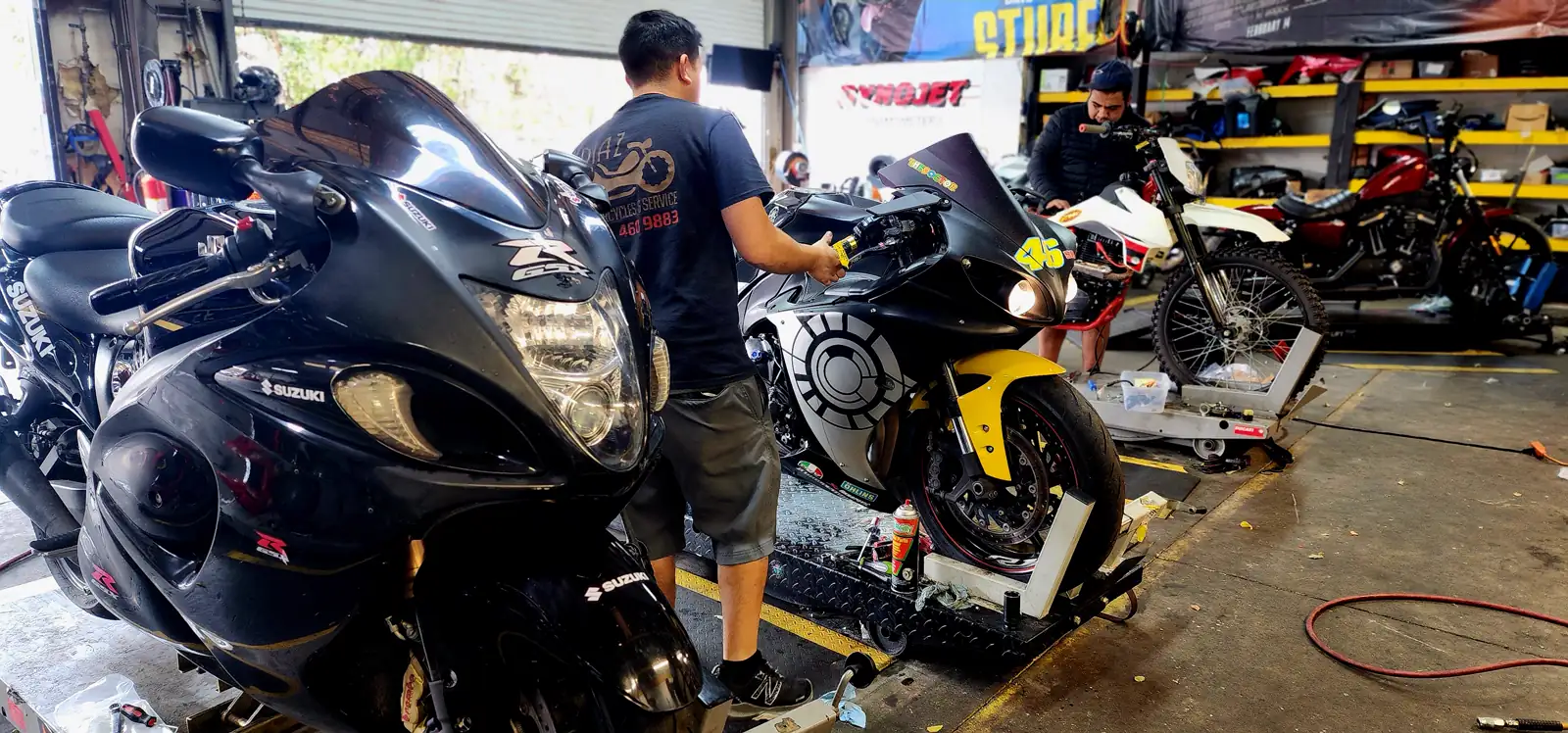
Labor is time. That’s it. It’s a tech standing at your bike, doing a thing, for however long that thing takes. Which sounds simple until you meet the third factor, the one nobody talks about: access. Access is how much of your motorcycle has to come off before the part in question is even visible.
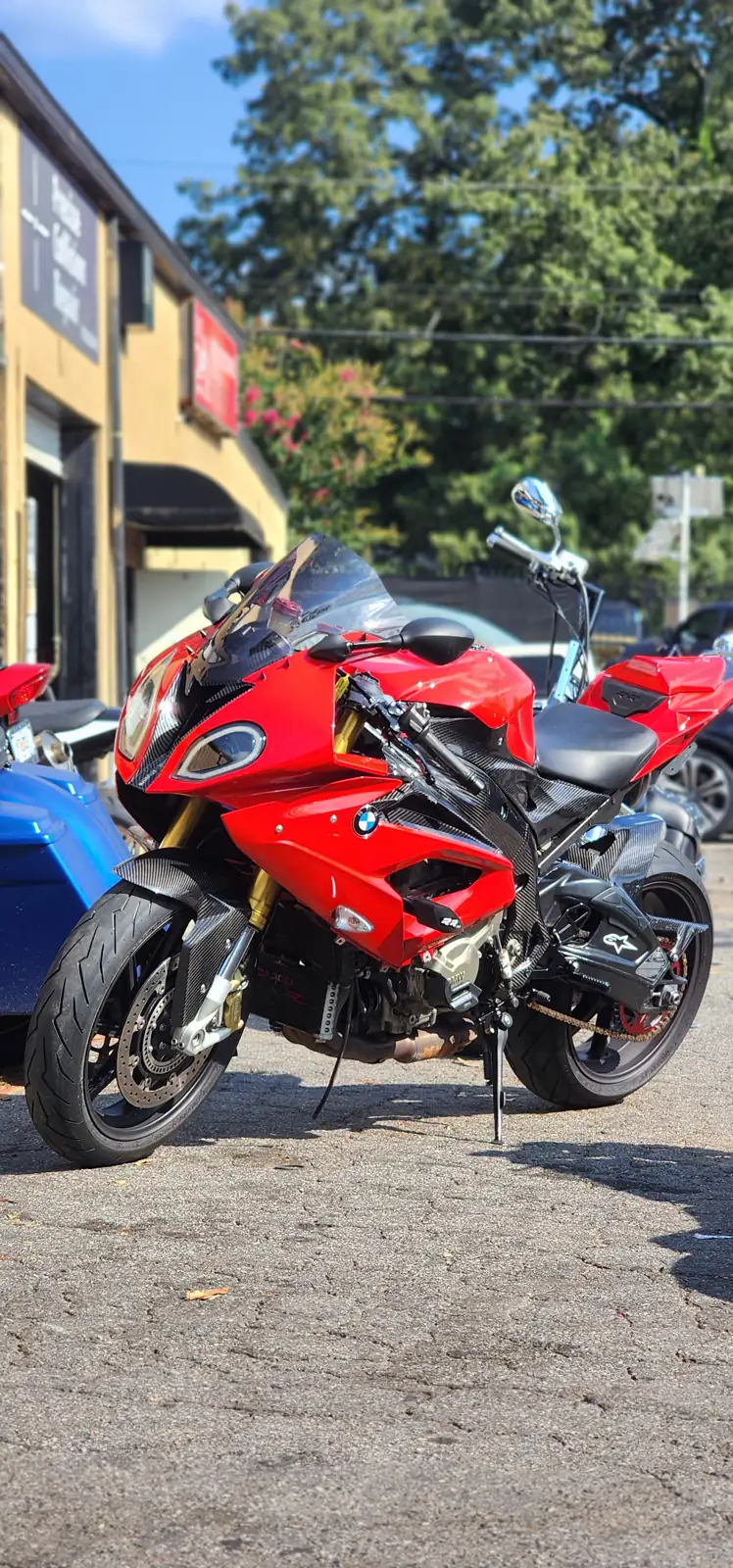
Two bikes can need the identical part and the identical fluid, and one takes a fraction of the time. A naked bike with the engine hanging out in the breeze? You reach in and go. A fully faired supersport with the airbox buried under the tank? Now there’s bodywork off, fasteners tracked, a tank lifted and supported, and every one of those pieces has to go back on straight with nothing rattling. Same job on paper. Very different afternoon.
- Bodywork — how many panels have to come off to reach the part
- Tank and airbox — lifted, drained, or fully removed changes everything
- Exhaust routing — some headers block the oil filter entirely
- Cooling and lines — anything that has to be drained and bled back up adds time
- What’s already been modified — aftermarket parts sometimes fit beautifully and sometimes fight you
- Fastener condition — a seized or rounded bolt turns a five-minute step into a careful one
But here’s what most riders get wrong about this. They assume a bigger bill means a bigger problem, like the shop found something scary. Usually it’s the opposite. The bill grows because of access and because of waiting, not because your engine is in trouble. A chain caught while it’s merely dry is a cleaning and an adjustment. That same chain three months later has chewed the sprockets, and now it’s a set. The problem didn’t get scarier. It just got wider.
How we actually diagnose it, start to finish
Here’s the real order of operations when a bike lands on our lift. No magic, no mystery, just a process we run the same way every time.
- We ask you what it’s doing. When it happens, what gear, hot or cold, and what changed recently. Riders describe symptoms better than they think they do.
- We look at the bike cold. Chain slack, sprocket teeth, tire date codes and tread, pad thickness, fluid color in the sight glass and reservoirs, and every fastener that should be tight.
- We start it and listen. A lot of diagnosis is just ears. Then we ride it or run it under load to reproduce what you described.
- We pull codes and check the fueling story. What’s been added, what’s been flashed, what the bike thinks it’s breathing versus what it’s actually breathing.
- We separate must-do from should-do from can-wait. Three buckets, plainly named.
- We call you with the whole picture before a wrench turns on anything you haven’t approved.
That last step is the one we care about most. You should never learn what a job involves by reading the invoice. Approval comes first, always, and if we find something mid-job you get another call, not a surprise.
Why we won't quote it over the phone
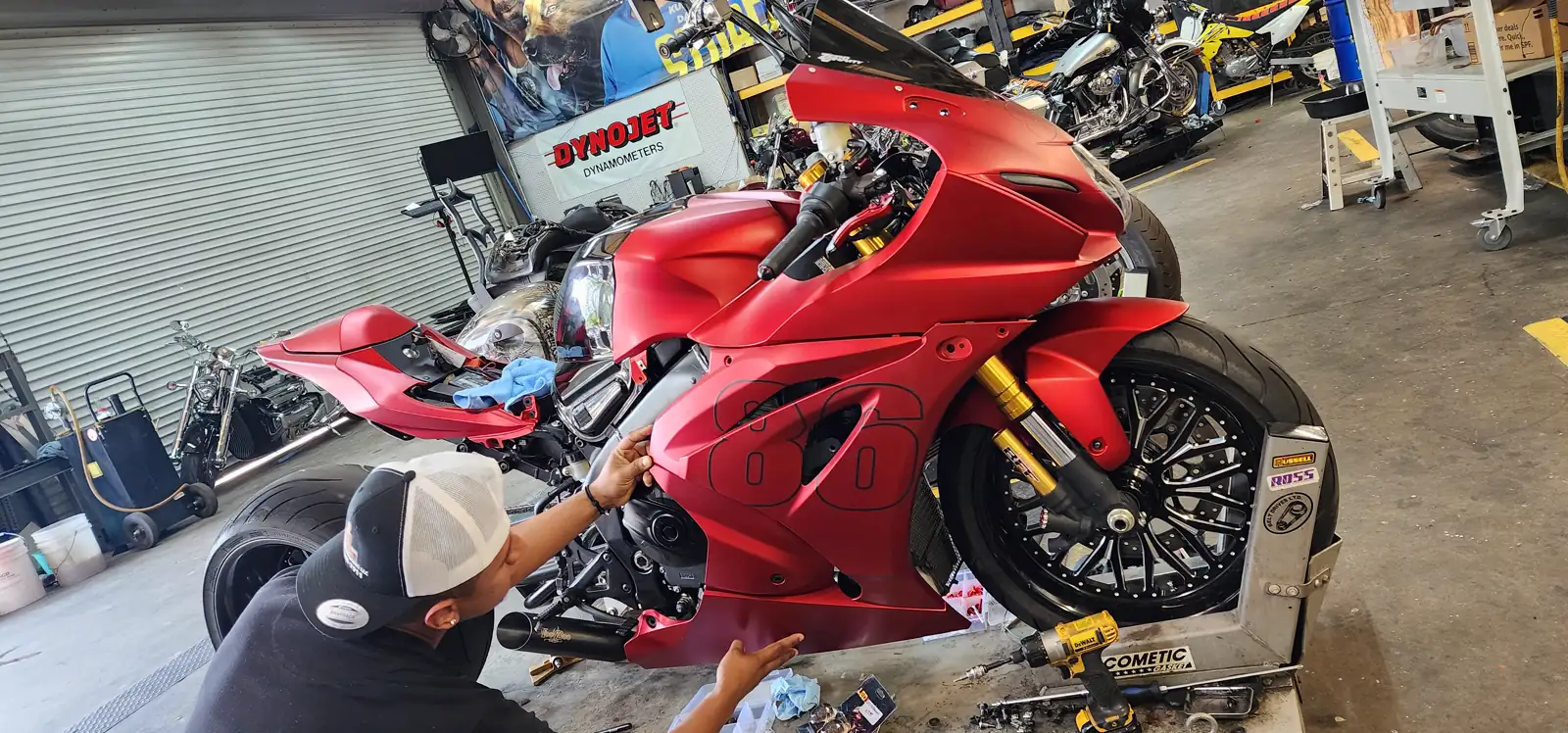
Because we can’t see your bike, and neither can anyone else on a phone call. Two riders call with the same sentence — my bike hesitates — and one needs a filter and plugs while the other has a header wrapped so tight the sensor’s reading wrong. Quoting both the same is either a lie to one of them or a bill that grows later. We’d rather look, then talk. When you want the routine stuff spelled out plainly, here’s how we handle that job for riders in your area, step by step.
There’s a second reason too, and it’s the one people appreciate once they hear it. A shop that quotes sight-unseen has to pad the number to protect itself. Every unknown gets a cushion built in. Looking first removes the guesswork, which means the number you get is the real one instead of the safe one. That’s better for you every single time.
THE SHORT VERSION
Parts have a known number. Labor is time. Access is what turns a short job into a long one. Waiting is what turns one part into three. Catch it early and the whole thing stays small.
Now the Lawrenceville part, said out loud
We’re in Marietta. You’re in Gwinnett. Going by road geography that’s somewhere around thirty-three to thirty-eight miles, and realistically forty-five minutes to over an hour depending on which way you go and when you leave. You can run GA-120 west through Duluth and Roswell and never touch an interstate, or you can take I-85 down to I-285 west and up I-75. Neither one is fun on a bike at rush hour, and I-285 in particular is the wall between Gwinnett and Cobb — stop-and-go, brake lights stacking up, and no legal way to filter through it since lane splitting isn’t allowed in Georgia.
So no, we’re not going to pretend you should ride an hour each way for an oil change. That’s silly, and you’d be right to ignore us. Lawrenceville has real shops with real techs, plenty of them trained right up the road at Gwinnett Technical College, and Polini Motorsports over on Swanson Drive has been handling repairs, mods and maintenance for street and dirt riders for a while now. Routine service is well covered in your county. We’re not pretending otherwise.
You can get an oil change anywhere. You can't get a dyno anywhere.
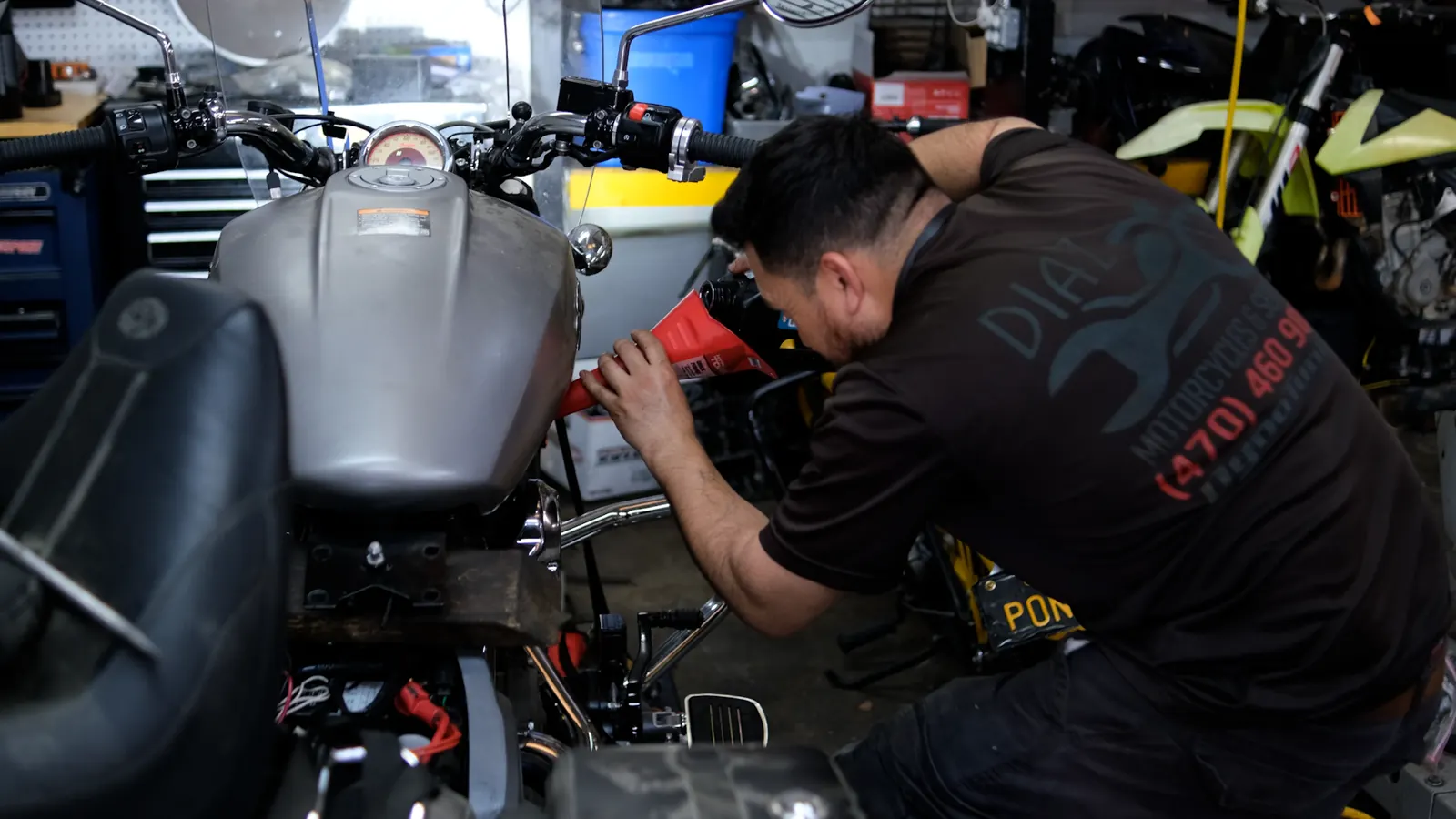
Here’s the gap, though. Nobody in Lawrenceville advertises in-house dyno tuning, ECU flashing, or a paint booth. Gwinnett is the densest sportbike county in our whole service radius and it’s full of modified bikes with nowhere local to make those modifications actually work. So the honest advice is this: keep your quick stuff close to home, and save the drive for the work that needs equipment your county doesn’t have. When you do come, bring us everything at once — tune, tires, brakes, fluids, the fork seal you’ve been ignoring. One trip, one day, all of it. That’s what we take care of here, and batching is how smart riders use us.
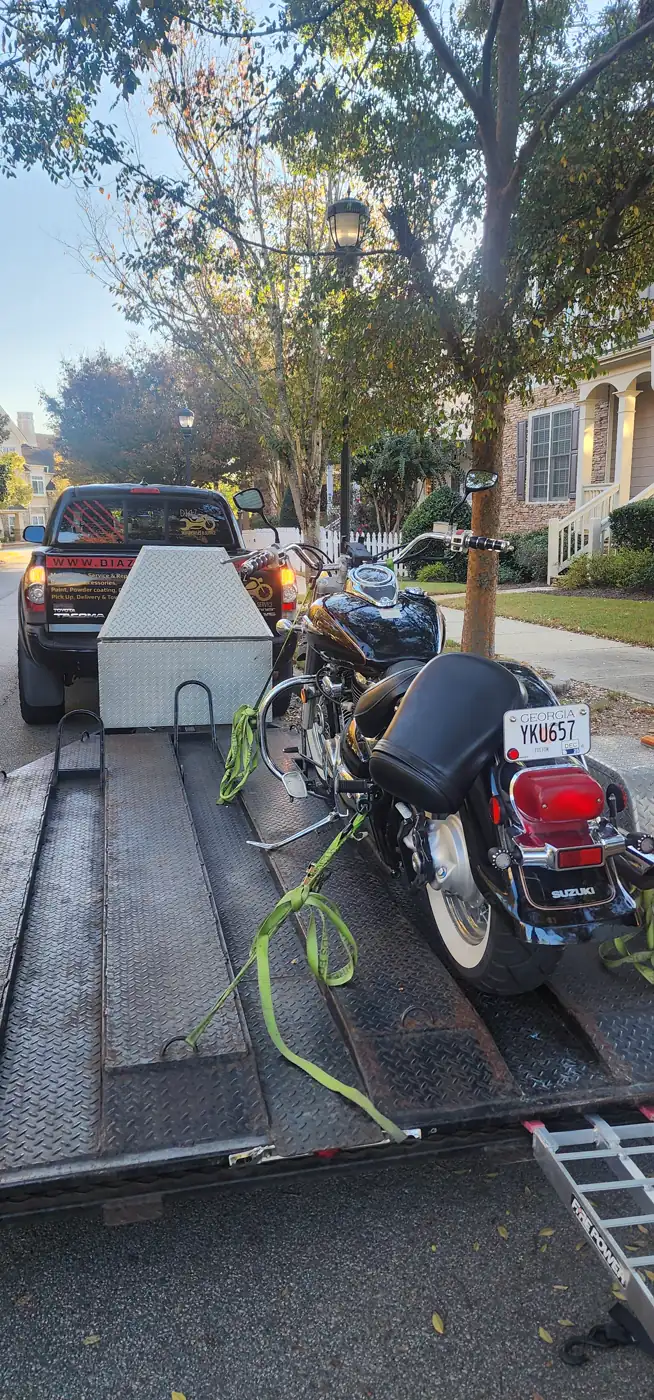
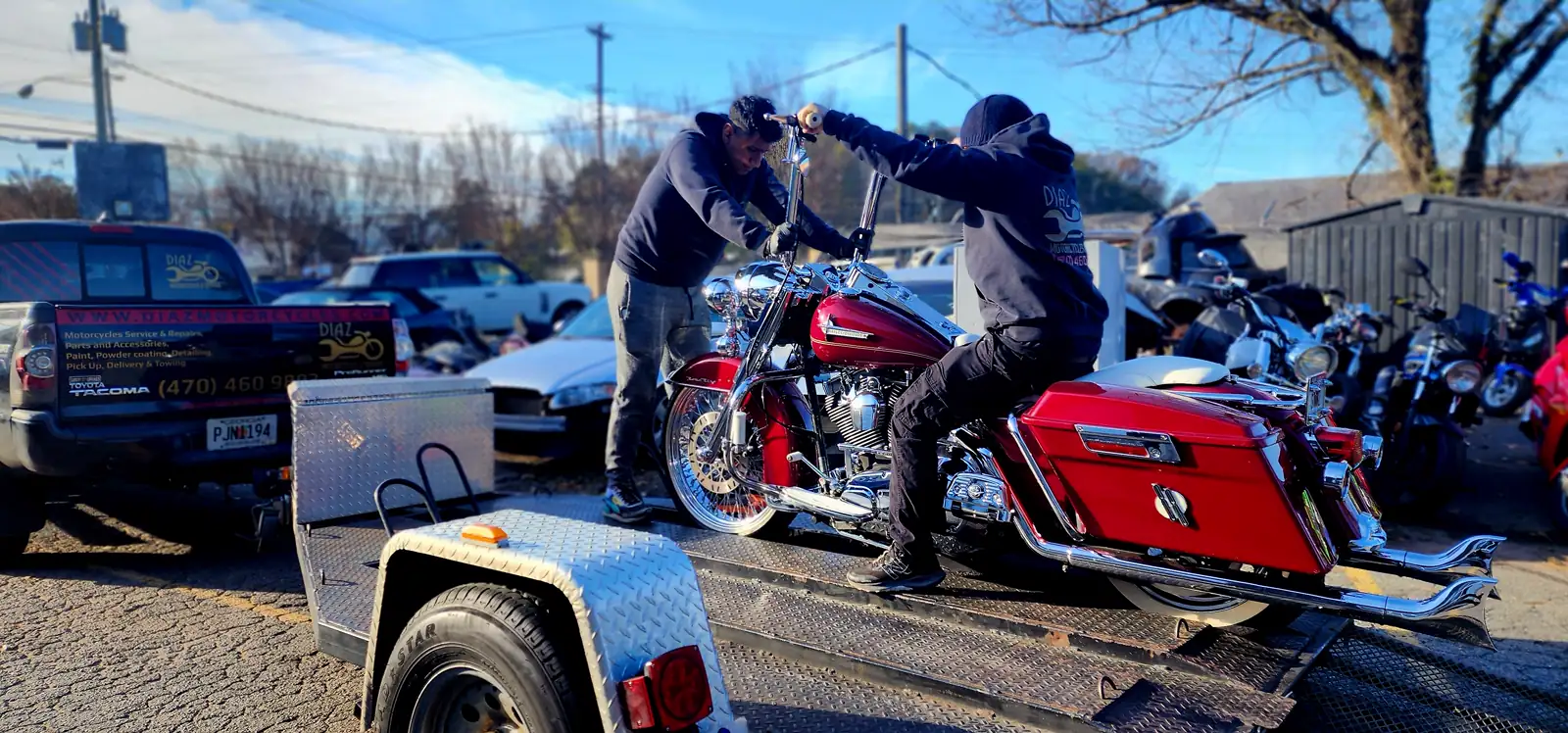
And if a trip still doesn’t fit your week, we’ll come get the bike. Pickup and delivery exists exactly for this, because your Saturday is worth more than a round trip on the perimeter.
A real example, since numbers in the abstract are useless
Let us tell you about a rider near Collins Hill Heights. He’d put a slip-on and a filter on an R1 over the winter, loved how it sounded, and spent spring fighting a hesitation off idle that got worse in traffic. He’d already had the plugs done locally, which was the right call and didn’t fix it, because the plugs weren’t the problem — the fueling was. He didn’t want to burn a day driving, so we picked the bike up on a Thursday.
Everything happened in one visit. Fueling sorted on the dyno so the bike actually ran right with the parts he’d bought. Chain and sprockets replaced while the rear was already up. Both tires, since the fronts had aged out. Brake fluid flushed because it was the color of sweet tea, which is a fine drink and a terrible brake fluid. Bike went back to him the following week. One pickup, one drop-off, zero hours of his life spent on I-285.
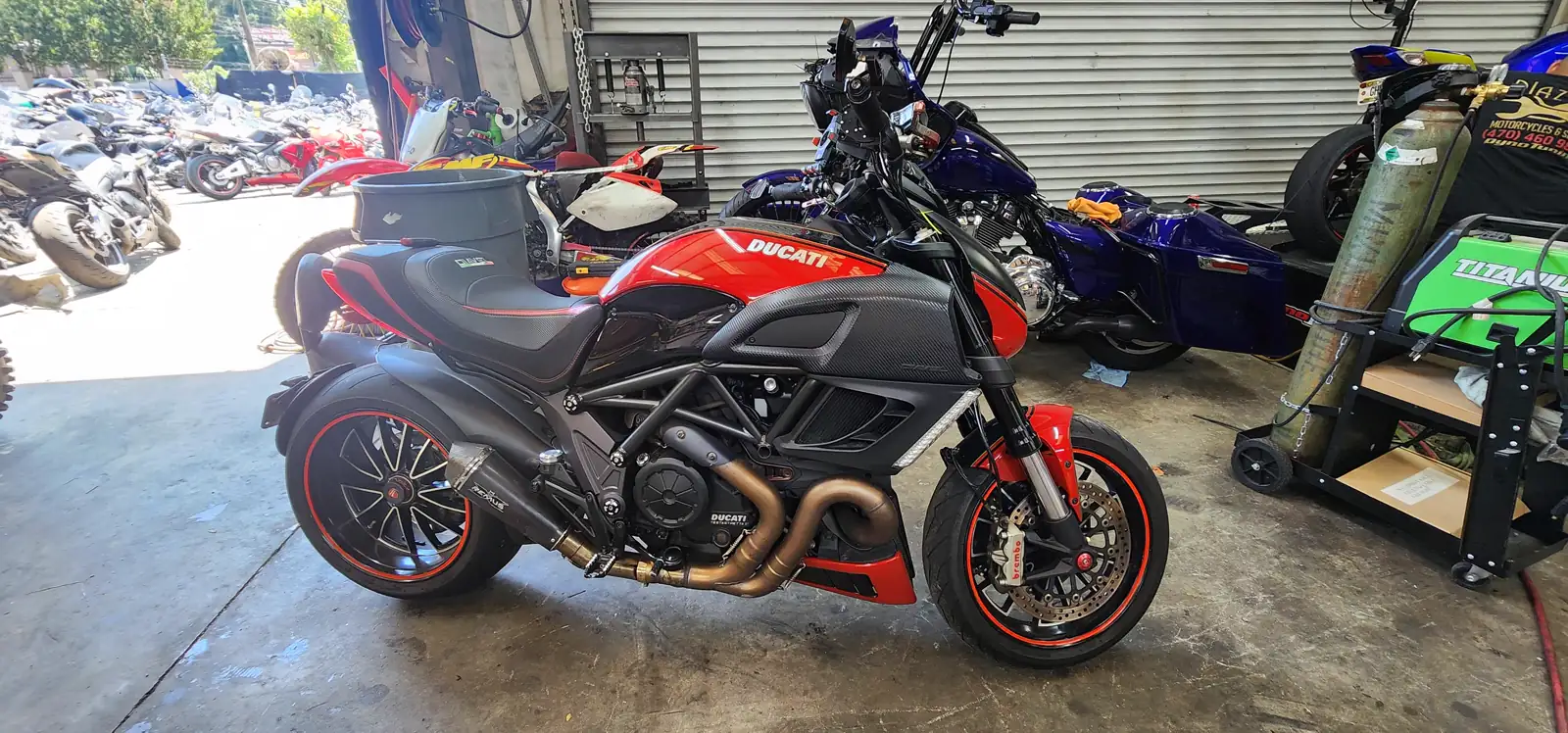
We see the same pattern from the bigger-lot houses out at the Estates at Great Oaks and Great Oaks Landing, where bikes live in clean garages and get ridden hard on weekends, and from the Fountain Lakes, Fountain Glen and Fountain Cove side of town, where the commuters are. Different budgets, same bikes, same question. And most of them are riding the same good roads — Tribble Mill and the Grayson and Loganville back roads south and east of you, which is honestly where a Gwinnett bike gets to be a motorcycle instead of a traffic appliance.
So what does a service actually include?
When somebody says “a service,” here’s what’s typically inside that word. It’s less mysterious than it sounds, and knowing the list makes every conversation easier.
- Oil and filter, drained warm, filled to the correct level for your engine
- Air filter checked and replaced if it’s loaded up
- Chain cleaned, lubed and adjusted to spec, sprockets inspected for hooking
- Brake pads measured, rotors checked, fluid inspected and flushed when it’s dark
- Tires checked for tread, age, pressure and uneven wear
- Coolant level and condition, plus a look at every hose and clamp
- Fasteners, controls, cables, lights and levers gone over
- A road or load test at the end, because paperwork isn’t proof
How often you need it is set by your owner’s manual, not by us and not by a number somebody made up on a forum. Every manufacturer publishes intervals for that exact bike, and those intervals assume normal use. Heavy commuting, hot stop-and-go, track days, or a heavily modified engine can all move things up. If you like reading around the sport, the American Motorcyclist Association is a solid place to spend an evening.
One more thing worth saying, since we’re being blunt about distance. Motorcycle service cost Lawrenceville riders weigh isn’t a Gwinnett-only puzzle. We have this same conversation with riders over in Smyrna, and the math always lands the same place: routine stuff close, specialty work where the equipment lives. Keep your tag and registration current with the Georgia Department of Revenue, keep your service records in one place, and the bike stays easy to own and easy to sell.
Ride past the Gwinnett Veterans War Museum and the Fallen Heroes Memorial and Armed Forces Monument downtown on a clear evening and you’ll see bikes parked all over. Good ones. Cared-for ones. That’s the whole goal here — a bike that starts, pulls clean, stops straight, and doesn’t make you wonder. Catch the small stuff, batch the big stuff, and let the little cough on GA-316 stay a little cough. That’s not expensive. That’s just paying attention, and you already are.
Questions Lawrenceville riders ask us
What makes one service job bigger than another?
Access, mostly. If the part is out in the open, it’s quick. If it lives under bodywork, a tank and an airbox, the same task takes far longer. The second factor is how long the issue has been ignored, because one worn part usually starts wearing the parts touching it.
Why won't you quote it over the phone?
Because two bikes with the same symptom can need completely different work, and we can’t see yours through a phone. Quoting blind forces a shop to pad the number to cover unknowns. We’d rather look first and give you the real figure, with your approval before anything gets touched.
What's included in a standard service?
Oil and filter, air filter, chain and sprockets, brakes and fluid, tires, coolant, and a full look over fasteners, cables, controls and lights. Then a test ride or load test to confirm the fix. We tell you what’s urgent, what’s soon, and what can wait.
How often should my bike be serviced?
Your owner’s manual sets the intervals for your exact bike, and we follow it rather than inventing a number. Hard commuting on GA-316, track days, or a modified engine can shorten those windows. Bring the manual or the model year and we’ll work from it.
How long does the work take?
A straightforward maintenance visit is usually a same-day or next-day job. Fueling work on the dyno, brake systems, or anything needing parts ordered runs longer. We give you a realistic window up front and call you if that window changes.
Do I really have to drive to Marietta from Lawrenceville?
For routine service, no, and we won’t pretend otherwise. For dyno tuning, ECU work or paint, there’s nothing comparable in your county. When you do need us, we offer pickup and delivery, and we recommend batching several jobs into one visit.
We work with riders all across Gwinnett and the east side of the metro, including Duluth, Suwanee, Snellville, Grayson, Dacula, Lilburn, Buford, Norcross, Loganville, Sugar Hill, Tucker and Stone Mountain. Some folks ride to us on a good morning, some meet us halfway, and plenty just have us come get the bike from the driveway. However you’d rather do it, the work and the honesty are the same.
TELL US WHAT IT'S DOING
If your bike is hesitating, ticking, or just feels off, describe it to us and we’ll tell you straight what we think is going on and what looking at it involves. Lawrenceville riders get the same deal everyone else does: we look first, we call before we work, and we can pick the bike up so you don’t lose a day to the perimeter. Bring us everything at once and get it all handled in one visit.
470-460-9883Diaz Motorcycles and Service, LLC · 847 Barnes Mill Road, Marietta, GA 30062