Motorcycle Transport Cost Marietta — What You Pay
The number is not about the bike. It is about how it sits, how far it goes, and how it loads.
In fact, most weeks, the same story rolls onto our trailer. The bike is not wrecked. For example, it just will not start, and its owner is done staring at it in the garage. That is the honest heart of the motorcycle transport cost Marietta riders keep asking us about: the bike that quit running is the one we haul the most. Even so, a dead battery, a deal made out of state, a move across town, an old bike left behind by a family member — the machine still needs to get somewhere, and it cannot ride itself.
What’s more, here is the good news right up front. A bike that will not run is not a lost cause. It is a Tuesday. We back the truck up, load it, and it is at the shop before the day is out. So before you sell it cheap or leave it under a tarp, hear us out on what a haul actually costs and why.
The myth: every bike costs the same to move
A lot of folks think transport works like a vending machine. You say the word “motorcycle,” a flat number drops out, and that is that. We get why that feels fair. But it treats a sportbike wedged into a third-floor apartment lot exactly like a cruiser sitting in an open driveway. Those are not the same job, not even close. So a straight answer starts with a couple of questions, not a guess.
And here is the part nobody tells you. The price of a haul has almost nothing to do with how shiny or how fast the bike is. A show-quality vintage build and a rough old commuter can cost the very same to move. What sets the number is not the bike at all. It is everything around the bike.
The reality: access and labor, not parts
Think of a haul the way you would think about moving a heavy couch. Two identical couches can be a five-minute job or a two-hour job, and the couch never changed. The stairs changed. Motorcycle transport works the same way. Three things drive the number, and none of them care what badge is on the tank.
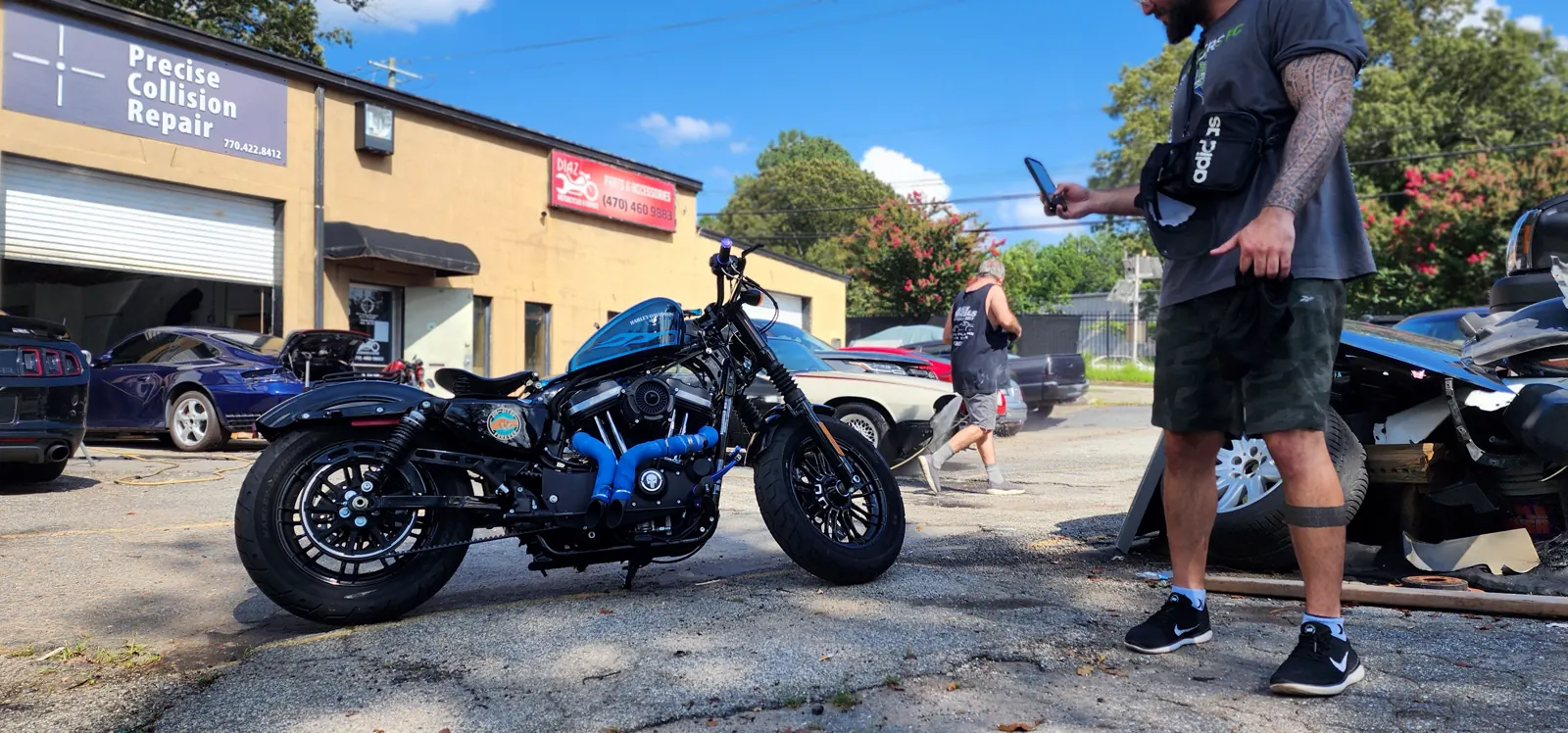
Access comes first. Where does the bike actually sit? A clean garage on a flat driveway over in Barrett Preserve, the newer build on the Barrett Parkway side, is a quick load and gone. A bike boxed in behind two cars in a packed apartment lot off Roswell Road is a different afternoon. Plenty of bikes around town live outside under covers, so the load spot might be soft grass, a tight gate, or a curb we have to walk it over. Time on site is the real cost, and access decides that time.
Distance is next. Coming to grab a bike near the Square is a short trip for us, since we sit about three miles out, roughly eight to twelve minutes away by Roswell Road, and no point inside the city is more than about twenty minutes from our door. A bike you bought two states away is a whole other animal, with fuel, hours, and an overnight in the mix. Shipping farther out, like the Peachtree City side of things, follows the very same rules, just with more miles stacked on top.
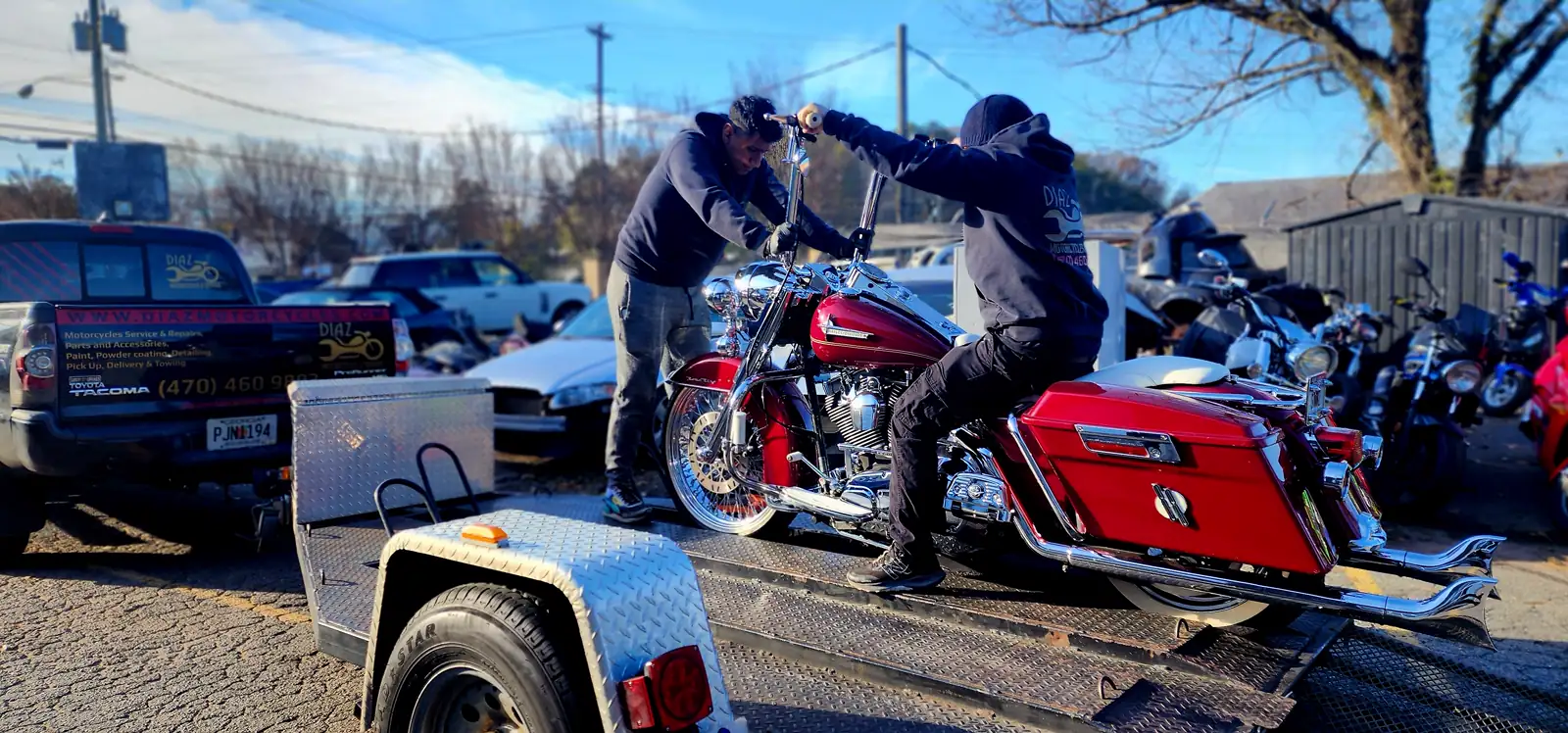
Load-out is the third piece, and it is the one people forget. A bike that rolls and steers can be walked up a ramp by two people in a couple of minutes. A non-running bike with a seized wheel or a flat needs a winch, extra hands, and patience. That is not a bigger machine. It is a bigger job, and it is exactly the job we do most.
Something changes once you know what to look for. When you start seeing a haul as access plus distance plus load-out, the mystery falls away. You stop wondering if you are being played and start noticing the same things we notice the second we pull up to your place. And that is a nice feeling. It is the difference between hoping for a fair shake and knowing you are getting one.
The actual process, start to finish
Here is how a pickup really goes, from the driveway to the shop. There is no mystery to it, and there is no reason it should feel like one.
- You send a couple of photos and tell us where the bike sits and whether it runs. That is the whole intake. Two minutes on your phone.
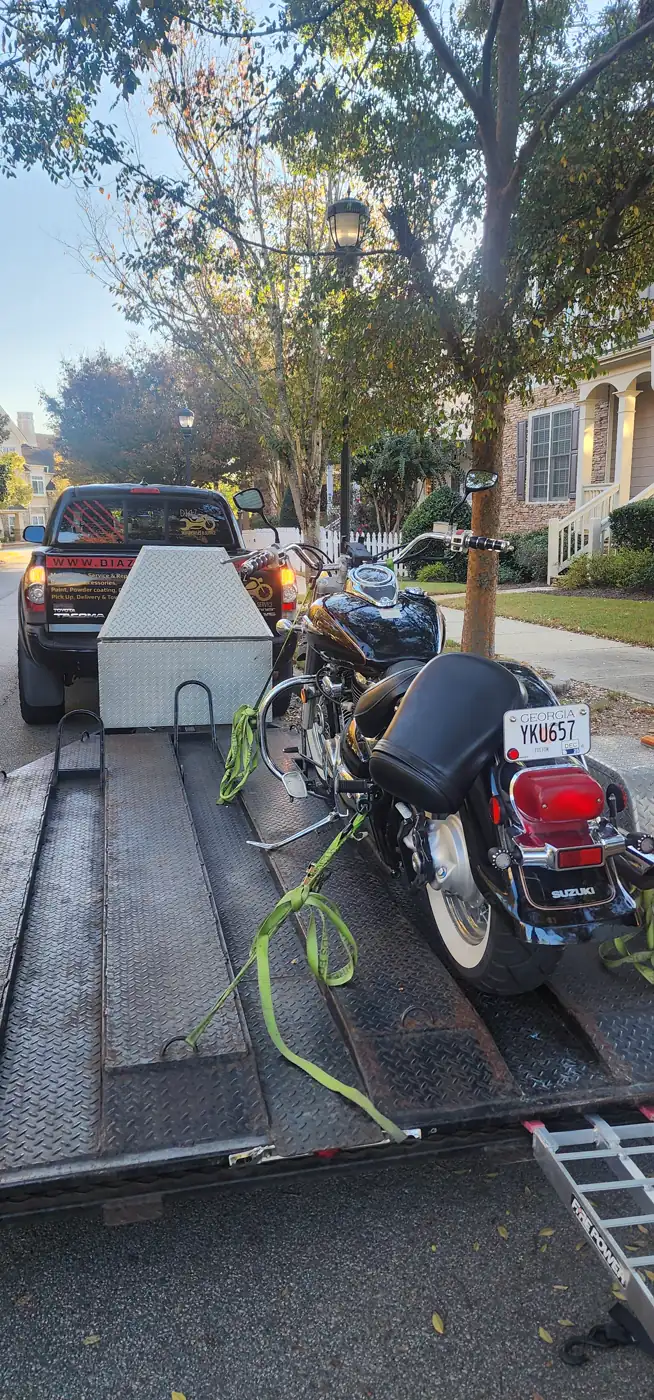
- We show up with the right rig for the job and roll or winch the bike onto the trailer.
- The front wheel goes into a chock so it cannot flop side to side.
- We compress the front forks a touch and run soft loops and tie-downs to solid points, then even out the tension so the bike stands on its own.
- We log the bike’s condition with photos before we roll a single foot, then again when it comes off at the shop.
- You get those photos, and the bike is home.
That tie-down step is where good transport lives or dies. A bike is not a box. It wants to lean and bounce, so the straps have to hold it upright without crushing the suspension flat. We use soft ties at the bars or the triple so nothing scratches, then pull even tension on both sides. Done right, the bike rides like it is parked, not like it is fighting you the whole way down the road.
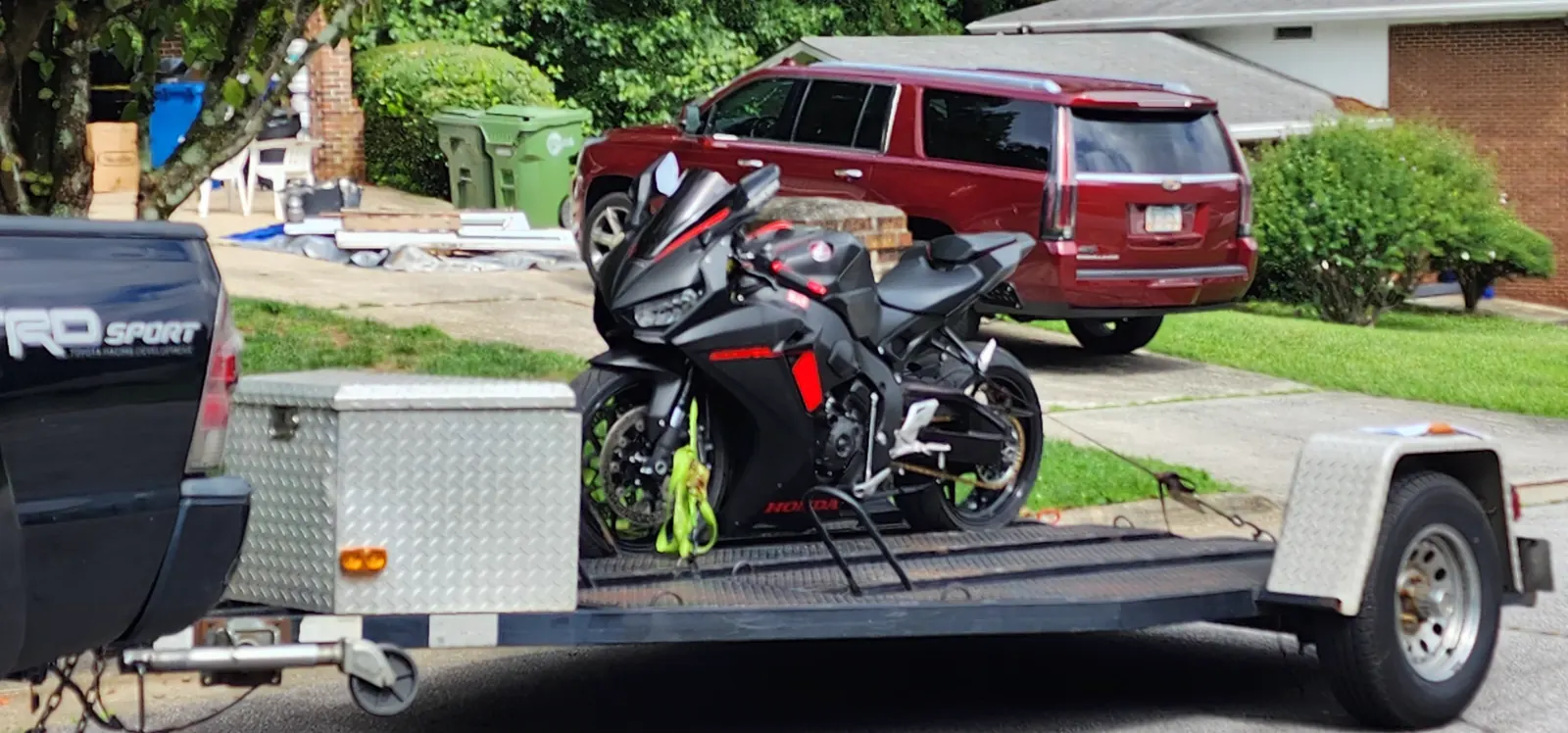
Then there is open versus enclosed. An open trailer is perfect for most local runs around Cobb County. It is quick, it is easy, and your bike is only out in the air for a few miles. An enclosed trailer earns its keep on long hauls, in rough weather, or when the bike is something special you do not want road grit touching. Neither one is “better.” They are tools, and we match the tool to the trip.
Last comes the paperwork, and this is the part that quietly protects you. A condition report with time-stamped photos, taken before and after, means there is never a fuzzy argument about a scratch. If you are moving a title across state lines, keep your registration and ownership papers handy, and the folks at the Georgia Department of Revenue lay out what the state needs. Good documentation is not red tape. It is your receipt that the bike showed up the same way it left.
How to tell a good shop from a guesser
A shop that quotes a flat transport price over the phone, sight unseen, is not doing you a favor. They are either padding it to cover the worst case or lowballing it to book you, and neither one is honest. A shop that says “send me a photo first” is the one telling the truth, because that photo is how they see the access and the load-out you already know matter. If you want the deeper version of what separates a good shop, we wrote that up too.
Around here, that straight-answer approach is the whole point. Texting photos back and forth beats the old call-and-wait-for-a-service-writer routine every dealer in town runs. You are talking to the person who will actually load your bike, not a front desk. If you are curious about what happens in our bays once the bike lands, we keep that open on purpose. And if it turns out your bike needs a tune once it is running again, that is a separate service, and how we handle that job is its own honest conversation.
You can lean on the wider rider community for a gut check too. Groups tied to the the American Motorcyclist Association are full of riders who have moved a bike or two and will tell you fast which habits mean a shop respects your machine.
The part that has nothing to do with parts
Now for the part that has nothing to do with parts at all. The best reason to call us for a stuck bike is not the trailer or the straps. It is that you get to stop wrestling it. There is a special kind of tired that comes from a bike that will not move, sitting exactly where it died, reminding you every time you walk past. “We come get it” is not a slogan. For a non-running bike, it beats every other option, because every other option starts with you sweating in the driveway.
A bike that will not run is not a lost cause. It is a Tuesday.
That is why we lead with pickup and delivery. The rider after a spill should not be pushing anything. Meanwhile, the person who inherited a bike they have never started should not be renting a truck. The buyer who scored a deal three states over should not be white-knuckling it home in a storm. You hand us the hard part, and it stops being your problem.
Where you sit in Marietta changes the run
Marietta gives us a real range of jobs, because Marietta rides a real range of bikes. There is a tight-knit spot like Whitlock, the small historic neighborhood tucked between downtown and the conference center, where the driveways are older and narrower. There is Marietta Country Club on the northwest side, the golf-community housing where a bike might be deep in a three-car garage. Each one asks a slightly different question of how we load, and that is fine, because we ask it before we roll out.
The roads themselves shape the work. Whitlock Avenue, the west-of-the-Square leg of GA-120 through the historic district, and the arterials feeding the area are hard on machines, with potholes and expansion joints that bend rims and pop fork seals. The railroad crossings near the Square district are their own little hazard. So a fair number of bikes we haul are not “broken” so much as banged up by the pavement, and they ride into the shop on our trailer instead of limping in under their own power.
You will pass plenty of landmarks on the way. The Marietta Square is the civic heart of the whole city, anchored by Glover Park with its fountain and gazebo, and the Marietta/Cobb Museum of Art sits right on the Square. Big dealers cluster nearby, like Mountain Motorsports over on Cobb Parkway South, though a run of them close Sunday and Monday, which is exactly when a lot of riders finally have time to deal with a dead bike. That gap is part of why an independent that answers a text on a Sunday matters.
And of course, the reason any of this exists is the good part: the riding. When September and October roll in with the best weather of the year, half the town points north toward the Suches Loop, the Georgia Triangle that runs SR-60 up to Suches, over Wolf Pen Gap Road on GA-180 to Vogel State Park, and back down US-19, with Two Wheels of Suches sitting right in the middle. A bike that is stranded in July is a bike that misses that. Getting it hauled in and sorted now is how you make the fall runs instead of watching them go by.
You end up in control
So here is where all of this lands. When you understand the motorcycle transport cost Marietta shops quote, you stop feeling like a passenger and start feeling like the one holding the map. You know the number rides on access, distance, and load-out. Of course, you know a real shop asks for a photo before it names a price. You know your bike gets logged, strapped right, and documented. That is not a shrug and a hope. That is you, in control, calling the shot on a bike that could not call it for itself.
Questions Marietta riders ask us
Does the kind of bike change the transport work?
Less than you would think. A heavy touring bagger needs more hands than a light sportbike, sure, but a show bike and a beater cost the same to strap down. What really changes the job is weight, whether the bike rolls, and where it is parked. The badge on the tank barely matters.
What if you find something else once the bike is at the shop?
We call you first, every time, before we touch anything past the haul. Transport gets your bike here; it does not sign you up for surprise repairs. If we spot a problem while it is on the lift, you hear about it and you decide what happens next.
How do I avoid surprises with transport?
Send a couple of photos, and tell us where the bike sits and whether it runs. That is it. Those two things let us see the access and the load-out before we ever arrive, so the number we give you is the number that holds. No mystery, no padding.
What makes one haul bigger than another?
Three things: how the bike sits, how far it goes, and how it loads. A bike boxed into a tight apartment lot takes longer than one in an open driveway. A run across the state costs more time than a hop across Cobb County. And a bike that will not roll needs a winch and extra hands.
Why can't you just quote it over the phone, sight unseen?
Because a blind guess either pads the price to cover the worst case or lowballs it to book you, and both are dishonest. A photo shows us the real access and load-out, so we can give you a number that actually sticks. Asking for that picture is us being straight with you, not stalling.
Do you handle bikes bought out of state?
Yes. Long-distance shipping is a core part of what we do, whether the bike runs or not. You buy it, we go get it, and it lands at the shop ready for whatever comes next. Keep your title and paperwork handy for the trip and we will handle the rest.
We pick up and deliver across Cobb County and well beyond it. That means East Cobb and Kennesaw, Smyrna and Acworth, plus Powder Springs, Mableton, Austell, and Vinings when a bike needs to move. We also run out to Woodstock, Roswell, Sandy Springs, and Dallas, and we ship long distance when a friend buys a bike a few states away. Wherever it sits, if it will not ride to us, we will come to it.
STUCK BIKE? WE COME GET IT
If a bike in Marietta will not start, will not roll, or just cannot make the trip, do not sell it short or leave it under a tarp. Text us a photo of where it sits and whether it runs, and we will give you a real answer, not a phone guess. Then we load it, log it, and bring it home. You stay in control the whole way.
470-460-9883Diaz Motorcycles and Service, LLC · 847 Barnes Mill Road, Marietta, GA 30062