Motorcycle Transport Douglasville — What to Expect
When riding it to us isn't an option, we bring the trailer to you. Here's exactly how the pickup works.
You hear it before you see it. That’s why a faint tick from the front end when you roll the bike back off the sidestand, or that dry scrape when the chain skips a link and the wheel won’t spin free. Some mornings it’s a smell instead. Either way a hot, sweetish whiff of coolant that means the bike isn’t going anywhere under its own power today. When that happens out in Douglas County, riding it to a shop is off the table, and that’s where motorcycle transport Douglasville folks can actually count on becomes the whole point. We come get it.
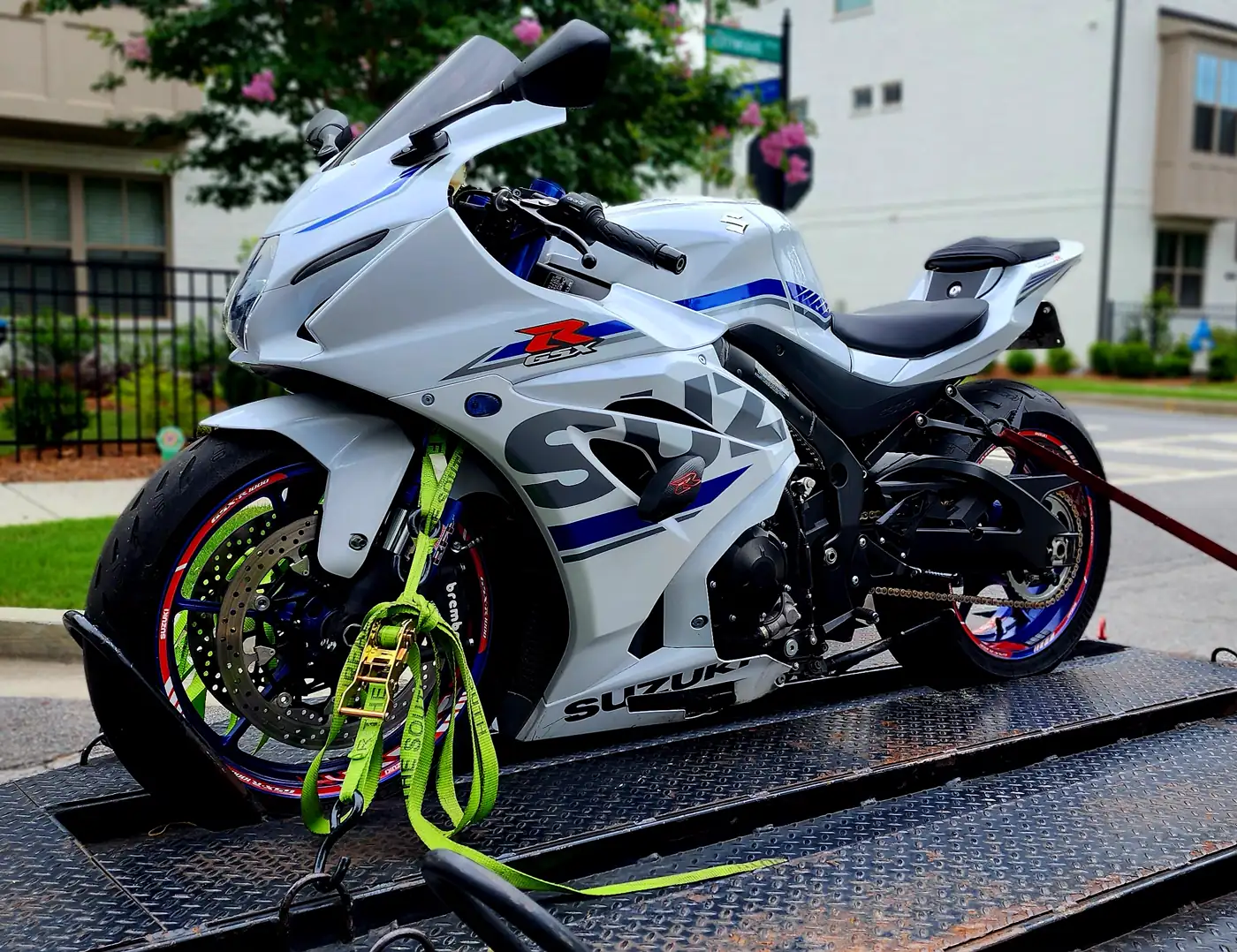
Let’s say the plain version first. Instead Motorcycle transport means we bring a truck and a trailer to wherever your bike is sitting, load it, tie it down, and haul it back to our shop in Marietta. It’s for the bike that won’t start. Or it’s for the rider who’s healing up and can’t throw a leg over anything yet. It’s for the machine you just bought two states away, or the one your uncle left behind that’s been under a tarp for six years. If the bike can’t come to us, the trailer comes to the bike. That’s it.
What drives the work: honestly, the distance
Here’s the part other shops skip. Douglasville is a real drive from us. From your driveway it’s roughly 28 to 32 miles up to our door, and depending on the hour that’s usually 40 to 60 minutes of real traffic. So why would you hand your bike to a shop that far away instead of one down the street? Fair question, and the honest answer is the reason transport exists at all. When you can’t ride the bike anyway, the distance stops mattering. A trailer covers 30 miles the same as three. The bike doesn’t feel the drive.
And there’s a route that keeps the trip sane. We don’t run I-20 east to I-285 north, because that I-20 and I-285 interchange is one of the worst congestion knots in the whole state, and nobody wants a loaded trailer parked in it. Instead we usually take Thornton Road up to GA-6 and cut over on the East-West Connector into Marietta. It’s calmer, it’s steadier, and a steady ride is a gentler ride for a bike strapped to a deck.
Distance also shapes what makes a shop worth the miles. A dealership close to you might be built around brand-new bikes under warranty, and an older machine or a project can get a cool reception there. An independent works differently. If you want to understand what separates a good shop from one that just moves metal, it usually comes down to whether they’ll take the bike you actually own, not the one they’d rather sell you.
What we check before we touch a strap
We don’t quote blind. Before we ever back the trailer up, we ask a few questions and, when we can, we look at photos. Besides it sounds small. Instead it saves you a headache. Here’s why. For more, here is the Alpharetta side of things.
A bike that rolls and steers loads one way. A bike with a seized wheel, a snapped chain, or a dropped-and-bent lever loads another way entirely, and it might need extra hands or a winch. Knowing that up front means we show up with the right gear instead of standing in your driveway improvising. When we tell you what the pickup will look like, we’ve already thought it through.
- Can the bike roll and steer, or is a wheel locked up?
- Where’s it parked — a flat garage floor, a gravel pad, a steep apartment lot?
- Is there a clear path from the bike to where a trailer can sit?
- Do you have the title, a bill of sale, or paperwork if it’s a bike you just bought?
- Any fresh damage we should photograph before it moves?
That last one matters more than people expect. We photograph the bike before it goes on the trailer and after it comes off. Both sides get a copy. If a scratch shows up, there’s no guessing about when it happened, because it’s right there in the pictures with a timestamp. Documentation isn’t red tape. It’s the thing that protects you, especially on an inherited bike or an out-of-state buy where you weren’t there when it was last ridden.
The timing on this matters more than the fix does. A bike that sat wet in an open apartment lot along the I-20 corridor for a season is a different job than the same bike pulled from a dry Chapel Hills garage. Fuel goes stale, brakes seize, tires flat-spot. If you call us the week you notice the problem, we can often stop a small thing from turning into a big one. Wait until spring, and that stale tank has had all winter to gum up the works. So the move is simple: tell us early, even if you’re not ready to commit. A heads-up costs you nothing.
Open trailer or enclosed: how we tie a bike down
People ask which trailer they’re getting, and the real answer depends on the bike and the trip. An open trailer is quick, easy to load, and perfectly safe for most local hops around Douglas County. An enclosed box trailer costs a little more time to load but keeps weather, road grime, and prying eyes off the bike, which is why we lean that way for a fresh custom paint job, a long haul, or anything you’d hate to see rained on. For more, here is the work we do in house.
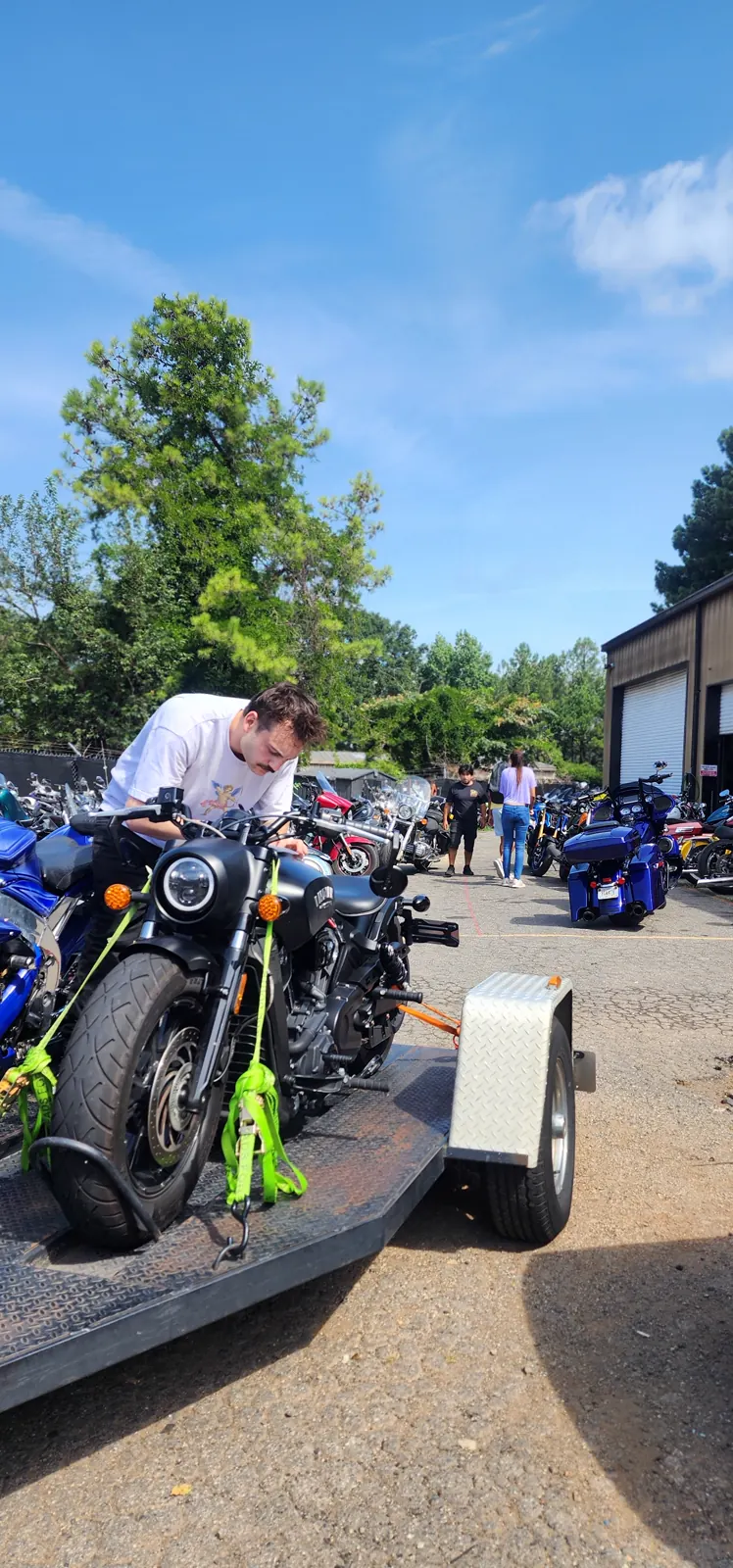
Either way, the tie-down is what keeps your bike happy, and there’s a right method. We chock the front wheel first so it can’t roll or twist. Then we use soft ties around the handlebars or triple clamp instead of hooking a bare ratchet onto your bars, because a metal hook on a painted part is how paint gets chewed. We compress the front suspension a bit and pull it down evenly on both sides so the fork stays loaded and the bike can’t hop. Straps run low and snug. We check them once in the driveway, and again after the first few miles when everything’s had a chance to settle.
A bike doesn't fall off a trailer because of the road. It falls because somebody rushed the straps.
For long-distance motorcycle shipping — a bike bought across the country, or a seasonal move — the same rules apply, just with more care packed in. Enclosed trailer, extra soft ties, wheel chock front and rear when the deck allows it, and photos at both ends. If you want the deeper version of that method, the folks at the Motorcycle Industry Council and outlets like RevZilla’s Common Tread both break down safe tie-down technique, and it lines up with how we do it every day.
Mistakes that cost people a bike
We’ve seen the aftermath of a few bad loads, and almost every one traces back to the same handful of shortcuts. None of them are hard to avoid once you know the trap.
- Hooking ratchet straps straight onto handlebars or bar risers — that’s how bars bend and paint chips. Soft ties first, always.
- Skipping the front wheel chock and trusting the straps alone. The chock does half the work.
- Cranking straps so tight the fork bottoms out for the whole trip, which tires the seals.
- No photos before loading, so any old scratch turns into an argument.
- Loading a leaking bike without a drip tray or shutting the fuel off, so gas or oil rides along for the trip.
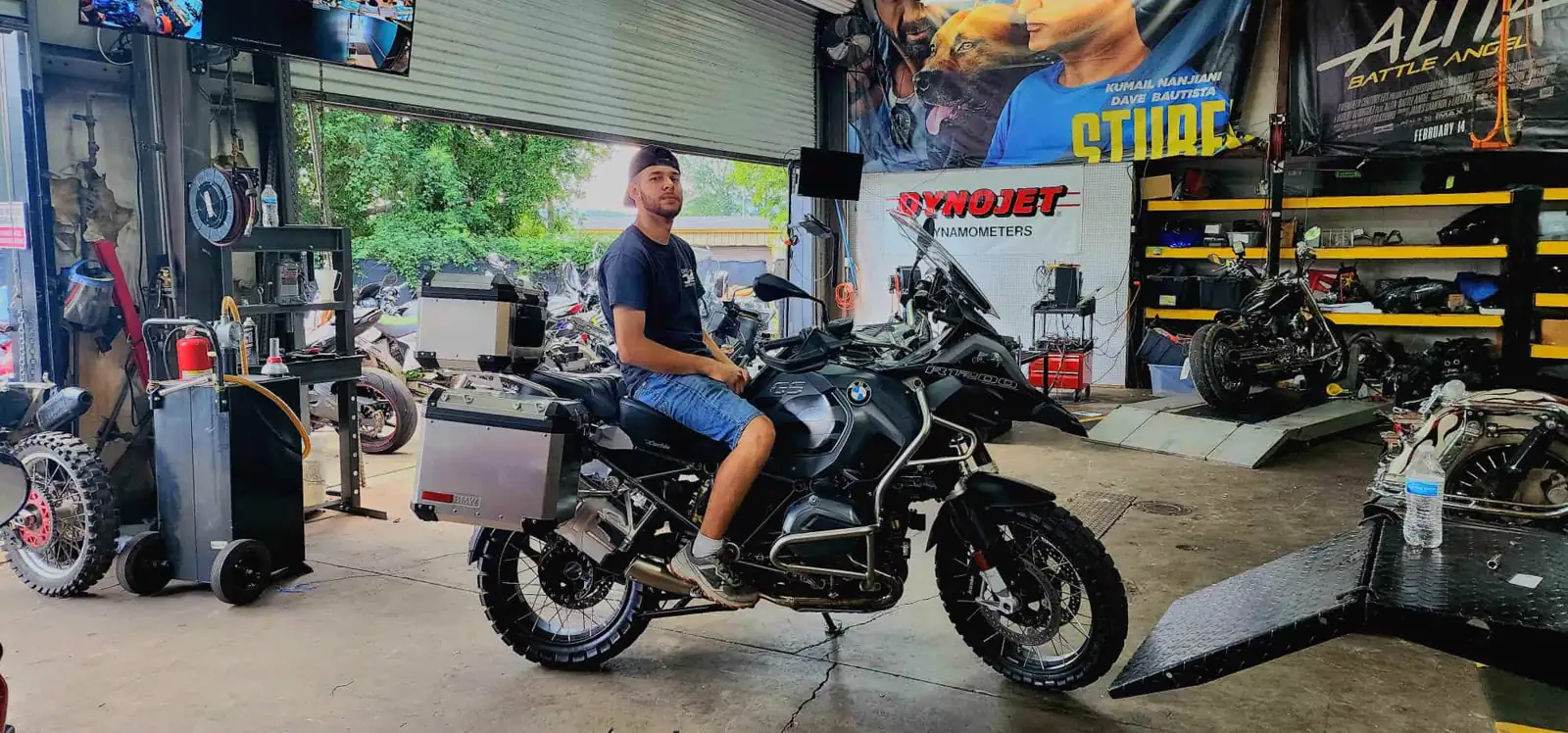
Weight is part of the plan too. A loaded BMW R1200GS with panniers or a big bagger tips the scale a lot heavier than a stripped sportbike, so the ramp angle and the strap points change. That’s not a problem, it’s just a reason we ask what you’re riding before we show up. A little planning beats a lot of grunting, and it beats a dropped bike every single time. For more, here is how we handle that job.
Local context: who we come get, and from where
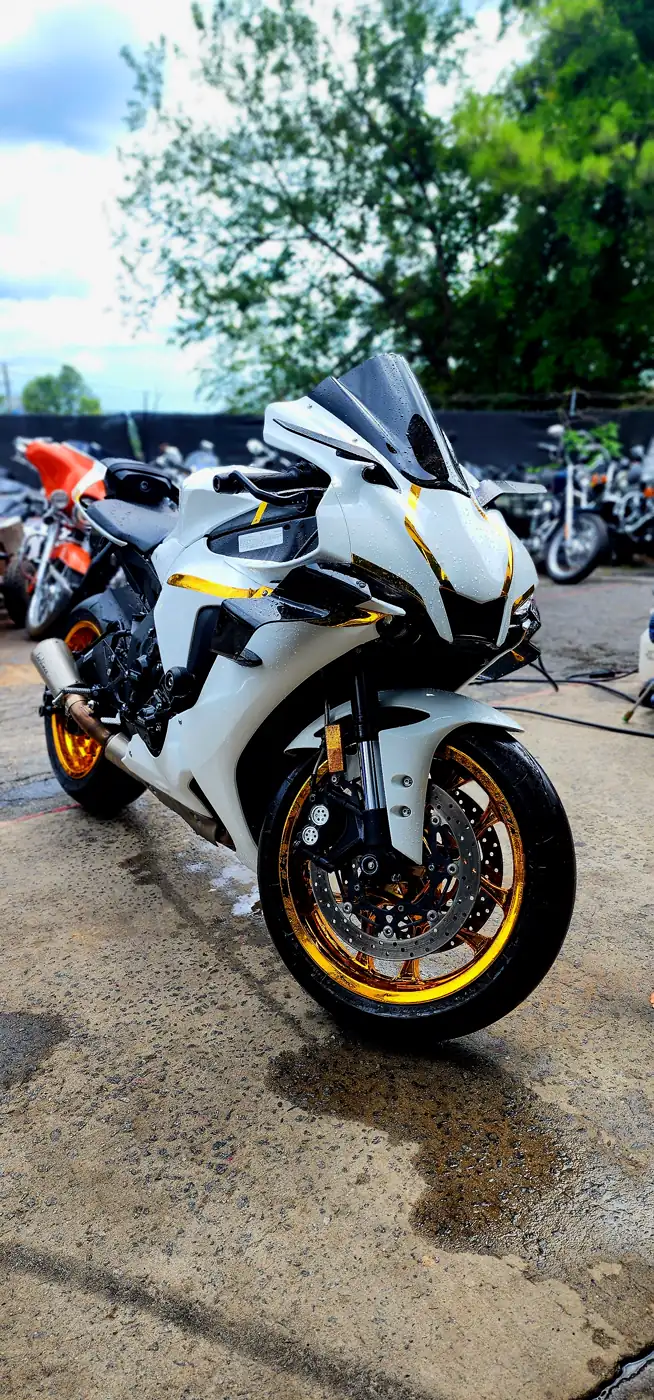
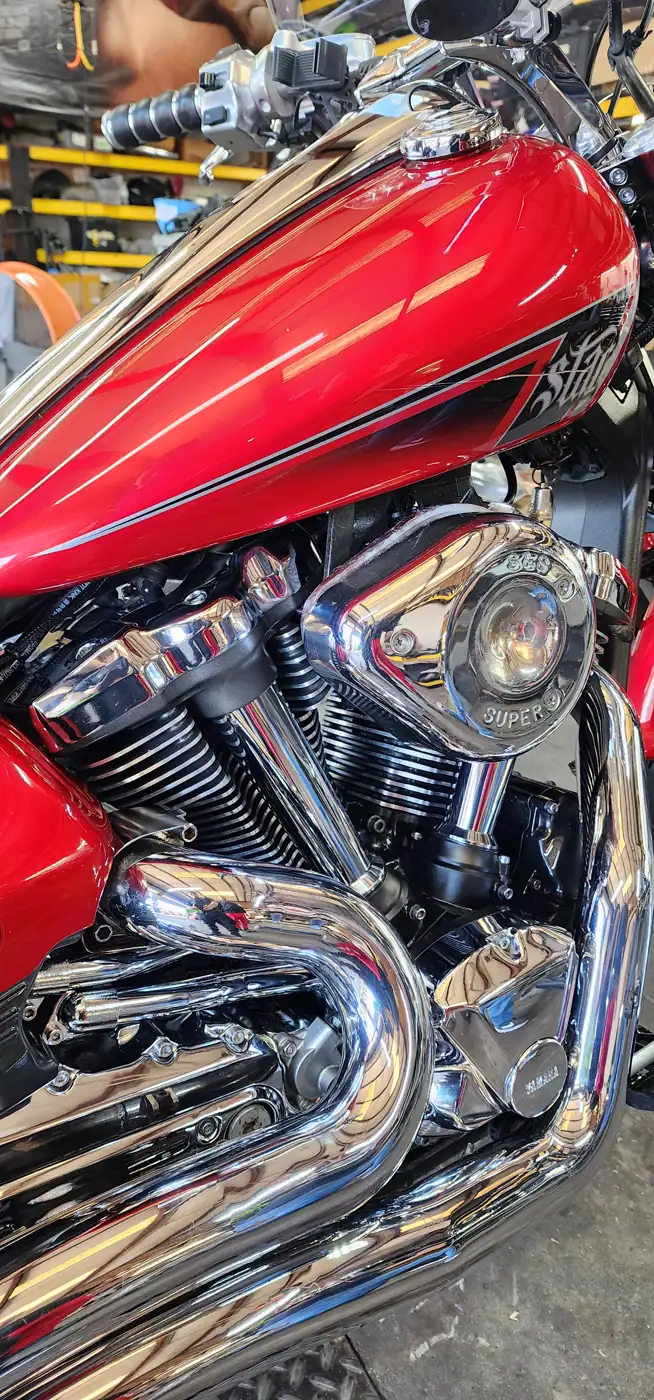
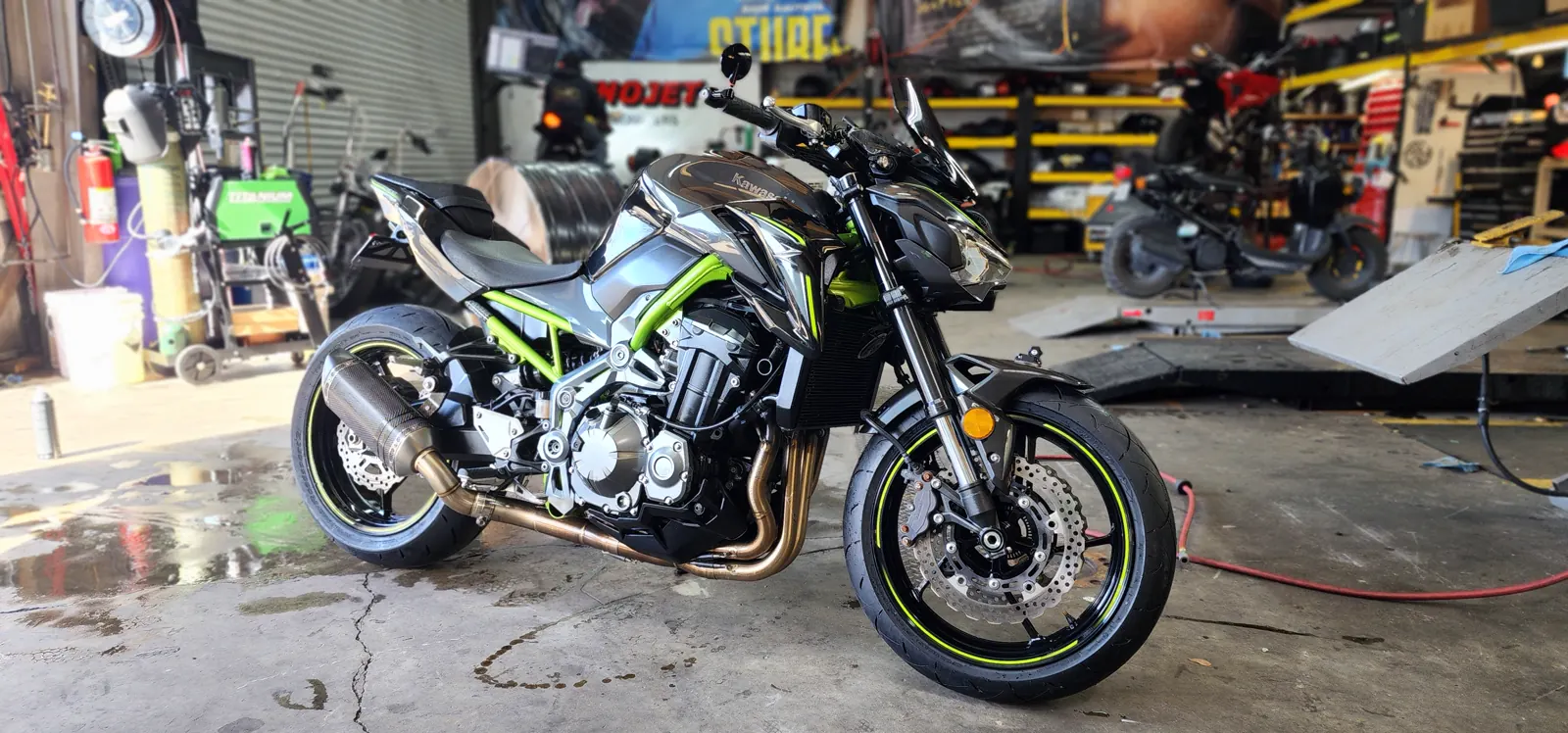
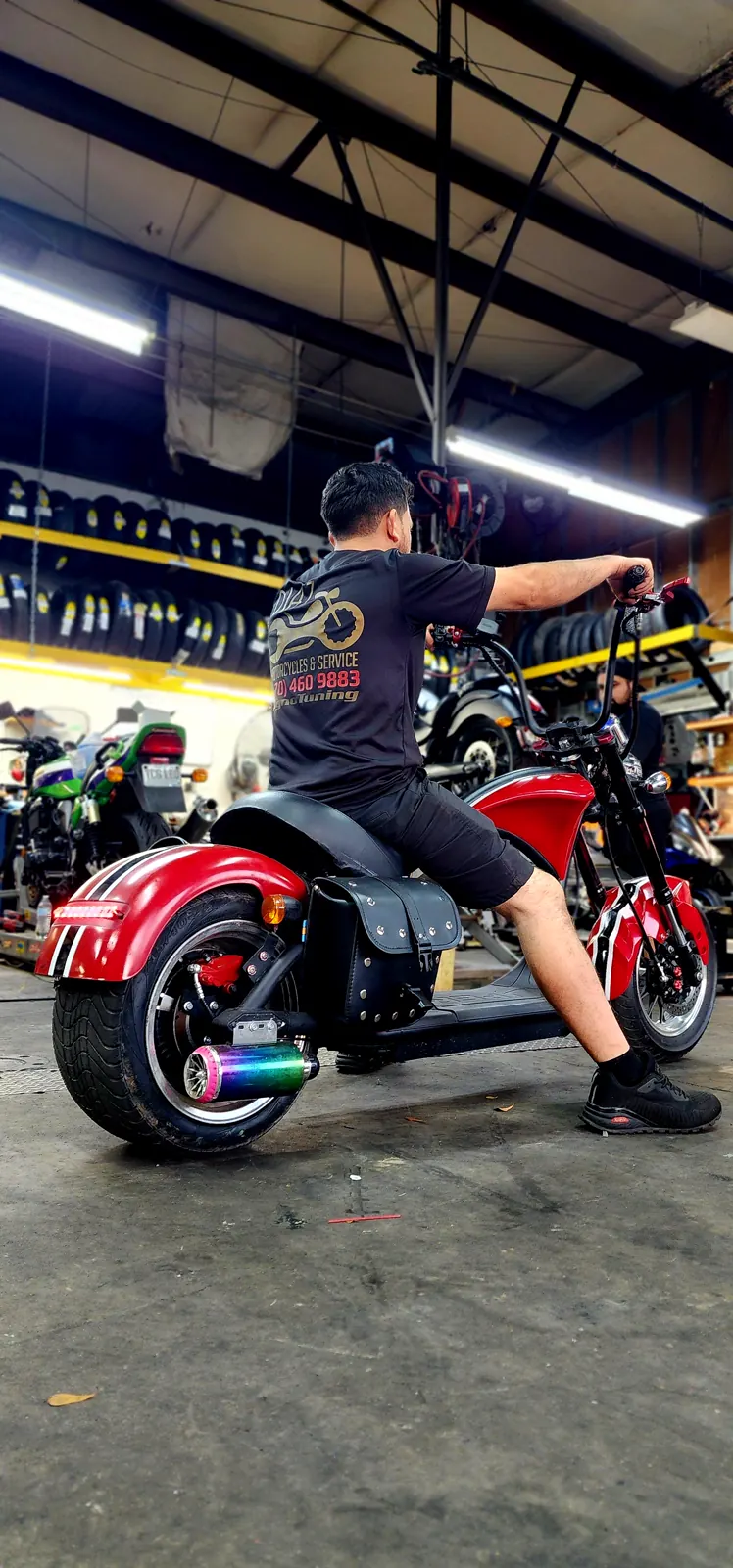
Douglasville is the most rider-heavy city we serve, and that shows up in the calls we get. We’ve hauled sportbikes out of apartment lots near the I-20 corridor, baggers with big audio systems and custom paint from single-family garages, and metric cruisers of every stripe. Southeast Motorcycle over on Spring Street pulls customers from five states and moves a lot of Vespas and CFMOTOs through the west side, so we see plenty of scooters and small-displacement bikes too. Different machines, same trailer, same care.
The pickup spots tell their own story. Some bikes come from a dry garage in Chapel Hills, tucked into one of the county’s nicest neighborhoods with the golf course out the window. Others come from Anneewakee, where the homes sit back among the woods and creek beds. We’ve grabbed a bike parked a couple blocks off the old Main Street in Downtown Douglasville, in the shadow of the historic district near the Douglas County Courthouse, since Douglasville is the county seat and the streets around there get tight.
A bike came in from Chapel Hills with exactly this. A rider had a sportbike that dropped a cylinder and wouldn’t stay running, sitting pretty in a spotless garage with golf-course views. He couldn’t limp it anywhere, and hauling it himself meant borrowing a trailer he didn’t have. We ran the East-West Connector route out, chocked and soft-tied it in his driveway, snapped the before photos, and had it on our lift the same afternoon. He never had to touch a strap or risk a ride on a sick engine. That’s the whole pitch in one trip.
We know the rural roads out that way too. If your bike’s parked down in south Douglas off Dorsett Shoals Road, Post Road, or Basket Creek, those chip-sealed connectors have gravel wash and shoulder drop-offs that don’t love a low trailer, so we take them slow and pick our loading spot with care. And if your ride is running fine and you just want to know where the good roads are, ask us — a lot of our friends chase the 72-mile run from Johns Mountain to Cloudland Canyon on GA-136, Armuchee Road, and the Lookout Mountain Scenic Highway when the fall hairpins are at their best, reached through Villanow.
Transport is only one thing we do. Once your bike’s on our lift, it’s in the same hands that handle the work we do in house every day, from diagnosis to repair to the appearance work this west-side culture is so picky about. If your bike needs dyno time after it lands, we can walk you through how we handle that job before you commit to anything. And if you’re closer to the north end of the metro, you can read up on the Alpharetta side of things too, since we run the same trailer and the same method up there.
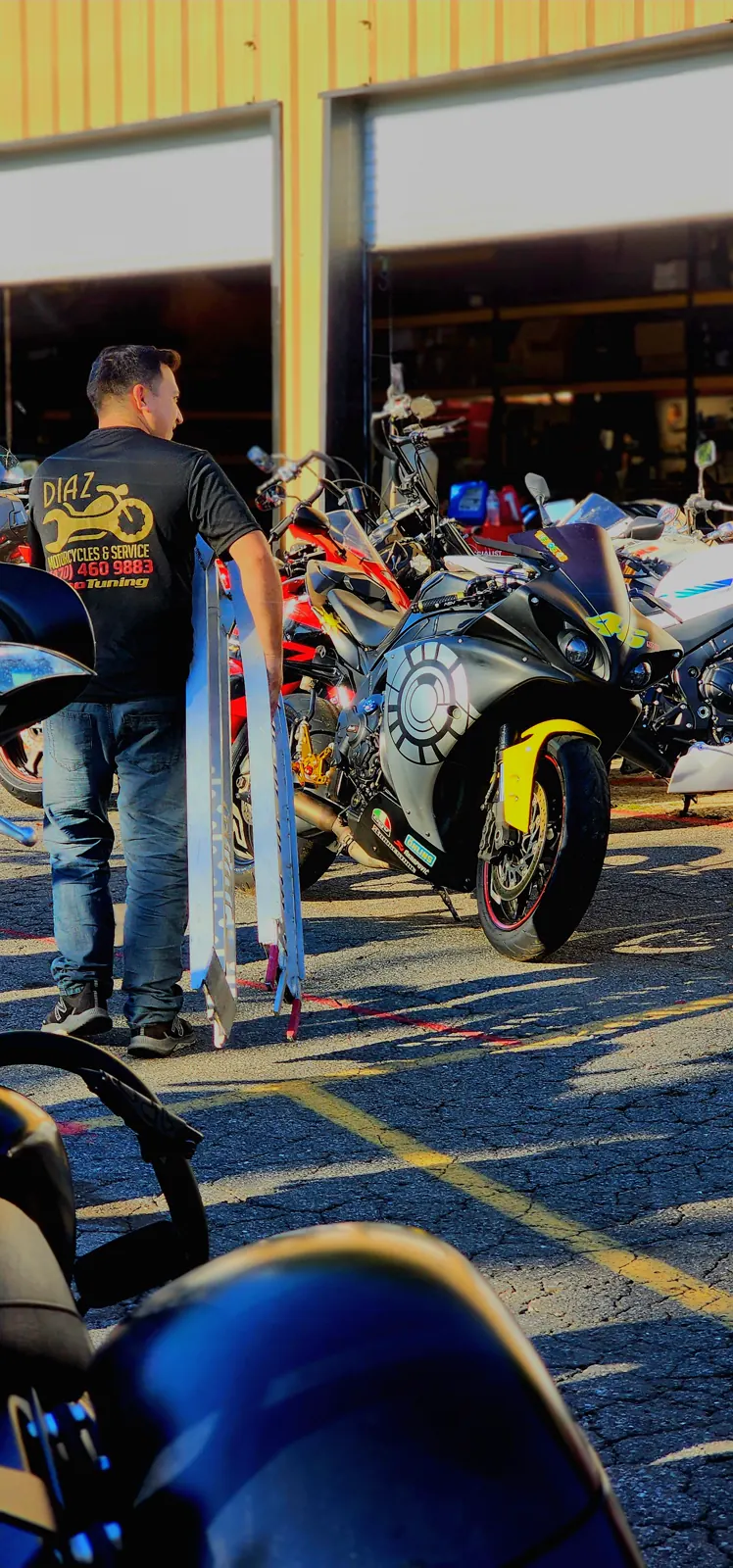
The outcome: your bike arrives, and you didn't lift a thing
When it goes right, transport is boring, and boring is exactly what you want. You text us. We ask a few questions and look at a photo or two. Instead we tell you what the pickup will take and what to have ready. We show up when we said, load the bike the right way, photograph it, and drive it back on a route that keeps it steady. You get pictures at both ends and a bike sitting safe on our floor, ready for whatever it came in for. No borrowed trailer. Besides No white-knuckle ride on a machine you don’t trust. No mystery scratches.
THE EASY NEXT STEP
Text us a photo of your bike and where it’s parked. That’s the whole start. We’ll tell you what the pickup looks like and get it scheduled — no appointment needed to just ask.
That’s the confidence we want you walking away with. Whether it’s a bike that quit, a bike you inherited, or a machine you bought sight-unseen out of state, the path to getting it fixed doesn’t start with you solving the hauling puzzle. Actually it starts with one text. We handle the trailer, the straps, the miles, and the paperwork that keeps you covered. You handle picking the bike back up when it’s ready to ride.
Questions Douglasville riders ask us
How long does transport take?
For a local Douglasville pickup, we can often schedule it within a day or two, and the drive back to Marietta is usually 40 to 60 minutes depending on traffic. Long-distance or out-of-state hauls take longer to arrange, so give us a heads-up as early as you can. Once we set a time, we show up when we say we will.
Do you transport my brand of bike?
Yes. Sportbikes, baggers, metric cruisers, adventure bikes like the BMW R1200GS, scooters, electric bikes — we’ve hauled all of it. The tie-down method changes a little with weight and shape, but every bike loads. Just tell us what you’re riding when you reach out so we bring the right gear.
Do I need an appointment to ask about a pickup?
No. You can text us a photo and your questions any time, and we’ll tell you what the pickup involves before you commit to anything. Getting a plan costs you nothing. We only lock in a time once you’re ready.
Can you pick up my bike if it won't run?
That’s most of what transport is for. A bike that won’t start, has a seized wheel, or got dropped still loads fine — we just plan for it and may bring extra hands or a winch. Send a quick photo of how it’s sitting so we show up prepared instead of improvising in your driveway.
How do I get a quote?
Text us where the bike is, what it is, and whether it rolls and steers. A photo of the bike and the spot it’s parked helps a lot. We look before we quote, so you get a real answer instead of a guess, and there’s no charge just to ask.
Is my bike protected while you have it?
We photograph it before loading and after unloading, and both of us keep a copy. If you bought it out of state or inherited it, that record matters even more, because it shows the bike’s exact condition the moment it left your hands. Documentation is there to protect you, not to slow things down.
We run our trailer all over the west metro, so if you’re near Douglasville, we’ve probably already been down your road. That includes Lithia Springs and Austell just to the north, Villa Rica and Temple out west, and Winston and Fairplay in the rural stretches of Douglas County. We regularly load bikes in Hiram, Dallas, and Powder Springs, and we cover Mableton and Smyrna on the way back toward the shop in Marietta. If your town isn’t on this list but you’re anywhere in this corner of the metro, just ask — odds are good we can get to you.
CAN'T RIDE IT? WE'LL COME GET IT.
If your bike’s stuck in a Douglasville garage, an apartment lot, or a driveway out on Bill Arp, you don’t have to solve the hauling part. Text us a photo of the bike and where it’s parked, and we’ll tell you exactly what the pickup looks like and get it on the schedule. One message is the whole first step.
470-460-9883Diaz Motorcycles and Service, LLC · 847 Barnes Mill Road, Marietta, GA 30062