Your Rider's Guide to a Detailing Shop Powder Springs Riders Trust
You bought the bike used and the finish told a story the listing left out. Here's how to read it, fix it, and choose who to trust.
You bought the bike used. Besides the photos looked clean, the price felt fair, and the seller swore it lived in a garage its whole life. Then you rolled it into full sun for the first time and saw what the listing left out — a spiderweb of fine swirls across the tank, chalky spots baked into the chrome, and a flat haze where the color should pop. Suddenly you’re not sure what else you inherited. Actually that’s usually the moment a rider starts hunting for a detailing shop Powder Springs can vouch for, someone they can hand the keys to without worrying they’ll make it worse.
First, read what the bike is telling you
A used bike’s finish is basically a logbook. That’s why it records every rushed wash, every driveway summer, every parking-lot lean it ever took. Either way you just have to know how to read the pages. In short and here’s the part nobody tells you when you’re stressing over a secondhand buy: almost none of it is permanent. Most of what makes an older bike look tired can be walked back, and a good chunk of it comes off in one visit.
When friends we’ve helped roll a new-to-them bike into daylight, these are the things they spot first.
- Swirl marks, those faint circular scratches that light up like a spiderweb in direct sun
- Water spots, the chalky rings etched into paint and chrome
- Cloudy chrome that used to throw back a clean mirror image
- Gray, dried-out plastic and trim that left the factory deep black
- Bug guts and tar freckling the nose, the fork legs, and the leading edge of the fairing
- Flat, hazy paint with no depth and no snap to the color
What each symptom actually means
Swirls come from washing. More exactly, they come from washing wrong — a dirty sponge, a gritty rag, or a drive-through brush dragging fine grit in tiny circles across the clear coat. Every scratch is shallow, but there are thousands of them, and together they scatter light instead of reflecting it. That’s why a swirled tank looks dull even when it’s spotless. The scratches live in the clear coat, not in the color itself, which is exactly why they can be polished out.
Water spots are a Georgia specialty. Our tap water runs hard, packed with minerals, and when a bead dries on hot paint the water leaves but the minerals stay welded to the surface. Add our heat and humidity and those rings etch in fast. Left alone through a couple of summers, they can bite into the clear coat. Caught early, though, they wipe away. Either way, a real detail is what breaks that cycle.
Dull chrome tells a similar story. Chrome is a mirror only while its surface stays perfectly smooth, and oxidation, road film, and those same mineral spots roughen it until it goes foggy. Faded plastic and trim, meanwhile, are the sun’s handiwork. UV bakes the oils out of the plastic, the surface dries and chalks, and deep black drifts toward a tired gray. Both look permanent. Neither one is.
Bug splatter and tar are more than ugly. Bug guts are acidic, and after a hot afternoon on the bike they start eating into the finish where they land. Tar bonds hard and shrugs off ordinary soap. And that overall flat, hazy look on older paint? That’s oxidation — the top layer of clear coat slowly breaking down. Polishing clears the dead layer and brings the depth roaring back.
A wash and a real detail aren't the same thing
Here’s where a lot of confusion starts. A wash removes what’s sitting on top of the paint — dust, mud, the salt off the road. Also a detail removes what’s bonded into the paint and then protects what’s left. Those are different jobs with different tools, and no amount of extra scrubbing turns one into the other. You can wash a bike every weekend and still watch it get duller every year, because washing was never going to touch the swirls.
Paint correction is the step that actually fixes the finish. Using a machine polisher and a series of progressively finer compounds, we level a hair’s width off the clear coat until the swirls and light scratches have nowhere left to hide. It’s slow, careful work — go too aggressive and you thin the clear coat, so the skill is in taking exactly enough and no more. Done right, the reflection sharpens, the color deepens, and the bike looks like it’s lit from inside.
There's a version of this that's cheap and a version that isn't.
That line matters, because “detailing” covers a huge range. A quick spray-wax makeover can make a bike shine for a week and hide swirls just long enough to sell it. Real paint correction is measured in hours of machine time, and it holds. Neither one is wrong, but you should know which you’re paying for before you agree to anything — and if you want to see how the work adds up, we break the pieces down so nothing surprises you.
What ceramic coating is — and what it isn't
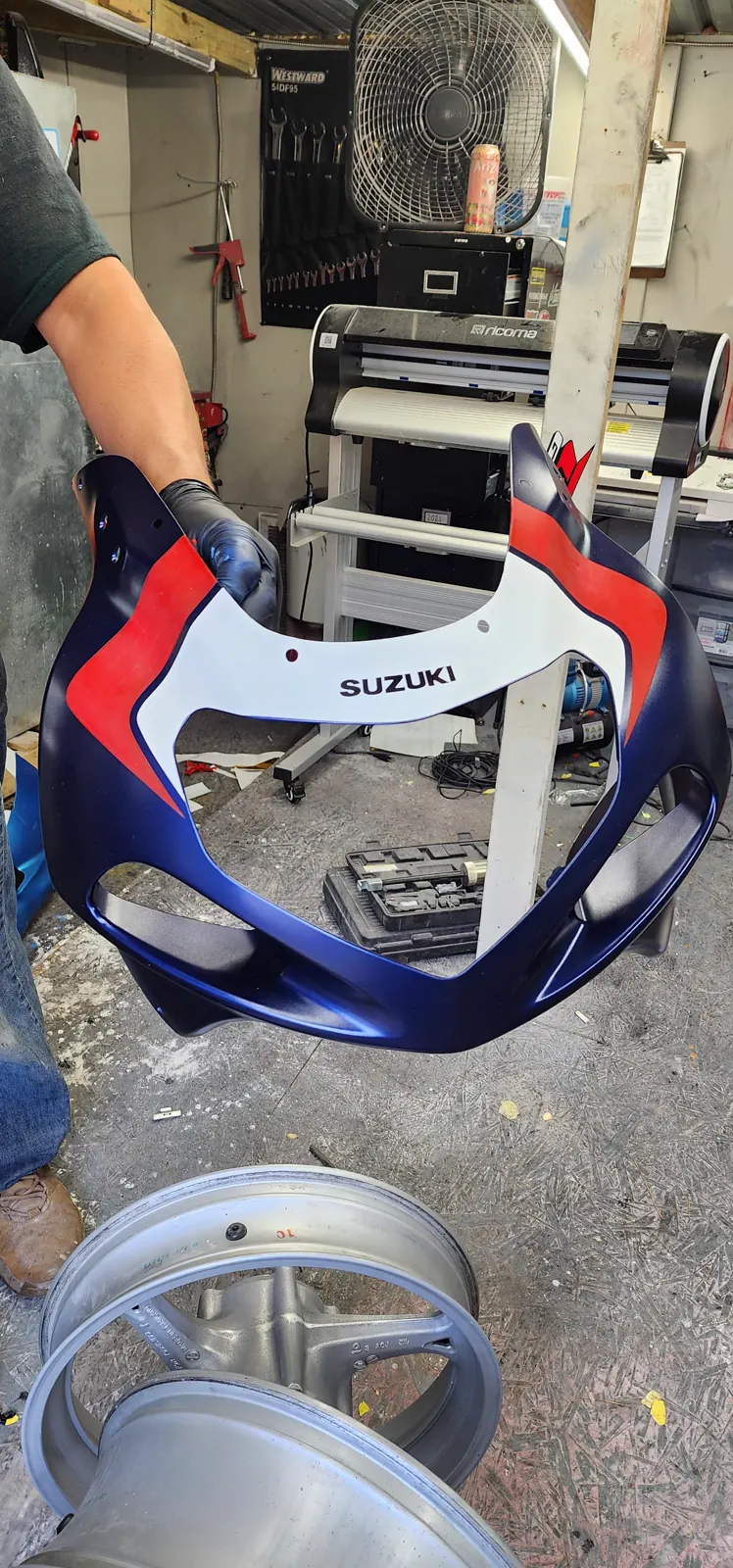
Once the paint is corrected, you want to keep it that way. That’s the job of a coating or a sealant. A ceramic coating is a liquid-glass layer that bonds to the clear coat and cures into a hard, slick shell. Water sheets off it, bugs and tar struggle to grab hold, and the whole bike gets dramatically easier to clean. Run your hand across a freshly coated tank and it feels glassy, almost frictionless — that slickness is the coating doing its job.
Now the honest part, because this is where marketing tends to oversell. A ceramic coating is not scratch-proof, and it won’t stop a rock chip or a parking-lot scuff. What it does is add gloss, block UV, resist those hard-water spots and acidic bug guts, and make regular cleaning far less of a chore. A quality coating lasts years, depending on how the bike is stored and cared for — not some fixed number a shop prints on a flyer. A sealant does a lighter version of the same thing for a shorter stretch. Both give your fresh finish real protection.
What actually happens when you bring it in
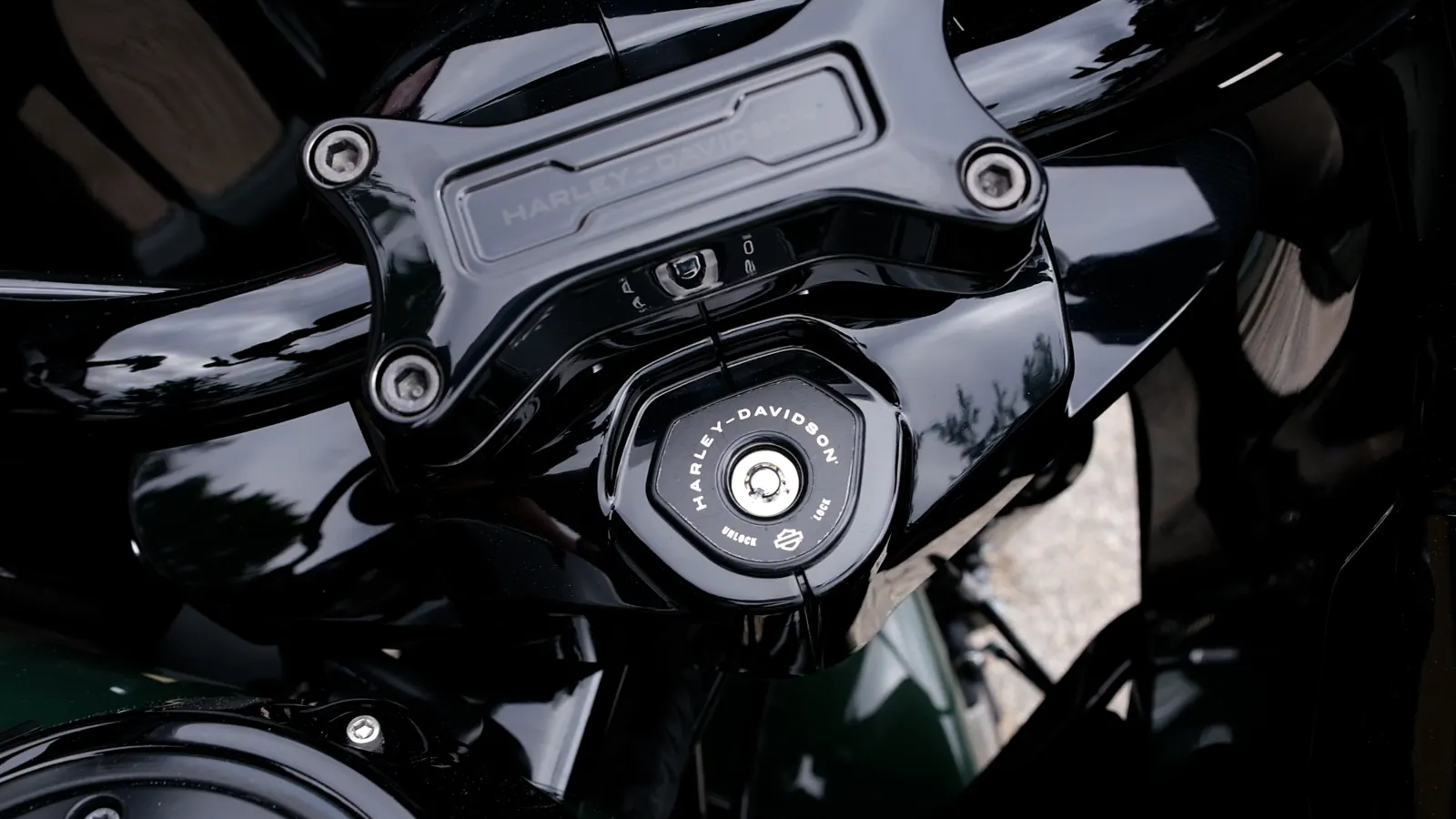
So what does a full detail look like from start to finish? Every bike is a little different, but the order rarely changes, and knowing it helps you judge whether a shop is cutting corners. If you’re curious about the full menu, this is what you get when you bring it in.
- A deep wash to strip loose dirt, then a chemical decontamination to dissolve bonded road film
- A clay treatment that pulls out embedded grit the wash left behind
- Machine paint correction to erase swirls and light scratches
- Chrome polishing until it mirrors again, plus wheel and engine-bay cleaning
- A ceramic coating or sealant locked over the corrected paint
- Leather, vinyl, plastic, and trim conditioned and brought back to black
That sequence is the whole point — clean, correct, protect, dress, in that order. Skip the decontamination and you polish grit into the paint. Coat before you correct and you seal the swirls in. So when friends ask what that service actually involves, that discipline is the honest answer.
How long it should take
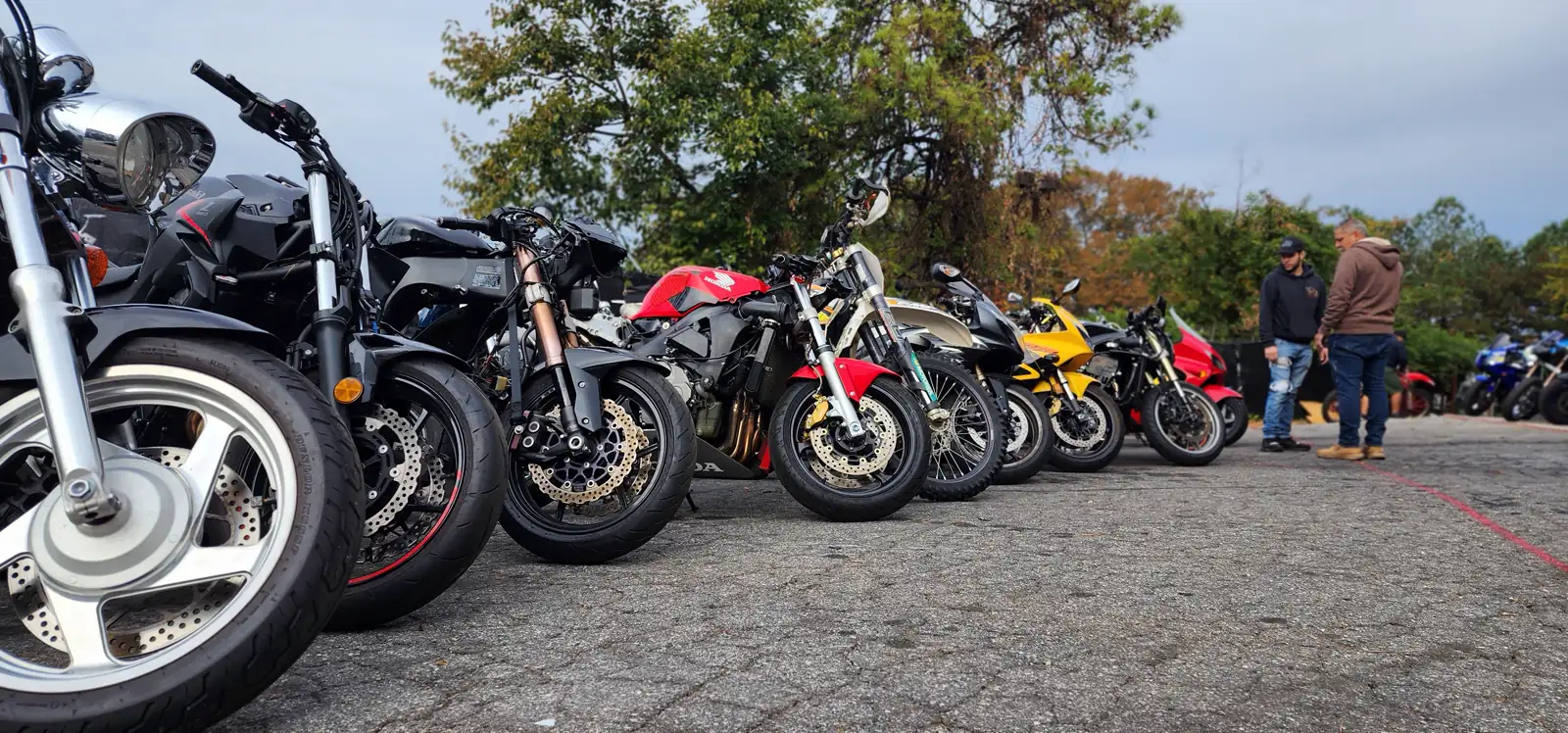
Timing depends on the bike and the shape it’s in. A maintenance detail on a well-kept machine is a same-visit job. A neglected used bike that needs full correction and a coating takes real time, because rushing correction is how clear coat gets ruined. Any shop that promises a showroom finish in an hour is really promising a spray-wax, so ask what’s included before you drop it off. Around here, the smart play on a project bike is the winter storage stretch from late November through February — the bike isn’t going anywhere, and it rolls out ready for spring.
Choosing a detailing shop in West Cobb
Something worth knowing before you book anywhere.
Powder Springs itself doesn’t have a motorcycle dealership or a big full-service shop inside the city limits, which leaves a thin layer of small independents and mobile setups, with the dealerships sitting a dozen-plus miles out. That’s no knock on anyone — dealers do good work, and specialists earn their reputations. Traxxion Dynamics up in Woodstock, roughly thirty miles north on Rope Mill Parkway, is a suspension house people trust precisely because it focuses on one thing. The lesson carries straight over to detailing: you want someone who does this work all day, not as an afterthought.
So how do you actually judge a detailing shop Powder Springs riders can rely on? A few things separate the real ones from the rest.
- They ask about the bike and inspect the finish before quoting anything
- They can explain paint correction and coatings in plain words, without hype
- They show you before-and-after work on bikes, not just on cars
- They’re honest about what a finish can and can’t recover
- They protect what’s already good instead of upselling work you don’t need
This matters more the more you love where you ride. Plenty of the bikes we see come out of garages in Country Walk and Oakleigh, or from the newer farmhouse-style homes over in Springside Reserve, where a machine stored indoors all winter deserves to look its best when it finally comes out. A clean bike earns second looks pulling into a concert at the Hardy Family Automotive Amphitheater in Thurman Springs Park, or rolling up to a weekend meet near Wild Horse Creek Park, the biggest park in the city and home to the Ron Anderson Recreation Center. Pride is a real reason to do this, and it’s a good one.
There’s a practical reason too. The arterials out here — Florence Road, Hopkins Road, and Brownsville Road — carry heavy construction and school traffic, and all that edge break and gravel wash flings tar and grime straight at your bike. You can track ongoing road work through Georgia DOT when you’re planning around it. And after a full-day run up SR 60 to Suches and back down Wolf Pen Gap Road on SR 180 — the Georgia Triangle out of Stonepile Gap — your bike comes home wearing a whole afternoon of bugs. A coated finish makes that cleanup quick instead of a Sunday-night chore.
Getting to us is easier than it looks on a map. We’re roughly fifteen to eighteen miles from Powder Springs, and while every trip is different, plan on something like thirty to forty minutes up Powder Springs Road or Macland Road into Marietta, then east on Roswell Road toward Barnes Mill Road. Since that’s a real haul just for a detail, pickup and delivery turns it into a non-issue — we come get the bike. Riders farther south ask us the same things, and how this plays out in Newnan looks a lot like it does here. If you want to plug into the wider riding community while you’re at it, the American Motorcyclist Association is a solid place to start.
What you actually get out of it
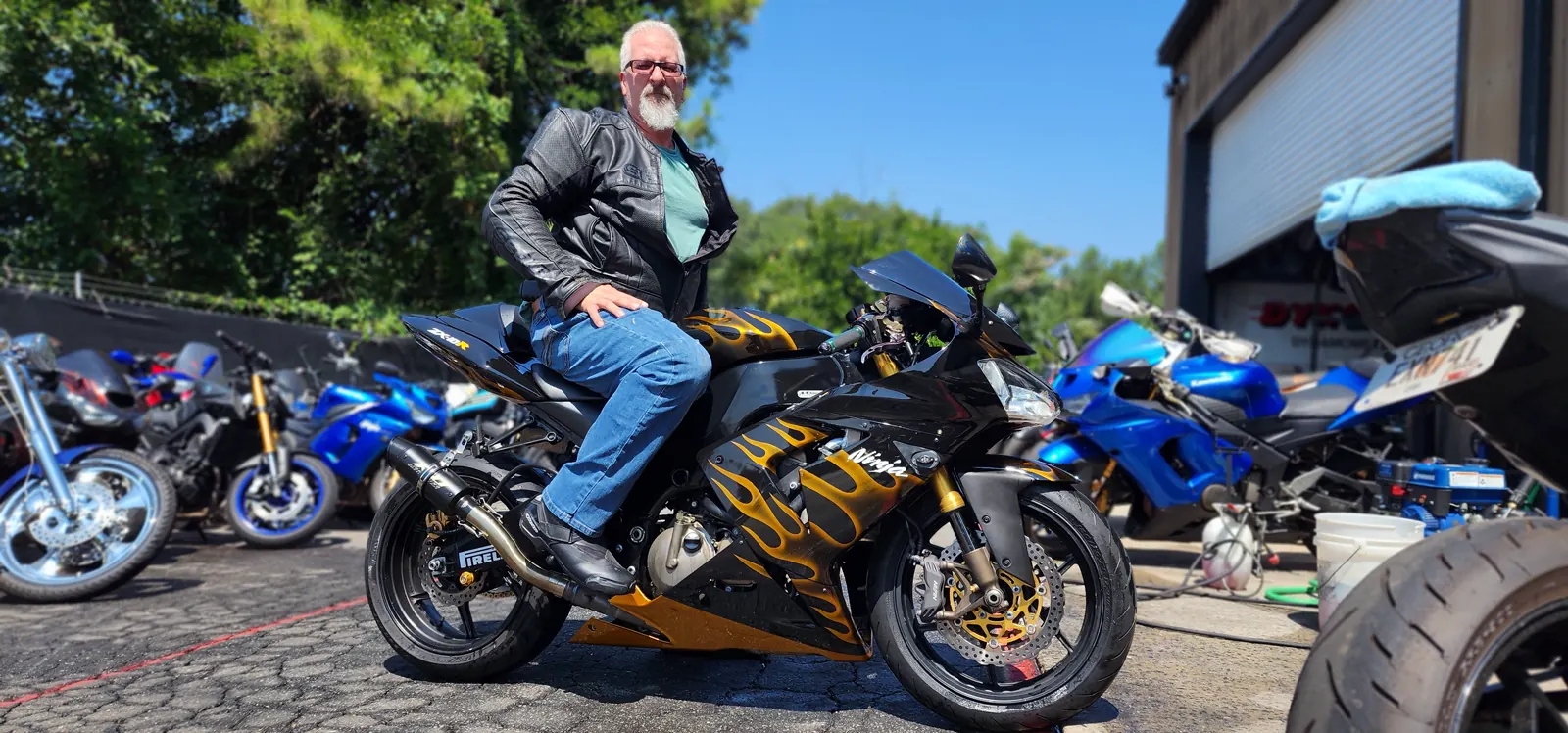
Here’s the payoff. A properly detailed bike doesn’t just look clean — it looks better than the day it left the showroom, because a factory finish was never corrected and coated to this level. The color has depth. Instead the chrome is a mirror. The black trim is black again. And that used bike with the mystery history? It stops looking like someone else’s castoff and starts looking like yours.
There’s a resale angle too, since a finish this clean quietly tells the next buyer the bike was cared for everywhere else. Mostly, though, it’s about how it feels to walk into the garage and see it sitting there gleaming. You bought that bike hoping it had good bones under a rough surface. Turns out it did — it just needed someone to bring it back. That’s the whole job, and it’s a genuinely satisfying one.
Questions Powder Springs riders ask us
How do I know the diagnosis is right?
A good shop inspects the finish in person and shows you exactly what it sees before quoting a thing. Ask them to point out the swirls, spots, and oxidation in daylight. If they can explain what caused each one and what it takes to fix it, the diagnosis is honest. Vague answers are the red flag.
What makes your approach different?
We do this work all day, and we tell you the truth about what a finish can recover. We won’t sell you correction a bike doesn’t need, and we won’t promise scratch-proof miracles. Clean, correct, protect, in that order — no shortcuts.
How do I pick a good detailing shop?
Look for someone who inspects before quoting, explains coatings without hype, shows real before-and-afters on bikes, and protects what’s already good. Someone doing this every day beats someone treating it as a sideline. Trust the shop that respects your bike enough to tell you no.
Dealer or independent — who should I trust?
Both can do great work. Dealers are convenient and specialists earn their reputations, like the suspension crew up in Woodstock. For detailing specifically, pick whoever focuses on finishes rather than treating it as an add-on. The focus is what shows up in the result.
What should I ask a shop before booking?
Ask what’s included, whether they do real machine correction or just a wax, how they store your bike, and what a coating realistically protects against. Straight answers mean a shop that respects your bike. Dodgy answers mean keep looking.
Is ceramic coating worth it on a used bike?
Once the paint is corrected, yes. It locks in the fresh finish, fights Georgia’s hard water and bugs, and makes every future wash easier. Just remember it protects and eases cleaning — it isn’t a force field against rocks.
We look after riders all across West Cobb and the surrounding OTP area. From Marietta and Smyrna to Austell, Mableton, and Fair Oaks, out to Hiram, Dallas, and Clarkdale, and west through Douglasville, Lithia Springs, and Villa Rica, we bring detailing and finish work to bikes that spend most of the year parked in a garage. Kennesaw riders are on that list too, and if you’re anywhere in between, pickup and delivery closes the gap.
BRING THAT USED BIKE BACK TO LIFE
That secondhand bike has better bones than its finish suggests, and we’d love to prove it. Text us about a detail and we’ll come get it right from your driveway in Powder Springs, correct the paint, polish the chrome, and hand it back looking better than the day it first rolled off the showroom floor. Tell us what you’re seeing and we’ll tell you honestly what it’ll take.
470-460-9883Diaz Motorcycles and Service, LLC · 847 Barnes Mill Road, Marietta, GA 30062