Best Dyno Tuning Lawrenceville — A Rider's Guide
How a dyno reads your bike, why it runs lean or rich, and what a real tune changes in the way it feels.
Here’s something no shop should make you feel bad about: you don’t have to know what’s wrong with your bike. That part is our job, not yours. Maybe it stumbles when you roll off a stop light. Maybe it runs hot and cranky when traffic backs up on GA-316. You just know it feels off, and you can’t put a name to it. That’s completely fine. When riders start looking for the best dyno tuning Lawrenceville can point them toward, most of them can’t describe the problem either. They just know the bike doesn’t feel the way it used to.
So let’s take the pressure off right now. You don’t need to walk in with the right words. You don’t need to guess at fuel maps or air-fuel ratios. Instead, you bring the bike, you tell us what you feel, and we go find the why. Think of us as a buddy who fixes bikes for a living and happens to have a dyno sitting in the building.
A story most Gwinnett riders will recognize
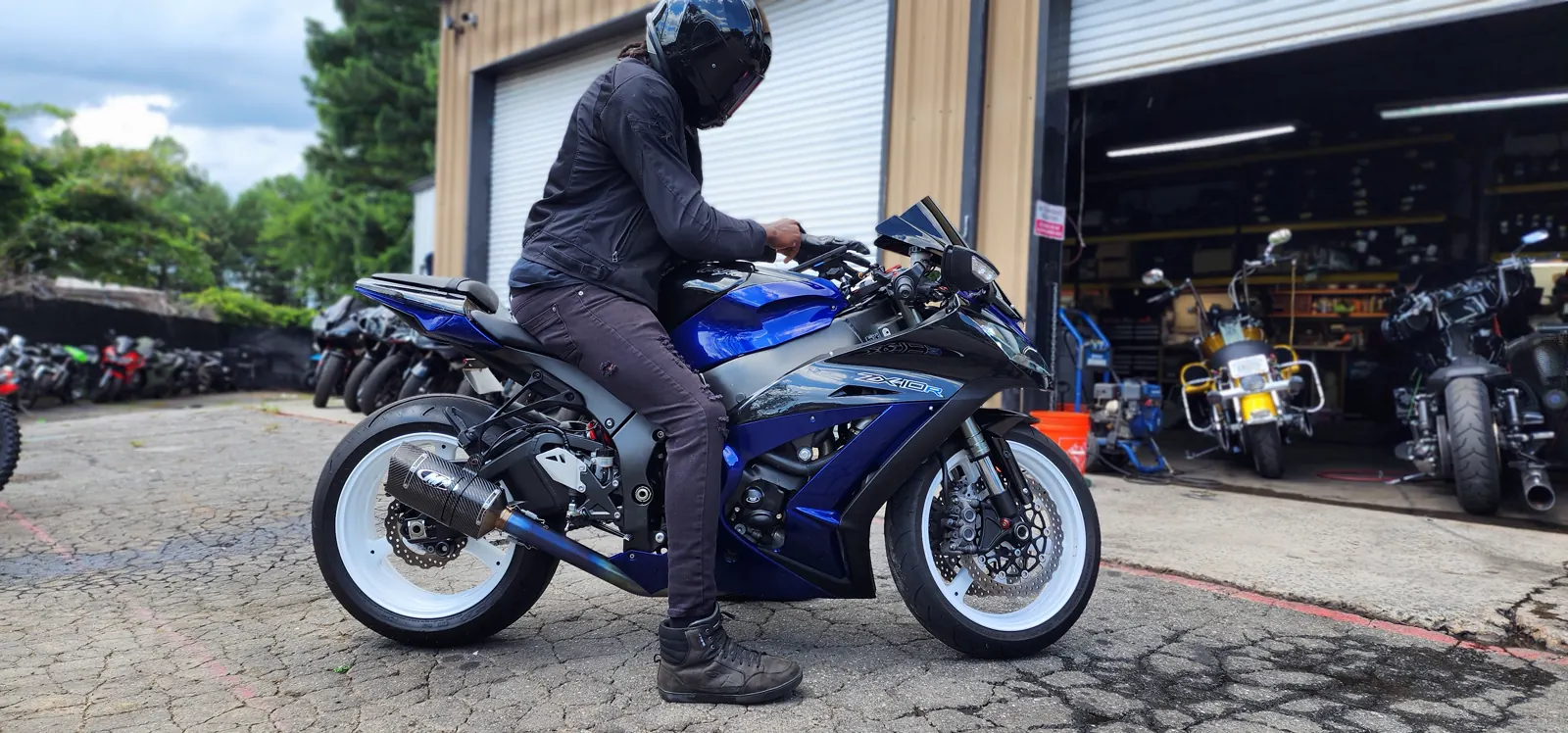
A friend we helped over in Collins Hill Heights bolted a slip-on exhaust onto his Ninja. It sounded amazing. Unfortunately, it also started popping on deceleration and felt flat right in the midrange. He figured he’d done something wrong. Also he hadn’t. He simply changed how much air the engine breathes, and nobody told the bike about it. That’s one of the most common stories we hear from OTP riders, and the fix is simple once you understand the cause.
The real cause: why a bike runs lean or rich
Your engine wants a steady mix of air and fuel. When that mix has too much air and not enough fuel, we call it lean. When it has too much fuel, we call it rich. From the factory, the mix is set for a stock bike breathing through stock parts. The moment you add an exhaust, an air filter, or new gearing, though, that balance shifts.
Lean is the one to watch. A lean bike runs hotter, surges at steady throttle, and can feel jerky when you crack it open. Rich isn’t great either, because it fouls plugs, wastes fuel, and feels lazy. Here’s the good news, though: both are fixable, and neither means you broke anything. You just moved the target, so now we move the aim to match. That’s the whole idea behind a custom tune, and it’s exactly why riders go hunting for real mapping in the first place.
Around here, lean is especially common because of how folks build their bikes. Gwinnett runs on modified sportbikes, and the usual recipe is a slip-on or full exhaust, a freer air filter, maybe new gearing and a fender eliminator. Every one of those lets the engine gulp more air. Meanwhile, the fuel side stays stuck on the factory setting, so the mix tilts lean. The bike didn’t fail — it just got a bigger set of lungs and the same small breakfast. A tune is how we finally feed it right.
What a dyno actually measures
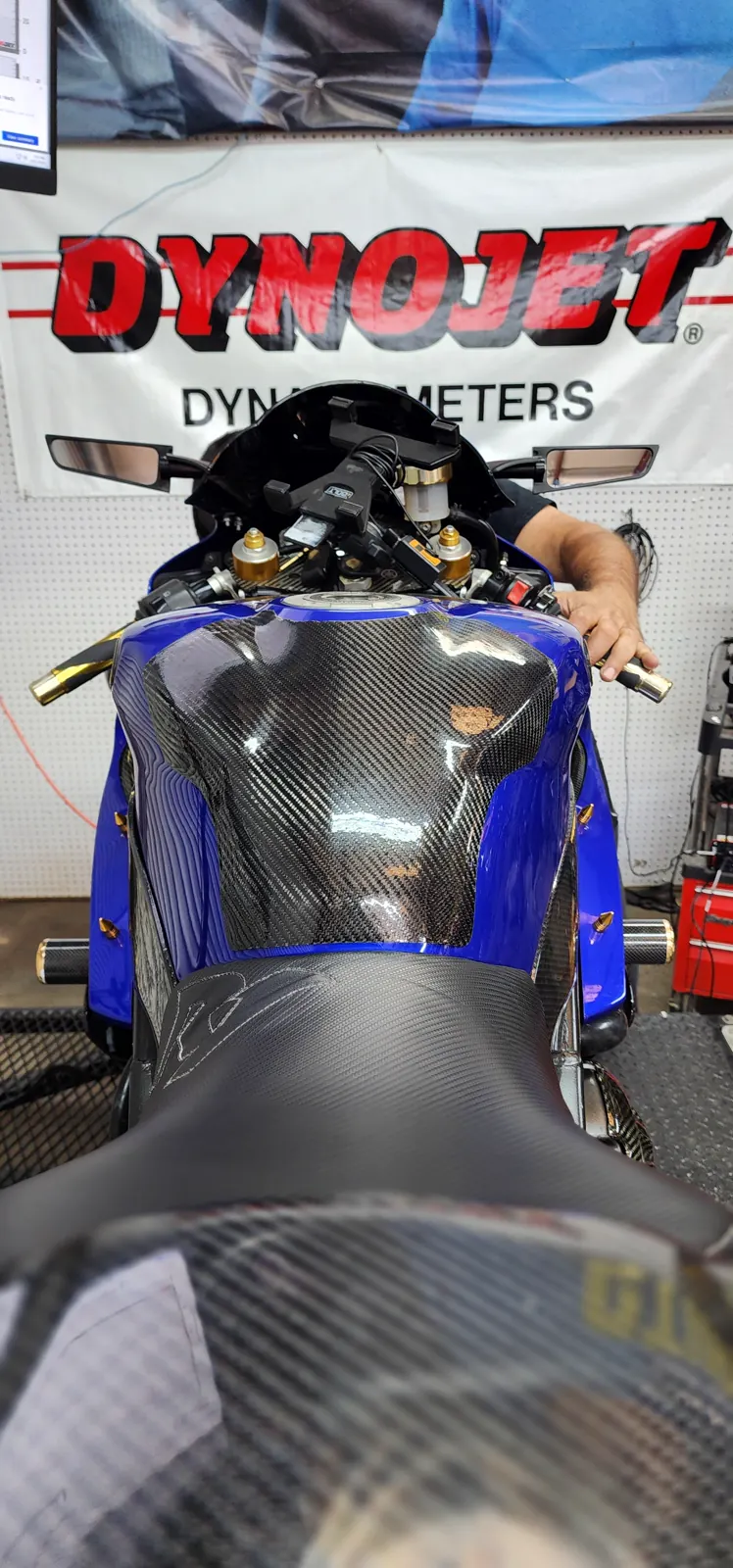
A dyno is a big drum the rear wheel sits on. You strap the bike down, and it runs against a controlled load, kind of like a treadmill for your motorcycle. As the engine pulls, the dyno reads how much power it makes across the whole rev range. At the same time, a sensor in the exhaust reads that air-fuel mix in real time. So instead of guessing, we watch the exact spot where the bike goes lean or rich and read it right off the screen. If you want the hardware version, Dynojet’s dyno center lays it out clearly.
Most people stop reading here. That’s the expensive mistake. They get the numbers, nod at the graph, and figure the job is done. But a printout isn’t a tune. The real work is what happens next, and it’s the part that decides how your bike feels for the next ten thousand miles.
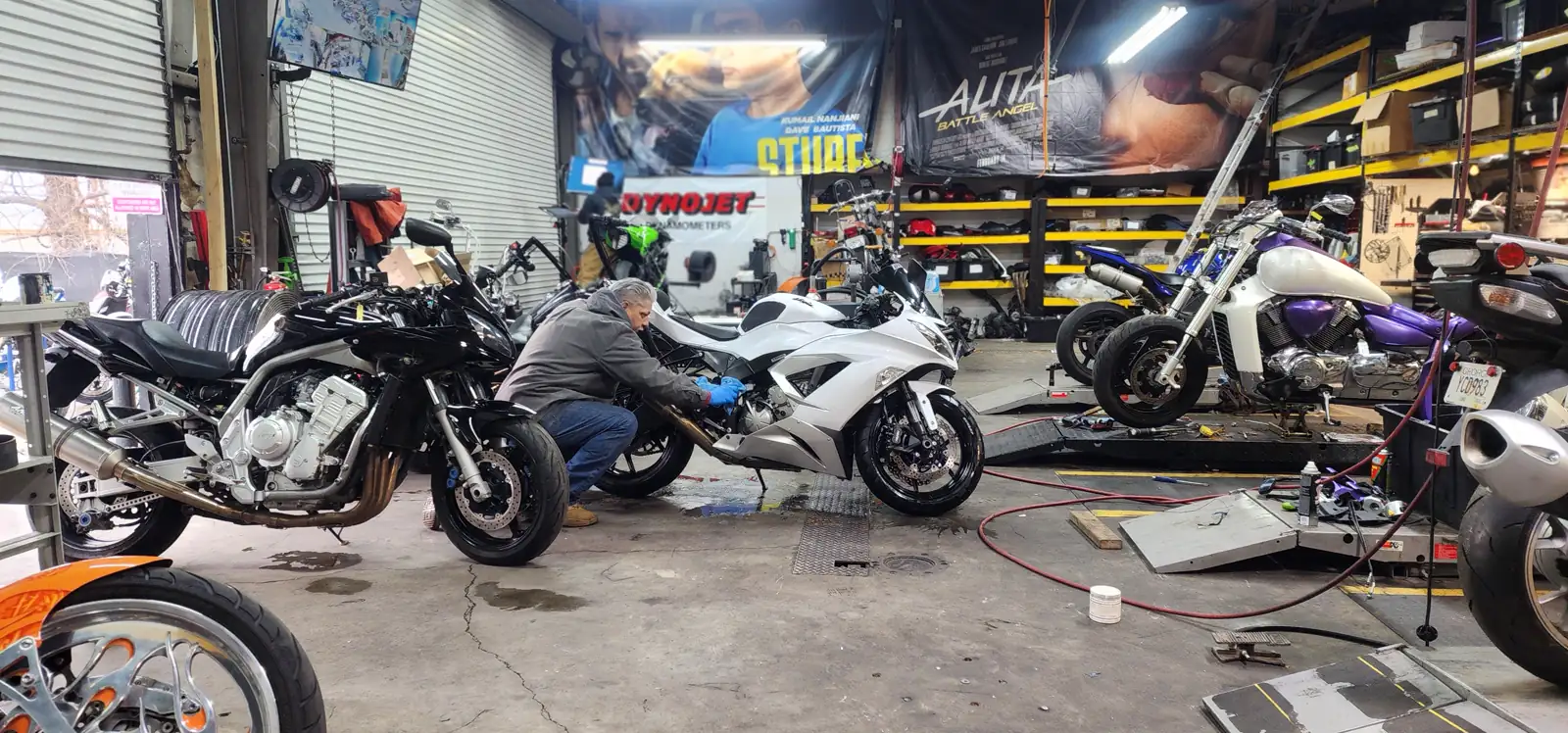
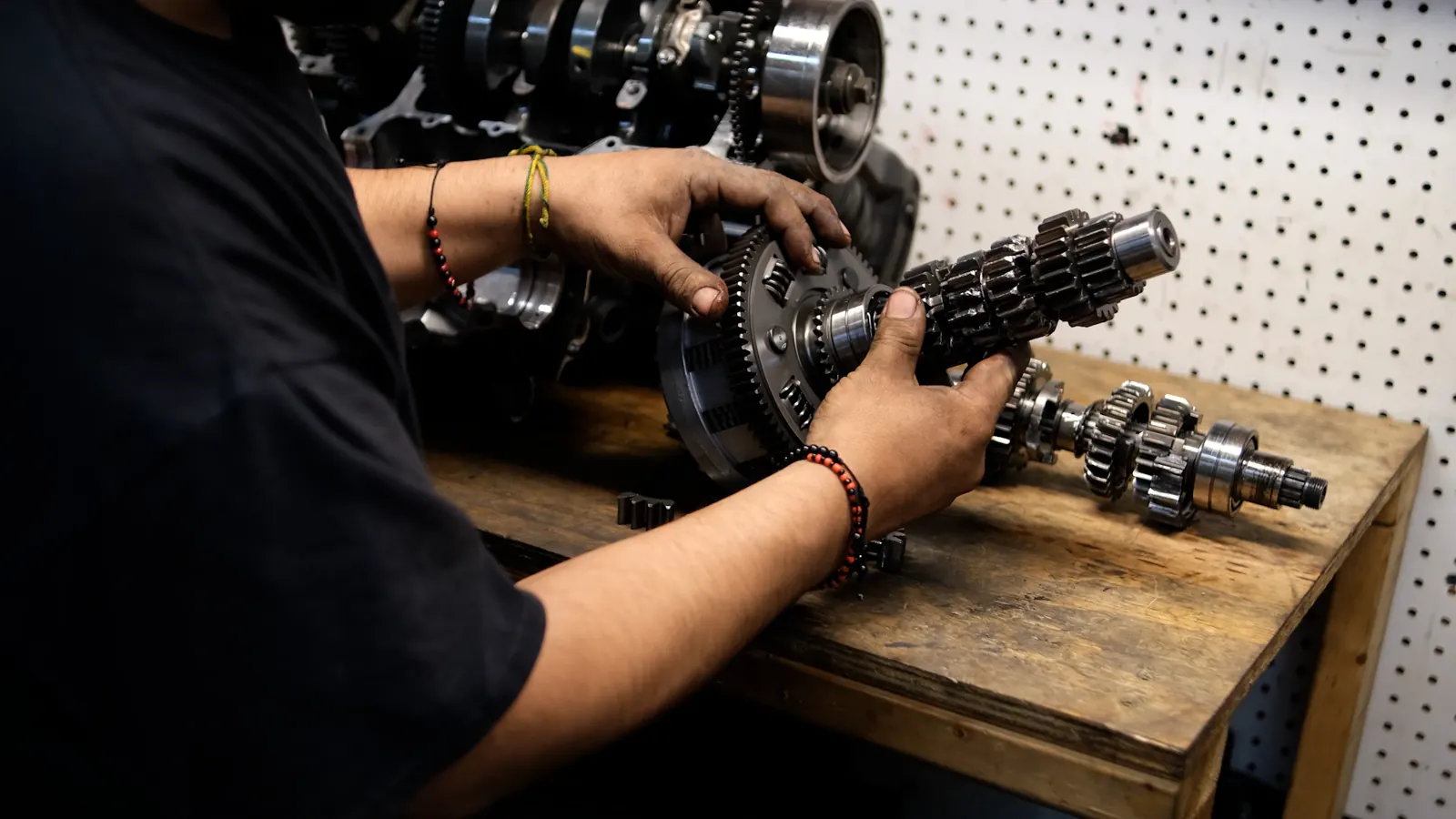
With the readings in hand, we adjust the fuel and timing across the whole range. On many bikes that means an ECU flash, where we rewrite the bike’s own computer. On others we run a Power Commander, which is a small piggyback box that trims the fuel. Either way, both get you to the same place: the right mix at every throttle position. We don’t just fix one rpm and call it done, either — the fueling gets shaped from idle all the way to redline, plus every step in between. Around Lawrenceville and the wider OTP area, this in-house mapping is harder to find than you’d expect, since most multi-line shops send tuning out or skip it. You can see what we take care of here.
Your options when the bike just feels off
So let’s say your bike feels wrong. You’ve actually got a few honest paths, and not all of them lead to a dyno.
- Do nothing and live with it — fine for a mild slip-on, risky if the bike runs lean and hot.
- Load a canned map — a generic file someone made for your exact parts. Better than nothing, yet it wasn’t built for your bike.
- Get a full custom dyno tune — mapped to your engine, your parts, and your air, on the day.
Which one is right really depends on your bike and how you ride. A cruiser that only sees a Sunday loop out to Tribble Mill Park has different needs than a track-day supersport. To be fair about it, plenty of good shops handle basic service well, and a dealer like Frazier’s Harley-Davidson up in Buford anchors the cruiser side of the market and does solid work. Custom mapping in-house is simply a different specialty, and it happens to be the one that’s thin on the ground out here. If you’re weighing paths, it also helps to see how the work adds up before you decide.
How we decide what your bike needs
Here’s the part that makes a shop worth trusting. We don’t start by selling you the biggest package. Instead, we start by listening and looking.
- We ask what you feel and where — off idle, in the midrange, up top, hot or cold.
- Instead we check what’s already on the bike, from the exhaust to the air filter to the gearing.
- We put it on the dyno and read the real air-fuel numbers, never a guess.
- We match the plan to how you actually ride, whether that’s a daily commute or carving canyons.
That order matters a lot. A shop that quotes you a tune before it has even heard the bike is guessing. For the full picture of a session, here’s what that service actually involves and how many pulls it really takes.
We’ll also tell you when you don’t need much. Sometimes a bike with a simple slip-on and a decent base map is already close, so we make small trims and send you home happy. Other times the bike is way off and needs real work to run safe and strong. Either way, you get the honest version, not a one-size-fits-all package. That’s the whole point of reading the bike first instead of selling a plan first.
The last piece is the one people underestimate. It isn’t the graph, and it isn’t the peak number. It’s the road test.
Numbers on a screen are only half the story. After the dyno, a good tuner rides the bike or hands it back for a real-world check. Traffic on I-85, which sits about eight to twelve minutes west via GA-316, throws heat and stop-and-go at your engine that a drum can’t fully copy. The commute is real here, too. Lane splitting is illegal in Georgia, so you’re sitting in that heat, not slipping through it, and plenty of that everyday risk shows up in IIHS motorcycle research. A tune that feels great on the drum but surges in traffic simply isn’t finished.
What your bike feels like after
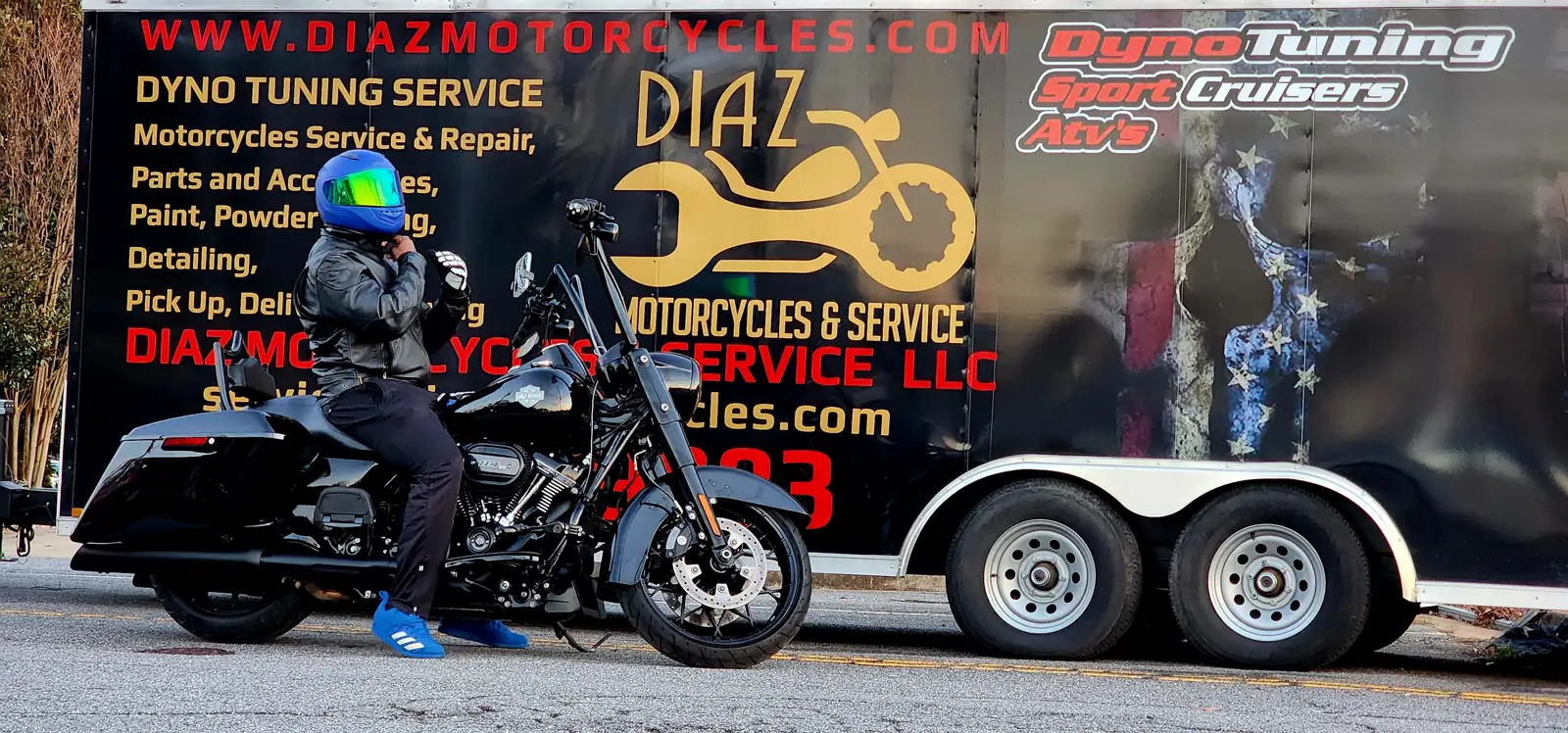
This is the fun part. A properly tuned bike feels like it finally woke up. Throttle response gets crisp and predictable. That flat spot in the midrange smooths right out. It also runs cooler in traffic, which your knees will quietly thank you for come July. Cold starts settle down, too, and that annoying pop on deceleration usually calms right down with it. Honestly, nothing about it feels dramatic — it just feels right, the way the bike should have felt the day you changed the parts.
The best way we can describe it is this: the bike stops asking you to manage it. Before a tune, you learn to work around the surge, the stumble, and the heat. Afterward, you don’t think about any of that. You just twist the throttle and the bike answers, smooth and steady. On a long day of stop-and-go, that’s easier on you and easier on the engine. On a good back road, it’s the difference between wrestling the bike and flowing with it.
Riders from the quiet streets around Ballantrae and Glen Oaks Racquet Club tell us the same thing afterward. The bike stops fighting them. And when they finally point it north, up GA-11 and GA-53 toward US-129, GA-60, GA-52 and the Russell-Brasstown Scenic Byway, the throttle just does what their wrist asks, corner after corner. That, right there, is the payoff.
How to judge a shop before you hand over the keys
You’re comparing shops and deciding who to trust. That’s smart, and you should. Here’s what actually tells you a tuning shop knows its stuff, no bragging required.
- They have a real dyno on site, not a partner shop across town.
- Besides they read air-fuel live and can explain what they saw in plain words.
- They ask about your riding before they quote a single thing.
- They do the mapping in-house — ECU flashing or Power Commander work under their own roof.
- Their recent Google reviews are strong, since word travels fast in a market this dense.
You bring the feeling. We find the fix. Then your bike just does what you ask.
Yes, it's a bit of a drive — and yes, it's worth it
We’ll be straight with you. Our shop sits on Barnes Mill Road, and from Lawrenceville that’s roughly 33 to 38 miles, give or take, usually somewhere around 45 to 70 minutes depending on your route and the traffic that day. So yes, it’s a real cross-metro trip, no sugarcoating it. But here’s why friends still make it: quality custom mapping is genuinely hard to find inside Gwinnett, so a lot of riders modify their bikes heavily and then have nowhere close to make those mods actually work.
Better still, you don’t even have to make the drive. We pick up and deliver. You keep living your life — drop the kids at school over near Northside Hospital Gwinnett on Philip Boulevard, head to work, whatever your day looks like — and we come get the bike, tune it, and bring it back dialed in. Curious how the numbers shake out closer to us? Take a look at how this plays out in Marietta.
So take a breath. You don’t need to be an engine expert to get this right. What you need is a shop that listens, a real dyno, and someone who’ll ride the bike before they call it done. Once you know what to look for, choosing the best dyno tuning Lawrenceville has access to gets a whole lot simpler — and your bike gets a whole lot more fun to ride.
Questions Lawrenceville riders ask us
What should I ask a dyno shop before I book?
Ask if they have a real dyno on site and do the mapping in-house, or if they send it out. Ask whether they read air-fuel live and road-test the bike after. Also ask them to explain, in plain words, what they’ll actually change. A shop that can answer all three clearly is one you can trust.
Do you tune all brands, or just Harleys?
We work on all of them. Sportbikes like the R6, GSX-R, Ninja and CBR, European bikes like Ducati and Aprilia, plus cruisers and baggers. Whether it runs an ECU flash or a Power Commander, we’ve got you. Bring the bike and tell us what it’s doing.
How far from Lawrenceville do you serve?
Plenty. From Lawrenceville it’s roughly 33 to 38 miles to our shop on Barnes Mill Road, usually around 45 to 70 minutes depending on your route. That’s a cross-metro drive, sure, but real custom mapping is hard to find closer to home. We serve riders all across Gwinnett and the wider metro.
Can you pick up my bike?
Yes, and a lot of Lawrenceville friends choose exactly that. We pick up and deliver, so you never have to ride cross-metro or trailer it yourself. We come get the bike, tune it, and bring it back ready to ride. You keep your day; we handle the miles.
How do I know the diagnosis is right?
Because it isn’t a guess. The dyno reads your bike’s actual air-fuel mix across the whole rev range, so we see the exact spot it goes lean or rich right on the screen. Then we road-test to confirm it feels right in traffic, not just on the drum. You’ll get the story of what we found in plain language.
My bike is already heavily modified. Is it too late to tune it?
Not at all — that’s the best time. Every mod you added, from the exhaust to the air filter to the gearing, changed how the engine breathes. A custom tune is what pulls all of it back into balance. The more you’ve changed, honestly, the more a proper tune wakes the bike up.
We take care of riders all over Gwinnett and the metro’s east side. That includes Duluth and Suwanee up the GA-316 corridor, Snellville, Grayson and Loganville out toward the southeast, and Dacula and Buford to the north. It also covers Lilburn, Norcross and Sugar Hill, plus Tucker and Stone Mountain closer to the perimeter. Wherever you ride from, pickup and delivery means the drive is our problem, not yours.
LET'S FIND OUT WHAT YOUR BIKE'S HIDING
You don’t have to name the problem — that’s on us. Text us what your bike is doing and where it feels off, and we’ll put it on the dyno, read the real numbers, and tune it to how you actually ride. We pick up and deliver right to Lawrenceville, so the cross-metro drive never touches your day. Let’s make that bike feel the way it should.
470-460-9883Diaz Motorcycles and Service, LLC · 847 Barnes Mill Road, Marietta, GA 30062