Best Dyno Tuning Woodstock — How to Choose
How to tell a real tuning shop from a shop that owns a dyno, without needing a technical background.
Call five shops and ask what a tune will do for your bike. You’ll get five confident answers, and honestly, not one of them can be true yet. Nobody knows your bike. It has its own pipe, its own air filter, its own miles, and its own history of short trips and long quiet weeks in the garage. That’s the odd thing about shopping for the best dyno tuning Woodstock riders can find. The shop worth trusting is usually the one that tells you the least over the phone.
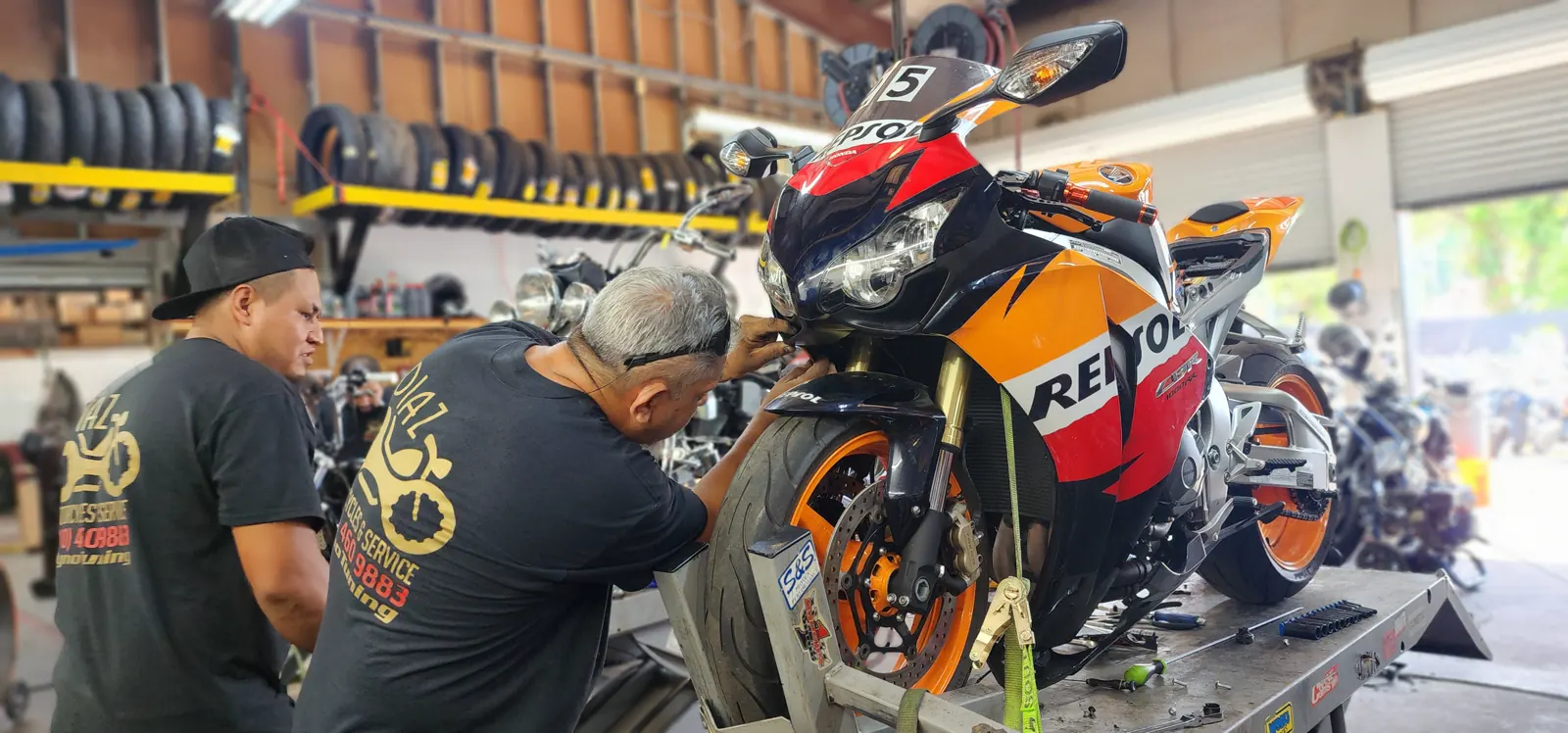
We’re Diaz Motorcycles, down on Barnes Mill Road in Marietta. We run our own dyno right here in the building, and we do ECU flashing and Power Commander work in-house instead of shipping your bike somewhere else and hoping. So we field that phone call constantly. Rather than hand you a made-up number, we’d rather show you how to judge any shop in the area, ours included. Bring a skeptical eye. Good shops like skeptical customers.
Start With What Your Bike Is Already Telling You
Before you compare shops, get clear on why you’re calling. A tune isn’t a magic wand you wave at a healthy bike. It’s a fix for specific behavior, and your bike has probably been complaining for a while in its own way. Riders usually describe it in feel words rather than technical ones, which is completely fine. Feel words are useful data. Here’s the list we hear most often from riders coming down out of Cherokee County.
- It surges or hunts at a steady throttle, especially around 3,000 to 4,000 rpm on the highway
- It pops and crackles on deceleration, more than it used to
- It runs hot in traffic, and your right leg knows it
- There’s a flat spot when you roll the throttle open in the midrange
- It’s fussy to start cold, or it stumbles the first mile
- Fuel mileage dropped after you added a pipe, a filter, or both
None of that means your bike is broken. Every one of those is a fueling conversation, and fueling is adjustable. That’s the good news buried in the annoyance. Also worth saying plainly: if none of those describe your bike and it runs beautifully, you may not need anything at all. A shop that agrees with that is showing you something about its character.
What Each One Usually Means
Surging at steady throttle is the classic lean-cruise signal. Manufacturers set bikes up to pass emissions rules, so many run thin on fuel in exactly the rpm range you use on I-575. The engine keeps grabbing for a little more fuel than it’s being given, and you feel that hunt through the grips as a soft push-pull. Consequently the bike feels nervous when you’re just trying to hold a lane and enjoy the morning.
Deceleration popping is the same story from the other end. When you close the throttle, a lean mixture can finish burning in the hot exhaust instead of the cylinder. It sounds cool for about a week. After that it mostly tells you fuel and air aren’t matched on the overrun. Meanwhile, running hot in stop-and-go traffic often points the same direction, because a lean burn simply runs hotter than a correct one.
Rich is the opposite problem, and it shows up mostly after somebody guesses at a fuel map. A rich bike feels lazy and soggy, fouls plugs, and drinks fuel. Either way, the cause is the same idea: air and fuel aren’t matched to what the engine is doing at that moment.
Hard cold starting and a first-mile stumble live in the same file. Cold engines need a richer mixture until they warm up, and that enrichment is programmed, not mechanical. If it’s set for a factory exhaust and yours isn’t factory anymore, mornings get grumpy. Likewise, a midrange flat spot after a pipe swap is usually the map still believing in a muffler that’s sitting in your garage corner.
What A Dyno Actually Measures
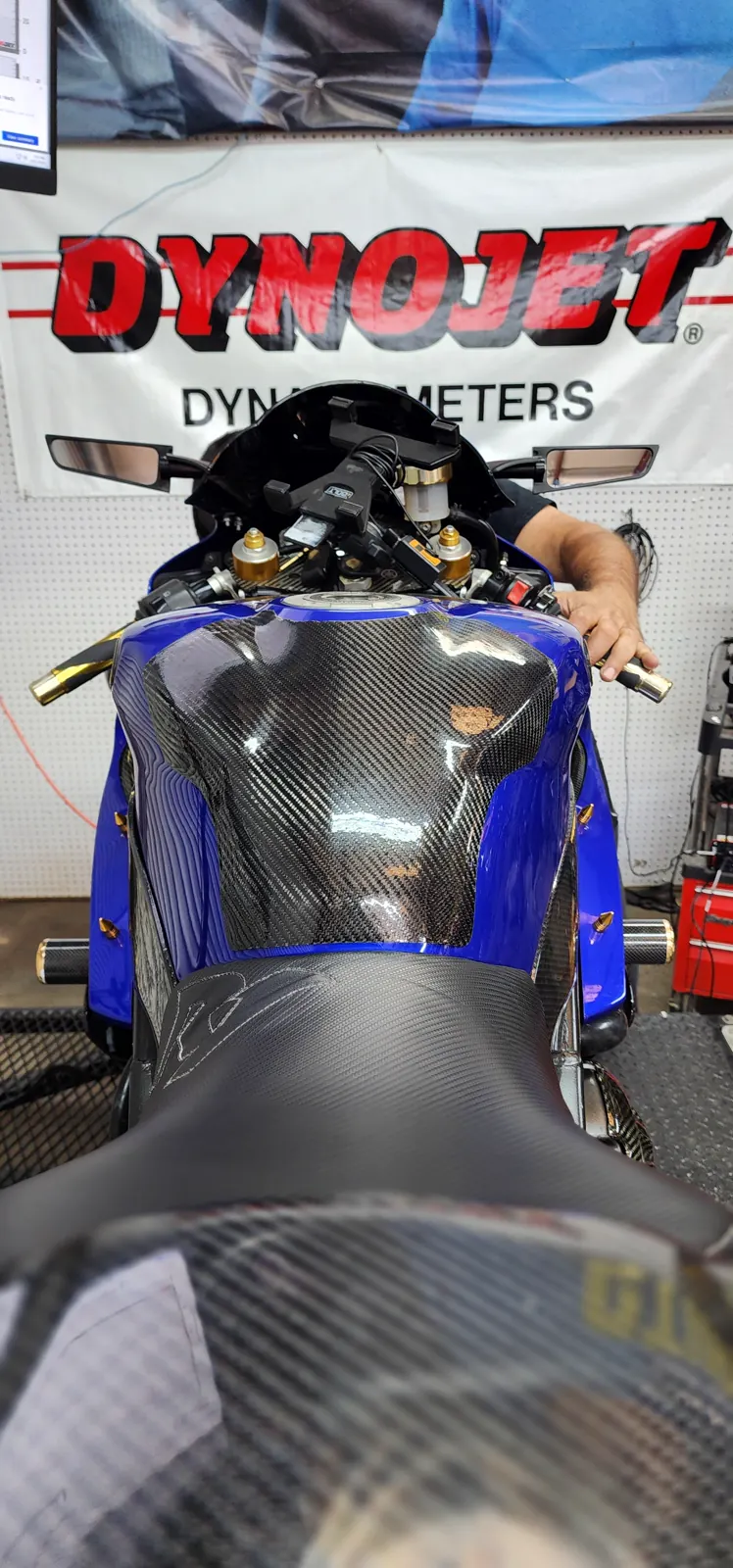
Here’s the plain-English version. A dyno is a heavy drum that your rear tire spins. The bike is strapped down, the tire turns the drum, and the machine measures how hard the engine has to work to accelerate that known weight. From that it calculates power and torque across the whole rev range. It doesn’t guess. It measures the bike you actually own, on that day, with that pipe and that filter.
The second thing it measures matters even more for how your bike feels. A sniffer in the exhaust reads the air-fuel ratio while the engine runs. Now the tuner can see, rpm by rpm and throttle position by throttle position, exactly where the mixture goes thin or fat. That’s the map. Afterward the tuner adjusts fueling and, where the bike allows it, ignition timing, then runs it again and checks the work.
A dyno doesn't make power. It shows the truth, and the truth is what makes the tune possible.
Now flip it around and look at it from the bike’s side. Your engine has no idea what pipe you bolted on. It’s following instructions written years ago in a lab, by engineers who had to satisfy emissions testing and a warranty department, for a bike wearing parts it no longer wears. Every day it does its honest best with outdated directions. Tuning is basically handing it a corrected set of instructions for the machine it grew into.
That reframe clears up a lot. Riders expect a tune to add something, when mostly it removes compromises the bike was carrying. It’s also why we won’t promise a figure before we see it. Two identical models with different pipes and different miles behave differently, and pretending otherwise is a sales pitch dressed up in numbers.
What Happens At The Shop, Step By Step
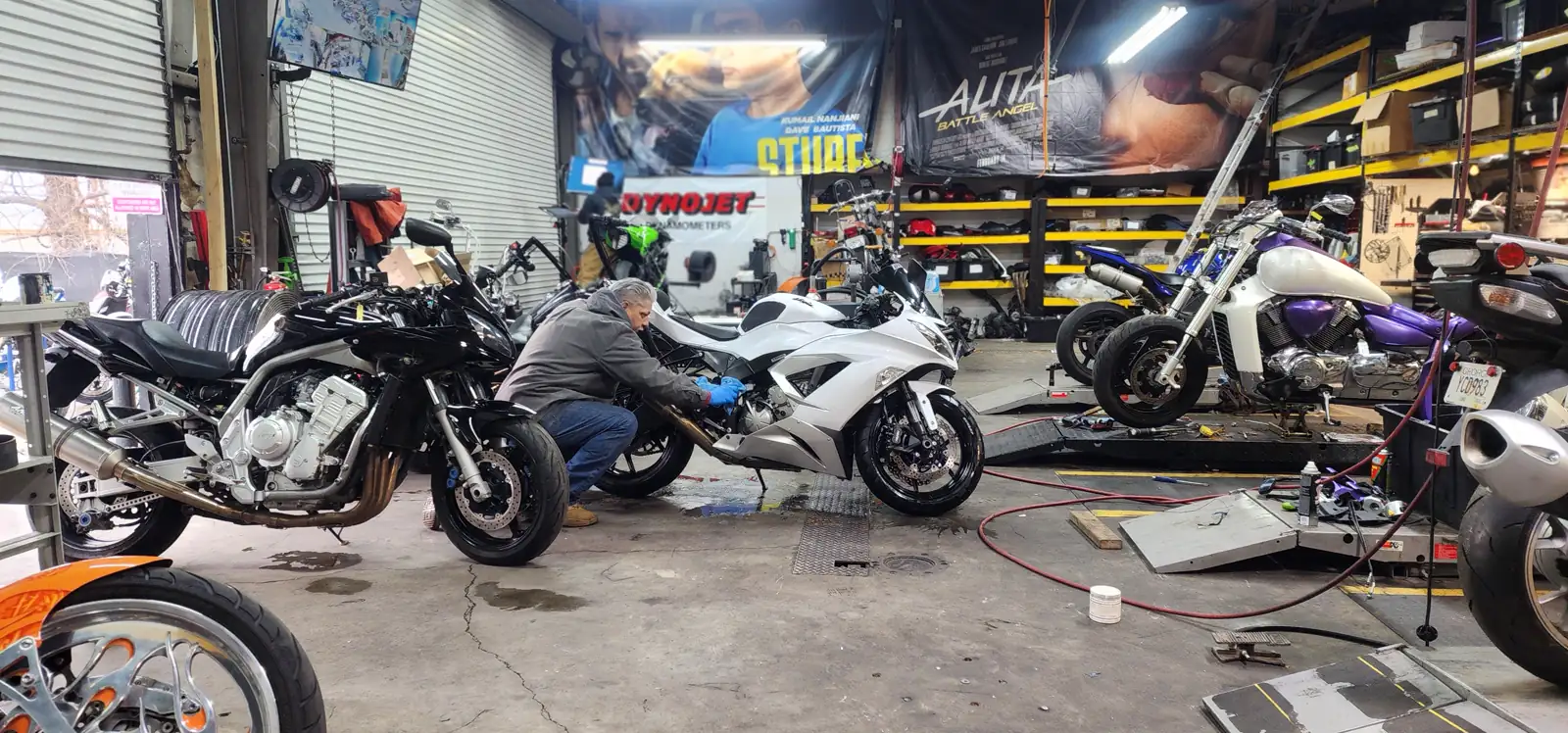
Transparency about process is one of the easiest ways to judge a shop, so here’s ours end to end. Ask any shop you’re considering to walk you through theirs the same way, and notice whether they can.
- We talk first. What does the bike do, when does it do it, and what’s been changed on it?
- We check health before power. Plugs, air filter, valve clearance history, cooling, tires, chain or belt, and any codes stored in the ECU.
- We strap it to the dyno and make baseline runs to see the bike as it sits today.
- For example, we read the air-fuel ratio across the rev range and find where it goes thin, fat, or ragged.
- We adjust fueling by ECU flash or Power Commander, depending on what your bike supports.
- After that, we run it again, then again, refining until the curve is smooth and the mixture is right everywhere you actually ride.
- We road test it, because the dyno and Barnes Mill Road are two different judges.
- We show you the before and after graphs and explain them in normal words.
Notice that step two comes before any tuning. Chasing a fueling problem on a bike with a clogged filter or a tired plug wastes your day and your money’s worth of attention. A shop that skips straight to the drum is selling dyno time rather than solving your problem, and you’ll feel the difference within a week of riding.
How Long It Takes
Plan on most of a day, sometimes a second day if the health check turns up something that ought to be handled first. Custom mapping isn’t a fifteen-minute download. There’s setup, cooldown between pulls, and slow careful passes fixing one ragged patch at a specific throttle opening. Rushing that is how a bike ends up great in one spot and worse in three others.
BOOK IT AROUND YOUR RIDING
Summer here is hot and humid down in the suburbs and cooler up in the mountains, with near-daily afternoon storms. Since June through September rides tend to start early, most riders drop the bike off before a stretch of bad-weather days rather than losing a good weekend.
Real Criteria For Judging A Shop
Anyone hunting for the best dyno tuning Woodstock has access to should ask these questions. They work whether you call us or somebody else, and we’d rather you use them than pick by whoever answers the phone fastest.
- Is the dyno in the building, or is the work sent out? In-house means the tuner can iterate all afternoon instead of booking a second appointment.
- Will they tune your specific make, model and model year, including older bikes and European brands?
- Do they check mechanical health before selling you power?
- Can they explain a before-and-after graph without making you feel small?
- Do they offer both ECU flashing and piggyback options like a Power Commander, or only the one they happen to stock?
- Will they tell you when you don’t need a tune?
- Do they road test after, on real pavement, not just on the drum?
Woodstock has more motorcycle businesses than any other city we serve, and several are genuinely excellent at what they focus on. Most are simply narrow by design. Atlanta Motorcycle Works on Mauldin Drive, for instance, is the in-city dealer for Moto Morini, Benelli, Benda and Keeway, with service covering Japanese motorcycles fifteen years old or newer, weekdays only. That’s a clear, honest scope. If your bike fits it, wonderful. If you ride an older Triumph or a European twin, you’re looking for a different kind of shop, and that’s no knock on anybody.
Same goes for brand dealerships. Factory training and factory tools are a real advantage on that brand. What dealers often don’t have is a dyno with a tuner behind it all week for every make that rolls in. That’s a business model, not a character flaw. For the deeper version, we wrote up what that service actually involves in a companion post.
The Woodstock Part Of This
Cherokee County riders are a particular bunch, and we mean that as a compliment. Towne Lake alone covers close to 5,700 single-family homes, making it one of the largest planned communities in the county, and those 1990s neighborhoods came with two- and three-car garages as standard. Over in Bradshaw Farm, 621 homes spread across 650 acres with a clubhouse, pools and tennis courts. Around Kingsgate, including Regency, Park and the Glens, the story repeats at a different price point. Practically speaking, that means bikes stored inside, on trickle chargers, next to a workbench, owned by folks who do their own oil changes and hire out the specialist work.
Riders here also read up before they call. A well-known suspension company is headquartered in town, which quietly raises the technical literacy of the whole local riding population. So a pointed question about closed-loop fueling delights us rather than surprises us. Our service page has the full list of what we do if you’d rather read before you dial.
Geography matters too. From Woodstock we’re roughly 15 to 19 miles out, about 25 to 35 minutes down I-575 to I-75, then east on Roswell Road to Barnes Mill Road. If the interstate is misbehaving, Bells Ferry Road runs south-southwest into north Cobb on surface streets instead. Similarly, riders over in Canton take almost the same route down.
What really raises the stakes is north of you. I-575 turns into GA 515, the Appalachian Highway, a straight shot toward Jasper, Ellijay and Blue Ridge that puts real mountain roads about an hour away. Since Georgia has a universal helmet law and lane splitting isn’t legal, commuting by bike from here isn’t much fun anyway. Riding is recreational and destination-driven, so bikes sit for weeks and then take a beating in one weekend.
There’s a detail in all this that changes how you’ll ride out of here. A bike that’s fueled correctly doesn’t just make more power at the top. It behaves better at the exact throttle openings you use on a tight mountain road, where you’re feeding it a quarter turn at a time through a corner. That’s the difference between a bike that lurches on the pick-up and one that meters out drive smoothly. On roads with gravel washed into the corners and damp shaded pavement, that smoothness is worth more than any number on a chart.
Local pavement makes the case too. Growth around Ridgewalk, Towne Lake Parkway and the SR 92 corridor means construction entrances tracking gravel onto the road, and out toward Wiley Bridge or Trickum you get blind crests, off-camber curves and deer. A predictable throttle isn’t a luxury there. For project notices before a long run north, Georgia DOT is worth a look.
What You'll Feel Riding Out
Riders describe it more or less the same way every time. The bike pulls without hesitation off idle. The surge at highway cruise goes quiet. Heat in traffic drops, which your leg notices before your brain does. Throttle response gets crisp instead of jumpy, and the bike stops feeling like it’s arguing with you. Fuel mileage often improves, since the engine is no longer burning fuel it can’t use. We wrote the full rundown on it if you want the detailed list.
Afterward, take the long way home. Roll past Olde Rope Mill Park, where mill ruins on the Little River mark a grist mill from the 1840s and a rope mill from the 1870s, now ringed by hiking and mountain-bike trails. Then swing downtown past the 1912 Louisville & Nashville depot, quiet since passenger service ended in 1949. Low speeds and stop signs are a great first test of a fresh tune.
So here’s the reassuring part. Finding the best dyno tuning Woodstock riders talk about doesn’t require you to become an expert. Ask a shop to explain itself, then listen for whether the answer makes sense or dodges. Good shops are eager to show their work. For rider advocacy and safety resources while you research, the American Motorcyclist Association is a solid, non-commercial place to spend twenty minutes.
When you’re ready, call and describe how the bike feels. We’ll ask questions, we’ll probably ask you to bring it by, and we’ll tell you honestly if a tune is the wrong answer. Your bike has been doing its best with old instructions for a long time. Handing it new ones is one of the more satisfying afternoons in motorcycling.
Questions Woodstock riders ask us
How far out do you serve, and is Woodstock too far?
Not at all. Woodstock is about 15 to 19 miles from the shop, roughly 25 to 35 minutes down I-575 and I-75. We see riders regularly from all over Cherokee and north Cobb, plus folks coming from further out for tuning specifically.
Can you pick up my bike?
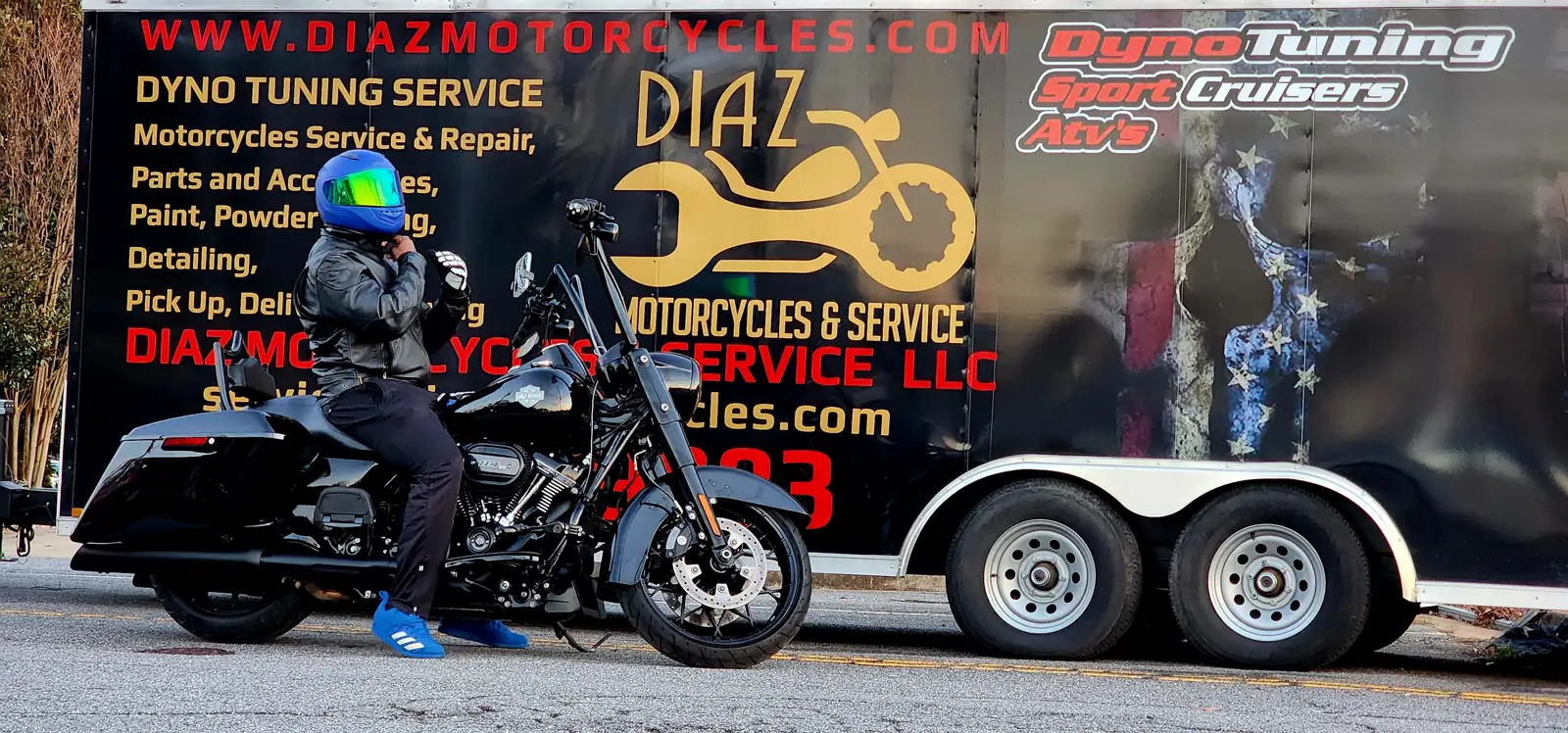
Yes. We run a fully enclosed trailer and can arrange pickup and delivery for Woodstock riders. It’s handy if the bike isn’t running well enough to ride down, or if you’d rather not fight I-575 traffic. Just ask when you call and we’ll work out timing.
How do I know the diagnosis is right?
Ask to see the data. On the dyno we record air-fuel ratio and power across the whole rev range, before and after, so the problem and the fix both show up on a graph. We’ll walk you through it in plain language. If we can’t point at something measurable, we won’t charge you for a guess.
What makes your shop different from a dealership?
Mainly the dyno being in-house, plus doing ECU flashing and Power Commander setup ourselves rather than sending work out. We also take all brands and all model years, including older and European bikes. Dealers have real strengths on their own brand, so this is about scope, not skill.
How do I pick a good tuning shop in general?
Ask whether the dyno is in the building, whether they check mechanical health before tuning, and whether they’ll explain the graphs to you. Then ask if they’d ever tell you not to tune. A shop willing to talk you out of work is usually the one worth booking.
Does a tune void my warranty?
It depends on the bike and the manufacturer, so ask us before we touch anything. On many machines a piggyback unit like a Power Commander can be removed and the bike returned to stock settings. We’ll lay out your options honestly and let you decide.
Diaz Motorcycles works on bikes from Woodstock and all around it, including Canton, Holly Springs, Ball Ground and the Towne Lake corridor up in Cherokee County. Riders come down to us from Acworth, Kennesaw and Cartersville on the west side, and over from Roswell, Alpharetta, Milton and East Cobb on the east. Marietta is home base, right on Barnes Mill Road. If you’re within an easy ride or a short trailer trip of any of those, we’d love to look at your bike.
LET'S SEE WHAT YOUR BIKE ACTUALLY WANTS
If your bike surges, pops, runs hot or feels flat, tell us how it feels and we’ll take it from there. Woodstock riders are a short run down I-575, and our dyno, ECU flashing and Power Commander work all happen right here in the building. Call or message Diaz Motorcycles, describe the symptoms in your own words, and we’ll tell you straight whether a tune is the right answer for your bike.
470-460-9883Diaz Motorcycles and Service, LLC · 847 Barnes Mill Road, Marietta, GA 30062