Dyno Tuning Cost Acworth — What You Pay For and Why
A plain-English walk through what a tune really involves, what makes one job bigger than another, and why an honest shop won't guess over the phone.
For example, You’ve had this bike a long time. After that, Long enough that you know the exact sound it makes when it’s happy, and the little stumble it makes at four thousand rpm when it isn’t. You’re not trading it in. What’s more, you want to keep it, and you’d like it to run the way it ran in your head the day you bought it. So you go looking for dyno tuning cost Acworth answers, and what comes back is either a number with no story behind it or a polite shrug. Let’s fix that.
The Myth: A Tune Has a Sticker Price Like a Set of Tires
So and Better yet, the idea floating around is that tuning is a product. Still, you drop the bike off, somebody presses a button, a number prints out, and you pay the number. Tires work that way. Batteries work that way. Tuning doesn’t, and once you see why, the whole thing stops feeling like a mystery and starts feeling like something you can plan for.
Start with the machine itself. Plus, a dyno is a big drum that your rear tire spins against while the bike is strapped down and going nowhere. The drum has a known weight. When your engine spins it up, the dyno measures how fast that weight accelerates, and from that it works out how much power the engine is actually making at every point in the rev range. At the same time, a sniffer in the exhaust reads the leftover oxygen in your exhaust gas. That tells us the air-fuel mixture. So we get two things at once: what the engine is doing, and what it’s eating while it does it.
Now the fun part. Of course, engines want a certain amount of fuel for a certain amount of air. Then again, Too little fuel for the air coming in and the bike runs lean, which feels hot and snatchy off idle and is hard on parts. Even so, too much fuel and it runs rich, which feels soft and lazy, fouls plugs and washes your gas mileage down the drain. Meanwhile, Neither one is a moral failing on your bike’s part. In fact, that said, it’s just math that stopped matching reality.
The Reality: You're Buying Time and Judgment, Not a Box
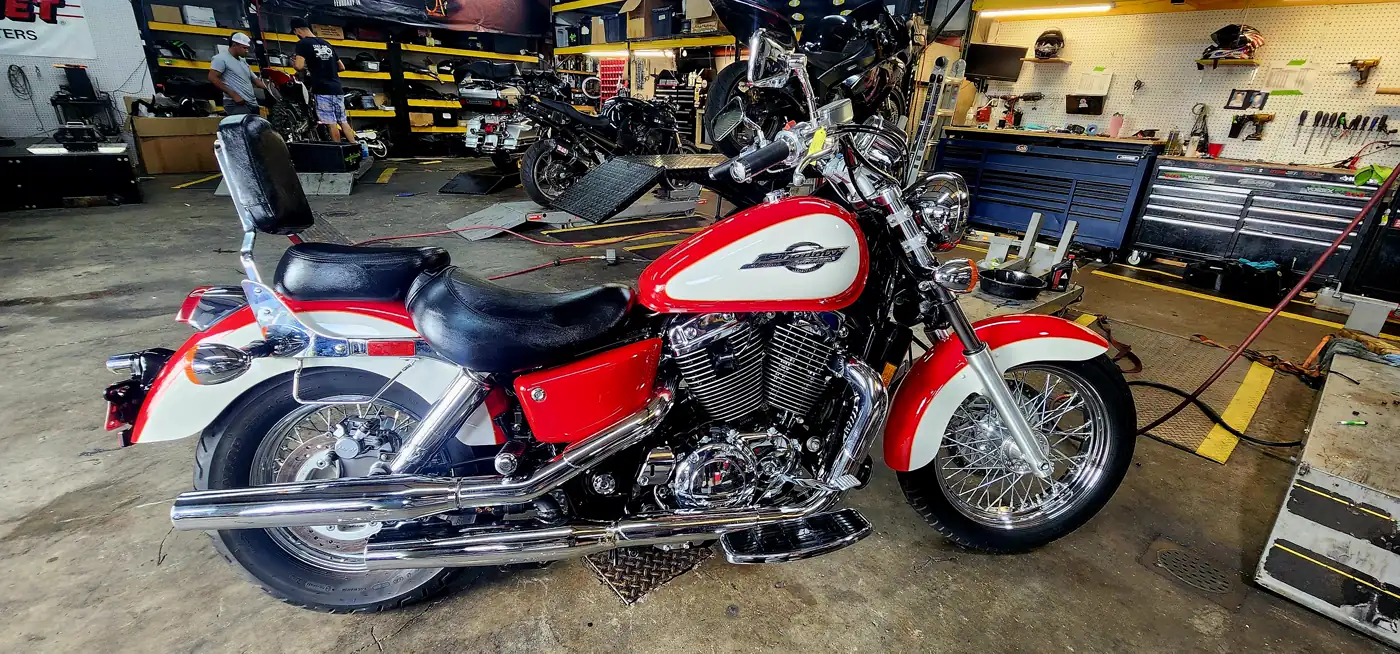
For example, here’s the shift that makes everything click. After that, On most repairs you’re buying a part plus the labor to install it. A tune flips that. There’s barely any part at all. Sometimes there’s a fuel controller like a Power Commander, or an autotune module, or a bung welded into the header so the sniffer has somewhere to live. On a lot of modern bikes there’s no part whatsoever, because we flash the ECU that’s already bolted to your frame and hand you back the same hardware with better instructions inside it.
So what are you paying for? Time on the machine, and the judgment of the person watching the screen. That’s it. And time on the machine varies enormously from bike to bike, which is exactly why the same job can be small on one motorcycle and long on another.
A short list of what stretches the clock:
- Whether the bike is healthy first. A tune on a motor with a weak coil, a tired plug or a leaking intake boot is a tune built on sand. We check before we map.
- How much has been changed. A slip-on and an air filter is one conversation. Full system, cams, big-bore kit and a different airbox is another.
- Whether the ECU can be flashed directly, or whether the bike needs a piggyback controller wired in.
- How many gears and how many load points the map covers. More points means more runs, and more runs means more hours.
- Whether you want one map or several. Some riders want a smooth street map and a wide-open map for a track day.
- Older bikes with carbs. Those get jetting changes by hand between runs, and every change means taking things apart again.
That’s also why parts and labor land so differently here than on, say, a fork rebuild. On a tune, the labor is the job. If you want the long version of what happens in our bays, we’ve written it out, but the short version is this: we’re selling careful hours, not a shrink-wrapped item.
WHY NO PHONE QUOTE
We can’t see your exhaust, your intake, your ECU, or how healthy the motor is over the phone. Any shop that names a firm number sight-unseen is either padding it heavily or planning to call you halfway through with bad news. We’d rather look first and tell you the truth once.
Here’s the question we’d ask if you were standing in the shop. Not “what bike is it” and not “what’s your budget.” The question is: what does it do now that you don’t like? Because that answer sorts the whole job in about thirty seconds. A bike that hesitates leaving a stop sign needs different attention than one that flattens out at the top of third gear. A bike that runs hot in traffic on the way back from the lake is telling us something specific. When you can describe the symptom, we can usually tell you before the bike ever touches the drum whether this is a short session or a long one.
The Actual Process, Start to Finish
No smoke, no secrets. This is the order it happens in every time.
- Talk first. You tell us what the bike does, what’s been changed, and what you want out of it. We write it down.
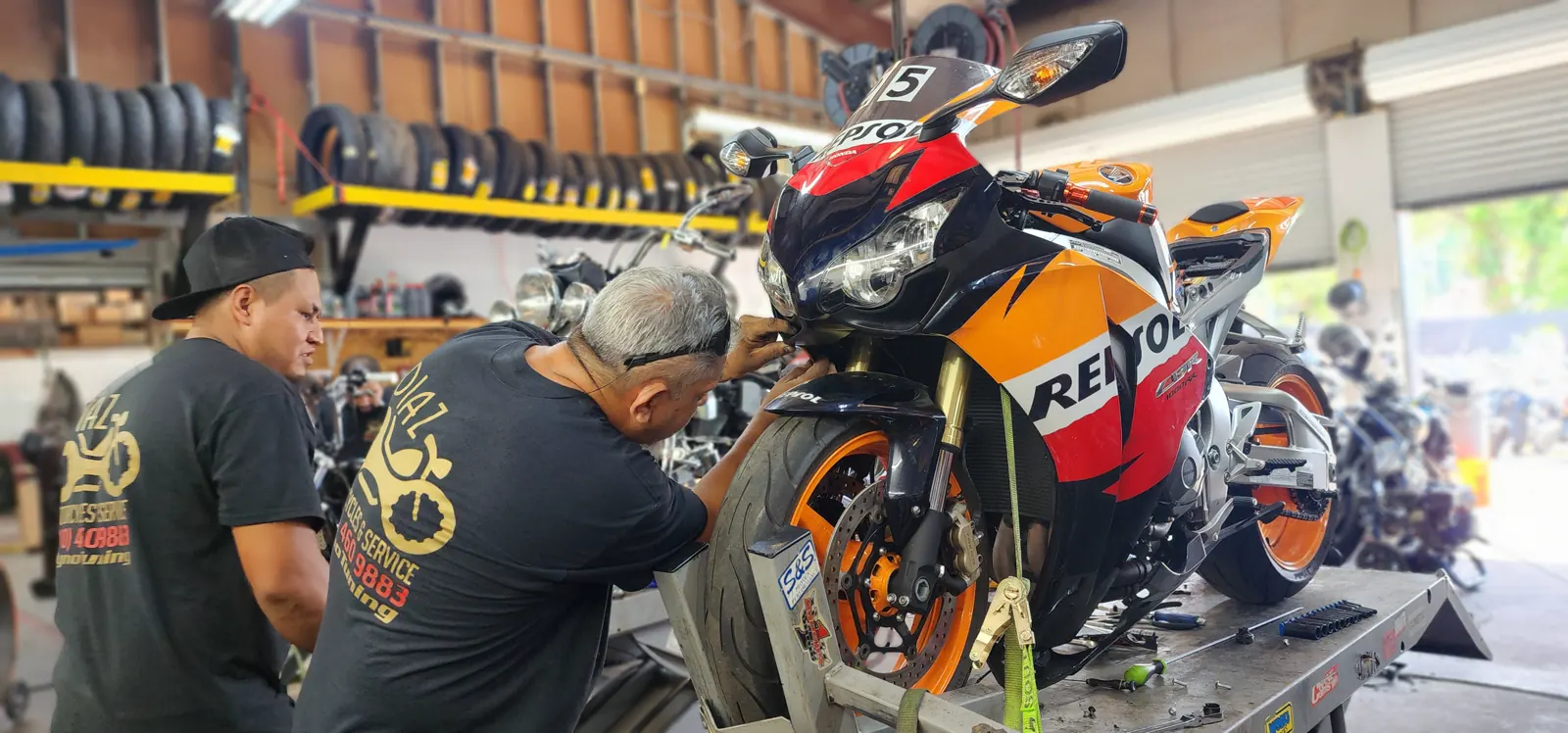
- Health check. Plugs, coils, filters, intake leaks, chain and tire condition, oil level. A dyno pull is hard work for an engine, and we don’t ask a sick one to do it.
- Strap down. The bike gets tied to the dyno at the triples and the rear, the fan goes in front, and the exhaust sniffer goes in the tailpipe.
- Baseline runs. We record what the bike does right now, exactly as you brought it. This is your before picture, and you keep it.
- Read the graph. Now we can see where it’s lean, where it’s rich, and where the power falls off a cliff.
- Make changes. On a modern bike that means editing fuel and ignition tables in the ECU or the controller. On a carbed bike it means jets, needles and screws, by hand.
- Run again. And again. Each change gets verified, not assumed.
- Road check. A dyno is honest but it isn’t the real world. Wind, load and heat behave differently on pavement, so the bike gets ridden.
- Hand back the numbers. You leave with the before and after graphs and a plain explanation of what changed.
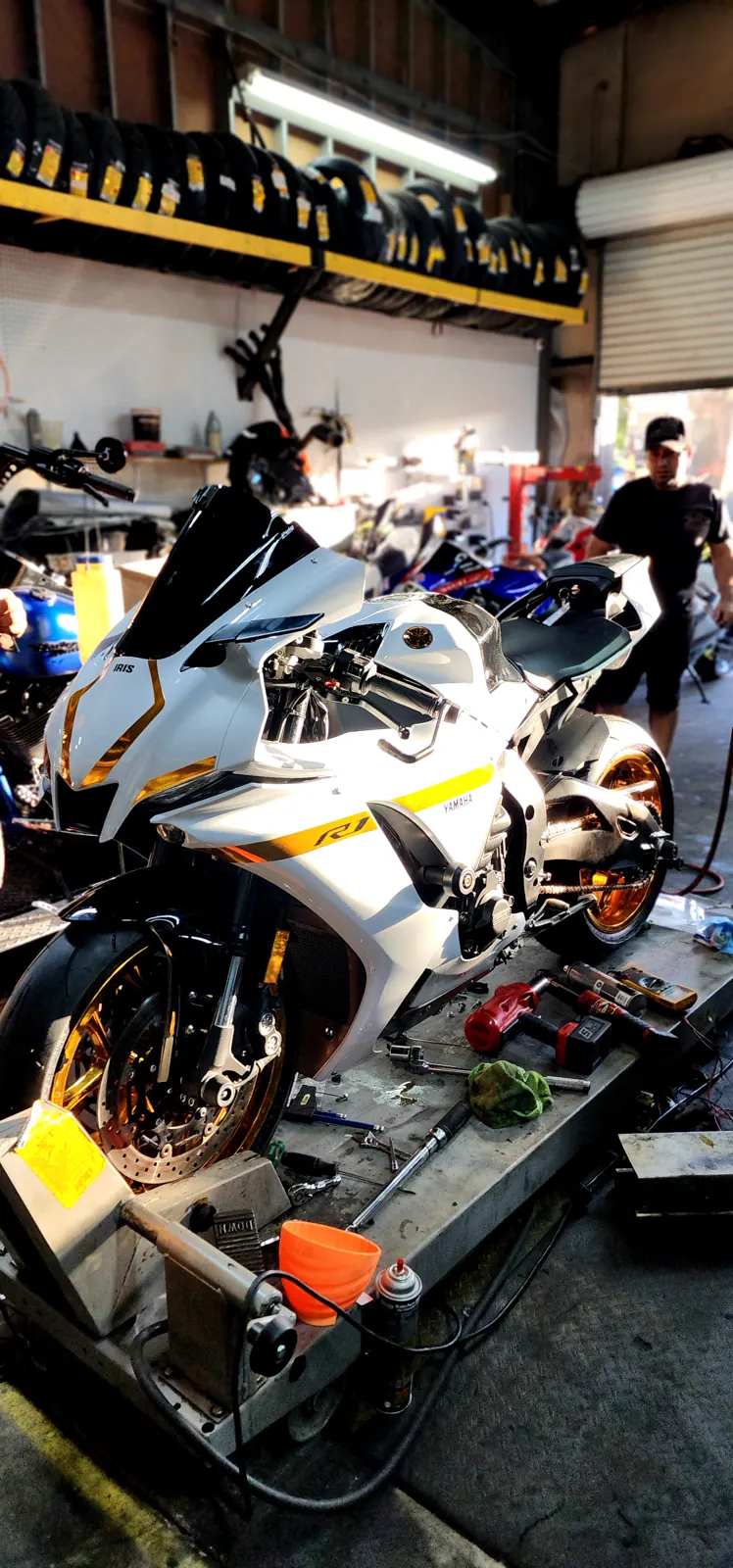
How long does all of that take? A straightforward flash on a healthy modern bike can be a same-day affair. A carbed bike getting jetted by hand, or a heavily modified motor that needs a map built from scratch, can eat a full day or spill into a second one. Neither one is a problem. It just means we tell you which one you’re looking at before we start, not after.
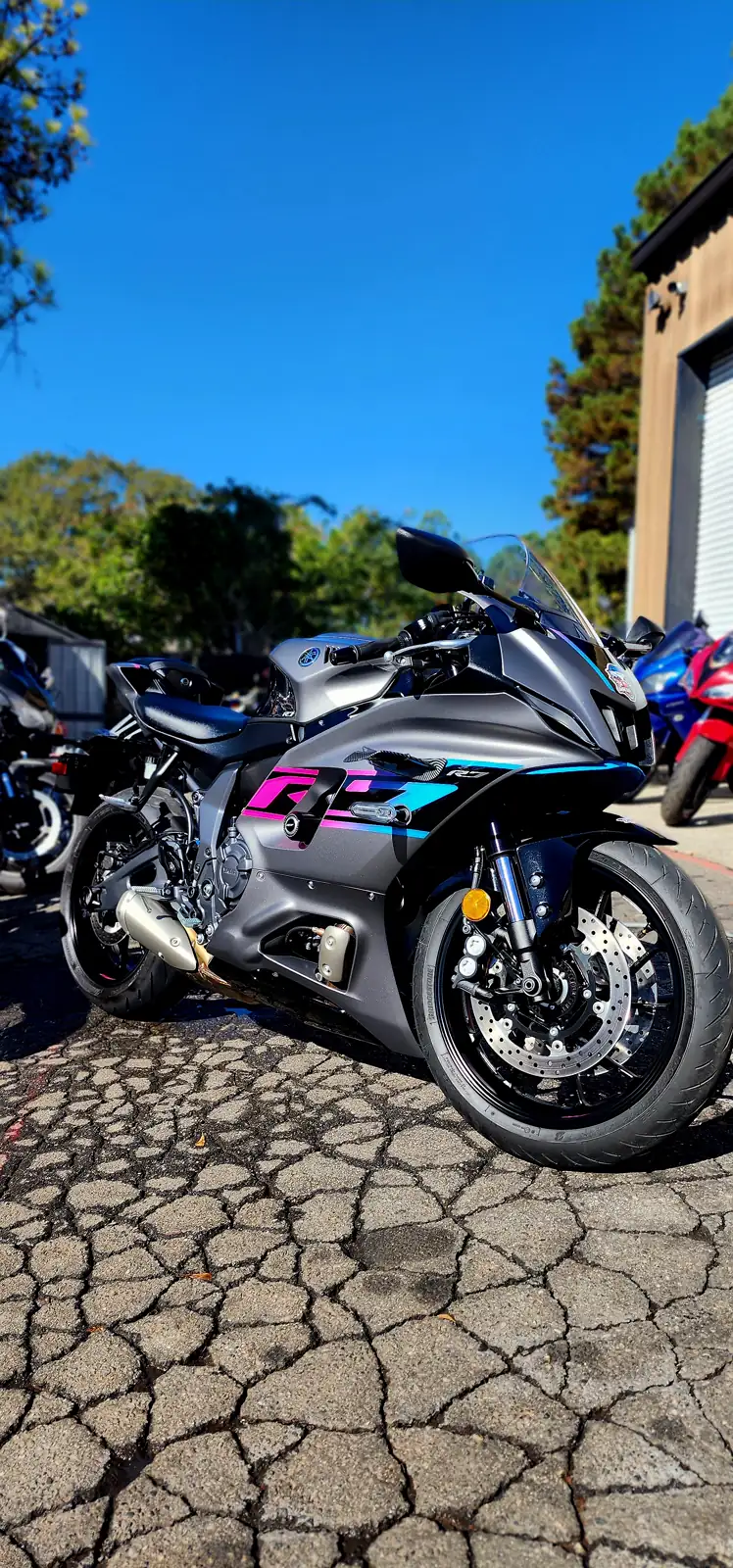
Sport bikes deserve a note of their own. High-revving four-cylinder engines pack an enormous amount of action into the top third of the tach, so the map needs far more detail up there, and the runs take longer. We’ve written up how we handle that job if that’s your kind of motorcycle.
How to Tell a Real Tuning Shop From a Guess
You don’t need a technical background to spot the difference. You just need to know what to listen for. Good shops volunteer information. Guessers get vague and then get defensive.
- They show you the baseline before they change anything, and they give you both graphs at the end.
- In fact, they inspect the bike before they map it, and they’ll tell you if something needs fixing first.
- They talk about air-fuel ratio and rideability, not just one big peak number.
- They ask how you ride. Lake roads and highway miles need a different map than track days.
- They explain what they can’t do. Some ECUs are locked, and honest shops say so out loud.
That’s the whole test, and it’s more or less what separates a good shop from a place with a dyno in the corner collecting dust. Owning the equipment is the easy part. Reading it is the job.
One more habit worth having: keep your paperwork. Riders who join groups like the American Motorcyclist Association hang onto records out of habit, and it pays off when a bike changes hands. Your future self will send a thank-you note.
A dyno tells the truth. Somebody still has to read it out loud.
Acworth Riders, and Why This Town Is Its Own Thing
This is where Acworth is genuinely different from other towns. The Lake City doesn’t really have motorcycle owners. It has fleet owners. A boat, a couple of side-by-sides, a dirt bike the kid outgrew, and a cruiser or a dual-sport under a cover in a three-car garage. That’s a normal driveway here. It’s also why both independent shops in town are Cycle and ATV generalists, and why nobody local is doing real custom mapping.
The bikes reflect the neighborhoods. Out at Governors Towne Club, spread across more than seven hundred acres of Cobb and Paulding with its Curtis Strange golf course and that enormous clubhouse, the garages tend to hold touring baggers and low-mile cruisers that get ridden hard on weekends and then sit. In Historic Downtown Acworth, where the Victorian and mid-century houses line the Main Street district, we see older project bikes and barn finds coming back to life. Around the Lake Acworth area, from little cottages up to lakefront places, it’s a mix of everything, plus a lot of machines that spend nine months parked.
Sitting is the real enemy around here. Garages are big and bikes stay dry indoors, which sounds perfect until you remember that fuel goes stale, batteries sulfate and calipers seize while nothing is moving. Then spring hits, the Friday morning farmers market fills up Logan Farm Park’s hundred and twenty acres downtown, everybody wheels the bike out at once, and half of them run rough. Head north off I-75 toward Red Top Mountain State Park on Lake Allatoona on the first warm Saturday and you’ll hear a few stumbling up the hill.
Distance doesn’t scare anybody in this town, either. Folks over on the Cherokee side by the Glade Road interchange already drive half an hour for groceries, a haircut and a decent breakfast. From downtown Acworth we’re about twenty miles down I-75 to Roswell Road, roughly a half hour. The Paulding side runs a little longer. That puts us in the same time bucket as the Marietta dealers on Cobb Parkway, including a high-volume BMW and KTM store like Wooly’s Cycles of Atlanta, except we build maps in house rather than sending them out. If riding time matters more to you than driving time, the Emerson to Canton run past Burnt Hickory Park starts right at your back door, and its fifty-odd miles of sweepers and elevation around Hickory Log Creek is where a properly mapped bike suddenly makes sense. Curious how this compares elsewhere in metro Atlanta? Here’s the Alpharetta side of things.
What You Actually Walk Away With
Winter is the smart season for this. December through February, everything’s parked anyway, so a tune costs you nothing in riding days. Drop it off, let us take our time, pick it up in March with fresh fuel, a clean battery and a map that fits it. If the bike is going to sit regardless, it may as well be sitting somewhere useful.
And a small housekeeping note while you’re thinking about the bike as a keeper: make sure the registration and title paperwork is current through the Georgia Department of Revenue. Nothing ruins a good spring morning like a tag that expired in February.
So, back to where we started. That bike you’ve kept all these years deserves a straight answer, and the honest one about dyno tuning cost Acworth riders should expect is this: it depends on your specific motorcycle, and we can tell you exactly what it depends on before you commit a dime of anything. You’ll know the plan, you’ll see the before graph, you’ll see the after graph, and you’ll feel the difference on the first ride home. That’s not a sales pitch. That’s just what happens when the math finally matches your engine.
Questions Acworth riders ask us
Why won't you quote a tune over the phone?
Because we’d be guessing, and guessing helps nobody. We need to know what’s been changed on the bike, whether the ECU can be flashed or needs a controller, and whether the motor is healthy enough to pull hard. Once we’ve laid eyes on it, we give you a firm plan and stick to it. That’s a much better conversation than a number we’d have to walk back later.
What's actually included in the work?
A pre-tune health check, baseline dyno runs, the mapping itself, verification runs after every change, a road check, and your before-and-after graphs to keep. If your bike needs a fuel controller or an oxygen sensor bung, we tell you that up front, before anything gets welded or wired. Nothing gets added mid-job without a phone call first.
How long will my bike be here?
A healthy modern bike getting a straightforward ECU flash is often a same-day job. A carbureted bike being jetted by hand takes longer, since every change means pulling things apart between runs. Heavily modified motors that need a map built from scratch can run a full day or two. We’ll tell you which bucket you’re in before we start.
Is a tune mostly parts or mostly labor?
Mostly labor, and that surprises people. Many bikes need no new parts at all, because we’re rewriting instructions in the ECU that’s already on your motorcycle. When parts do come into it, it’s usually a fuel controller, an autotune module or a sensor bung. The hours on the dyno are the real substance of the job.
Does the type of bike change the work?
Quite a bit. A big cruiser making its power down low needs detail in a narrow rev range, while a high-revving sport bike needs far more resolution up top, which means more runs. Dirt bikes and dual-sports get mapped for throttle control and traction rather than peak output. Same dyno, genuinely different sessions.
My bike sat in the garage all winter. Tune it now or fix it first?
Fix it first, and it’s usually simple stuff. Stale fuel, a tired battery and a gummed-up fuel system will make a dyno graph look like a heart monitor, and no map can correct for that. We sort the basics, then tune the bike it actually is. You get a cleaner result and you don’t pay for guesswork.
We take care of riders all over the northwest side of metro Atlanta, and the drive is easier than most folks expect. Along with Acworth and the lake communities, we regularly see bikes from Kennesaw and Marietta, from Woodstock and Canton on the Cherokee side, and from Cartersville, Emerson, Adairsville and White up the I-75 corridor. Riders come across from Dallas and Powder Springs in Paulding County too, along with Euharlee and Taylorsville out west. If the bike won’t start or you’d rather not trailer it, ask about pickup. Plenty of our Acworth friends never load a ramp at all.
LET'S SEE WHAT YOUR BIKE IS REALLY MAKING
Text or call us and describe what the bike does that bugs you. That’s the whole first step. We’ll tell you honestly whether it’s a short session or a long one, what the plan looks like, and when we can get you on the dyno. Acworth is an easy run down I-75, and if getting it here is the hard part, ask about pickup. Your bike has more in it than it’s showing you.
470-460-9883Diaz Motorcycles and Service, LLC · 847 Barnes Mill Road, Marietta, GA 30062