Dyno Tuning Cost Alpharetta — Full Breakdown
What a dyno really measures, why a bike runs lean or rich, and why an honest shop looks before it quotes.
That’s why the first real riding day of spring is a feeling you can’t fake. The sun finally wins, the garage door rolls up, and your bike has been waiting all winter for exactly this. So you thumb the starter, point it toward Birmingham Highway, and roll out grinning. Then the thing stumbles, coughs, and runs like it’s mad at you. Either way that’s usually the moment folks start asking what dyno tuning cost Alpharetta shops actually charge, because a bike that won’t cooperate on the best day of the year is a problem worth fixing right.
In short here’s the good news, right up front. At the same time a rough-running bike is almost never a mystery we can’t solve. As a result most of the time it’s a tune, and a tune is one of the most satisfying fixes in the whole shop. You get your bike back, it pulls clean, and that first ride down GA 372 feels like the machine you thought you bought. So let’s walk through the whole thing in plain words, start to finish, with no mystery and no runaround.
The myth that tuning has a sticker price
On the other hand a lot of riders think a tune is like an oil change, one tidy number on a menu. So we wish it were that simple, honestly. But no honest shop can hand you a real dyno tuning cost Alpharetta price over the phone before seeing your bike. Still, that’s not a dodge, and it’s not us being cagey. Plus, it’s just the truth of how this work goes.
Think of it like a tailor. Meanwhile, two guys can wear the same size jacket off the rack. Of course, one needs a quick nip at the sleeves and he’s out the door. The other needs the shoulders rebuilt from scratch. Same starting size, completely different job. Bikes work the same way once you get under the tank, and pretending otherwise would just set you up for a surprise later.
What a dyno actually measures
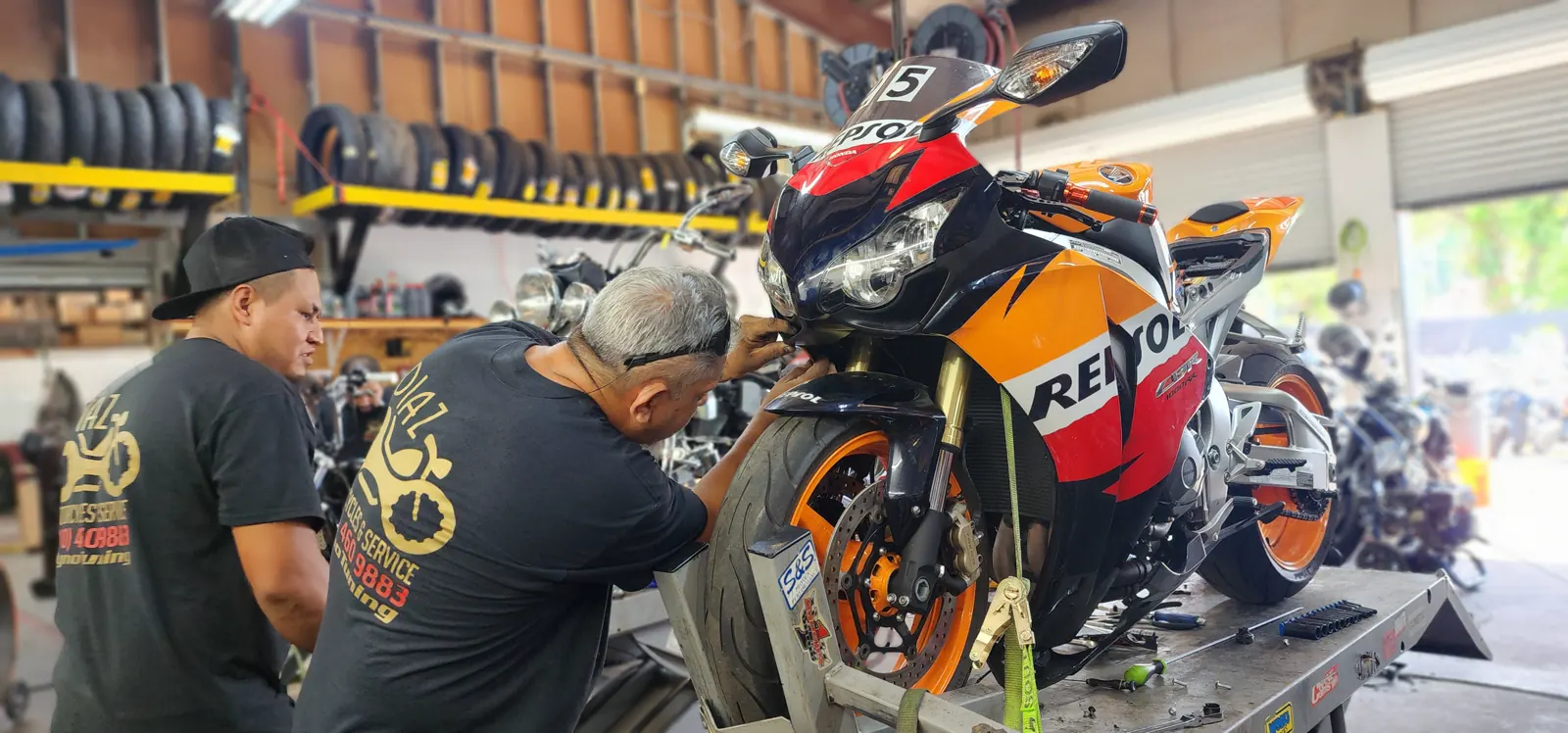
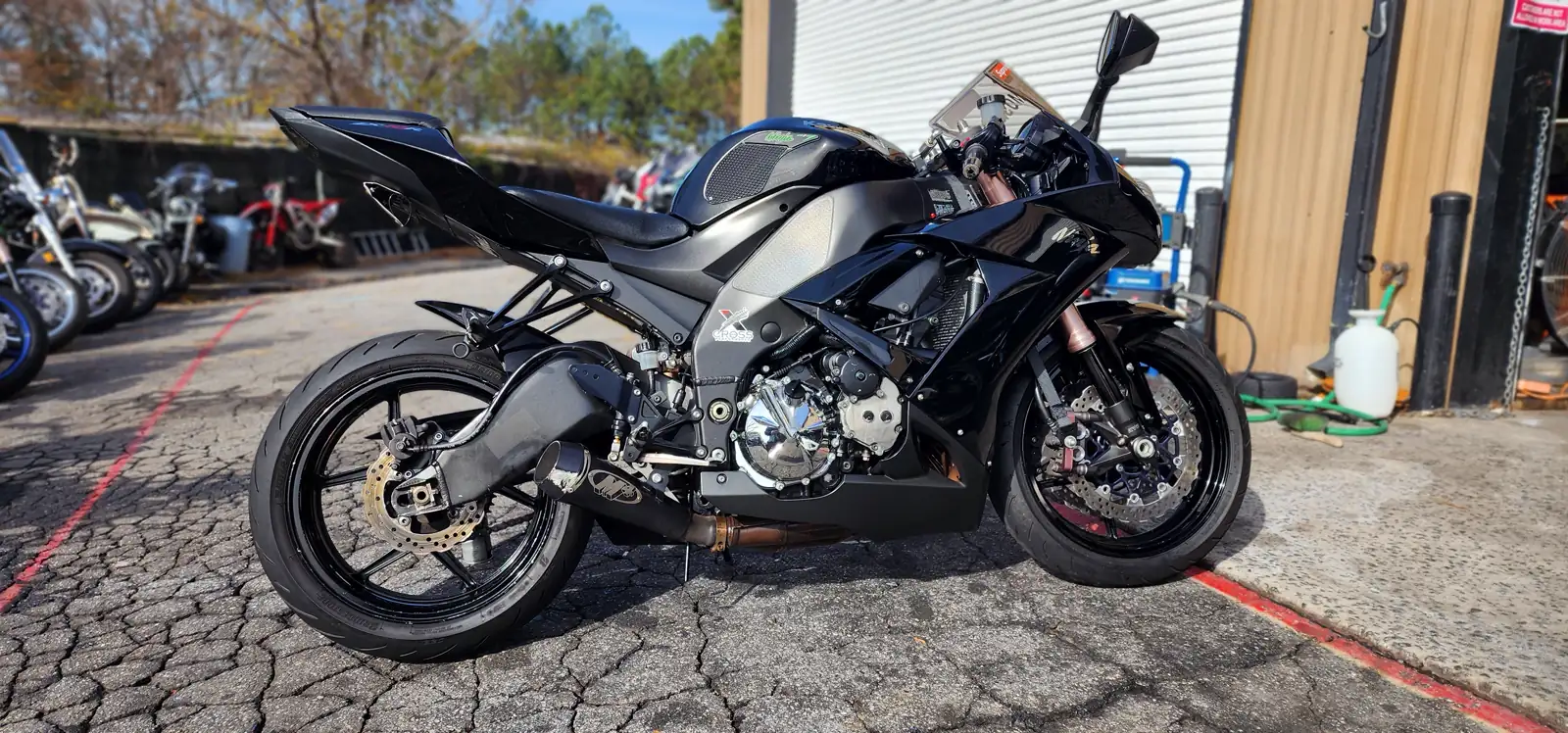
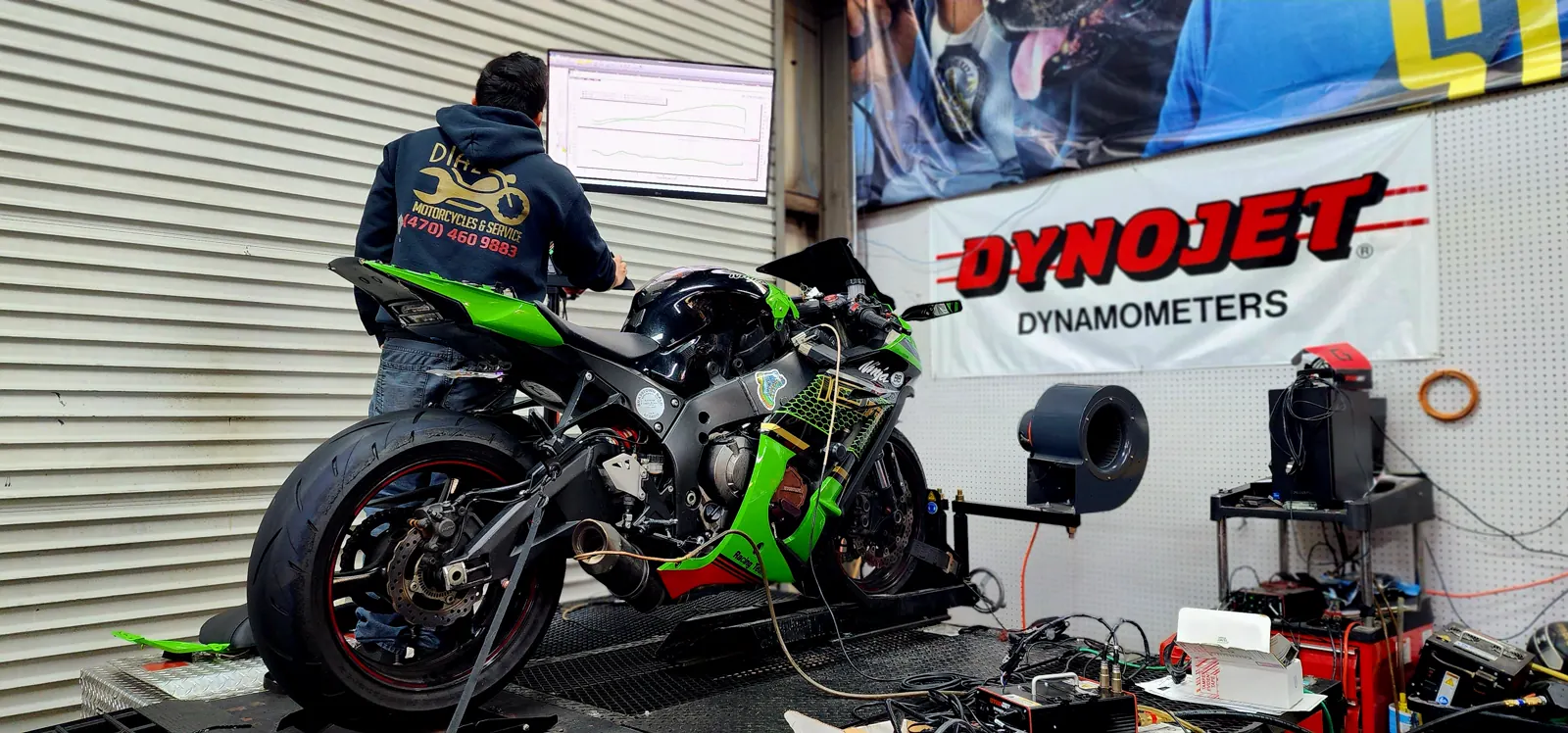
So what is a dyno, really? Picture a treadmill built for your motorcycle. We strap the bike down, the rear wheel spins a big steel drum, and sensors read exactly what the engine is doing while it works. The dyno doesn’t guess and it doesn’t go by feel. Instead, it measures real output, run after run, while we watch the numbers move in front of us.
The big thing we chase is the air-fuel mix. Your engine wants a certain balance of air and gas to burn clean and strong. Too much air and not enough fuel, and we call that running lean. Too much fuel for the air, and it’s running rich. Lean bikes run hot, pop on decel, and feel flat when you crack the throttle. Rich bikes foul their plugs, smell like a gas can, and waste fuel you paid for. Neither one is how your bike is supposed to feel. If yours has been running lean, there’s a short list of what usually causes it, and a dyno sorts it out fast.
Why do so many bikes drift lean around here? Two big reasons stand out. First, aftermarket pipes and filters. That louder exhaust everybody loves lets in more air, and unless the fuel gets bumped to match, the bike leans right out. Second, our storage habits. A bike that napped through winter often wakes up with stale fuel and gummed injectors, and that throws the mix off too. Both are common, and both are very fixable.
A dyno doesn't guess. It measures, run after run, until your bike runs the way it was born to.
A tune changes the instructions the engine follows. On modern bikes those instructions live in the ECU, the little computer that decides how much fuel to send and when to spark. We flash new instructions onto it, or we add a Power Commander to fine-tune the fuel on the fly. On older bikes it’s jets and needles down in the carbs. Either way, the goal never changes. We match the fuel to the air your engine is really breathing, right now, on our drum.
Two bikes, one complaint, two very different jobs
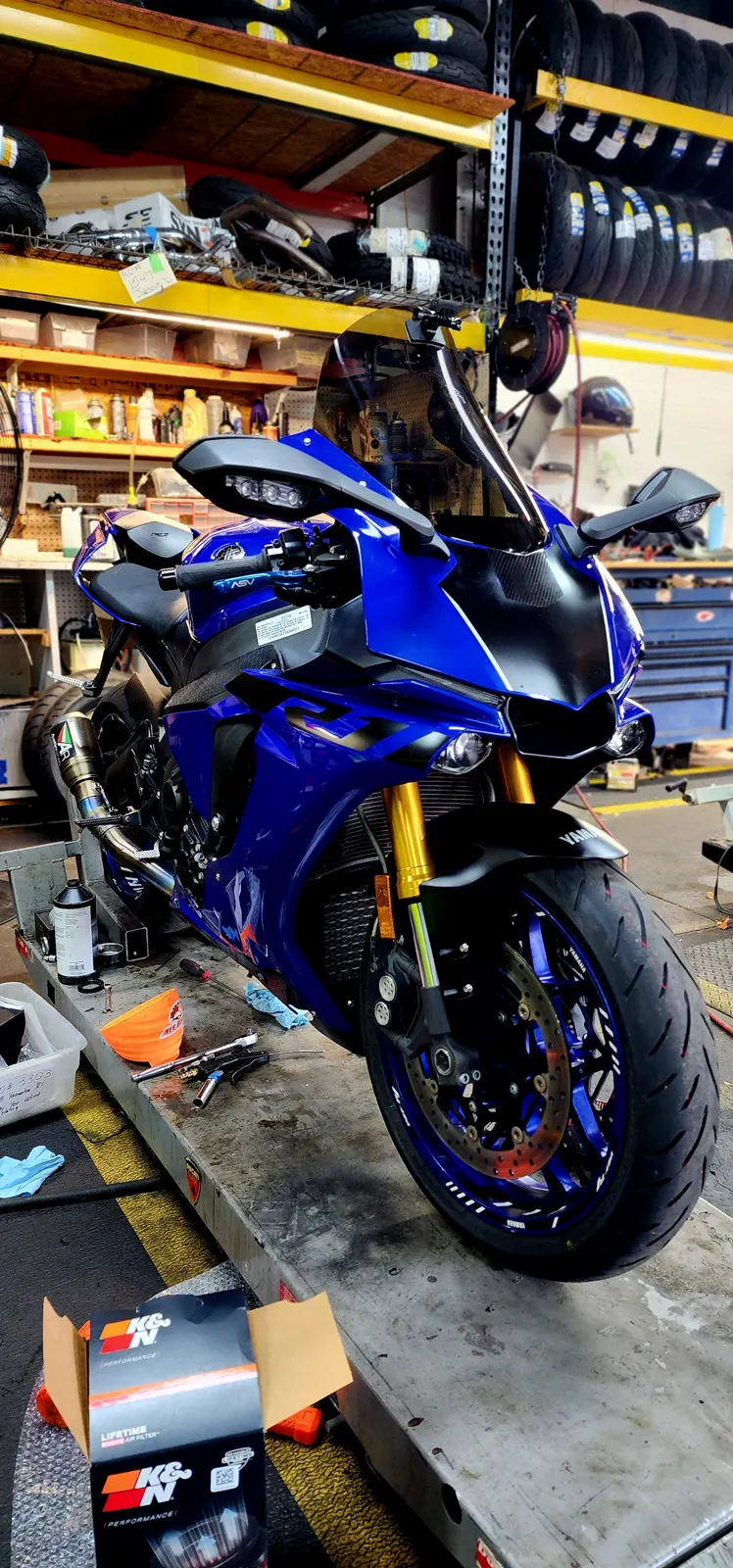
Here’s a truth that catches people off guard. Two bikes with the same symptom can need completely different work. That’s the whole reason we won’t put a flat number on the wall, and once you see it, the whole thing makes sense.
Picture two riders rolling in the same week. Both say the exact same thing: my bike stutters when I get on the gas. The first bike just got a slip-on exhaust and simply needs a fuel map to match it. Half a day, done, everybody’s happy. The second bike has a clogged injector, a tired sensor, and a stale tank of winter gas hiding under a clean paint job. Same complaint, three times the work. Until we run it, nobody knows which bike is yours, and that’s exactly why looking first protects you.
The actual process, start to finish
- Intake and listen. We talk to you first. When did it start? What have you changed? What did you add? Your story saves us real hours on the drum.
- Baseline run. We strap it down and make a first pull to see where your bike stands right now. Think of this as the before picture.
- Inspect the basics. We check plugs, filter, sensors, and fuel. A tune can’t paper over a mechanical problem hiding underneath, so we clear those first.
- Map the fuel. We adjust the ECU flash or dial in the Power Commander, run after run, watching the air-fuel numbers fall into line.
- Confirm and cool. We make final pulls to prove the change held, let the bike cool, and double-check nothing’s leaking or reading wrong.
- Ride and hand off. We walk you through what we found and what we changed, in plain words, so you leave knowing your own bike better than when you came in.
That’s the honest version. Some bikes sail through every single step. Others surprise us at step three, and that surprise is exactly why the price isn’t printed on a sign out front. We’re not hiding anything from you. We just refuse to promise a number we haven’t earned yet.
WHY WE WON'T QUOTE BLIND
We can’t see a clogged injector or a tired sensor over the phone. Quoting your bike sight-unseen would mean guessing, and a guess helps nobody. A ten-minute look tells us more than an hour of questions ever could.
Two things really drive the size of any job: access and parts. Access is how much we have to take off to reach the work. A naked bike with the tank right there is quick and easy. A full-fairing sportbike means pulling bodywork before we even start, and that’s labor, not parts. Parts are their own line entirely. A fuel controller, a filter, fresh plugs, maybe a sensor. The more your bike genuinely needs, the bigger the job, and none of it has a thing to do with anyone padding a bill.
How to spot a shop that'll treat you right
Here’s how you protect yourself, no matter who you hand your keys to. A good shop quotes a number, explains it, and holds it. We’d rather look at your bike, tell you the real range, and stick to it than throw out a lowball over the phone and shock you at pickup. So if a shop won’t explain why one bike costs more than the next, take that as your sign to keep looking.
- They put your bike on a real dyno instead of guessing by ear.
- Actually they quote a range, explain what’s in it, and hold to it.
- They show you the before-and-after runs on the screen.
- They tell you what they found in plain words, not shop-talk that leaves you nodding along.
You can lean on outside help too. Riders new to all this often find the American Motorcyclist Association worth knowing, and if your bike sat so long the tags lapsed, the Georgia Department of Revenue handles that side before your first legal ride of the year.
Curious how the same job shakes out one town over? It’s worth reading what East Cobb riders run into and what the work covers a little farther north, because the pattern holds true everywhere. And if you want the full rundown of what we take care of here, that’s all laid out for you too.
The part riders thank us for later
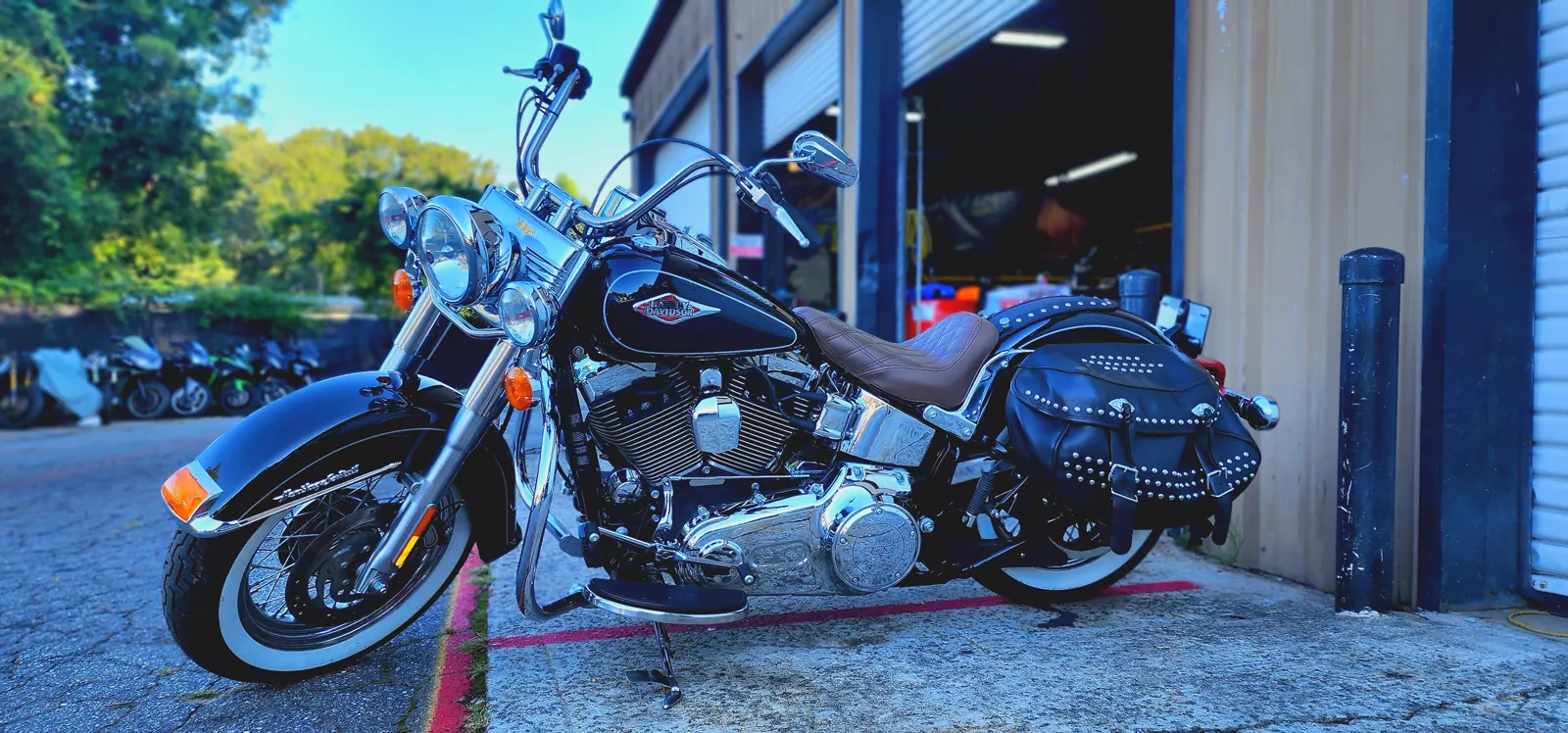
One more thing, and it’s the part riders thank us for later. When we hand your bike back, we don’t just drop the keys in your palm and wave. We tell you what we found, what we changed, and how to keep it happy through the whole season. Riders thank us for that on some warm evening out on GA 372, when the bike pulls clean the entire loop and they finally feel exactly why it’s different now.
That knowledge is the quiet bonus of a good tune. You stop dreading the first cold morning of the year. You know what a lean bike feels like now, and you know yours isn’t one anymore. Better still, you can explain it to your buddies at the coffee stop without missing a beat.
Why Alpharetta riders make the drive
Alpharetta is loaded with great riding and a little short on independent tuning shops. You’ve got a strong dealer scene, sure. Mountain Motorsports Roswell over at 10885 Alpharetta Highway is a family-owned, multi-line store that’s carried Honda, Suzuki, Yamaha, Sea-Doo, Can-Am and Ducati since 1999, and they’re good folks. But they keep dealer hours, Tuesday through Saturday, nine to six, closed Sunday and Monday, and a busy dealer service queue can run weeks when the weather turns nice all at once.
This is also a garage-kept town, top to bottom. Bikes live in the three-car garages of neighborhoods like Windward, the 3,400-acre master plan built around Lake Windward, and Crooked Creek, the gated community that’s been here since 1993 across more than 500 acres. Newer riders over in Foundry, the fresh single-family and townhome build near Avalon, are just getting their first bikes out into the sun. In every one of those garages, a bike often sits for months at a stretch, and a bike that sits is a bike that tends to run rough come spring.
Getting to us is an easy call. From Alpharetta it’s roughly 18 to 22 miles, about 30 to 40 minutes when traffic’s kind and 45 to 60 at rush hour. There’s no freeway that runs straight to us, so most riders take Old Milton and Rucker down to GA 9, cut south through Roswell, then swing GA 120 west into East Cobb. Plenty of folks just turn the trip into part of the ride. And once your bike’s finally dialed, the reward is right at home: a warm-up loop out past Wills Park, that 120-acre spread off Old Milton Parkway with the ballfields, the disc golf and the Wills Park Equestrian Center, then out onto Hopewell Road and Cogburn Road, where the deer come out at dusk so keep your eyes up and your speed sensible.
The feeling at the end
Here’s the part we love most. When your bike finally runs the way it should, you don’t just ride better. You ride prouder. That frustrating spring morning turns into the best kind of bragging rights, and the machine you rolled out of the garage on faith becomes the one you actually trust. So the honest answer to dyno tuning cost Alpharetta comes down to your bike, your build, and what we find on that very first run. Bring it in, let us look, and we’ll tell you straight. Then go enjoy the season the way you meant to all along.
Questions Alpharetta riders ask us
How long does a dyno tune take?
A clean bike that only needs a fuel map can be done in about half a day. A bike that needs parts, fresh fuel, or a clogged injector cleared takes longer. We give you a real timeline after the baseline run, not before, because that’s the first honest look we get.
Is more of the cost parts or labor?
It depends entirely on your bike. Access, meaning how much bodywork we pull to reach the work, is labor. Fuel controllers, filters, plugs and sensors are parts. A naked bike leans toward labor-light, while a full-fairing sportbike takes more time to open up. We break both out plainly for you.
Does the type of bike change the work?
Yes, quite a bit. A carbureted vintage bike is tuned with jets and needles, while a modern bike gets an ECU flash or a Power Commander. Baggers, sportbikes and adventure bikes all reach their fuel systems differently. Same goal, different path to get there.
What if you find something else while it's on the dyno?
We stop and call you before we touch it. If the baseline run turns up a tired sensor or a gummed injector, you hear about it first and decide with us. We never add work to your bike without your okay, full stop.
How do I avoid surprises at pickup?
Come in for a look so we can quote a real range instead of a phone guess. A good shop explains why your number is what it is and holds to it. Ask to see the before-and-after runs, and you’ll leave knowing exactly what you paid for.
Can I still ride while I wait for an appointment?
If your bike is running rough, it’s smart to have it looked at before you lean on it hard, especially if it’s popping or running hot. A quick baseline tells us whether it’s a simple map or something to sort first. We’ll get you back on GA 372 as fast as we safely can.
We tune bikes for riders all across the north metro, not just Alpharetta. Friends roll in from Roswell, Milton, Johns Creek and Crabapple, and plenty make the trip from Cumming, Suwanee and Duluth when the weather turns. We also see steady work out of Sandy Springs, Dunwoody, Woodstock, East Cobb and right here in Marietta. Wherever your garage sits, if your bike’s running rough, we’d love to put it on the dyno and set it right.
LET'S GET YOUR BIKE RUNNING RIGHT
If your Alpharetta bike is stumbling on the throttle, running hot, or just not feeling like itself, don’t guess and don’t wait out the good weather. Text us, tell us what it’s doing, and bring it by for a real look. We’ll run it, tell you straight what it needs, and get you back on the road proud of how it pulls.
470-460-9883Diaz Motorcycles and Service, LLC · 847 Barnes Mill Road, Marietta, GA 30062